

Old and New Initiation Methods
Drama and Poetry in the Shift
of Consciousness in the Modern Era
GA 210
11 February 1922, Dornach
Translated by Steiner Online Library
4. Old and New Dedication Methods I
[ 1 ] Today I would like to speak to you about a topic that may, in turn, offer some perspectives for assessing contemporary spiritual life in the context of what has preceded it in human development. In fact, as I have often explained, humanity’s spiritual life has, since the first third of the 15th century, become thoroughly different from what it was in earlier times, and we are now faced with the necessity of returning—in a certain way, but fully consciously and thoughtfully—to an understanding of the spiritual aspect of our world context. The spiritual aspect of our world context was, after all, permeated by an ancient, instinctive spiritual insight, most notably in the earliest periods of earthly civilizational development. Then, more and more, people’s ability to penetrate the spiritual realm in this instinctive way began to recede, and at the time when this decline was so pronounced that humanity needed a new direction, the Mystery of Golgotha came about.
[ 2 ] Today I would like to mention that, before the Mystery of Golgotha, people—insofar as they looked toward spiritual life—also looked toward those institutions that we know in general human civilization as the mysteries. In these earliest times of humanity, one could not, so to speak, conceive that a spiritual insight, that spiritual knowledge, could spread in any way other than by originating from the Mysteries. And if we examine the consciousness of the people who, in that era—if they sought knowledge at all—turned to the Mysteries, the following picture emerges: All external intellectual knowledge—that which did not originate in the Mysteries but was attained by human beings themselves—actually did not emerge until the later Greek period. It was only then that people sought to arrive at certain truths from within themselves, without the aid of the Mysteries. That is why, if one understands the matter correctly, the course of scientific development is generally considered to have begun only with the time of Thales. I have elaborated on this in my Riddles of Philosophy. Everything that came before sought knowledge entirely with the help of the Mysteries. Now, if one examines this underlying consciousness, one comes to the conclusion that within the Mysteries, those who led the Mysteries and their disciples regarded as of the utmost importance what was called the “Prince of this World”—by which they meant the Earth—in contrast to the princes, that is, the spiritual beings of other worlds.
[ 3 ] When we speak today in our language of the “Prince of this World,” as he existed in the consciousness of the ancient world, we would be referring, so to speak, to the Ahrimanic entity. We would thus encounter, in the Ahrimanic entity, this Prince of earthly life, so to speak. When we look at the spiritual revelation that can be derived from the side of the Prince of this World, we must point specifically to the intellectualistic aspect of human cognition. The leaders of the Mysteries would certainly have described what existed in independent Greek knowledge—knowledge that arose outside the Mysteries—as knowledge inspired by the Prince of this World. In contrast, they saw the task of the Mysteries as introducing human beings to a spiritual vision that turns them away from the Prince of this World and leads the human soul to immerse itself in worlds not ruled by the Prince of this World. If one wishes to view the matters at hand in the correct way, one must make use of such expressions, and no one should associate anything superstitious or the like with the use of such expressions.
[ 4 ] I want to paint a picture for you of how someone initiated into the Greek, Egyptian, Persian, or other mysteries might have thought of the Prince of this World in ancient times. One must be clear about the fact that even if those concerned used other names, they were nevertheless speaking of the Christ Being. After all, one does not speak of the Christ Being only when one utters the name “Christ.” Although we must, of course, utter the name “Christ” when speaking of the Christ Being, we actually use the term “Christ” to designate the Being in question only after it has passed through the Mystery of Golgotha and united itself with earthly civilization. Before the Mystery of Golgotha, it was not united with earthly civilization. It lived, so to speak, as the great solar being outside the earthly world. It was only the Mystery of Golgotha that marked the connection of this being—living outside the earthly world—with the earthly world itself. But as such an extraterrestrial being, it was certainly known to those initiated into the Mysteries. The one who was called the Prince of this World—the spiritual being of Ahrimanic nature—also recognized it as such a being. He felt, in a sense—as I said, I am describing what lived in the consciousness of the initiates of the Mysteries—that he was the lord of the Earth. He could say to himself: Whatever people have through the forces of the Earth, they have from me. — On the other hand, he also knew that Christ lived outside the Earth and exerted an influence on human life, albeit indirectly through the Mysteries, whose teachings were then popularized and carried out among the peoples.
[ 5 ] If one wishes to describe what was alive in consciousness even more precisely, one must say that the initiates of the Mysteries thought to themselves: The Prince of this world exerts his greatest influence on the physical body of the human being; this is entirely subject to him, and he feels himself to be the master of this physical body of the human being. He could not feel himself to be the master of what constituted the human being’s etheric and astral nature—that is, the life body and the soul. This life body and the soul were seen to be under the influence of an extraterrestrial being; for people had always seen the forces of the Christ Being flowing into human beings. However, human beings could not receive what was to flow into them from the Christ Being through the powers of their own souls at all, but only by turning to what the initiate of the mysteries received after being prepared in the appropriate manner. The Mysteries were conceived in such a way that, through them, the extraterrestrial was, so to speak, captured and channeled to human beings. So that the Prince of this World said to himself: Here on this Earth, I am lord. Here, from this Earth, the physical body of the human being draws its powers, and the human earthly intellect also belongs to these powers of the physical body. There I am lord. Here on this earth, nothing challenges my dominion. The otherworldly flows into this earth by a roundabout route through the Mysteries. I will tolerate that.
[ 6 ] But it was precisely for this reason that the prince of this world rebelled against the Mystery of Golgotha: because he was now to share his dominion over the earth with the Christ, who had descended to earth through the Mystery of Golgotha. The prince of this world perceived the Christ as a rival for dominion over the earth. He would have been willing, so to speak, to accept co-rule from outside the earth, but he would not tolerate having a rival right here within the realm of the earth itself.
[ 7 ] And here, in the spirit of the ancient mysteries, we find a reference to the fundamental opposition of the prince of this world to Christ. This opposition was, in turn, keenly felt throughout the Middle Ages and well into the 15th century by those who were initiated into these matters. When people spoke of the Prince of this World and of Christ well into the 15th century, they did so entirely in this sense. And there was a certain awareness that, so to speak, there are two dominions: one that formerly, before the Mystery of Golgotha, rightfully ruled over human physicality, but which must now share its influence over human physicality with the other dominion—with Christ. For Christ no longer radiates His effects merely upon the soul—that is, upon the astral and etheric—but He now also wishes to radiate His effects upon the physical body of the human being, that is, upon that which is expressed through the human physical body: namely, upon the intellectual, upon the human being’s own faculties in the broadest sense. Christ was to live in the whole of human nature. That, after all, was essentially what came into humanity through the Mystery of Golgotha.
[ 8 ] Before the Mystery of Golgotha, it never occurred to those who knew about these things to seek knowledge of eternal matters within the realm of what the human mind can conceive, or what the other soul forces—including the powers of the emotions—can attain on their own. That was left to the mysteries. Thus, even before the Mystery of Golgotha, there was a strong awareness that earthly knowledge and earthly perception are something other than the perception of the supersensible powers. And one can only understand the early centuries of the Middle Ages in their particular spiritual configuration if one has a clear awareness of this fact.
[ 9 ] Now, it may be particularly enlightening to examine this fact by looking at something that has been regarded as a kind of central element within the various mystery schools. Certainly, the preparations and the subsequent trials and so on that the mystery student, the initiate, had to undergo varied from one mystery center to another. But the differences in these areas are only apparent, much like when one climbs a mountain from different sides and yet, despite the different paths, arrives at the same summit. Ultimately, everything led to that one goal of the mysteries. Now, even though the details may have varied, one can still identify two key elements of these mysteries to which everyone had to submit. The first was the so-called “drink of forgetfulness,” and the second was something that, within the mystery rituals, had the effect on the person of a severe shock, like being plunged into a state of intense fear. Today, neither of these things may be undergone in the same way for the purpose of attaining higher supersensible knowledge. Today, everything must be experienced on a soul-spiritual level, whereas the mystery students of ancient times underwent these experiences in such a way that they always had to rely on the physical realm. Yet something similar is achieved; it is just that in today’s spiritual striving for higher knowledge, everything falls within the sphere of consciousness, whereas in the past it fell into the sphere of the instinctive and the dreamlike. For by the fact that something like the “drink of forgetfulness” was administered in all the mysteries, and something like a physical shock was induced, human beings were in fact tempered with regard to their external intellectualism—which, though more dull than today’s, nevertheless dominated them in matters relating to the external world.
[ 10 ] Thus, man was led into a dull existence both by the potion of forgetfulness and by the other, which can be compared to a shock or a feeling of dread. What, then, was the significance of the potion of forgetfulness? It was not a matter of man forgetting anything. He did, however, forget as a result of this potion. But the effect it was intended to have came from the fact that it was steeped in a specific ritual, that it was prepared in a specific way, and that certain preparations were made before the drink was served. It was, however, very much a physical drink which, through the manner in which it was administered, did indeed bring about what one might call: the person forgot their life since birth. This is something that is achieved again today through soul-spiritual development. The difference is that today it is achieved by first evoking a clear awareness of a vast panorama of life encompassing everything since birth. This awareness is then suppressed, thereby introducing the person to the spiritual mode of life prior to birth or conception. This was achieved in a more physical manner through the ancient potion of forgetfulness.
[ 11 ] But that is not the essential point—that a person forgets. The negative aspect is never the essential point. The positive result achieved through this is that thinking became more agile and intense. But it also became more dull. It became more dreamlike, precisely because it was directed toward the physical organism. The effect of this “potion of forgetfulness” on the physical organism was—and this can be described quite precisely—that the brain, if I may put it that way, was made more fluid than it is in ordinary life. Because the brain was made more fluid—that is, because the person thought more with the cerebrospinal fluid than with its solid components—their thinking became more agile and more intense.
[ 12 ] Today, this must be achieved by a direct path, namely through soul-spiritual development, as described in How Does One Attain Knowledge of the Higher Worlds? and in the second part of my Outline of Esoteric Science. At that time, however, the brain was, so to speak, made more fluid through external influences. This made it possible for the human soul-spiritual being—as it is before the human being unites with a physical body through conception, that is, as it exists in the spiritual world—to permeate the brain once again as a soul-spiritual entity. That is the essential point.
[ 13 ] If we were to depict this graphically, it would look like this [Here the drawing for Plate 5 begins]: Suppose this were the structure of the brain (green); then, for a human being who has been born, the spiritual-soul aspect (red) stops short of it. The brain is constituted in such a way that this inner spiritual-soul aspect that a human being possesses cannot pass through the brain. The human being is not filled with this spiritual-soul aspect within the brain. Instead, however, external perceptions can enter and make themselves felt in the brain through the senses—I have drawn the eye here. I would like to say that the brain, in its present constitution, is such that what is eternal in the human being cannot rise up into the brain. External impressions, however, can enter through it. By receiving the “drink of forgetfulness,” the human being gained the ability to bring into the brain that which was spiritual-soul-related before conception or before birth (red). That is one aspect.
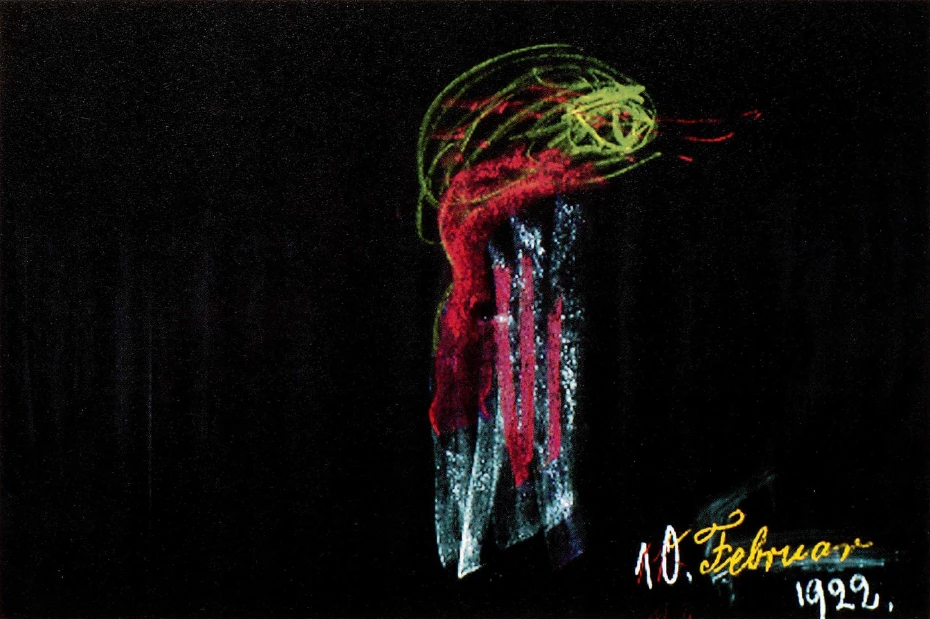
[ 14 ] The other aspect is what I called: a kind of terror was inflicted upon the person. Now, consider how terror affects a person: one freezes. And there can be a terror that truly causes a kind of paralysis of the entire person. In a person as they are in ordinary life, where they can walk around—the frozen, cataleptic person cannot walk around, for their muscles are frozen—in the person who is not frozen, the rest of the body absorbs this Eternal (white with red). The spiritual-soul aspect, the eternal, is absorbed into our blood and into our muscles below. As a result, it cannot be perceived. It cannot rise up into the brain; it is absorbed down below. So it cannot be perceived, but it emerges freely and independently when the muscles stiffen.
[ 15 ] This muscular rigidity was caused by the shock. And as a result, the spiritual-soul aspect was not absorbed by the rest of the organism—except for the brain—but was set free. So the person had the spiritual-soul aspect within the brain, because his brain had become softened by the potion of forgetfulness, and the rest of the organism was, so to speak, prevented from absorbing the spiritual-soul aspect. As a result, the spiritual-soul aspect was perceived. The person thus gained the ability to perceive his spiritual-soul aspect from two sides. In ordinary life, he could not perceive it, for he could not take it in through the brain—the organ through which he normally perceives; it does not enter there. Nor could it be perceived through the rest of the organism—through the will and so on—because the rest of the organism absorbed it. Now his brain was softened, of course only for the moments of insight. As a result, the spiritual-soul aspect surged into his brain. The rest of his body became rigid. Consequently, he did not absorb the spiritual-soul aspect. And the person stood, as it were, in his softened brain on the one hand and in his rigid organ system on the other, as if in a casing; he stood there in the spiritual-soul aspect that was given to him from two sides.
[ 16 ] So you see where these things, which are described in such an external way, actually lead. I want to emphasize that these things cannot be replicated today. People wouldn’t even know how to replicate them. Nor would they do them any good today. Today, everything must simply be attained through spiritual and soul-related means. But one can certainly say: When, in the mysteries, people had received the potion of forgetfulness and the other effect—physical numbness—enabled them to perceive the spiritual and soul-related within themselves, then they were “Christians.” In the mysteries, they became Christians.
[ 17 ] This was certainly part of the consciousness of the early Church Fathers. It’s just that people aren’t told this today, or it is even denied. The early Church Fathers were clearly aware that people had become Christians through the mysteries. That is why we find passages among the early Church Fathers stating that Heraclitus and Socrates—even though they lived before the Mystery of Golgotha—were Christians, even though they were called atheists in their own time. I have quoted this passage many times; it can be found in the writings of the early Church Fathers.
[ 18 ] So one could say: According to the view of the older mystery leaders and initiates, the Prince of this World took no interest in this human being who emerged from the other; he left him to Christ. But he did not want Christ to come down to earth and take possession of the whole human being. This is hinted at in the Gospels by the fact that the demons—that is, the lower servants of the Prince of this World—heard: “Christ has arrived; he is here.” — Then they rebelled. This is clearly indicated in the Gospels. They recognized him, and they became frenzied.
[ 19 ] We must therefore be perfectly clear that, when we speak of earthly conditions of development, we must see an essential aspect of the Mystery of Golgotha in the fact that the spiritual power which, up until the Mystery of Golgotha, had a fully justified influence on human physicality, had to share this influence with Christ in the period that followed. This is why the Middle Ages referred to the prince of this world as the “unlawful prince of this world.” This expression is not actually justified within the old pagan worldview, but it came into use during the Middle Ages as a designation that was entirely justified by the circumstances.
[ 20 ] The essential point regarding the spiritual development of humanity is that, in earlier times, the body was, so to speak, withdrawn from the spiritual-soul aspect. The brain’s activity was suspended by softening the brain with the “drink of forgetfulness.” The absorptive power of the rest of the organism was suspended by hardening the rest of the organism through the shock. Thus, in those earlier times, the body was withdrawn from the spiritual-soul realm.
[ 21 ] The more recent effort consists in not withdrawing the body, but rather in drawing out the spirit by strengthening and invigorating the spiritual and soul forces. Thus, the exact opposite must take place in our time; the spirit must be drawn out. In a sense, no change may occur within the physical body. For human beings, especially since the 15th century, are organized in such a way that a change in their physical nature—of the kind that was quite common among the ancient mystery school students—would be pathological. It would be pathological, and that must not occur in the course of normal development.
[ 22 ] I am describing all this to you to give you an idea of what is meant by the recurring term from earlier times, “the prince of this world.” This prince of this world, who in the Middle Ages became the “unlawful prince of this world,” is an Ahriman-like entity. We can trace such an entity everywhere, in the external natural world and within the human being. And it is only when we are able to trace such an entity in its effects—both in the external natural world and within the human being—that we gradually begin to understand it.
[ 23 ] Turn your gaze to the natural world. You will find two contrasts in the natural world. One need only perceive these contrasts in all their distinctiveness. Think for a moment about the blue sky. Certainly, the blue sky—especially in southern regions—can be perceived in a completely different way than I must characterize it here. This is the case when the Earth is enveloped, when, so to speak, the Earth’s atmosphere is permeated by the sun’s rays. Then one does not experience the pure effect of the sky being merely blue; rather, this effect is, so to speak, overlaid by something else. But when one experiences the pure effect of the blue sky, one experiences a sensation of cold. The blue sky as such has a cold effect. And what you can sense in a cold blue sky—one that is not tempered by earthly humidity—is, in a broad sense, the Ahrimanic. One might say that the Ahrimanic causes space to solidify into the blue. Take note of this expression! It does have something unusual about it, but if you gradually learn to feel what it means for “space to solidify into the blue,” then you will have grasped the Ahrimanic influence on the external natural world.
[ 24 ] You see this contrast when you look at the passing clouds, which appear reddish or yellowish. It is precisely the opposite effect. There is something warm about it. Of course, this can also be masked by the cold of the Earth’s surroundings, but on the whole, the reddish-edged cloud, the yellowish cloud, has something warm about it. This is the opposite effect; it is an atmospheric effect. What actually benefits human life on Earth unfolds between these two polar opposites. So one can say: Medieval people imagined the cosmic influence of the Prince of this World in the effect of space, frozen into blue, upon the Earth.
[ 25 ] If we then look into the human being, we observe a state in which the person turns pale. You know, the pallor of a human being always has a waxy, bluish quality. This paleness in a person, this feeling of coldness, is the sensation of the Ahrimanic influence within the person, whereas the redness represents the Luciferic aspect of human nature. Only when one pieces together from all these details what the Ahrimanic being—the being of the Prince of this World—actually is does one gain a complete understanding of it. Then again, when one considers the pale, sometimes so clever, but always linear thoughts of human beings—when one considers what is essentially intellectual—one finds, in relation to the human being’s mental activity, the Ahrimanic, that of the Prince of this World.
[ 26 ] These things must be understood today from a spiritual-psychic perspective. One must sense, in the pallor, in the human turning pale, in the inner wasting away, in the feeling of coldness, in being permeated by pale, abstract thoughts—in all of this one must sense the Ahrimanic, the dominion of the Prince of this World. And one must feel the warming effect of the Christ impulse.
[ 27 ] For our time, this recognition of the initiation of ancient times—which, on the one hand, is quite different from our principle of initiation—is, in a certain sense, instructive and also necessary. After all, there are indeed people today who simply do not yet have the courage to approach the anthroposophical movement, but who have a deep longing for what, in the end, only the anthroposophical movement can provide: the transformation of the soul, so that only after this transformation can one arrive at the decisive insights. Of course, the majority of humanity today rejects this transformation of the soul and believes that whatever knowledge a person can attain at all can be achieved through the ordinary state of the soul acquired through ordinary education and ordinary life. During my last trip, for example, a man who strives hard to arrive at a kind of insight based on the philosophical possibilities of the present—but without anthroposophy—said to me: “Yes, what would be most interesting about anthroposophy—and it would be important to demonstrate—is how these higher insights are attained, for everywhere—and this ‘everywhere’ must, of course, be taken very relatively—the recognition arises in today’s worldviews that it depends not only on the intellect but also on the will whether a person can attain true insight or not.” And the transformation of the will was, after all, also the focus of the ancient mysteries.
[ 28 ] If you now look at what I have described regarding the ancient mysteries in my book Christianity as a Mystical Fact, you will see that the fundamental, radical difference between this ancient quest for knowledge and today’s lies in the fact that the ancient quest for knowledge absolutely required a preparation of the will. The will had to take a different direction than it did in ordinary life. The will had to be purified and refined; it had to, so to speak, transform itself and rise to a higher level. A person had to redirect their worldly will—which is under the dominion of the prince of this world—in a different direction. Thus, they first had to reach, through a discipline of the will, that place where one can then gain insights, whereas people today believe one can remain exactly where one stands as a result of ordinary education. And intellectual life exists only through the ordinary configuration of the brain. If this is softened, as I have indicated, then—above all in the brain—the strong capacity arises to will thoughts, to will thoughts everywhere. And in turn, the act of willing becomes conscious as the body stiffens; that is, thoughts arise within the act of willing itself. This also occurs today when, through the paths I have described, insights into higher worlds have become possible.
[ 29 ] This is a very significant sign that there are already people today who are deeply convinced that mere intellectualism is not enough; a culture of the will is needed to arrive at the insights possible for human beings. And so, when one looks at the phenomena one encounters on a broad scale, one sees that numerous people are indeed coming forward to hear about spiritual matters. Even from the things that, I might say, appear before the eye of the soul in the intervals between, one can see that there are people who now believe once again that a culture of the will is necessary to attain knowledge. All of this, however, shows that there is a strong need for spiritual life today. People, of course, because they lack the courage to approach anthroposophy—since they regard it as something peculiar—believe they can achieve what they are actually striving for through all sorts of other means. But the world will have to come to realize that it can only be achieved through the anthroposophical path. That is to say—please do not misunderstand me: I certainly do not regard what has emerged as anthroposophy to date as universally valid or self-evident. It is only the direction in which this anthroposophy is moving that I would like to highlight as significant—and as that which can lead to the fulfillment of the strong longings present in our time, longings without the fulfillment of which the civilization of human development simply cannot move forward.