

The Relationship of Man to the Starry World
The Spiritual Communion of Mankind
GA 219
26 November 1921, Dornach
Translated by Steiner Online Library
First Lecture
[ 1 ] As the anthroposophical movement—and I would like to note this by way of introduction today—we have once again completed a series of events on anthroposophy and eurythmy, specifically in the Netherlands and in London. I would like to make just a few remarks about this. Above all, I would like to point out the exceptionally gratifying fact that, compared to the last time, there has been extraordinary progress in terms of the public’s reception of both the anthroposophical lectures and the eurythmy performances. In the Netherlands, I was able to give three public lectures in The Hague—two strictly on anthroposophical topics and one on a distinctly pedagogical subject: moral and religious education from an anthroposophical perspective. In Rotterdam, I gave a general lecture on anthroposophy. In Delft, the city where the Dutch Technical University is located, I spoke about the relationship between anthroposophy and science. And the participants—some of whom were also present here—will certainly be able to confirm that there was interest in what was said both about the more specific field of anthroposophy and about the field of education.
[ 2 ] It should be noted, however, with regard to all these matters, that the general decline in contemporary civilization is exceptionally pronounced, so that visitor numbers naturally fall far short of what they would be if we were not living in such an exceptionally difficult time overall. This is evident everywhere, and it is something that makes it all the more urgent to bring to the fore, in an intensive way, what anthroposophy can offer to today’s civilization. I would like to say: every step forward proves precisely this. To my great satisfaction, I have observed that, particularly in The Hague during this period, the eurythmy performances held at the Royal Schauburg were received in an exceptionally favorable manner. After the performances, people from a wide variety of backgrounds expressed the view that the more often one sees such eurythmy performances, the more one can penetrate the very spirit of this attempt at artistic renewal.
[ 3 ] In London, I was able to give three semi-public lectures and three branch lectures. In The Hague, I also gave a branch lecture at the end. It was particularly gratifying to me that one of the public lectures in London was also able to address the topic of education. You may already know that I was able to speak in England partly under the influence of the lectures I gave here last Christmas, which were attended by numerous English adherents of the anthroposophical movement and other individuals interested in education. Partly under the influence of these Christmas lectures, and partly under the influence of my Oxford lectures on anthroposophical education held this past summer, an Educational Union has been founded in England, modeled after the Waldorf School Association, which strives to bring to bear what anthroposophical education has to offer by establishing schools in England as well. This Educational Union then organized one of the public lectures specifically for teachers, and this clearly shows that the topic of education is indeed of great interest in England as well.
[ 4 ] We had, after all, come to London at a relatively inopportune time this time around, right in the middle of the election season. The eurythmy performances, in particular, took place during the election days. Nevertheless, it can be said that, particularly with regard to the eurythmy performances in London, the interest and enthusiasm with which they were received grew from performance to performance, so that one can truly say that, from this perspective, one can already see that anthroposophy and all that pertains to it are making good progress.
[ 5 ] These lectures will deal with humanity’s journey through the two aspects of life: the spiritual world between death and a new birth, and the physical, earthly world between birth and death.
[ 6 ] Today I would like to recall a few things that may have touched our souls during the recent lectures here. I told you: During the most important period—the time that elapses between death and a new birth—the human being finds themselves in the spiritual world with a significantly higher level of consciousness than they possess here on Earth within the physical body. —When we stand here on Earth in our physical body, this earthly sensory and nervous consciousness depends on the human being’s entire physical organization. We feel ourselves to be human beings here because we carry within our skin our brain, our lungs, our heart, and so on. This is what we can say is within us. But we feel connected to what is around us—whether through our senses, our breathing, or our intake of food.
[ 7 ] When we live in that state that flows between death and a new birth, we cannot speak of our inner self in the same sense. For at the very moment we pass through the gate of death—indeed, even at the moment we drift off to sleep, when consciousness is already dulled—for these unconscious states of life still unfold as I have described them—we find ourselves in such a state that we can actually describe the entire world, the universe, as our inner self.
[ 8 ] So while here on Earth we have an organization that manifests itself in our organs and their interactions within the skin, our inner being reveals itself to us—unconsciously during sleep, yet full of life, and fully conscious between death and a new birth—as a starry inner being. We feel toward the world of the stars in such a way that we say of the beings of the stars that they are our inner being, just as we say here of the lungs and the heart that they belong to our physical inner being. From the moment we fall asleep until we wake up, we have a cosmic life. From death to a new birth, we possess a cosmic consciousness. That which is the external world here on Earth—especially when we gaze out into the vastness of outer space—becomes our inner self.
[ 9 ] And what appears to us in the spiritual world as the outer self? Our outer self becomes precisely what is now our inner self. Our outer form becomes the human being itself, but the human being in a very special way—the human being such that we build up what is then the outer form as a kind of spiritual seed from which our future physical earthly body is to emerge. In collaboration with the beings of the higher hierarchies, we develop this spiritual seed. It is present at a specific point in the course of life between death and a new birth. It exists as a spiritual being, but as a spiritual being it carries within itself the forces that will then organize the human physical body, just as, let us say, the plant seed carries within itself the forces that organize the future plant. However, we must imagine the plant seed as small and the plant as large; the spiritual seed of the human physical organism, on the other hand, is, so to speak, a universe of immeasurable size, although speaking of “large” in the strict sense is no longer entirely accurate for these states.
[ 10 ] But I have also pointed out that this spiritual seed, so to speak, is lost to us after a certain time. From a certain point onward, we feel that we have developed the spiritual seed of our physical organism in connection with other beings of the universe, with beings of the higher hierarchies; we have brought it to a certain point. Then it departs from us and sinks into the physical forces of the earth, with which it is related and which come from the father and the mother. It unites with the human element of the hereditary stream. It descends to Earth earlier than we ourselves do as spiritual-soul beings, so that we still spend a time—albeit a brief one—in the spiritual world, even though the interplay of forces constituting our physical organism has already descended to Earth and lives as such in the human embryo within the mother’s body.
[ 11 ] During this time, we draw the forces and substances of the world ether itself from the world ether and form our etheric body, adding it to our astral body and the “I.” And as such a being—comprising the I, the astral body, and the etheric body—we ourselves descend to Earth and connect with what has become of the spiritual seed sent down earlier. Anyone who examines this process more closely will see very clearly how the human being actually relates to the universe. And this becomes clear when one looks, above all, at three manifestations of the human being—which have already been pointed out here and elsewhere in an anthroposophical context—when one looks at those three manifestations of human nature through which the human being actually becomes the being that he is on Earth.
[ 12 ] We are actually born as children quite different from what we later become. We first learn to walk, speak, and think here on Earth. That which, I would say, remains dormant in human beings between birth and death—the will—and that which remains only half-dormant—feeling—are already present, albeit in a primitive form, even in the very young child. The emotional life, even if it is directed entirely toward inner functions, is present in the young child. The life of the will is present. Proof of this lies in the movements—albeit chaotic ones—that the child performs.
[ 13 ] The reason why the child’s emotional and volitional life changes in later life, becoming something different from what it is in childhood, is that thinking gradually develops and this thinking permeates both emotion and will, thereby making emotion and will more perfect. But they are, after all, already present in the child. Thinking, on the other hand, is something the child develops only here on Earth, in connection with other people—something it develops, so to speak, under the guidance of others. The same is true of walking and speaking, which the child masters before thinking.
[ 14 ] Anyone who has a sufficiently deep sense of what is truly human will realize, simply by observing how a child develops through walking, speaking, and thinking, what a significant role these activities play in human development on Earth. But human beings are not merely earthly beings. Human beings are beings who, just as they belong to the Earth and its forces and substances, also belong to the spiritual world, to the beings of the higher hierarchies, and to the activities that take place among the individual beings of these higher hierarchies. Human beings, so to speak, belong to earthly existence with only one part of their being; with the other part of their being, they belong to a world that is not the sensory one.
[ 15 ] In this world—which is not the sensory one—he prepares his spiritual seed, as I have already mentioned. I have told you that one should not believe that all the cultural and civilizational achievements of human beings on Earth, however complex and magnificent they may be, can match in grandeur what is accomplished between human beings and the beings of the higher hierarchies in order to first construct this entire miracle of the human physical organism in the spiritual world. But what is built there—and what, as I have described, is actually sent down to us on Earth—is organized somewhat differently than what then exists here on Earth as a human being between birth and death.
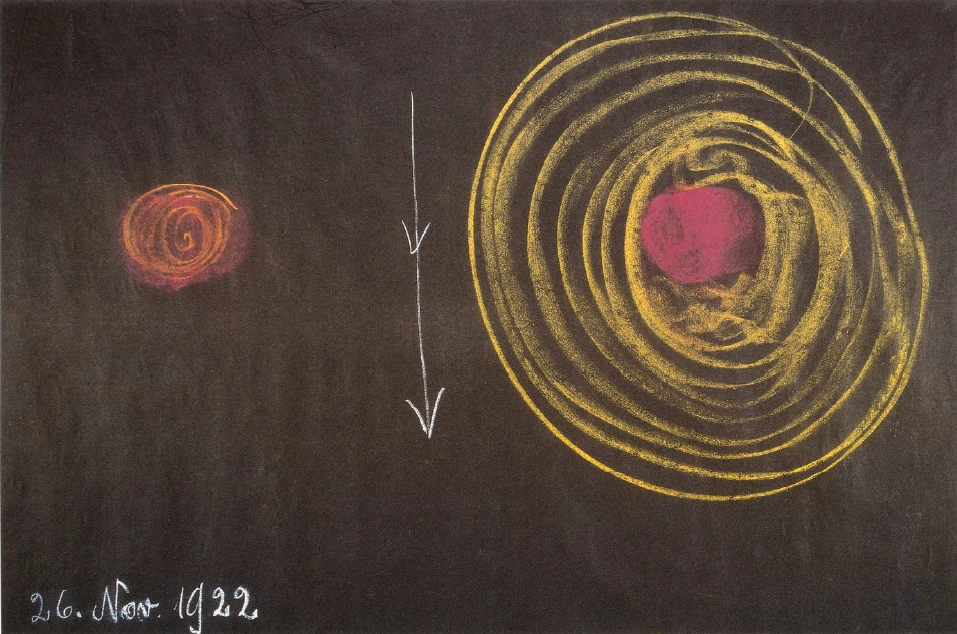
[ 16 ] What the human being builds up as the spiritual germ of his physical organism also possesses powers within itself. The entire structure, which then unites with the physical human germ—which actually becomes the physical human germ by taking substances from the parents—is endowed with all manner of qualities and powers; but there are three things for which it receives no powers from within the spiritual world itself, and these are precisely thinking, speaking, and walking. Thinking, speaking, and walking are distinctly human activities on Earth.
[ 17 ] Let’s take walking, for example—or indeed everything related to walking; I could even say, the way human beings orient themselves within their physical existence on Earth in general. After all, when I move my arm or my head, that, too, is something related to the mechanism of walking. A person’s ability to stand upright in childhood is a form of orientation. All of this is connected to what is called the Earth’s gravity; it is connected to the fact that everything that lives physically on Earth has a weight. But when it comes to what develops as a spiritual seed between death and a new birth, one cannot speak of a weight or of heaviness.
[ 18 ] So everything related to walking has to do with gravity. It is a matter of overcoming gravity. It is a matter of positioning oneself within gravity. By lifting a leg to take a step, we align ourselves with gravity. We first acquire this ability to place ourselves within the force of gravity here on Earth; it does not exist between death and a new birth, but it has its counterpart there. There, too, we have a sense of orientation, only it is not based on gravity, for in the spiritual world there is no gravity, there is no weight. There, orientation is purely spiritual, and it works in such a way that what corresponds here on Earth to lifting a leg—to aligning oneself with gravity—corresponds in the spiritual world to becoming connected, let us say, with a being of the higher hierarchies belonging to the order of the Angeloi or Archangeloi. If I feel an inner, soulful closeness under the influence of a being from the hierarchy of the Angeloi—or, let us say, the Exusiai—with whom human beings collaborate, then the human being orients themselves between death and a new birth. Just as we deal here on Earth with our physical weight, there we deal with the forces of sympathy that emanate from the individual beings of the higher hierarchies toward our own human being.
[ 19 ] It is not like gravity, which has a single direction: toward the Earth. That which corresponds to gravity in the spiritual world extends in all directions, for the spiritual beings of the higher hierarchies are not arranged centrally; they are everywhere, and their orientation is not, so to speak, a geometric one like the gravitational orientation toward the center of the Earth—rather, it is an orientation in all directions. Depending on whether a person needs to develop their lungs or has some other task to work on in connection with the beings of the higher hierarchies, they may say: “I am drawn to the third hierarchy,” or “I am drawn to the first hierarchy.” — They feel placed within the entire world of the hierarchies. They feel, as it were, drawn—or perhaps even repelled—in all directions—not physically, as by gravity, but spiritually. This corresponds in the spiritual world to physical orientation within the gravitational field on Earth.
[ 20 ] Here on Earth, human beings learn to speak, and this, in turn, is part of their earthly nature. We cannot speak in the spiritual world between death and a new birth. Speech requires the physical organs of speech. We do not have these organs there, but in the spiritual world between death and a new birth, we experience the following: we feel ourselves rhythmically contracting, as it were, into our own human being. Our much higher consciousness then contracts. Just as we experience sleep here on Earth, during which we withdraw into ourselves, so too do we withdraw into ourselves between death and a new birth. But then we open ourselves up again. Just as here on the physical Earth we direct our eyes and our other senses out into the universe, so it is there as well: we direct our spiritual organs of perception out toward the beings of the higher hierarchies; we allow our being, so to speak, to flow out into the vastness, and then we draw it back in again.
[ 21 ] This is a spiritual breathing process, but it unfolds in such a way that one could describe it something like this. If one were to describe what a person says to themselves in the spiritual world using earthly words—concepts drawn from earthly life—one would have to say something like this: As a human being in the spiritual world, I have this or that to do. I know this through the faculties of perception that are my own within the spiritual world between death and a new birth. I feel myself as this human being, as this individuality. But just as I exhale on Earth, so I allow myself to flow out into the universe in my soul—I become one with the cosmos. And just as I inhale on Earth, I take back into myself as a human being what I have experienced in my outflowing being. — This takes place continuously between death and a new birth. Schematically, I could illustrate it like this:
[ 22 ] Suppose a person feels their own being (red). Then that person feels expanded into the vastness of the universe. They extend their own being into what lies out there (yellow). So at times the human being is drawn inward into his own being (red), and at other times he is extended with his own being into the vastness of the universe. I want to illustrate this drawing in, after the expansion has taken place, once more in particular: There is, then, the human being (red), and now it draws what is out there (yellow) back into itself, so that it is condensed within its own being, just as a person draws air from the physical expanses of the universe into themselves when inhaling.
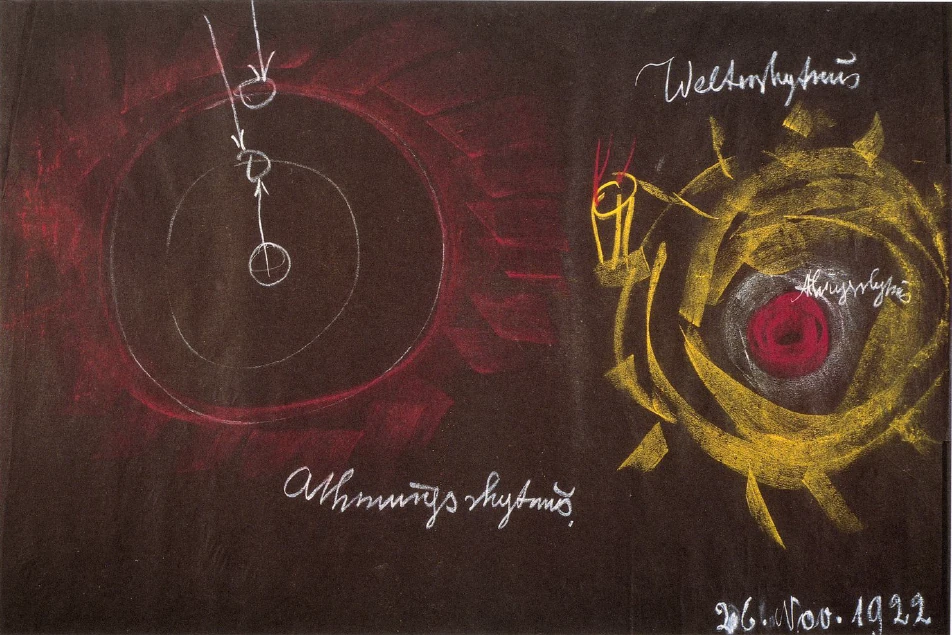
[ 23 ] Yes, but once we have spread our being throughout the cosmos and then drawn it back into ourselves, then—I cannot put it any other way—that which we have encompassed by spreading our being into the vastness of the world, and which we then draw back into ourselves, begins to speak within us of what it is. And then, between death and a new birth, we say: the Logos, into which we first immersed ourselves, the Logos speaks within us.
[ 24 ] Here on Earth, when it comes to physical speech, we generally have the sense that we form words as we exhale. Between death and a new birth, we perceive that the words spread throughout the universe—which embody the essence of the universe—enter into us as our being inhales, revealing themselves within us as the World Word. Here on Earth, we speak as we exhale; in the spiritual world, we speak as we inhale. And as we unite within ourselves what the Logos—what the World Word—tells us, the world-thoughts shine forth within our being. Here, through our nervous system, we strive to nurture earthly thoughts; there, we draw into ourselves the world-thoughts from the language of the Logos, which arises after we have first spread our being throughout the universe.
[ 25 ] And now grasp this connection with all its vitality! Between death and a new birth, you say to yourself: “I have this to do”—you take this as an inner experience from what you have lived through so far, that you are to do this or that. With this intention to do this or that, you extend your being into the vastness of the world, but in such a way that this extension occurs with a sense of direction. When you say to yourself here, “I must buy butter”—that is an intention. You set out for Basel, for example, to buy your butter there and bring it back here. Between death and a new birth, you also harbor an intention regarding those things that must be done over there in the other world, and you expand your being. It is your intention to do within yourself all that now also gives you orientation; but when this is done, it draws you toward an angelic being; when that is done, perhaps toward a being of will, and so on. They unite with your expanded being. You breathe in: this being expresses that which is its share in the Logos, and the world-thoughts of this being dawn upon you.
[ 26 ] Actually, when a human being descends here to Earth in relation to their spiritual seed—we ourselves, as I have described, remain for a while in the spiritual world above— they are not predisposed, coming from the spiritual world, to think in the earthly sense, nor to speak in the earthly sense, nor even to walk in the earthly sense subject to gravity; rather, they are predisposed to move among the beings of the higher hierarchies and to orient themselves. He is not predisposed to speaking; he is predisposed to allowing the Logos to resound within him. He is not predisposed to the dark thoughts of earthly life; he is predisposed to the thoughts that become luminous within him within the cosmos.
[ 27 ] What here on Earth is walking, speaking, and thinking has its analogies over there in the spiritual world: First, in orientation within the hierarchies; second, in the World Word becoming alive and resounding within itself; and third, in the spiritual, inner illumination of the World Thoughts.
[ 28 ] Now vividly imagine a person journeying out into the vastness of the universe after death. In doing so, they pass through the planetary spheres surrounding the Earth. I have spoken about such things in my recent lectures here. He passes through the lunar sphere, the Venusian sphere, the Mercurian sphere, the Jovian sphere, and the Saturnian sphere. Imagine that he has gone out into the vastness of the cosmos. He then always sees the stars from the other side. From Earth, we look up at the stars (upward arrow); but when we are out there, we look in from the outside (downward arrow). The forces that enable us here to see the stars give us the physical image of the stars. The forces that enable us to see the stars from the other side do not allow the stars to appear to us as they do here; rather, from the other side we see the stars entirely as spiritual beings. And when we then—I must, of course, use earthly terms—emerge from the realm of our planetary sphere, just as world evolution stands at this very moment—this “now” is, of course, a cosmic “now” that lasts a long time—then we tell ourselves, based on the understanding we acquire through the higher consciousness we possess between death and a new birth: It is a great blessing for us that the forces of Saturn shine not only into the planetary world of Earth but also into the vastness of cosmic space. — There, however, they are something quite different from the small, insignificant bluish rays of Saturn that can be seen here on Earth. There, the spiritual rays appear to us—rays that radiate out into the cosmos and even cease to be spatial, shining into a non-spatial realm—so that between death and a new birth we say to ourselves: We look back here with gratitude toward the outermost planet of our Earth’s planetary system, toward Saturn—for Uranus and Neptune are not, strictly speaking, planets of the Earth; they were added later—and we are aware that it shines not only down upon the Earth but also out into the vastness of outer space. It is thanks to the spiritual rays it radiates out into the cosmos that we are stripped of earthly heaviness, stripped of what constitutes the physical powers of speech and the physical powers of thought. Saturn is indeed our greatest benefactor between death and a new birth through its out-radiation into the vastness of the cosmos; in this respect, from a spiritual point of view, it is the opposite of the forces of the Moon.
[ 29 ] The spiritual forces of the Moon bind us to the Earth, while the spiritual forces of Saturn enable us to live in the vastness of the universe. Here on Earth, as human beings, the forces of the Moon are of very special significance to us; I have described how they even play a role in our daily waking up. What the lunar forces are to us here on Earth are the same forces that radiate out into the universe from the outermost sphere of our planetary system as Saturn forces. For in fact, this outward radiation is not something you should imagine as follows: Well, Saturn simply has a front side that radiates down toward Earth and a back side that radiates out into the cosmos. That is not how it is; rather, Saturn—if it were as depicted (see drawing)—moves along this orbit. Now it radiates spiritually from all sides (red), so that the outward radiation occurs in this way. — On the contrary: physical Saturn appears, I would say, like a hole in this sphere of the cosmic Saturn, which radiates spiritually out into cosmic space. It is certainly the case that what radiates out from there covers everything earthly for us from a certain point in time after death—but covers it with light.
[ 30 ] Well, from a cosmic perspective, it is like this: here on Earth, human beings are under the influence of the spiritual forces of the Moon; between death and a new birth, they are under the influence of the forces of Saturn. And as they descend once more to Earth, they withdraw from the forces of Saturn and gradually enter the sphere of the lunar forces. What happens there? As long as the human being is connected to the sphere of the forces of Saturn—and Saturn, if I may say so, is aided in this by Jupiter and Mars, which have a special task that I will speak about here in the near future—as long as the human being is thus under the influence of Saturn, Jupiter, and Mars—he actually aspires to become a being who does not walk, speak, or think in the earthly sense, but who seeks to orient himself among spiritual beings, who wishes to experience the Logos resounding within himself, and who desires to have the world-thoughts shining within him. And with these inner intentions, the spiritual seed of the physical organism is indeed sent down to Earth.
[ 31 ] The human being who descends from the spiritual worlds to Earth has, in fact, not the slightest inclination to submit to Earth’s gravity, nor does he have any inclination to set his speech organs in vibration so that his physical speech resounds, or to think about physical things with a physical brain. He possesses none of this. He acquires it as he is sent down to Earth from the sphere of the Saturn forces—that is, as a physical spirit germ—passes through the Sun, and then enters the other planetary spheres: the spheres of Mercury, Venus, and the Moon. The spheres of Mercury, Venus, and the Moon transform the cosmic predispositions toward spiritual orientation, toward experiencing the Logos, and toward the inner illumination of world thoughts, into the predispositions for speaking, thinking, and walking. And the Sun—that is, the spiritual Sun—brings about this reversal.
[ 32 ] As a result of human beings entering the lunar sphere—and the forces of Venus and Mercury assist the lunar forces—the, if I may put it this way, celestial faculties of orientation, Logos, and thought are transformed into earthly ones. Actually, as the human child here on Earth begins to rise from a crawling position, we ought to address it by saying: Before you were taken up by the forces of Mercury, Venus, and the Moon, you were predisposed, over there in the celestial spheres, for spiritual orientation within the hierarchies, for the inner experience of the resounding Logos, and for inner enlightenment through the world-thoughts. You have accomplished the metamorphosis of those celestial faculties into earthly faculties, and you have worked toward this accomplishment by passing through the entire planetary sphere, and the Sun has brought about precisely the transformation of the celestial into the earthly.
[ 33 ] But something truly momentous takes place here: namely, that when human beings step from the heavenly into the earthly realm, they experience only one aspect of the etheric. The etheric is spread throughout the entire sphere of planets and stars. But at the moment when the heavenly faculties are transformed into earthly faculties, the human being loses the experience of cosmic morality. When one experiences orientation among the beings of the higher hierarchies, one does not merely experience it as interwoven with natural laws, but as moral orientation. Everything there is moral at the same time. Likewise, the Logos speaks within the human being—not amorally, as natural phenomena do (though not antimorally, but amorally do natural phenomena speak)—but the Logos speaks with morality. And in the same way, the world-thoughts shine forth in the sense of morality.
[ 34 ] Saturn, Jupiter, and Mars—though this must be stated, much to the horror of physicists—possess, in addition to their other powers, forces that are morally orienting. It is only when human beings transform these characteristic abilities into walking, speaking, and thinking that they lose these moral elements.
[ 35 ] This is extremely important. When we here on Earth speak of the ether in which we initially live—as we approach the Earth to be born—we speak of the ether in such a way that we ascribe all sorts of properties to it. But that is only one side of the ether. The other aspect is that it is a substance with a moral influence, that it is permeated everywhere by moral impulses. Just as it is permeated by light, so too is it permeated by moral impulses. These are not present in the earthly ether.
[ 36 ] The fact is, however, that human beings, as earthly beings, are not—so to speak—entirely cut off from the forces within which they live between death and a new birth. It could, after all, be the case— —if, by some divine providence in the order of the worlds, it had come to pass that human beings here on Earth had no inkling whatsoever that they are meant to be moral beings as well as physical ones—that their walking, speaking, and thinking here on Earth correspond to a heavenly orientation, a heavenly Logos, and a heavenly enlightenment through the world-thoughts. Unless it is stirred within him, a human being knows little on Earth about these heavenly counterparts to his earthly existence, yet intuitions of them do exist within him. Everything that would connect a human being to the spiritual world would be forgotten without a trace on Earth; not even the conscience would stir if there were not, nevertheless, aftereffects of the heavenly realm present on Earth.
[ 37 ] I want to start with something very specific. What I am about to tell you may seem somewhat paradoxical at first, but it is entirely consistent with the facts that can be ascertained spiritually. Let’s assume we have the Earth itself here (red), and its atmospheric environment here (light). Of course, it’s not drawn to scale, but that doesn’t matter. And further out, we have that which gradually transitions into the spiritual world: we have the cosmic ether, which gradually transitions into the spiritual world. That is where it ends. When I draw, I still have to draw in three dimensions, but beyond that point it actually becomes non-spatial (see drawing, yellow).
[ 38 ] Well, here on Earth we breathe—we inhale and exhale the air—and that is the rhythm of breathing. But out there, we expand our being into the cosmos, so that we take in the Logos, the world-thoughts, within us. There we let the world speak within us. This also happens in a rhythm—a rhythm that is attuned to the star beings. Out there, too, there is rhythm. Here on Earth, for us humans, the breathing rhythm stands in a certain ratio to the circulatory rhythm—one to four, for example: four heartbeats per breath. Out there, what we exhale and inhale spiritually is the cosmic rhythm. Here, we live by having a certain number of breaths and a certain number of circulatory beats per minute. As human beings on Earth, we live through our breathing rhythm and our circulatory rhythm. We reach out into the world; we live out there within a cosmic rhythm by, so to speak, inhaling the moral-etheric world—there we are within ourselves—and by exhaling it again—there we are together with the beings of the higher hierarchies. Just as we have rhythmically stimulated regular movements here within our physical body beneath the skin, so too do we find these stimuli outside, in the course and position of the stars, within the rhythm of the world into which we live ourselves between death and a new birth.
[ 39 ] So it is indeed true that (see illustration) there is the Earth with its immediate surroundings. We live in the air and develop our breathing rhythm in the air. This rhythm is extraordinarily regular. Any irregularity in it signifies illness for human beings. Out there, however, we must—I would say—pass through an “interworld space”—we experience the rhythm of the world by living in the morally imbued world ether out there. These are two different rhythms: the human rhythm and the cosmic rhythm; both are human rhythms, for the cosmic rhythm is the human rhythm between death and a new birth.
[ 40 ] The world has, so to speak, the regular rhythm of humanity here on Earth, and beyond, the rhythm in which we ourselves participate between death and a new birth. What lies between the two? The rhythm of humanity enables us, between birth and death, to speak human words—to make human words and human language our own. The rhythm of the world enables us, between death and a new birth, to let the word of the world resound within us. The Earth gives us language; the universe—the spiritual universe—gives us the Logos. You can imagine that things look quite different where that rhythm weaves, the one that gives us the Logos, than here on Earth in the air, where we unfold the human word.
[ 41 ] What, then, distinguishes these two realms? We look out into the physical world. Out there, we do not see the rhythm of the worlds. Both are harmoniously and thoroughly governed by lawful connections from within. What lies between them? Between them lies that which causes the rhythm of the world—as it, I might say, comes too close to the Earth—to shatter, and which, under certain circumstances, also disrupts the human breathing rhythm; between them lie all those phenomena that find expression in atmospheric phenomena, in everything that pertains to meteorology. If there were no snowstorms, thunderstorms, cloud formation, or wind on our Earth—if the air did not, in addition to what it regularly provides in terms of oxygen and nitrogen for our breathing, contain this essence of meteorology within itself—for it is always there, even when the air appears pure— we would look out into the universe and behold a rhythm of a different kind—but the exact counterpart, translated only into the grandiose—of our breathing rhythm. Chaotic weather phenomena lie between the two regularities of the world. Chaotic weather phenomena separate the rhythm of the world from the human breathing rhythm.
[ 42 ] And in a similar way, human beings here on Earth are subject to gravity. They adapt their gait and every movement of their hands to this gravity, to these forces of gravity. Out there, they are quite different; there, they are oriented in all directions. There, the lines run from being to being within the higher hierarchies. What lies between the two? Just as the weather lies between the rhythm of the heavens and the rhythm of humanity and the Earth—what lies between the contrast of the gravity of the cosmos and the gravity of the Earth?
[ 43 ] Well, just as the weather exists between the rhythms, so too does that which manifests itself on Earth as volcanic forces and earthquake forces exist between the opposing forces of gravity and the spiritual force of celestial orientation. These forces are irregular.
[ 44 ] With what interest, for example, have the marvelous formations of Easter Island—located out in the Pacific Ocean—been described, which contain particularly marvelous remnants of ancient formations. You will recall how precisely these formations were described. Since early November, everything is gone! A terrible earthquake and tsunami have wiped Easter Island off the face of the earth; it has sunk into the sea.
[ 45 ] What takes place in wind and weather is intimately connected with our respiratory processes in the way I have described it from the perspective of the cosmos. What takes place in volcanic forces is so closely connected with gravity that it actually appears to us, if we are only willing to view it in this context, as if from time to time the supersensible powers were reclaiming pieces of the Earth by intervening in the laws of gravity—by imprinting, from the other side, what the forces of gravity have gradually built up into a state of chaos in order to reclaim it.
[ 46 ] Indeed, all earthly formations, as they have come into being through gravity, are influenced by such—I would say—terrestrial phenomena. But while in the weather it is the airy, the warm, and the watery elements that move, here we are dealing with the earthly, solid elements and with the watery element through which the Earth revolts. We are dealing here with that which transcends the regularity of weight ratios and which will gradually carry the Earth away just as it was formed by gravity. As for the fact that a third factor comes into play in meteorology and volcanism, I will speak of that next time.
[ 47 ] Conventional science doesn’t really know what to make of volcanic phenomena and often explains them in the way I, for example, read about recently in connection with that terrible earthquake. Someone wrote an article about it. A geologist—that is, an expert in this field—described the situation and then said: “Yes, but when we consider the cause of these phenomena, which recur from time to time and destroy so much on Earth, we must classify this latest earthquake as a tectonic earthquake.” — What does that mean: When we consider the cause, we must classify it as a tectonic earthquake? -— When we speak of tectonic earth tremors, these are tremors in which the various parts of the Earth shift relative to one another. So if we want to discuss the cause of this shifting, we must discuss the shifting itself! Poverty comes from “pauvreté”!
[ 48 ] It is indeed quite true: if we wish to see connections in these matters, then we must turn to the spiritual realm. For the moment we take what ordinary natural laws tell us in any given field—let us say, in the field of gravity or that of rhythmic phenomena in the ether— and move from that to what leads from the cosmos into an apparent chaos—but in order to ascend through this chaos to the higher realms of the cosmos—in other words, if we wish to penetrate the realms of volcanism and meteorology, we must turn to the spiritual realm.
[ 49 ] What appears to be a coincidence—as it is commonly called—within the totality of the world reveals itself within the spiritual realm in its fully valid, lawful context. One can know that, as a human being, one is taken out of the state one is in between death and a new birth through meteorological phenomena. Speaking concretely in contrast to the many abstractions that exist today, one can say: In the heavenly regions, the human being is subject to a law that is concealed from him here on Earth because he is caught up in the meteorological phenomena of the air cycle. Meteorological phenomena are the dividing wall between what the human being experiences on Earth and what he experiences between death and a new birth.
[ 50 ] In this way, I would like to strive to show you more and more connections that are truly concrete and not merely descriptive.