

The Relationship of Man to the Starry World
The Spiritual Communion of Mankind
GA 219
26 November 1922, Dornach
Translate the original German text into any language:
Versions Available:
The Relationship of Man to the Starry World, tr. SOL
Erster Vortrag
First Lecture
[ 1 ] Wir haben als anthroposophische Bewegung - das möchte ich heute einleitend bemerken — wiederum eine Reihe von Veranstaltungen über Anthroposophie und Eurythmie, und zwar in Holland und in London, hinter uns. Ich möchte darüber nur einige Bemerkungen machen. Vor allen Dingen möchte ich auf die außerordentlich erfreuliche Tatsache hinweisen, daß in bezug auf die Aufnahme der anthroposophischen Vorträge in der Öffentlichkeit wie auch der eurythmischen Darstellungen gegenüber dem letzten Mal ein außerordentlicher Fortschritt zu verzeichnen ist. In Holland konnte ich in Den Haag drei öffentliche Vorträge halten, zwei im engeren Sinne über anthroposophische Themata und einen über ein ausgesprochen pädagogisches Thema: über die moralische und religiöse Erziehung vom anthroposophischen Gesichtspunkte. In Rotterdam hatte ich einen allgemeinen anthroposophischen Vortrag zu halten. In der Stadt der holländischen technischen Hochschule, in Delft, hatte ich zu sprechen über die Beziehungen der Anthroposophie zur Wissenschaft. Und es werden gewiß die Teilnehmer, die ja auch von hier anwesend waren, bestätigen können, daß ein Interesse für dasjenige vorhanden war, was sowohl über das engere anthroposophische Gebiet wie über das Erziehungsgebiet gesagt werden konnte.
[ 1 ] As the anthroposophical movement—and I would like to note this by way of introduction today—we have once again completed a series of events on anthroposophy and eurythmy, specifically in the Netherlands and in London. I would like to make just a few remarks about this. Above all, I would like to point out the exceptionally gratifying fact that, compared to the last time, there has been extraordinary progress in terms of the public’s reception of both the anthroposophical lectures and the eurythmy performances. In the Netherlands, I was able to give three public lectures in The Hague—two strictly on anthroposophical topics and one on a distinctly pedagogical subject: moral and religious education from an anthroposophical perspective. In Rotterdam, I gave a general lecture on anthroposophy. In Delft, the city where the Dutch Technical University is located, I spoke about the relationship between anthroposophy and science. And the participants—some of whom were also present here—will certainly be able to confirm that there was interest in what was said both about the more specific field of anthroposophy and about the field of education.
[ 2 ] Es ist ja allerdings bei allen diesen Dingen zu bemerken, daß der allgemeine Rückgang in der Zivilisation der Gegenwart sich außerordentlich stark bemerkbar macht, so daß die Besucherzahl natürlich längst nicht die Höhe erreicht, die sie erreichen würde, wenn wir nicht in einer im allgemeinen so außerordentlich schwierigen Zeit lebten. Das ist ja überall zu bemerken, und das ist etwas, was um so mehr dazu auffordert, das, was Anthroposophie dieser Zivilisation der Gegenwart geben kann, in einer intensiven Weise zur Geltung zu bringen. Ich möchte sagen: jeder Schritt nach vorwärts beweist einem gerade dieses. Zu meiner ganz besonderen Befriedigung habe ich zu bemerken, daß gerade in Den Haag in dieser Zeit die eurythmischen Vorstellungen, die dort in dem Hause der Königlichen Schauburg stattfinden konnten, in einer außerordentlich günstigen Weise aufgenommen worden sind. Es ist nach den Vorstellungen die Ansicht von den verschiedensten Seiten geäußert worden, daß man, je öfter man solche eurythmischen Vorstellungen sieht, desto mehr in den eigentlichen Geist dieses Versuches einer künstlerischen Neuschöpfung eindringen kann.
[ 2 ] It should be noted, however, with regard to all these matters, that the general decline in contemporary civilization is exceptionally pronounced, so that visitor numbers naturally fall far short of what they would be if we were not living in such an exceptionally difficult time overall. This is evident everywhere, and it is something that makes it all the more urgent to bring to the fore, in an intensive way, what anthroposophy can offer to today’s civilization. I would like to say: every step forward proves precisely this. To my great satisfaction, I have observed that, particularly in The Hague during this period, the eurythmy performances held at the Royal Schauburg were received in an exceptionally favorable manner. After the performances, people from a wide variety of backgrounds expressed the view that the more often one sees such eurythmy performances, the more one can penetrate the very spirit of this attempt at artistic renewal.
[ 3 ] In London konnte ich drei halböffentliche Vorträge und drei Zweigvorträge halten. In Den Haag habe ich auch einen Zweigvortrag zum Schluß noch gehalten. Es war mir besonders auch noch befriedigend, daß einer der öffentlichen Vorträge in London auch das Erziehungsthema behandeln konnte. Sie wissen ja vielleicht schon, daß ich in England zum Teil unter dem Eindruck derjenigen Vorträge sprechen konnte, die ich hier vorige Weihnachten hielt, und bei denen ja zahlreiche englische Bekenner der anthroposophischen Bewegung und sonstige für die Pädagogik interessierte Persönlichkeiten anwesend waren. Teils unter dem Eindrucke dieser Weihnachtsvorträge, teils unter dem Eindrucke meiner im Sommer dieses Jahres gehaltenen Oxforder Vorträge über anthroposophische Pädagogik, hat sich in England nach dem Muster des Waldorfschulvereins eine Erziehungsunion begründet, welche bestrebt ist, dasjenige, was anthroposophische Pädagogik geben kann, durch die Begründung von Schulen auch in England geltend zu machen. Diese Erziehungsunion hat dann den einen der öffentlichen Vorträge namentlich für Lehrer veranstaltet, und man kann eben daran sehen, daß auch das pädagogische Thema durchaus in England Interesse findet.
[ 3 ] In London, I was able to give three semi-public lectures and three branch lectures. In The Hague, I also gave a branch lecture at the end. It was particularly gratifying to me that one of the public lectures in London was also able to address the topic of education. You may already know that I was able to speak in England partly under the influence of the lectures I gave here last Christmas, which were attended by numerous English adherents of the anthroposophical movement and other individuals interested in education. Partly under the influence of these Christmas lectures, and partly under the influence of my Oxford lectures on anthroposophical education held this past summer, an Educational Union has been founded in England, modeled after the Waldorf School Association, which strives to bring to bear what anthroposophical education has to offer by establishing schools in England as well. This Educational Union then organized one of the public lectures specifically for teachers, and this clearly shows that the topic of education is indeed of great interest in England as well.
[ 4 ] Wir waren ja diesmal in einer verhältnismäßig recht ungünstigen Zeit nach London gekommen, mitten in die Wahlzeit hinein. Namentlich die eurythmischen Vorstellungen fanden während der Wahltage statt. Aber dennoch darf gesagt werden, daß gerade gegenüber den eurythmischen Vorstellungen in London von Vorstellung zu Vorstellung das Interesse und die Freudigkeit, mit der die Sache aufgenommen wurde, gewachsen ist, so daß man wirklich sagen kann, von dieser Seite her kann man schon finden, daß Anthroposophie und das, was zu ihr gehört, einen guten Fortschritt macht.
[ 4 ] We had, after all, come to London at a relatively inopportune time this time around, right in the middle of the election season. The eurythmy performances, in particular, took place during the election days. Nevertheless, it can be said that, particularly with regard to the eurythmy performances in London, the interest and enthusiasm with which they were received grew from performance to performance, so that one can truly say that, from this perspective, one can already see that anthroposophy and all that pertains to it are making good progress.
[ 5 ] Von dem Durchgang des Menschen durch die beiden Seiten seines Lebens, durch die geistige Welt zwischen dem Tode und einer neuen Geburt und dutch die physisch-irdische Welt zwischen der Geburt und dem Tode, sollen diese Vorträge handeln.
[ 5 ] These lectures will deal with humanity’s journey through the two aspects of life: the spiritual world between death and a new birth, and the physical, earthly world between birth and death.
[ 6 ] Ich möchte heute an einiges erinnern, was uns innerhalb der letzten Vorträge hier vor die Seele getreten sein kann. Ich sagte Ihnen: In der wichtigsten Zeit, welche verfließt zwischen dem Tode und einer neuen Geburt, findet sich der Mensch innerhalb der geistigen Welt mit einem wesentlich höheren Bewußtsein, als er es hier innerhalb des physischen Leibes auf der Erde hat. - Wenn wir hier auf der Erde in unserem physischen Leib stehen, so hängt ja dieses irdische Sinnen- und Nervenbewußtsein ab von der Gesamtorganisation des Menschen. Wir fühlen uns als Menschen hier, indem wir innerhalb unserer Haut tragen: unsere Gehirnorganisation, unsere Lungen-, Herzorganisation und so weiter. Das ist dasjenige, wovon wir sagen können, es ist in unserem Innern. Das aber, was um uns herum ist, mit dem fühlen wir uns verbunden, sei es durch unsere Sinne, sei es durch unsere Atmung, sei es durch unsere Nahrungsaufnahme.
[ 6 ] Today I would like to recall a few things that may have touched our souls during the recent lectures here. I told you: During the most important period—the time that elapses between death and a new birth—the human being finds themselves in the spiritual world with a significantly higher level of consciousness than they possess here on Earth within the physical body. —When we stand here on Earth in our physical body, this earthly sensory and nervous consciousness depends on the human being’s entire physical organization. We feel ourselves to be human beings here because we carry within our skin our brain, our lungs, our heart, and so on. This is what we can say is within us. But we feel connected to what is around us—whether through our senses, our breathing, or our intake of food.
[ 7 ] Wenn wir nun in jenem Zustande leben, der da verfließt zwischen dem Tode und einer neuen Geburt, so können wir nicht in dem gleichen Sinne von unserem Innern sprechen. Denn in dem Augenblick, wo wit durch die Pforte des Todes gehen, ja schon in dem Augenblick, wo wir in den Schlaf hinübergehen, wenn da auch das Bewußtsein herabgelähmt ist — die bewußtlosen Lebenszustände laufen doch so ab, wie ich sie dargestellt habe -, befinden wir uns in einem solchen Zustande, daß wir eigentlich da die ganze Welt, das Weltenall als unser Inneres bezeichnen können.
[ 7 ] When we live in that state that flows between death and a new birth, we cannot speak of our inner self in the same sense. For at the very moment we pass through the gate of death—indeed, even at the moment we drift off to sleep, when consciousness is already dulled—for these unconscious states of life still unfold as I have described them—we find ourselves in such a state that we can actually describe the entire world, the universe, as our inner self.
[ 8 ] Während wir also hier auf der Erde eine Organisation haben, die sich in unseren Organen und deren Wechselwirkung innerhalb der Haut offenbart, offenbart sich uns - im Schlafe bloß bewußtlos, lebensvoll, zwischen dem Tod und einer neuen Geburt aber vollbewußt unser Inneres als ein Sterneninneres. Wir fühlen uns der Sternenwelt gegenüber so, daß wir zu den Wesenheiten der Sterne ebenso sagen, sie seien unser Inneres, wie wir hier zu Lunge und Herz sagen, sie gehören zu unserem physischen Inneren. Wir haben vom Einschlafen bis zum Aufwachen ein kosmisches Leben. Wir haben von dem Tode bis zu einer neuen Geburt ein kosmisches Bewußtsein. Dasjenige, was hier auf der Erde Außenwelt ist, insbesondere wenn wir den Blick hinausrichten in die Weiten des Weltenraumes, das wird zu unserem Inneren.
[ 8 ] So while here on Earth we have an organization that manifests itself in our organs and their interactions within the skin, our inner being reveals itself to us—unconsciously during sleep, yet full of life, and fully conscious between death and a new birth—as a starry inner being. We feel toward the world of the stars in such a way that we say of the beings of the stars that they are our inner being, just as we say here of the lungs and the heart that they belong to our physical inner being. From the moment we fall asleep until we wake up, we have a cosmic life. From death to a new birth, we possess a cosmic consciousness. That which is the external world here on Earth—especially when we gaze out into the vastness of outer space—becomes our inner self.
[ 9 ] Und was stellt sich uns in der geistigen Welt als das Äußere dar? Unser Äußeres wird gerade das, was jetzt unser Inneres ist. Unser Äußeres wird der Mensch selbst, aber der Mensch in einer ganz besonderen Weise, der Mensch so, daß wir dasjenige, was dann Äußeres ist, wie eine Art geistigen Keim aufbauen, aus dem hervorgehen soll unser künftiger physischer Erdenkörper. Im Zusammenhang mit den Wesenheiten der höheren Hierarchien arbeiten wir diesen Geistkeim aus. Der ist vorhanden in einem bestimmten Zeitpunkte des Durchlaufens des Lebens zwischen dem Tode und einer neuen Geburt. Er ist als Geistwesenheit da, aber er trägt als Geistwesenheit in sich die Kräfte, welche dann den physischen Leib des Menschen organisieren, so wie, sagen wir, der Pflanzenkeim in sich trägt die Kräfte, welche die spätere Pflanze organisierten. Nur müssen wir uns den Pflanzenkeim klein, die Pflanze groß vorstellen; der Geistkeim des menschlichen physischen Organismus aber ist sozusagen ein Universum von unermeßlicher Größe, obwohl im eigentlichen Sinne von «groß» zu sprechen ja für diese Zustände nicht mehr ganz richtig ist.
[ 9 ] And what appears to us in the spiritual world as the outer self? Our outer self becomes precisely what is now our inner self. Our outer form becomes the human being itself, but the human being in a very special way—the human being such that we build up what is then the outer form as a kind of spiritual seed from which our future physical earthly body is to emerge. In collaboration with the beings of the higher hierarchies, we develop this spiritual seed. It is present at a specific point in the course of life between death and a new birth. It exists as a spiritual being, but as a spiritual being it carries within itself the forces that will then organize the human physical body, just as, let us say, the plant seed carries within itself the forces that organize the future plant. However, we must imagine the plant seed as small and the plant as large; the spiritual seed of the human physical organism, on the other hand, is, so to speak, a universe of immeasurable size, although speaking of “large” in the strict sense is no longer entirely accurate for these states.
[ 10 ] Ich habe aber auch darauf hingedeutet, daß dieser Geistkeim uns gewissermaßen in einer gewissen Zeit entfällt. Wir fühlen von einer gewissen Zeit an: wir haben den Geistkeim unseres physischen Organismus im Zusammenhange mit andern Wesen des Weltenalls, mit Wesen der höheren Hierarchien ausgearbeitet; wir haben ihn bis zu einem gewissen Punkte gebracht. Dann entfällt er uns, und er senkt sich ein in die physischen Erdenkräfte, mit denen er verwandt ist und die vom Vater und von der Mutter kommen. Er verbindet sich mit dem Menschlichen der Vererbungsströmung. Er geht früher auf die Erde herunter als wir selbst als geistig-seelische Menschen, so daß wir noch eine wenn auch kurze Zeit in der geistigen Welt zubringen, wenn schon der Kräftezusammenhang unseres physischen Organismus auf die Erde heruntergegangen ist und als solcher in dem Menschenkeim im Leibe der Mutter lebt.
[ 10 ] But I have also pointed out that this spiritual seed, so to speak, is lost to us after a certain time. From a certain point onward, we feel that we have developed the spiritual seed of our physical organism in connection with other beings of the universe, with beings of the higher hierarchies; we have brought it to a certain point. Then it departs from us and sinks into the physical forces of the earth, with which it is related and which come from the father and the mother. It unites with the human element of the hereditary stream. It descends to Earth earlier than we ourselves do as spiritual-soul beings, so that we still spend a time—albeit a brief one—in the spiritual world, even though the interplay of forces constituting our physical organism has already descended to Earth and lives as such in the human embryo within the mother’s body.
[ 11 ] In dieser Zeit, da ziehen wir zusammen aus dem Weltenäther die Kräfte und Substanzen des Weltenäthers selber und bilden unseren Ätherleib zu unserem astralischen Leib und dem Ich hinzu. Und als solches Wesen im Ich und im astralischen Leib und Ätherleib kommen wir selber zur Erde herunter und verbinden uns mit dem, was aus dem schon früher heruntergeschickten Geistkeim geworden ist. Wer diesen Vorgang genauer betrachtet, dem wird ganz besonders klar, wie der Mensch eigentlich in seinem Verhältnisse zum Weltenall steht. Und es wird einem das klar, wenn man vor allen Dingen auf drei Äußerungen der Menschenwesenheit hinschaut, auf die hier und an andern Orten im anthroposophischen Zusammenhange auch schon aufmerksam gemacht worden ist, wenn man hinschaut auf jene drei Äußerungen der Menschennatur, durch welche der Mensch eigentlich das Wesen wird, das er auf der Erde ist.
[ 11 ] During this time, we draw the forces and substances of the world ether itself from the world ether and form our etheric body, adding it to our astral body and the “I.” And as such a being—comprising the I, the astral body, and the etheric body—we ourselves descend to Earth and connect with what has become of the spiritual seed sent down earlier. Anyone who examines this process more closely will see very clearly how the human being actually relates to the universe. And this becomes clear when one looks, above all, at three manifestations of the human being—which have already been pointed out here and elsewhere in an anthroposophical context—when one looks at those three manifestations of human nature through which the human being actually becomes the being that he is on Earth.
[ 12 ] Wir werden eigentlich ganz anders als Kind geboren, als wir dann später sind. Wir lernen erst auf der Erde gehen, sprechen, denken. Dasjenige, was, ich möchte sagen, dumpf bleibt beim Menschen zwischen der Geburt und dem Tode, der Wille, und was halb dumpf bleibt, das Gefühl, sie sind, wenn auch in einer primitiven Weise, schon beim ganz kleinen Kinde vorhanden. Das Gefühlsleben, wenn es auch ganz nur den inneren Funktionen zugewendet ist, es ist beim kleinen Kinde vorhanden. Das Willensleben ist vorhanden. Dafür sind ein Beweis die, wenn auch chaotischen Bewegungen, die das Kind ausführt.
[ 12 ] We are actually born as children quite different from what we later become. We first learn to walk, speak, and think here on Earth. That which, I would say, remains dormant in human beings between birth and death—the will—and that which remains only half-dormant—feeling—are already present, albeit in a primitive form, even in the very young child. The emotional life, even if it is directed entirely toward inner functions, is present in the young child. The life of the will is present. Proof of this lies in the movements—albeit chaotic ones—that the child performs.
[ 13 ] Daß aus dem Gefühlsleben und aus dem Willensleben im späteren Daseinsalter etwas anderes wird, als es beim Kinde ist, davon ist die Ursache, daß sich allmählich das Denken ausbildet und dieses Denken das Gefühl durchdringt, den Willen durchdringt, und so Gefühl und Wille etwas Vollkommeneres werden. Aber sie sind eben beim Kinde schon vorhanden. Dagegen ist das Denken etwas, was das Kind erst hier auf der Erde ausbildet, im Zusammenhange mit andern Menschen, was es gewissermaßen unter der Lehre der andern Menschen ausbildet. Ebenso ist es mit dem Gehen und Sprechen, die vor dem Denken von dem Kinde angeeignet werden.
[ 13 ] The reason why the child’s emotional and volitional life changes in later life, becoming something different from what it is in childhood, is that thinking gradually develops and this thinking permeates both emotion and will, thereby making emotion and will more perfect. But they are, after all, already present in the child. Thinking, on the other hand, is something the child develops only here on Earth, in connection with other people—something it develops, so to speak, under the guidance of others. The same is true of walking and speaking, which the child masters before thinking.
[ 14 ] Wer für das wahrhaft Menschliche ein genügend tiefes Gefühl hat, dem wird schon aus der Betrachtung, wie das Kind sich durch Gehen, Sprechen und Denken entwickelt, aufgehen, welche bedeutungsvolle Rolle dieses Gehen, Sprechen und Denken in der menschlichen Erdenentwickelung spielt. Aber der Mensch ist eben nicht nur ein Erdenwesen. Der Mensch ist ein Wesen, welches ebenso, wie es der Erde und ihren Kräften, ihren Substanzen angehört, auch angehört der geistigen Welt, den Wesenheiten der höheren Hierarchien, den Tätigkeiten, die sich abspielen zwischen den einzelnen Wesen dieser höheren Hierarchien. Der Mensch gehört sozusagen nur mit dem einen Teile seines Wesens dem irdischen Dasein an, mit dem andern Teil seines Wesens gehört er einer Welt an, die nicht die sinnliche ist.
[ 14 ] Anyone who has a sufficiently deep sense of what is truly human will realize, simply by observing how a child develops through walking, speaking, and thinking, what a significant role these activities play in human development on Earth. But human beings are not merely earthly beings. Human beings are beings who, just as they belong to the Earth and its forces and substances, also belong to the spiritual world, to the beings of the higher hierarchies, and to the activities that take place among the individual beings of these higher hierarchies. Human beings, so to speak, belong to earthly existence with only one part of their being; with the other part of their being, they belong to a world that is not the sensory one.
[ 15 ] In dieser Welt, die nicht die sinnliche ist, bereitet er, wie ich schon erwähnt habe, seinen Geistkeim. Ich habe Ihnen gesagt, man soll ja nicht glauben, daß alle Kultur- und Zivilisationstaten der Menschen auf der Erde, so kompliziert und so großartig sie sein mögen, an Großartigkeit das erreichen, was getan wird zwischen den Menschen und den Wesenheiten der höheren Hierarchien, um dieses ganze Wunder des menschlichen physischen Organismus zunächst in der geistigen Welt aufzubauen. Aber das, was da aufgebaut wird, und was, wie ich dargestellt habe, eigentlich vor uns auf die Erde heruntergeschickt wird, das ist doch etwas anders organisiert als dasjenige, was dann hier auf Erden als Mensch vorhanden ist zwischen der Geburt und dem Tode.
[ 15 ] In this world—which is not the sensory one—he prepares his spiritual seed, as I have already mentioned. I have told you that one should not believe that all the cultural and civilizational achievements of human beings on Earth, however complex and magnificent they may be, can match in grandeur what is accomplished between human beings and the beings of the higher hierarchies in order to first construct this entire miracle of the human physical organism in the spiritual world. But what is built there—and what, as I have described, is actually sent down to us on Earth—is organized somewhat differently than what then exists here on Earth as a human being between birth and death.
[ 16 ] Dasjenige, was da der Mensch aufbaut am Geistkeim seines physischen Organismus, hat auch Kräfte in sich. Der ganze Aufbau, der sich dann zusammenschließt mit dem physischen Menschenkeim, der eigentlich zum physischen Menschenkeim wird, indem er die Substanzen von den Eltern nimmt, der ist mit allen möglichen Eigenschaften und Kräften ausgerüstet; nur zu drei Dingen bekommt er innerhalb der geistigen Welt selbst keine Kräfte, und das sind gerade das Denken, das Sprechen, das Gehen. Denken, Sprechen und Gehen sind durchaus menschliche Tätigkeiten auf der Erde.
[ 16 ] What the human being builds up as the spiritual germ of his physical organism also possesses powers within itself. The entire structure, which then unites with the physical human germ—which actually becomes the physical human germ by taking substances from the parents—is endowed with all manner of qualities and powers; but there are three things for which it receives no powers from within the spiritual world itself, and these are precisely thinking, speaking, and walking. Thinking, speaking, and walking are distinctly human activities on Earth.
[ 17 ] Nehmen wir einmal das Gehen, nehmen wir überhaupt alles, was mit dem Gehen verwandt ist, ich könnte sagen, das Orientieren des Menschen innerhalb seines physischen Erdendaseins überhaupt. Denn schließlich, wenn ich den Arm bewege, wenn ich den Kopf bewege, so ist das ja auch etwas, was verwandt ist mit dem Mechanismus des Gehens. Das Aufrichten des Menschen im kindlichen Alter ist ein Orientieren. All das hängt zusammen mit dem, was man die Schwerkraft der Erde nennt, hängt zusammen mit der Tatsache, daß alles, was physisch auf der Erde lebt, ein Gewicht hat. Bei dem aber, was als Geistkeim ausgebildet wird zwischen dem Tode und einer neuen Geburt, kann man nicht von einem Gewicht, nicht von einer Schwere reden.
[ 17 ] Let’s take walking, for example—or indeed everything related to walking; I could even say, the way human beings orient themselves within their physical existence on Earth in general. After all, when I move my arm or my head, that, too, is something related to the mechanism of walking. A person’s ability to stand upright in childhood is a form of orientation. All of this is connected to what is called the Earth’s gravity; it is connected to the fact that everything that lives physically on Earth has a weight. But when it comes to what develops as a spiritual seed between death and a new birth, one cannot speak of a weight or of heaviness.
[ 18 ] Es hat also alles das, was mit dem Gehen zusammenhängt, mit der Schwerkraft zu tun. Es ist ein Überwinden der Schwerkraft. Es ist ein Sich-Hineinstellen in die Schwerkraft. Indem wir ein Bein heben zu einem Schritt, fügen wir uns in die Schwerkraft hinein. Das eignen wir uns erst auf der Erde an, dieses Sich-Hineinstellen in die Schwerkraft, das ist nicht vorhanden zwischen dem Tode und einer neuen Geburt, aber es hat sein Analogon dort. Auch dort haben wir eine Orientierung, nur ist es nicht die in der Schwerkraft, denn in der geistigen Welt gibt es keine Schwerkraft, gibt es kein Gewicht. Dort ist die Orientierung lediglich eine geistige, und zwar so, daß dem, was hier auf der Erde entspricht dem Aufheben einesBeines, dem SichHineinstellen in die Schwerkraft, daß dem in der geistigen Welt entspricht das Verwandtwerden, sagen wir mit einem Wesen der höheren Hierarchien, das der Form der Angeloi oder Archangeloi angehört. Fühle ich mich innerlich seelisch nahe unter dem Einflusse eines Wesens aus der Hierarchie der Angeloi, oder sagen wir der Exusiai, mit denen der Mensch zusammenarbeitet, so orientiert sich der Mensch zwischen dem Tode und einer neuen Geburt. Wie wir es hier auf-der Erde mit unserem Gewicht zu tun haben, haben wir es dort zu tun mit dem, was an Sympathiekräften mit unserem eigenen menschlichen Wesen von den einzelnen Wesen der höheren Hierarchien ausgeht.
[ 18 ] So everything related to walking has to do with gravity. It is a matter of overcoming gravity. It is a matter of positioning oneself within gravity. By lifting a leg to take a step, we align ourselves with gravity. We first acquire this ability to place ourselves within the force of gravity here on Earth; it does not exist between death and a new birth, but it has its counterpart there. There, too, we have a sense of orientation, only it is not based on gravity, for in the spiritual world there is no gravity, there is no weight. There, orientation is purely spiritual, and it works in such a way that what corresponds here on Earth to lifting a leg—to aligning oneself with gravity—corresponds in the spiritual world to becoming connected, let us say, with a being of the higher hierarchies belonging to the order of the Angeloi or Archangeloi. If I feel an inner, soulful closeness under the influence of a being from the hierarchy of the Angeloi—or, let us say, the Exusiai—with whom human beings collaborate, then the human being orients themselves between death and a new birth. Just as we deal here on Earth with our physical weight, there we deal with the forces of sympathy that emanate from the individual beings of the higher hierarchies toward our own human being.
[ 19 ] Es ist nicht so wie bei derSchwerkraft, die eine Richtung hat: hin zur Erde. Das, was dort in der geistigen Welt der Schwerkraft entspricht, hat alle Richtungen, denn die geistigen Wesen der höheren Hierarchien sind nicht zentral geordnet, sie sind überall, und die Orientierung ist nicht eine solch geometrische, möchte man sagen, wie die SchwereOrientierung nach dem Mittelpunkte der Erde, sie ist eine Orientierung nach allen Richtungen hin. Je nachdem der Mensch seine Lunge aufzubauen hat, oder irgend etwas anderes zu arbeiten hat in Verbindung mit den Wesen der höheren Hierarchien, kann er sagen: Es zieht mich an die dritte Hierarchie, es zieht mich an die erste Hierarchie. — Er fühlt sich hineingestellt in die ganze Welt der Hierarchien. Er fühlt sich gewissermaßen nach allen Seiten — nicht physisch wie durch die Schwerkraft, sondern geistig — gezogen oder wohl auch abgestoßen. Das entspricht in der geistigen Welt der physischen Orientierung innerhalb der Schwere auf Erden.
[ 19 ] It is not like gravity, which has a single direction: toward the Earth. That which corresponds to gravity in the spiritual world extends in all directions, for the spiritual beings of the higher hierarchies are not arranged centrally; they are everywhere, and their orientation is not, so to speak, a geometric one like the gravitational orientation toward the center of the Earth—rather, it is an orientation in all directions. Depending on whether a person needs to develop their lungs or has some other task to work on in connection with the beings of the higher hierarchies, they may say: “I am drawn to the third hierarchy,” or “I am drawn to the first hierarchy.” — They feel placed within the entire world of the hierarchies. They feel, as it were, drawn—or perhaps even repelled—in all directions—not physically, as by gravity, but spiritually. This corresponds in the spiritual world to physical orientation within the gravitational field on Earth.
[ 20 ] Hier auf der Erde lernt der Mensch sprechen, und das gehört wiederum zu seinem Erdenwesen. Sprechen können wir nicht innerhalb der geistigen Welt zwischen dem Tode und einer neuen Geburt. Zum Sprechen gehören die physischen Sprachorgane. Die sind nicht da, aber wir haben innerhalb der geistigen Welt zwischen dem Tode und einer neuen Geburt folgende Erlebensform: wir fühlen uns abwechselnd rhythmisch gewissermaßen zusammengezogen in unser eigenes Menschenwesen. Da zieht sich unser viel höheres Bewußtsein zusammen. Wie wir hier auf der Erde den Schlaf haben, wo wir uns in uns _ selbst abschließen, so schließen wir uns auch zwischen dem Tode und einer neuen Geburt in uns selbst ab. Dann aber schließen wir uns wieder auf. Wie wir hier auf der physischen Erde unser Auge, unsere andern Sinne hinausrichten in das Universum, so ist es auch dort: wir richten unsere geistigen Wahrnehmungsorgane hinaus zu den Wesenheiten der höheren Hierarchien, wir lassen gewissermaßen unser Wesen in die Weiten ausströmen, wir ziehen es wieder zusammen.
[ 20 ] Here on Earth, human beings learn to speak, and this, in turn, is part of their earthly nature. We cannot speak in the spiritual world between death and a new birth. Speech requires the physical organs of speech. We do not have these organs there, but in the spiritual world between death and a new birth, we experience the following: we feel ourselves rhythmically contracting, as it were, into our own human being. Our much higher consciousness then contracts. Just as we experience sleep here on Earth, during which we withdraw into ourselves, so too do we withdraw into ourselves between death and a new birth. But then we open ourselves up again. Just as here on the physical Earth we direct our eyes and our other senses out into the universe, so it is there as well: we direct our spiritual organs of perception out toward the beings of the higher hierarchies; we allow our being, so to speak, to flow out into the vastness, and then we draw it back in again.
[ 21 ] Das ist ein geistiger Atmungsprozeß, aber er verläuft so, daß man es etwa so darstellen könnte. Wenn man das, was der Mensch sich da sagt in der geistigen Welt, mit irdischen Worten, mit Vorstellungen, die dem irdischen Leben entnommen sind, darstellen wollte,so müßte man etwa das Folgende sagen: Ich habe als Mensch in der geistigen Welt dies oder jenes zu tun. Ich weiß das durch diejenigen Wahrnehmungsmöglichkeiten, die mir innerhalb der geistigen Welt eigen sind zwischen dem Tode und einer neuen Geburt. Ich fühle mich als dieses Menschenwesen, als diese Individualität. Aber so, wie ich auf der Erde ausatme, so lasse ich mich seelisch in das Universum hinausströmen ich werde eins mit dem Kosmos. Und wie ich auf der Erde einatme, so nehme ich dasjenige, was ich erlebt habe in meinem ausgeströmten Wesen, wiederum in mich als Mensch zurück. — Das findet fortwährend statt zwischen dem Tode und einer neuen Geburt. Schematisch könnte ich es so darstellen:
[ 21 ] This is a spiritual breathing process, but it unfolds in such a way that one could describe it something like this. If one were to describe what a person says to themselves in the spiritual world using earthly words—concepts drawn from earthly life—one would have to say something like this: As a human being in the spiritual world, I have this or that to do. I know this through the faculties of perception that are my own within the spiritual world between death and a new birth. I feel myself as this human being, as this individuality. But just as I exhale on Earth, so I allow myself to flow out into the universe in my soul—I become one with the cosmos. And just as I inhale on Earth, I take back into myself as a human being what I have experienced in my outflowing being. — This takes place continuously between death and a new birth. Schematically, I could illustrate it like this:
[ 22 ] Nehmen Sie an, der Mensch fühlt sich in seinem eigenen Wesen (rot). Dann fühlt sich der Mensch ausgedehnt in die Weltenweiten. Er breitet sein eigenes Wesen aus in das, was da draußen ist (gelb). Bald ist der Mensch also zusammengezogen in sein eigenes Wesen (rot), bald ist er ausgebreitet mit seinem eigenen Wesen in die Weiten des Weltenalls. Ich will diese Zusammenziehung, nachdem die Ausbreitung geschehen ist, noch einmal besonders zeichnen: Da ist also das Menschenwesen (rot), und jetzt zieht es dasjenige, was draußen ist (gelb), wiederum in sich herein, so daß es verdichtet in dem eigenen Wesen ist, wie der Mensch aus den physischen Weiten des Weltenalls die Luft in sich hereinzieht beim Einatmen.
[ 22 ] Suppose a person feels their own being (red). Then that person feels expanded into the vastness of the universe. They extend their own being into what lies out there (yellow). So at times the human being is drawn inward into his own being (red), and at other times he is extended with his own being into the vastness of the universe. I want to illustrate this drawing in, after the expansion has taken place, once more in particular: There is, then, the human being (red), and now it draws what is out there (yellow) back into itself, so that it is condensed within its own being, just as a person draws air from the physical expanses of the universe into themselves when inhaling.
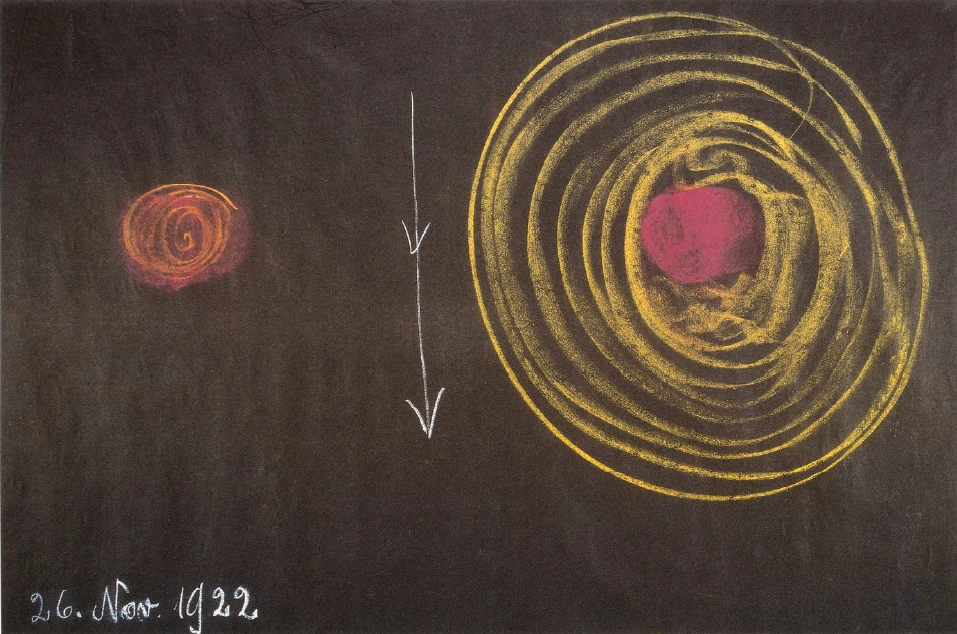
[ 23 ] Ja, aber wenn wir erst unser Wesen über den Kosmos ausgebreitet haben, dann es wiederum in uns hereinziehen, dann beginnt in uns, ich kann es nicht anders ausdrücken, dasjenige, was wir umfaßt haben, indem wit unser Wesen ausgebreitet haben in die Weltenweiten, und was wir wiederum in uns zusammenziehen, es beginnt in uns zu sagen, was es ist. Und wir sagen dann zwischen dem Tode und einer neuen Geburt: der Logos, in den wit uns zunächst hinausversenkt haben, der Logos spricht in uns.
[ 23 ] Yes, but once we have spread our being throughout the cosmos and then drawn it back into ourselves, then—I cannot put it any other way—that which we have encompassed by spreading our being into the vastness of the world, and which we then draw back into ourselves, begins to speak within us of what it is. And then, between death and a new birth, we say: the Logos, into which we first immersed ourselves, the Logos speaks within us.
[ 24 ] Wir haben hier auf der Erde in bezug auf die physische Sprache vorzugsweise das Gefühl, daß wir die Worte entwickeln, indem wir ausatmen. Wir haben zwischen dem Tode und einer neuen Geburt die Wahrnehmung, daß die Worte, die im Weltenall ausgebreitet sind und die das Wesen des Weltenalls bedeuten, beim Einatmen unseres Wesens in uns hereinkommen und sich selber als Weltenwort in uns offenbaren. Wir sprechen hier auf der Erde ausatmend, wir sprechen in der geistigen Welt einatmend. Und indem wir mit uns vereinen, was uns der Logos, was uns das Weltenwort sagt, leuchten auf in unserem Wesen die Weltgedanken. Hier mühen wir uns durch unscr Nervensystem ab, die Erdgedanken zu hegen, dort saugen wir in uns selbst die Weltgedanken aus der Sprache des Logos, die auftritt, nachdem wir zuerst unser Wesen ausgebreitet haben über das Weltenall.
[ 24 ] Here on Earth, when it comes to physical speech, we generally have the sense that we form words as we exhale. Between death and a new birth, we perceive that the words spread throughout the universe—which embody the essence of the universe—enter into us as our being inhales, revealing themselves within us as the World Word. Here on Earth, we speak as we exhale; in the spiritual world, we speak as we inhale. And as we unite within ourselves what the Logos—what the World Word—tells us, the world-thoughts shine forth within our being. Here, through our nervous system, we strive to nurture earthly thoughts; there, we draw into ourselves the world-thoughts from the language of the Logos, which arises after we have first spread our being throughout the universe.
[ 25 ] Und nun fassen Sie in aller Lebendigkeit diesen Zusammenhang! Sie sagen sich zwischen dem Tode und einer neuen Geburt: Ich habe dieses zu tun — das nehmen Sie als innere Erfahrung aus dem, was Sie bisher erlebt haben, daß Sie dies oder jenes tun sollen. Mit dieser Absicht, dies oder jenes zu tun, breiten Sie Ihr Wesen in die Weiten der Welt hinaus, aber so, daß dieses Ausbreiten in Orientierung geschieht. Wenn Sie hier sich sagen: Ich muß mir Butter kaufen -, so ist das eine Absicht. Sie setzen sich in Bewegung nach Basel hinein zum Beispiel, um dort sich Ihre Butter zu kaufen und bringen sie hierher zurück. Zwischen dem Tod und einer neuen Geburt hegen Sie auch eine Absicht in bezug auf diejenigen Dinge, die eben drüben in der andern Welt getan werden müssen, und Sie breiten Ihr Wesen aus. In Ihrer Absicht liegt es, daß Sie alles das in sich tun, was nun auch Sie orientiert, aber, wenn dieses getan wird, zieht es Sie zu einem Engelwesen hin, wenn jenes getan wird, vielleicht zu einem Willenswesen hin und so weiter. Die vereinen sich mit Ihrem ausgebreiteten Wesen. Sie atmen ein: dieses Wesen spricht dasjenige aus, was sein Anteil an dem Logos ist, und die Weltgedanken von diesem Wesen gehen Ihnen auf.
[ 25 ] And now grasp this connection with all its vitality! Between death and a new birth, you say to yourself: “I have this to do”—you take this as an inner experience from what you have lived through so far, that you are to do this or that. With this intention to do this or that, you extend your being into the vastness of the world, but in such a way that this extension occurs with a sense of direction. When you say to yourself here, “I must buy butter”—that is an intention. You set out for Basel, for example, to buy your butter there and bring it back here. Between death and a new birth, you also harbor an intention regarding those things that must be done over there in the other world, and you expand your being. It is your intention to do within yourself all that now also gives you orientation; but when this is done, it draws you toward an angelic being; when that is done, perhaps toward a being of will, and so on. They unite with your expanded being. You breathe in: this being expresses that which is its share in the Logos, and the world-thoughts of this being dawn upon you.
[ 26 ] Eigentlich, wenn der Mensch hier auf die Erde in bezug auf seinen Geistkeim herunterströmt — wir selbst bleiben dann noch etwas, wie ich dargestellt habe, in der geistigen Welt oben -, da ist er aus der geistigen Welt her nicht zum Denken im irdischen Sinne, nicht zum Sprechen im irdischen Sinne, auch nicht zum Gehen im irdischen Sinne der Schwerkraft veranlagt, sondern er ist veranlagt, zwischen den Wesen der höheren Hierarchien sich zu bewegen, sich zu orientieren. Er ist nicht zum Sprechen veranlagt, er ist veranlagt dazu, den Logos in sich ertönen zu lassen. Er ist nicht zu den finsteren Gedanken des Erdenlebens veranlagt, er ist veranlagt zu den Gedanken, die in ihm leuchtend werden innerhalb des Kosmos.
[ 26 ] Actually, when a human being descends here to Earth in relation to their spiritual seed—we ourselves, as I have described, remain for a while in the spiritual world above— they are not predisposed, coming from the spiritual world, to think in the earthly sense, nor to speak in the earthly sense, nor even to walk in the earthly sense subject to gravity; rather, they are predisposed to move among the beings of the higher hierarchies and to orient themselves. He is not predisposed to speaking; he is predisposed to allowing the Logos to resound within him. He is not predisposed to the dark thoughts of earthly life; he is predisposed to the thoughts that become luminous within him within the cosmos.
[ 27 ] Dasjenige, was hier auf der Erde Gehen, Sprechen, Denken ist, das hat seine Analogien drüben in der geistigen Welt: Erstens in der Orientierung innerhalb der Hierarchien, zweitens in dem In-sich-lebendigTönendwerden des Weltenwortes und drittens in dem geistigen innerlichen Aufleuchten der Weltgedanken.
[ 27 ] What here on Earth is walking, speaking, and thinking has its analogies over there in the spiritual world: First, in orientation within the hierarchies; second, in the World Word becoming alive and resounding within itself; and third, in the spiritual, inner illumination of the World Thoughts.
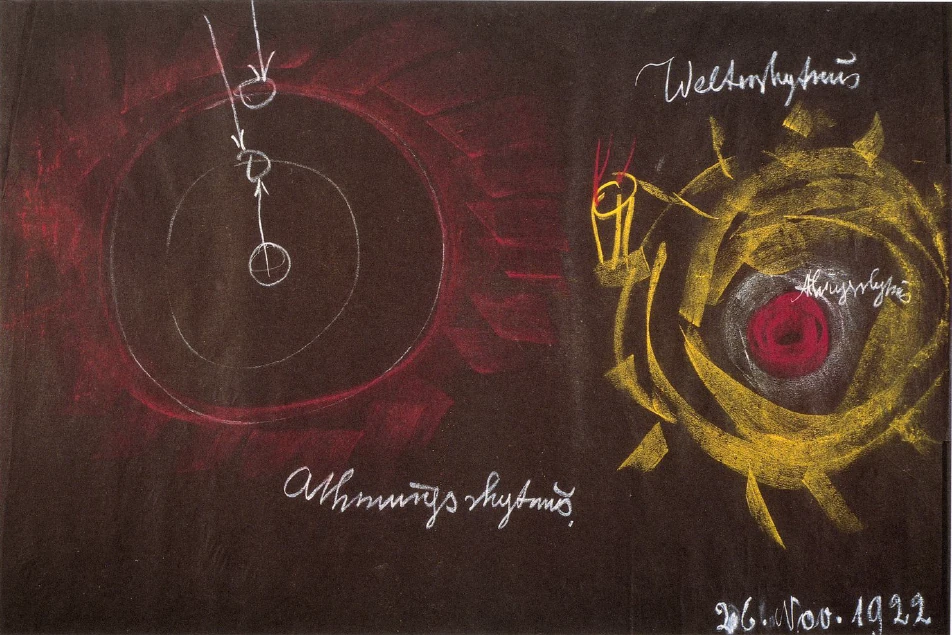
[ 28 ] Stellen Sie sich jetzt lebhaft das Hinausgehen des Menschen nach dem Tode in die Weiten des Universums vor. Er passiert dabei die Planetensphären im Umkreise der Erde. Über solche Dinge habe ich in den letzten Vorträgen hier gesprochen. Er passiert die Mondensphäre, die Venussphäre, die Merkursphäre, die Jupitersphäre, die Saturnsphäre. Denken Sie sich, er ist da hinausgekommen in die Weltenweiten. Er sieht die Sterne dann immer von der andern Seite. Von der Erde aus sehen wir zu den Sternen hinauf (Pfeil aufwärts); wenn wir aber draußen sind, sehen wir von außen herein (Pfeil abwärts). Die Kräfte, die uns hier befähigen, die Sterne zu sehen, geben uns das physische Abbild der Sterne. Die Kräfte, welche uns befähigen, die Sterne von der andern Seite zu sehen, lassen uns die Sterne nicht so erscheinen, wie sie uns hier erscheinen, sondern von der andern Seite sehen wir die Sterne durchaus als geistige Wesenheiten. Und wenn wir dann, ich muß mich natürlich irdischer Ausdrücke bedienen, aus dem Gebiete unserer Planetensphäre hinauskommen, so wie die Weltenentwickelung jetzt eben ist — dieses «jetzt» ist allerdings ein kosmisches Jetzt, das dauert lange -, dann sagen wir uns aus dem Verständnis, das wir uns aneignen durch das höhere Bewußtsein, das wir zwischen dem Tode und einer neuen Geburt haben: Die größte Wohlrat ist es für uns, daß die Kräfte des Saturns nicht nur hereinscheinen in die Planetenwelt der Erde, sondern auch in die Weiten des Weltenraumes. — Da sind sie allerdings etwas ganz anderes als die kleinen unbedeutenden bläulichen Strahlen des Saturns, die hier auf der Erde sichtbar sein können. Da erscheinen uns die Geiststrahlen, die ins Weltenall hinausstrahlen und die sogar aufhören, räumlich zu sein, die in ein Unräumliches hineinscheinen, so, daß wir uns zwischen dem Tode und einer neuen Geburt sagen: Wir schauen in Dankbarkeit hierher zurück zu dem äußersten Planeten unseres Erden-Planetensystems, zu dem Saturn — denn Uranos und Neptun sind ja nicht eigentliche Planeten der Erde, sie sind später hinzugekommen -, wir sind uns bewußt, er scheint nicht nur auf die Erde nieder, er scheint auch in die Weiten des Weltenraumes hinaus. Dem, was et da hinausstrahlt an Geiststrahlen, verdanken wir es, daß wir entkleidet werden der irdischen Schwere, entkleidet werden dessen, was die physischen Sprachkräfte sind, dessen, was die physischen Denkkräfte sind. Saturn ist in der Tat unser größter Wohltäter zwischen dem Tode und einer neuen Geburt in seinem Hinausstrahlen in die Weltenweiten, er ist in dieser Beziehung vom geistigen Gesichtspunkte aus das Entgegengesetzte der Mondenkräfte.
[ 28 ] Now vividly imagine a person journeying out into the vastness of the universe after death. In doing so, they pass through the planetary spheres surrounding the Earth. I have spoken about such things in my recent lectures here. He passes through the lunar sphere, the Venusian sphere, the Mercurian sphere, the Jovian sphere, and the Saturnian sphere. Imagine that he has gone out into the vastness of the cosmos. He then always sees the stars from the other side. From Earth, we look up at the stars (upward arrow); but when we are out there, we look in from the outside (downward arrow). The forces that enable us here to see the stars give us the physical image of the stars. The forces that enable us to see the stars from the other side do not allow the stars to appear to us as they do here; rather, from the other side we see the stars entirely as spiritual beings. And when we then—I must, of course, use earthly terms—emerge from the realm of our planetary sphere, just as world evolution stands at this very moment—this “now” is, of course, a cosmic “now” that lasts a long time—then we tell ourselves, based on the understanding we acquire through the higher consciousness we possess between death and a new birth: It is a great blessing for us that the forces of Saturn shine not only into the planetary world of Earth but also into the vastness of cosmic space. — There, however, they are something quite different from the small, insignificant bluish rays of Saturn that can be seen here on Earth. There, the spiritual rays appear to us—rays that radiate out into the cosmos and even cease to be spatial, shining into a non-spatial realm—so that between death and a new birth we say to ourselves: We look back here with gratitude toward the outermost planet of our Earth’s planetary system, toward Saturn—for Uranus and Neptune are not, strictly speaking, planets of the Earth; they were added later—and we are aware that it shines not only down upon the Earth but also out into the vastness of outer space. It is thanks to the spiritual rays it radiates out into the cosmos that we are stripped of earthly heaviness, stripped of what constitutes the physical powers of speech and the physical powers of thought. Saturn is indeed our greatest benefactor between death and a new birth through its out-radiation into the vastness of the cosmos; in this respect, from a spiritual point of view, it is the opposite of the forces of the Moon.
[ 29 ] Die geistigen Mondenkräfte bannen uns auf die Erde herein, die geistigen Saturnkräfte befähigen uns, in den Weiten des Weltenalls zu leben. Hier auf Erden sind uns als Menschen die Mondenkräfte von ganz besonderer Bedeutung; ich habe dargestellt, wie sie sogar bei unserem alltäglichen Aufwachen ihre Rolle spielen. Dasjenige, was uns die Mondenkräfte hier auf Erden sind, das sind uns die Kräfte, die von der äußersten Sphäre unseres Planetensystems als Saturnkräfte in das Weltenall hinausstrahlen. Denn in der Tat, dieses Hinausstrahlen ist nicht so, daß Sie sich vorstellen sollen: Nun ja, der Saturn hat eben eine Vorderseite, strahlt auf die Erde herunter, hat eine Rückseite, strahlt in das Weltenall hinaus. So ist es nicht, sondern der Saturn, wenn er das wäre (siehe Zeichnung), bewegt sich in dieser Bahn. Nun strahlt er von überall geistig aus (rot), so daß das Hinausstrahlen so geschieht. — Im Gegenteil: der physische Saturn erscheint, ich möchte sagen, wie ein Loch in dieser Sphäre des Weltensaturns, die hinausleuchtet geistig in den Weltenraum. Es ist durchaus so, daß dasjenige, was da hinausstrahlt, alles Irdische uns von einem bestimmten Zeitpunkte an nach dem Tode zudeckt, aber mit Licht zudeckt.
[ 29 ] The spiritual forces of the Moon bind us to the Earth, while the spiritual forces of Saturn enable us to live in the vastness of the universe. Here on Earth, as human beings, the forces of the Moon are of very special significance to us; I have described how they even play a role in our daily waking up. What the lunar forces are to us here on Earth are the same forces that radiate out into the universe from the outermost sphere of our planetary system as Saturn forces. For in fact, this outward radiation is not something you should imagine as follows: Well, Saturn simply has a front side that radiates down toward Earth and a back side that radiates out into the cosmos. That is not how it is; rather, Saturn—if it were as depicted (see drawing)—moves along this orbit. Now it radiates spiritually from all sides (red), so that the outward radiation occurs in this way. — On the contrary: physical Saturn appears, I would say, like a hole in this sphere of the cosmic Saturn, which radiates spiritually out into cosmic space. It is certainly the case that what radiates out from there covers everything earthly for us from a certain point in time after death—but covers it with light.
[ 30 ] Nun, kosmisch angeschaut ist das so: hier auf der Erde steht der Mensch unter dem Einfluß der geistigen Mondenkräfte, zwischen dem Tod und einer neuen Geburt steht er unter dem Einfluß der Saturnkräfte. Und indem er wiederum auf die Erde heruntergeht, entzieht er sich den Saturnkräften und kommt allmählich in die Sphäre der Mondenkräfte. Was geschieht da? Solange der Mensch mit der Sphäre der Saturnkräfte verwandt ist - und dem Saturn, wenn ich so sagen darf, helfen Jupiter und Mars dabei, die eine besondere Aufgabe haben, von der ich in der nächsten Zeit hier sprechen werde -, solange der Mensch also unter dem Einflusse von Saturn, Jupiter und Mars steht, will er eigentlich ein Wesen werden, das nicht geht und spricht und denkt im irdischen Sinne, sondern das sich unter Geistwesen orientieren will, das den Logos in sich tönend erleben will, das die Weltgedanken in sich aufleuchtend haben will. Und mit diesen inneren Absichten wird nun in der Tat der Geistkeim des physischen Organismus auf die Erde herunter entlassen.
[ 30 ] Well, from a cosmic perspective, it is like this: here on Earth, human beings are under the influence of the spiritual forces of the Moon; between death and a new birth, they are under the influence of the forces of Saturn. And as they descend once more to Earth, they withdraw from the forces of Saturn and gradually enter the sphere of the lunar forces. What happens there? As long as the human being is connected to the sphere of the forces of Saturn—and Saturn, if I may say so, is aided in this by Jupiter and Mars, which have a special task that I will speak about here in the near future—as long as the human being is thus under the influence of Saturn, Jupiter, and Mars—he actually aspires to become a being who does not walk, speak, or think in the earthly sense, but who seeks to orient himself among spiritual beings, who wishes to experience the Logos resounding within himself, and who desires to have the world-thoughts shining within him. And with these inner intentions, the spiritual seed of the physical organism is indeed sent down to Earth.
[ 31 ] Der Mensch, der von den geistigen Welten auf die Erde steigt, hat nämlich nicht die geringste Neigung, sich der Erdenschwere zu fügen, et hat keine Neigung zu gehen, die Sprachorgane in Vibration zu bringen so, daß seine physische Sprache ertönt, und mit einem physischen Gehirn über die physischen Dinge nachzudenken. Das hat er alles nicht. Das bekommt er dadurch, daß er, indem er aus der Sphäre der Saturnkräfte, also als physischer Geistkeim, auf die Erde hinunter entlassen wird, durch die Sonne durchgeht und dann in die andere Planetensphäre hineinkommt, in die Merkur-, Venus-, Mondensphäre. Merkur-, Venus- und Mondensphäre verwandeln die kosmischen Anlagen zur Geistorientierung, zum Logoserleben, zum Aufleuchten der Weltgedanken im Innern, in die Anlagen zum Sprechen, zum Denken, zum Gehen. Und die Umkehrung bewirkt die Sonne, das heißt, die geistige Sonne.
[ 31 ] The human being who descends from the spiritual worlds to Earth has, in fact, not the slightest inclination to submit to Earth’s gravity, nor does he have any inclination to set his speech organs in vibration so that his physical speech resounds, or to think about physical things with a physical brain. He possesses none of this. He acquires it as he is sent down to Earth from the sphere of the Saturn forces—that is, as a physical spirit germ—passes through the Sun, and then enters the other planetary spheres: the spheres of Mercury, Venus, and the Moon. The spheres of Mercury, Venus, and the Moon transform the cosmic predispositions toward spiritual orientation, toward experiencing the Logos, and toward the inner illumination of world thoughts, into the predispositions for speaking, thinking, and walking. And the Sun—that is, the spiritual Sun—brings about this reversal.
[ 32 ] Dadurch, daß der Mensch in die Mondensphäre kommt - und den Mondenkräften helfen eben die Venus- und Merkurkräfte -, werden die, wenn ich mich so ausdrücken darf, himmlischen Orientierungs- und Logos- und Gedankenanlagen in die irdischen verwandelt. Eigentlich müßten wir das Menschenkind hier auf der Erde, indem es beginnt, sich aus der kriechenden Stellung aufzurichten, so ansprechen, daß wir sagen: Du warst, ehe du aufgenommen worden bist von Merkur-, Venus-, Mondenkraft, veranlagt drüben in den himmlischen Sphären für Geistorientierung innerhalb der Hierarchien, für das innerliche Erleben des tönenden Logos, für das innere Erleuchtetsein mit den Weltgedanken. Die Metamorphose von jenen himmlischen Fähigkeiten in irdische Fähigkeiten hast du vollzogen, und gearbeitet hast du an diesem Vollzug, indem du durch die ganze Planetensphäre gegangen bist, und die Sonne gerade die Umkehrung des Himmlischen in das Irdische bewirkt hat.
[ 32 ] As a result of human beings entering the lunar sphere—and the forces of Venus and Mercury assist the lunar forces—the, if I may put it this way, celestial faculties of orientation, Logos, and thought are transformed into earthly ones. Actually, as the human child here on Earth begins to rise from a crawling position, we ought to address it by saying: Before you were taken up by the forces of Mercury, Venus, and the Moon, you were predisposed, over there in the celestial spheres, for spiritual orientation within the hierarchies, for the inner experience of the resounding Logos, and for inner enlightenment through the world-thoughts. You have accomplished the metamorphosis of those celestial faculties into earthly faculties, and you have worked toward this accomplishment by passing through the entire planetary sphere, and the Sun has brought about precisely the transformation of the celestial into the earthly.
[ 33 ] Dabei aber vollzieht sich noch etwas ganz Gewaltiges: dabei vollzieht sich dieses, daß der Mensch, indem er aus dem Himmlischen in das Irdische tritt, nur die eine Seite des Ätherischen erlebt. Das Ätherische ist ausgebreitet innerhalb der ganzen Planeten- und Sternensphäre. Aber in dem Moment, wo sich die himmlischen Fähigkeiten in die irdischen Fähigkeiten verwandeln, verliert der Mensch das Erlebnis der kosmischen Moralität. Wenn man die Orientierung unter den Wesen der höheren Hierarchien erlebt, dann erlebt man sie nicht bloß mit Naturgesetzen durchsetzt, sondern man erlebt sie als moralische Orientierung. Da ist alles zugleich moralisch. Ebenso spricht der Logos in dem Menschen, nicht wie die Naturerscheinungen amoralisch - wenn auch nicht antimoralisch, aber amoralisch sprechen die Naturerscheinungen -, der Logos spricht mit Moralität. Und ebenso leuchten die Weltgedanken im Sinne der Moralität.
[ 33 ] But something truly momentous takes place here: namely, that when human beings step from the heavenly into the earthly realm, they experience only one aspect of the etheric. The etheric is spread throughout the entire sphere of planets and stars. But at the moment when the heavenly faculties are transformed into earthly faculties, the human being loses the experience of cosmic morality. When one experiences orientation among the beings of the higher hierarchies, one does not merely experience it as interwoven with natural laws, but as moral orientation. Everything there is moral at the same time. Likewise, the Logos speaks within the human being—not amorally, as natural phenomena do (though not antimorally, but amorally do natural phenomena speak)—but the Logos speaks with morality. And in the same way, the world-thoughts shine forth in the sense of morality.
[ 34 ] Saturn, Jupiter, Mars enthalten, wenn das auch zum Horror der Physiker ausgesprochen werden muß, neben ihren sonstigen Kräften durchaus Kräfte, die moralisch orientierend sind. Erst indem der Mensch diese charakterisierten Fähigkeiten umwandelt in das Gehen, Sprechen, Denken, verliert er die moralischen Ingredienzien.
[ 34 ] Saturn, Jupiter, and Mars—though this must be stated, much to the horror of physicists—possess, in addition to their other powers, forces that are morally orienting. It is only when human beings transform these characteristic abilities into walking, speaking, and thinking that they lose these moral elements.
[ 35 ] Das ist außerordentlich wichtig. Wenn wir hier auf der Erde vom Äther sprechen, in dem wir zunächst leben, wenn wir uns der Erde nähern, um dann geboren zu werden, da sprechen wir vom Äther so, daß wir ihm allerlei Eigenschaften zuschreiben. Aber das ist nur die eine Seite des Äthers. Die andere Seite ist die, daß er eine moralisch wirkende Substanz ist, daß er von Moralimpulsen überall durchsetzt ist. Wie er vom Licht durchsetzt ist, so ist er von Moralimpulsen durchsetzt. Die sind im irdischen Äther nicht vorhanden.
[ 35 ] This is extremely important. When we here on Earth speak of the ether in which we initially live—as we approach the Earth to be born—we speak of the ether in such a way that we ascribe all sorts of properties to it. But that is only one side of the ether. The other aspect is that it is a substance with a moral influence, that it is permeated everywhere by moral impulses. Just as it is permeated by light, so too is it permeated by moral impulses. These are not present in the earthly ether.
[ 36 ] Nun ist es aber doch so, daß der Mensch als irdisches Wesen sozusagen nicht ganz verlassen ist von den Kräften, innerhalb derer er zwischen dem Tode und einer neuen Geburt lebt. Es könnte ja auch so sein -— wenn es in der Weltenordnung durch irgendeine göttliche Fügung so gekommen wäre, daß der Mensch hier auf der Erde gar keine Ahnung davon hätte, daß er neben einem physischen auch ein moralisches Wesen sein soll -, daß sein Gehen, Sprechen, Denken hier auf der Erde einer himmlischen Orientierung, einem himmlischen Logos, einem himmlischen Erleuchtetwerden mit den Weltgedanken entspricht. Der Mensch weiß, wenn es nicht in ihm angeregt wird, auf der Erde nicht viel von diesen himmlischen Gegenbildern seines Irdischen, aber Ahnungen davon sind in ihm doch vorhanden. Alles, was den Menschen mit der geistigen Welt verbinden würde, würde auf der Erde spurlos vergessen sein, nicht einmal das Gewissen würde sich regen, wenn nicht auf der Erde dennoch Nachwirkungen des Himmlischen vorhanden wären.
[ 36 ] The fact is, however, that human beings, as earthly beings, are not—so to speak—entirely cut off from the forces within which they live between death and a new birth. It could, after all, be the case— —if, by some divine providence in the order of the worlds, it had come to pass that human beings here on Earth had no inkling whatsoever that they are meant to be moral beings as well as physical ones—that their walking, speaking, and thinking here on Earth correspond to a heavenly orientation, a heavenly Logos, and a heavenly enlightenment through the world-thoughts. Unless it is stirred within him, a human being knows little on Earth about these heavenly counterparts to his earthly existence, yet intuitions of them do exist within him. Everything that would connect a human being to the spiritual world would be forgotten without a trace on Earth; not even the conscience would stir if there were not, nevertheless, aftereffects of the heavenly realm present on Earth.
[ 37 ] Ich will von etwas ganz Bestimmtem ausgehen. Es wird zunächst etwas paradox erscheinen, was ich Ihnen jetzt sagen werde, aber es entspricht durchaus den geistig festzustellenden Tatsachen. Nehmen wir an, wir haben hier die Erde selbst (rot), wir haben hier ihre Luftumgebung (hell). Es ist natürlich nicht in dem richtigen Verhältnis gezeichnet, das macht aber nichts. Und wir haben dann weiter draußen dasjenige, was allmählich übergeht in die geistige Welt: wir haben den kosmischen Äther, der allmählich übergeht in die geistige Welt. Da hört es dann auf. Wenn ich zeichne, so muß ich noch räumlich zeichnen, aber eigentlich wird es unräumlich da hinaus (siehe Zeichnung, gelb).
[ 37 ] I want to start with something very specific. What I am about to tell you may seem somewhat paradoxical at first, but it is entirely consistent with the facts that can be ascertained spiritually. Let’s assume we have the Earth itself here (red), and its atmospheric environment here (light). Of course, it’s not drawn to scale, but that doesn’t matter. And further out, we have that which gradually transitions into the spiritual world: we have the cosmic ether, which gradually transitions into the spiritual world. That is where it ends. When I draw, I still have to draw in three dimensions, but beyond that point it actually becomes non-spatial (see drawing, yellow).
[ 38 ] Nun, hier auf der Erde atmen wir, atmen die Luft ein und aus, und das ist der Atmungsrhythmus. Aber draußen breiten wir unser Wesen in den Kosmos aus, so daß wir den Logos, die Weltgedanken in uns hereinnehmen. Da lassen wir die Welt in uns sprechen. Das geschieht auch im Rhythmus, in einem Rhythmus, der sich nach den Sternenwesen richtet. Da draußen ist auch Rhythmus. Hier auf der Erde ist bei uns Menschen also der Atmungsrhythmus, der in einem gewissen Verhältnis steht zum Zirkulationsrhythmus, wie eins zu vier, während eines Atemzuges vier Pulsschläge. Da draußen ist das, was wir da geistig ausatmen und wieder einatmen, Weltenrhythmus. Hier leben wir dadurch, daß wir eine bestimmte Anzahl von Atemzügen, eine bestimmte Anzahl von Zirkulationsschlägen in der Minute haben. Wir leben als Menschen auf der Erde von unserem Atmungsrhythmus, von unserem Zirkulationsrhythmus. Wir dringen hinaus in die Welt, wir leben da draußen in einem Weltenrhythmus, indem wir gewissermaßen die moralisch-ätherische Welt einatmen — da sind wir in uns; und indem wir sie wieder ausatmen -, da sind wir mit den Wesen der höheren Hierarchien zusammen. So wie wir hier in unserem physischen Leib innerhalb der Haut regelmäßige Bewegungen rhythmisch angeregt haben, so haben wir draußen in dem Gang und in der Stellung der Sterne diese Anreger in dem Weltenrhythmus, in den wir uns einleben zwischen dem Tode und einer neuen Geburt.
[ 38 ] Well, here on Earth we breathe—we inhale and exhale the air—and that is the rhythm of breathing. But out there, we expand our being into the cosmos, so that we take in the Logos, the world-thoughts, within us. There we let the world speak within us. This also happens in a rhythm—a rhythm that is attuned to the star beings. Out there, too, there is rhythm. Here on Earth, for us humans, the breathing rhythm stands in a certain ratio to the circulatory rhythm—one to four, for example: four heartbeats per breath. Out there, what we exhale and inhale spiritually is the cosmic rhythm. Here, we live by having a certain number of breaths and a certain number of circulatory beats per minute. As human beings on Earth, we live through our breathing rhythm and our circulatory rhythm. We reach out into the world; we live out there within a cosmic rhythm by, so to speak, inhaling the moral-etheric world—there we are within ourselves—and by exhaling it again—there we are together with the beings of the higher hierarchies. Just as we have rhythmically stimulated regular movements here within our physical body beneath the skin, so too do we find these stimuli outside, in the course and position of the stars, within the rhythm of the world into which we live ourselves between death and a new birth.
[ 39 ] Es ist also wirklich so, da (siehe Zeichnung) ist die Erde mit ihrer nächsten Umgebung. Wir leben in der Luft, entfalten in der Luft unseren Atmungsrhythmus. Der ist außerordentlich regelmäßig. Seine Unregelmäßigkeit bedeutet Krankheit für den Menschen. Draußen da müßten wir aber, ich möchte sagen, einen Weltenzwischenraum durchgehen - erleben wir den Weltenrhythmus, indem wir in dem moraldurchdrungenen Weltenäther draußen leben. Das sind zwei verschiedene Rhythmen: der Menschenrhythmus, der Weltenrhythmus; beides sind Menschenrhythmen, denn der Weltenrhythmus ist der Menschenrhythmus zwischen dem Tode und einer neuen Geburt.
[ 39 ] So it is indeed true that (see illustration) there is the Earth with its immediate surroundings. We live in the air and develop our breathing rhythm in the air. This rhythm is extraordinarily regular. Any irregularity in it signifies illness for human beings. Out there, however, we must—I would say—pass through an “interworld space”—we experience the rhythm of the world by living in the morally imbued world ether out there. These are two different rhythms: the human rhythm and the cosmic rhythm; both are human rhythms, for the cosmic rhythm is the human rhythm between death and a new birth.
[ 40 ] Die Welt hat sozusagen hier auf der Erde den regelmäßigen Menschheitsrhythmus, draußen den Rhythmus, an dem wir selber teilnehmen zwischen dem Tode und einer neuen Geburt. Was ist da zwischen beiden? Der Menschheitsrhythmus befähigt uns zwischen der Geburt und dem Tode, menschliche Worte zu sprechen, die Menschenworte, die Menschensprache uns anzueignen. Der Weltenrhythmus befähigt uns zwischen dem Tode und einer neuen Geburt, das Weltenwort in uns ertönen zu lassen. Die Erde gibt uns die Sprache; das Universum, das Geistuniversum gibt uns den Logos. Sie werden ahnen, daß es da ganz anders ausschaut, wo jener Rhythmus webt, der uns den Logos gibt, als hier auf der Erde in der Luft, wo wir das Menschenwort entfalten.
[ 40 ] The world has, so to speak, the regular rhythm of humanity here on Earth, and beyond, the rhythm in which we ourselves participate between death and a new birth. What lies between the two? The rhythm of humanity enables us, between birth and death, to speak human words—to make human words and human language our own. The rhythm of the world enables us, between death and a new birth, to let the word of the world resound within us. The Earth gives us language; the universe—the spiritual universe—gives us the Logos. You can imagine that things look quite different where that rhythm weaves, the one that gives us the Logos, than here on Earth in the air, where we unfold the human word.
[ 41 ] Wodurch sind denn die beiden Gebiete abgegrenzt? Wir schauen hinaus in die physische Welt. Wir schauen da draußen nicht den Weltenrhythmus. Beides sind harmonisch innerlich durch und durch gesetzmäßige Zusammenhänge. Was ist zwischen beiden? Zwischen beiden ist dasjenige, an dem der Weltenrhythmus, indem er, ich möchte sagen, der Erde zu nahe kommt, zerstiebt, und das unter Umständen auch den menschlichen Atmungsrhythmus in Unordnung bringt; zwischen beiden sind all diejenigen Erscheinungen, die sich ausdrücken in den Lufterscheinungen, in alldem, was zur Meteorologie gehört. Würden auf unserer Erde nicht Schneegestöber, Gewitter, Wolkenbildung, Wind stattfinden, würde nicht die Luft zunächst neben dem, was sie regelmäßig an Sauerstoff und Stickstoff für unsere Atmung bedeutet, dieses Wesen der Meteorologie in sich haben denn es ist immer da, auch wenn sie scheinbar rein ist —, wir würden hinausblicken in das Weltenall und draußen einen andersgearteten Rhythmus, aber das volle Gegenbild, nur ins Grandiose übersetzt, unseres Atmungsrhythmus überblicken. Die chaotischen Wettererscheinungen liegen zwischen den beiden Regelmäßigkeiten der Welt. Die chaotischen Wettererscheinungen trennen voneinander den Weltenrhythmus und den Menschen-Atmungsrhythmus.
[ 41 ] What, then, distinguishes these two realms? We look out into the physical world. Out there, we do not see the rhythm of the worlds. Both are harmoniously and thoroughly governed by lawful connections from within. What lies between them? Between them lies that which causes the rhythm of the world—as it, I might say, comes too close to the Earth—to shatter, and which, under certain circumstances, also disrupts the human breathing rhythm; between them lie all those phenomena that find expression in atmospheric phenomena, in everything that pertains to meteorology. If there were no snowstorms, thunderstorms, cloud formation, or wind on our Earth—if the air did not, in addition to what it regularly provides in terms of oxygen and nitrogen for our breathing, contain this essence of meteorology within itself—for it is always there, even when the air appears pure— we would look out into the universe and behold a rhythm of a different kind—but the exact counterpart, translated only into the grandiose—of our breathing rhythm. Chaotic weather phenomena lie between the two regularities of the world. Chaotic weather phenomena separate the rhythm of the world from the human breathing rhythm.
[ 42 ] Und in einer ähnlichen Weise ist der Mensch hier auf Erden der Schwere unterworfen. Er ordnet seinen Gang, er ordnet jede Handbewegung in diese Schwere, in diese Kräfte der Schwere ein. Draußen sind sie ganz anders, da sind sie nach allen Seiten orientiert. Da laufen die Linien von Wesenheit zu Wesenheit der höheren Hierarchien. Was ist zwischen beiden? So wie das Wetter zwischen Himmelsrhythmus und Menschen-Erdenrhythmus ist — was ist zwischen dem Gegensatz der Schwere des Kosmos und der Schwere der Erde?
[ 42 ] And in a similar way, human beings here on Earth are subject to gravity. They adapt their gait and every movement of their hands to this gravity, to these forces of gravity. Out there, they are quite different; there, they are oriented in all directions. There, the lines run from being to being within the higher hierarchies. What lies between the two? Just as the weather lies between the rhythm of the heavens and the rhythm of humanity and the Earth—what lies between the contrast of the gravity of the cosmos and the gravity of the Earth?
[ 43 ] Nun, geradeso wie das Wetter zwischen den Rhythmen ist, so ist zwischen den einander entgegengesetzten Kräften, der Schwerkraft und der geistigen Himmelsorientierungskraft, dasjenige, was sich auf der Erde als die vulkanischen Kräfte, als die Erdbebenkräfte auslebt. Die sind unregelmäßig.
[ 43 ] Well, just as the weather exists between the rhythms, so too does that which manifests itself on Earth as volcanic forces and earthquake forces exist between the opposing forces of gravity and the spiritual force of celestial orientation. These forces are irregular.
[ 44 ] Mit welchem Interesse sind zum Beispiel die wunderbaren Bildungen der im Stillen Ozean draußen liegenden Osterinsel beschrieben worden, die ganz besonders wunderbare Reste aus alten Bildungen enthält. Sie werden sich erinnern, wie gerade diese Bildungen beschrieben worden sind. Seit Anfang November alles fort! Ein furchtbares Erd- und Seebeben hat die Osterinsel von dem Erdboden verschwinden lassen; sie ist hineingesunken in das Meer.
[ 44 ] With what interest, for example, have the marvelous formations of Easter Island—located out in the Pacific Ocean—been described, which contain particularly marvelous remnants of ancient formations. You will recall how precisely these formations were described. Since early November, everything is gone! A terrible earthquake and tsunami have wiped Easter Island off the face of the earth; it has sunk into the sea.
[ 45 ] Dasjenige, was sich in Wind und Wetter abspielt, steht im innigen Zusammenhange mit unseren Atmungsvorgängen auf die Weise, wie ich es geschildert habe vom Kosmos aus gesehen. Was sich in den vulkanischen Kräften abspielt, das steht so im Zusammenhange mit der Schwerkraft, daß es uns tatsächlich erscheint, wenn wir es nur in diesem Zusammenhang erblicken wollen, wie wenn sich von Zeit zu Zeit die übersinnlichen Mächte Stücke von der Erde heimholten, indem sie in die Gesetzmäßigkeit der Schwerkräfte eingreifen, indem sie von der andern Seite her das, was die Schwerkräfte nach und nach aufgebaut haben, ins Chaotische hineinprägen, um es heimzuholen.
[ 45 ] What takes place in wind and weather is intimately connected with our respiratory processes in the way I have described it from the perspective of the cosmos. What takes place in volcanic forces is so closely connected with gravity that it actually appears to us, if we are only willing to view it in this context, as if from time to time the supersensible powers were reclaiming pieces of the Earth by intervening in the laws of gravity—by imprinting, from the other side, what the forces of gravity have gradually built up into a state of chaos in order to reclaim it.
[ 46 ] So wirkt in der Tat alle irdische Bildung, wie sie durch die Schwerkraft entstanden ist, durch solche, ich möchte sagen terrestrischen Erscheinungen. Aber während sich beim Wetter das Luftförmige, das Warme bewegt und das Wäßrige, haben wir es hier mit dem IrdischFesten zu tun und mit dem Wäßrigen, durch das die Erde revoltiert. Wir haben es da zu tun mit demjenigen, was über die Regelmäßigkeit der Gewichtsverhältnisse hinausführt und was nach und nach die Erde ebenso wieder hinwegnehmen wird, wie sie entstanden ist durch die Schwerkr aft. Daß dazu noch ein Drittes kommt zur Meteorologie und zum Vulkanismus, davon werde ich dann das nächste Mal sprechen.
[ 46 ] Indeed, all earthly formations, as they have come into being through gravity, are influenced by such—I would say—terrestrial phenomena. But while in the weather it is the airy, the warm, and the watery elements that move, here we are dealing with the earthly, solid elements and with the watery element through which the Earth revolts. We are dealing here with that which transcends the regularity of weight ratios and which will gradually carry the Earth away just as it was formed by gravity. As for the fact that a third factor comes into play in meteorology and volcanism, I will speak of that next time.
[ 47 ] Eine gewöhnliche Wissenschaft weiß eigentlich nicht viel mit den vulkanischen Erscheinungen anzufangen und erklärt sie oftmals so, wie ich zum Beispiel neulich gerade in Anknüpfung an dieses furchtbare Erdbeben gelesen habe. Da schrieb jemand einen Artikel darüber. Ein Geologe, das heißt ein Weiser auf diesem Gebiete, beschrieb die Sache und sagte dann: Ja, aber wenn wir über die Ursache dieser Erscheinungen, die von Zeit zu Zeit immer wiederkommen und so vieles auf der Erde zerstören, nachdenken, so müssen wir dieses letzte Erdbeben in die Kategorie der tektonischen Erderschütterungen rechnen. -— Was heißt das: Wenn wir über die Ursache nachdenken, müssen wir das in die Reihe der tektonischen Erderschütterungen rechnen? -— Wenn man sagt tektonische Erderschütterungen, so sind das Erschütterungen, wo sich die verschiedenen Partien der Erde so umeinander umwälzen. Also wenn wir über die Ursache dieses Umwälzens sprechen wollen, da müssen wir über das Umwälzen sprechen! Die Armut kommt von der pauvreté!
[ 47 ] Conventional science doesn’t really know what to make of volcanic phenomena and often explains them in the way I, for example, read about recently in connection with that terrible earthquake. Someone wrote an article about it. A geologist—that is, an expert in this field—described the situation and then said: “Yes, but when we consider the cause of these phenomena, which recur from time to time and destroy so much on Earth, we must classify this latest earthquake as a tectonic earthquake.” — What does that mean: When we consider the cause, we must classify it as a tectonic earthquake? -— When we speak of tectonic earth tremors, these are tremors in which the various parts of the Earth shift relative to one another. So if we want to discuss the cause of this shifting, we must discuss the shifting itself! Poverty comes from “pauvreté”!
[ 48 ] Es ist eben schon durchaus so: wenn wir Zusammenhänge in diesen Dingen sehen wollen, dann müssen wir herantreten an das Geistige. Denn in dem Augenblicke, wo wir das, was uns die gewöhnliche Naturgesetzlichkeit auf irgendeinem Gebiete, sagen wir auf dem Gebiete der Schwerkraft oder auf dem der rhythmischen Erscheinungen im Äther, gibt, wenn wir von dem übergehen zu dem, was aus dem Kosmos in ein scheinbares Chaos führt - um aber durch dieses Chaos hinauf in das Höhere des Kosmos zu führen -, wenn wir mit andern Worten durch Vulkanismus und Meteorologie dringen wollen, so müssen wir an das Geistige heran.
[ 48 ] It is indeed quite true: if we wish to see connections in these matters, then we must turn to the spiritual realm. For the moment we take what ordinary natural laws tell us in any given field—let us say, in the field of gravity or that of rhythmic phenomena in the ether— and move from that to what leads from the cosmos into an apparent chaos—but in order to ascend through this chaos to the higher realms of the cosmos—in other words, if we wish to penetrate the realms of volcanism and meteorology, we must turn to the spiritual realm.
[ 49 ] Was sich wie ein Zufälliges - so nennt man es ja dann - hineinstellt in das Weltenganze, das enthüllt sich innerhalb des Geistigen in seinem vollgültigen gesetzmäßigen Zusammenhange. Man kann wissen, daß man durch das Meteorologische als Mensch zwischen der Geburt und dem Tode herausgenommen wird aus dem, worinnen man zwischen dem Tode und einer neuen Geburt ist. Wenn man konkret spricht gegenüber den vielen Abstraktionen, die es heute gibt, so kann man sagen: In den himmlischen Regionen ist der Mensch in einer Gesetzmäßigkeit darinnen, die ihm hier auf Erden dadurch verdeckt ist, daß er in die meteorologischen Erscheinungen des Luftkreislaufes eingespannt ist. Das Meteorologische ist die Scheidewand zwischen dem, was der Mensch auf Erden erlebt, und dem, was er erlebt zwischen dem Tode und einer neuen Geburt.
[ 49 ] What appears to be a coincidence—as it is commonly called—within the totality of the world reveals itself within the spiritual realm in its fully valid, lawful context. One can know that, as a human being, one is taken out of the state one is in between death and a new birth through meteorological phenomena. Speaking concretely in contrast to the many abstractions that exist today, one can say: In the heavenly regions, the human being is subject to a law that is concealed from him here on Earth because he is caught up in the meteorological phenomena of the air cycle. Meteorological phenomena are the dividing wall between what the human being experiences on Earth and what he experiences between death and a new birth.
[ 50 ] Auf diese Weise möchte ich mich bemühen, Ihnen immer mehr und mehr Zusammenhänge zu zeigen, die wirklich ins Konkrete gehen und nicht bloße Umschreibungen sind.
[ 50 ] In this way, I would like to strive to show you more and more connections that are truly concrete and not merely descriptive.