

The Relationship of Man to the Starry World
The Spiritual Communion of Mankind
GA 219
29 December 1921, Dornach
Translated by Steiner Online Library
Tenth Lecture
[ 1 ] In the lectures I gave here just before Christmas, I had the opportunity to point out the connection between human beings and the entire cosmos, and in particular to what interweaves and permeates the cosmos as spiritual and soul forces. Today, I would like to pick up where I left off then, albeit in a separate, independent reflection.
[ 2 ] Human life, as it is experienced through our connection with nature and as the inner life of the human soul and spirit, stands between two poles, and a great many of the thoughts people must form about their relationship to the world are influenced by the perspective of these two polar opposites.
[ 3 ] On the one hand, so-called natural necessity precedes human thought and feeling. Human beings feel dependent—and must feel dependent—on the necessary, one might say ironclad, laws that they find everywhere in the external world, and which, because their physical and etheric organisms are integrated into this external world, also pass through them.
[ 4 ] On the other hand, there is a feeling that lives within every human being—and this feeling must arise in every healthy human nature—that human dignity would not be fully realized unless a person were granted freedom in the course of their life between birth and death. These are the two polar opposites: necessity and freedom.
[ 5 ] You know how much the age of natural science—which I discuss in the other series of lectures I am currently giving—how much this age of natural science extends the necessity of events, which is found everywhere in nature, to everything that originates from human beings themselves, and how many of its proponents have gradually come to regard freedom as something impossible, as an illusion that lives in the human soul only because, when a person is faced with a decision involving his will, he has, on the one hand, the reasons for it and, on the other, the reasons against it, which act upon him with necessity from both sides. And in fact, according to this view, it is not the individual who makes the decision, but ultimately it is those reasons that represent the greatest force and the greatest sum. They prevail over the other reasons, which also act upon the individual with a certain necessity but possess lesser force and a lesser sum. And one might say that the person is simply swept along by the resultant of the impulses acting upon him with a certain inevitability. The fact that he considers himself free—as many proponents of this view say— stems solely from the fact that the opposing polar “yes” and “no” reasons, taken as a whole, constitute something so complex that the individual does not realize how he is being torn back and forth, and how, in the end, as it were, in a subtle swing of the scales, one category of reasons prevails and he is carried away by it.
[ 6 ] However, this is countered not only by the ethical consideration that human dignity in the world would not be fulfilled if humans were merely at the mercy of “yes” and “no” impulses, but also by the fact that the sense of freedom lives within human volition; for the unbiased observer, it is actually quite beyond doubt that if any theory were to lead him astray from this sense of freedom, he would just as well have to be misled by simple, elementary sensory perceptions. If the very elementary experience of freedom present in the human sphere of feeling could be deceptive, then so too could the experience of the color red, the experience of the note C-sharp or C, and so on. And it is, after all, characteristic that the modern scientific worldview, as held by many of its proponents, values the theoretical so highly that it allows itself to be led by the theoretical away from the absolute, unconditional natural necessity—which is supposed to encompass human actions and the human will as well—to the point of simply disregarding an experience such as the experience of freedom.
[ 7 ] But this question—necessity and freedom, with all its accompanying aspects in the life of the soul—and these are extraordinarily numerous—is one that is connected to something far deeper in the course of the world than what can be found in the natural sciences or even in the immediate, everyday experience of the human soul. For even when the human worldview was quite different, this anxious question of doubt had already presented itself to the human soul.
[ 8 ] You have seen from the other series of lectures I am to give here that true scientific thinking—the scientific thinking of modern times—is not all that old. If we go back to earlier times, we find a way of human thinking and human worldviews that are just as one-sidedly spiritual as today’s worldviews have become one-sidedly naturalistic. We find that the further back we go in history, the less present in human perception is precisely what we today call natural necessity. Even in the ancient Greek worldview, there was nothing of what we today call natural necessity, for Greek necessity, in its true intellectual character, was something entirely different.
[ 9 ] But if we go back even further, we find that in place of natural necessity there are entirely the effects of forces—effects that, in their entirety, are attributed to a divine-spiritual providence. Today—if I may put it in trivial terms—for those who think in a truly scientific way, everything is accounted for by natural forces; in ancient times, for the thinkers of old, everything was accounted for by spiritually conceived forces that acted with intentions, just as human beings themselves act with intentions, except that those intentions were far more comprehensive than human intentions can ever be. But even within this worldview, which was entirely spiritual, people turned their gaze toward the determination of their will by divine-spiritual powers; and just as they feel determined today by natural forces and natural laws when they think in a scientific sense, so they once found themselves determined by divine-spiritual forces or divine-spiritual laws. And for many who held a deterministic view in this older spiritualist sense, human freedom—even though it is a direct experience—was just as inconceivable as it is for today’s naturalists. Today, naturalists think: natural necessity operates through human action. Back then, spiritualists thought: divine-spiritual forces operate through human action according to their own intentions.
[ 10 ] One need only consider how the question of freedom and necessity arises within these completely opposing worldviews, and one will say to oneself: On the surface of things and events, nothing can certainly be discerned about this question, which penetrates deeply into all life and the course of the universe. — One must look deeper into what the course of the universe is—on the one hand, the course of nature; on the other, the unfolding of the spirit—in a way that is only possible through the anthroposophical perspective, in order to even begin to grasp the full meaning of this question that stirs the human soul.
[ 11 ] Now, the course of nature is usually viewed in an extremely limited way. Today, the course of nature is viewed in such a way that one attempts to bring isolated events—isolated processes of the most specific kind—into the observation room, indeed even into the field of view of a telescope, or to subject them to experimentation; and in doing so, one remains within a very narrow field to which one limits the observation of the course of nature, indeed of the course of the world as a whole. One might say that those who study the spiritual and psychological realms are imitating the observers of nature. They shy away from taking in the totality of the human being with regard to his or her psychological life. One “specializes” in establishing small connections between some individual thought or fragment of feeling, and one hopes that from such small connections one will eventually piece together a psychology, just as one attempts to derive a kind of worldview of the physical realm from the individual observations and experiments carried out in the physics and chemistry laboratory, in the clinic, and the like.
[ 12 ] But in reality, all these considerations never actually lead to a comprehensive understanding, neither in the physical realm nor in the spiritual-psychic realm. And just as I do not intend to say anything here against the validity of these specialized investigations—they are justified from the perspectives I have often cited in my lectures—it must nevertheless be strongly emphasized: if nature, if the world itself does not somewhere reveal to human beings what emerges from the interplay of the details, then human beings will never be able to construct, from their individual observations and experiments, a structure of the world illuminated by the events of the world.
[ 13 ] Just as one can study liver cells and small liver processes, just as one can study brain cells and small brain processes, just as one can specialize more and more in these directions, and just as one can never, from these studies—because they lead directly into isolation rather than into the whole—gain an understanding of the entirety of the human organism, unless one has this entirety, this totality of the human organism before one from the outset in a mentally comprehensive, perceptive idea, so that one can then, with its help, bring the individual investigations together into a whole—in the same way, chemistry or astrochemistry, physics or astrophysics, or biology, insofar as they are limited to individual investigations, ever be able to provide a picture of how the various natural forces and laws operating in our cosmic environment interact to form a whole, unless the human being develops the ability to perceive something similar out in nature to what one can perceive in the totality of the human organism when considering the details—the processes of the liver, the kidneys, the heart, and the brain. It simply depends on being able to point to something somewhere in the universe where all the forces that appear to us in our surroundings interact to form a coherent whole.
[ 14 ] Isn't it true that we can say: Perhaps certain processes in the human liver and in the human brain will only be discovered much later in such a way that they provide biological satisfaction. — But in any case, as long as people have observed other people, one can—and always has been able to—say: The interactions taking place in the liver, the stomach, and the heart work together within the boundaries of the human body to form the human whole. Once, without needing to look at the details, one has before one—in pure totality—the interplay of everything that is relevant to human nature in terms of chemical, physical, and biological effects; one has this before one as a closed whole.
[ 15 ] Is it possible, then, to have before us—even within a closed whole—the sum of the forces of nature and the laws of nature that act around human beings? In a certain sense, it is possible. To avoid any misunderstanding, I would like to emphasize explicitly that such totalities are, of course, always relative; that we can, for example, summarize the processes of our outer ear within the human being and thereby arrive at a relative whole. But we can also summarize the processes by which the auditory organ extends into the brain, and there, too, we have a relative whole. If we combine the two, we have a larger relative whole, which in turn belongs to the head, and the head, in turn, belongs to the entire organism. The same will be true when we attempt to encompass the totality of the human being—as the forces and laws that are of primary concern to the human being—in a holistic view.
[ 16 ] Well, I would say that the course of the day is one such initial, comprehensive view. As paradoxical as that may sound at first hearing: in a certain sense, the course of the day is a synthesis of a certain set of natural laws around us, taken as a whole. Throughout the course of the day, processes simply take place in our surroundings and within us that, when broken down, can be divided into a wide variety of physical and chemical processes and so on. One could say that the course of the day is a kind of temporal organism—a temporal organism that encompasses within itself a sum of natural processes that we can otherwise study in detail.
[ 17 ] And a larger totality is the course of the year. For when you turn your attention to the course of the year and take in everything that happens during that time in the outer spheres in connection with the Earth and humanity—let us assume, for example, in the atmosphere— if you summarize all the processes that take place in plants and also in minerals from spring to spring, then you have a temporal, organic synthesis of what otherwise appears to you as scattered findings in various scientific investigations of nature, just as we have a synthesis in the human organism of the processes of the liver, kidneys, spleen, and so on. The course of the year is, in fact, an organic summation—it is not strictly speaking accurate, but one must use words—of what we otherwise examine in detail through the natural sciences.
[ 18 ] One might say this somewhat lightly, but there is a very profound meaning behind it, as you will sense: So that human beings do not have the same abstract relationship to the natural environment that they have to descriptions of physical and chemical experiments, or to what is often told to them today in botany or zoology, they must be introduced to the daily cycle organism and the annual cycle organism within the cosmos. There, they find, so to speak, their equals. — And let us consider for a moment the fact that they find their equal.
[ 19 ] Let us first consider the course of the year. If we survey it in a similar way to how we did last time before Christmas, we see a multitude of processes taking place in the sprouting, budding plants, processes that rush toward the green leaves and later toward the flowers. We have an immeasurable multitude of natural processes unfolding from the life in the roots to the life in the green leaves, and on to the life in the colorful petals. And we have, in turn, an entirely different kind of process when, in the fall, we observe the withering, drying up, and dying of the outer natural world. We have truly synthesized the events of the world around us into an organic unity. As we go through the summer, we see what grows forth on the earth, including the animal world, especially the lower animal kingdom. Consider the activity and teeming life of the insect world, how it, as it were, rises up from the earth, how it is surrendered to the cosmos—namely, to all that is composed from the cosmos under the influence of the sun. We see there how the Earth, as it were, opens all its organs to the vastness of the cosmos, and how, through this, the ascending processes also emerge from the Earth and tend toward the vastness of the cosmos. We see how, from autumn onward and throughout the winter, that which sprouts in the spring and strives toward the vastness of the cosmos falls back into the earthly realm; how the Earth— I might say, gains ever more power over all that is sprouting, budding life, how it brings this sprouting, budding life, as it were, into a kind of apparent death, or at least envelops it in sleep, and how the Earth thus closes all its organs to the influences of the cosmic expanses. Here we see two opposites in the course of the year, which contain an immeasurable number of details, yet together form a coherent whole.
[ 20 ] And when we let our spiritual gaze wander over the course of such a year—which constitutes a self-contained whole simply because it repeats itself from a certain point onward, unfolding once again in an approximately identical manner—we find that there is nothing in it but natural necessity. And we humans participate in this natural necessity as part of our earthly existence. If we were to participate in it fully, we would be absolutely subject to this natural necessity. Now, the annual cycle certainly contains, first and foremost, those natural forces and powers that are relevant to us humans as inhabitants of the Earth, for the Earth does not change so quickly. We will also come to other cycles in the next few days, but the Earth does not change so quickly that the small changes that occur from year to year become noticeable within a human lifetime—no matter how old a person may become. Thus, every year, as we experience spring, summer, fall, and winter, we participate in this natural necessity with our own bodies.
[ 21 ] This is how one must view things, for only real experience provides knowledge. No theory provides knowledge. Every theory starts from some specific field and generalizes that field. True knowledge can only be gained by starting from life and experience. One must therefore not consider the laws of gravity, the laws of plant life, the laws of animal instincts, or the laws of human thought compulsion in isolation, for if one does so, one always examines them in their individual details, generalizes them, and then arrives at entirely false generalizations. One must focus on where the forces of nature manifest themselves in their mutual interaction. That is the cycle of the year.
[ 22 ] Even a superficial examination shows that human beings have a relative freedom with respect to the course of the year. But an anthroposophical perspective reveals this even more clearly. In this anthroposophical perspective, we turn our attention to the two alternating states in which every human being lives within a twenty-four-hour period: the state of sleep and the state of wakefulness. And we know that during the state of wakefulness, the physical body, the etheric body, the astral body, and the I-organism form a relative unity within the human being. In the state of sleep, the physical body and the etheric body remain in bed, intimately interwoven, while the “I” and the astral body are outside the physical and etheric bodies. If we now examine—using all the tools provided by anthroposophical research, which you are familiar with from our literature—what the human physical body and etheric organism are during sleep and what they are during wakefulness, the following emerges.
[ 23 ] When the “I” and the astral body are outside the physical and etheric organisms, a form of life begins within the physical and etheric organisms that we see manifested externally in nature only in the mineral and plant kingdoms. Mineral and plant life, in and of itself, begins there. The fact that the human physical and etheric organisms do not gradually transform entirely into a mere sum of processes that are mineral and plant-like stems solely from the fact that they are organized in a way that corresponds to the astral body—which is temporarily present within them—and to the “I.” They would transition into mineral and plant life if the human being, with his “I” and his astral body, were to return too late to the physical and etheric bodies. However, the tendency within him to become mineral-vegetative begins immediately after he falls asleep. This tendency gains the upper hand during the sleep state.
[ 24 ] When one looks at the sleeping physical human being through the lens of anthroposophical research, one sees in this sleeping human being—with the necessary variations, of course—a faithful reflection of what the Earth is like from spring through summer. The mineral-plant element sprouts and shoots forth, albeit in a different form than is the case with the green plants that grow out of the earth. But with some variation, I say, what takes place during sleep in the human physical and etheric organism is a faithful reflection of the Earth’s spring and summer seasons. Human beings in the present world epoch are organized for this outer nature. They can let their physical gaze wander over this outer nature. They behold the sprouting, budding life. The moment a human being acquires inspiration and imagination, the sight of a summertime is revealed to them simply through the physical human being’s sleep. To sleep means that spring and summer set in for the physical and etheric bodies. Sprouting and budding life begins.
[ 25 ] And when we wake up, when the “I” and the astral body return once more, all the burgeoning and sprouting life of the physical and etheric bodies recedes. To the spiritually perceptive eye, life within the human physical and etheric organism begins to resemble the Earth’s autumn and winter very closely. And indeed, if one observes a person through successive periods of waking and sleeping, one soon sees a microcosmic reflection of autumn, winter, spring, and summer. You need only observe a human being from a spiritual-scientific perspective for twenty-four hours as a physical and etheric organism, and you will experience the course of a year in the microcosm. So one can say that if one looks merely at that part of the human being that remains in bed or walks about during the day, the course of the year unfolds microcosmically.
[ 26 ] But let us now consider, on the other hand, what separates during sleep: the “I” and the astral body of the human being. There we will find—if we proceed once again with the methods of spiritual scientific research, with inspiration and intuition—that while the human being sleeps, the “I” and the astral body are entrusted to spiritual powers, within which they will only be able to live consciously in a normal state during a later epoch of Earth’s history. And we will have to say: During sleep, from falling asleep to waking up, the “I” and the astral body are withdrawn from the world just as the Earth is withdrawn from the cosmic expanses during winter. — The ego and the astral body are truly in their “winter season” during sleep. Thus, during sleep, a human being experiences a reversal of what the Earth initially experiences only on its opposing hemispheres: namely, that during sleep, with regard to his physical and etheric being, he experiences “summer,” while for his ego and astral being, he experiences “winter.”
[ 27 ] And the opposite is true during wakefulness. Then the physical and etheric organisms are in a state of “winter.” The “I” and the astral organism are open to whatever may first come to meet them from the cosmic expanses in the waking human state. So when the ego and the astral body submerge into the physical and etheric bodies, the ego and the astral body are in the “summer season.” Once again, winter reigns in the physical-etheric organism, while summer reigns in the ego and the astral organism.
[ 28 ] Take the Earth, for example: even in its various regions, it must have both summer and winter at the same time, but you cannot interweave them. In human beings, summer and winter constantly intermingle on a microcosmic level. When a person sleeps, their physical summer is intermingled with their spiritual winter; when a person is awake, their physical winter is intermingled with their spiritual summer. In the external natural world, a person experiences winter and summer as separate seasons throughout the year; within themselves, however, they constantly intermingle winter and summer from two different perspectives.
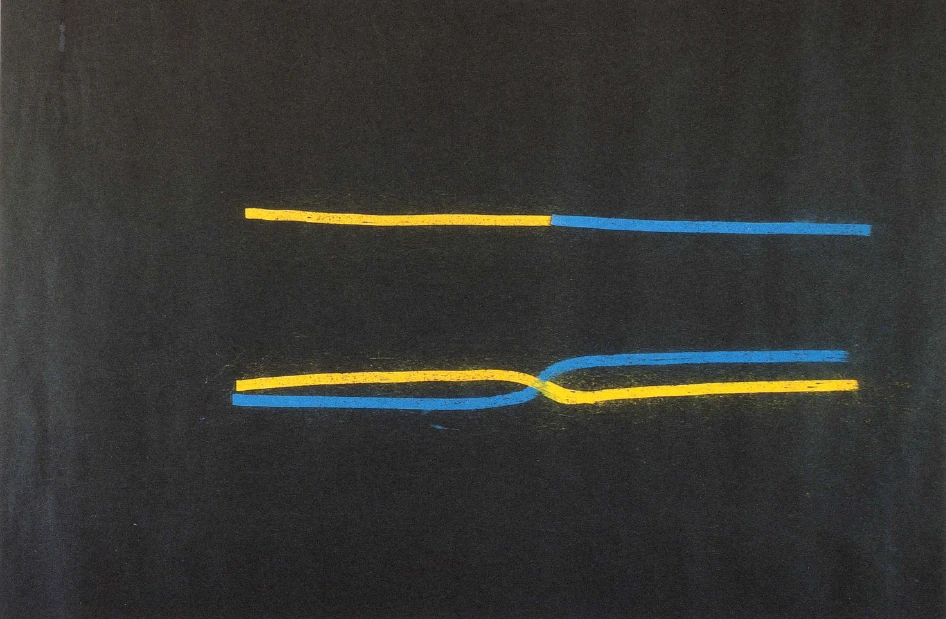
[ 29 ] So, if—to put it schematically—the natural cycle of the external world requires that winter and summer be depicted one after the other for a given region of the Earth—that is, as successively occurring in time—then, for human beings, I must depict these two currents side by side, albeit in a peculiar way; I must depict them side by side as follows:
[ 30 ] So, within a human being, it is always both winter and summer at the same time. It’s just that sometimes there is a spiritual summer and a physical winter, and other times a spiritual winter and a physical summer.
[ 31 ] What we thus have in the external course of nature—this compendium of natural forces and laws—in our surroundings, which cannot neutralize itself within a given region of the Earth because it acts sequentially, neutralizes itself within the human being and is thereby canceled out. The course of nature is such that, just as two opposing forces can bring about a state of rest, so too can countless natural laws neutralize and cancel each other out. This occurs in human beings with regard to all external natural laws through the fact that they sleep and wake in accordance with these laws, just as they do.
[ 32 ] Because in human beings, that which appears to be merely a natural necessity—when broken down over time—intertwines and neutralizes itself, this makes them free beings. Therefore, there can be no understanding of freedom unless a person understands how the opposing winters and summers of their spiritual life are added to their physical-etheric external nature—in which there can be summer and winter—in a way that neutralizes them.
[ 33 ] So you see, when we look at the external natural world, we are presented with images that we must not allow to enter our inner being—neither while awake nor while asleep. We must not look for them within ourselves at all, but rather we must tell ourselves: Within human nature, these images of the course of nature lose their validity, and we must look toward something else. — And when the course of nature no longer disturbs us within human nature, we gain the opportunity to look all the more closely at the spiritual, moral, and soul-life essence of the human being. In the same way that we develop a natural relationship with nature, we develop an ethical and moral relationship with human beings.
[ 34 ] When we look at ourselves through the insights gained in this way—there are many other things that can be characterized in a similar way—we see, condensed into a single whole, what has unfolded over the course of time. If we look into our inner selves and understand this inner world correctly in the sense described today, we relate it to the flow of time in a different way than is customary today.
[ 35 ] A purely external, scientific approach does not rise to the level of saying to itself: When you look into a human being, you must perceive, in harmony, that which, in the course of time, can only be perceived as individual tones. If you develop your spiritual ear, the summer and winter tones that one hears out in the world when one enters the flow of time itself resound together within a human being in a single moment. — Time truly becomes space. The universe, even in the flow of time, resounds toward us, stretching out into the vastness—that which resonates from within us as from a center, as if gathered in a single point.
[ 36 ] This is indeed the moment when scientific contemplation merges into artistic contemplation, when art and science no longer stand opposed to one another as they did in the naturalistic era, but rather face each other as Goethe, for example—albeit in a somewhat subtler way—perceived it when he said: Art reveals a kind of natural mystery without which one can never fully understand nature. — From a certain point onward, one must understand the artistic shaping of the world. And once one has taken this path from mere conceptual scientific understanding toward artistic perception, one then takes the third step as well—that toward religious deepening.
[ 37 ] Once one has found the physical, soul, and spiritual forces of the world working together within oneself, one sees them outside in the vastness of the universe. Human will rises to artistic creation and ultimately to a relationship with the world that is not merely passive cognition, but rather a positive devotion, which I would like to characterize by saying: Human beings no longer look into the world in an abstract way with the powers of their minds, but rather begin more and more to look into it with their entire being. And living in harmony with the course of the world becomes for him an experience of a different kind than living with the facts of everyday life. Living in harmony with the course of the world becomes a form of worship for him, and the cosmic cult emerges, in which human beings can stand at the very heart of it at every moment of their lives.
[ 38 ] Every earthly cult is a symbolic reflection of this cosmic cult. This cosmic cult is the higher reality in relation to every earthly cult. And if we truly take to heart what has been said today, we will have gained the ability to consider the relationship between the anthroposophical worldview and any religious cult. And that is what we will do in the coming days: take a brief look at the relationships between anthroposophy and the various forms of worship.