

The Relationship of Man to the Starry World
The Spiritual Communion of Mankind
GA 219
29 December 1922, Dornach
Translate the original German text into any language:
Versions Available:
The Relationship of Man to the Starry World, tr. SOL
Zehnter Vortrag
Tenth Lecture
[ 1 ] In den Vorträgen, die ich unmittelbar vor Weihnachten hier gehalten habe, war es gegeben, auf den Zusammenhang des Menschen mit dem ganzen Kosmos hinzuweisen, insbesondere auch auf das, was den Kosmos als geistig-seelische Mächte durchwebt und durchlebt. Ich möchte in einer gewissen Art wiederum heute an das Damalige anknüpfen in einer allerdings davon unabhängigen, selbständigen Betrachtung.
[ 1 ] In the lectures I gave here just before Christmas, I had the opportunity to point out the connection between human beings and the entire cosmos, and in particular to what interweaves and permeates the cosmos as spiritual and soul forces. Today, I would like to pick up where I left off then, albeit in a separate, independent reflection.
[ 2 ] Das menschliche Leben, so wie es durchgemacht wird als Miterleben der Natur und als inneres Leben der menschlichen Seele und des menschlichen Geistes, steht zwischen zwei Polen, und eine große Anzahl von Gedanken, die sich die Menschen über ihren Zusammenhang mit der Welt machen müssen, wird von dem Ausblick auf diese zwei polarischen Gegensätze beeinflußt.
[ 2 ] Human life, as it is experienced through our connection with nature and as the inner life of the human soul and spirit, stands between two poles, and a great many of the thoughts people must form about their relationship to the world are influenced by the perspective of these two polar opposites.
[ 3 ] Auf der einen Seite steht vor dem menschlichen Denken und Empfinden die sogenannte Naturnotwendigkeit. Der Mensch fühlt sich abhängig und muß sich abhängig fühlen von den notwendig, man möchte sagen ehern wirkenden Gesetzen, die er überall draußen in der Welt findet, und die dadurch, daß sein physischer und auch sein ätherischer Organismus in diese Außenwelt eingeschaltet sind, auch durch ihn hindurchgehen.
[ 3 ] On the one hand, so-called natural necessity precedes human thought and feeling. Human beings feel dependent—and must feel dependent—on the necessary, one might say ironclad, laws that they find everywhere in the external world, and which, because their physical and etheric organisms are integrated into this external world, also pass through them.
[ 4 ] Auf der andern Seite lebt dann in dem Menschen die Empfindung und in jeder gesunden Menschennatur muß sich diese Empfindung einstellen —, daß des Menschen Würde nicht voll erfüllt wäre, wenn ihm nicht in seinem Leben zwischen Geburt und Tod die Freiheit zukäme. Das sind die beiden polarischen Gegensätze: Notwendigkeit und Freiheit.
[ 4 ] On the other hand, there is a feeling that lives within every human being—and this feeling must arise in every healthy human nature—that human dignity would not be fully realized unless a person were granted freedom in the course of their life between birth and death. These are the two polar opposites: necessity and freedom.
[ 5 ] Sie wissen, wie sehr das naturwissenschaftliche Zeitalter, das ich in der andern Klasse von Vorträgen bespreche, die ich jetzt zu geben habe, wie sehr dieses naturwissenschaftliche Zeitalter die Notwendigkeit des Geschehens, die man draußen überall in der Natur findet, auch auf alles dasjenige ausdehnt, was vom Menschen selbst ausgeht, und wie es in vielen seiner Vertreter nach und nach dazu gekommen ist, Freiheit als etwas Unmögliches zu betrachten, als eine Illusion, die nur dadurch in der Menschenseele lebt, daß der Mensch, wenn er mit seinem Willen vor eine Entscheidung hingestellt wird, auf der einen Seite die Gründe für, auf der andern Seite die Gründe dagegen hat, die mit Notwendigkeit von beiden Seiten aus auf ihn wirken. Und eigentlich ist es nicht er nach dieser Anschauung, der die Entscheidung trifft, sondern zuletzt sind es doch diejenigen Gründe, welche die stärkste Kraft und die stärkste Summe repräsentieren. Sie siegen über die andern Gründe, die auch mit einer gewissen Notwendigkeit auf den Menschen wirken, die aber geringere Kraft und eine geringere Summe haben. Und der Mensch wird einfach mitgerissen, möchte man sagen, von der Resultierenden der mit Notwendigkeit auf ihn wirkenden Impulse. Daß er sich für frei hält — so sagen viele Vertreter dieser Anschauung —, rührt nur davon her, daß die einander entgegengesetzten polarischen Ja- und Nein-Gründe in ihrer Gesamtheit etwas so Kompliziertes darstellen, daß der Mensch nicht merkt, wie er hin- und hergerissen wird, und wie zuletzt sozusagen in feinem Waagebalkenausschlag die eine Kategorie der Gründe siegt und er eben von dieser mitgerissen wird.
[ 5 ] You know how much the age of natural science—which I discuss in the other series of lectures I am currently giving—how much this age of natural science extends the necessity of events, which is found everywhere in nature, to everything that originates from human beings themselves, and how many of its proponents have gradually come to regard freedom as something impossible, as an illusion that lives in the human soul only because, when a person is faced with a decision involving his will, he has, on the one hand, the reasons for it and, on the other, the reasons against it, which act upon him with necessity from both sides. And in fact, according to this view, it is not the individual who makes the decision, but ultimately it is those reasons that represent the greatest force and the greatest sum. They prevail over the other reasons, which also act upon the individual with a certain necessity but possess lesser force and a lesser sum. And one might say that the person is simply swept along by the resultant of the impulses acting upon him with a certain inevitability. The fact that he considers himself free—as many proponents of this view say— stems solely from the fact that the opposing polar “yes” and “no” reasons, taken as a whole, constitute something so complex that the individual does not realize how he is being torn back and forth, and how, in the end, as it were, in a subtle swing of the scales, one category of reasons prevails and he is carried away by it.
[ 6 ] Demgegenüber steht aber nicht nur die ethische Erwägung, daß des Menschen Würde in der Welt nicht erfüllt wäre, wenn er also ein Spielball der Ja- und Nein-Impulse wäre, sondern es steht dem gegenüber, daß im menschlichen Wollen das Freiheitsgefühl lebt, daß für den Unbefangenen es eigentlich ganz zweifellos ist, daß, wenn er durch irgendeine Theorie an diesem Freiheitsgefühl irre werden muß, er eigentlich ebensogut an den einfachen elementaren Sinnesempfindungen irre werden müßte. Wenn das ganz elementare in der menschlichen Gefühlssphäre vorhandene Freiheitserlebnis trügen könnte, so könnte auch trügen das Rot-Erlebnis, das Cis- oder C-Erlebnis und so weiter. Und es ist immerhin charakteristisch, daß die neuere naturwissenschaftliche Weltanschauung in vielen ihrer Vertreter das Theoretische so hochschätzt, daß sie sich durch das Theoretische von der absoluten, ausnahmslosen Naturnotwendigkeit, die auch die menschlichen Handlungen, den menschlichen Willen umfassen soll, dazu versuchen läßt, einfach über eine Erfahrung, wie sie das Freiheitserlebnis darstellt, hinwegzugehen.
[ 6 ] However, this is countered not only by the ethical consideration that human dignity in the world would not be fulfilled if humans were merely at the mercy of “yes” and “no” impulses, but also by the fact that the sense of freedom lives within human volition; for the unbiased observer, it is actually quite beyond doubt that if any theory were to lead him astray from this sense of freedom, he would just as well have to be misled by simple, elementary sensory perceptions. If the very elementary experience of freedom present in the human sphere of feeling could be deceptive, then so too could the experience of the color red, the experience of the note C-sharp or C, and so on. And it is, after all, characteristic that the modern scientific worldview, as held by many of its proponents, values the theoretical so highly that it allows itself to be led by the theoretical away from the absolute, unconditional natural necessity—which is supposed to encompass human actions and the human will as well—to the point of simply disregarding an experience such as the experience of freedom.
[ 7 ] Aber diese Frage, Notwendigkeit und Freiheit, mit allen ihren Begleiterscheinungen im seelischen Leben — und die sind außerordentlich reichlich —, ist eine solche, die mit viel Tieferem im Weltenlaufe zusammenhängt als mit dem, was naturwissenschaftlich oder auch in der unmittelbaren alltäglichen menschlichen Seelenerfahrung zu finden ist. Denn als die menschliche Anschauung noch ganz anders war, war schon diese bange Zweifelsfrage vor die menschliche Seele getreten.
[ 7 ] But this question—necessity and freedom, with all its accompanying aspects in the life of the soul—and these are extraordinarily numerous—is one that is connected to something far deeper in the course of the world than what can be found in the natural sciences or even in the immediate, everyday experience of the human soul. For even when the human worldview was quite different, this anxious question of doubt had already presented itself to the human soul.
[ 8 ] Sie haben gesehen aus der andern Klasse von Vorträgen, die ich hier zu halten habe, daß das eigentliche Naturdenken, das naturwissenschaftliche Denken der neueren Zeit, gar nicht so alt ist. Wenn wir in ältere Zeiten zurückgehen, so finden wir ein menschliches Denken, menschliche Anschauungen, die ebensosehr einseitig spirituell sind, wie die heutigen Anschauungen einseitig naturalistisch geworden sind. Wir finden, je mehr wir in ältere Epochen zurückgehen, wie immer weniger im menschlichen Anschauen gerade das vorhanden ist, was wir heute Naturnotwendigkeit nennen. Auch im älteren griechischen Anschauen war nichts von dem vorhanden, was wir heute Naturnotwendigkeit nennen, denn die griechische Notwendigkeit war in ihrem eigentlichen Gedankentimbre doch etwas ganz anderes.
[ 8 ] You have seen from the other series of lectures I am to give here that true scientific thinking—the scientific thinking of modern times—is not all that old. If we go back to earlier times, we find a way of human thinking and human worldviews that are just as one-sidedly spiritual as today’s worldviews have become one-sidedly naturalistic. We find that the further back we go in history, the less present in human perception is precisely what we today call natural necessity. Even in the ancient Greek worldview, there was nothing of what we today call natural necessity, for Greek necessity, in its true intellectual character, was something entirely different.
[ 9 ] Aber wenn wir noch weiter zurückgehen, so finden wit, daß an der Stelle der Naturnotwendigkeit ganz und gar Kräftewirkungen stehen, Wirkungen, die dem ganzen Umfange nach einer göttlich-geistigen Vorsehung zugeschrieben werden. Heute, wenn ich mich trivial ausdrücken darf, machen für den eigentlich naturwissenschaftlich Denkenden alles die Naturkräfte, einstmals machten für den Denker der alten Zeiten alles geistig gedachte Kräfte, die mit Absichten wirkten, wie der Mensch selber mit Absichten wirkt, nur daß deren Absichten weit umfassender waren, als es die menschlichen Absichten sein können. Aber auch innerhalb dieser Weltanschauung, die ganz spirituell war, wendete der Mensch seinen Blick hin auf die Bestimmung seines Willens durch göttlich-geistige Mächte, und wie er sich heute durch Naturkräfte und Naturgesetze determiniert fühlt, wenn er im naturwissenschaftlichen Sinne denkt, so fand er sich dereinst durch göttlich-geistige Kräfte oder göttlich-geistige Gesetze determiniert. Und für viele, die in diesem älteren spiritualistischen Sinne deterministisch gesinnt waren, galt die Freiheit des Menschen, trotzdem sie ein unmittelbares Erlebnis ist, ebensowenig wie für die heutigen Naturalisten. Heute denken die Naturalisten: durch das menschliche Handeln hindurch wirkt die Naturnotwendigkeit. Dazumal dachten die Spiritualisten: durch das menschliche Handeln hindurch wirken die göttlich-geistigen Kräfte nach ihren Absichten.
[ 9 ] But if we go back even further, we find that in place of natural necessity there are entirely the effects of forces—effects that, in their entirety, are attributed to a divine-spiritual providence. Today—if I may put it in trivial terms—for those who think in a truly scientific way, everything is accounted for by natural forces; in ancient times, for the thinkers of old, everything was accounted for by spiritually conceived forces that acted with intentions, just as human beings themselves act with intentions, except that those intentions were far more comprehensive than human intentions can ever be. But even within this worldview, which was entirely spiritual, people turned their gaze toward the determination of their will by divine-spiritual powers; and just as they feel determined today by natural forces and natural laws when they think in a scientific sense, so they once found themselves determined by divine-spiritual forces or divine-spiritual laws. And for many who held a deterministic view in this older spiritualist sense, human freedom—even though it is a direct experience—was just as inconceivable as it is for today’s naturalists. Today, naturalists think: natural necessity operates through human action. Back then, spiritualists thought: divine-spiritual forces operate through human action according to their own intentions.
[ 10 ] Man braucht sich einfach nur vorzuhalten, wie auf diesen völlig entgegengesetzten Anschauungswelten die Frage nach Freiheit und Notwendigkeit daliegt, und man wird sich sagen: An der Oberfläche der Dinge und der Geschehnisse kann ganz gewiß nichts ausgemacht werden über diese tief in alles Leben und allen Weltenlauf hineindringende Frage. — Man muß schon in dasjenige, was Weltenlauf ist Weltenlauf auf der einen Seite als Naturlauf, Weltenlauf auf der andern Seite als Geistesentfaltung —, tiefer hineinblicken, wie es nur mit anthroposophischer Anschauungsweise möglich ist, um überhaupt auf den ganzen Sinn dieser den Menschen aufrüttelnden Frage zu kommen.
[ 10 ] One need only consider how the question of freedom and necessity arises within these completely opposing worldviews, and one will say to oneself: On the surface of things and events, nothing can certainly be discerned about this question, which penetrates deeply into all life and the course of the universe. — One must look deeper into what the course of the universe is—on the one hand, the course of nature; on the other, the unfolding of the spirit—in a way that is only possible through the anthroposophical perspective, in order to even begin to grasp the full meaning of this question that stirs the human soul.
[ 11 ] Nun betrachtet man gewöhnlich den Naturlauf in einer außerordentlich eingeschränkten Weise. Heute wird der Naturlauf so betrachtet, daß man versucht, herausgerissene Geschehnisse, herausgerissene Vorgänge speziellster Art in das Beobachtungszimmer, ja wohl gar in das Blickfeld des Teleskops zu bringen oder dem Experimente zu unterwerfen, und man steht damit innerhalb eines ganz engen Gebietes, auf das man die Beobachtung des Naturlaufes, des Weltenlaufes überhaupt beschränkt. Man möchte sagen, diejenigen, die das Geistige und Seelische betrachten, machen es den Naturbeobachtern nach. Man scheut sich davor, die Totalität des Menschen in bezug auf sein seelisches Leben ins Auge zu fassen. Man «spezialisiert» sich, um irgendeinen einzelnen Gedanken oder Gefühlsfetzen mit kleinen Beziehungen herzustellen, und man hofft, daß man aus solchen kleinen Beziehungen ebenso einmal eine Psychologie zusammenstellen werde, wie man versucht, eine Art Weltanschauung des Physischen aus den Einzelbeobachtungen und Einzelexperimenten zu gewinnen, die man im physikalisch-chemischen Kabinett, in der Klinik und dergleichen vollführt.
[ 11 ] Now, the course of nature is usually viewed in an extremely limited way. Today, the course of nature is viewed in such a way that one attempts to bring isolated events—isolated processes of the most specific kind—into the observation room, indeed even into the field of view of a telescope, or to subject them to experimentation; and in doing so, one remains within a very narrow field to which one limits the observation of the course of nature, indeed of the course of the world as a whole. One might say that those who study the spiritual and psychological realms are imitating the observers of nature. They shy away from taking in the totality of the human being with regard to his or her psychological life. One “specializes” in establishing small connections between some individual thought or fragment of feeling, and one hopes that from such small connections one will eventually piece together a psychology, just as one attempts to derive a kind of worldview of the physical realm from the individual observations and experiments carried out in the physics and chemistry laboratory, in the clinic, and the like.
[ 12 ] Aber alle diese Betrachtungen führen eigentlich in Wirklichkeit niemals zu einer Gesamtauffassung, weder auf physischem noch auf geistig-seelischem Gebiet. Und so wenig als hier gegen die Berechtigung dieser Spezialuntersuchungen irgend etwas gesagt werden soll sie sind von den Gesichtspunkten aus berechtigt, die ich in meinen Vorträgen oftmals angeführt habe —, so stark muß aber doch betont werden: wenn die Natur, wenn die Welt nicht selbst irgendwo dem Menschen vorführt, was aus dem Zusammenwirken der Einzelheiten hervorgeht, dann wird der Mensch niemals sich ein vom Weltengeschehen durchleuchtetes Weltengebäude aus seinen Einzelbeobachtungen und Einzelexperimenten zusammenstellen können.
[ 12 ] But in reality, all these considerations never actually lead to a comprehensive understanding, neither in the physical realm nor in the spiritual-psychic realm. And just as I do not intend to say anything here against the validity of these specialized investigations—they are justified from the perspectives I have often cited in my lectures—it must nevertheless be strongly emphasized: if nature, if the world itself does not somewhere reveal to human beings what emerges from the interplay of the details, then human beings will never be able to construct, from their individual observations and experiments, a structure of the world illuminated by the events of the world.
[ 13 ] Geradeso wie man Leberzellen und kleine Lebervorgänge, wie man Gehirnzellen und kleine Gehirnvorgänge untersuchen kann, wie man sich nach diesen Richtungen immer mehr spezialisieren kann, und wie man aus diesen Untersuchungen, weil sie geradezu in die Vereinzelung und nicht in das Ganze hineinführen, niemals eine Anschauung über die Gesamtheit des menschlichen Organismus gewinnen kann, wenn man nicht von vornherein in einer geistig umfassenden, empfindenden Idee diese Gesamtheit, diese Totalität des menschlichen Organismus vor sich hat, um dann mit ihrer Hilfe eben wiederum die einzelnen Untersuchungen zu einem Ganzen zu machen, ebensowenig werden jemals Chemie oder Astrochemie, Physik oder Astrophysik oder Biologie, insofern sie sich auf Einzeluntersuchungen beschränken, ein Bild davon geben können, wie die verschiedenen, in unserer Weltenumgebung lebenden Naturkräfte und Naturgesetze zu einem Ganzen zusammenwirken, wenn nicht die Fähigkeit in dem Menschen entsteht, etwas Ähnliches draußen in der Natur zu schauen, wie man es gegenüber den Einzelheiten, den Lebervorgängen, den Nierenvorgängen, den Herzvorgängen, den Gehirnvorgängen, in der Totalität des menschlichen Organismus schauen kann. Es hängt einfach davon ab, daß man irgendwo im Weltenwesen etwas aufzeigen kann, wo alle die Kräfte, die uns in unserer Umgebung erscheinen, zu einer geschlossenen Totalität zusammenwirken.
[ 13 ] Just as one can study liver cells and small liver processes, just as one can study brain cells and small brain processes, just as one can specialize more and more in these directions, and just as one can never, from these studies—because they lead directly into isolation rather than into the whole—gain an understanding of the entirety of the human organism, unless one has this entirety, this totality of the human organism before one from the outset in a mentally comprehensive, perceptive idea, so that one can then, with its help, bring the individual investigations together into a whole—in the same way, chemistry or astrochemistry, physics or astrophysics, or biology, insofar as they are limited to individual investigations, ever be able to provide a picture of how the various natural forces and laws operating in our cosmic environment interact to form a whole, unless the human being develops the ability to perceive something similar out in nature to what one can perceive in the totality of the human organism when considering the details—the processes of the liver, the kidneys, the heart, and the brain. It simply depends on being able to point to something somewhere in the universe where all the forces that appear to us in our surroundings interact to form a coherent whole.
[ 14 ] Nicht wahr, wir können sagen: Vielleicht werden gewisse Vorgänge in der menschlichen Leber, im menschlichen Gehirn erst in sehr später Zeit so entdeckt werden, daß man daran eine biologische Befriedigung hat. — Aber jedenfalls kann man und konnte man immer, solange Menschen Menschen angeschaut haben, sagen: Dasjenige, was in der Leber, was im Magen, was im Herzen in gegenseitiger Wechselwirkung steht, wirkt innerhalb der menschlichen Hautgrenze zu dem menschlichen Ganzen zusammen. Man hat einmal, ohne daß man nötig hat, auf die Einzelheiten hinzuschauen, in reiner Totalität das Zusammenwirken alles desjenigen vor sich, was für die menschliche Natur in Betracht kommt an chemischen, an physischen, an biologischen Wirkungen, man hat das in einem geschlossenen Ganzen vor sich.
[ 14 ] Isn't it true that we can say: Perhaps certain processes in the human liver and in the human brain will only be discovered much later in such a way that they provide biological satisfaction. — But in any case, as long as people have observed other people, one can—and always has been able to—say: The interactions taking place in the liver, the stomach, and the heart work together within the boundaries of the human body to form the human whole. Once, without needing to look at the details, one has before one—in pure totality—the interplay of everything that is relevant to human nature in terms of chemical, physical, and biological effects; one has this before one as a closed whole.
[ 15 ] Kann man so auch in einem geschlossenen Ganzen die Summe der Naturkräfte und Naturgesetze vor sich haben, die um den Menschen herum wirken? Man kann es in einer gewissen Weise. Ich betone ausdrücklich noch, damit ich nicht mißverstanden werde, daß natürlich solche Totalitäten immer relativ sind, daß wir auch, sagen wir, im Menschen die Vorgänge unseres äußeren Ohres zusammenfassen können und dann ein relatives Ganzes haben. Wir können aber auch die Vorgänge der Fortsetzung des Gehörorgans nach dem Gehirn hin zusammenfassen und haben da auch ein relatives Ganzes. Fassen wir beide zusammen, so haben wir ein größeres relatives Ganzes, das wiederum dem Kopf und dieser wiederum dem ganzen Organismus angehört. So wird es auch sein, wenn wir versuchen, die Gesamtheit im Menschlichen, als für den Menschen zunächst in Betracht kommende Kräfte und Gesetze, in einer Totalanschauung zu umfassen.
[ 15 ] Is it possible, then, to have before us—even within a closed whole—the sum of the forces of nature and the laws of nature that act around human beings? In a certain sense, it is possible. To avoid any misunderstanding, I would like to emphasize explicitly that such totalities are, of course, always relative; that we can, for example, summarize the processes of our outer ear within the human being and thereby arrive at a relative whole. But we can also summarize the processes by which the auditory organ extends into the brain, and there, too, we have a relative whole. If we combine the two, we have a larger relative whole, which in turn belongs to the head, and the head, in turn, belongs to the entire organism. The same will be true when we attempt to encompass the totality of the human being—as the forces and laws that are of primary concern to the human being—in a holistic view.
[ 16 ] Nun, ich möchte sagen, eine solche erste Totalanschauung ist der Tageslauf. So paradox das für das erste Hören klingt: es ist der Tageslauf in einer gewissen Beziehung eine Zusammenfassung einer gewissen Summe von Naturgesetzen um uns herum in diesem Ganzen. Während des Tageslaufes gehen einfach in unserer Umgebung und durch uns hindurch Prozesse vor sich, welche, wenn man sie auseinanderlegt, in die verschiedensten physikalischen und chemischen Prozesse und so weiter zerfallen. Man kann sagen, eine Art Zeitorganismus ist der Tageslauf, ein Zeitorganismus, der in sich eine Summe von Naturprozessen faßt, die wir sonst im einzelnen studieren können.
[ 16 ] Well, I would say that the course of the day is one such initial, comprehensive view. As paradoxical as that may sound at first hearing: in a certain sense, the course of the day is a synthesis of a certain set of natural laws around us, taken as a whole. Throughout the course of the day, processes simply take place in our surroundings and within us that, when broken down, can be divided into a wide variety of physical and chemical processes and so on. One could say that the course of the day is a kind of temporal organism—a temporal organism that encompasses within itself a sum of natural processes that we can otherwise study in detail.
[ 17 ] Und eine größere Totalität ist der Jahreslauf. Wenn Sie nämlich zum Jahreslauf übergehen und alles ins Auge fassen, was während des Jahreslaufes mit der Erde und der Menschheit zusammenhängend im äußeren Sphärenbereich an Veränderungen geschieht — nehmen wir nur an im Luftkreise —, wenn Sie alles das zusammenfassen, was vom Frühling bis wieder zum Frühling an Vorgängen in den Pflanzen und auch in den Mineralien geschieht, dann haben Sie eine zeitlich organische Zusammenfassung von dem, was Ihnen sonst zerstreut bei den verschiedenen Naturuntersuchungen erscheint, so wie wir im menschlichen Organismus eine Zusammenfassung haben der Leber-, Nieren-, Milzvorgänge und so weiter. Es ist in der Tat der Jahreslauf eine organische Summierung — es ist nicht genau gesprochen, aber man muß eben Worte gebrauchen — von dem, was wir sonst im einzelnen naturwissenschaftlich untersuchen.
[ 17 ] And a larger totality is the course of the year. For when you turn your attention to the course of the year and take in everything that happens during that time in the outer spheres in connection with the Earth and humanity—let us assume, for example, in the atmosphere— if you summarize all the processes that take place in plants and also in minerals from spring to spring, then you have a temporal, organic synthesis of what otherwise appears to you as scattered findings in various scientific investigations of nature, just as we have a synthesis in the human organism of the processes of the liver, kidneys, spleen, and so on. The course of the year is, in fact, an organic summation—it is not strictly speaking accurate, but one must use words—of what we otherwise examine in detail through the natural sciences.
[ 18 ] Man möchte sagen, etwas leichthin, aber es ist etwas sehr Tiefes damit gemeint, wie Sie fühlen werden: Damit der Mensch nicht jenes abstrakte Verhältnis zur Naturumgebung hat, das er zu den Beschreibungen der physikalischen und chemischen Experimente hat, oder zu dem, was ihm heute vielfach in der Pflanzenlehre oder Tierlehre gesagt wird, müssen ihm im Kosmos der Tageslauforganismus, der Jahreslauforganismus vorgestellt werden. Da findet er gewissermaßen seinesgleichen. — Und daß er seinesgleichen findet, das wollen wir ein wenig betrachten.
[ 18 ] One might say this somewhat lightly, but there is a very profound meaning behind it, as you will sense: So that human beings do not have the same abstract relationship to the natural environment that they have to descriptions of physical and chemical experiments, or to what is often told to them today in botany or zoology, they must be introduced to the daily cycle organism and the annual cycle organism within the cosmos. There, they find, so to speak, their equals. — And let us consider for a moment the fact that they find their equal.
[ 19 ] Gehen wit zunächst auf den Jahreslauf ein. Wir haben, wenn wir ihn in einer ähnlichen Weise überblicken, wie das schon das letzte Mal vor Weihnachten geschehen ist, eine Summe von Prozessen in den sprießenden, sprossenden Pflanzen, die zu den grünen Laubblättern, später zu den Blüten hineilen. Wir haben eine unermeßliche Summe von Naturprozessen, die sich vom Leben in der Wurzel zum Leben in den grünen Laubblättern abspielen, zum Leben in den farbigen Blumenblättern. Und wir haben wiederum eine ganz andere Art von Prozessen, wenn wir im Herbste das Welken, das Abdorren und Hinsterben der äußeren Natur sehen. Wir haben wirklich zusammengefaßt in eine organische Einheit das um uns herumliegende Weltengeschehen. Wir sehen, wenn wir den Sommer durchmachen, was auf der Erde herauswächst, einschließlich der tierischen Welt, insbesondere der niederen Tierwelt. Betrachten Sie das Wirken und Wimmeln der Insektenwelt, wie das gewissermaßen sich von der Erde abhebt, wie es hingegeben ist dem Kosmos, namentlich alldem, was in der Sonnenwirkung aus dem Kosmos sich zusammensetzt. Wir sehen da, wie die Erde gewissermaßen alle ihre Organe den Weltenweiten öffnet und wie dadurch auch die aufsteigenden Prozesse aus der Erde hervorkommen und nach den Weltenweiten hin tendieren. Wir sehen, wie vom Herbste an und durch den Winter hindurch dasjenige, was vom Frühling an aufsprießt und nach den Weltenweiten strebt, wiederum ins Irdische zurückfällt, wie die Erde, ich möchte sagen, immer mehr Gewalt bekommt über alles, was sprießendes, sprossendes Leben ist, wie sie dieses sprießende, sprossende Leben gewissermaßen in eine Art Scheintod bringt, wenigstens in einen Schlaf hüllt, wie also die Erde all ihre Organe schließt gegenüber den Einflüssen der kosmischen Weiten. Wir sehen hier zwei Gegensätze im Jahreslauf, die unermeßlich viele Einzelheiten in sich haben, die aber in sich ein geschlossenes Ganzes darstellen.
[ 19 ] Let us first consider the course of the year. If we survey it in a similar way to how we did last time before Christmas, we see a multitude of processes taking place in the sprouting, budding plants, processes that rush toward the green leaves and later toward the flowers. We have an immeasurable multitude of natural processes unfolding from the life in the roots to the life in the green leaves, and on to the life in the colorful petals. And we have, in turn, an entirely different kind of process when, in the fall, we observe the withering, drying up, and dying of the outer natural world. We have truly synthesized the events of the world around us into an organic unity. As we go through the summer, we see what grows forth on the earth, including the animal world, especially the lower animal kingdom. Consider the activity and teeming life of the insect world, how it, as it were, rises up from the earth, how it is surrendered to the cosmos—namely, to all that is composed from the cosmos under the influence of the sun. We see there how the Earth, as it were, opens all its organs to the vastness of the cosmos, and how, through this, the ascending processes also emerge from the Earth and tend toward the vastness of the cosmos. We see how, from autumn onward and throughout the winter, that which sprouts in the spring and strives toward the vastness of the cosmos falls back into the earthly realm; how the Earth— I might say, gains ever more power over all that is sprouting, budding life, how it brings this sprouting, budding life, as it were, into a kind of apparent death, or at least envelops it in sleep, and how the Earth thus closes all its organs to the influences of the cosmic expanses. Here we see two opposites in the course of the year, which contain an immeasurable number of details, yet together form a coherent whole.
[ 20 ] Und wenn wir den seelischen Blick über einen solchen Jahreslauf hinschweifen lassen, der schon dadurch ein geschlossenes Ganzes darstellt, daß er einfach von einem bestimmten Punkte an sich wiederholt, wiederum in einer annähernd gleichen Weise abläuft, dann finden wir, daß in ihm nichts anderes ist als Naturnotwendigkeit. Und wir Menschen machen im Erdenlauf diese Naturnotwendigkeit mit. Machten wir sie ganz mit, dann wären wir dieser Naturnotwendigkeit auch unbedingt unterworfen. Nun sind gewiß in dem Jahreslauf zunächst diejenigen Naturkräfte und Naturmächte vorhanden, die für uns Menschen als Erdenbürger in Betracht kommen, denn die Erde ändert sich nicht so schnell. Wir werden auch zu andern Kreisläufen in den nächsten Tagen noch kommen, aber die Erde ändert sich nicht so schnell, daß sich etwa während eines Menschenlebens, wenn der Mensch auch noch so alt wird, die kleinen Veränderungen, die von Jahr zu Jahr auftreten, bemerkbar machen. Wir machen also jedes Jahr, indem wir im Frühling, Sommer, Herbst und Winter drinnenstehen, mit unserem eigenen Leibe die Naturnotwendigkeit mit.
[ 20 ] And when we let our spiritual gaze wander over the course of such a year—which constitutes a self-contained whole simply because it repeats itself from a certain point onward, unfolding once again in an approximately identical manner—we find that there is nothing in it but natural necessity. And we humans participate in this natural necessity as part of our earthly existence. If we were to participate in it fully, we would be absolutely subject to this natural necessity. Now, the annual cycle certainly contains, first and foremost, those natural forces and powers that are relevant to us humans as inhabitants of the Earth, for the Earth does not change so quickly. We will also come to other cycles in the next few days, but the Earth does not change so quickly that the small changes that occur from year to year become noticeable within a human lifetime—no matter how old a person may become. Thus, every year, as we experience spring, summer, fall, and winter, we participate in this natural necessity with our own bodies.
[ 21 ] So muß man betrachten, denn nur die wirkliche Erfahrung gibt Erkenntnis. Keine Theorie gibt Erkenntnis. Jede Theorie geht von irgendeinem speziellen Gebiete aus und verallgemeinert dieses Gebiet. Wirkliche Erkenntnisse bekommt man nur, wenn man vom Leben und von Erfahrungen ausgeht. Man muß daher nicht vereinzelt die Gesetze der Gravitation, die Gesetze des vegetabilischen Lebens, die Gesetze der tierischen Instinkte, die Gesetze des menschlichen Gedankenzwanges ins Auge fassen, denn die faßt man dann immer in ihren Einzelheiten ins Auge, verallgemeinert sie und kommt dann zu ganz falschen Verallgemeinerungen. Man muß das ins Auge fassen, wo sich die Naturkräfte in ihrem wechselweisen Zusammenwirken zeigen. Das ist der Jahreslauf.
[ 21 ] This is how one must view things, for only real experience provides knowledge. No theory provides knowledge. Every theory starts from some specific field and generalizes that field. True knowledge can only be gained by starting from life and experience. One must therefore not consider the laws of gravity, the laws of plant life, the laws of animal instincts, or the laws of human thought compulsion in isolation, for if one does so, one always examines them in their individual details, generalizes them, and then arrives at entirely false generalizations. One must focus on where the forces of nature manifest themselves in their mutual interaction. That is the cycle of the year.
[ 22 ] Nun zeigt schon eine oberflächliche Betrachtungsweise, daß der Mensch eine relative Freiheit gegenüber dem Jahreslauf hat. Aber eine anthroposophische Betrachtungsweise zeigt das noch stärker. Bei dieser anthroposophischen Betrachtungsweise wenden wir den Blick hin auf die zwei Wechselzustände, in denen jeder Mensch innerhalb vierundzwanzig Stunden lebt: auf den Schlafzustand und auf den Wachzustand. Und wir wissen: während des Wachzustandes sind physischer Leib, ätherischer Leib, astralischer Leib und Ich-Organismus eine relative Einheit im Menschen. Im Schlafzustand bleiben im Bette zurück physischer Leib und ätherischer Leib im innigen Durcheinanderweben, und außerhalb des physischen und ätherischen Leibes sind das Ich und der astralische Leib. Wenn wir nun mit all den Mitteln, die uns anthroposophische Forschung gibt und die Sie aus unserer Literatur kennen, darauf hinschauen, was dieser physische Leib und der ätherische Organismus des Menschen im Schlafe und was sie im Wachen sind, dann ergibt sich das Folgende.
[ 22 ] Even a superficial examination shows that human beings have a relative freedom with respect to the course of the year. But an anthroposophical perspective reveals this even more clearly. In this anthroposophical perspective, we turn our attention to the two alternating states in which every human being lives within a twenty-four-hour period: the state of sleep and the state of wakefulness. And we know that during the state of wakefulness, the physical body, the etheric body, the astral body, and the I-organism form a relative unity within the human being. In the state of sleep, the physical body and the etheric body remain in bed, intimately interwoven, while the “I” and the astral body are outside the physical and etheric bodies. If we now examine—using all the tools provided by anthroposophical research, which you are familiar with from our literature—what the human physical body and etheric organism are during sleep and what they are during wakefulness, the following emerges.
[ 23 ] Wenn das Ich und der astralische Leib außer dem physischen und ätherischen Organismus sind, dann beginnt im physischen und ätherischen Organismus ein Leben, das wir äußerlich mit der Natur nur im mineralischen und im pflanzlichen Gebiete verwirklicht sehen. Mineralisches und pflanzliches Leben für sich beginnt da. Daß der physische Organismus und der ätherische Organismus des Menschen nicht allmählich überhaupt nur in eine Summe von Prozessen übergehen, die mineralisch und pflanzlich sind, rührt nur davon her, daß sie so organisiert sind, wie das dem zeitweilig in ihm befindlichen astralischen Leib mit dem Ich entspricht. Sie würden in das mineralische und pflanzliche Leben übergehen, wenn der Mensch mit seinem Ich und seinem astralischen Leib zu spät in den physischen und Ätherleib zurückkäme. Es beginnt aber sogleich, nachdem der Mensch eingeschlafen ist, die Tendenz in ihm, mineralisch-vegetabilisch zu werden. Diese Tendenz bekommt die Oberhand während des Schlaflebens.
[ 23 ] When the “I” and the astral body are outside the physical and etheric organisms, a form of life begins within the physical and etheric organisms that we see manifested externally in nature only in the mineral and plant kingdoms. Mineral and plant life, in and of itself, begins there. The fact that the human physical and etheric organisms do not gradually transform entirely into a mere sum of processes that are mineral and plant-like stems solely from the fact that they are organized in a way that corresponds to the astral body—which is temporarily present within them—and to the “I.” They would transition into mineral and plant life if the human being, with his “I” and his astral body, were to return too late to the physical and etheric bodies. However, the tendency within him to become mineral-vegetative begins immediately after he falls asleep. This tendency gains the upper hand during the sleep state.
[ 24 ] Wenn man mit den Mitteln der anthroposophischen Forschung hinschaut auf den schlafenden physischen Menschen, dann sieht man in diesem schlafenden Menschen — selbstverständlich mit der nötigen Variante — ein getreuliches Abbild desjenigen, was die Erde von der Frühlings- durch die Sommerszeit hindurch ist. Es sprießt und sproßt das Mineralisch-Pflanzliche heraus, allerdings in anderer Form, als das bei den grünen Pflanzen der Fall ist, die aus der Erde wachsen. Aber mit einer Variante, sage ich, ist dasjenige, was während des Schlafes im menschlichen physischen und ätherischen Organismus vor sich geht, ein getreuliches Abbild der Frühlings- und Sommerszeit der Erde. Für diese äußere Natur ist der Mensch der gegenwärtigen Weltenepoche organisiert. Er kann seinen physischen Blick über diese äußere Natur hinschweifen lassen. Er schaut das sprießende, sprossende Leben. In dem Augenblicke, wo sich der Mensch Inspiration und Imagination erwirbt, wird ihm einfach durch die Schlafenszeit des physischen Menschen der Anblick einer Sommerszeit enthüllt. Schlafen heißt: der Frühling und Sommer stellen sich ein für den physischen und Ätherleib. Sprießendes und sprossendes Leben beginnt.
[ 24 ] When one looks at the sleeping physical human being through the lens of anthroposophical research, one sees in this sleeping human being—with the necessary variations, of course—a faithful reflection of what the Earth is like from spring through summer. The mineral-plant element sprouts and shoots forth, albeit in a different form than is the case with the green plants that grow out of the earth. But with some variation, I say, what takes place during sleep in the human physical and etheric organism is a faithful reflection of the Earth’s spring and summer seasons. Human beings in the present world epoch are organized for this outer nature. They can let their physical gaze wander over this outer nature. They behold the sprouting, budding life. The moment a human being acquires inspiration and imagination, the sight of a summertime is revealed to them simply through the physical human being’s sleep. To sleep means that spring and summer set in for the physical and etheric bodies. Sprouting and budding life begins.
[ 25 ] Und wenn wir aufwachen, wenn das Ich und der astralische Leib wiederum zurückkehren, dann tritt all das sprießende und sprossende Leben des physischen und ätherischen Leibes zurück. Es beginnt für den geistsehenden Blick das Leben im physischen und ätherischen Organismus des Menschen dem Herbst- und Winterleben der Erde sehr ähnlich zu werden. Und man hat tatsächlich, wenn man den Menschen in einer Wachens- und Schlafensperiode hintereinander verfolgt, in kurzem ein mikrokosmisches Abbild von Herbst, Winter, Frühling, Sommer. Sie brauchen nur einen Menschen geisteswissenschaftlich vierundzwanzig Stunden hindurch als physischen und ätherischen Organismus zu verfolgen, und Sie machen einen Jahreslauf im Mikrokosmischen durch. So daß man sagen kann, wenn man bloß auf dasjenige vom Menschen schaut, was im Bette liegen bleibt oder bei Tag herumläuft: der Jahreslauf vollzieht sich mikrokosmisch.
[ 25 ] And when we wake up, when the “I” and the astral body return once more, all the burgeoning and sprouting life of the physical and etheric bodies recedes. To the spiritually perceptive eye, life within the human physical and etheric organism begins to resemble the Earth’s autumn and winter very closely. And indeed, if one observes a person through successive periods of waking and sleeping, one soon sees a microcosmic reflection of autumn, winter, spring, and summer. You need only observe a human being from a spiritual-scientific perspective for twenty-four hours as a physical and etheric organism, and you will experience the course of a year in the microcosm. So one can say that if one looks merely at that part of the human being that remains in bed or walks about during the day, the course of the year unfolds microcosmically.
[ 26 ] Aber betrachten wir jetzt auf der andern Seite dasjenige, was sich im Schlafe trennt: das Ich und den astralischen Leib des Menschen. Da werden wir finden, wenn wir wiederum mit geisteswissenschaftlichen Forschungsmitteln, mit der Inspiration und Intuition vorgehen, daß, während der Mensch schläft, das Ich und der astralische Leib an geistige Mächte hingegeben sind, innerhalb welcher sie bewußt erst in einer späteren Erdenepoche im normalen Zustande werden leben können. Und wir werden sagen müssen: Während des Schlafens, vom Einschlafen bis zum Aufwachen, sind das Ich und der astralische Leib der Welt so entzogen, wie die Erde während der Winterszeit den kosmischen Weiten entzogen ist. — Ich und astralischer Leib sind wirklich während des Schlafes in ihrer Winterszeit. So daß der Mensch während des Schlafes ineinandergemischt hat, was die Erde zunächst nur für ihre entgegengesetzten Kugeloberflächen hat: daß er nämlich in der Tat während des Schlafes in bezug auf sein physisches und ätherisches Wesen Sommerszeit und für sein Ich und astralisches Wesen Winterszeit hat.
[ 26 ] But let us now consider, on the other hand, what separates during sleep: the “I” and the astral body of the human being. There we will find—if we proceed once again with the methods of spiritual scientific research, with inspiration and intuition—that while the human being sleeps, the “I” and the astral body are entrusted to spiritual powers, within which they will only be able to live consciously in a normal state during a later epoch of Earth’s history. And we will have to say: During sleep, from falling asleep to waking up, the “I” and the astral body are withdrawn from the world just as the Earth is withdrawn from the cosmic expanses during winter. — The ego and the astral body are truly in their “winter season” during sleep. Thus, during sleep, a human being experiences a reversal of what the Earth initially experiences only on its opposing hemispheres: namely, that during sleep, with regard to his physical and etheric being, he experiences “summer,” while for his ego and astral being, he experiences “winter.”
[ 27 ] Und umgekehrt ist es während des Wachens. Da haben der physische und ätherische Organismus Winterszeit. Das Ich und der astralische Organismus sind hingegeben demjenigen, was ihnen zunächst aus den kosmischen Weiten im wachen menschlichen Zustande entgegentreten kann. Tauchen also Ich und astralischer Leib in den physischen und ätherischen Leib unter, dann sind das Ich und der astralische Leib in der Sommerszeit. Wiederum sind nebeneinander Winterszeit im physisch-ätherischen Organismus, Sommerszeit im Ich und astralischen Organismus.
[ 27 ] And the opposite is true during wakefulness. Then the physical and etheric organisms are in a state of “winter.” The “I” and the astral organism are open to whatever may first come to meet them from the cosmic expanses in the waking human state. So when the ego and the astral body submerge into the physical and etheric bodies, the ego and the astral body are in the “summer season.” Once again, winter reigns in the physical-etheric organism, while summer reigns in the ego and the astral organism.
[ 28 ] Wenn Sie die Erde nehmen: sie muß auch auf ihren verschiedenen Gebieten Sommer und Winter zugleich haben, die können Sie aber nicht ineinanderschieben. Im Menschen schieben sich fortwährend mikrokosmisch Sommer und Winter ineinander. Schläft der Mensch, so ist sein physischer Sommer mit dem geistigen Winter vermischt; wacht der Mensch, so ist sein physischer Winter mit dem geistigen Sommer vermischt. Der Mensch hat in der äußeren Natur im Jahreslauf getrennt Winter und Sommer; in sich vermischt er von zwei verschiedenen Seiten her fortwährend Winter und Sommer.
[ 28 ] Take the Earth, for example: even in its various regions, it must have both summer and winter at the same time, but you cannot interweave them. In human beings, summer and winter constantly intermingle on a microcosmic level. When a person sleeps, their physical summer is intermingled with their spiritual winter; when a person is awake, their physical winter is intermingled with their spiritual summer. In the external natural world, a person experiences winter and summer as separate seasons throughout the year; within themselves, however, they constantly intermingle winter and summer from two different perspectives.
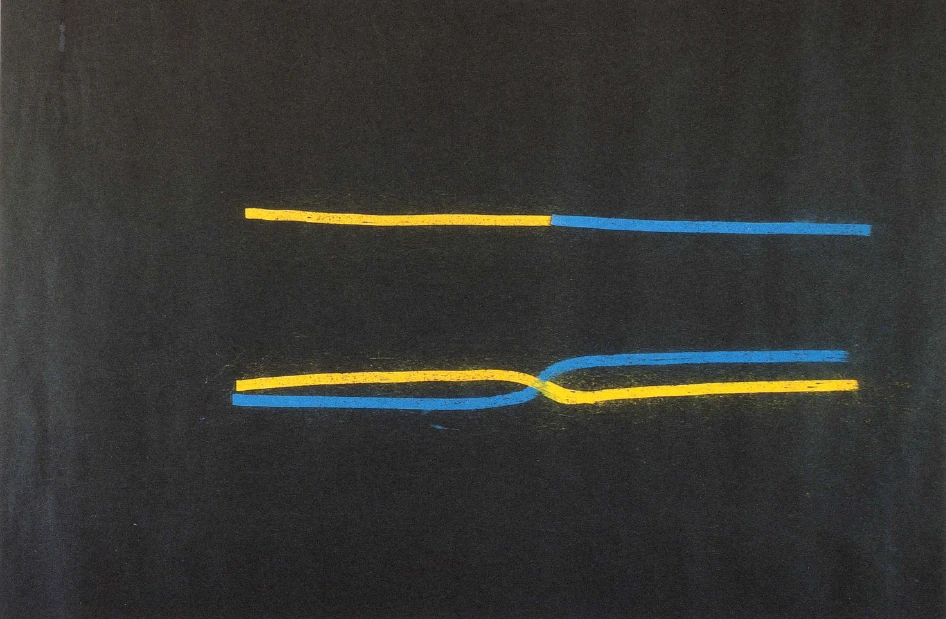
[ 29 ] Ist es also im äußeren Naturlaufe so, daß, wenn ich schematisch zeichnen soll, Winterszeit und Sommerszeit nacheinander gezeichnet werden müssen für ein Erdgebiet, also zeitlich sich folgend, so muß ich für das menschliche Wesen diese beiden Strömungen nebeneinander zeichnen, allerdings in einer eigentümlichen Weise, ich muß sie so nebeneinander zeichnen:
[ 29 ] So, if—to put it schematically—the natural cycle of the external world requires that winter and summer be depicted one after the other for a given region of the Earth—that is, as successively occurring in time—then, for human beings, I must depict these two currents side by side, albeit in a peculiar way; I must depict them side by side as follows:
[ 30 ] Also beim menschlichen Wesen ist immer zugleich im Innern Winter und Sommer. Nur wechselt das eine Mal Geist-Sommer mit Körper-Winter, das andere Mal Geist-Winter mit Körper-Sommer.
[ 30 ] So, within a human being, it is always both winter and summer at the same time. It’s just that sometimes there is a spiritual summer and a physical winter, and other times a spiritual winter and a physical summer.
[ 31 ] Was wit also im äußeren Naturlaufe, diesem Kompendium der Naturkräfte und Naturgesetze, in unserer Umgebung so haben, daß es sich für ein Erdgebiet nicht neutralisieren kann, weil es nacheinander wirkt, das neutralisiert sich im menschlichen Wesen, hebt sich da auf. Der Naturlauf ist ein solcher, daß geradeso, wie durch zwei entgegengesetzte Kräfte eine Ruhelage hervorgebracht werden kann, sich auch Unsummen von Naturgesetzmäßigkeiten neutralisieren, aufheben können. Das geschieht im Menschen mit Bezug auf alle äußeren Naturgesetze dadurch, daß er in der gesetzmäßigen Weise schläft und wacht, wie er es eben tut.
[ 31 ] What we thus have in the external course of nature—this compendium of natural forces and laws—in our surroundings, which cannot neutralize itself within a given region of the Earth because it acts sequentially, neutralizes itself within the human being and is thereby canceled out. The course of nature is such that, just as two opposing forces can bring about a state of rest, so too can countless natural laws neutralize and cancel each other out. This occurs in human beings with regard to all external natural laws through the fact that they sleep and wake in accordance with these laws, just as they do.
[ 32 ] Weil sich im Menschen also dasjenige, was nur als Naturnotwendigkeit erscheint, wenn es in der Zeit auseinandergelegt wird, ineinanderschiebt, neutralisiert, macht ihn das zum freien Wesen. Daher gibt es kein Verständnis der Freiheit, wenn der Mensch nicht versteht, wie zu seiner physisch-ätherischen Außennatur, in der Sommer und Winter sein kann, jeweilig die entgegengesetzten Winter und Sommer seines geistigen Lebens neutralisierend hinzukommen.
[ 32 ] Because in human beings, that which appears to be merely a natural necessity—when broken down over time—intertwines and neutralizes itself, this makes them free beings. Therefore, there can be no understanding of freedom unless a person understands how the opposing winters and summers of their spiritual life are added to their physical-etheric external nature—in which there can be summer and winter—in a way that neutralizes them.
[ 33 ] Sie sehen also, wenn wir in die äußere Natur schauen, bekommen wir Bilder, die wir gar nicht in uns hineinschauen dürfen, weder in den Wach- noch in den Schlafzustand. Wir dürfen sie gar nicht in uns hineinschauen, sondern wir müssen uns sagen: Innerhalb der Menschennatur verlieren diese Bilder des Naturlaufes ihre Gültigkeit, und wir müssen auf etwas anderes hinschauen. — Und wenn uns der Naturlauf innerhalb der Menschennatur nicht mehr stört, bekommen wir die Möglichkeit, auf des Menschen geistig-moralisch-seelische Wesenheit erst recht hinzuschauen. Wir bekommen auf dieselbe Weise ein ethisches, ein moralisches Verhältnis zum Menschen, wie wir zu der Natur ein natürliches Verhältnis bekommen.
[ 33 ] So you see, when we look at the external natural world, we are presented with images that we must not allow to enter our inner being—neither while awake nor while asleep. We must not look for them within ourselves at all, but rather we must tell ourselves: Within human nature, these images of the course of nature lose their validity, and we must look toward something else. — And when the course of nature no longer disturbs us within human nature, we gain the opportunity to look all the more closely at the spiritual, moral, and soul-life essence of the human being. In the same way that we develop a natural relationship with nature, we develop an ethical and moral relationship with human beings.
[ 34 ] Wenn wir mit so gewonnenen Erkenntnissen uns selbst anschauen — es gibt noch vieles andere, das in einer ähnlichen Weise charakterisiert werden kann —, dann bekommen wir ineinandergeschoben, was in dem Zeitenlauf ausgebreitet ist. Schauen wir hinein in unser Inneres, verstehen wir dieses Innere richtig in dem heute dargestellten Sinne, so bringen wir es anders in das Verhältnis zum Zeitenlaufe, als man das heute gewohnt ist.
[ 34 ] When we look at ourselves through the insights gained in this way—there are many other things that can be characterized in a similar way—we see, condensed into a single whole, what has unfolded over the course of time. If we look into our inner selves and understand this inner world correctly in the sense described today, we relate it to the flow of time in a different way than is customary today.
[ 35 ] Die bloß äußerlich-wissenschaftliche Betrachtungsweise schwingt sich nicht dazu auf, sich zu sagen: Wenn du in den Menschen hineinschaust, mußt du zusammenklingend empfinden dasjenige, was im Zeitenlauf nur als einzelne Töne empfunden werden kann. Entwickelst du das geistige Ohr, so klingen im Menschen zusammen in einem Augenblicke die Sommer- und Wintertöne, die man draußen in der Welt hört, wenn man in den Zeitenlauf selber eintritt. — Die Zeit wird wirklich zum Raume. Der Weltenumkreis, auch der Zeit nach, tönt uns entgegen, auseinandergezogen in die Weiten dasjenige, was aus uns selber herausklingt wie aus einem Zentrum, wie in einem Punkte gesammelt.
[ 35 ] A purely external, scientific approach does not rise to the level of saying to itself: When you look into a human being, you must perceive, in harmony, that which, in the course of time, can only be perceived as individual tones. If you develop your spiritual ear, the summer and winter tones that one hears out in the world when one enters the flow of time itself resound together within a human being in a single moment. — Time truly becomes space. The universe, even in the flow of time, resounds toward us, stretching out into the vastness—that which resonates from within us as from a center, as if gathered in a single point.
[ 36 ] Da tritt in der Tat der Moment ein, wo wissenschaftliche Betrachtung in künstlerische Betrachtung einmündet, wo Kunst und Wissenschaft einander nicht mehr gegenüberstehen so, wie das im naturalistischen Zeitalter der Fall ist, sondern wo sie sich so gegenüberstehen, wie es zum Beispiel auch, wenn auch in einer nicht sehr starken Nuance, Goethe empfunden hat, indem er sagte: Die Kunst eröffnet eine Art Naturgeheimnisse, ohne die man die Natur niemals vollständig versteht. — Man muß die künstlerische Weltengestaltung verstehen von einem gewissen Punkte an. Und hat man einmal diesen Weg gemacht aus der bloßen begriffswissenschaftlichen Gestaltung zum Kunsterkennen hin, dann macht man auch den dritten Schritt, den zur religiösen Vertiefung.
[ 36 ] This is indeed the moment when scientific contemplation merges into artistic contemplation, when art and science no longer stand opposed to one another as they did in the naturalistic era, but rather face each other as Goethe, for example—albeit in a somewhat subtler way—perceived it when he said: Art reveals a kind of natural mystery without which one can never fully understand nature. — From a certain point onward, one must understand the artistic shaping of the world. And once one has taken this path from mere conceptual scientific understanding toward artistic perception, one then takes the third step as well—that toward religious deepening.
[ 37 ] Hat man in sich im Zentrum die physischen und seelischen und geistigen Weltenkräfte zusammenwirkend gefunden, schaut man sie draußen in den Weltenweiten. Das menschliche Wollen erhebt sich zum künstlerischen Schaffen und zuletzt zu einem solchen Verhältnisse zur Welt, das nicht bloß ein passives Erkennen ist, sondern das eine positive Hingabe ist, die ich so charakterisieren möchte, daß ich sage: Der Mensch sieht nicht mehr in abstrakter Weise mit den Kräften seines Kopfes in die Welt hinein, sondern er beginnt mehr und mehr mit seiner ganzen Wesenheit hineinzuschauen. Und das Zusammenleben mit dem Weltenlaufe wird ihm ein Geschehen von anderer Art als das Zusammenleben mit den Alltagstatsachen. Das Zusammenleben mit dem Weltenlauf wird ihm zum Kultus, und es entsteht der kosmische Kultus, in dem der Mensch in jedem Augenblicke seines Lebens darinnenstehen kann.
[ 37 ] Once one has found the physical, soul, and spiritual forces of the world working together within oneself, one sees them outside in the vastness of the universe. Human will rises to artistic creation and ultimately to a relationship with the world that is not merely passive cognition, but rather a positive devotion, which I would like to characterize by saying: Human beings no longer look into the world in an abstract way with the powers of their minds, but rather begin more and more to look into it with their entire being. And living in harmony with the course of the world becomes for him an experience of a different kind than living with the facts of everyday life. Living in harmony with the course of the world becomes a form of worship for him, and the cosmic cult emerges, in which human beings can stand at the very heart of it at every moment of their lives.
[ 38 ] Von diesem kosmischen Kultus ist jeder Erdenkultus ein symbolisches Abbild. Dieser kosmische Kultus ist das Höhere gegenüber jedem Erdenkultus. Und wenn wir uns richtig durchdringen mit dem, was heute gesagt worden ist, haben wir die Möglichkeit gewonnen, das Verhältnis anthroposophischen Weltenausblickes zu irgendeinem religiösen Kultus zu betrachten. Und das werden wir in den nächsten Tagen tun: die Beziehungen der Anthroposophie zu den verschiedenen Kultusformen ein wenig ins Auge fassen.
[ 38 ] Every earthly cult is a symbolic reflection of this cosmic cult. This cosmic cult is the higher reality in relation to every earthly cult. And if we truly take to heart what has been said today, we will have gained the ability to consider the relationship between the anthroposophical worldview and any religious cult. And that is what we will do in the coming days: take a brief look at the relationships between anthroposophy and the various forms of worship.