

Living Knowledge of Nature,
Intellectual Fall from Grace
and Spiritual Elevation from Sin
GA 220
7 January 1923, Dornach
Translate the original German text into any language:
Versions Available:
Living Knowledge of Nature, Intellectual Fall from Grace and Spiritual Elevation from Sin, tr. SOL
Dritter Vortrag
Third Lecture
[ 1 ] Ich möchte heute innerhalb des veranstalteten Kurses eine Betrachtung anschließen an das Vorangehende, die allerdings etwas weiter hergeholte Ergebnisse der Geisteswissenschaft über den Menschen bringen soll. Ergebnisse, welche zeigen sollen, wie der Mensch in das Weltenall hineingestellt ist. Wir sprechen vom Menschen so, daß wir zunächst den Blick auf seine physische Organisation richten, dann auf das, was sich der geistigen Forschung enthüllt, den Äther- oder Lebensleib, den astralischen Leib und die Ich-Organisation. Aber wir verstehen diese Gliederung des Menschen noch nicht, wenn wir einfach diese Dinge in einer Reihenfolge aufzählen, denn ein jedes dieser Glieder ist in einer andern Weise in das Weltenall eingeordnet. Und nur dann, wenn wir die Einordnung der verschiedenen Glieder in das Weltenall verstehen, können wir uns überhaupt eine Vorstellung von der Stellung des Menschen im Universum machen.
[ 1 ] Today, as part of this course, I would like to follow up on what has been discussed so far by presenting some findings from spiritual science regarding the human being—findings that may seem somewhat far-fetched. These findings are intended to show how the human being is situated within the universe. When we speak of the human being, we first direct our attention to their physical organization, then to what is revealed to spiritual research: the etheric or life body, the astral body, and the “I” organization. But we do not yet understand this structure of the human being if we simply list these elements in sequence, for each of these components is integrated into the universe in a different way. And only when we understand how the various components are integrated into the universe can we even begin to form a conception of the human being’s place in the universe.
[ 2 ] Wenn wir den Menschen betrachten, wie wir ihn vor uns haben, so sind diese vier Glieder der menschlichen Natur in einer zunächst ununterscheidbaren Weise ineinandergefügt, zu einer Wechselwirkung vereinigt, und um sie zu verstehen, muß man sie gewissermaßen erst auseinanderhalten, jedes für sich in seinem besonderen Verhältnisse zum Weltenall betrachten. Wir werden, nicht in einer umfassenden Weise, aber von einem gewissen Gesichtspunkte aus eine solche Betrachtung anstellen können, wenn wir dies in der folgenden Weise tun.
[ 2 ] When we consider human beings as they appear before us, these four elements of human nature are interwoven in a way that is, at first glance, indistinguishable; they are united in a reciprocal relationship, and in order to understand them, one must, so to speak, first distinguish them from one another and consider each one individually in its specific relationship to the universe. We will be able to undertake such an examination—not in an exhaustive manner, but from a certain perspective—if we proceed as follows.
[ 3 ] Lenken wir den Blick auf das mehr Peripherische des Menschen, auf das Äußere, auf die Umgrenzung. Da begegnen uns zunächst die Sinne. Wir wissen allerdings aus andern anthroposophischen Betrachtungen, daß wir gewisse Sinne erst entdecken, wenn wir gewissermaßen unter die Oberfläche der menschlichen Form, in das menschliche Innere hineingehen. Aber im wesentlichen würden wir auch die Sinne, welche uns von unserem eigenen Inneren unterrichten, zunächst auf eine sehr unbewußte Art in ihrem Ausgangspunkte, eben auf der Innenseite der Oberfläche des Menschen zu suchen haben. So daß man sagen kann, alles, was Sinn ist am Menschen, ist an der Oberfläche zu suchen. Man braucht nur einen der auffälligsten Sinne ins Auge zu fassen, zum Beispiel das Auge selbst oder das Ohr, und man wird finden, daß der Mensch gewisse Eindrücke von außen haben muß. Wie es sich mit ihnen wirklich verhält, das muß ja natürlich immer erst ersehen werden in einer eingehenderen Betrachtung, in einer eingehenderen Forschung, die wir für manche Sinne auch schon hier in diesem Raum angestellt haben. Aber so, wie sich die Dinge im Alltagsleben darstellen, kann man etwa sagen: Ein solcher Sinn, wie das Auge oder das Ohr, nimmt durch äußere Eindrücke die Dinge wahr.
[ 3 ] Let us turn our attention to the more peripheral aspects of the human being—to the exterior, to the boundaries. There we first encounter the senses. We know, however, from other anthroposophical considerations that we only discover certain senses when we, so to speak, go beneath the surface of the human form, into the human interior. But essentially, we would also have to seek the senses that inform us about our own inner being—at their point of origin—in a very unconscious way, precisely on the inner side of the human surface. So one can say that everything that constitutes a sense in the human being is to be found on the surface. One need only consider one of the most conspicuous senses—for example, the eye itself or the ear—and one will find that human beings must receive certain impressions from the outside. How things really stand with these impressions, of course, must always first be discerned through more detailed observation and more thorough research, which we have already undertaken here in this room for some of the senses. But as things appear in everyday life, one can say, for example: A sense such as the eye or the ear perceives things through external impressions.
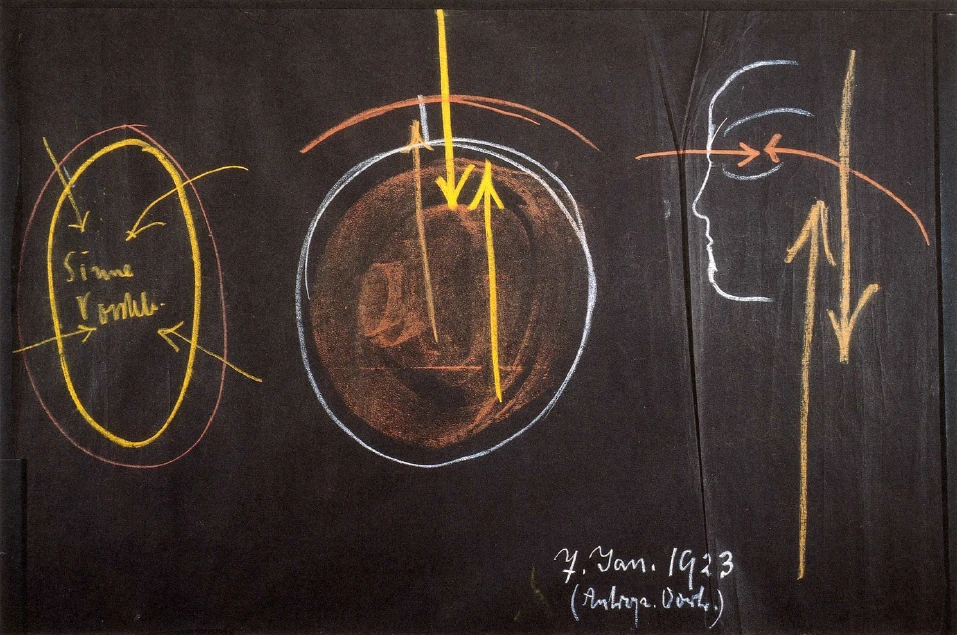
[ 4 ] Nun ist die Stellung des Menschen im Irdischen so, daß leicht zu ersehen ist, daß man die Hauptrichtung, in der die Wirkungen der Dinge eintreffen, damit er zu sinnlichen Wahrnehmungen kommt, annähernd «horizontal» nennen könnte. Eine genauere Betrachtung würde auch zeigen, daß die Behauptung, die ich jetzt getan habe, restlos richtig ist. Denn wenn es scheint, als ob wir in einer andern Richtung wahrnehmen würden, so beruht das bloß auf einer Täuschung. Es muß jede Wahrnehmungsrichtung zuletzt in die Horizontale fallen. Und die Horizontale ist diejenige Linie, welche parallel zur Erde ist. Wenn ich also schematisch zeichne, so müßte ich “sagen: Ist das die Erdoberfläche und darauf der wahrnehmende Mensch, so ist die Hauptrichtung seines Wahrnehmens diese, welche mit der Erde parallel ist (Zeichnung S. 42, links). In dieser Richtung verlaufen die Richtungen all unseres Wahrnehmens.
[ 4 ] Now, the position of human beings in the earthly realm is such that it is easy to see that the main direction in which the effects of things occur—enabling them to arrive at sensory perceptions—could be described as roughly “horizontal.” A closer examination would also show that the assertion I have just made is entirely correct. For if it seems as though we perceive in a different direction, this is merely due to an illusion. Every direction of perception must ultimately fall along the horizontal plane. And the horizontal plane is the line that is parallel to the Earth. So if I were to draw a schematic diagram, I would have to say: If this is the Earth’s surface and the perceiving human is standing on it, then the main direction of his perception is the one that is parallel to the Earth (drawing on p. 42, left). All the directions of our perception run in this direction.
[ 5 ] Und wenn wir den Menschen betrachten, so werden wir auch unschwer sagen können: Die Wahrnehmungen kommen von außen, gehen gewissermaßen von außen nach innen. — Was bringen wir ihnen von innen entgegen? Wir bringen ihnen von innen entgegen das Denken, die Vorstellungskraft. Sie brauchen sich diesen Vorgang nur vor Augen zu führen. Sie werden sich sagen: Wenn ich durch das Auge wahrnehme, kommt der Eindruck von außen, die Vorstellungskraft, die kommt von innen (Zeichnung S. 42, rechts). Von außen kommt der Eindruck, wenn ich den Tisch sehe. Daß ich den Tisch dann auch in der Erinnerung mit Hilfe einer Vorstellung behalten kann, dazu kommt die Kraft des Vorstellens von innen. So daß wir also sagen können: Wenn wir uns schematisch einen Menschen vorstellen, so haben wir die Richtung des Wahrnehmens von außen nach innen, die Richtung des Vorstellens von innen nach außen. Was wir da ins Auge fassen, bezieht sich auf die Wahrnehmungen des alltäglichen Lebens des Erdenmenschen, jenes Erdenmenschen, wie er sich in unserem gegenwärtigen Zeitalter der Erdenentwickelung äußerlich offenbart. Es ist das, was ich oben erwähnt habe, der Tatbestand des gewöhnlichen Bewußtseins. Aber wenn Sie die anthroposophische Literatur durchgehen, werden Sie finden, daß es andere Bewußtseinsmöglichkeiten gibt als diejenigen, die eben für den Erdenmenschen im alltäglichen Leben vorhanden sind.
[ 5 ] And when we consider human beings, we can easily say: Perceptions come from the outside; they move, so to speak, from the outside to the inside. — What do we offer them from within? We offer them, from within, thinking and the power of imagination. You need only visualize this process. You will say to yourselves: When I perceive through the eye, the impression comes from the outside; the power of imagination, that comes from within (drawing on p. 42, right). The impression comes from the outside when I see the table. The fact that I can then also retain the table in my memory with the help of an image—that is where the power of imagination comes in from within. So we can say: When we schematically imagine a human being, the direction of perception is from the outside to the inside, while the direction of imagination is from the inside to the outside. What we are considering here relates to the perceptions of the everyday life of the earthly human being—that earthly human being as he outwardly manifests himself in our present age of earthly evolution. This is what I mentioned above: the reality of ordinary consciousness. But if you go through anthroposophical literature, you will find that there are other possibilities of consciousness besides those that are available to the earthly human being in everyday life.
[ 6 ] Nun versuchen Sie einmal, wenn auch nur annähernd und verschwommen, sich ein Bild zu machen von dem, was da durch den Erdenmenschen wahrgenommen wird. Sie sehen das, was auf Erden vorhanden ist, in Farben, hören es in Tönen, nehmen es in Wärmeempfindungen: wahr und so weiter. Sie schaffen sich Konturen für das, was wahrgenommen wird, so daß Sie die Dinge gestaltet wahrnehmen. Nun ist aber dasjenige, in dem wir uns da zusammen mit unserer Umgebung wissen, eben nur der Tatbestand des gewöhnlichen alltäglichen Bewußtseins. Es gibt eben andere Bewußtseinsmöglichkeiten, die beim Erdenmenschen mehr unbewußt bleiben, die in die Tiefen des Seelenlebens gedrängt sind, die aber für dieses menschliche Leben von einer ebenso großen, oft viel größeren Bedeutung sind als solche Bewußtseinstatsachen, die sich in dem erschöpfen, was ich bisher erwähnt habe.
[ 6 ] Now try, even if only roughly and vaguely, to form a picture of what is perceived by the earthly human being. You see what exists on Earth in colors, hear it in sounds, perceive it through sensations of warmth—and so on. You create contours for what is perceived, so that you perceive things as shaped forms. But what we recognize as our own existence in relation to our surroundings is merely the reality of ordinary, everyday consciousness. There are, in fact, other possibilities of consciousness that remain largely unconscious in human beings on Earth, that are pushed into the depths of the soul life, but which are of equally great—and often much greater—significance for this human life than those aspects of consciousness that are limited to what I have mentioned so far.
[ 7 ] Für die menschliche Konstitution, für das, was der Mensch auf Erden ist, da ist dasjenige, was innerhalb der Erdoberfläche ist, ebenso wichtig wie das, was im Umkreise der Erde ist. Der Umkreis der Erde, was um die Erde herum ist, das ist es eben, was für die gewöhnlichen Sinne wahrnehmbar ist, was durch die der Sinneswahrnehmung entgegenkommende Vorstellungskraft nun einmal das Bewußtsein des gewöhnlichen Erdenmenschen werden kann.
[ 7 ] For the human constitution—for what a human being is on Earth—what lies within the Earth’s surface is just as important as what lies in the Earth’s orbit. The Earth’s surroundings—that which is around the Earth—is precisely what is perceptible to the ordinary senses, and what, through the imagination that responds to sensory perception, can become the consciousness of the ordinary earthly human being.
[ 8 ] Aber betrachten wir zunächst das Innere der Erde. Eine gewöhnliche Überlegung wird Ihnen sagen können, daß das Innere der Erde sich dem gewöhnlichen Bewußtsein verschließt. Gewiß, wir können eine kurze Strecke in die Erde hineingraben und dann in den Löchern, sagen wir in Bergwerken, ebenso beobachten, wie wir auf der Oberfläche beobachten. Aber das ist nicht anders, als wenn wir vom Menschen den Leichnam betrachten. Wenn wir einen Leichnam beobachten, so beobachten wir ja nur etwas, was eigentlich nicht mehr der ganze Mensch ist, was ein Rest des ganzen Menschen ist; wer diese Dinge richtig anschauen kann, muß sogar sagen: was das Gegenteil des Menschen ist. Das Wirkliche des Erdenmenschen ist der lebendig herumgehende Mensch, und dem ist angemessen dasjenige, was er an Knochen, Muskeln und so weiter in sich trägt. Dem lebendigen Menschen entspricht als eine Wahrheit der Knochenbau, der Muskelbau, der Nervenbau, entsprechen Herz, Lunge und so weiter. Wenn ich den Leichnam vor mir habe, so entspricht das ja nicht mehr dem Menschen. An dem Gebilde, das ich als Leichnam vor mir habe, gibt es gar keinen Grund, daß eine Lunge, ein Herz oder ein Muskelsystem da sein soll. Daher zerfallen sie auch. Sie erhalten eine Weile die Form, die ihnen aufgedrängt ist. Aber ein Leichnam ist eigentlich eine Unwahrheit, denn so, wie er ist, kann er nicht bestehen, muß er sich auflösen. Er ist keine Wirklichkeit. Ebenso ist das keine Wirklichkeit; was ich im Inneren der Erde finde, wenn ich hineingrabe, weil die geschlossene Erde auf den daraufstehenden Menschen anders wirkt, als das, was der Mensch, wenn er auf der Erde steht, als die Umgebung der Erde durch seine Sinne betrachtet. Sie können sagen, wenn Sie zunächst die Sache seelisch betrachten: Die Umgebung der Erde ist in der Lage, auf die gewöhnlichen Sinne des Menschen zu wirken und begriffen zu werden durch das Vorstellungsvermögen des gewöhnlichen Erdenbewußtseins. Das, was im Inneren der Erde ist, wirkt auch auf den Menschen, aber es wirkt nicht in der horizontalen Richtung, es wirkt von unten nach oben. Es geht durch den Menschen durch (Zeichnung S. 46, links, roter Pfeil). Und während des gewöhnlichen Bewußtseins nimmt der Mensch dasjenige nicht in derselben Weise wahr, was da von unten nach oben wirkt, wie er durch seine gewöhnlichen Sinne das wahrnimmt, was in seiner Erdenumgebung ist. Denn wurde der Mensch in derselben Weise das, was von der Erde heraufwirkt, wahrnehmen, wie er dasjenige wahrnimmt, was in der Erdenumgebung ist, dann würde er gewissermaßen eine Art Auge oder eine Art Getast haben müssen, um hineinzugreifen in die Erde, ohne daß er ein Loch hineingräbt, um die Erde ebenso zu durchgreifen, wie man die Luft durchgreift, wenn man etwas angreift, oder wie man die Luft durchschaut, wenn man etwas anschaut. Wenn Sie durch die Luft schauen, graben Sie nicht ein Loch durch die Luft. Wenn Sie ein Loch durch die Luft graben und dann erst anschauen würden, so würden Sie die Umgebung so anschauen, wie Sie in einem Bergwerk die Erde anschauen. Wenn Sie also nicht ein Loch zu graben brauchten, um das Innere der Erde zu sehen, dann müßten Sie ein Sinnesorgan haben, welches sehen kann, ohne Löcher in die Erde zu graben, für welches also die Erde, so wie sie ist, durchsichtig oder durchfühlbar ist. Das ist sie in gewisser Beziehung für den Menschen. Aber dem Menschen kommen im gewöhnlichen Erdenleben die Wahrnehmungen, um die es sich handelt, nicht zum Bewußtsein. Was der Mensch da nämlich wahrnehmen würde, das sind die differenzierten Metalle der Erde.
[ 8 ] But let us first consider the interior of the Earth. A simple reflection will tell you that the interior of the Earth is hidden from ordinary consciousness. Certainly, we can dig a short distance into the Earth and then, in these holes—say, in mines—observe just as we do on the surface. But this is no different from observing a human corpse. When we observe a corpse, we are, after all, observing only something that is no longer the whole human being—something that is a remnant of the whole human being; anyone who can look at these things correctly must even say: it is the opposite of the human being. The reality of the earthly human being is the living, walking human being, and what corresponds to this is what he carries within himself in terms of bones, muscles, and so on. The skeletal structure, the muscular structure, and the nervous system correspond to the living human being as a truth; the heart, lungs, and so on correspond to him as well. When I have the corpse before me, it no longer corresponds to the human being. There is absolutely no reason why the structure I have before me as a corpse should contain lungs, a heart, or a muscular system. That is why they decay. For a while, they retain the form that has been imposed upon them. But a corpse is actually an untruth, for as it is, it cannot exist; it must disintegrate. It is not reality. Likewise, what I find inside the Earth when I dig into it is not reality either, because the closed Earth has a different effect on the human being standing upon it than what the human being, when standing on the Earth’s surface, perceives through their senses as the Earth’s surroundings. You might say, if you first consider the matter from a spiritual perspective: The Earth’s surroundings are capable of acting upon human beings’ ordinary senses and of being grasped by the imagination of ordinary earthly consciousness. What lies within the Earth also acts upon human beings, but it does not act in the horizontal direction; it acts from below upward. It passes through the human being (drawing on p. 46, left, red arrow). And in ordinary consciousness, a person does not perceive what acts from below upward in the same way that they perceive, through their ordinary senses, what is in their earthly environment. For if a person were to perceive what acts upward from the Earth in the same way that they perceive what is in the earthly environment, then they would, so to speak, need to have a kind of eye or a kind of sense of touch to reach into the earth without digging a hole in it, in order to pass through the earth just as one passes through the air when reaching for something, or just as one sees through the air when looking at something. When you look through the air, you do not dig a hole through the air. If you were to dig a hole through the air and only then look, you would view the surroundings just as you view the earth in a mine. So if you did not need to dig a hole to see the interior of the earth, you would have to have a sense organ capable of seeing without digging holes in the earth—one for which the earth, just as it is, is transparent or perceptible through touch. In a certain sense, this is true for human beings. But in ordinary earthly life, the perceptions in question do not come to human consciousness. For what a person would perceive there are the differentiated metals of the Earth.
[ 9 ] Denken Sie sich doch nur einmal, wieviel Metalle die Erde in sich enthält! Geradeso nun wie Sie in Ihrer Luftumgebung Tiere, Pflanzen, Mineralien, Kunstsachen der verschiedensten Art wahrnehmen, so nehmen Sie vom Inneren der Erde herauf Metalle wahr. Aber die Wahrnehmungen der Metalle würden, wenn sie Ihnen wirklich zum Bewußtsein kämen, eben nicht gegenständliche Wahrnehmungen sein, sondern sie würden Imaginationen sein. Und diese Imaginationen kommen auch fortwährend von unten in den Menschen herauf. Geradeso wie von der Horizontalen die Seheindrücke kommen, so kommen fortwährend von unten herauf die Metalleinstrahlungen, nicht die Sehwahrnehmungen von den Mineralien, sondern etwas von der inneren Natur der Mineralien wirkt durch den Menschen herauf zu Imaginationen, zu Bildern. Der Mensch nimmt diese Bilder nicht wahr, sondern sie schwächen sich ab. Sie werden gewissermaßen unterdrückt, weil das Erdenbewußtsein des Menschen nicht so ist, daß er die Imaginationen wahrnehmen kann. Sie schwächen sich ab zu Gefühlen.
[ 9 ] Just imagine for a moment how many metals the Earth contains! Just as you perceive animals, plants, minerals, and all manner of artistic objects in the air around you, so too do you perceive metals rising up from the Earth’s interior. But if these perceptions of metals were to truly enter your consciousness, they would not be concrete perceptions; rather, they would be imaginations. And these imaginations also rise up continuously from below into human beings. Just as visual impressions come from the horizontal plane, so too do the radiations of metals continually rise from below—not visual perceptions of the minerals, but rather something of the inner nature of the minerals works its way up through the human being to form imaginations, to form images. Human beings do not perceive these images; rather, they fade away. They are, so to speak, suppressed, because human beings’ earthly consciousness is not such that they can perceive these imaginations. They fade away into feelings.
[ 10 ] Wenn Sie sich zum Beispiel alles Gold denken, das in der Erde . irgendwie in Klüften und so weiter ist, so nimmt tatsächlich Ihr Herz ein Bild wahr, welches dem Golde in der Erde entspricht (Zeichnung S. 46, links, lila). Nur ist dieses Bild eben Imagination, und deshalb wird es vom gewöhnlichen Bewußtsein nicht wahrgenommen, sondern zu einem bloßen innerlichen Lebensgefühl abgestumpft, zu einem Lebensgefühl, das der Mensch noch nicht einmal deuten kann, geschweige denn, daß er das entsprechende Bild wahrnehmen würde. Ebenso ist es mit andern Organen, zum Beispiel nimmt die Leber alles Zinn der Erde in einem bestimmten Bilde wahr und so weiter.
[ 10 ] For example, if you imagine all the gold that is in the earth—somehow in crevices and so on—your heart actually perceives an image that corresponds to the gold in the earth (drawing on p. 46, left, purple). However, this image is merely an imagination, and therefore it is not perceived by ordinary consciousness; rather, it is dulled into a mere inner sense of life—a sense of life that a person cannot even interpret, let alone perceive the corresponding image. The same is true of other organs; for example, the liver perceives all the tin in the earth as a specific image, and so on.
[ 11 ] Das alles sind unterbewußte Eindrücke, die sich nur im allgemeiin horizontaler Weise die Wahrnehmungen von der Erdenumgebung kommen und ihnen von innen die Vorstellungskraft entgegenkommt, so kommen von unten herauf die Metallwahrnehmungen, speziell die Metallwahrnehmungen, und ihnen kommt, geradeso wie den gewöhnlichen Wahrnehmungen die Vorstellungskraft entgegenkommt, für das Bewußtsein das Fühlen entgegen (Zeichnung links, gelbe Pfeile). Aber den Menschen des heutigen Erdenlebens bleibt es chaotisch und unklar. Es kommt eben nur ein allgemeines Lebensgefühl heraus.
[ 11 ] All of these are subconscious impressions that arise generally in a horizontal manner from perceptions of the earthly environment, with the imagination meeting them from within; thus, perceptions of metal—specifically perceptions of metal—rise up from below, and just as the imagination meets ordinary perceptions, feeling meets them in consciousness (drawing on the left, yellow arrows). But for people living on Earth today, it remains chaotic and unclear. All that emerges is a general sense of life.
[ 12 ] Würde dieser Erdenmensch Begabung haben für Imagination, so könnte er eben wissen, daß sein Wesen auch mit dem Metallischen der Erde zusammenhängt. Eigentlich ist jedes menschliche Organ ein Sinnesorgan, und wenn wir es zu etwas anderem gebrauchen oder wenn es scheint, daß wir es zu etwas anderem gebrauchen, so ist es doch ein Sinnesorgan. Sein Gebrauch im Erdenleben ist eigentlich nur ein stellvertretender. Mit allen Organen, die der Mensch hat, nimmt er eigentlich irgend etwas wahr. Der Mensch ist ganz und gar ein großes Sinnesorgan, und wiederum als solches groRes Sinnesorgan spezifiziert, differenziert in seine einzelnen Organe als besondere Sinnesorgane.
[ 12 ] If this earthly human being had a gift for imagination, he would know that his being is also connected to the metallic element of the earth. In fact, every human organ is a sensory organ, and even if we use it for something else—or if it seems that we are using it for something else—it is still a sensory organ. Its function in earthly life is, in fact, only a vicarious one. With all the organs that a human being possesses, he or she actually perceives something. The human being is entirely a great sensory organ, and, as such, this great sensory organ is further specified and differentiated into its individual organs as specific sensory organs.
[ 13 ] Der Mensch hat also von unten herauf Metallwahrnehmungen, und der Metallwahrnehmung entspricht das Gefühlsleben. Unsere Gefühle haben wir geradeso als Gegenwirkung gegen alles, was metallisch aus der Erde auf den Menschen wirkt, wie wir unsere Vorstellungskraft haben als Gegenwirkung gegen alles, was aus der Umgebung in die Sinneswahrnehmung hereindringt. Aber ebenso wie der Mensch von unten herauf die Metallwirkungen hat, so wirkt von oben nach unten aus dem Weltenraum herein dasjenige, was Bewegung und Form der Himmelskörper ist. Wie wir in unserer Umgebung also die Sinneswahrnehmung haben, so haben wir wiederum für ein Bewußtsein, das als inspiriertes Bewußtsein wirken würde, Inspirationen von jeder Planetenbewegung, von der Fixsternkonstellation. Und so wie wir die Vorstellungskraft entgegenströmen lassen den gewöhnlichen Sinneswahrnehmungen, so lassen wir den Bewegungen der Himmelskörper entgegenströmen eine Kraft (siehe Zeichnung rechts, gelbe Pfeile), die den Sterneindrücken entgegengesetzt ist, und diese Kraft ist die Willenskraft. Was in unserer Willenskraft liegt, würden wir, wenn wir mit dem inspirierten Bewußtsein rechneten, eben als Inspiration wahrnehmen.
[ 13 ] Human beings thus have perceptions of metal rising up from below, and these perceptions of metal correspond to the life of feeling. We have our feelings precisely as a counteraction to everything that acts upon us from the earth in a metallic way, just as we have our power of imagination as a counteraction to everything that penetrates into our sensory perception from the environment. But just as human beings experience the effects of the metals rising from below, so too does that which constitutes the movement and form of the celestial bodies act from above, from outer space, down toward us. Just as we have sensory perception in our surroundings, so too do we have, for a consciousness that would function as inspired consciousness, inspirations from every planetary movement and from the constellations of fixed stars. And just as we allow the power of imagination to flow in opposition to ordinary sensory perception, so we allow a force (see drawing on the right, yellow arrows) to flow in opposition to the movements of the celestial bodies—a force that is opposed to the impressions of the stars—and this force is the power of the will. What lies within our willpower, we would perceive as inspiration if we were to take inspired consciousness into account.
[ 14 ] Wenn wir den Menschen in dieser Weise studieren, dann sagen wir uns also: Wir finden in seinem Erdenbewußtsein zunächst dasjenige, in dem er am meisten wach ist, das Vorstellungs-Sinnesleben. Eigentlich sind wir nur in diesem Vorstellungs-Sinnesleben im gewöhnlichen Erdenbewußtsein ganz wach. Dagegen ist nur traumhaft vorhanden unser Gefühlsleben. Unser Gefühlsleben ist nicht intensiver, nicht heller als Träume sind, nur sind Träume Bilder, während das Gefühlsleben die allgemeine, durch das Leben bestimmbare Seelenverfassung, eben die des Fühlens, ist. Aber diesem Fühlen liegt zugrunde die Metallwirkung der Erde. Noch tiefer — das habe ich öfter auseinandergesetzt —, noch dumpfer ist das Bewußtsein des Willens. Der Mensch weiß nicht, was sein Wille in ihm eigentlich ist. Ich habe es oft so ausgesprochen, daß ich sagte: Der Mensch hat
[ 14 ] When we study human beings in this way, we tell ourselves: In their earthly consciousness, we first find that aspect in which they are most awake—the life of imagination and the senses. In fact, it is only in this life of imagination and the senses that we are fully awake in ordinary earthly consciousness. In contrast, our emotional life exists only in a dreamlike state. Our emotional life is no more intense, no brighter than dreams are; it is just that dreams are images, whereas the emotional life is the general state of the soul—one that can be determined by life itself—namely, the state of feeling. But underlying this feeling is the metallic influence of the Earth. Even deeper—as I have often explained—and even more subdued is the consciousness of the will. Human beings do not know what their will actually is within them. I have often put it this way: Human beings have
[ 15 ] den Gedanken, er strecke den Arm aus, er greife mit der Hand etwas. Diesen Gedanken kann er mit seinem wachen Bewußtsein haben. Dann sieht er wiederum den Tatbestand des Ergreifens. Aber was eigentlich dazwischen liegt, dieses Hineinschießen des Willens in die Muskeln und so weiter, das bleibt dem gewöhnlichen Bewußtsein ebenso verborgen wie die Erlebnisse des tiefen traumlosen
[ 15 ] the thought that he is stretching out his arm, that he is grasping something with his hand. He can have this thought with his waking consciousness. Then he sees, in turn, the act of grasping itself. But what actually lies in between—this surge of the will into the muscles and so on—remains just as hidden from ordinary consciousness as the experiences of deep, dreamless
[ 16 ] Schlafes. Im Fühlen traumen wir, im Wollen schlafen wir. Aber dieser im gewöhnlichen Bewußtsein schlafende Wille ist eben auch dasjenige, was der Mensch auf die Sterneindrücke geradeso entgegnet, wie er in seinen Vorstellungen auf die Sinneseindrücke des gewöhnlichen Bewußtseins entgegnet. Und was der Mensch in seinen Gefühlen träumt, das ist die Gegenwirkung auf die Metallwirkung der Erde.
[ 16 ] Sleep. In feeling, we dream; in willing, we sleep. But this will, which lies dormant in ordinary consciousness, is precisely what the human being responds with to the impressions of the stars, just as he responds in his ideas to the sensory impressions of ordinary consciousness. And what the human being dreams in his feelings is the counteraction to the metallic influence of the Earth.
[ 17 ] Wenn wir als heutiger Erdenmensch wachen, so nehmen wir die Dinge um uns herum wahr. Unser Vorstellungsvermögen wirkt ihnen entgegen. Dazu brauchen wir unseren physischen und unseren Ätherleib. Ohne den physischen und ohne den Ätherleib können wir nicht die Kräfte entwickeln, welche in der horizontalen Richtung wahrnehmend, vorstellungsmäßig wirken. So daß wir, wenn wir uns das schematisch vorstellen wollen, sagen können: physischer Leib, Ätherleib erfüllen sich für das Tagesbewußtsein mit den Eindrücken der Sinne und des Vorstellungsvermögens (siehe Zeichnung, gelb). Wenn der Mensch nun schläft, so sind ja sein astralischer Leib und seine Ich-Organisation außerhalb. Sie sind es nun, welche die Eindrücke von unten und von oben bekommen. Sie sind es, das Ich und der astralische Leib, die eigentlich schlafen in dem, was von der Erde aus Metallausströmung ist und was von oben herunter die Strömungen der Planetenbewegungen und der Fixsternkonstellationen sind. Was so in der Umgebung der Erde erzeugt wird, was aber in der Richtung der Horizontale keine Kraftwirkung hat, sondern als Kräfte von oben nach unten wirkt, das ist dasjenige, in dem wir während der Nacht sind.
[ 17 ] When we, as modern human beings on Earth, are awake, we perceive the things around us. Our power of imagination interacts with them. For this, we need our physical body and our etheric body. Without the physical body and without the etheric body, we cannot develop the forces that act in the horizontal direction through perception and imagination. So that, if we want to visualize this schematically, we can say: the physical body and the etheric body are filled, for daytime consciousness, with the impressions of the senses and the power of imagination (see diagram, yellow). When a person sleeps, their astral body and their “I” organization are outside the physical body. It is these that receive the impressions from below and from above. It is the “I” and the astral body that actually sleep within what emanates from the Earth as metallic currents and what descends from above as the currents of planetary movements and the constellations of fixed stars. What is thus generated in the Earth’s surroundings—but which has no horizontal force effect, instead acting as forces from above downward—is the very environment in which we find ourselves during the night.
[ 18 ] Wenn Sie den Versuch machen würden, vom gewöhnlichen Bewußtsein zur Imagination zu kommen, so daß das wirkliche imaginierende Bewußtsein da ist, so müßte das, vermöge des gegenwärtigen Zeitalters der Menscheitsentwickelung, so sein, daß gleichmäßig alle menschlichen Organe von diesem Bewußtsein ergriffen werden. Es darf nicht etwa, sagen wir, bloß das Herz ergriffen werden, sondern es müssen alle Organe gleichmäßig ergriffen werden. Ich sagte vorhin, das Herz nimmt das Gold wahr, das in der Erde ist. Aber es kann niemals allein das Gold wahrnehmen, denn die Sache ist so: Solange das Ich und der astralische Leib mit dem physischen Leib und mit dem Ätherleib in einer solchen Verbindung sind, wie das beim normalen wachenden Menschen der Fall ist, so lange kann ja überhaupt nichts von einer Wahrnehmung bewußt werden. Erst dann, wenn das Ich und der astralische Leib, wie das bei der Imagination der Fall ist, bis zu einem gewissen Grade selbständig gemacht werden, so daß sie von dem physischen und dem Ätherleib unabhängig werden, dann können wir sagen: Es werden der astralische Leib und die Ich-Organisation in der Nähe der Herzgegend fähig, etwas von diesem Ausströmen des Metallischen in der Erde zu wissen. Und da kann man sagen: Das Zentrum für die Einwirkungen der Goldausströmung liegt im astralischen Leibe in der Gegend des Herzens. Das Herz nimmt wahr, weil der astralische Leib, der dieser Partie, dem Herzen, zugehört, das eigentlich Wahrnehmende ist. Das physische Organ nimmt nicht wahr, sondern .es nimmt der astralische Leib wahr.
[ 18 ] If you were to attempt to move from ordinary consciousness to imagination—so that true imaginative consciousness is present—then, given the current stage of human development, this would have to be such that all human organs are equally engaged by this consciousness. It must not be, say, merely the heart that is engaged, but all the organs must be engaged equally. I said earlier that the heart perceives the gold that is in the earth. But it can never perceive the gold on its own, for the fact is this: As long as the “I” and the astral body are connected to the physical body and the etheric body in the way that is the case with the normal waking human being, nothing at all can become a conscious perception. Only when the “I” and the astral body—as is the case in imagination—are made independent to a certain degree, so that they become separate from the physical and etheric bodies, can we say: The astral body and the “I”-organization in the vicinity of the heart region become capable of perceiving something of this outflow of the metallic element within the earth. And so one can say: The center for the effects of the outflow of gold lies in the astral body in the region of the heart. The heart perceives because the astral body, which belongs to this region—the heart—is what actually perceives. The physical organ does not perceive; rather, it is the astral body that perceives.
[ 19 ] Wenn nun das imaginative Bewußtsein erworben wird, dann muß der gesamte astralische Leib und auch die gesamte Ich-Organisation in einem Zustande sein, daß diejenigen Partien wahrnehmen, die allen menschlichen Organen entsprechen. Das heißt, der Mensch nimmt dann die gesamte Metallität der Erde, allerdings in Differenzierungen, wahr. Einzelheiten kann er darin nur wahrnehmen, wenn er sich besonders darauf trainieren und es zu seinem besonderen okkulten Studium machen würde, die Metallität der Erde kennenzulernen. Diese Erkenntnis ist etwas, was für die gegenwärtige Zeitepoche nicht eine gewöhnliche Erkenntnis für den Menschen sein soll. Der Mensch sollte diese Erkenntnis heute nicht in den Dienst seines nützlichen und nutzbringenden Lebens stellen. Weil dieses Weltgesetz ist, würde sofort, wenn jemand diese Metallerkenntnis der Erde nur im geringsten in den Dienst des gewöhnlichen nutzenden Lebens stellen wollte, die imaginative Erkenntnis genommen werden.
[ 19 ] Once imaginative consciousness is acquired, the entire astral body—as well as the entire “I”-organization—must be in a state in which they perceive the parts corresponding to all human organs. This means that the human being then perceives the entire metallic nature of the Earth, albeit in varying degrees of differentiation. One can perceive details of this only if one were to train oneself specifically for this purpose and make it one’s special occult study to become acquainted with the metallic nature of the Earth. This knowledge is not meant to be ordinary knowledge for human beings in the present epoch. People today should not put this knowledge to use in the service of their practical and beneficial lives. Because this is a universal law, if anyone were to put this knowledge of the Earth’s metallic nature to use—even in the slightest way—in the service of ordinary, utilitarian life, their imaginative perception would be taken away.
[ 20 ] Es kann aber vorkommen, daß durch krankhafte Zustände irgendwo im Menschen oder auch im allgemeinen der innige Zusammenhang, der zwischen dem astralischen Leib und den Organen eigentlich da sein sollte, unterbrochen ist, so daß der Mensch gewissermaßen in einer sehr leisen Art wachend schläft. Wenn er wirklich schläft, so ist auf der einen Seite sein physischer Leib und sein Ätherleib, auf der andern Seite sein astralischer Leib und sein Ich auseinander. Aber es gibt auch ein so leises Schlafen, daß der Mensch kaum bemerkbar benommen herumgeht in einem Zustande, der einem sogar vielleicht sehr interessant ist, weil solche Menschen merkwürdig «mystisch» aussehen, so mystische Augen haben und dergleichen. Das kann davon herrühren, daß ein ganz leises Schlafen auch während des Wachens vorhanden ist. Es ist immer eine Art Vibrieren des physischen und des Ätherleibes gegenüber der Ich-Organisation und dem astralischen Leibe. Das vibriert so hin und her. Und solche Menschen sind dann geeignet, als Metallfühler gebraucht zu werden. Aber es beruht die Fähigkeit, da oder dort spezielles Metallisches im Irdischen zu fühlen, immer auf einer gewissen krankhaften Anlage. Natürlich, sobald man die Sache bloß technisch anschaut und in den Dienst des Technisch-Irdischen stellt, kann es einem ganz gleichgültig sein — wenn ich grausam sprechen will —, ob die Leute ein bißchen krank sind oder nicht. Man sieht ja auch sonst nicht so sehr auf die Mittel, durch die man dieses oder jenes Nützliche bewerkstelligt. Aber innerlich angesehen, vom Standpunkt einer höheren Weltauffassung, ist es immer etwas Krankhaftes, wenn der Mensch dazukommt, auf diese Weise nicht nur in der Horizontalen in der Erdenumgebung, sondern nach unten hin wahrzunehmen, und zwar nicht durch Löcher, sondern direkt. Dann ist es natürlich notwendig, daß der Mensch dasjenige, was er da ausdrückt, auch nicht auf gewöhnliche Weise kundgibt. Wenn man eine Feder nimmt und etwas aufschreibt, da ist das gewöhnliche Vorstellungsleben darin, das muß tot sein. Aber dieses gewöhnliche Vorstellungsvermögen, das — wenn ich mich des Ausdrucks bedienen darf: verleuchtet, als Gegensatz zum Verdunkeln —, das verleuchtet die Wahrnehmung, die von unten heraufkommt. Und so ist es notwendig, daß man andere Zeichen macht, als wenn man schreibt oder spricht, wenn man durch krankhafte Zustände speziell Metallisches in der Erde wahrnimmt. Ich bemerke, daß zum Beispiel Wasser auch ein Metall ist. Solche krankhaften Personen können gerade darauf trainiert werden, nicht bloß unbewußt wahrzunehmen, sondern für die Wahrnehmung auch unbewußt Zeichen zu machen. Wenn man solchen Menschen etwa eine Rute in die Hand gibt, dann machen sie damit die Zeichen. Worauf beruht das Ganze? Es beruht eben darauf, daß jene leise Unterbrechung zwischen dem Ich und dem astralischen Leib auf der einen Seite und dem physischen Leib und dem Ätherleib auf der andern Seite da ist, und dadurch der Mensch nicht nur dasjenige wahrnimmt, was neben ihm ist, approximativ gesprochen, sondern, indem er seinen physischen Leib ausschaltet, sich zum Sinnesorgan macht und das Innere der Erde wahrnimmt, ohne daß er Löcher hineinmacht. Aber wenn diese Richtung wirkt, die sonst nur die Normalrichtung des Fühlens ist, dann kann er sich auch nicht so ausdrücken, wie es dem Vorstellungsvermögen entspricht. Er spricht es nicht in Worten aus. Er kann es nur in der Weise, wie ich angedeutet habe, in Zeichen aussprechen.
[ 20 ] However, it can happen that, due to pathological conditions somewhere within the human being or even in general, the intimate connection that should actually exist between the astral body and the organs is interrupted, so that the person, in a sense, sleeps while remaining awake in a very subtle way. When they are truly asleep, their physical body and etheric body are on one side, and their astral body and ego are on the other. But there is also a form of sleep so subtle that the person walks around in a barely perceptible daze, in a state that one might even find very interesting, because such people look strangely “mystical,” with such mystical eyes and the like. This may stem from the fact that a very subtle form of sleep is present even while the person is awake. There is always a kind of vibration of the physical and etheric bodies in relation to the “I” organization and the astral body. It vibrates back and forth like this. And such people are then suited to be used as metal detectors. But the ability to sense specific metallic elements here and there in the earthly realm is always based on a certain pathological predisposition. Of course, as soon as one views the matter purely from a technical standpoint and puts it in the service of technical-earthly purposes, one may be quite indifferent—if I may speak harshly—as to whether people are a little ill or not. After all, one does not usually pay much attention to the means by which one accomplishes this or that useful end. But viewed from within, from the standpoint of a higher worldview, it is always something pathological when a person comes to perceive in this way—not only horizontally within the earthly environment, but also downward—and not through holes, but directly. Then, of course, it is necessary that the person not express what he or she perceives there in the ordinary way. When one takes a pen and writes something down, the ordinary life of imagination is present there; that must be set aside. But this ordinary power of imagination—which, if I may use the expression, “illuminates” as opposed to “darkening”—illuminates the perception that rises from below. And so it is necessary to make different signs than when writing or speaking, when, through pathological states, one perceives specifically metallic elements in the earth. I note, for example, that water is also a metal. Such individuals with pathological conditions can be trained precisely to not only perceive unconsciously, but also to make signs unconsciously for that perception. If, for example, one gives such a person a divining rod, they use it to make these signs. What is the basis for all this? It is based precisely on the fact that there is that slight interruption between the “I” and the astral body on the one hand, and the physical body and the etheric body on the other, and as a result, the person not only perceives what is beside them—roughly speaking—but, by shutting out their physical body, becomes a sensory organ and perceives the interior of the Earth without making holes in it. But when this direction—which is otherwise merely the normal direction of feeling—is at work, then the person cannot express themselves in a way that corresponds to their imagination. They do not articulate it in words. They can only express it through signs, as I have indicated.
[ 21 ] In einer ähnlichen Weise aber kann angeregt werden, daß der Mensch die Wahrnehmung hat, die von oben herunterkommt. Sie hat einen andern inneren Charakter. Sie ist nun nicht Metallwahrnehmung, sondern sie ist Inspiration, welche Sternbewegungen oder Sternkonstellationen wiedergibt. Und da nimmt der Mensch dann ebenso, wie er von unten her die Konstitution der Erde wahrnimmt, von oben herunter dasjenige wahr, was also auch nur durch diese krankhaften Zustände eintritt, wenn in diesem Falle das Ich vom astralischen Leibe etwas abgelockert ist. Er nimmt dann von oben herunter dasjenige wahr, was eigentlich der Welt die Zeiteinteilung, den Zeitenfluß gibt. Dadurch sieht er tiefer hinein in das Geschehen der Welt, nicht nur nach der Vergangenheit, sondern auch nach gewissen Ereignissen, die allerdings nicht solche sind, die aus dem freien menschlichen Willen fließen, sondern die aus der Notwendigkeit der Weltenordnung fließen. Er sieht dann gewissermaßen prophetisch in die Zukunft, er sieht in die Zeitenordnung hinein.
[ 21 ] In a similar way, however, it is possible to stimulate in a person a perception that comes down from above. This perception has a different inner character. It is not a metallic perception, but rather inspiration that reflects the movements of the stars or constellations. And just as a person perceives the constitution of the Earth from below, so too does he perceive from above that which occurs only through these pathological states—namely, when, in this case, the “I” is somewhat detached from the astral body. He then perceives from above that which actually gives the world its division of time, the flow of time. Through this, they see more deeply into the events of the world—not only into the past, but also into certain events that do not, however, arise from free human will, but rather from the necessity of the world order. They then look, as it were, prophetically into the future; they look into the order of time.
[ 22 ] Ich wollte Ihnen durch diese Dinge nur andeuten, daß durch gewisse krankhafte Zustände allerdings der Mensch sein Wahrnehmungsvermögen erweitern kann. In gesunder Weise wird es durch Imagination und Inspiration erweitert. Was auf diesem Felde das Gesunde und Krankhafte bedeutet, das wird Ihnen vielleicht durch folgendes klarwerden: Es ist für einen normalen Menschen ganz gut, wenn er, sagen wir, auch einen normalen Geruch hat. Wenn ein Mensch einen normalen Geruch hat, dann wird er die Gegenstände um sich herum durch den Geruch wahrnehmen. Aber wenn er für irgendwelche Dinge der Umgebung, die riechen, einen abnormalen Geruch hat, so kann es passieren, daß er an Idiosynkrasie erkrankt, wenn diese oder jene Gegenstände in seiner Umgebung sind. Es kann Menschen geben, die zum Beispiel wirklich durch den Geruch ganz krank werden, wenn sie in ein Zimmer gehen, in dem eine einzige Erdbeere ist; sie brauchen sie gar nicht zu essen. Das ist nicht gerade ein wünschenswerter Zustand. Dennoch könnte es unter Umständen geschehen, daß jemand, der nicht auf den Menschen sieht, sondern vielleicht darauf, daß irgendwo durch den Menschen gestohlene Erdbeeren gefunden werden könnten, oder überhaupt gestohlene zu riechende Gegenstände, dieses besondere Vermögen des Menschen verwendet. Wenn der Mensch sein Riechvermögen so ausbilden könnte wie die Hunde, so brauchte man keine Polizeihunde, sondern man könnte den Menschen dazu verwenden.
[ 22 ] I simply wanted to use these examples to suggest to you that, through certain pathological conditions, a person can indeed expand their powers of perception. In a healthy way, these powers are expanded through imagination and inspiration. What constitutes the healthy and the pathological in this field may become clear to you from the following: It is quite good for a normal person to have, let’s say, a normal sense of smell. If a person has a normal sense of smell, they will perceive the objects around them through smell. But if they have an abnormal sensitivity to certain things in their environment that have a smell, they may develop an idiosyncrasy when these particular objects are present in their environment. There may be people who, for example, actually become quite ill from the smell when they enter a room containing a single strawberry; they don’t even need to eat it. That is not exactly a desirable condition. Nevertheless, under certain circumstances, someone who isn’t focusing on the person but perhaps on the possibility that strawberries stolen by that person—or any other stolen items with a distinct scent—might be found somewhere could make use of this particular human ability. If humans could develop their sense of smell to the same degree as dogs, there would be no need for police dogs; instead, humans could be used for that purpose.
[ 23 ] Aber man darf das nicht tun. Sie werden daher verstehen, wenn ich sage, daß auch das Wahrnehmungsvermögen nach unten und nach oben nicht in einer unrichtigen Weise, so daß es mit dem Krankhaften zusammenhängt, entwickelt werden darf, denn das ist so beschaffen, daß es direkt zerstörerisch für des Menschen ganze Organisation ist. Also Metallfühler geradezu auszubilden, zu trainieren, würde ganz gleichkommen dem Unternehmen, Menschen als Polizeihunde, als Spürhunde auszubilden. Nur daß das rein Menschlich-Sträfliche hier in einer viel intensiveren Weise vorliegt. Aber eben nur durch krankhafte Zustände kann bei dem einen oder andern Menschen so etwas auftreten.
[ 23 ] But one must not do that. You will therefore understand when I say that the faculty of perception—both downward and upward—must not be developed in an incorrect way, such that it becomes associated with pathological conditions, for this is of such a nature that it is directly destructive to the entire human organism. To train people to be “metal detectors” would be tantamount to training people to be police dogs or bloodhounds. Except that the purely human criminality involved here is much more intense. But such a thing can occur in one person or another only through pathological conditions.
[ 24 ] Sie werden alle Dinge, die Ihnen in einer zumeist laienhaft verworrenen, nebulosen Weise zukommen, sowohl hinsichtlich ihres Theoretischen verstehen können, wie Sie ermessen können, wie diese Dinge im ganzen Weltzusammenhang des Menschen bewertet werden müssen. Das ist die eine Seite der Sache.
[ 24 ] You will be able to understand all the things that come your way—in a mostly amateurish, confused, and nebulous manner—both in terms of their theoretical aspects and in terms of how these things must be evaluated within the broader context of human existence. That is one side of the matter.
[ 25 ] Aber die andere Seite der Sache ist diese, daß es auch eine gerechte Anwendung solcher Erkenntnisse gibt. Um den Menschen Gold zu verschaffen, darf derjenige, der die imaginative Erkenntnis besitzt, nicht die imaginative Kraft des astralischen Leibes anwenden, die in der Herzgegend sitzt. Aber er kann sie anwenden, um die Konstruktion, die wahren Aufgaben, die Innerlichkeit des Herzens selber zu erkennen. Er kann sie anwenden im Sinne der menschlichen Selbsterkenntnis. Das entspricht auch im physischen Leben der gerechten Anwendung, sagen wir des Geruchsvermögens oder des Sehvermögens oder dergleichen. Und so lernt man jedes Organ des Menschen erkennen, indem man zusammenzufügen vermag das, was man von unten, und das, was man von oben erkennt.
[ 25 ] But the other side of the matter is this: there is also a just use of such insights. In order to provide people with gold, the one who possesses imaginative insight must not use the imaginative power of the astral body, which is located in the region of the heart. But they can use it to recognize the structure, the true tasks, and the inner nature of the heart itself. They can use it in the sense of human self-knowledge. This also corresponds in physical life to the proper use of, say, the sense of smell or the sense of sight, or the like. And in this way one learns to recognize every human organ by being able to bring together what one perceives from below and what one perceives from above.
[ 26 ] Sie lernen zum Beispiel das Herz erkennen, wenn Sie den Goldgehalt der Erde, wie er ausströmt und durch das Herz wahrgenommen werden kann, erkennen, und wenn Sie auf der. andern Seite die Willensströmung von der Sonne oben herein, das heißt, die Gegenströmung von der Sonnenströmung als Wille erkennen, so daß im Zusammenwirken der Sonnenströmung von oben, von der Zenitstellung der Sonne aus, mit der Golderkenntnis von unten, indem Sie diese zwei zusammenbringen, Sie sich von dem Goldgehalt der Erde zur Imagination, von der Sonne aus zur Inspiration anregen lassen, dann bekommen Sie die Herzerkenntnis des Menschen. Und so die Erkenntnis der andern Organe. Der Mensch muß also tatsächlich, wenn er sich kennenlernen will, die Elemente dieser Erkenntnisse aus dem Kosmos auf sich einwirken lassen.
[ 26 ] For example, you learn to recognize the heart when you perceive the earth’s gold content as it flows out and can be sensed by the heart, and when, on the. other hand, recognize the flow of will coming in from the sun above—that is, the countercurrent to the solar flow as will—so that through the interaction of the solar flow from above, from the sun’s zenith, with the recognition of gold from below, by bringing these two together, allow yourself to be inspired by the Earth’s golden essence toward imagination, and by the Sun toward inspiration, then you will attain the heart-knowledge of the human being. And in the same way, the knowledge of the other organs. Thus, if a person truly wishes to come to know themselves, they must allow the elements of this knowledge from the cosmos to take effect within them.
[ 27 ] Wir haben damit ein Gebiet betreten, das nun in einer noch konkreteren Weise, als ich das manchmal schon früher getan habe, hinweist auf den Zusammenhang des Menschen mit dem Kosmos. Wenn Sie dazu die Vorträge nehmen, die ich über die Entwickelung der Naturerkenntnis in der neueren Zeit abgeschlossen habe, so werden Sie gerade aus dem gestrigen Vortrage ersehen haben, wie es im wesentlichen das Tote ist, das der Mensch durch die gegenwärtige Stufe der Naturwissenschaft erkennt. Er erkennt sich’ selbst ja nicht, wie er in Wirklichkeit ist, sondern eigentlich hinsichtlich seines Toten. Und eine wirkliche Erkenntnis des Menschen wird erst erblühen aus dem Zusammenschauen dessen, was man am Menschen als tote Organe erkennt, als Organe in ihrer Torheit, mit dem, was man von oben und von unten für diese Organe erkennen. kann.
[ 27 ] We have thus entered a realm that points, in an even more concrete way than I have sometimes done in the past, to the connection between human beings and the cosmos. If you consider the lectures I have recently concluded on the development of the understanding of nature in modern times, you will have seen from yesterday’s lecture in particular that it is essentially the “dead” that humanity perceives through the current stage of natural science. For humanity does not perceive itself as it truly is, but rather in terms of its “dead” aspect. And a true understanding of the human being will only blossom from the synthesis of what is recognized in the human being as dead organs—as organs in their lifelessness—with what can be recognized about these organs from above and from below.
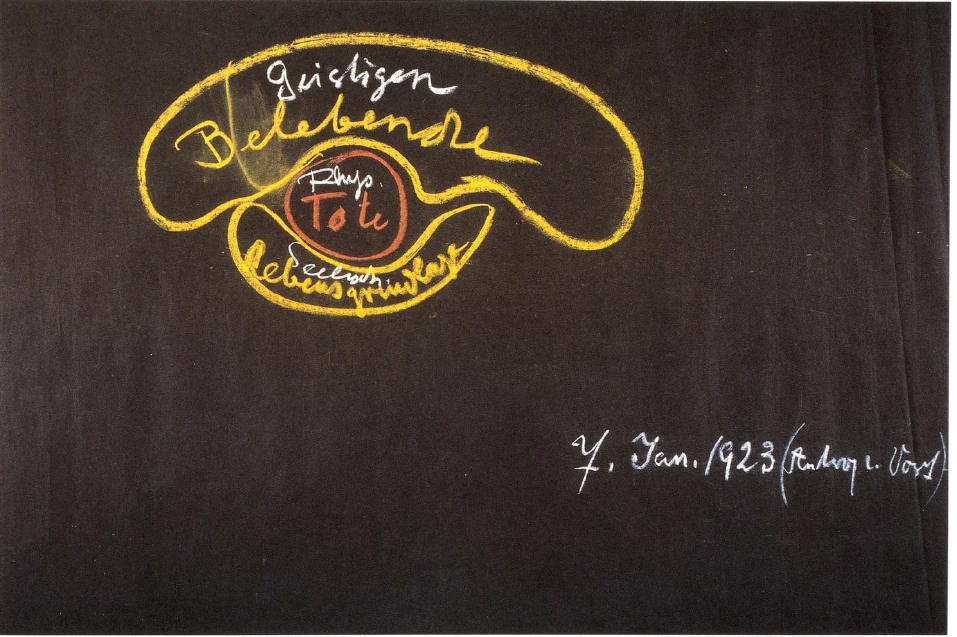
[ 28 ] Dadurch erlangt man eine Erkenntnis mit vollem Bewußtsein. Früheres instinktives Erkennen war die Folge einer andern Einschaltung des astralischen Leibes in den ätherischen Leib, als sie heute der Fall ist. Heute ist die Einschaltung diese, daß der Mensch als Erdenmensch ein freier Mensch werden kann. Dazu ist aber notwendig, daß der Mensch erstens erkennt das tote Gegenwärtige, die Lebensgrundlage der Vergangenheit durch dasjenige, was von unten heraufkommt von der Metallizität der Erde, und das Belebende von oben als Sternenwirkungen und Sternenkonstellationen (siehe Zeichnung Seite 55).
[ 28 ] This leads to insight gained through full consciousness. Earlier, instinctive recognition was the result of a different kind of interaction between the astral body and the etheric body than is the case today. Today, this interaction is such that human beings, as earthly beings, can become free human beings. For this to happen, however, it is necessary that human beings first recognize the “dead present”—the foundation of life from the past—through what rises from below, from the earth’s metallic nature, and the life-giving forces from above as stellar influences and constellations (see illustration on page 55).
[ 29 ] Und bei jedem Organ wird eine wahre Menschenkenntnis suchen müssen diese Dreiheit — nach Totem oder Physischem, nach der Lebensgrundiage oder dem Seelischen, nach dem Belebenden oder dem Geistigen. Und so wird man bis in die Einzelheiten der menschlichen Natur überall suchen müssen nach dem PhysischKörperlichen, nach dem Seelischen, nach dem Geistigen. Und der Ausgangspunkt dafür muß vernünftigerweise gewonnen werden aus einer richtigen Einschätzung desjenigen, was wir als das bisherige Ergebnis der Naturwissenschaft erkannt haben. Es muß erkannt werden, daß uns der gegenwärtige Stand der Naturwissenschaft überall zu dem Erdengrabe hinführt und daß wir herausfinden müssen aus dem Erdengrab das Lebendige.
[ 29 ] And for every organ, a true understanding of human nature must seek out this triad—the inorganic or physical, the life-principle or the psychical, and the animating or the spiritual. And so, down to the finest details of human nature, one must search everywhere for the physical, for the soul, and for the spiritual. And the starting point for this must reasonably be derived from a correct assessment of what we have recognized as the results of natural science to date. It must be recognized that the current state of natural science leads us everywhere to the earthen grave, and that we must discover the living from within that earthen grave.
[ 30 ] Das finden wir, wenn wir in der Tat gewahr werden, wie die neuere Geisteswissenschaft alte Ahnungen beleben muß. Ahnungen von diesen Dingen waren immer da. Ich habe in diesen Tagen den Arbeitenden auf den verschiedensten Gebieten Verschiedenes geraten. Ich möchte nun den Literaturhistorikern auch anraten, wenn sie von Goetheanismus reden wollen, sich doch einmal an die Goethesche Ahnung zu halten, die sie im zweiten Teil von «Wilhelm Meister, in «Wilhelm Meisters Wanderjahren», finden, wo ein Wesen vorkommt, das durch einen krankhaften Seelen-Geisteszustand Sternbewegungen mitlebt. Ihr ist ein Astronom an die Seite gegeben. Aber diesem Wesen steht eine andere Person entgegen, die Metallfühlerin. Ihr ist der Montanus, der Bergmann, an die Seite gegeben, der Geologe. Darin liegt eine tiefe Ahnung, eine Ahnung, die viel tiefer ist als alles, was an physikalischen Wahrheiten seit Goethe in der naturwissenschaftlichen Entwickelung zutage getreten ist, so groß diese auch sind. Denn diese naturwissenschaftlichen Erkenntnisse gehören dem Umkreise des Menschen an; Goethe hat hingedeutet im zweiten Teil seines «Wilhelm Meister», in «Wilhelm Meisters Wanderjahren», auf dasjenige, was den Welten angehört, mit denen der Mensch nach oben hin zu den Sternen, nach unten hin in die Tiefe der Erde zusammenhängt.
[ 30 ] This is what we discover when we truly become aware of how modern spiritual science must breathe new life into ancient intuitions. Intuitions about these things have always been there. In recent days, I have offered various pieces of advice to people working in a wide variety of fields. I would now also like to advise literary historians, if they wish to speak of “Goetheanism,” to stick to the Goethean intuition found in the second part of Wilhelm Meister’s Journeyman Years, where a being appears who, due to a pathological state of soul and spirit, experiences the movements of the stars as if they were her own. An astronomer is assigned to her side. But this being is contrasted by another character, the “metal-senser.” She is accompanied by Montanus, the miner, the geologist. Herein lies a profound insight—one that is far deeper than any of the physical truths that have come to light in the development of the natural sciences since Goethe, however great those truths may be. For these scientific insights belong to the sphere of the human being; in the second part of his Wilhelm Meister, Wilhelm Meister’s Journeyman Years, Goethe pointed to that which belongs to the worlds with which the human being is connected—upward toward the stars and downward into the depths of the Earth.
[ 31 ] Und von solchen Dingen können noch sehr viele gefunden werden sowohl in den nutzbringenden Wissenschaften wie in den Luxuswissenschaften. Aber auch diese Dinge werden erst als wirkliche Erkenntnisschätze gehoben werden, wenn man einmal den Goetheanismus auf der andern Seite so ernst nehmen wird, daß man manches, was bei Goethe Ahnung ist, durch Geisteswissenschaft erleuchtet, oder aber auch vielleicht das Geisteswissenschaftliche dadurch zu etwas umgestaltet, was einem eine gewisse historische Freude macht, indem man die Dinge, die jetzt als Erkenntnis auftreten, bei Goethe als eine Art Ahnung in romanhafter Form verarbeitet findet.
[ 31 ] And many more such things can be found both in the practical sciences and in the liberal arts. But even these things will only be unearthed as true treasures of knowledge once Goetheanism is taken so seriously on the other hand that much of what is merely a hunch in Goethe’s work is illuminated by spiritual science—or perhaps even transforms the spiritual-scientific perspective into something that brings a certain historical joy, by reworking the things that now appear as knowledge are found in Goethe’s work as a kind of intuition rendered in novelistic form.
[ 32 ] Durch alles das aber möchte ich eben darauf hindeuten, daß, wenn die Rede davon ist, daß wissenschaftliche Bestrebungen innerhalb der anthroposophischen Bewegung gepflegt werden sollen, sie mit dem tiefen Ernst gepflegt werden sollen, der nicht die Anthroposophie in die Gefahr bringt, nach der heutigen Chemie oder der heutigen Physik oder der heutigen Physiologie und dergleichen abgeleitet zu werden, sondern der in den wirklichen Strom anthroposophisch lebendiger Erkenntnis die einzelnen Wissenschaften einbezieht. Hören möchte man, daß die Chemiker, daß die Physiker, daß die Physiologen, daß die Mediziner anthroposophisch reden. Denn das wird nicht weiterführen, daß die einzelnen Spezialisten dazu kommen, Anthroposophie zu zwingen, chemisch oder physikalisch oder physiologisch zu reden. Dadurch wird Anthroposophie doch nur Gegnerschaft erwecken, während endlich vorwärtsgekommen werden muß, indem die Anthroposophie sich auch für diese Spezialisten als Anthroposophie erweist, und nicht bloß als irgend etwas, was seiner Terminologie nach genommen wird, wo die einzelnen Termini hinübergestülpt werden über das, was man sonst auch schon hat. Es ist ganz gleichgültig, ob man anthroposophische oder andere Termini über den Wasserstoff oder über den Sauerstoff und so weiter stülpt, oder ob man bei den alten Termini bleibt. Worauf es ankommt, ist, mit seinem ganzen Menschen die Anthroposophie aufzunehmen. Dann wird man in der richtigen Weise Anthroposoph auch als Chemiker, als Physiologe, als Arzt sein.
[ 32 ] Through all of this, however, I would simply like to point out that when we speak of the need to cultivate scientific endeavors within the anthroposophical movement, they must be pursued with a profound seriousness that does not put anthroposophy at risk of being reduced to modern chemistry, modern physics, modern physiology, and the like, but rather incorporates the individual sciences into the true stream of living anthroposophical knowledge. One would like to hear chemists, physicists, physiologists, and physicians speak in an anthroposophical way. For it will lead nowhere if individual specialists are compelled to make anthroposophy speak in chemical, physical, or physiological terms. This will only arouse opposition to anthroposophy, whereas progress must ultimately be made by anthroposophy proving itself to be anthroposophy even for these specialists—and not merely something whose terminology is adopted, where individual terms are simply superimposed onto what already exists. It makes no difference at all whether one applies anthroposophical or other terms to hydrogen or oxygen and so on, or whether one sticks with the old terms. What matters is embracing anthroposophy with one’s whole being. Then one will truly be an anthroposophist—as a chemist, as a physiologist, as a physician.
[ 33 ] Ich wollte gerade, daß dieser Kursus, für den man von mir verlangt hat, eine Darstellung der Geschichte naturwissenschaftlicher Denkweise zu geben, wirklich diejenige Erkenntnis aus dieser historischen Betrachtung bringt, die auch fruchtbar werden kann. Denn fruchtbar zu werden auf den verschiedensten Gebieten, wirklich fruchtbar, das hat die anthroposophische Bewegung durchaus nötig. Davon werde ich dann in meinem nächsten Vortrag für diejenigen, die dann da sein werden, weiter sprechen.
[ 33 ] My intention was that this course—which I was asked to give to present the history of scientific thinking—should truly yield insights from this historical perspective that can also bear fruit. For the anthroposophical movement has a vital need to bear fruit in the most diverse fields—truly bear fruit. I will speak further on this in my next lecture for those who will be present then.