

Living Knowledge of Nature,
Intellectual Fall from Grace
and Spiritual Elevation from Sin
GA 220
7 January 1923, Dornach
Translated by Steiner Online Library
Third Lecture
[ 1 ] Today, as part of this course, I would like to follow up on what has been discussed so far by presenting some findings from spiritual science regarding the human being—findings that may seem somewhat far-fetched. These findings are intended to show how the human being is situated within the universe. When we speak of the human being, we first direct our attention to their physical organization, then to what is revealed to spiritual research: the etheric or life body, the astral body, and the “I” organization. But we do not yet understand this structure of the human being if we simply list these elements in sequence, for each of these components is integrated into the universe in a different way. And only when we understand how the various components are integrated into the universe can we even begin to form a conception of the human being’s place in the universe.
[ 2 ] When we consider human beings as they appear before us, these four elements of human nature are interwoven in a way that is, at first glance, indistinguishable; they are united in a reciprocal relationship, and in order to understand them, one must, so to speak, first distinguish them from one another and consider each one individually in its specific relationship to the universe. We will be able to undertake such an examination—not in an exhaustive manner, but from a certain perspective—if we proceed as follows.
[ 3 ] Let us turn our attention to the more peripheral aspects of the human being—to the exterior, to the boundaries. There we first encounter the senses. We know, however, from other anthroposophical considerations that we only discover certain senses when we, so to speak, go beneath the surface of the human form, into the human interior. But essentially, we would also have to seek the senses that inform us about our own inner being—at their point of origin—in a very unconscious way, precisely on the inner side of the human surface. So one can say that everything that constitutes a sense in the human being is to be found on the surface. One need only consider one of the most conspicuous senses—for example, the eye itself or the ear—and one will find that human beings must receive certain impressions from the outside. How things really stand with these impressions, of course, must always first be discerned through more detailed observation and more thorough research, which we have already undertaken here in this room for some of the senses. But as things appear in everyday life, one can say, for example: A sense such as the eye or the ear perceives things through external impressions.
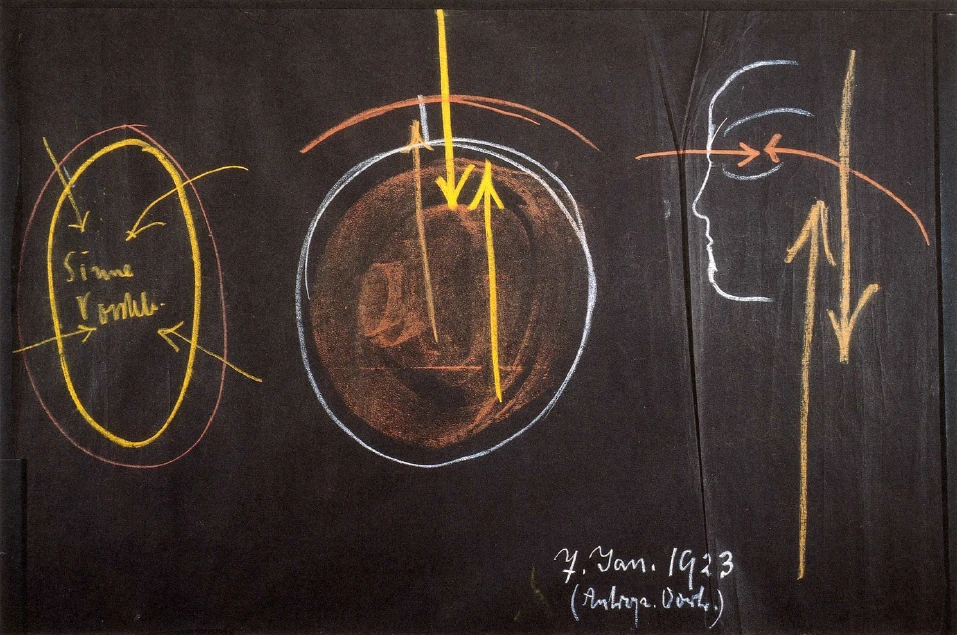
[ 4 ] Now, the position of human beings in the earthly realm is such that it is easy to see that the main direction in which the effects of things occur—enabling them to arrive at sensory perceptions—could be described as roughly “horizontal.” A closer examination would also show that the assertion I have just made is entirely correct. For if it seems as though we perceive in a different direction, this is merely due to an illusion. Every direction of perception must ultimately fall along the horizontal plane. And the horizontal plane is the line that is parallel to the Earth. So if I were to draw a schematic diagram, I would have to say: If this is the Earth’s surface and the perceiving human is standing on it, then the main direction of his perception is the one that is parallel to the Earth (drawing on p. 42, left). All the directions of our perception run in this direction.
[ 5 ] And when we consider human beings, we can easily say: Perceptions come from the outside; they move, so to speak, from the outside to the inside. — What do we offer them from within? We offer them, from within, thinking and the power of imagination. You need only visualize this process. You will say to yourselves: When I perceive through the eye, the impression comes from the outside; the power of imagination, that comes from within (drawing on p. 42, right). The impression comes from the outside when I see the table. The fact that I can then also retain the table in my memory with the help of an image—that is where the power of imagination comes in from within. So we can say: When we schematically imagine a human being, the direction of perception is from the outside to the inside, while the direction of imagination is from the inside to the outside. What we are considering here relates to the perceptions of the everyday life of the earthly human being—that earthly human being as he outwardly manifests himself in our present age of earthly evolution. This is what I mentioned above: the reality of ordinary consciousness. But if you go through anthroposophical literature, you will find that there are other possibilities of consciousness besides those that are available to the earthly human being in everyday life.
[ 6 ] Now try, even if only roughly and vaguely, to form a picture of what is perceived by the earthly human being. You see what exists on Earth in colors, hear it in sounds, perceive it through sensations of warmth—and so on. You create contours for what is perceived, so that you perceive things as shaped forms. But what we recognize as our own existence in relation to our surroundings is merely the reality of ordinary, everyday consciousness. There are, in fact, other possibilities of consciousness that remain largely unconscious in human beings on Earth, that are pushed into the depths of the soul life, but which are of equally great—and often much greater—significance for this human life than those aspects of consciousness that are limited to what I have mentioned so far.
[ 7 ] For the human constitution—for what a human being is on Earth—what lies within the Earth’s surface is just as important as what lies in the Earth’s orbit. The Earth’s surroundings—that which is around the Earth—is precisely what is perceptible to the ordinary senses, and what, through the imagination that responds to sensory perception, can become the consciousness of the ordinary earthly human being.
[ 8 ] But let us first consider the interior of the Earth. A simple reflection will tell you that the interior of the Earth is hidden from ordinary consciousness. Certainly, we can dig a short distance into the Earth and then, in these holes—say, in mines—observe just as we do on the surface. But this is no different from observing a human corpse. When we observe a corpse, we are, after all, observing only something that is no longer the whole human being—something that is a remnant of the whole human being; anyone who can look at these things correctly must even say: it is the opposite of the human being. The reality of the earthly human being is the living, walking human being, and what corresponds to this is what he carries within himself in terms of bones, muscles, and so on. The skeletal structure, the muscular structure, and the nervous system correspond to the living human being as a truth; the heart, lungs, and so on correspond to him as well. When I have the corpse before me, it no longer corresponds to the human being. There is absolutely no reason why the structure I have before me as a corpse should contain lungs, a heart, or a muscular system. That is why they decay. For a while, they retain the form that has been imposed upon them. But a corpse is actually an untruth, for as it is, it cannot exist; it must disintegrate. It is not reality. Likewise, what I find inside the Earth when I dig into it is not reality either, because the closed Earth has a different effect on the human being standing upon it than what the human being, when standing on the Earth’s surface, perceives through their senses as the Earth’s surroundings. You might say, if you first consider the matter from a spiritual perspective: The Earth’s surroundings are capable of acting upon human beings’ ordinary senses and of being grasped by the imagination of ordinary earthly consciousness. What lies within the Earth also acts upon human beings, but it does not act in the horizontal direction; it acts from below upward. It passes through the human being (drawing on p. 46, left, red arrow). And in ordinary consciousness, a person does not perceive what acts from below upward in the same way that they perceive, through their ordinary senses, what is in their earthly environment. For if a person were to perceive what acts upward from the Earth in the same way that they perceive what is in the earthly environment, then they would, so to speak, need to have a kind of eye or a kind of sense of touch to reach into the earth without digging a hole in it, in order to pass through the earth just as one passes through the air when reaching for something, or just as one sees through the air when looking at something. When you look through the air, you do not dig a hole through the air. If you were to dig a hole through the air and only then look, you would view the surroundings just as you view the earth in a mine. So if you did not need to dig a hole to see the interior of the earth, you would have to have a sense organ capable of seeing without digging holes in the earth—one for which the earth, just as it is, is transparent or perceptible through touch. In a certain sense, this is true for human beings. But in ordinary earthly life, the perceptions in question do not come to human consciousness. For what a person would perceive there are the differentiated metals of the Earth.
[ 9 ] Just imagine for a moment how many metals the Earth contains! Just as you perceive animals, plants, minerals, and all manner of artistic objects in the air around you, so too do you perceive metals rising up from the Earth’s interior. But if these perceptions of metals were to truly enter your consciousness, they would not be concrete perceptions; rather, they would be imaginations. And these imaginations also rise up continuously from below into human beings. Just as visual impressions come from the horizontal plane, so too do the radiations of metals continually rise from below—not visual perceptions of the minerals, but rather something of the inner nature of the minerals works its way up through the human being to form imaginations, to form images. Human beings do not perceive these images; rather, they fade away. They are, so to speak, suppressed, because human beings’ earthly consciousness is not such that they can perceive these imaginations. They fade away into feelings.
[ 10 ] For example, if you imagine all the gold that is in the earth—somehow in crevices and so on—your heart actually perceives an image that corresponds to the gold in the earth (drawing on p. 46, left, purple). However, this image is merely an imagination, and therefore it is not perceived by ordinary consciousness; rather, it is dulled into a mere inner sense of life—a sense of life that a person cannot even interpret, let alone perceive the corresponding image. The same is true of other organs; for example, the liver perceives all the tin in the earth as a specific image, and so on.
[ 11 ] All of these are subconscious impressions that arise generally in a horizontal manner from perceptions of the earthly environment, with the imagination meeting them from within; thus, perceptions of metal—specifically perceptions of metal—rise up from below, and just as the imagination meets ordinary perceptions, feeling meets them in consciousness (drawing on the left, yellow arrows). But for people living on Earth today, it remains chaotic and unclear. All that emerges is a general sense of life.
[ 12 ] If this earthly human being had a gift for imagination, he would know that his being is also connected to the metallic element of the earth. In fact, every human organ is a sensory organ, and even if we use it for something else—or if it seems that we are using it for something else—it is still a sensory organ. Its function in earthly life is, in fact, only a vicarious one. With all the organs that a human being possesses, he or she actually perceives something. The human being is entirely a great sensory organ, and, as such, this great sensory organ is further specified and differentiated into its individual organs as specific sensory organs.
[ 13 ] Human beings thus have perceptions of metal rising up from below, and these perceptions of metal correspond to the life of feeling. We have our feelings precisely as a counteraction to everything that acts upon us from the earth in a metallic way, just as we have our power of imagination as a counteraction to everything that penetrates into our sensory perception from the environment. But just as human beings experience the effects of the metals rising from below, so too does that which constitutes the movement and form of the celestial bodies act from above, from outer space, down toward us. Just as we have sensory perception in our surroundings, so too do we have, for a consciousness that would function as inspired consciousness, inspirations from every planetary movement and from the constellations of fixed stars. And just as we allow the power of imagination to flow in opposition to ordinary sensory perception, so we allow a force (see drawing on the right, yellow arrows) to flow in opposition to the movements of the celestial bodies—a force that is opposed to the impressions of the stars—and this force is the power of the will. What lies within our willpower, we would perceive as inspiration if we were to take inspired consciousness into account.
[ 14 ] When we study human beings in this way, we tell ourselves: In their earthly consciousness, we first find that aspect in which they are most awake—the life of imagination and the senses. In fact, it is only in this life of imagination and the senses that we are fully awake in ordinary earthly consciousness. In contrast, our emotional life exists only in a dreamlike state. Our emotional life is no more intense, no brighter than dreams are; it is just that dreams are images, whereas the emotional life is the general state of the soul—one that can be determined by life itself—namely, the state of feeling. But underlying this feeling is the metallic influence of the Earth. Even deeper—as I have often explained—and even more subdued is the consciousness of the will. Human beings do not know what their will actually is within them. I have often put it this way: Human beings have
[ 15 ] the thought that he is stretching out his arm, that he is grasping something with his hand. He can have this thought with his waking consciousness. Then he sees, in turn, the act of grasping itself. But what actually lies in between—this surge of the will into the muscles and so on—remains just as hidden from ordinary consciousness as the experiences of deep, dreamless
[ 16 ] Sleep. In feeling, we dream; in willing, we sleep. But this will, which lies dormant in ordinary consciousness, is precisely what the human being responds with to the impressions of the stars, just as he responds in his ideas to the sensory impressions of ordinary consciousness. And what the human being dreams in his feelings is the counteraction to the metallic influence of the Earth.
[ 17 ] When we, as modern human beings on Earth, are awake, we perceive the things around us. Our power of imagination interacts with them. For this, we need our physical body and our etheric body. Without the physical body and without the etheric body, we cannot develop the forces that act in the horizontal direction through perception and imagination. So that, if we want to visualize this schematically, we can say: the physical body and the etheric body are filled, for daytime consciousness, with the impressions of the senses and the power of imagination (see diagram, yellow). When a person sleeps, their astral body and their “I” organization are outside the physical body. It is these that receive the impressions from below and from above. It is the “I” and the astral body that actually sleep within what emanates from the Earth as metallic currents and what descends from above as the currents of planetary movements and the constellations of fixed stars. What is thus generated in the Earth’s surroundings—but which has no horizontal force effect, instead acting as forces from above downward—is the very environment in which we find ourselves during the night.
[ 18 ] If you were to attempt to move from ordinary consciousness to imagination—so that true imaginative consciousness is present—then, given the current stage of human development, this would have to be such that all human organs are equally engaged by this consciousness. It must not be, say, merely the heart that is engaged, but all the organs must be engaged equally. I said earlier that the heart perceives the gold that is in the earth. But it can never perceive the gold on its own, for the fact is this: As long as the “I” and the astral body are connected to the physical body and the etheric body in the way that is the case with the normal waking human being, nothing at all can become a conscious perception. Only when the “I” and the astral body—as is the case in imagination—are made independent to a certain degree, so that they become separate from the physical and etheric bodies, can we say: The astral body and the “I”-organization in the vicinity of the heart region become capable of perceiving something of this outflow of the metallic element within the earth. And so one can say: The center for the effects of the outflow of gold lies in the astral body in the region of the heart. The heart perceives because the astral body, which belongs to this region—the heart—is what actually perceives. The physical organ does not perceive; rather, it is the astral body that perceives.
[ 19 ] Once imaginative consciousness is acquired, the entire astral body—as well as the entire “I”-organization—must be in a state in which they perceive the parts corresponding to all human organs. This means that the human being then perceives the entire metallic nature of the Earth, albeit in varying degrees of differentiation. One can perceive details of this only if one were to train oneself specifically for this purpose and make it one’s special occult study to become acquainted with the metallic nature of the Earth. This knowledge is not meant to be ordinary knowledge for human beings in the present epoch. People today should not put this knowledge to use in the service of their practical and beneficial lives. Because this is a universal law, if anyone were to put this knowledge of the Earth’s metallic nature to use—even in the slightest way—in the service of ordinary, utilitarian life, their imaginative perception would be taken away.
[ 20 ] However, it can happen that, due to pathological conditions somewhere within the human being or even in general, the intimate connection that should actually exist between the astral body and the organs is interrupted, so that the person, in a sense, sleeps while remaining awake in a very subtle way. When they are truly asleep, their physical body and etheric body are on one side, and their astral body and ego are on the other. But there is also a form of sleep so subtle that the person walks around in a barely perceptible daze, in a state that one might even find very interesting, because such people look strangely “mystical,” with such mystical eyes and the like. This may stem from the fact that a very subtle form of sleep is present even while the person is awake. There is always a kind of vibration of the physical and etheric bodies in relation to the “I” organization and the astral body. It vibrates back and forth like this. And such people are then suited to be used as metal detectors. But the ability to sense specific metallic elements here and there in the earthly realm is always based on a certain pathological predisposition. Of course, as soon as one views the matter purely from a technical standpoint and puts it in the service of technical-earthly purposes, one may be quite indifferent—if I may speak harshly—as to whether people are a little ill or not. After all, one does not usually pay much attention to the means by which one accomplishes this or that useful end. But viewed from within, from the standpoint of a higher worldview, it is always something pathological when a person comes to perceive in this way—not only horizontally within the earthly environment, but also downward—and not through holes, but directly. Then, of course, it is necessary that the person not express what he or she perceives there in the ordinary way. When one takes a pen and writes something down, the ordinary life of imagination is present there; that must be set aside. But this ordinary power of imagination—which, if I may use the expression, “illuminates” as opposed to “darkening”—illuminates the perception that rises from below. And so it is necessary to make different signs than when writing or speaking, when, through pathological states, one perceives specifically metallic elements in the earth. I note, for example, that water is also a metal. Such individuals with pathological conditions can be trained precisely to not only perceive unconsciously, but also to make signs unconsciously for that perception. If, for example, one gives such a person a divining rod, they use it to make these signs. What is the basis for all this? It is based precisely on the fact that there is that slight interruption between the “I” and the astral body on the one hand, and the physical body and the etheric body on the other, and as a result, the person not only perceives what is beside them—roughly speaking—but, by shutting out their physical body, becomes a sensory organ and perceives the interior of the Earth without making holes in it. But when this direction—which is otherwise merely the normal direction of feeling—is at work, then the person cannot express themselves in a way that corresponds to their imagination. They do not articulate it in words. They can only express it through signs, as I have indicated.
[ 21 ] In a similar way, however, it is possible to stimulate in a person a perception that comes down from above. This perception has a different inner character. It is not a metallic perception, but rather inspiration that reflects the movements of the stars or constellations. And just as a person perceives the constitution of the Earth from below, so too does he perceive from above that which occurs only through these pathological states—namely, when, in this case, the “I” is somewhat detached from the astral body. He then perceives from above that which actually gives the world its division of time, the flow of time. Through this, they see more deeply into the events of the world—not only into the past, but also into certain events that do not, however, arise from free human will, but rather from the necessity of the world order. They then look, as it were, prophetically into the future; they look into the order of time.
[ 22 ] I simply wanted to use these examples to suggest to you that, through certain pathological conditions, a person can indeed expand their powers of perception. In a healthy way, these powers are expanded through imagination and inspiration. What constitutes the healthy and the pathological in this field may become clear to you from the following: It is quite good for a normal person to have, let’s say, a normal sense of smell. If a person has a normal sense of smell, they will perceive the objects around them through smell. But if they have an abnormal sensitivity to certain things in their environment that have a smell, they may develop an idiosyncrasy when these particular objects are present in their environment. There may be people who, for example, actually become quite ill from the smell when they enter a room containing a single strawberry; they don’t even need to eat it. That is not exactly a desirable condition. Nevertheless, under certain circumstances, someone who isn’t focusing on the person but perhaps on the possibility that strawberries stolen by that person—or any other stolen items with a distinct scent—might be found somewhere could make use of this particular human ability. If humans could develop their sense of smell to the same degree as dogs, there would be no need for police dogs; instead, humans could be used for that purpose.
[ 23 ] But one must not do that. You will therefore understand when I say that the faculty of perception—both downward and upward—must not be developed in an incorrect way, such that it becomes associated with pathological conditions, for this is of such a nature that it is directly destructive to the entire human organism. To train people to be “metal detectors” would be tantamount to training people to be police dogs or bloodhounds. Except that the purely human criminality involved here is much more intense. But such a thing can occur in one person or another only through pathological conditions.
[ 24 ] You will be able to understand all the things that come your way—in a mostly amateurish, confused, and nebulous manner—both in terms of their theoretical aspects and in terms of how these things must be evaluated within the broader context of human existence. That is one side of the matter.
[ 25 ] But the other side of the matter is this: there is also a just use of such insights. In order to provide people with gold, the one who possesses imaginative insight must not use the imaginative power of the astral body, which is located in the region of the heart. But they can use it to recognize the structure, the true tasks, and the inner nature of the heart itself. They can use it in the sense of human self-knowledge. This also corresponds in physical life to the proper use of, say, the sense of smell or the sense of sight, or the like. And in this way one learns to recognize every human organ by being able to bring together what one perceives from below and what one perceives from above.
[ 26 ] For example, you learn to recognize the heart when you perceive the earth’s gold content as it flows out and can be sensed by the heart, and when, on the. other hand, recognize the flow of will coming in from the sun above—that is, the countercurrent to the solar flow as will—so that through the interaction of the solar flow from above, from the sun’s zenith, with the recognition of gold from below, by bringing these two together, allow yourself to be inspired by the Earth’s golden essence toward imagination, and by the Sun toward inspiration, then you will attain the heart-knowledge of the human being. And in the same way, the knowledge of the other organs. Thus, if a person truly wishes to come to know themselves, they must allow the elements of this knowledge from the cosmos to take effect within them.
[ 27 ] We have thus entered a realm that points, in an even more concrete way than I have sometimes done in the past, to the connection between human beings and the cosmos. If you consider the lectures I have recently concluded on the development of the understanding of nature in modern times, you will have seen from yesterday’s lecture in particular that it is essentially the “dead” that humanity perceives through the current stage of natural science. For humanity does not perceive itself as it truly is, but rather in terms of its “dead” aspect. And a true understanding of the human being will only blossom from the synthesis of what is recognized in the human being as dead organs—as organs in their lifelessness—with what can be recognized about these organs from above and from below.
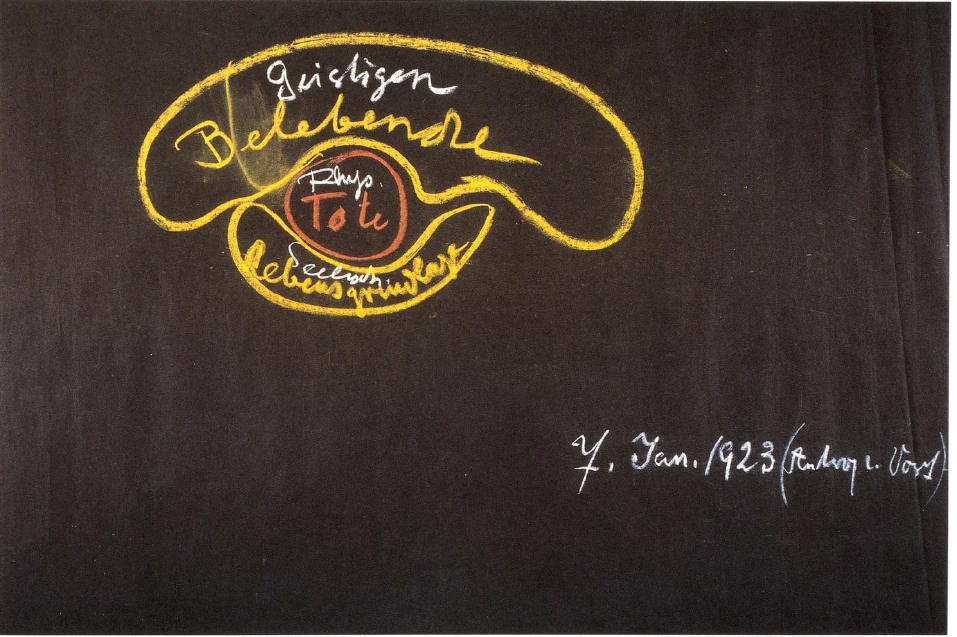
[ 28 ] This leads to insight gained through full consciousness. Earlier, instinctive recognition was the result of a different kind of interaction between the astral body and the etheric body than is the case today. Today, this interaction is such that human beings, as earthly beings, can become free human beings. For this to happen, however, it is necessary that human beings first recognize the “dead present”—the foundation of life from the past—through what rises from below, from the earth’s metallic nature, and the life-giving forces from above as stellar influences and constellations (see illustration on page 55).
[ 29 ] And for every organ, a true understanding of human nature must seek out this triad—the inorganic or physical, the life-principle or the psychical, and the animating or the spiritual. And so, down to the finest details of human nature, one must search everywhere for the physical, for the soul, and for the spiritual. And the starting point for this must reasonably be derived from a correct assessment of what we have recognized as the results of natural science to date. It must be recognized that the current state of natural science leads us everywhere to the earthen grave, and that we must discover the living from within that earthen grave.
[ 30 ] This is what we discover when we truly become aware of how modern spiritual science must breathe new life into ancient intuitions. Intuitions about these things have always been there. In recent days, I have offered various pieces of advice to people working in a wide variety of fields. I would now also like to advise literary historians, if they wish to speak of “Goetheanism,” to stick to the Goethean intuition found in the second part of Wilhelm Meister’s Journeyman Years, where a being appears who, due to a pathological state of soul and spirit, experiences the movements of the stars as if they were her own. An astronomer is assigned to her side. But this being is contrasted by another character, the “metal-senser.” She is accompanied by Montanus, the miner, the geologist. Herein lies a profound insight—one that is far deeper than any of the physical truths that have come to light in the development of the natural sciences since Goethe, however great those truths may be. For these scientific insights belong to the sphere of the human being; in the second part of his Wilhelm Meister, Wilhelm Meister’s Journeyman Years, Goethe pointed to that which belongs to the worlds with which the human being is connected—upward toward the stars and downward into the depths of the Earth.
[ 31 ] And many more such things can be found both in the practical sciences and in the liberal arts. But even these things will only be unearthed as true treasures of knowledge once Goetheanism is taken so seriously on the other hand that much of what is merely a hunch in Goethe’s work is illuminated by spiritual science—or perhaps even transforms the spiritual-scientific perspective into something that brings a certain historical joy, by reworking the things that now appear as knowledge are found in Goethe’s work as a kind of intuition rendered in novelistic form.
[ 32 ] Through all of this, however, I would simply like to point out that when we speak of the need to cultivate scientific endeavors within the anthroposophical movement, they must be pursued with a profound seriousness that does not put anthroposophy at risk of being reduced to modern chemistry, modern physics, modern physiology, and the like, but rather incorporates the individual sciences into the true stream of living anthroposophical knowledge. One would like to hear chemists, physicists, physiologists, and physicians speak in an anthroposophical way. For it will lead nowhere if individual specialists are compelled to make anthroposophy speak in chemical, physical, or physiological terms. This will only arouse opposition to anthroposophy, whereas progress must ultimately be made by anthroposophy proving itself to be anthroposophy even for these specialists—and not merely something whose terminology is adopted, where individual terms are simply superimposed onto what already exists. It makes no difference at all whether one applies anthroposophical or other terms to hydrogen or oxygen and so on, or whether one sticks with the old terms. What matters is embracing anthroposophy with one’s whole being. Then one will truly be an anthroposophist—as a chemist, as a physiologist, as a physician.
[ 33 ] My intention was that this course—which I was asked to give to present the history of scientific thinking—should truly yield insights from this historical perspective that can also bear fruit. For the anthroposophical movement has a vital need to bear fruit in the most diverse fields—truly bear fruit. I will speak further on this in my next lecture for those who will be present then.