Living Knowledge of Nature,
Intellectual Fall from Grace
and Spiritual Elevation from Sin
GA 220
5 January 1923, Dornach
Translated by Steiner Online Library
First Lecture
[ 1 ] Today, following the lectures I gave during the final days of the former Goetheanum, I would like to take you back once more—in connection with the relationship between the human being and the cycle of the year, and the insights pertaining to this relationship—to an era that we have often considered and that must be fully understood if one is to perceive the present state of human development in the proper way. We have, after all, spoken of the possibility that processes take place within the human being in the most definite way, processes that can be recognized in the ever-recurring events of the course of the year. And I have also pointed out how the ancient science of the mysteries, the science of initiation, set out to disseminate such insights among those who were receptive to them. By disseminating such insights, the aim was to strengthen human thinking, feeling, and willing—the whole way in which human beings relate to the world.
[ 2 ] Now we may ask ourselves: What was the reason that, in earlier times, people had an innate understanding of this relationship between the human being—the microcosm—and the greater world—the macrocosm—as it is expressed in the course of the year? For people did indeed possess such an understanding. They possessed this understanding because, in those earlier times, the inner soul of the human being was more closely bound to the etheric body—or body of formative forces—than is the case today. We know, after all, from the sketchy descriptions I was able to provide in the French course, that when a human being has passed through the supersensible phase of life between death and a new birth, after having sent the spiritual seed of his physical body down to Earth but not yet having descended himself as a soul-spiritual being prior to conception—that he then draws in the forces of the world ether from the cosmos and forms his etheric body from them, which he thus possesses before uniting with his physical body. Human beings thus descend from the spiritual and supersensible worlds in such a way that they first clothe their spiritual-soul nature with their etheric body. Then they unite with that which is handed down to them as a physical body through the physical hereditary stream, via their father and mother.
[ 3 ] In earlier periods of human evolution, the connection that a person could establish with the etheric body before their earthly life was much more intimate than it was later on and is today. It was precisely this deeper connection with the etheric body that enabled an earlier humanity to understand what was meant when the insight emerged from the mysteries: That which is seen as the physical sun is the physical expression of something spiritual. — There was an understanding when people spoke of the spirit of the sun. Understanding existed because, given that intimate connection between the human spiritual-soul being and the etheric body—or body of formative forces—it would have seemed utterly absurd to people if they had had to believe that somewhere up there in outer space floated that physical ball of gas of which, for example, modern astrophysics tells us. It had seemed self-evident to these ancient people that a spiritual aspect belonged to this physical reality. And this spiritual aspect was precisely what was recognized and revered in all the ancient mysteries as the Sun Spirit.
[ 4 ] Now we can—of course, all these things are only approximately correct, but in essence they are indeed true—identify the 4th century A.D. as the period during which human beings descending from the spiritual-supernatural world no longer had this inner connection with the etheric body or the body of formative forces. It was a looser connection. Consequently, the conditions were increasingly being set in motion so that even in their physical earthly lives, people could make use of their physical bodies only when they—if I may put it this way—looked up toward heaven. In earlier times, when people looked up toward the heavens, they saw the sun, but an impulse arose within them not to see in this sun merely something physical, but to know that something spiritual-soul-related was connected with it. After the 4th century A.D., in order to see the sun, one could make use only of the physical body and the physical eyes, through which the gaze, when it wandered outward, was no longer carried by the power of the etheric body or the body of formative forces. Consequently, people saw more and more only the physical sun. And the existence of a sun spirit could be taught only because the ancients knew of it and because it was preserved as tradition. Thus, for example, Julian the Apostate, as I have mentioned before, learned from his teachers that such a sun spirit exists. Now, as we know, this Sun Spirit descended to Earth through the Mystery of Golgotha. He transferred his heavenly life course down to Earth and transformed it into an earthly life course by orienting his future work, since the Mystery of Golgotha, toward guiding the development of humanity within the context of earthly activity.
[ 5 ] You will notice: the two points in time do not coincide. The moment of the Mystery of Golgotha—how does it appear to us when we look back on it today? We must then say: At this moment, the Christ, the High Solar Being, passes through the Mystery of Golgotha and unites with earthly existence. To put it simply: since that moment, the Christ has been on Earth. People were able to perceive the Sun Spirit until the 4th century A.D., because until then they were still more intimately connected to their etheric body, or body of formative forces.
[ 6 ] Even though Christ himself had already been on Earth, people continued to see the sun—right up into the 4th century—in such a way that, in a sense, they were still seeing its afterimage through the etheric body. Just as in the physical world, when one looks intently at something and then closes one’s eyes, an afterimage remains in the eye, so too did the human etheric body—when it beheld the sun—retain an afterimage of the solar spirit in those individuals in whom this capacity had not yet been lost, whenever the person gazed out into the cosmos. This is why such people, who were still connected in this way to their etheric body—and this was particularly the case for very many people in southern European regions, in North Africa, and in the Near East—simply said to themselves, based on their experience: The Sun Spirit can be seen when one looks out into the vastness of the heavens. — And they did not understand what was meant by what the teachers and leaders of those other mysteries—which I have mentioned during this French course—said; they did not understand what it meant to say that Christ was on Earth.
[ 7 ] Consider that nearly four centuries had passed since the Mystery of Golgotha, during which a large number of well-organized people, because of what I have just said, could not truly grasp the significance of it: Christ had appeared on Earth. — For them, what had taken place in Palestine was an insignificant event—as insignificant as it actually was for those Roman writers who recorded it in passing. He was, after all, an insignificant figure who had met his death under strange circumstances. For the whole profound mystery was precisely not understood by these people. Essentially, one can say: These people did not need the Christ on Earth, for they still had him in the heavens in the old way. For them, he was still the Spirit of the universe who worked in the light. For them, he was the all-encompassing Enlightener of humanity. For them, there was still no need to look within the human being and seek him in the “I.”
[ 8 ] Such a man—who could not at all comprehend why one should seek Christ in a human being on earth, since he is to be sought in the heavens and lives in the light that shines upon the earth daily at sunrise and ceases to shine at sunset—such a man was none other than Julian the Apostate, Julianus Apostata. For these people, what had taken place in Palestine was simply an event like any other historical event—but a highly insignificant one. And it was an ordinary—indeed, insignificant—historical event precisely because the longing for Christ had not yet taken root in these people. When, then, could the longing for Christ begin to take root in human beings? Let us consider today when this longing for Christ could have emerged in humanity at all.
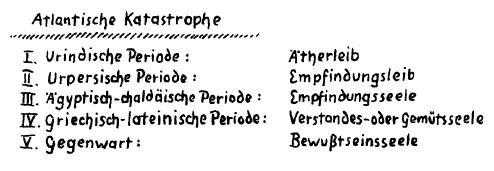
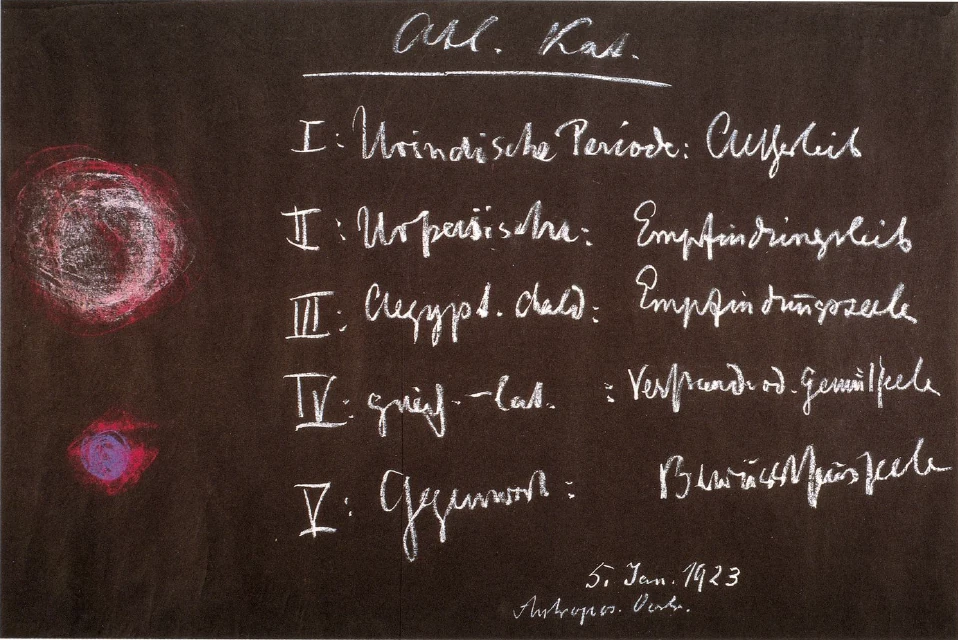
[ 9 ] When we consider the successive epochs of Earth’s development following the great Atlantean catastrophe, the situation is as follows: If we go back to the 8th and 9th millennia, we encounter the Atlantean catastrophe, which I have described on several occasions. We then have the first post-Atlantean cultural period, which you can read about in my Outline of Esoteric Science, which I have called the Proto-Indian period (see diagram). In this Proto-Indian period, human beings live primarily in their etheric body or body of formative forces. The connection is still so intense that one can even say: Human beings live in their etheric body or body of formative forces. They live in such a way that, essentially, the physical body is for them more of a garment, something external. They perceive the world much more with their etheric eye than with their physical eyes. The second period is the Proto-Persian period. In this period, human beings perceive their surroundings primarily through what might be called the sensory body. In the third, the Egyptian-Chaldean period, human beings perceive the world with the help of their sensory soul. Finally, in the fourth, the Greek-Latin period, human beings perceive the world with their intellectual or emotional soul.
[ 10 ] And in our fifth epoch, beginning in the 15th century—which can be called the historical present—human beings view the world through the soul of consciousness. And this perception through the consciousness soul brings about everything I have described in the Course in Natural Science in terms of historical sequence.

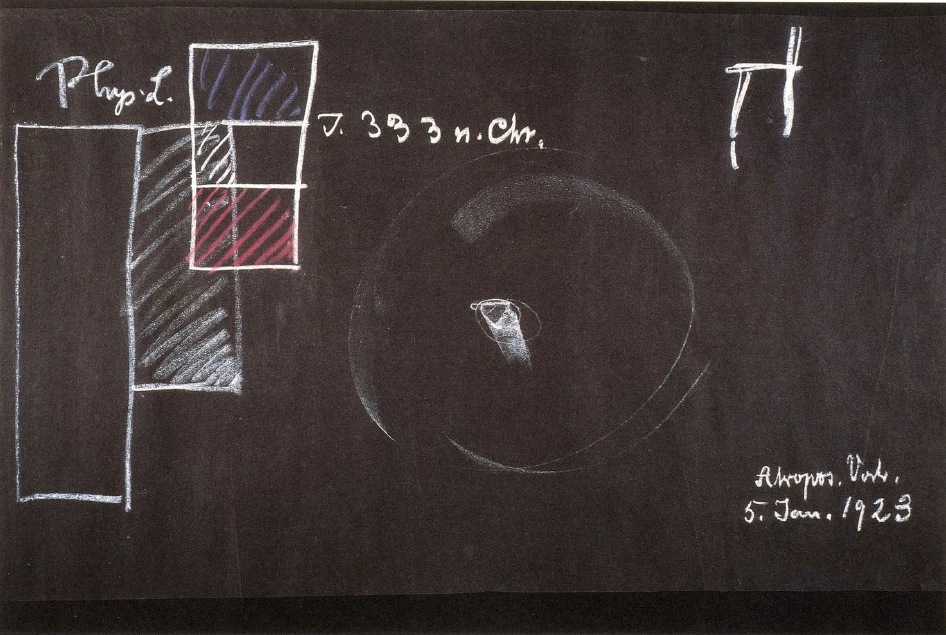
[ 11 ] But let’s now clarify exactly how this works. It is actually very difficult, but if one were to outline this situation schematically, one would have to say: Physical body (see diagram), etheric body (hatched), and within this etheric body the soul first makes itself felt—but in such a way that, at first, the human being still lives entirely within the etheric body. Then, however, in the sensory body, which in reality is still entirely etheric. For it is only in the Egyptian-Chaldean period that the human being lives in the soul, but even then the soul still lives entirely within the etheric body. So that I could, for example, depict the soul like this (red hatched). As the human being feels himself inwardly in a soulful way, he still feels himself to be half within the etheric body.
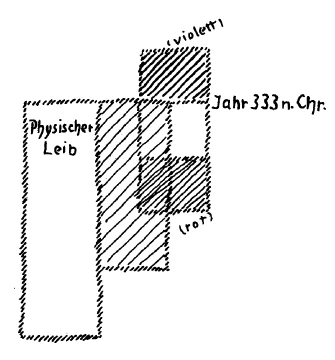
[ 12 ] During the Greco-Latin period, human beings grow out of the etheric body with their soul. The human being still retains the etheric body within until about the year 333. Then the human being grows out of the etheric body in such a way that the soul is only very loosely connected to the etheric body and no longer has any inner connection at all (shaded in violet). The soul feels abandoned to the outside world. It is now compelled to go out into the world without the support of the etheric body. This gives rise to the need for Christ. For now that the soul is no longer intimately connected to the etheric body, one no longer sees the Sun Spirit ahead, not even its afterimage, when looking out into the heavens. But in the development of the world, everything unfolds gradually over long periods of time. At first, from the 4th century onward, the soul was, so to speak, inwardly emancipated from the etheric body, but it had not yet grown strong in itself; it was still weak within. And if we look through all the centuries, from the 5th, 6th, and 7th centuries through the 14th, 15th, 16th centuries, indeed right up to our own time—but let us focus for now specifically on the period up to the 15th century—we find the soul that has just been inwardly emancipated but is still weak; a soul that feels a need for something but is not yet strong enough to respond to this need out of an inner impulse and, instead of seeking Christ in the sun as in earlier times, now to seek Christ in the Mystery of Golgotha; instead of seeking him in the external world, to seek him in the course of time. The soul first had to grow stronger inwardly in order to develop any powers at all within itself. Throughout the centuries up to and including the 15th century, people were not strong enough to develop inner powers, to arrive at any understanding of the world through the soul at all. Therefore, they limited themselves to drawing knowledge from the books left behind by the ancients, accepting what had been historically preserved as knowledge.
[ 13 ] This is something one must take into account. The soul must grow stronger within. In the 15th century, it had reached the point where it began to experience as its own, in abstraction—abstract space as thought—that which it no longer learned from the etheric body or, indirectly through the etheric body, from the physical body as mathematics. Humanity has not yet progressed very far in this experience, but as you can see, it is a different experience than it was in the past. It is the urge to arrive at something from within the soul itself—something humanity was able to attain in ancient times, when it could still make use of its etheric body, to which the soul was intimately connected. People now had to strengthen themselves inwardly to the point of coming to Christ, whereas in the past the etheric body had served them to see Christ descending from the sun. And so we can say that up until the 4th century, even the most civilized people did not really know what to make of the news about Christ, about the Mystery of Golgotha.
[ 14 ] It is interesting to note that neither Emperor Constantine’s conversion to Christianity nor Julian’s rejection of Christ is actually based on any solid ground. The historian Zosimus even explains that Emperor Constantine converted to Christianity for his own sake because he had committed so many crimes against his family that the old priests would no longer forgive him. That is why he broke away from the old pagan religion and its priests—because the Christian priests had promised him they could forgive him. So, basically, it was a rather superficial reason. One could certainly say that his profession of faith in Christ was not at all motivated by a need for Christ.
[ 15 ] For Julianus, all it took was initiation into the Eleusinian Mysteries—which, even back then, was already a very superficial experience—to inspire him with a passion for the Sun Spirit in the ancient form of knowledge. For him, too, this was not exactly based on a very deep foundation, even though he did, of course, gain extraordinarily significant knowledge through his initiation into the Eleusinian Mysteries. But in any case, neither the arguments for nor against were particularly strong or intense at that time with regard to the question of Christ, precisely because people had no idea what the assertion meant that Christ was to be sought historically in a human body.
[ 16 ] Starting in the 4th century, it was once again the case that people—whose souls were internally emancipated but still weak—could find no other path to Christ, or indeed to an explanation of the world at all—for the entire explanation of the world had to be rebuilt from scratch—than precisely the historical tradition, the written or oral tradition; that is, oral tradition in the sense that only a few people possessed the written tradition and provided the others with an oral interpretation.
[ 17 ] This remained the case for many centuries and, in terms of the view of Christ, has in fact remained so to this day. But it is something very significant that the soul had now become inwardly free. As I said, even though everything in history has its precursors and aftereffects, we can still point to the year 333 as the year in which this emancipation of the soul took place for the most advanced human beings, even if the soul was still too weak to gain any inner insights at all. It was the case that, if a person at that time reflected deeply—since there was still good news from earlier times—he could say: There were people not so long ago who still saw something divine and spiritual in the sun. I no longer see anything. But the people who saw something divine and spiritual in the sun also drew other insights from within, for example, mathematical insights. My soul, though, is such that it feels itself to be an independent being, yet it cannot pull itself together; it cannot draw forces from within itself to recognize anything.
[ 18 ] That was precisely what was significant in the 15th and 16th centuries: that people at least began to conceive of mathematical-mechanical insights from within the soul. And Copernicus was the first to apply what he experienced in this way within his emancipated soul to the structure of the heavens. The earlier world systems were such that they had been derived with the help of souls that were not yet emancipated from the etheric body—souls that were still intellectual or emotional souls—but which, as intellectual or emotional souls, still possessed, in a sense, the power of the etheric body to look out into the world. The intellectual or emotional soul was still present until the 15th century, but people could only use the physical body and the physical eye to look out into the world. These are the reasons why, throughout all these centuries and up to the present day, the knowledge of Christ and the Mystery of Golgotha could be passed down only through Scripture or oral tradition.
[ 19 ] What, after all, have we gained through the soul that has gradually grown stronger over the centuries, beginning in the 4th and 5th centuries? Outwardly, mechanical knowledge—the kind of physical knowledge I described in the course on the natural sciences. But now the time has come when the soul must grow strong enough that, just as it once saw the spiritual sun alongside the physical sun when looking out into the heavens with the aid of the etheric body, it now looks inward into the “I,” perceives the “I,” and, in a sense, perceives Christ behind the “I.”

[ 20 ] If we imagine this not schematically, but in a very real way, it is as follows: Through physical sight, the sun is seen (light hatched); through seeing with the etheric body behind the sun, the Sun Spirit, Christ (ancient times, red), is perceived. Today, when a person looks within, they have that “I.” They perceive the “I”; they have a sense of “I.” But this is very obscure. This sense of “I” first arose in the emancipated soul. In the past, people looked out into the world; now they must look within. Looking out into the world brought them into contact with the Sun and with Christ. Looking inward has, for the time being, brought them into contact only with the “I.” They must come to find, behind the “I,” what they formerly found before the Sun. They must come to feel, radiating inwardly from their “I,” that which they experienced in the light—what they experienced from sunrise to sunset—Christ, the Enlightener of their own knowledge, so that they find in Christ the strong support of their own “I.” So that one can say: In the past, one looked out toward the sun and found the Christ-imbued light. Now one looks inward and learns to recognize the Christ-imbued “I” (red, violet).

[ 21 ] However, we are still in the very early stages in this regard. For anthroposophy consists, so to speak, in telling humanity: These centuries since the 4th century A.D. are intermediate centuries. What came before was a time when humanity could look out into the heavens and find Christ as an outer, spatial Sun Spirit. After these intermediate centuries, a new humanity must arise—one that looks inward and, on the path to this inner world, rediscovers the inner Sun, the Christ, who now appears with the “I” just as he formerly appeared with the Sun, and who is now the bearer of the “I,” just as he was formerly the Sun Spirit.
[ 22 ] With the 4th century, humanity—which was gradually evolving from the Greco-Latin races—began to feel a need for Christ, a need that at first could be satisfied only through written or oral tradition. But today the situation is such that this written or oral tradition has lost its power of conviction, especially among the more advanced spirits, and that people must learn to find Christ within themselves, just as ancient humanity found him externally through the sun and its light. We need only understand the intervening centuries in the right way—that is, to understand that at that time the soul was initially independent, yet in a certain sense empty. When the soul looked out, armed with the etheric body, it could not see in the celestial phenomena that mechanical-mathematical system which later became the Copernican model. Things were perceived as being much more closely bound to human beings. And what presented itself was not a world system arbitrarily torn from the human being, but precisely that world system which, even in its state of decline, appears as the Ptolemaic system.
[ 23 ] But when the soul began to lose its roots in the ether through its own etheric body, the mindset that would later give rise to an astronomy—one that was indifferent to whether human beings belonged to the starry heavens or not—gradually began to take shape. The only tribute this transformed human being paid to the old era was that he shifted the starting point for his mechanical system to where Christ had formerly been seen—namely, the Sun. Through Copernicus, the Sun was made the center of the universe—not the spiritual universe, but the physical one. In this there still lives a vague sense of how strongly humanity once felt the Sun, together with Christ, to be the center of the world. One must not only consider the outward appearance of world history, as has gradually become customary, but one must also take the development of feelings somewhat into account.
[ 24 ] Precisely when one truly understands how to read Copernicus, one notices this remarkable intuitive impulse that one encounters in his work: He did not merely calculate; he had an inner intuitive impulse to restore something of the old to the Sun. It was through this inner impulse that he arrived at three laws, the third of which actually casts everything stated in the first two back into a certain state of uncertainty. For Copernicus has a third law that later astronomy simply omitted because it mechanized everything. He has a law according to which the Earth’s motion around the Sun is by no means presented as absolutely certain as it is viewed today. Today, as I have already mentioned, the matter is viewed as a fact that would emerge from observation if one were to place a chair out in the vastness of space—quite far out, in fact—and from there observe what the Sun is like and how the Earth orbits around it. But the chair would have to be out there, and the schoolteacher in question would have to be sitting on it, observing the solar system from out there. That is not, of course, an observational result. Copernicus, I would say, did not yet possess such a strongly contrary conviction in such matters as later people did when they mechanized the entire structure of the universe. He also cited those phenomena that actually suggest that the Earth’s motion around the Sun is not entirely correct. But as I said, this third law was simply ignored, suppressed by later science. People stuck with the first two—the Earth’s rotation on its axis and its orbit around the Sun—and had a very simple system, which is now gradually being taught in this straightforward way in schools. Of course, the intention here is not to oppose the Copernican system. It was necessary in the course of human development. Today, however, the time has come when these matters must be discussed in the manner I attempted in a natural science course in Stuttgart, where I spoke about astronomical topics. There I demonstrated how these matters must be conceived in a way quite different from what is possible within the framework of today’s materialistic-mechanistic worldview.
[ 25 ] But in Copernicus’s case, there is indeed, throughout his entire conception of his system, a sentiment that can be characterized exactly as I just described. In a certain sense, he did not merely want to create a mathematical coordinate system for our solar system and place the sun at the center of this coordinate system; rather, he wanted to restore to the sun what had been taken from it by the fact that people could no longer perceive Christ in the sun.
[ 26 ] These are things intended to show you that one should not only trace the external facts and the shift in people’s thinking throughout historical development, but also the transformation of their feelings. This, however, only became apparent once the mechanism had fully emerged. In Copernicus, and especially in Kepler, one can still find such feelings; in Newton, they are already very strong. I have already discussed in the Natural Science Course how Newton later felt somewhat uneasy about his mathematical philosophy of nature. After he had initially viewed space in such a way that he imbued it with nothing but mathematical-mechanical forces, and after he later reconsidered the matter, he felt a sense of unease and said that what he had established as abstract space with its three abstract dimensions was in fact the Sensorium Dei, the Sensorium of God. Now, for Newton—who had grown somewhat older and whose conscience was stirring in response to these mathematical-mechanical concepts—it was the case that space, which he had sufficiently mathematized, was now the most important space in God’s mind, namely the sensorium, the most important part of God’s mind.
[ 27 ] It was only later that we were able to evaluate thinking individuals solely on the basis of their thoughts, and no longer at all on the basis of their feelings. Newton must still be evaluated on the basis of his feelings, Leibniz all the more so, and indeed all the natural scientists of that era. And anyone who reads Galileo’s life will find—I would say—on every page how the whole person still comes into play there. This human “thought apparatus”—which feeds itself, as its own thought apparatus, with the results of observation and experiment, just as one feeds a steam engine with coal—this human being only emerges later, and only later does he become the authoritative guide of unconditional science. This science is, in fact, unconditional only because it lacks any prerequisite for true knowledge.
[ 28 ] But what must now be added to the achievements of the strengthened soul—which, admittedly, is no longer an empty soul, as it had become in the 4th century A.D., but has now, for its part, filled itself with many mathematical -mechanical concepts, is that within the “I” the inner light is found—which perhaps should no longer be called merely the “I,” so as not to speak only figuratively or symbolically, but which one must call: the sustaining essence of the soul.
[ 29 ] And in this way we come to recognize something that has emerged more and more over the centuries, something that is powerful today but is pushed down into the subconscious depths of the soul by people who numb themselves to it: the need for Christ. Only spiritual insight—an understanding of the spiritual universe—can meet this longing for Christ. Among the defining features of our own age in the 20th century is this: the longing for Christ and the soul’s inner striving for the strength to find Christ within the “I,” behind the “I,” just as he was once found before the sun.
[ 30 ] The way people viewed the Sun Spirit during the Greco-Latin period was like twilight. For it was only during the primordial Indian period that the Sun Spirit was seen with true clarity—I would say, with spiritual and soulful clarity. Now we live in a time when we should feel the dawn breaking—the dawn of true Christ-knowledge, won through human effort. The ancient understanding of the Sun Spirit, which Julian the Apostate still sought to revive, can no longer offer humanity any kind of satisfaction. Julian’s endeavor itself was futile in the face of historical development. But after the epoch of the first four centuries, when people did not really know what to make of Christ, and after the epoch that followed, when there was a need for Christ but this need could be satisfied only through oral or written tradition, there must come an age that understands something like the addition to the Gospel: “I have much more to say to you, but you cannot bear it now.”
[ 31 ] An age must come that understands what Christ meant when he said, “I am with you always, even to the end of the age.” For Christ is not dead, but alive. He speaks not only through the Gospels; he speaks to the spiritual eye when that eye opens once more to the mysteries of human existence. There He is every day, speaking and revealing Himself. And it is a weak humanity that does not even wish to strive for the time when what was not said back then can be said—because people were not yet ready to bear it, those people who were still in a state where, fundamentally, they could not understand what Christ was offering them.
[ 32 ] Certainly, those around him could understand some of it, but the Gospel is, after all, addressed to everyone, and this saying naturally spreads far and wide throughout the world. We must strive for a humanity that replaces the mere tradition of Christ with the living Christ. And it is the most unchristian thing—even in the sense of tradition—to insist that only what is written down is valid, and not what speaks to us every day from the spiritual world as the revelation of Christ to our minds striving for enlightenment, to our feeling hearts, and to our whole being as we will it today.