

Living Knowledge of Nature,
Intellectual Fall from Grace
and Spiritual Elevation from Sin
GA 220
20 January 1923, Dornach
Translated by Steiner Online Library
Eighth Lecture
[ 1 ] We have been talking recently about the relationships that people in earlier times had with nature and with the world as a whole, and about the relationships they have with it today, in our present age. For example, I have pointed out how much more real and concrete human beings’ experience of nature was in earlier times, and how they were able to experience nature more concretely precisely because they also experienced things more fully within themselves. I have pointed out how human beings once perceived their thought process as a kind of—well, to put it crudely—salt-deposition process within their own organism. Something hardens within one’s own organism—that is roughly how people felt when they thought. They felt, as it were, the thoughts radiating through their human being, and they sensed a kind of etheric-astral skeletal structure. They could tell the difference between looking at a cube-shaped crystal and one that tapers to a point. So they felt thoughts within themselves as a process of hardening. And they felt the will within themselves as a process of fire, as a process of inwardly radiating warmth.
[ 2 ] Because human beings felt so defined and so complete within themselves, they were also able to empathize more fully with the external natural world and, as a result, live more concretely within it. One might say: It has now come to pass with human beings that they actually know little more about their inner selves than the mirror images cast within them by the external world. They recognize these mirror images as memories. They know what they experience—or have experienced—emotionally, though in a very abstract way. But this fully alive sensation of being permeated, radiated through, warmed through, and illuminated within their organism—this is something people today do not know. Today, people know about their own inner world only as much as a doctor or natural scientist can tell them. A genuine inner experience no longer exists. Yet everything a person perceives in the external world always corresponds exactly to what they perceive in their inner world. Since people today know little more about themselves than what a natural scientist or doctor can tell them, they remain abstract in their relationship to the external world as well. They inquire only about the laws of nature, which are abstract concepts. But a shared experience with nature actually exists only in the instinctive sense, which human beings can never deny. And as a result, human beings have gradually lost the insight that elemental forces are truly at work in nature. A rich life of nature has thus been lost to human beings.
[ 3 ] Today, people refer to what has been preserved from earlier times regarding the life of nature as myths and fairy tales. Certainly, these myths and fairy tales are expressed in images, but the images point to a spiritual reality that reigns in nature—one that is, at first, an elemental-spiritual force with indefinite contours, yet is nonetheless spiritual, and which, when penetrated, reveals a higher spiritual reality. One might say: In earlier times, human beings did not merely interact with plants, stones, and animals, but also with the elemental spirits that dwell in earth, water, air, fire, and so on. By losing touch with themselves, human beings have also lost this experience of the spirits of nature.
[ 4 ] Now, a kind of dreamlike revival of these nature spirits in human consciousness cannot simply take place, for that would lead to superstition. A new way of relating to nature must take hold of human consciousness. One must be able to say, for example: Yes, once upon a time, people looked within themselves; they had a vivid empathy for what lies within their own human being. Through this, they came to know certain elemental spirits. Ancient, inner experiences of insight—which people expressed in images that still affect us today with elemental-poetic power—were what those spiritual forces whispered within the human soul; these forces began to speak inwardly to the human spirit when a person turned their gaze inward.
[ 5 ] These beings, who actually had their home in the human organs—one of whom was, so to speak, an inhabitant of the human brain, another an inhabitant of the human lungs, and yet another an inhabitant of the human heart—for people did not perceive their inner being as an anatomist describes it today, but rather perceived it as a living, active elemental being—these spiritual beings, were now able to speak to human beings. And when today, through the science of initiation, one seeks the path to these beings, one develops a very specific feeling, a very specific sensation toward them. One says to oneself: These beings once spoke to human beings through the inner being of the human person, through every single part of that inner being. In a sense, they could not step outside the human skin. They inhabited the Earth, but they inhabited it within human beings. They were inside human beings and spoke to them, imparting their insights. Human beings could only know about earthly existence by experiencing what, so to speak, can be experienced of this earthly existence from within the human skin.
[ 6 ] Well, with humanity’s evolution toward freedom and independence, these beings have indeed lost their dwelling places within human beings on Earth. They do not incarnate in human flesh and blood and therefore cannot inhabit the Earth as part of the human race. But they are still present in the earthly realm, and they must work together with human beings to achieve a certain earthly goal. They can do this only if human beings today, so to speak, repay them for what they once owed them. And so, when we once again follow the path toward an understanding of these beings through the science of initiation, we say to ourselves: These beings once nurtured and cultivated human knowledge; we owe them much of what we are, for they permeated us during our earlier lives on Earth, and through them we have become what we are today. Yet they have neither physical eyes nor physical ears. They once lived among human beings. Now they no longer dwell within human beings, but they are present in the earthly realm. We must, so to speak, tell ourselves: They were once our educators; they have now grown old; we must in turn give back to them what they once gave us. But we can only do this if, in our present stage of development, we approach nature with the spirit; if we seek in natural beings not only what today’s abstract intellect seeks, but also the pictorial aspect of natural beings—that which is accessible not only to dead intellectual judgments but to full life and to feeling.
[ 7 ] When we seek this in spirituality—that is, from the perspective of the anthroposophical worldview—these beings come to us once again. They watch and listen, as it were, as we immerse ourselves in nature from an anthroposophical perspective, and they then gain something from us, whereas they gain nothing from ordinary physiological and anatomical knowledge—on the contrary, they are terribly deprived of it. They have no part in anatomy lecture halls or dissection rooms, no part in chemistry laboratories or physics laboratories. In the face of all this, they feel: Is the Earth completely empty? Has the Earth become a wasteland? Are those people on Earth not still alive to whom we once gave what we had? Do they not now want to lead us back—as only they can—to the things of nature?
[ 8 ] By this I simply mean that there are beings who are waiting today for us to unite with them in the same way that we unite with other human beings in a genuine sense of understanding, so that these beings may share in what we learn about knowing things and dealing with them. When people today study physics or chemistry in the conventional sense, they are ungrateful toward the nurturing and caring beings who once made them what they are. For these beings must freeze to death in the earthly realm alongside all that human beings today unfold in their consciousness. And humanity will only once again become grateful toward these nurturers and caregivers when it deigns to seek the spirit anew for what it can see with its eyes, hear with its ears, and grasp with its hands on Earth. For in everything that spiritually permeates sensory perceptions, these beings have the opportunity to experience it together with human beings. Through what is perceived in a purely material way, these beings are unable to live alongside human beings. They are excluded from it. We humans, however, can only show these beings the gratitude we owe them when we truly take seriously what lies at the heart of the anthroposophical worldview.
[ 9 ] Let us assume, for example, that a person today has a fish placed on the table and a bird locked in a cage, and that he looks at the fish outwardly with his senses, and looks at the bird outwardly with his senses. But they are so self-centered in their perception that they stop at what is immediately apparent. One becomes selfless in perception only when one sees not merely the fish in the water and the bird in the air, but when one can already discern from the form of the fish and the form of the bird that the fish is an animal of the water and through the water, and the bird an animal of the air and through the air. Imagine, for a moment, that one does not merely observe flowing water with the mind of a chemist and say: “Well, that is a chemical compound, H₂O, of hydrogen and oxygen”—but that one looks at the water as it actually is in reality. Then one might find fish in it; one finds these fish such that they form a soft bodily substance into peculiar respiratory structures extending forward, and that this surrounds the skeletal framework—which remains soft because of the water—along with, I might say, a delicate jaw—a jaw over which the bodily substance is draped. This bodily substance may appear, as it were, to emerge directly from the water—though, to be precise, from the water into which the sun’s rays fall. If one has a sense of how the sun’s rays (red) fall into this water, illuminating and warming it, and how the fish swims toward this illuminated and warmed water, then one gets a feeling for how this solar warmth, tempered by the water, and how the sunlight, shining within the water, comes toward one.
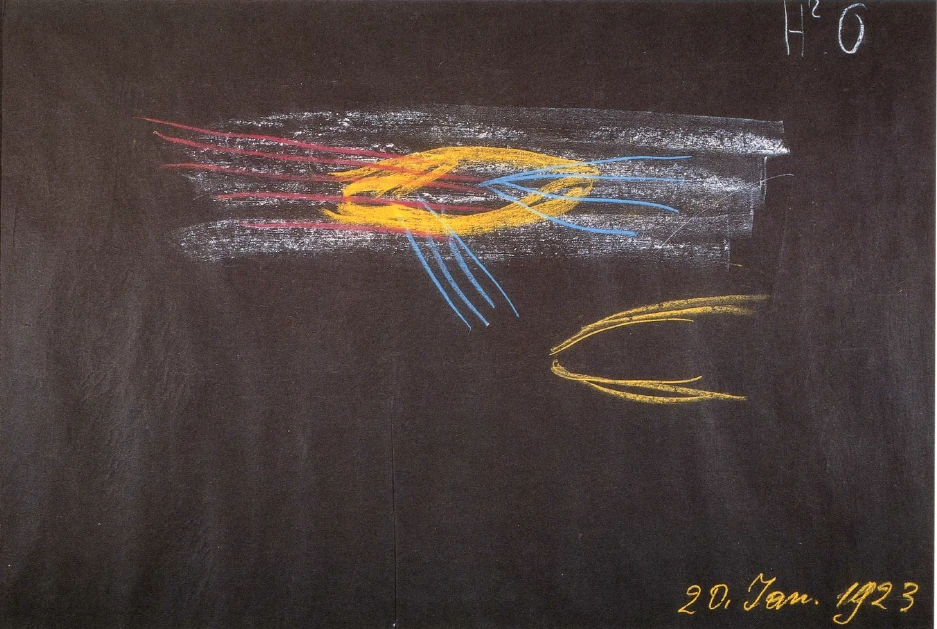
[ 10 ] As the fish swims toward me, so to speak, presenting its teeth—if I may put it that way— but this light-filled, warm water lays the soft substance of the fish’s body across its jaws in time with its breathing rhythm; as the fish, with the peculiar shape of its head, holds its overhanging jaws out toward me, I feel how, with this fish, the light-filled and warm water comes toward me. And then I feel how, on the other side, in the structure of the fins (blue), something else is at work. Through this—I want only to hint at this today—I gradually learn to feel how, in the tail fin and in the other fins, there is a dimmed light—a light so dimmed that it no longer compels the body’s substance to soften, but instead has a hardening effect. In this way, I gradually come to recognize the solar aspect in the fish’s head through what it presents to me; I come to recognize the lunar aspect in the hardened fin structures, as it reflects back—in short, I will be able to place the fish within the entire water element.
[ 11 ] And I look at the bird, which has no way of submerging its head in the water by swimming toward the sun-warmed, sun-illuminated water, or by swimming with the sun-warmed, sun-illuminated water; the bird that depends on the air. I come to understand the strain that now lies in its breathing, where the water that aids respiration cannot act on its gills, but where breathing becomes an effort. I come to recognize how the sun’s warmth and light act differently in the air, and I become aware of how the bird’s substance is pushed back by its beak. I recognize that with the bird it is roughly as if I were to push back all the flesh clinging to the teeth, causing the jaw to move forward in a rigid manner. I come to understand why the bird extends its beak toward me, whereas with the fish, the jaw is held out toward me in a more delicate manner as part of its bodily substance. I am learning to recognize how the bird’s head is a creature of the air—but of the air that is internally glowing and illuminated by the sun. I am learning to recognize what a tremendous difference there is between the water—warmed and illuminated—that gives rise to fish, and the air—warmed and illuminated—that gives rise to birds. I am learning to understand how, through this difference, the entire element in which the bird lives becomes something else; how the fish’s fin derives its simple radiance from the water element, and how the bird’s feathers take shape through the specific way in which the air—in which sunlight and solar warmth are at work—acts upon them.
[ 12 ] When I move in this way from a mere, crude perception to a conception in which I am not too lazy, when the fish is served, to observe the water as well, and when the bird is in the cage, to see the air as well—if I do not limit myself to seeing the air around the bird only when it is flying through the air, but instead sense and observe the air-forming aspect of its form—then what already lives within the forms comes to life and becomes imbued with spirit for me. And in this way I learn to distinguish, in my experience of the external natural world, the difference between a pachyderm—a hippopotamus, for example—and an animal covered with soft skin, such as a pig. I learn to recognize that the hippopotamus is predisposed to expose its skin more to direct sunlight, while the pig constantly withdraws its skin from direct sunlight and has a greater preference for what is shielded from the sun’s rays. In short, I come to know the workings of nature in every single being.
[ 13 ] I move from individual animals to the elements. I leave behind the chemist’s approach, which states that water consists of two atoms of hydrogen and one atom of oxygen. I leave behind the physical perspective, which states that air consists of oxygen and nitrogen. I move on to concrete observation. I see the water teeming with fish. I see the kinship between water and fish. I say: It is, after all, quite extraordinary that I should speak of water only in its abstract form as hydrogen and oxygen. In reality, water, together with the sun and moon, gives rise to fish, and through the fish, the elemental nature of water speaks to my soul. It is merely an abstraction when I speak of the air as a mixture of oxygen and nitrogen—the air that is illuminated and warmed, that pushes back the flesh from the bird’s beak, and that shapes the respiratory organs of fish and birds in a unique way. These elements express their distinctive qualities to me through fish and birds. Imagine how everything becomes inwardly enriched in this way, and how everything becomes inwardly impoverished when we speak of the nature that surrounds us solely in material terms.
[ 14 ] Yes, you see, what we encounter in anthroposophical spiritual science provides the impetus for everything I have just described. For what we encounter in anthroposophical spiritual science is not meant to be accepted in the same way as the products of modern civilization, but rather is intended to serve as an inspiration for a particular way of viewing the world.
[ 15 ] If one were to feel what I have just tried to describe, then a coming together of people in a society such as the Anthroposophical Society would make that society a reality. For then everyone who belongs to this Anthroposophical Society would, with some justification, say to themselves: I am grateful to the elemental beings who once worked within my human existence and who actually made me what I am today—those who once dwelt within my skin and spoke to me through my organs. They have now lost the ability to speak to me through my organs. But when I look at every single thing in the world in this way—seeing how it is shaped by the whole of nature—and when I take seriously the descriptions given to me in anthroposophy, then I speak in my soul a language that these beings can understand once again. I become a person filled with gratitude toward these spiritual beings.
[ 16 ] This is what is meant when it is said: In the Anthroposophical Society, one should not merely speak of the Spirit in general—for even the pantheist does that—but rather, in the Anthroposophical Society, one should be conscious of being able to live with the Spirit once again. Then this life in the Spirit—shared once again with other people—would naturally find its way into the Anthroposophical Society. One would say: The Anthroposophical Society exists to repay our guardians and caregivers from times past for what they have done for us, and one would become aware of the reality of the Spirit reigning within the Anthroposophical Society. And much of the old feelings and old sensibilities that still live on traditionally among people today would disappear, and a genuine sense of the Anthroposophical Society’s very specific mission would develop. And everything else that has developed would now, for the first time, take on its true meaning.
[ 17 ] Certainly, we can say with a certain inner satisfaction: Yes, here at this building, which has now met such a sad end, seventeen nations worked together during the war, when the peoples of Europe were at war with one another. But what is truly real about the Anthroposophical Society will only come into being when the various nationalities shed what clings to them within the narrow confines of nationality, and when anthroposophical unity becomes a reality for them; when what is abstractly strived for through the union in the Anthroposophical Society is experienced as something real. However, very specific preparations are necessary for this.
[ 18 ] The outside world leveled a criticism against the anthroposophists that, in a certain sense, is justified: namely, that while there is much talk within the anthroposophical movement about spiritual progress, one sees little evidence of this spiritual progress in individual anthroposophists. Such progress would certainly be possible. A proper reading of each individual book offers the possibility of genuine spiritual progress. But for this to happen, it is necessary that the things discussed yesterday become truly real and are taken seriously: that the physical body be properly constituted through truthfulness, the etheric body through a sense of beauty, and the astral body through a sense of goodness.
[ 19 ] When we speak first of all of truthfulness—this truthfulness should, so to speak, be the great precursor for all those who now truly aspire to unite within an Anthroposophical Society. Truthfulness must first be acquired in life, and truthfulness must take on a different meaning for those who wish to be grateful to their guardians and nurturers from times past than it does for those who know nothing and wish to know nothing about such a relationship with the former guardians and nurturers of humanity.
[ 20 ] Those who refuse to acknowledge this may, guided by their prejudices, distort the facts; they may, if it suits them, claim that something happened one way or another; they may, if it happens to suit them to describe a person as having one character or another, claim that he is of such-and-such a nature. But anyone who wishes to cultivate inner truthfulness within themselves must never go beyond what the facts of the external world tell them. And, strictly speaking, they should always be careful to formulate their words in such a way that, with regard to the external world, they state only the established facts.
[ 21 ] Just think for a moment how it has become customary in today’s world to somehow assume what one likes and, on top of that, to take it for granted that this is the case. Anthroposophists should get into the habit of rigorously separating all their prejudices from the pure course of events and describing only the pure course of events. In this way, anthroposophists would naturally become a kind of corrective force against what is otherwise customary today.
[ 22 ] Just think about all the things we read about in the newspapers today. The newspapers feel obligated to report everything, regardless of whether it can be verified in any way that it is or is not true. And then one often senses, when someone tells a story, that there is a lack of effort to ascertain whether what is being claimed is actually true. Then one often hears the judgment: “Well, why couldn’t that be the case?” — Certainly, if one approaches the world in such a way that, when faced with a claim, one says, “Why couldn’t that be the case?” — then one cannot arrive at inner truthfulness. For what we cultivate within ourselves in observing the external sensory world must, especially among anthroposophists, be shaped in such a way that one strictly adheres to stating only what has actually presented itself to one’s eyes in the external sensory world. Pursuing such a goal would, of course, have a very peculiar consequence in today’s civilized world. If, by some miracle, many people were compelled to choose their words only in a way that corresponds exactly to the facts, a widespread silence would ensue. For most of what is spoken today does not correspond to established facts, but is spoken out of all manner of opinions and passions.
[ 23 ] The fact is, however, that everything we add to the external sensory conditions—and which does not correspond to the pure, mere course of events—when we express it in concepts, extinguishes within us the capacity for higher knowledge.
[ 24 ] Once, in a college where law students were studying, a short skit was carefully prepared and performed in front of about twenty people. The twenty people were then asked to write down what they had seen. Of course, everyone knew exactly what had been done, since every detail had been rehearsed. Twenty people were asked to write it down afterward; three wrote it down more or less correctly, seventeen incorrectly. And this was in a law seminar, where at least three people managed to correctly describe the facts of the case! If you listen to twenty people today describing one after another something they claim to have seen, what they describe usually does not correspond in the least to the facts. I will leave aside entirely those extraordinary moments that occur in human life. It has indeed happened, in the heat of war, that someone mistook the evening star, glimmering through a cloud, for an enemy aircraft. Certainly, such things can happen in the heat of the moment. But those are the major aberrations. In everyday life, when it comes to the small things, they are constantly present.
[ 25 ] But when we speak of the development of anthroposophical life, it depends on this sense of reality truly taking root in people, on them, so to speak, training themselves to gradually acquire this sense of reality, so that when they observe an external event in terms of its reality, they do not conjure up ghosts when they describe it afterward. One need only read the newspapers today. Isn’t it true that ghosts have been abolished, yet what is presented in the newspapers as reliable news is, in reality, nothing but ghosts—ghosts of the worst kind. And what people say is often nothing but phantoms as well. The point is that, so to speak, the most fundamental prerequisite for ascending to the higher worlds is this: that one first acquires a pure sense of fact for the sensory world. Only through this does one arrive at what I characterized yesterday as truthfulness.
[ 26 ] And the only way to arrive at a true sense of beauty—which I tried to describe yesterday in all its vitality—is to begin by really looking at things: looking at the bird to see why it has a beak, looking at the fish to see why it has that peculiar little protrusion at the front, behind which a delicate jaw is hidden, and so on. Only by truly learning to live with things can one develop a sense of beauty.
[ 27 ] And a spiritual truth cannot be attained at all without a certain degree of goodness, of a sense of goodness. For a person must have the capacity to feel interest and devotion toward another person: what I characterized yesterday as the fact that morality actually begins only when one forms the worry lines of another person in one’s own astral body as an astral worry line. That is where morality begins; otherwise, morality will be nothing more than the imitation of conventional rules or habits. What I described in my Philosophy of Freedom as a moral act is connected to this experience within one’s own astral body of the worry lines or the lines that arise from another’s smile, and so on. Unless this immersion of one person’s soul into the being of another takes place in human coexistence, a sense of the truly real life of spirituality cannot develop.
[ 28 ] Therefore, it would be a particularly good foundation for cultivating spirituality if there were an Anthroposophical Society that is a reality in which everyone relates to one another in such a way that they truly experience in the other a person who, like themselves, is devoted to anthroposophy; if today’s all-too-human feelings and emotions were not brought into the Anthroposophical Society. If the Anthroposophical Society were truly a new formation in which the very first principle were: “The other person is, after all, a fellow anthroposophist”—then the Anthroposophical Society would be established as a reality. Then, for example, it would be impossible for cliques and the like to form within this Society again, or for the temptation to arise—as is common practice in everyday life today—to carry into the Society, to an even greater degree, the antipathy people feel toward one another simply because of their physical appearance. Relationships between people could then truly be founded on what they mutually experience in one another on a spiritual level. But to achieve this, one would have to begin by genuinely cultivating a sense of truthfulness toward the facts—which, in essence, is one and the same as the precision, responsibility, and care required for an exact and accurate rendering of what one communicates to another or says in general.
[ 29 ] This sense of truthfulness is the first. And the sense of each being’s deep connection to the whole world—of feeling the water as the fish does, the air as the bird does—which then extends to a sense of understanding another human being—that should be the second. And the sense of kindness—of sharing in all that interests others, of what lives in the soul of another—that would have to prevail as the third. Then the Anthroposophical Society would become a place where the aim is to gradually develop the physical body, the etheric body, and the astral body in accordance with their purposes and their nature. Then a start would be made on what I must repeatedly characterize by saying: The Anthroposophical Society should not be just something that issues cards bearing names, where one is merely registered and has a certain number on one’s membership card; rather, the Anthroposophical Society should be something truly imbued with a communal spirituality—a spirituality that at least has the potential to grow ever stronger, to become more and more than other spiritual traditions, so that ultimately it would be the case that it would mean more to a person to feel at home in the anthroposophical spiritual tradition than in the Russian, English, or German spiritual traditions. Only then will the sense of community truly be present.
[ 30 ] Today, this historic moment is not yet regarded as essential. But it is the task of people in modern times to develop a sense of living within history and to recognize that the Christian principle of universal humanity must now be taken seriously; otherwise, the Earth will lose its purpose and its inner meaning. One can begin by acknowledging that there once were elemental spiritual beings who nurtured and cared for humanity, and whom we should remember with gratitude; that in recent centuries, within the civilized world of Europe and America, these beings have lost their connection with humankind; and that humankind must learn once again to feel gratitude toward the spiritual world. Only then will we arrive at true social conditions on Earth, when we develop toward the beings of the spiritual world that deep gratitude and that deep love which can exist when we truly come to know these beings as something concrete. Then, too, the way people relate to one another will become entirely different from what has developed out of older contexts—through the times that have passed in recent centuries—toward the more recent conditions, where people actually perceive every other person more or less as a stranger and consider only themselves to be important above all else, even though they do not really know themselves at all, even though they can really only say—though of course they do not admit it to themselves: “Oh, I actually love myself the most.” — One might ask: “Well, what is it, then, that you love most of all?” — “Yes, the natural scientist must first tell me, or the doctor must explain to me, what it actually is that I love most of all!” — But unconsciously, in terms of emotion, human beings actually live only within themselves.
[ 31 ] This is the opposite of what an Anthroposophical Society can offer. It must first be recognized that a person must step outside of themselves; that people must, at least in part, be just as interested in others and their individual characteristics as they are in their own. If that is not the case, an Anthroposophical Society cannot exist. One can admit members—and because rules are established, they may remain for a while—but that is not a reality. Realities do not arise simply by admitting members and giving them cards that make them Anthroposophists. Realities never arise at all from what is written or printed; rather, realities arise from that which is alive. And what is written or printed can only be an expression of life. If it is an expression of life, then a reality exists. But if what is written and printed is merely the written and printed word, whose meaning is conventionally defined, then it is a corpse. For the moment I write something down, I molt my thoughts. You know what “moulting” means; when a bird sheds its feathers, the dead is cast off. Such a moulting is what happens when I write something down. Today, people actually strive only for the moulting of thoughts: they want to transform everything into the written word. But it would be terribly difficult for a bird that had just molted to molt again right away. If anyone wanted a canary that had just molted to molt again immediately, they’d have to make the feathers from scratch. Yes, but that’s how it is today! Because people want everything to exist solely as a dead byproduct of molting, we’re actually dealing only with imitated realities, not with real ones anymore. And for the most part, what people put forth are imitated realities. It’s enough to drive one to despair when you measure it against what a real reality is; when you see how people don’t really speak anymore. It is no longer the human being who speaks. It is, well, the government councilor or the lawyer who speaks; it is abstract categories that speak. It is the young lady or the Dutchman or the Russian who speaks. But what we must strive for is not that the court councilor, not the government councilor, not the Russian, not the German, not the Frenchman, and not the Englishman speak—but that the human being speaks. But the human being must first truly be there. Yet he does not become a human being if he knows only himself. For this is the peculiar thing: just as one cannot breathe the air that one produces oneself, so too one cannot live the human being whom one merely fills within oneself, whom one feels within oneself. Breathe the air that you yourself produce within yourself! You cannot do that. But in reality, you cannot live the human being that you yourself create within yourself either. You must live in social life through what other people are, through what you experience together with other people. That is true humanity; that is true human life. To want to live what one creates only within oneself would be the same as deciding, instead of taking in the outside air, to breathe into a vessel in order to breathe back the very same air that one has generated as one’s own breath. Since the physical realm is more unforgiving than the spiritual, one would die very quickly. But if one continually breathes only in and out what one experiences as a human being, then one also dies—only one does not realize that one has died spiritually, or at least mentally.
[ 32 ] And the point is that it is only through the Anthroposophical Society or movement that what I recently characterized with the words from the Christmas Play—“Stichl, arise!”—is truly brought to fruition. I described in one of my recent lectures that this anthroposophical life is meant to be an awakening, a stirring to life. But at the same time, it must be a constant warding off of spiritual death, a constant appeal to the vitality of the soul’s life. In this way, the Anthroposophical Society would become a reality of its own accord through the inner power of spiritual and soul life.