

Living Knowledge of Nature,
Intellectual Fall from Grace
and Spiritual Elevation from Sin
GA 220
21 January 1923, Dornach
Translated by Steiner Online Library
Ninth Lecture
[ 1 ] You have seen from my previous remarks that it is my duty at this time to speak about the kind of consciousness that must be attained as one of the tasks of the Anthroposophical Society. And today I would like to begin by pointing out that this consciousness can only be attained by truly grasping the entire task of culture and civilization in the present from the standpoint of spiritual science. On various occasions, I have attempted to characterize, from this standpoint, what is meant by the Fall of humanity mentioned in all religious creeds. Religious creeds speak of this Fall, which lies at the starting point of humanity’s historical development, and we have seen through the various discussions in recent years how this Fall—which I need not characterize in greater detail today—is an expression of what once occurred in the course of human development: humanity’s becoming independent of the divine-spiritual powers that guide it.
[ 2 ] We know, of course, that awareness of this independence did not arise until the soul of consciousness emerged in the course of human development—that is, during the first half of the 15th century A.D. We have spoken of this point in time time and again in our recent reflections. But fundamentally, the entire development of humanity—as characterized by history and myths—is a kind of preparation for this important moment when human beings become aware of their freedom and their independence; a preparation for the fact that humanity on Earth is to attain the ability to make independent decisions in relation to the divine-spiritual powers. And so the religious creeds point to a cosmic-earthly event through which the spiritual-soul instincts—which in very ancient times were the sole determining factor in what humanity did—were superseded precisely by this free decision-making on the part of human beings. As I said, we do not wish to discuss here exactly how this is to be understood—but the religious creeds interpret the matter in such a way that, with regard to human moral impulsiveness, humanity has, in a certain sense, set itself in opposition to the guiding spiritual powers—let us say, to use the language of the Old Testament, to the powers of Yahweh or Jehovah. So, if we consider this interpretation, the situation can initially be described as if, from a certain point in their development onward, human beings no longer felt that the divine-spiritual powers were active within them and that they themselves were now active.
[ 3 ] Thus, with regard to man’s overall moral perspective, he came to feel himself to be sinful, whereas he would have been incapable of falling into sin had he remained in his former state—the state of being instinctively guided by divine-spiritual powers. Whereas in that state he would have remained incapable of sinning—and thus sinless—like a mere creature of nature, he has become capable of sinning through this independence from the divine-spiritual powers. And this awareness of sin then arose in humanity: I, as a human being, am sinless only when I find my way back to the divine-spiritual powers. Whatever I decide on my own is, as such, sinful, and I can attain sinlessness only by finding my way back to the divine-spiritual powers.
[ 4 ] This sense of sin was most pronounced during the Middle Ages. And that was also when human intellectuality—which had not previously been a distinct faculty—began to develop. Thus, in a sense, what human beings developed as the intellect—as their intellectual content—was also, and indeed with some justification, infected by this sense of sin. Yet people did not realize that the intellect, which had been emerging since the 3rd and 4th centuries A.D., was now also infected by this sense of sin. The unnoticed sense of sin within the intellect first developed in the scholastic wisdom of the Middle Ages.
[ 5 ] This scholastic wisdom of the Middle Ages held that: No matter how keenly one develops one’s intellect as a human being, one can still perceive only external, physical nature through it. Through the intellect alone, one can at most prove that divine-spiritual forces exist; but one cannot know anything about these divine-spiritual forces—one can only believe in them. One can believe in what they themselves have revealed, whether through the Old or the New Testament.
[ 6 ] So the person who in earlier times felt sinful in terms of his morality—and “sinful” here means: separated from the divine-spiritual powers—this person, who had long felt morally sinful, felt, in a sense, intellectually sinful within scholastic wisdom. He attributed to himself only the capacity to possess an intellect for the physical-sensory world. He told himself: As a human being, I am too flawed to ascend, through my own power, to that region of knowledge where I can also grasp the spirit. — One fails to notice how dependent this intellectual fall is on the general moral fall. It is the direct continuation of the moral Fall that comes into play here in the conception of human intellectuality.
[ 7 ] When scholastic wisdom gives way to the modern scientific worldview, the connection to the ancient moral concept of the Fall is completely forgotten, and—as I have often emphasized—the deeply rooted connection between modern scientific concepts and ancient scholasticism is even denied. And in modern natural science, people speak of the fact that human beings have limits to their knowledge, that they must be content to extend their understanding only to the sensory-physical world. Du Bois-Reymond speaks of this, and others speak of the fact that human beings have limits to their research—and indeed to their entire thinking.
[ 8 ] But this is a direct continuation of Scholasticism. The only difference is that Scholasticism assumed: If, then, the human intellect is limited, one must turn to something other than the intellect itself—namely, to revelation—if one wishes to know anything about the spiritual world. The modern scientific worldview takes half instead of the whole, leaves revelation where it is, but then adopts entirely the standpoint that is possible only if one presupposes revelation—it adopts the standpoint that human cognitive capacity is too limited to ascend into the divine-spiritual worlds.
[ 9 ] However, during the Scholastic period—particularly during its heyday in the Middle Ages—people did not possess the same state of mind as they do today. Back then, it was assumed that when a person applied their intellect, they could thereby gain insights into the sensory world; and when one applied the intellect, one still sensed and experienced something of the fusion of the human being with the sensory world. And people were then of the opinion that one had to ascend to revelation—which can no longer be comprehended, that is, no longer grasped intellectually—if one wished to know anything about the spiritual realm. But—and this is what we must look at!—spirituality had already, unnoticed, flowed into the concepts that the Scholastics formulated about the sensory world. The Scholastics’ concepts were not as spiritless as those of today. The Scholastics still approached human beings with the concepts they formed about nature, so that human beings were not yet entirely excluded from knowledge. For the Scholastics, at least in their realist current, were firmly of the opinion that thoughts are given to human beings from the outside, not fabricated from within. Today, the prevailing view is that thoughts are not given from the outside but are fabricated from within. As a result, human beings have gradually come to discard, in the course of their development, everything that does not relate to the external sensory world.
[ 10 ] And, you see, the ultimate consequence of having discarded everything that does not relate to the external sensory world is the modern theory of evolution, understood in the Darwinian sense. Goethe laid the groundwork for a true theory of evolution that extends all the way up to the human being. If you examine his writings in this regard, you will see that he always stumbled whenever he sought to address the human being. He wrote an excellent treatise on botany and made many accurate observations about animals, yet he always falls short when he attempts to address the human being. The intellect, when applied solely to the sensory world, is not sufficient to reach the human being. This is particularly evident in Goethe’s work: even Goethe cannot say anything about human beings. His theory of metamorphosis does not extend all the way up to human beings. You know how we have had to expand this theory of metamorphosis—entirely in the spirit of Goethe, yet going far beyond him—within the anthroposophical worldview.
[ 11 ] What, then, has modern intellectualism actually achieved in the natural sciences? It has only managed to comprehend the evolution of animals up to the point of the ape, and it has then appended humans to that sequence without being able to advance inwardly toward humanity. I would say that the more humans approached the higher animals, the more incapable these concepts became of comprehending anything further. And it is not at all true that humans, for example, still comprehend the higher animals. They merely believe that they do.
[ 12 ] And so, little by little, the conception of the human being fell completely out of the worldview, because the conception fell out of the concepts. The concepts became increasingly soulless, and these soulless concepts—which view human beings merely as the final link in the animal chain—now constitute the content of all thought; they are instilled in children as early as their first years of school, and as a result, it has become part of general education to be unable to perceive the essence of the human being.
[ 13 ] Now, as you know, I tried to approach the whole of knowledge from a different angle. That was when I wrote my Philosophy of Freedom and its prelude, Truth and Science, although the first hints of this approach were already present in my Epistemology of Goethe’s Worldview in the 1880s. I tried to approach the subject from a completely different angle. I sought to show what modern human beings can aspire to when they arrive at pure thinking—not in the traditional sense, but through free inner formation—that is, this volitional pure thinking, which is something positive and real when it is at work within them. And in my Philosophy of Freedom, I sought the moral impulses arising from this purified thinking.
[ 14 ] Thus, the course of development up to that point had led to an increasing tendency to view human beings as too flawed to act morally, and this perception of human imperfection was also applied to their intellectual capacity. If I were to express this visually, I would say: Humanity developed in such a way that what people knew about themselves as human beings became increasingly thin. That aspect (light) grew ever thinner. But beneath the surface, that aspect (red)—which lives in real, rather than abstract, thinking—continued to develop.
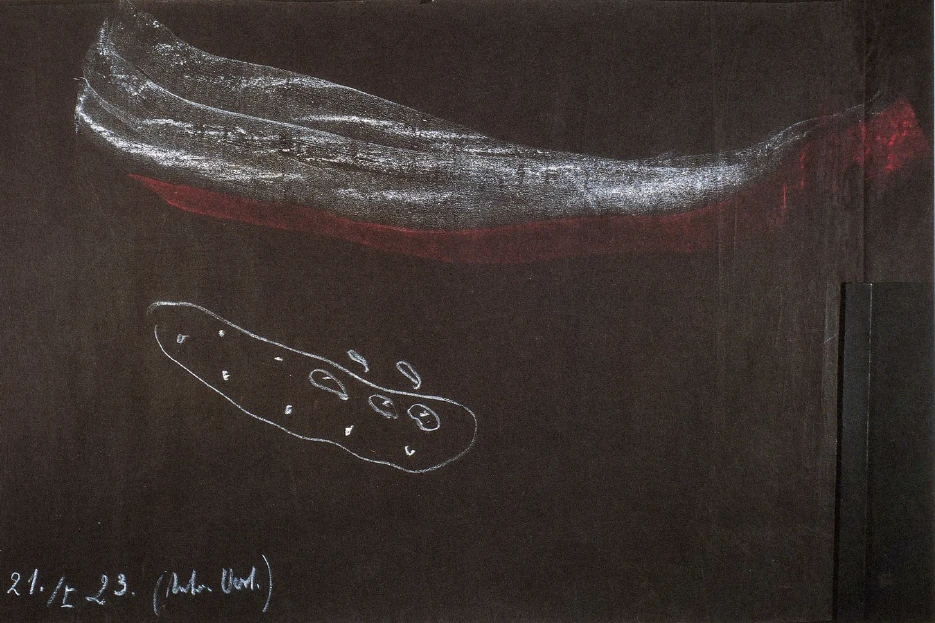
[ 15 ] By the end of the 19th century, the time had come when people no longer even noticed what I have highlighted in red, and because of what I have highlighted in light colors, they no longer believed themselves to be connected to anything divine-spiritual. The sense of sin had torn people away from the divine-spiritual; the historical forces that were emerging could not draw them back into it.
[ 16 ] But what I wanted to say with my Philosophy of Freedom is: Just look once into the depths of the soul, and there you will find that something has remained in human beings, namely, genuine, energetic thinking that arises from within themselves—pure thinking that is no longer mere thinking, that is full of sensation and feeling, and that ultimately finds its fulfillment in the will—and that this can become the impulse for moral action. — And for this reason I spoke of moral intuition, into which ultimately flows what is otherwise merely moral imagination. But what is actually meant by the “Philosophy of Freedom” can only truly come to life if one retraces the path one has taken—namely, the path of separating oneself more and more, to the point of intellectualism, from the divine-spiritual content of the world. When one rediscovers the spiritual in nature, one will also rediscover humanity. And that is why I once explained in a lecture I gave many years ago in Mannheim—a point that went largely unnoticed—that humanity, in its present stage of development, is in fact at the point of undoing the Fall. Namely: the Fall was understood as a moral fall; ultimately, it also influenced the intellect; the intellect felt itself at the limits of knowledge. And whether the old theologian speaks of sin or Du Bois-Reymond of the limits of knowledge of nature, it is essentially one and the same thing, only in a slightly different form. I pointed out how one must now grasp the spiritual—which has indeed been filtered down to pure thought—and how, from there, one can reverse the Fall, how one can work one’s way back up to the divine-spiritual through the spiritualization of the intellect.
[ 17 ] So while in ancient times reference was made to the moral Fall and the development of humanity was conceived in terms of this moral Fall, today we must think of an ideal of humanity—the rectification of this Fall through the spiritualization of knowledge and the rediscovery of the spiritual content of the world. Through the moral Fall, humanity has distanced itself from the gods. It must rediscover the path of the gods through the path of knowledge. Humanity must transform its descent into an ascent. Through inner energy and strength, humanity must grasp, from the purely perceived spirit of its own being, the goal—the ideal—of taking the Fall seriously once again. For it must be taken seriously. It extends right into our present day, even into the discourse of natural science. Humanity must summon the courage to gradually add, through the power of its knowledge, a rising above sin to the Fall—to work out a transcendence of sin from what can become possible for it through a genuine, authentic spiritual-scientific understanding of modern times.
[ 18 ] One might say: If we look back at the development of humanity, human consciousness places the Fall at the beginning of humanity’s historical development on Earth. But the Fall must eventually be counterbalanced: it must be opposed by a redemption from sin. And this redemption can only emerge from the age of the conscious soul. Thus, the historical moment has arrived in our time when humanity’s highest ideal must be spiritual redemption. Without this, the development of humanity cannot continue.
[ 19 ] That is what I once discussed in that lecture in Mannheim. I said that, in addition to the moral fall in modern times—particularly in scientific views—there has also been an intellectual fall, and this is the great historical sign that the spiritual redemption must begin.
[ 20 ] But what does this “spiritual redemption from sin” actually mean? It means nothing other than truly understanding Christ. Those who have still understood something of this—those who have not completely lost sight of Christ through modern theology—have spoken of Christ in such a way that they said he came to earth, that as a being of a higher order he incarnated in an earthly body. They have drawn upon the scriptural traditions to connect with what has been proclaimed about Christ. They spoke precisely of the Mystery of Golgotha.
[ 21 ] But today the time has come when Christ must be understood. People resist this understanding of Christ, and the way they resist is extraordinarily telling. You see, if even a single spark of what Christ truly is were still alive in those who claim to understand Christ, what would have to happen then? Then they would surely realize: Christ descended to Earth as a heavenly being; therefore, he spoke to humanity not in an earthly language, but in a heavenly one. So we must strive to understand him; we must strive to speak a cosmic, an extraterrestrial language. This means we must not limit our science merely to the Earth—for that was, after all, new territory for Christ—but we must extend our science into the cosmic realm. We must learn to understand the elements; we must learn to understand the movements of the planets; we must learn to understand the constellations and their influence on what happens on Earth. Then we will draw closer to the language that Christ spoke.
[ 22 ] But this is something that coincides with spiritual redemption from sin. For why was humankind limited to understanding only what lives on Earth? Because it had this sense of sin, because it considered itself too unworthy to comprehend the world in its spiritual nature beyond the earthly realm. And that is why people actually speak as if human beings could recognize nothing beyond the earthly realm. I characterized this yesterday by saying: Human beings understand the fish only when it is on the table, and the bird only when it is on the table, in a cage. — An awareness that human beings can rise above this purely earthly knowledge—such an awareness is certainly absent from our civilized natural science, for it mocks any attempt to go beyond the earthly. As soon as one begins to speak of the stars, the terrible mockery of the scientific community is naturally immediately present.
[ 23 ] If we still want to hear accurate words about the connection between humans and the animal realm, we must turn our gaze to the extraterrestrial, for only plants can still be explained by earthly means—animals can no longer be. That is why I had to say earlier: Humans do not really understand even the monkey; animals can no longer be explained. If one wants to understand animals, one must resort to the extraterrestrial, for they are governed by forces that are extraterrestrial. I demonstrated this to you yesterday using the fish as an example. I told you how the forces of the sun and moon act upon the water in the case of the fish and, if I may put it that way, shape it out of the water; the same applies to the bird in the air. As soon as one turns to the elements, one also arrives at the extraterrestrial. The entire animal kingdom can be explained in terms of the extraterrestrial, and human beings all the more so. But as soon as one begins to speak of the extraterrestrial, ridicule immediately follows. The courage to speak of the extraterrestrial once again must grow out of a genuine spiritual-scientific perspective. For being a spiritual scientist today is actually more a matter of courage than of intellectuality. It is, in essence, a moral matter, because it must also be set in opposition to a moral concept—namely, the moral Fall.
[ 24 ] And so we must say: We must first learn the language of Christ, namely the language of τῶν οὐρανῶν — ton uranón —, the language of the heavens in the Greek sense. We must relearn this language in order to make sense of what Christ intended on earth. So while people have spoken of Christianity up to now and described the history of Christianity, the task today is to understand Christ, to understand him as an extraterrestrial being. And this is identical to what can be called the ideal of redemption from sin.
[ 25 ] However, there is a great difficulty associated with shaping this ideal, for, as you know, the awareness of sin has made people humble. In more recent times, however, they are only very rarely humble. Often, those who consider themselves the most humble are actually the most arrogant. The greatest arrogance is found today among those who strive for the so-called simplicity of life. They disregard everything that the humble soul seeks in inner elevation through true spiritual truths, and say: All of this must be sought in pure simplicity. Such naive souls—for they regard themselves as naive souls—are often the most arrogant of all today. But still, during the time of a genuine awareness of sin, there were humble people; humility was still regarded as something of value in the fabric of humanity. And little by little, arrogance has arisen without justification. Why? Well, I can say this again in words similar to those I have spoken to you here during this time. Why, then, has arrogance arisen? It has arisen because people did not hear the call, “Arise!” For they had fallen asleep. Whereas in the past, while watching with utmost intensity, they felt themselves to be sinners, they now drifted gently off to sleep and dreamed only of the awareness of sin. Before, they watched in the awareness of sin, and they said: A human being is sinful if they do not take actions that bring them back onto the path toward the divine-spiritual powers. — That is when one was awake. One may view this today however one wishes, but one was awake in the confession of sinfulness. Now, however, one drifted off—and then the dreams came, and the dreams whispered: There is a causal order in the universe in the sense that what precedes always causes what follows. And so we come to trace what we see in the starry sky as the attraction and repulsion of celestial bodies down to the molecular level, assuming a kind of small world system between molecules and atoms.
[ 26 ] And the dreaming continued. And then the dream ended with the assertion: We can know nothing other than what is provided by external sensory experience. And going beyond sensory experience was called “supernaturalism.” But where supernaturalism begins, science ends. And now these dreams were presented in hoarse tirades—as, for example, in Du Bois-Reymond’s “On the Limits of Natural Knowledge”—at gatherings of natural scientists. And when the dream finally came to an end—sometimes it doesn’t end so melodiously when it’s a real nightmare—but when this dream came to an end: “Where supernaturalism begins, science ends”—not only did the speaker fall asleep, but the entire audience of natural scientists now drifted from the dream into a blissful slumber. One no longer needed any kind of inner impulse toward the activity of inner knowledge; one could take comfort in the fact that human beings simply have limits to their understanding of nature, “and that they cannot go beyond these limits of understanding nature.” The time had come when one could already say: “Stichl, get up, the sky is already rumbling”—but modern civilization replied: “Let it rumble; it’s old enough for that!”—Yes, that is indeed how things are. And with that, we have slipped into a state of complete lethargy of cognition.
[ 27 ] But what is asserted through spiritual scientific, anthroposophical insight must resonate within this drowsiness. The fact that human beings are capable of establishing within themselves the ideal of redemption from sin must first arise from this insight. And this, in turn, is linked to the fact that with a possible awakening, the arrogance that has hitherto existed only in a dreamlike state can grow all the more. And it has indeed sometimes turned out—and I say this, of course, without any insinuation—that in anthroposophical circles, the redemption from sin has not yet fully matured, but that this arrogance has sometimes already reached a level that is, I won’t say decent, but rather quite indecent. For it is indeed in human nature that arrogance tends to flourish more readily than the light side of the matter. And so, along with the necessity of the atonement for sin, one must also recognize that the human being must now fully and consciously internalize the education in humility that he or she has undergone. And he certainly can do that. For when pride arises from knowledge, it is always a sign that there is actually a tremendous lack of true knowledge. For when true knowledge is truly present, it naturally leads to humility. One becomes arrogant when, for example, one draws up a program today—a reform program—and, within, say, the social movement or the women’s movement, knows from the outset what is possible, what is right, what is necessary, and what is best, and then lists program points as first, second, third, and so on. In that case, you know everything there is to know; you don’t even think about being arrogant, even as each individual declares themselves to be all-knowing. But with true insight, you remain quite humble, because you know that true insight is only attained—to put it simply—over time.
[ 28 ] When one lives in this realization, one knows how hard it has sometimes been to arrive at even the simplest truths—a process that can take decades. This, in and of itself, prevents one from becoming arrogant. However, attention must be drawn to the fact that, while the Anthroposophical Society must be required to maintain full awareness of today’s great human ideal of redemption from sin, at the same time vigilance—not suspicion, but vigilance—must be aroused against any arrogance that might arise.
[ 29 ] People today need a strong inclination to truly grasp the nature of knowledge, so that they do not immediately become the very epitome of arrogance by merely spouting a few anthroposophical formulas about the physical body, the etheric body, reincarnation, and so on. This vigilance against ordinary arrogance must truly be cultivated as a new moral principle. It must be incorporated into our meditation. For if the redemption from sin is truly to come about, then the experiences we have with the physical world must lead us across into the spiritual world. Then they must lead us to self-sacrificing devotion with the innermost forces of the soul, but not to the dictation of dogmatic truths. Then, above all, they must instill a sense of responsibility toward every single word one utters about the spiritual world. Then the striving must prevail to truly carry the truthfulness—which one has first acquired through external sensory facts—up into the realm of spiritual knowledge. Anyone who has not accustomed themselves to sticking to the facts and relying on facts in the physical sensory world will not, when speaking of the spirit, accustom themselves to truthfulness either. For in the spiritual world, one can no longer acquire truthfulness; one must bring it with oneself.
[ 30 ] But you see, on the one hand, modern civilization pays little heed to the facts; on the other hand, science simply eliminates those facts that lead us down the right path. I want to highlight just one fact from among many. There are insects that are themselves vegetarians once they reach adulthood. They eat no meat, not even other insects. When the female insect comes to lay her fertilized eggs, she deposits them inside another insect, so that this insect is filled entirely with such eggs through the female’s ovipositor. So the eggs are now inside a host insect. It is not the fully developed insects that emerge, but small larvae. These, however, are initially inside the host insect. These small larvae, which only later metamorphose into fully developed insects, are not vegetarians. They could not be vegetarians; they must consume the flesh of the other insect. Only when they emerge and undergo metamorphosis can they do without the flesh of other insects. Consider this: the mother insect is herself a vegetarian; in her consciousness, she knows nothing of carnivory, yet she lays her eggs inside another insect for the sake of the future generation.
[ 31 ] And furthermore: if these insects were to eat away at, say, the stomach of the insect they’re inside, they’d soon have nothing left to eat, because the insect wouldn’t be able to survive; if they were to eat away at any vital organ, the insect wouldn’t be able to survive. What do these insects do after they’ve just hatched? They avoid any vital organs and eat only what the host insect doesn’t need to live—what it can do without—so that it can continue to live. Then, when these little insects are mature, they crawl out, become vegetarians, and continue what their host insect mother did.
[ 32 ] Yes, you really have to say: Reason reigns in nature. And if you truly study nature, you can find this reigning reason everywhere. And you’ll then think more humbly of your own intellect, because, first of all, it’s not as great as the intellect that reigns in nature; and second, it’s really just like a little water that’s been scooped from a lake and poured into a jug. For in reality, human beings are like such a jug, which contains the intellect of nature. In nature, reason is everywhere; everything is wisdom everywhere. Anyone who attributes reason solely to human beings is about as clever as someone who says: “Is there supposed to be water in that lake out there or in that stream? That’s nonsense—there’s no water in there.” Only in my pitcher is there water; the pitcher has produced the water. — So man thinks he produces reason, whereas he merely draws it from the universal ocean of reason. |
[ 33 ] It is therefore necessary to truly take the facts of nature into account. But these are precisely what are omitted when Darwinian theory is promoted and when today’s materialistic views are shaped, because they contradict modern materialistic thinking at every turn. So these facts are glossed over. Certainly, they are mentioned, but really only on the margins of science, as mere anecdotes. Consequently, they do not receive the recognition in general public education that they deserve. And so not only are the facts that we have not presented truthfully, but there is also the dishonesty of omitting the compelling facts—that is, of glossing them over.
[ 34 ] But if one is to be lifted out of sin, one must first train oneself in truthfulness within the sensory world and then carry this training, this habit, into the spiritual world. Only then will they be able to be truthful in the spiritual world as well. Otherwise, they will tell people the most unbelievable stories about the spiritual world. If they have become accustomed to imprecision, untruthfulness, and inaccuracy in the physical world, then they will tell nothing but untruths about the spiritual world.
[ 35 ] If one grasps the ideal of which the Anthroposophical Society can become consciously aware as a reality, and if one emphasizes what arises from such an awareness, then even the most ill-willed person must lose the belief that the Anthroposophical Society could be a sect. Well, of course, opponents will say all sorts of things that are not true. But we cannot remain indifferent to whether what the opponents say is true or false, as long as we give them cause to say it.
[ 36 ] Now, by the very nature of things, the Anthroposophical Society has thoroughly extricated itself from the sectarianism in which it was certainly mired at the beginning—especially as long as it was affiliated with the Theosophical Society. However, many members have not yet realized this and are still attached to sectarianism. And so it has come to pass that even long-standing anthroposophical members—who were almost bursting with excitement at the transformation of the Anthroposophical Society from a sectarian organization into one that is conscious of its mission in the world—these very members, who were almost bursting with excitement, have recently taken a leap. The movement for religious renewal, when it follows its true nature, can be just as far removed from all sectarianism. But this movement for religious renewal has initially prompted a number of even older anthroposophists to say to themselves: Yes, in the Anthroposophical Society, the sectarian nature is being eradicated more and more—here we can cultivate it once again! — And so, precisely through the actions of anthroposophists, the movement for religious renewal is often turned into the most extreme form of sectarianism, which it truly need not be at all.
[ 37 ] We can see, then, that—if the Anthroposophical Society is to become a reality—the courage to rise once more into the spiritual world must be actively cultivated. Then art and religion will surely flourish within the Anthroposophical Society. Even if our artistic forms are taken from us at first, they live on in the very essence of the anthroposophical movement itself and must be rediscovered again and again.
[ 38 ] Likewise, true religious deepening lives in those who find their way back into the spiritual world, who take the atonement for sin seriously. But what we must root out within ourselves is the tendency toward sectarianism, for it is always selfish. It always seeks to avoid the effort required to penetrate the reality of the spirit, contenting itself instead with a mystical revelry that is, at its core, a selfish indulgence. And all this talk about the Anthroposophical Society
[ 39 ] has become far too intellectualistic is actually due to the fact that those who speak this way simply want to avoid the consistent experience of spiritual content and, instead, seek the selfish pleasure of indulging the soul in a mystical, nebulous vagueness. Selflessness is necessary for true anthroposophy. It is mere spiritual egoism when this true anthroposophy is resisted by the anthroposophical members themselves, driving them all the more into a sectarian existence intended solely to satisfy spiritual indulgence, which is thoroughly egoistic.
[ 40 ] These are the things we must keep in mind with regard to our task. In this way, nothing will be lost of the warmth, the artistic sensibility, and the religious depth of the anthroposophical endeavor. But we will avoid what must be avoided: the sectarian tendency. And this sectarian tendency has brought about many things that have led to the dissolution of the Society, even if it has often come about through the detour of pure clique formation. But clique formation arose within the anthroposophical movement only because of its kinship—admittedly a distant one—with the sectarian tendency. We must return to cultivating a certain world consciousness, so that only opponents who deliberately seek to spread falsehoods can call the Anthroposophical Society a sect. We must reach the point where we can strictly reject the sectarian character of the anthroposophical movement. But we should reject it in such a way that, if something arises that is not itself conceived in a sectarian manner—such as the religious renewal movement—it is not immediately embraced simply because it can be shaped more easily in a sectarian sense than the Anthroposophical Society itself.
[ 41 ] These are the things we must give serious thought to today. Today, drawing from the very essence of anthroposophy, we must understand to what extent anthroposophy can give human beings a world consciousness—not a sectarian consciousness. That is why I felt compelled to speak specifically about these more specific tasks of the Anthroposophical Society in recent days.