Living Knowledge of Nature,
Intellectual Fall from Grace
and Spiritual Elevation from Sin
GA 220
26 January 1923, Dornach
Translated by Steiner Online Library
Tenth Lecture
[ 1 ] In my recent lectures here, I have spoken of the Fall and the Redemption, and I have described the Redemption as something that, in the current epoch, must be recognized by the general consciousness of humanity as a kind of ideal for human striving and human will. Now I have emphasized more the formal aspect of the Fall, as it still manifests itself in our time, by pointing out how the Fall plays a role in intellectual life. What is said about the limits of knowledge of nature stems, after all, from the view that human beings lack the inner strength to attain the spiritual, and that they should therefore not even strive to rise above the contemplation of the earthly. And I said: When people speak today of the limits of knowledge of nature, this is really just the modern intellectual way of speaking about the burden of sin that weighed upon humanity—a view that was common in earlier times and especially throughout medieval civilization. Today I would like to speak more from a material perspective on this matter and point out how humanity in the present age, if it remains bound by the views that have arisen in the course of recent development—particularly in the course of intellectualistic development—cannot at all attain the earthly goal. For today’s general consciousness has, in a sense, already succumbed to the very concept of the Fall through its awareness of it. Intellectualism today already bears the character of decay—and indeed, such a profound decay that, if intellectualist culture remains as it is currently shaped, there can be no question of humanity achieving the earthly goal. It is essential today to recognize that forces still at work in the depths of the human soul are, in a sense, superior to the culture of consciousness that has prevailed until now.
[ 2 ] To understand this, it is necessary to clearly visualize the nature of this culture of consciousness. This culture of consciousness has, after all, arisen, on the one hand, from a certain conception of the thinking human being, and, on the other hand, from a certain conception of the willing human being. The feeling human being lies in between, and one also considers the feeling human being when one considers, on the one hand, the thinking human being and, on the other hand, the willing human being. Today, humanity uses its thinking solely to gain knowledge of the external realms of nature to the greatest possible extent and also to understand human life in accordance with the mode of thinking accustomed to the conventional view of nature. Today, people learn to think through the natural sciences and then apply this way of thinking—which they have acquired through the natural sciences as they are practiced today—to social life as well.
[ 3 ] Now, it is widely believed that the impression one has of the thinking human being—the person who contemplates nature through thought—is an unbiased one. People speak of all sorts of things, such as the lack of presuppositions in science and the like. But I have emphasized many times before: there is not much to this so-called “unbiased” approach. For everything that the thinker applies today when engaging in scientific research—research that the rest of humanity then uses to guide their lives—has, after all, evolved from earlier ways of thinking. In fact, modern thinking has developed entirely out of medieval thinking. Even what is said today—as I have also emphasized—by opponents of medieval thinking is conceived using methods of thought that themselves developed out of medieval thinking. And an essential characteristic of medieval thinking has found its way into contemporary thinking in that thinking itself is regarded solely in terms of how it applies to external nature; the thought process is not really considered at all; and one does not engage in any form of contemplation directed toward the examination of thinking itself. One takes no notice of thinking itself, in its inner vitality.
[ 4 ] This happens for a reason that becomes clear from the reflections I have presented here. I once said here: The thoughts that modern human beings form about nature are actually “thought corpses.” When we reflect on the realms of nature, we think in terms of these “thought corpses”; for the life of these “thought corpses” belongs to humanity’s pre-earthly existence. The thoughts we develop today about the realms of nature and also about human life are, as we think them, dead; but they were alive in our pre-earthly existence.
[ 5 ] In our pre-earthly existence, before we descended into physical embodiment on Earth, the abstract, lifeless thoughts that we develop here on Earth today according to the customs of our age were living, elemental beings. Back then, we lived within these thoughts as living beings, just as we live today here on Earth, for example, within our blood. Now, here in our earthly existence, these thoughts have died out and thus become abstract. But only as long as we limit ourselves to viewing our thinking in relation to external nature is it dead. As soon as we look within ourselves, it reveals itself to us as something living, for there, within ourselves, it continues to work—albeit in a way that is unconscious to ordinary modern consciousness. What existed in our pre-earthly existence continues to work there. For it is the forces of these living thoughts that take possession of our physical organism upon incarnation on Earth. It is the power of these living pre-earthly thoughts that causes us to grow and shapes our organs. So that when, for example, contemporary epistemologists speak of thinking today, they are speaking of something dead. For if they were to speak of the true nature of thinking—not of its corpse—they would have to realize that they must look inward, and within they would notice that there is no independence in that which began with the birth or conception of the human being on Earth, but rather that the living power of pre-earthly thought continues in this inner workings of thought.
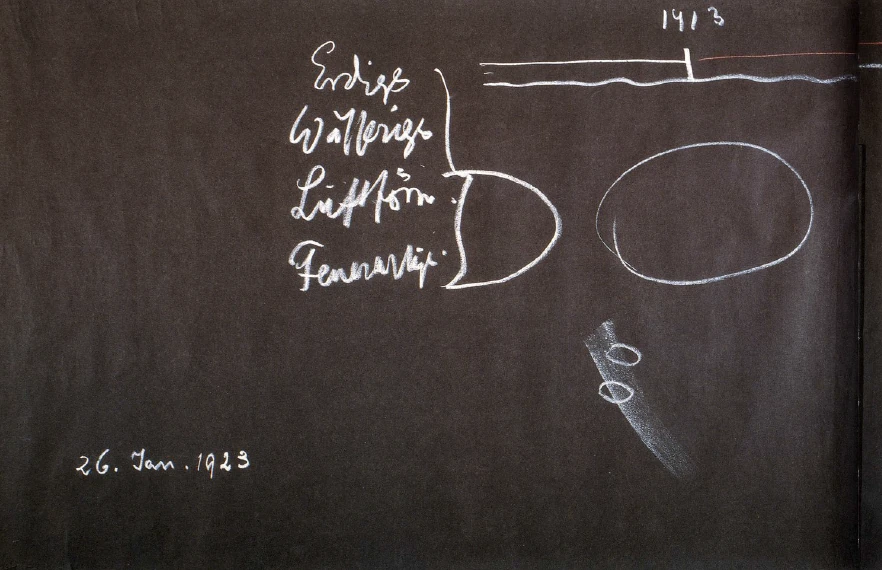
[ 6 ] Even if we consider only the very young child—I do not wish to take into account the human embryo in the mother’s womb at this time— even in the small child, who is still leading a dreamlike, slumbering earthly life, we see in what is growing within the child—even in what is raging within the child—the living power of pre-earthly thinking, if we are able to recognize what is truly presented to us. And we then become aware of the reason why the child is actually still slumbering in a dreamlike state and only later begins to have thoughts. This is because, during the early stages of the small child’s life, when it is still slumbering in a dreamlike state, its entire organism is encompassed by thought. But as the organism gradually solidifies within itself, it is no longer the earthy and watery aspects of the organism that are strongly grasped by thought, but only the airy and fiery, the warm aspects. So that we can say: In the very young child, all four elements are grasped by thought. — Later development consists precisely in the fact that only the airy and fiery aspects are grasped by thought, for this is our adult thinking: we actually bring the power of thought only into our continuous breathing process and into the process of warming the body.
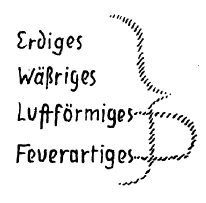
[ 7 ] So the power of thought rises, I would say, from the denser parts of the physical organism into the airy, volatile, weightless parts of the body. Through this process, thinking becomes precisely that independent element that then carries us through life between birth and death. And only when we sleep—that is, when the power of thought acquired on Earth, which is weaker, does not take hold of the physical organism via the indirect route of warmth and air—does the continuation of the pre-earthly power of thought also make itself felt in sleep. And so we can say that only when modern humanity turns to a genuine inner contemplation of the human being—of itself—does something become clear to it regarding the true nature of thought. All other theories of knowledge are, in essence, merely abstract concepts. If one truly grasps this, one must say: When one comprehends the process of imagination and thought, the perspective into pre-earthly existence opens up everywhere.
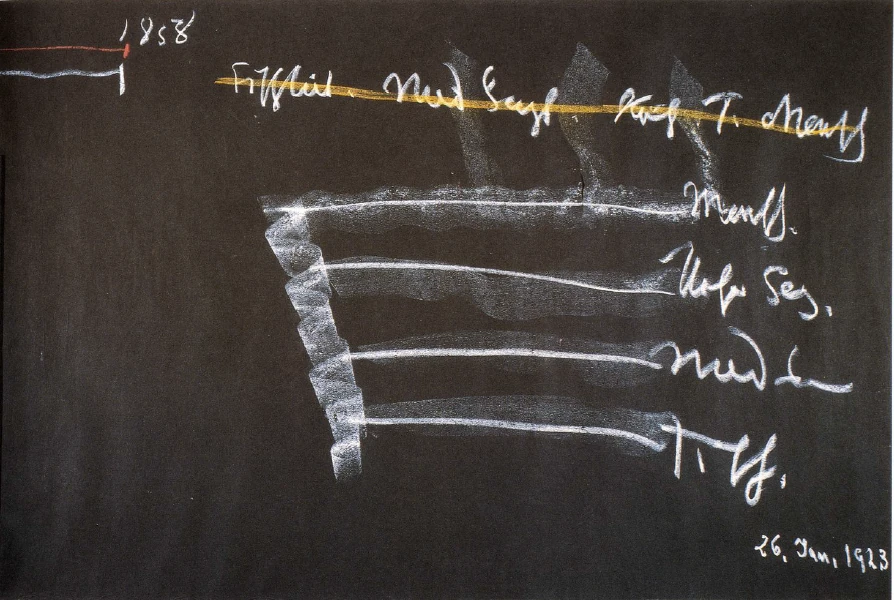
[ 8 ] But medieval thought, which still possessed a certain strength, had been forbidden to explore pre-earthly existence. The pre-existence of human beings had been dogmatically declared heresy. Well, whatever is imposed on humanity for centuries, humanity eventually grows accustomed to it. Just imagine the period in the development of modern humanity up to, say, 1413. By that time, humanity had become so accustomed to the prohibition against thinking about pre-earthly existence that it had ceased to direct its thoughts even in the direction where they might lead to an understanding of pre-earthly existence. People had thoroughly lost the habit of directing their thoughts toward pre-earthly existence. Had humanity not been forbidden to think about pre-earthly existence up until 1413, a completely different course of development would have emerged, and we would have experienced—not merely probably, but one might even say quite certainly—the following: it is paradoxical for me to say this, but it is nonetheless a truth— When, say, Darwinism emerged in 1858—which viewed nature’s development from an external perspective—the idea of pre-earthly existence would have dawned on it everywhere, from all realms of nature, due to this different way of thinking. It would have established a natural science grounded in the light of humanity’s pre-earthly existence. Instead, humanity had been weaned from considering pre-earthly existence, and thus emerged that natural science which, as I have often stated, regarded human beings merely as the culmination of the animal kingdom—and therefore could not at all conceive of a pre-earthly, individual life, because animals simply do not possess a pre-earthly, individual life.
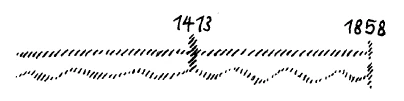
[ 9 ] So one can say: From the old conception of the Fall, as intellectualism began to dawn, the precept arose not to speak of pre-existence. As a result, natural science has flourished directly as the child of the misunderstood Fall. And we have a sinful natural science; we have a natural science that emerged directly from the misunderstanding of the Fall. This means that if this natural science were to remain as it is, the Earth would not be able to reach the goal of its development; rather, humanity would develop a consciousness that stems not from a connection with its divine-spiritual origin, but from a separation from that divine-spiritual origin.
[ 10 ] So today we are not merely discussing the limits of scientific knowledge in theoretical terms; rather, we are witnessing—in a concrete, material sense—a humanity that has already sunk below its proper level as a result of developments influenced by intellectualism. If one were to speak in the spirit of the Middle Ages—that is, in the words of the Middle Ages—one would have to say: Natural science has fallen into the hands of the devil.
[ 11 ] Yes, history tells a rather strange story here. When the natural sciences emerged with their brilliant results—which I do not intend to dispute even today—those who still had some sense of the true nature of humanity feared that the natural sciences might bring people closer to the devil. What was fear and dread back then—and what still lingers in Faust as he bids farewell to the Bible and turns to nature—is the fear that humanity might approach the knowledge of nature not under the sign of the redemption from sin, but under the sign of the Fall. The matter really goes much deeper than is generally supposed. And while all sorts of traditional sentiments still existed in the early Middle Ages—fear that the devilish poodle might latch onto the heels of natural scientists—in more recent times, humanity has pulled its nightcap over its head and no longer thinks about these things at all.
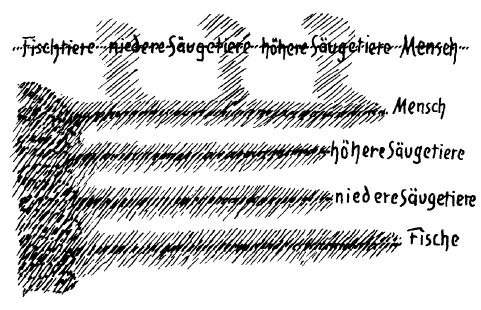
[ 12 ] This is the material aspect of the matter. It is not merely a matter of theoretical discourse influenced by the Fall when speaking of the limits of the understanding of nature; rather, the decline of humanity as a result of the Fall is in fact evident today in the intellectual-empirical realm. For if that were not the case, then we would not, for example, have a theory of evolution such as we have today; rather, ordinary research—which, in fact, does yield this result—would have revealed the following: We have, let us say, fish, lower mammals, higher mammals, and humans. Today, people construct a line of evolution that is roughly straight. But the facts do not support this at all. You will find everywhere that wherever this line of evolution is drawn, the facts do not add up.
[ 13 ] Actual scientific research is magnificent; what naturalists say about it is not true. For if one were to view the facts impartially, one would arrive at this: humans, higher mammals, lower mammals, fish. Of course, I am omitting some details. So, starting with human beings, one moves through an era of higher mammals, lower mammals, and so on, until one reaches a point of origin where everything is still spiritual, and where one can see how human beings, in their further development, are directly descended from it and have gradually assimilated its higher spirituality, and how the lower beings are also descended from it but have not assimilated any higher spirituality. This follows directly from the facts. We would have a correct understanding of this fact if human habits of thought had not been so directed—by the prohibition against believing in pre-existence, in a pre-earthly existence—that, for example, a mind like Darwin’s could not even conceive that things might be as presented here, but instead had to fall back on the alternative, precisely because of these habits of thought, not out of the necessity of research.
[ 14 ] It would also have been possible to develop Goethe’s theory of metamorphosis in a straightforward manner. As I have explained to you time and again, Goethe got stuck with his theory of metamorphosis. One need only take an unbiased look at how things stand with Goethe. He got stuck: he observed the plant in its development, arrived at the primordial plant, then arrived at the human being, and attempted to observe the metamorphosis of the bones in humans; that is where he got stuck—completely stuck.
[ 15 ] Just take a look at what Goethe wrote about the morphology of the human skeletal system: brilliant on the one hand. From a shattered sheep skull that caught his eye at the Lido in Venice, he realized that the bones of the skull are modified vertebral bones. But he didn’t take it any further.
[ 16 ] I drew attention to a note I found in the Goethe Archive during my stay in Weimar, in which Goethe points out: “The entire human brain is a transformed spinal ganglion.” But that was as far as it went. This sentence is written in pencil in a notebook, and one might say that you can tell from the final pencil strokes of this note how dissatisfied Goethe was with the matter, how he wanted to go further. But his individual research had not yet gone far enough. Today, research has advanced far enough—it has long been far enough—to address this question. If we examine the human being from even the earliest embryonic stage, there can be no question whatsoever that the shape of today’s skull bones somehow evolved from the spinal vertebrae—there can be no question of it at all. Anyone familiar with modern embryology knows this: Based on what we observe in humans today, there is no basis for assuming that the skull bones are modified vertebral bones. Therefore, one can naturally say: When Gegenbaur later reexamined the matter, he found that everything about the skull bones—particularly the facial bones—was different from what Goethe had assumed.
[ 17 ] But when one realizes that the present form of the skull bones can be traced back to the bones of the body from earlier earthly lives, then one understands the metamorphosis. One is thus led, through the external morphology itself, into the doctrine of repeated earthly lives. This lies directly in line with Goethe’s theory of metamorphosis. But it is impossible for the current of thought that culminated in Darwin—and which still prevails today in official science—to arrive at the truth. For the misunderstood Fall of Man has ruined thinking, bringing it into decline. The matter is simply more serious than people are inclined to admit today.
[ 18 ] One really must be fully aware of how human consciousness has changed over time in order to see things like the ones I have just mentioned in the right light. Today we talk about how something can be beautiful. But if you ask philosophers today—and they ought to know something about such things, don’t they, since that’s what they’re there for—what beauty consists of, you’ll find that you get the most incredible abstractions. “Beautiful” is simply a word that one sometimes uses instinctively and correctly based on one’s feelings. But what, for example, a Greek imagined when he spoke of beauty in his own way—we have no idea about that today. We don’t even know that the Greek spoke of the cosmos, which was something very concrete for him. Our “universe”—that’s a word. Well, as for what’s swirling around in that jumble when people speak of the universe under the influence of modern thinking, let’s not get into that today! The Greeks spoke of the cosmos. Cosmos is a word that encompasses beauty, the ornamental, the decorative, and the artistic. The Greeks knew: as soon as they speak of the entire world, they cannot help but speak of it in such a way that they characterize it with the concept of beauty. “Cosmos” does not merely mean the universe; “cosmos” means the laws of nature that have become universal beauty. That is what lies in the word “cosmos.”
[ 19 ] And when the Greek had a single beautiful work of art before him, or let’s say, when he wanted to depict a human being—how did he intend to depict him by making him beautiful? If one considers Plato’s definitions, one gets a sense of what the Greek meant when he wanted to portray a human being artistically. The term he coined for this conveys roughly the following: Here on earth, human beings are not at all what they are meant to be. They come from heaven, and I have depicted them in such a way that one can see their heavenly origin. — As if he had fallen from heaven—that is roughly how the Greeks imagined man to be beautiful, as if he had just come down from heaven, where he is, of course, quite different from humans in their outward form. They do not look as if they had just fallen from heaven; they bear the mark of Cain from the Fall of Man everywhere in their form. That is the Greek conception. We must not allow ourselves such a view in our time, when we have forgotten the connection between human beings and their pre-earthly—that is, heavenly—existence. So one can say that for the Greeks, “beautiful” means “revealing one’s heavenly significance.” There, the concept of beauty becomes concrete. You see, for us it is abstract.
[ 20 ] Yes, there was an interesting debate between two aestheticians: the so-called V-Vischer—because he spelled his name with a “V”—the Swabian Vischer, a very witty man who wrote an extraordinarily significant work on aesthetics, significant in the sense of our age; and the formalist Robert Zimmermann, who wrote a different work on aesthetics. One of them, V-Vischer, defines beauty as the revelation of the idea in sensory form. Zimmermann defines beauty as the harmony of the parts within a whole—that is, in terms of form; Vischer, more in terms of content.
[ 21 ] Actually, these definitions are all like that famous figure who keeps pulling himself up by his own hair. For when someone says: “The appearance of the idea in sensory form”—well, what is the idea? —one would first have to have something that is the idea. For the corpse of thought that humanity has as an idea, when it appears in a sensory form—well, nothing comes of it! But it means something when one asks, in the Greek sense: What is a beautiful human being? — A beautiful human being is one who embodies the human form in such an idealized way that he resembles a god—that is a beautiful human being in the Greek sense. With such a definition, one can actually do something; there is substance to such a definition.
[ 22 ] The point is to become aware of how the content of consciousness—the state of mind—of human beings has changed over time. Modern people believe, after all, that the Greeks thought exactly as we do today. And when histories of Greek philosophy are written today, this is indeed the case: for example, when Zeller writes an excellent history of Greek philosophy—excellent in the sense of our present age—it is as if Plato had taught not at the Academy but in the nineteenth century, just as Zeller himself taught at the University of Berlin. As soon as one grasps the idea concretely, one sees its impossibility, for Plato, of course, could not have taught at the University of Berlin in the 19th century—that simply would not have been possible. But what has been handed down from him is then translated into the concepts of the 19th century, and one has no sense at all that one must, with one’s entire state of mind, go back to another age if one truly wants to encounter Plato.
[ 23 ] Once one becomes aware of how things have come to be in the human soul, one will no longer find it so absurd to say: In fact, with regard to his thinking about the external natural world and about human beings themselves, man has completely succumbed to the Fall.
[ 24 ] And here we must consider something that people today do not think about—indeed, something they might even regard as twisted. We must speak of the fact that in today’s theoretical understanding—which has become popular and now dominates every mind, even in the remotest corners of the world and in the most remote villages—there is something that must first be redeemed through Christ. Christianity must first be understood in this regard.
[ 25 ] Well, if one were to expect a scientific thinker today to understand that his thinking must be redeemed by Christ, well, then he would clutch his head and say: Christ’s work may have been done for all sorts of things in the world, but for the redemption of natural science from the Fall—we won’t go there! — But even when theologians write scientific books—as so many did in the 19th and 20th centuries, some about ants, others about different subjects, such as the brain and so on—and these books are, for the most part, excellent, even better than those written by natural scientists, because these people are able to write in a somewhat more readable style— even then, these books written in the scientific field all the more exude the need: here we must take a true Christology seriously; that is to say, we need today—precisely in the intellectual realm—a genuine redemption from sin that must counter the Fall.
[ 26 ] Thus, on the one hand, we see that intellectualism is corroded by what has arisen from a misunderstood sense of sin—not from the fact of the Fall, but from this misunderstood sense of sin. For the unambiguous sense of sin must place Christ—as a higher being—at the center of Earth’s evolution and, from there, find the way out of the Fall. This requires a deeper, detailed examination of human evolution, including in the spiritual realm.
[ 27 ] If one considers medieval scholasticism—as is commonly done today—going back, for my part, even to Augustine, then nothing at all can be concluded from it. Nothing can be deduced from it because one sees nothing other than that modern scientific consciousness is, so to speak, developing further, but one disregards the higher, the overarching.
[ 28 ] Here in this hall, I have attempted to present medieval scholasticism in such a way that one can see the whole context. I have given a short series of lectures here on Thomism and related topics. But that is precisely the painful thing about our anthroposophical
[ 29 ] The movement is so unhelpful that such ideas are not even taken up, that the connection between today’s brilliant state of the natural sciences and what must now be incorporated into them is simply not sought! And if this connection is not sought, then our research institutes—which were truly achieved through great sacrifice—would remain fruitless. Their task would be to actually make use of such ideas in order to move forward, not to engage in fruitless polemics about atomism.
[ 30 ] Today, our natural sciences have advanced so far in every area of their factual domain that they are urging us to finally abandon those sterile speculations that we find in current scientific textbooks. After all, we know the human being well enough anatomically and physiologically that, if we choose the right methods of thinking, we can arrive at conclusions—such as the metamorphosis of the shape of the head from the shape of the body in a previous life—that still seem bold today. But of course, if one clings to the material, one cannot arrive at this conclusion, for then one asks, in a very clever way: “Yes, but then the bones would have to remain material so that they could gradually transform themselves materially in the grave.” — The point is precisely that the material form is an external form and that the formative forces are subject to metamorphosis.
[ 31 ] On the one hand, thought has been shackled by the fact that darkness has been cast over pre-existence. On the other hand, there is post-existence—life after death. But life after death cannot be attained through any knowledge other than supersensible knowledge. If one rejects supersensible knowledge, then life after death remains an article of faith that can only be believed on the basis of authority. A correct understanding of the thought process leads to pre-existent life, provided that thinking about it is not forbidden. Post-existent life, however, can only become true knowledge through supersensible knowledge. This requires the method I described in How Does One Attain Knowledge of the Higher Worlds?. Yet this method, in turn, is frowned upon by today’s prevailing mindset.
[ 32 ] And so two things work together: on the one hand, the continuing effect of the prohibition against approaching a person’s pre-existing life; on the other hand, the abhorrence of supernatural knowledge. When these two are brought together, the entire supersensible world remains the domain of non-knowledge—namely, of mere faith—and Christianity remains a matter of faith, not of knowledge. And then the science that claims to be “science” refuses to have anything to do with Christ at all. And that brings us to the situation we find today.
[ 33 ] But as I already said at the beginning of today’s reflections: With regard to consciousness, which today is entirely filled with intellectualism, humanity has fallen prey to the consequences of the Fall and will not be able to rise again—that is, it will not be able to attain the earthly goal. The goal of earthly existence cannot be attained through today’s scientific approach. But deep within the soul, human beings remain unbroken even today. If they draw upon these depths of their soul and develop supersensible knowledge in the spirit of the Christ impulse, they will thereby also find redemption in the intellectual realm from today’s—if I may put it that way—intellectualism that has fallen into sin.
[ 34 ] The first thing that is necessary, then, is to recognize that intellectual-empirical research must be permeated by that which can be grasped from the spirituality of the world. Science, therefore, must be permeated by spirituality. But this spirituality cannot reach human beings if we always examine only what exists side by side in space in terms of its juxtaposition, or what follows one another in time in terms of its succession.
[ 35 ] If you examine the form of the human head—specifically with regard to its bone structure—and compare it only with the rest of the skeletal structure: long bones, vertebrae, ribs, and the skull—then you will come up with nothing. You must go beyond space and time to those concepts that are developed here in spiritual science by grasping the human being from one earthly existence to the next. So you must be clear about this: When we look at the skull bones today, we can regard them as transformed vertebral bones. But what the vertebrae of the spinal cord are in humans today will never transform into skull bones within the realm of earthly existence; they must first decay, must first be transformed into the spiritual, in order to become skull bones in a subsequent earthly life.
[ 36 ] When an instinctive-intuitive mind like Goethe’s emerges, he can see from the shapes of the skull bones that they are transformed vertebrae. But to move from this insight to the facts, one needs spiritual science. Goethe’s theory of metamorphosis only makes sense within the context of spiritual science. It has no meaning without spiritual science. That is why, in the end, it was ultimately unsatisfying even to Goethe himself. But that is also why it is solely these insights—which are connected to anthroposophical spiritual science—that bring human beings into the right relationship between the Fall and redemption. That is why these anthroposophical insights today are something that seeks to be incorporated not merely as a subject of contemplation, but as a living substance of life into human development.