

Earthly Knowledge and Heavenly Insight
GA 221
10 February 1923, Dornach
Translated by Steiner Online Library
5. Knowledge of the Earth and Understanding of the Heavens. Man as a Citizen of the Universe and Man as an Earthly Hermit
[ 1 ] As a result of the great transformation that I have now described here from various perspectives, and which has taken place in the spiritual development of humanity over the course of the last few centuries, not only—let us say—the intellectual, theoretical character of cognition has changed, but what has changed also has a definite influence on the emotions and feelings of the entire human soul life, and thus on human life as a whole. To understand this, one can consider the following. Of course, what manifests itself in individual symptoms—which stand out more or less clearly—must be revealed in characteristic forms of expression of life if one wishes to understand the actual foundations of life.
[ 2 ] We have often referred to what were, in ancient times of human development, places of knowledge. These were the mystery temples. In a sense, these mystery temples were, to the greatest extent, steeped in the reverence of the people. When people spoke of mysteries and mystery beings, they said that what took place within the mysteries represented something of the utmost importance for humanity on Earth. They believed that everything of significance in human life radiated from the mysteries. People said to themselves, as it were: If there were no mysteries among human beings, people on Earth could not at all be what the gods intended them to be!
[ 3 ] People thus looked upon the Mysteries with a feeling of the highest reverence and the most profound respect, and at the same time they looked upon the Mysteries with a feeling of gratitude, aware that they give one what makes it possible to be on Earth what the gods wish to make of human beings. One need only compare this with the way people view educational institutions today, in a certain sense, and one will find nowhere that immense, warm reverence. In many cases, one will even find a feeling that, once one has necessarily completed what comes from these institutions of learning, one is glad to be free of them. But in any case, even if one does not look at this extreme, one still knows that one does not actually receive from these institutions of learning what, inwardly as a human being, seems necessary for one’s true humanity—what makes one human. After all, no matter how much one may revere—with a certain theoretical reverence—what one gains from chemical laboratories, biological institutes, law schools, or even philosophical seminaries, one will not have the feeling: “You are aware of your humanity because chemical laboratories, biological institutes, law schools, and even philosophical seminaries exist.”
[ 4 ] One cannot say that—even if these educational institutions are perhaps shrouded in a certain theoretical aura—all the warm feelings of reverence felt by people in the widest possible circle are directed toward these institutions.
[ 5 ] In any case, it is not all that common today for a student—who, for example, is writing a paper for a university seminar and thereby intellectually expressing what he has to reveal—to feel that this work is interwoven with his entire fundamental humanity in the same way that a student of the mysteries once did when he had passed one of the stages of training.
[ 6 ] But on the other hand, human beings need something that connects them, here in their earthly lives, to something worthy of reverence, from which they feel the divine radiating. But let us compare this—I would say—more cultural-historical nuance with what actually underlies it; let us go back, so to speak, to the times when, in the Near East, two or three millennia before the Mystery of Golgotha, mystery-like educational institutions existed: It was precisely in these mystery-like educational institutions that the natural sciences of that time were studied, if one can call them that. They studied the starry sky, the nature of the stars, the movements of the stars, the appearance of the stars at certain times, and so on. Today, people imagine that this study of the starry sky back then might even have been something fanciful. It was not. It was conducted with at least the same, if not much greater, methodological rigor as mineralogy, geology, or biology are conducted today.
[ 7 ] But what did people tell themselves when they studied the nature of the starry sky? They said to themselves: If you know the nature of the starry sky, then you know something about the nature and destiny of humankind on Earth. — After all, the study of the starry sky culminated in gaining knowledge, from the constellations of the stars, about the destiny of human beings—indeed, of entire peoples on Earth.
[ 8 ] People did not look up at the starry sky merely for theoretical purposes, but rather they said to themselves: If you know the relationship of Saturn to the Sun, or the relationship of Saturn to a sign of the zodiac at the moment when a person is called upon to act, or when he accomplishes an important deed in life, then you know how the heavens have placed humanity upon the Earth; you know to what extent a human being is a creature, a child of the heavens. Ultimately, you study the heavens in order to understand what provides you with a guiding principle in your life on Earth. — Everything that was gained as knowledge about the celestial realm was directed toward human beings. In fact, all knowledge was thoroughly imbued with something thoroughly human. And whatever human beings did on Earth, they felt it in connection with what they were able to study in the heavens. We can take an example from, say, a human artistic endeavor. When people in ancient times composed poetry or music, they drew it from that inspiration that came to them from the heavens.
[ 9 ] I have mentioned this often: Homer does not say—to use a poetic phrase—“Sing, O Muse, of the wrath of Achilles, son of Peleus,” but rather because he was aware that he was not expressing something that came from human whim, but rather something whispered to him by the heavens. And anyone on earth who was involved in music in any way reproduced through the sound of earthly instruments what he believed he had heard from the heavenly realms as celestial music. Human beings certainly felt, in the way they acted on earth, in the way they interacted with other people on Earth, and in the way they established communities on Earth, that they experienced the impulses of will that radiated down to Earth from the vastness of the universe—impulses they explored in light of their knowledge of the starry heavens—and that they acted here on Earth as human beings in accordance with these intentions of the heavens.
[ 10 ] One might say: Everything that constituted science, art, and religion in those ancient times flowed into human life and activity. For religion, science, and art were, after all, a unity—a unity that ultimately shone into the human being, so that the human being might feel himself on earth as the being the gods intended him to be.
[ 11 ] This mood persisted as long as human beings held a spiritual perspective in their understanding of the heavens—as long as they were able to perceive a spiritual element in the nature, the course, and the appearance of the stars, a spiritual element that, in a sense, flowed down to them on Earth through their knowledge of the stars, so that they could bring it to life here on Earth.
[ 12 ] Astrology is a word that doesn’t have a very good ring to it today. But if we consider it in its original sense, it takes on a better meaning. Human beings looked up at the stars, and from the stars the Logos revealed itself to them, which in turn worked here on Earth through their thoughts, their imagination, and their language. Even when humans set their speech organs in motion, they practiced that which, through the shaping of sound, allowed the mysteries of the heavens to resound here on Earth. The Logos, which is the reason that reigns within the human race, appeared as an emanation from the world of the stars. Astrology: what took place here on Earth below appeared as a reflection of the archetype that was perceived through astrology.
[ 13 ] When we look at our knowledge today, we see how this knowledge is gained through sensory observation of the earthly realm. Even when studying astronomy today—as I explained yesterday—it is, after all, merely the reflection of earthly knowledge projected upward into the heavens. Modern human beings acquire knowledge through the senses. Indeed, they stand in the world differently than they did in the past. I recently characterized this different way of standing in the world in these lectures here. I said: What modern, intellectualistic humanity is—with its abstract concepts, but also with its freedom, which is only possible through the development of abstract-intellectualistic concepts that do not constrain the individual, and that also provide moral precepts arising from his individuality, as I have described in my *Philosophy of Freedom*—this human being, with such intellectualistic concepts and such a sense of freedom, only entered the course of human development at a time when that consciousness—which stemmed from astrology and made human beings appear as beings carrying out the intentions of the gods on Earth—had ceased to exist. This human being, with his intellect and his sense of freedom, is a being cut off from the heavens. He has truly become an earthly hermit and thus acquires his knowledge here on earth. And the way in which he acquires his knowledge—it is this very way—that explains the interest with which he clings to these insights.
[ 14 ] In ancient times, it would have been unthinkable to view religion and scientific knowledge as two separate things. Once scientific knowledge had been acquired, it was such that it immediately instilled a religious feeling, that it showed one the way to the gods, so that one could not help but be a religious person in the true sense once one had acquired such knowledge.
[ 15 ] Today, one can acquire the full breadth of common knowledge; yet this does not make one a religious person. I would like to know who, today, becomes a religious person simply by becoming a botanist, a zoologist, or a chemist! If one wishes to become a religious person, one seeks the religious alongside knowledge. That is why we seek places where religious life can flourish alongside knowledge; we are even often convinced that knowledge leads us away from religious paths, that we must seek other paths that will in turn lead us back to the religious. And yet, we have had to emphasize time and again the significance of these newer insights. We have had to point out that these newer insights are absolutely necessary for modern human beings and for the further development of humanity. But when people today step into the world with their intellectualism and their sense of freedom, they are already developing here on earth what the people of old—who, if I may put it that way, had a sense of the heavenly—only developed after death.
[ 16 ] When we describe the moments following death for people today, we describe how a person, in a sense, looks back on their life as they separate their etheric body from themselves. We then describe how they retrace their life in a subsequent period. In earlier times, life after death had to be described in such a way that people were told: What you can attain here only through a higher revelation—an intellectualistic worldview—will appear to you after death. What you are meant to achieve here on Earth can exist only as an ideal; you will be a free human being after death. — That is what was said to people in earlier times. — The true human being emerges once one has passed from this physical world into the spiritual world. That is what was said in ancient times. But what in ancient times was experienced only after death—looking back on earthly life, intellectualism, and a sense of freedom, for which the whole of earthly life served as preparation—modern man has already forced into his life between birth and death. Here on earth, he becomes an intellectual being; here on earth, he becomes a being with a sense of freedom.
[ 17 ] To do this, however, he must acquire something on earth through sensory perception and the synthesis of his sensory perceptions—something that is initially far removed from his interests. No matter how long we may explore through the telescope what we know today about the world of the stars, on a human level this does not truly warm our hearts or enlighten our souls. Expeditions are organized by astronomers and naturalists to verify Einstein’s ideas. But no one expects the observations made there to yield anything that belongs as closely to immediate, elemental human nature as was once expected of the astronomers of ancient Babylonian or Assyrian culture. This is a tremendous difference in what modern discoveries offer us: a lack of interest in values. It may indeed be extraordinarily interesting when this or that biological discovery is made today, but no one says: “Because this or that biological discovery has been made, human beings are drawing closer to the divine-spiritual being they carry within their souls.” It is through a separate religious interest that human beings seek to draw closer to this divine-spiritual being they carry within their souls.
[ 18 ] Even today, however, people do not have a proper understanding of the way in which an ancient humanity came to knowledge, even in later times. One need only think of what a momentous, fateful experience it was when a man like Archimedes discovered the Archimedean principle while bathing and burst out with the fateful words: “I have found it!” — At that moment, such an individual insight was something that felt as though one had looked through a window into the mysteries of the universe.
[ 19 ] This warmth toward knowledge was certainly not present when X-rays, for example, were discovered. One might say: Today’s relationship to what knowledge provides is more a gesture of gaping in astonishment than of inner spiritual exultation. That makes a human difference! And this human difference must be taken into account for the development of humanity.
[ 20 ] Something most remarkable emerges from all this. For centuries now, modern human beings have brought into human life what they previously experienced only after death: an intellectual understanding of the world and a sense of freedom. But they have not even really noticed it yet. That is what is so remarkable: that modern humanity has not even really noticed that it has brought into earthly life something it received from heaven. It has not at all taken hold of the emotional world, the elemental aspect of the human world. One might say that, for humanity, this has rather a bitter aftertaste. After all, humanity does not view the pure idea in the way I attempted to view it in my *Philosophy of Freedom*, where one would actually prefer to sing hymns to it rather than first take it apart. And the consciousness of freedom has, at first, led people to all sorts of tumultuous behavior, but not to the realization that something has descended from heaven to earth. Not even the fundamental force behind the modern development of humanity has been perceived in a purely human way. Where does this come from?
[ 21 ] When one answers this question, one is at the same time answering one of the most important questions of human existence itself. In ancient times, human beings acquired their knowledge by looking up to the heavens, seeking there the Logos—that which the gods spoke to humanity through the movement of the stars and the nature of the stars—and human reason was the reflection of this divine Logos. Everything humans did here on Earth was illuminated by the content of the Logos, and this content, in turn, had been drawn from the stars. Human life would have been meaningless had it not been possible to give it meaning through knowledge of the world of the stars.
[ 22 ] Well, today, in a very similar sense, everything we internalize as knowledge is, in fact, nothing. We acquire it by allowing ourselves to be guided toward botany, zoology, biology, physiology, and so on—driven, at most, by ambition or by the realization that this is necessary for us to eke out a living on Earth. This is, again, a radical statement, but in a certain sense it borders on reality. For those who project grand ideals onto things today—there is, after all, a certain element of illusion through which they reinterpret the matter as ideal. At the very least, it is exceedingly rare to find people who could attach any meaning to the phrase: “I pray a chemical formula.” — Yes, one must indeed articulate an important cultural-historical fact—albeit a negative one—in just such a way!
[ 23 ] It takes someone like Novalis—with his insight, both profound and yet glowing with youthful enthusiasm—to feel something like this: “I pray as I solve a differential equation.” — Our ordinary mathematicians do not feel at all as if they are praying when they unravel the mystery of a differential equation. The self-evident fact that, with this insight, the whole person is engaged—that the whole person feels its inclination toward the divine—this self-evident fact is, after all, not at all self-evident to humanity today. It is far more common for precisely those who ascend to the highest achievements of knowledge to be glad when their exams are behind them, so that they no longer have to go through these things. The joy of passing through the stages of the mysteries: among modern people who go through their exams, one hardly notices any of this at all. At least it is exceedingly rare today for anyone to speak, with the full solemnity of the ancient mysteries, of that intimate divine act which this or that professor has performed by assigning him a dissertation topic and thereby enabling him to pass through the waters [consecrations?] of holiness while working on that dissertation topic! Yet this would be the norm, the natural state of affairs!
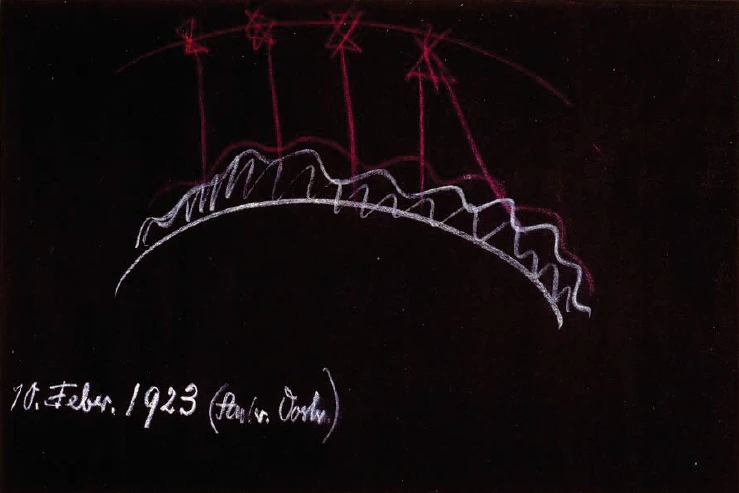
[ 24 ] One need only keep this in mind to say: Yes, down there is the Earth with its many things (see drawing, white and green). The ancient sages saw these many things. But they believed they could only grasp them in the true sense by looking up at the stars and drawing down the rays from the stars, through which everything was illuminated for them in the proper way (red).
[ 25 ] These ancient sages sought the reflection of the world of the stars in earthly life (lower red); otherwise, everything I have hinted at down here would have seemed worthless to them. Today we do not concern ourselves with what is above, but study what is below. We study it in countless details. Once we have devoted ourselves to any kind of knowledge oriented toward one direction or another, we have many details in our minds. But our assessment of these details takes on a certain indifference toward life, and with it, a certain lack of interest in the higher, elemental aspects of humanity. This is particularly evident in the realm of the spirit itself.
[ 26 ] Even Schwaben-Vöscher mocked how indifferent to a universal human consciousness the very thing that must be overcome today becomes when one strives to reach that level of understanding, saying that one of the “most significant” treatises in the field of modern literary history would be one on the connection between Christiane von Goethe’s chilblains and the symbolic-allegorical figures in the second part of *Faust*! Why couldn’t a dissertation be written on this connection, just as one might on many other things? After all, the methodology employed and the human interest involved are no different in quality from, say, someone writing a treatise—such things do happen—on the dashes in Homer’s poetry! Yes, we truly gain insights into what an ancient human understanding deemed worthy only after it could illuminate it from the perspective of celestial knowledge.
[ 27 ] We do not possess knowledge of the heavens. We do not look at copper when we gaze up at Venus, nor do we look at lead when we gaze up at Saturn, we do not look at the primordial human when we gaze upon the constellation of Aquarius, nor do we look at that which, in the animal nature of the Lion, corresponds to certain inner impulses of human nature when we gaze upon the constellation of Leo, and so on. We do not draw anything further from the heavens that is meant to explain the earthly world; rather, we turn our gaze solely to the vast, scattered details of the Earth.
[ 28 ] We, in turn, need something that instills values into the individual, something that leads us to see once again what a person saw when they observed an earthly object illuminated from the heavens. We have knowledge of many things, but we need a unified body of knowledge that can radiate into all individual fields of knowledge and provide those fields with a sense of value. That is what anthroposophy aims to be.
[ 29 ] Just as astrology once looked to the heavens to explain the Earth, anthroposophy seeks to look within the human being to discover what the human being has to say of its own accord, so that from this perspective, everything we know about minerals, animals, plants, human beings—and indeed everything else that can otherwise only be known in a scattered, fragmented way—may be illuminated by anthroposophy.
[ 30 ] And just as human beings once looked up to the heavens to understand their earthly life, so too must the intellectually liberated human being learn to know himself, so that he may once again look toward the moment of death, when he steps out into a spiritual world, and where the gods will look down upon what he brings to them—that which radiates from him. For they are to have already become human beings here on earth, whereas in the past they only became human after death.
[ 31 ] How he became human will be revealed through the power he has drawn from pure human consciousness. And this pure human consciousness is to be given to him through that which radiates from anthroposophy to everything else—not only what human beings on Earth can know, but also what they can accomplish.
[ 32 ] “In the beginning was the Word, and the Word was with God, and the Word was God”—that is, in the beginning was the Logos, and the Logos was with God, and the Logos was God. The Logos was brought down from the revelation of the gods in the heavens.
[ 33 ] But the Word became flesh, and not only dwelt among us, but continues to dwell among us. The Logos became flesh. What was once to be sought in the heavens must now be sought in humanity. For the Logos was once rightly sought in God the Father; in our time, the Logos must be sought in God the Son.
[ 34 ] But human beings find this Son of God in his elemental significance when they live out the words of Paul: “Not I, but Christ in me,” when they come to know themselves. The whole of anthroposophy aims to delve deep into the human being. When ancient times delved deep into human beings, what did they find? At the very depths of human nature, the Luciferic forces. If modern human beings only delve deep enough within themselves, they will find Christ. This is the other side of the transition from older to newer times. As intellectualism and the consciousness of freedom have descended from heaven to earth, and Christ has united Himself with humanity on earth, human beings find Christ in the depths of their own being—if they descend deeply enough—whereas people of earlier times found the Luciferic spirit precisely through this deep descent.
[ 35 ] That was, after all, precisely what was to become particularly clear to the older generation of students in the Mysteries: Delve deep into the human being as he exists on Earth, and you will ultimately find, at the very depths of your own soul, that which you must recoil from in trembling fear: the Luciferic forces. Therefore, look forward to the moment of death; only then, when you have passed through the gate of death, will you become true human beings. Then you will be saved from what you find at the depths of your soul here on Earth: the Luciferic forces.
[ 36 ] That was the experience of death in the ancient mysteries. That was why these ancient mystery students had to turn their attention to the insight into, and the depiction of, the moment of death in the mysteries.
[ 37 ] Modern man should embrace what has become part of him: intellectualism and the sense of freedom. If he accepts them with dignity, so that he permeates all other knowledge of the earth and all other deeds with what springs forth from him out of pure human consciousness—as anthroposophy intends—then he will find the Christ forces at the depths of his soul. Then he says to himself: Once I looked up at the constellations to fathom human destiny on Earth; now I look to the human being and thereby learn to recognize how this human being, having already been permeated on Earth by the Christ substance while in possession of humanity, shines forth for the universe, how he shines upward toward the heavens as the star of humanity once he has passed through the gate of death.
[ 38 ] This is the spiritual humanism that can take the place of the old astrology. This is what instructs people to look upon that which human beings can likewise reveal within themselves as Sophia—Anthroposophia—just as the stars once revealed themselves as Logia. But this is also the consciousness with which one must imbue oneself. And there one comes to know the cosmic significance of the human being. From there, one learns to recognize that cosmic significance of the human being which first leads us to study the physical body and then leads us to study the form-forming body, or etheric body. But I will mention just one example: If one learns to study the human physical body in the proper sense, by illuminating it from the perspective of anthroposophy, then one learns about this physical body of the human being and how it can follow its own forces. When it follows its own forces, it is constantly striving to become ill. Indeed, what exists down there in the human being as the physical body is actually in a constant effort to become ill. And when we look up from the physical body to the etheric body, we find in the etheric body the totality of those human forces that are constantly striving to restore the sick person to health. The oscillation between the physical body and the etheric body is aimed at continuously maintaining a balance between the pathological and the therapeutic. The etheric body is the cosmic healer, and the physical body is the cosmic pathogen.
[ 39 ] And we might just as well be speaking of other areas of human knowledge. And in saying this, we ask ourselves: When we are faced with an illness, what must we do? We must somehow, through specific combinations of remedies, call upon the etheric body to heal. After all, this is essentially what all medicine does: it calls upon the human etheric body to heal, for it is the healer. If we approach the etheric body in the right way in a person who can be restored to health—if we seek out the healing forces that can flow to them from the etheric body in accordance with their general human destiny—then we are on the path to healing them.
[ 40 ] But I'll talk more about that tomorrow. Tomorrow I want to discuss precisely this last topic we touched on in connection with what we discussed today.