

The Annual Cycle as the Earth's Breathing Process
and the Four Major Festival Seasons
GA 223
1 April 1923, Dornach
Translated by Steiner Online Library
Second Lecture
[ 1 ] Yesterday I tried to speak to you, from the esoteric perspective of the Easter concept, about how a kind of connection to the course of nature must be established on the part of those spiritually enlightened by incorporating, so to speak, a celebration of autumn into the annual festivals, a celebration of autumn as a kind of Michaelmas, which would have to coincide with the autumnal equinox in much the same way that Christmas coincides with the winter solstice, Easter with the vernal equinox, and St. John’s Day with the summer solstice.
[ 2 ] Today I would like to try to elaborate on this Easter reflection—which is appropriate for our times—by focusing more on its emotional content, so that I can then explain to you tomorrow the full significance of precisely such a reflection.
[ 3 ] When we celebrate Easter today and look around at the consciousness of contemporary humanity, we must—if we are honest with our own inner selves—admit just how little the idea of Easter actually holds true for a large part of humanity today. For what does the truth of the Easter idea depend on? This truth depends, after all, on how a person can form a conception of the Christ Being having passed through death, having conquered death, having passed through the Resurrection, and—after enduring death and following the Resurrection—having initially connected with humanity in such a way that He could still give revelations to those who had previously been the apostles and disciples.
[ 4 ] But the idea of the Resurrection has, after all, faded more and more. It was so vibrant in the early days of Christianity that Paul’s words from that era still resonate with us: “And if Christ has not been raised, your faith is in vain!” Paul literally tied Christianity to the idea of Easter—that is, to the idea of the Resurrection. For those who have embraced the education of our time, the Resurrection is something called a miracle, and as such it is relegated outside the realm of what is real or can be real, so that for all those for whom the idea of the Resurrection is no longer comprehensible, Easter is really nothing more than an old custom, just like the other Christian holidays.
[ 5 ] Well, we have touched on this from a wide variety of perspectives over the years. Once again, it will be necessary for an understanding of the spiritual world as such to reach humanity in order to comprehend events that do not belong to the realm of sensory reality. And what is connected with the idea of the Resurrection will have to be regarded as such a fact. Then, too, the idea of Easter will truly be able to come alive again. For a human race that relegates the Resurrection to the realm of unreal miracles, the idea of Easter can hold no life. After all, this idea of Easter arose in that epoch of human history in which remnants of the ancient, original human perception of the spiritual world were still present.
[ 6 ] We know that at the very beginning of human development on Earth, people possessed, so to speak, an instinctive clairvoyance through which they could gain insights into the spiritual world, viewing it in such a way that it was on a par with the physical-sensory world. This instinctive, primordial clairvoyance has been lost to humanity on Earth. It was still present, at least in its final vestiges, during the first three centuries of Christian development. Therefore, even in those early centuries, a certain understanding of the Easter message—based on ancient human insights—was still able to take root. Such an understanding was stifled in the 4th century, when the groundwork was laid for what has since occurred to the fullest extent since the first third of the 15th century: human life within abstract, lifeless thoughts, as we have often discussed. Within these abstract thoughts, in which the natural sciences were able to flourish, the idea of Easter, too, was initially forced to wither away.
[ 7 ] Today is the time when this Easter idea must once again awaken as a living idea. But in order to awaken, it must pass from a state of death into a state of life. That which is alive is characterized by the fact that it drives other living things forth from itself. When the Easter idea spread throughout Christendom in the early Christian centuries, people’s minds were still receptive enough to experience something profoundly powerful within themselves at the sight of Christ’s tomb and at the sight of the being rising from the tomb, now united with humanity. People’s minds were able to experience with inner intensity what this powerful image presented to their souls. And this inner experience was a reality in human soul life. Only that which truly grips the human soul in the same way that the sensory external world otherwise grips the senses is a reality in human soul life. People felt transformed by contemplating the event of Christ’s death and resurrection. Through this contemplation, they felt spiritually transformed in the same way that a person otherwise feels changed by physical events in the course of their life on earth.
[ 8 ] A person undergoes a transformation around the age of seven through the change of teeth, and another transformation around the ages of fourteen or fifteen through sexual maturity. These are physical transformations. In contemplating the meaning of Easter, the early Christians felt transformed inwardly and spiritually. They thus felt lifted out of a certain stage of human existence and transported into another stage.
[ 9 ] Over time, the idea of Easter has lost this power, this force. And it can only regain it if the resurrection—which, after all, cannot be understood according to the laws of nature—once again becomes a reality within a spiritual science, a science that comprehends the spiritual. But what is grasped spiritually only becomes a reality if this spiritual aspect is not merely grasped in abstract thought, but is understood in a living connection with the world that also presents itself to the senses.
[ 10 ] Anyone who wishes to conceive of the spiritual only in its abstract form—anyone who, for example, says that one should not draw the spiritual down into the physical-sensory world—should also immediately consider the idea that the divine being is defiled if one imagines that it created the world. After all, the divine can only be grasped in its greatness and power when one does not place it beyond the sensory realm, but rather attributes to it the power to act within this sensory realm, to creatively permeate it. It is a demeaning of the Divine to want to relegate it, as it were, merely to abstract heights, to a cloud-cuckoo-land. And so one will never live in spiritual realities if one grasps the spiritual only in its abstractness, if one cannot relate it to the entire course of the world as it presents itself to us.
[ 11 ] The course of the world initially presents itself to us in our earthly life in such a way that this earthly life spans a certain number of years, and that these years, in a regular rhythm, represent the recurrence of certain events, as I already hinted at yesterday. After a year, we return to roughly the same phenomena of the weather, the constellations, and so on. The course of the year is, in a sense, something that inserts itself into our earthly life in a rhythmic manner. We saw yesterday that this annual cycle represents an exhalation and inhalation of the Earth’s soul-spiritual life by the Earth itself. If we once again bring to mind the four main points of this Earth-breathing process, as we allowed them to arise before our souls yesterday, we must say: The Christmas season represents the Earth’s inner holding of its breath. The soul-spiritual aspect has been completely absorbed by the Earth. Deep within the Earth rests everything that the Earth has unfolded during the summer months to be inspired by the cosmos. Everything that opened itself up and surrendered to the cosmic forces during the summer has been absorbed by the Earth and rests in the depths of the Earth during the Christmas season. After all, human beings do not live in the depths of the Earth; physically, they live on the Earth’s surface. Nor do they live spiritually and soulfully in the depths of the Earth; rather, they actually live within the Earth’s atmosphere. Spiritually and soulfully, they also live within the atmosphere that surrounds the Earth.
[ 12 ] For this reason, all esoteric science has always recognized the essence of the Earth at the time of the winter solstice—the Christmas season—as something initially hidden, something that cannot be fathomed by ordinary human powers of cognition, something that belongs to the realm of the esoteric mysteries. And in all earlier times, when there was something similar to our modern Christmas celebration, it was held that what takes place with the Earth during the Christmas season could only be understood through initiation into the knowledge of the mysteries—through initiation, as it was still called in Greece, into the chthonic mysteries. Through this initiation into the knowledge of the mysteries, human beings, so to speak, distanced themselves from the sphere of the Earth in which they live with their ordinary consciousness, to the extent that they immersed themselves in something into which they could not physically immerse themselves: that is, he immersed himself in the spiritual-soul realm and came to know what the Earth becomes during the height of winter by drawing in its spiritual-soul essence. And through this initiation into the mysteries, humanity then came to know that at the time of the winter solstice, the Earth becomes particularly receptive to the permeation of the lunar forces. This was regarded as the secret—if I may express it in modern terms—as the Christmas secret of the ancient mysteries: that it is precisely at Christmas time that one comes to understand the way in which the Earth, by being saturated and permeated with its spiritual-soul aspect, becomes particularly receptive to the influence of the lunar forces within the Earth.
[ 13 ] For example, in certain earlier times, no one was considered capable of understanding the science of healing unless they had been initiated into the winter mysteries—unless they understood how the earth, by holding its breath, becomes particularly receptive to the effects of the moon’s forces within it; how, at this time, it especially imbues plants with healing powers; and how it transforms something entirely different from the plant world, but also from the world of lower animals.
[ 14 ] The Christmas initiation was experienced as a descent into the depths of the earthly realm. But people associated something else with this Christmas initiation as well. They associated with it something that, in a certain sense, was perceived as a danger to the human being. People would say to themselves, for example: If one truly looked with love, filling one’s consciousness with it—that which lives in the Earth as lunar forces at Christmas time—then one enters a kind of state of consciousness in which one must be very strong inwardly, must have strengthened oneself greatly, in order to withstand the onslaught coming from all sides from the Ahrimanic forces, which live in the Earth precisely through the absorption of the lunar influence. And only through the strength one has developed within oneself in one’s soul-spiritual being to break the resistance of these forces—only through this strength—could one see that which enables human beings to endure their earthly existence in the long run.
[ 15 ] But then, some time after the celebration of these Christmas Mysteries, the Mystery teachers gathered their students, and as if in a kind of revelation, they shared the following with them. They said to them: “Yes, indeed, to perceive with full consciousness what is at work within the earth at the winter solstice—this is possible through initiation. But, especially as spring approaches, that which the Ahrimanic forces bring about rises from the depths of the earth along with the growing plant world and permeates everything that grows and sprouts—it also permeates human beings themselves. In the time when human beings were still endowed with divine powers—as they were at the very beginning of the Earth—they were able, through this original divine heritage, to withstand the onslaught of the Ahrimanic forces that poured out upon humanity in this way during the winter lunar period. But—as the initiates told their students—a time will come for humanity when, in a sense, people will be numbed to the spiritual realm by what the Earth absorbs of the Moon’s forces during the winter. With the growth and sprouting of spring, a kind of intoxication regarding the spiritual will come over humanity, robbing it of the awareness that the spiritual exists at all. Then, unless humanity finds a way to resist these intoxicating forces, it will fall prey to the Earth and be unable to evolve with the Earth toward future, higher stages of earthly development. — The initiates painted a bleak picture of the age that was to dawn for humanity in the 15th century, an age in which humanity would indeed be great in abstract, lifeless thoughts, but in which humanity could only regain its spiritual capacity by gaining new strength to through the spiritual power that humanity can develop.
[ 16 ] When we form such ideas, we place ourselves, as it were, within the context of the natural cycle of the year and what lives in the spirit. We bring together what is otherwise abstract—what would otherwise be merely a matter of reflection—with the natural, sensory course of events, as it presents itself to us, for example, in the seasons.
[ 17 ] The opposite of this Christmas Mystery is the Mystery of St. John at the summer solstice. At that time, the Earth has exhaled completely. At that time, the spiritual-soul aspect of the Earth is entirely surrendered to the super-earthly powers, the cosmic powers. At that time, the spiritual-soul aspect of the Earth takes in everything that is extra-earthly. Just as with the Christmas Mystery, the ancient initiates said of the St. John’s Mystery that it is necessary—the terms are, of course, modern, but there have always been ancient forms for these mysteries as well—to attain initiation in order to penetrate the mysteries of the St. John’s Mystery, that is, the mysteries of the heavens. For human beings belong to the sphere of the Earth; as earthly human beings, they belong neither to the interior of the Earth nor to the heavens. Therefore, they must be initiated into the mysteries of the subterranean in order to come to know the mysteries of the superterrestrial.
[ 18 ] The Easter Mystery and the Michael Mystery—the Autumn Mystery—were regarded, in a sense, as a balance between the supernatural and the subterranean; however, as mentioned, the latter is only to gain its true significance in a time that appears as the future in relation to our own.
[ 19 ] The Easter Mystery entered human evolution in all its grandeur through the Mystery of Golgotha. As I have already said, the Easter Mystery was understood in a time when remnants of the ancient gift of clairvoyance still existed. Back then, people could still lift their spirits up to the risen Christ. The Easter Mystery was therefore woven into a form of worship that was no longer an initiation rite but a rite for all of humanity: the Easter Mystery was woven into the Mass, into the rite of the Mass. But as the old, primitive clairvoyance receded, so too was the understanding of the Easter Mystery lost. After all, one only begins to discuss a matter when one no longer understands it. All the discussions that began after the first Christian centuries regarding how to grasp the idea of Easter stem precisely from the fact that the idea of Easter can no longer be brought into immediate, elementary understanding.
[ 20 ] Well, we have often been able to apply what anthroposophical spiritual science offers us to the idea of Easter. And the essential point is that this anthroposophical spiritual research, in turn, points to forms of life that are not limited to birth and death in the sensory world, and that it contrasts what is spiritually knowable with what is sensually knowable, making it understandable how Christ was able to commune with his disciples even after his physical body had disintegrated. The idea of the Resurrection regains its vitality in the light of spiritual science. But this idea of the Resurrection is fully understood only when it is, I would say, also connected with its opposite pole.
[ 21 ] What, then, does the idea of the Resurrection actually represent? The Christ Being descended from spiritual heights, entered into the body of Jesus, lived on Earth in the body of Jesus, and thereby, in a sense, brought the forces of the extraterrestrial realm into the earthly sphere; and by bringing the forces of the non-earthly realm into the earthly sphere, these super-earthly forces were linked to the forces of human evolution from that moment on—from the moment of the Mystery of Golgotha. Since then, what people in ancient times could only perceive out there in the vastness of the cosmos can now be felt within the course of human evolution on Earth. After the Resurrection, Christ united himself with humanity; since then, he has lived not only in extraterrestrial heights, but within earthly existence, living within the development, within the current of human evolution.
[ 22 ] Above all, this event must be viewed not only from an earthly perspective, but also from a supernatural perspective. One might say: One should not only view Christ as he comes down from the heavenly realms to Earth and becomes human—that is, as he is given to humanity—but one should also view this Christ event as Christ departs from the spiritual world and descends to Earth. — In a sense, people saw Christ arrive in their realm. The gods saw Christ leave the heavenly world and immerse Himself in humanity. Christ appeared to human beings; to a certain spiritual world, He vanished. And as He passed through the Resurrection, He appeared—I would say—shining from the Earth to certain spiritual beings of the extra-earthly realm like a star that now shines into their spiritual world from the Earth. Spiritual beings describe the Mystery of Golgotha in such a way that they say: A star began to shine from the earth into the spiritual realm. — And it was perceived as something extraordinarily significant for the spiritual world that Christ had incarnated into a human body and experienced death within a human body. For by experiencing death within a human body, he was able, immediately after this death, to undertake something that his former divine companions had not been able to undertake.
[ 23 ] These earlier divine companions faced, as if it were a hostile world, that which was also called “hell” in ancient times. But the influence of these spiritual beings was limited to the gates of hell. These spiritual beings acted upon human beings. Human powers also extend into hell; which is nothing other than the human being’s penetration—the subconscious penetration—into the Ahrimanic forces during the winter and during the rise of these Ahrimanic forces in the spring. The divine-spiritual beings perceived this as a world standing opposed to them. They saw it rising from the earth; they perceived this as an extraordinarily difficult world; but they were connected to this world only indirectly through human beings; they could, so to speak, only observe it. Because Christ had descended to Earth and become human Himself, He was able to descend into the realm of these Ahrimanic forces and defeat them—which is precisely what is expressed in the creeds as the descent into hell.
[ 24 ] This represents the other pole of the Resurrection. This is what Christ did for humanity: descending from the divine heights and taking on human form, he was enabled to truly descend into the realm where human beings are exposed to danger—a realm into which the gods of old, who had not subjected themselves to human death, could not descend. In this way, he achieved victory over death in his own way, and thus, I would say, the ascent into the spiritual world was added as the other pole of this descent into hell—even though he remained on earth: because Christ had united himself with humanity in such a way that he had descended into that to which humanity is exposed. During the winter and spring seasons, he was able to win for humanity what, from extraterrestrial regions, works its way back into the Earth from the time of St. John through to the fall. And so, in the idea of Easter, we see, as it were, the descent into the hellish region united with—and through this descent—the conquest of the heavenly region for the further development of humanity.
[ 25 ] All of this is part of a true understanding of the Easter concept. But what would this Easter concept be if it could not come to life! In ancient times, it was only possible to connect the right feeling with the concept of the winter solstice by having, on the other hand, the concept of St. John’s Day. To put it schematically: If one had the earthly realm with its deeply hidden winter aspect (orange), then its counterpart was that which existed in the super-earthly sphere during the summer (orange); both were accessible only through initiation, but were connected by that which existed in the earthly sphere, in the atmospheric sphere (green).
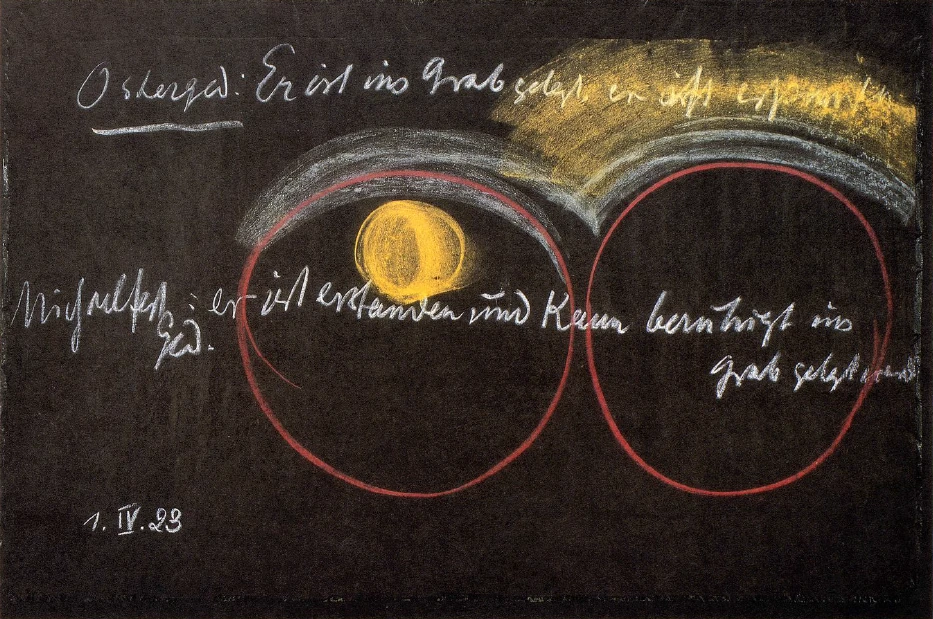
[ 26 ] Christmas calls for St. John’s Day, and St. John’s Day calls for Christmas. Human beings would be frozen in place by the Ahrimanic forces if they were not also exposed to the dissolving Luciferic forces, which in turn give wings to thought, so that they do not have to remain frozen but can thaw again under the influence of the light.
[ 27 ] To begin with, humanity has, in its development, only one pole—the Easter pole—and this Easter pole has been paralyzed. Easter no longer possesses its inner vitality. It will regain its inner vitality when we can reflect on this Easter in the following way, when we can say to ourselves: Through what is symbolically expressed in the descent into hell—which in reality can be understood as the Resurrection—humanity was given a counterbalance to something that was bound to come: the numbing of all spiritual perception, the withering away in earthly life. Christ Jesus sought to foreshadow prophetically what was to come: that during his life on earth, between birth and death, human beings actually forget the supermundane, the spiritual, to such an extent that they, so to speak, die to this supermundane spiritual realm. This dying of the human being in earthly life is counterbalanced by the Easter idea of the victory of the supermundane life over earthly life.
[ 28 ] On the one hand, we have this: Human beings descend from their pre-earthly life. But in the era that began in the first half of the 15th century, human beings in their earthly lives will increasingly forget their super-earthly origin; they will, so to speak, die to their soul life in their earthly existence. That is on the one hand. On the other hand, however, there is this: There was a spiritual-heavenly being who, through an act that worked from the heavens down into the earth, established the counter-image—that spiritual being who descended into a human body and, through his own being, brought the super-earthly-spiritual into the midst of the people of the earth through the Resurrection. In remembrance of this, we have the Easter festival, which presents to humanity the image of the burial of Christ Jesus and the resurrection of Christ Jesus.
[ 29 ] He was laid in the tomb and later rose again—that is the essence of Easter; that is the essence of Easter as it is reflected in the cosmic wisdom. — Look within yourself, O human being; you have descended from super-earthly worlds; you face the danger of losing your soul in earthly life. But then Christ appears, revealing to you how that which you, too, originated from—the super-earthly-spiritual—overcomes death. This stands before you in the greatest of the images that could ever be set before humanity: the burial of Christ Jesus, the resurrection of Christ Jesus. He was laid in the tomb. He rose from the tomb and appeared to those who could see him.
[ 30 ] But with our soul forces now weakened, this image can no longer come to life. Where can it still come to life today within the weakened powers of the soul, as they are today? Within a traditional faith, a person can still look to what the Easter season offers: the magnificent image of the burial and the Resurrection. From the inner power of the soul, he can no longer connect anything of his own to this Easter thought, to the thought of the burial and the Resurrection. From spiritual insight, they must once again connect something to it. And that can be nothing other than this: Yes, it is possible for a person to allow spiritual insight to approach them and to comprehend the other. Let us hold this before us, so that we may inscribe it deeply into our souls—this other!
[ 31 ] The Easter message: He was laid in the tomb; he has risen. Let us, however, consider the other thought that must come to humanity: He has risen and can be laid in the tomb with peace of mind. — The message of Easter: He was laid in the tomb; he has risen. The message of the Feast of St. Michael: He has risen and can be laid to rest in the tomb with peace of mind.
[ 32 ] The first thought—the thought of Easter—refers to Christ; the second thought refers to the human being, to the human being who is just beginning to grasp the power of the thought of Easter: just as through spiritual knowledge, when he has entered into present-day earthly life—where his soul-spiritual nature dies—his soul can be resurrected, so that he becomes alive between birth and death, so that he becomes inwardly alive in earthly life. This inner rising, this inner awakening, is what the human being must comprehend through spiritual science; then he will be laid to rest in the grave with peace of mind. Then he will be laid in the grave, through which he would otherwise have to fall prey to those forces that, as Ahrimanic forces, are at work within the earthly realm at the time of the winter solstice.
[ 33 ] And the festival that embodies this thought—that He has risen and can be laid to rest in the tomb—must fall during the time when the leaves begin to turn yellow and fall from the trees, when the fruits ripen, when the sun has attained that power through which it brings to maturity that which sprouts in spring, sprouted, and was full of growth, to maturity—but also causes it to wither and return to the earth’s interior; when what develops on earth begins to become a symbol of the grave.
[ 34 ] If we place the Easter festival within the time when life begins to sprout and bud, when the forces of growth reach their peak, then we must consider the other festival it encompasses: He has risen and can be laid to rest in the tomb—place it in that time of year when nature begins to wither, when a tomb-like mood spreads throughout the natural world, when the symbol of the tomb can appear before the human soul. There the Michaelic thought stirs within the human being: that thought which, unlike the Easter thought in the first centuries of Christianity, is not directed toward contemplation. In the first centuries of Christianity, contemplation was directed toward Christ laid in the tomb and risen from it. Through contemplation, the soul was filled with its strongest forces and made powerful. In the festive thought of the autumnal equinox, the soul must feel its strength, not through an appeal to its contemplation, but through an appeal to its will: Take into yourself the thought of Michael that defeats the Ahrimanic forces—that thought which empowers you to acquire spiritual knowledge here on earth, so that you may overcome the powers of death.
[ 35 ] Just as the Easter idea is directed toward perception, so this idea is directed toward the powers of the will: to take in the Michael force—that is, to take in the power of spiritual knowledge into the powers of the will. And so the Easter idea can come to life, can be brought directly into contact with the human soul-spiritual realm, in that just as the Johannine idea was perceived as the counterpole to the Christmas idea, so now the Michael idea—the idea of the Michaelmas festival in the fall—is perceived as the counterpole to the Easter idea. Just as the Christmas idea, through its inner vitality, gave rise to the St. John idea after half a year, so must the Easter idea give rise to the Michael idea. Humanity must attain an esoteric maturity so that it may once again think not merely in abstract terms, but in such concrete terms that it can once more become a creator of festivals. Then it will once again be able to connect something spiritual with the course of sensory phenomena.
[ 36 ] All our thoughts remain abstract. But no matter how magnificent or how inspired our thoughts may be—if they remain abstract, they will not be able to permeate life. Today, when humanity is pondering how to set the date of Easter on some abstract day, no longer according to the constellations, today, when all higher knowledge is obscured, when there is no longer any connection between an understanding of moral-spiritual and naturalistic-physical forces—today, the power within human beings must once again awaken to be able to directly connect something spiritual with the sensory phenomena of the world.
[ 37 ] What, then, was the spiritual power that enabled humans to create festivals throughout the year in accordance with the course of the seasons? It lay in the original spiritual power. Today, people can continue to celebrate festivals according to the old traditional customs, but humanity must once again regain the esoteric power to be able to speak into nature of its own accord, in accordance with the natural course of events. We must find a way to conceive of the autumn Michael thought as the flowering of the Easter thought. While the Easter thought is the outflow of sensory flowering, the flowering of the Easter thought—the Michael thought—must be able to be placed within the course of the year as the outflow of physical withering.
[ 38 ] People must once again learn to conceive of the spiritual in conjunction with the course of nature. Today, people are not merely permitted to engage in esoteric contemplation; today, it is necessary for people to be able to practice the esoteric once again. But they will only be able to do this if they are capable of grasping their thoughts so concretely, vividly that they no longer think merely by withdrawing from all that is happening, but rather by thinking in harmony with the course of events—thinking together with the withering leaves and the ripening fruits in a manner as characteristic of Michael as the Easter-like way of thinking was with the blooming plants, the sprouting plants, and the budding blossoms.
[ 39 ] When one learns to think in harmony with the cycle of the year, those forces will blend into one’s thoughts that, in turn, will enable human beings to enter into dialogue with the divine-spiritual forces that reveal themselves through the stars. From the stars, human beings have drawn the power to establish festivals that have inner, human significance. People must establish festivals out of inner esoteric power. Then, through their dialogue with withering and ripening plants and with the dying earth—by finding the right inner festive mood for this—they will once again be able to enter into dialogue with the gods and link human existence to divine existence. Then the true meaning of Easter will also return, when this Easter spirit is so alive that it can drive forth the Michael spirit from within itself.