

The Annual Cycle as the Earth's Breathing Process
and the Four Major Festival Seasons
GA 223
2 April 1923, Dornach
Translated by Steiner Online Library
Third Lecture
[ 1 ] We must not underestimate the significance for humanity of something like focusing all attention on a festive season of the year. Even though the celebration of religious festivals is more of a matter of habit in our time, this was not always the case, and there were times when people aligned their consciousness with the course of the entire year, feeling at the beginning of the year that they stood at a certain point in the passage of time, so that they said to themselves: There is a certain degree of cold or warmth, there are certain conditions regarding the rest of the weather, and there are certain conditions regarding the growth or lack of growth of plants or animals. — And people then experienced firsthand how nature gradually underwent its transformations, its metamorphoses. But they experienced this in such a way—by uniting their consciousness with the phenomena of nature—that they, so to speak, oriented this consciousness toward a specific festival season; let us say, at the beginning of the year, through the various sensations associated with the passing of winter toward Easter, or in the fall, with the withering of life toward Christmas. Then the soul was filled with those sensations that found expression precisely in the particular way one related to what the festivals meant to one.
[ 2 ] This is how one experienced the passing of the year, and this experience of the year’s cycle was, in essence, a spiritualization of what one not only saw and heard around oneself, but experienced with one’s whole being. One experienced the course of the year as the unfolding of an organic life, just as one might, for example, in a human being—when that person is a child—connect the expressions of the child’s soul with the child’s clumsy movements and imperfect speech. Just as one associates certain soul experiences with the changing of teeth, and other soul experiences with later changes in the body, so one saw the working and weaving of the spiritual in the changes of the external conditions of nature. It was a process of growth and decline.
[ 3 ] But this is connected to the very way in which human beings, as earthly beings, perceive themselves within the world. And so one can say: In the time when, at the beginning of our calendar, people began to commemorate the event at Golgotha—which then became the Easter festival—in the time when Easter was vividly experienced throughout the year, when people lived through the course of the year as I have just described, it was essentially the case that people felt they had surrendered their own lives to the outer spiritual-physical world. They felt that, in order to make their lives complete, they needed the vision of the burial and resurrection, the magnificent image of the event at Golgotha.
[ 4 ] But it is from such a fulfillment of consciousness that inspiration flows to human beings. People are not always aware of this inspiration, but it is a mystery of human development that inspiration for all of life flows from these religious attitudes toward the phenomena of the world. First of all, we must be clear that during a certain era—the Middle Ages—the people who guided spiritual life were the priests, those priests who were primarily concerned with organizing the festivals and setting the tone for their celebration. The priesthood was the group within humanity that presented the festivals to the rest of humanity—the laity—and gave the festivals their content. Consequently, the priesthood felt this content of the festivals in a very special way. And the entire state of mind that arose from the inspiring effect of such festivals was then expressed in the rest of their spiritual life.
[ 5 ] The Middle Ages would not have had what is called Scholasticism—the philosophy of Thomas Aquinas, Albertus Magnus, and other Scholastics—if this philosophy, this worldview, and all that it entailed socially had not been inspired precisely by the most important concept of the Church: the concept of Easter. In the vision of Christ descending to earth, living a temporary life among humanity, and then passing through the Resurrection, lay the spiritual impulse that led to the establishment of that distinctive relationship between faith and knowledge, between insight and revelation, which is precisely what Scholasticism is. The idea that human beings can gain knowledge only of the sensory world, and that everything pertaining to the supersensory world must be attained through revelation, was essentially determined by the idea of Easter, as it followed on from the idea of Christmas.
[ 6 ] And if, on the other hand, today’s scientific worldview is in fact entirely a product of Scholasticism—as I have often discussed here—then one must say: Without the scientific knowledge of the present being aware of it, it is essentially a true imprint, I would say, of the Easter idea, as it prevailed in the earlier periods of the Middle Ages, and as it was subsequently diluted in the development of the human spirit during the later Middle Ages and in modern times. Let us consider how natural science employs in its ideas what is popular today and dominates our entire culture; let us see how natural science uses its ideas: it applies them to inanimate nature; it does not believe it can rise above inanimate nature. This is a result of that inspiration which was stimulated by contemplating the burial. And as long as one could add the Resurrection to the burial as something to which one looked up, one also added revelation about the supersensible to mere external sensory knowledge. As the view increasingly took hold that the Resurrection should be regarded as an inexplicable and therefore unjustified miracle, the revelation—that is, the supersensible world—was set aside. Today’s scientific worldview is, so to speak, inspired solely by the Good Friday perspective, not by the Easter Sunday perspective.
[ 7 ] One must recognize this inner connection: What is inspired is always that which is experienced within all festive moods in relation to nature. One must recognize the connection between this source of inspiration and what finds expression in all human life. Once one realizes what an intimate connection exists between this immersion in the cycle of the year and what people think, feel, and will, then one will also recognize how significant it would be if, for example, we were able to make the Michaelmas celebration a reality—if we could truly succeed, drawing from spiritual and esoteric foundations, in making the Michaelmas celebration something that would now enter people’s consciousness and, in turn, have an inspiring effect. If the idea of Easter were to take on its character through the fact that, in addition to the Easter idea: “He was laid in the tomb and rose again”—the other thought, the human thought: “He has risen and may be laid in the tomb without perishing”—if this Michael thought could come to life, what immense significance could such an event have for the entire sensibility, feeling, and will of humanity! How could this take root in the entire social fabric of humanity!
[ 8 ] Everything that people hope for from a renewal of social life will not come from all the discussions and institutions that relate to the external and sensory, it can come about only when a powerful, inspiring thought passes through humanity, when an inspiring thought seizes humanity, through which, in turn, the moral-spiritual is directly felt and experienced in connection with the natural-sensory. People today are searching, I might say, like earthworms underground searching for sunlight, whereas to find sunlight, one must emerge above the surface of the earth. In reality, nothing can be achieved with all of today’s discussions and reform ideas; something can be achieved only through the powerful impact of a thought impulse drawn from the spirit. For one must be clear that the very idea of Easter would take on a new nuance if it were supplemented by the Michael idea.
[ 9 ] Let’s take a closer look at this thought from Michael. When we turn our attention to the idea of Easter, we must note that Easter falls during the time of spring life as it sprouts and shoots forth. During this time, the Earth exhales its soul forces so that these soul forces, within the Earth’s sphere, may interpenetrate with what surrounds the Earth in the astral realm—with the extraterrestrial cosmic forces. The Earth exhales its soul. What does that mean? It means that certain elemental beings—which exist in the Earth’s atmosphere just as the air or the forces of plant growth do—connect their own essence with the exhaled Earth soul in those regions where spring is just beginning. These beings merge and float together with the exhaled Earth soul. They lose their individuality; they dissolve into the general earthly-spiritual realm. In the spring, especially around Easter, one can observe numerous elemental beings as they, like clouds, dissolve from the final stage of their individual existence—which they had during the winter—and merge into the general earthly-spiritual realm. I would like to say:
[ 10 ] During the winter season, these elemental beings were within the soul-life of the Earth, where they had become individualized (see illustration: green within yellow). Before the Easter season, they still possess a certain degree of individuality; they fly and, in a sense, float about as individual beings. During the Easter season, we see how they converge into general clouds and form a collective mass within the Earth’s soul (green within yellow). As a result, however, these elemental beings lose their consciousness to a certain degree. They enter a kind of sleep-like state. Certain animals hibernate; these elemental beings undergo a summer slumber. This is most pronounced during the St. John’s period, when they are completely asleep. But then they begin to individualize again, and one can already see them clearly as distinct beings in the Earth’s inhalation phase around St. Michael’s Day, at the end of September.
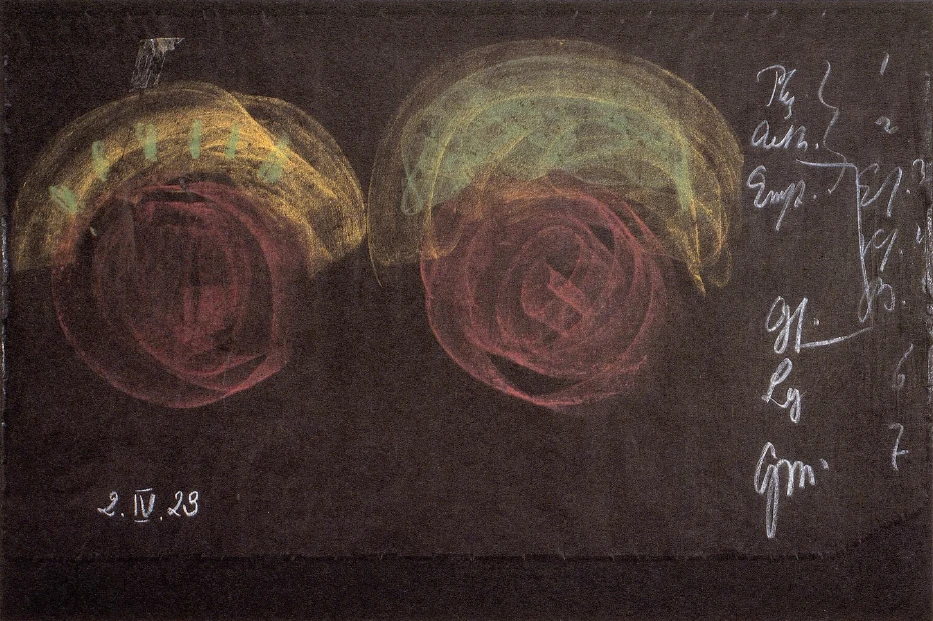
[ 11 ] But these elemental beings are the ones that human beings need now. None of this is present in human consciousness, but human beings need them nonetheless—to unite with them so that they can prepare for their future. And human beings can unite with these elemental beings if, during a festival season that would fall toward the end of September, they were to feel—with a special inner, soulful vitality—how nature is transforming itself as autumn approaches; if people could sense how animal and plant life is receding, how certain animals are preparing to seek out their shelters for the winter, how the leaves of the plants take on their autumn colors, how the whole natural world withers. Certainly, spring is beautiful, and the beauty of spring—the growing, sprouting, and budding life of spring—is a beautiful quality of the human soul. But to be able to feel, too, when the leaves turn pale and take on their autumnal hues, when the animals retreat into their hiding places; to be able to sense how, within the dying-away of the physical, the glittering, radiant spiritual-soul aspect arises; to be able to perceive how, with the yellowing of the leaves, there is a passing away of the sprouting, budding life, but how the physical world turns yellow so that the spiritual can live in that yellowing as such; to be able to sense how, in the falling of the leaves, the ascent of the spirit takes place, how the spiritual is the counter-revelation of the fading physical world: this is what should inspire people as a spiritual sensation during the autumn season. Then he prepares himself in the right way for the Christmas season.
[ 12 ] Through anthroposophical spiritual science, human beings should be imbued with the truth that it is precisely the spiritual life of human beings on Earth that is connected to the descending physical life. As we think, our physical matter is, in fact, broken down within the nerves. The thought struggles its way up out of the decaying matter. The unfolding of thoughts within themselves, the shining forth of ideas in the human soul and throughout the entire human organism; a sense of kinship with the yellowing leaves, with the withering foliage of plants, with the drying up of plants—this sense of kinship between the human spiritual being and the spirit of nature: this can give a person that impulse which strengthens their will, that impulse which points the person to the permeation of the will with spirituality.
[ 13 ] But by infusing his will with spirituality, man becomes a partner in Michael’s work on earth. And when human beings live in harmony with nature in this way as autumn approaches, and express this harmony with nature through a corresponding festive celebration, then they can truly experience that complement to the Easter spirit. Through this, however, something else becomes clear to them. You see, what people think, feel, and will today is, after all, inspired by the one-sided Easter mood, which is, moreover, a stunted one. This Easter mood is essentially a result of the sprouting, budding life that causes everything to merge into a pantheistic unity. People are devoted to the unity of nature and to the unity of the world in general. That, after all, is also the structure of our spiritual life today. People want to reduce everything to a unity, to a “monon.” One is either a follower of the Universal Spirit or of Universal Nature: accordingly, one is either a spiritualistic monist or a materialistic monist. Everything is encompassed in an indeterminate “All-One.” This is essentially a springtime mood.
[ 14 ] If one looks into the atmosphere of autumn—with the spiritual (yellow) rising and becoming free, and the sensual (red), I might say, dripping away and withering—then one has a view of the spiritual as such, and of the sensual as such.
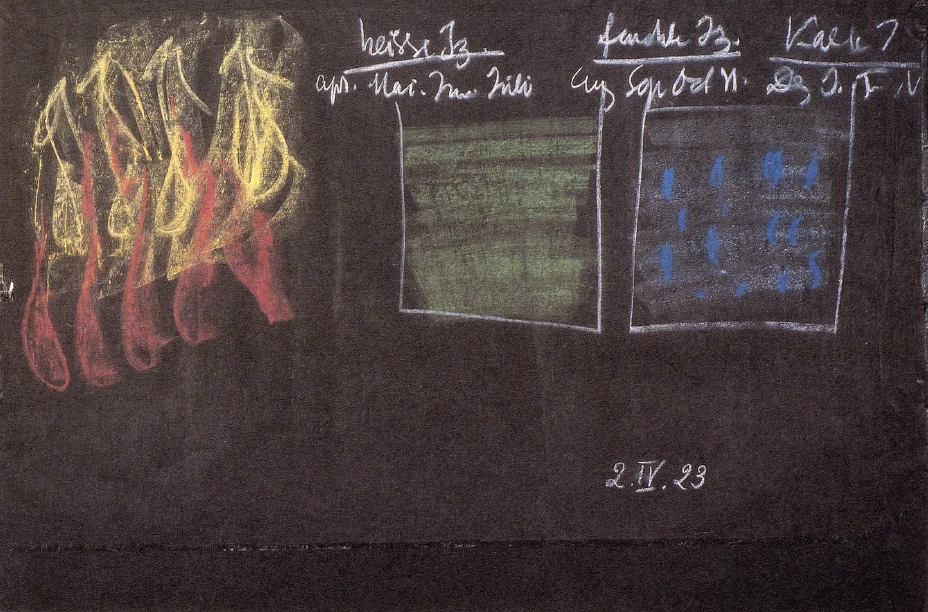
[ 15 ] The spring-blooming plant contains the spiritual within its growth, as shown in Figure 5, in its shoots and development. The spiritual is intermingled with the physical; essentially, they form a unity. As the plant withers, it sheds its leaves and the spirit ascends: one has the spirit—the invisible, supersensible spirit—and the material aspect falls away. It is as if one were to start with a homogeneous liquid in a vessel, in which something is dissolved, and then, through some process, cause something to settle out of this liquid, which falls to the bottom as “turbidity.” Thus, the two that were connected and formed a single whole are now separated.
[ 16 ] Spring has a way of weaving everything together, of blending everything into an undifferentiated, indefinite unity. The autumn perspective—if one looks at it closely enough, if one contrasts it properly with the spring perspective—draws one’s attention to how the spiritual works on the one hand, and the physical-material on the other. And of course, one must not then remain one-sidedly fixed on one or the other. The idea of Easter does not lose its value when one adds the idea of Michael. On the one hand, there is the idea of Easter, where everything—I would say—appears in a kind of pantheistic blending, in a unity. Then there is the differentiated, but the differentiation does not occur in some irregular, chaotic way. There is definitely a regularity. Imagine the cyclical process: interweaving, intermingling, unification, an intermediate state where differentiation occurs—complete differentiation—and then, once again, the merging of the differentiated into the unified, and so on. There, in addition to these two states, you always see a third: you see the rhythm between the differentiated and the undifferentiated—in a sense, between the inhalation of what has been differentiated and its subsequent exhalation. You see a rhythm, an intermediate state, something physical-material, something spiritual; an interplay of the physical-material and the spiritual: something soulful. You learn to see, in the course of nature, nature permeated by the primordial trinity: the material, the spiritual, and the soulful.
[ 17 ] But what is important is that one does not get stuck in the universal human fantasy that everything must be reduced to a single unity. By doing so, one reduces everything—whether that unity is spiritual or material—to the indeterminacy of the night of the worlds. At night, all cows are gray; in spiritual monism, all ideas are gray; in material monism, they are just as gray. These are merely differences in perception. This is of no consequence whatsoever for a higher perspective. What matters is that we, as human beings, can connect with the course of the world in such a way that we are able to trace the living transition from unity to the Trinity, and the return from the Trinity to unity. Then, when—by supplementing the idea of Easter in this way with the idea of Michaelmas—we enable ourselves to perceive the primordial Trinity in all of being in the right way, we will take it into our entire soul’s constitution. Then we will be able to see that, in fact, all life is based on the activity and interplay of primordial Trinities. And then, if we experience the Michaelmas festival as an inspiration for such a view—just as the one-sided Easter festival served as an inspiration for the views that have come to the fore—then we will have an inspiration, a natural-spiritual impulse, to introduce the threefold structure, the impulse toward threefolding, into all life that is to be observed and shaped. And ultimately, it depends solely on the introduction of this impulse whether the forces of decline present in human development can once again be transformed into forces of ascent.
[ 18 ] One might say that when the impulse toward disintegration in social life was spoken of, it was, in a sense, a test to see whether the Michael idea was already strong enough for people to sense how such an impulse springs directly from the forces that shape the times. It was a test of the human soul to see whether the Michael idea was strong enough in a number of people. Well, the test yielded a negative result. The Michael idea is not yet strong enough in even a small number of people to be truly felt in all its time-shaping power and vigor. And it will hardly be possible to connect human souls to the primordial formative forces of the worlds in the way necessary for new forces of ascent unless something as inspiring as a Michael festival can take hold—unless, that is, a new-forming impulse can arise from the depths of esoteric life.
[ 19 ] If, instead of the passive members of the Anthroposophical Society, there were only a few active members, such an idea might be worth considering. The essence of the Anthroposophical Society lies, after all, in the fact that while inspirations are indeed lived out within the Society, the members actually place their primary value on participating in what is taking place; that while they do turn their contemplative soul powers toward what is taking place, the activity of their own souls is not connected to that which passes through time as an impulse. Therefore, given the current state of the anthroposophical movement, it is naturally not possible to speak of something like this—which is now, so to speak, being expressed as an esoteric impulse—as something that can be actively considered. But one must understand how the course of human development actually proceeds—how the great, sustaining forces of humanity’s world development do not arise from what is expressed outwardly in superficial words, but rather, I would say, emerge from entirely different quarters.
[ 20 ] People in the old days always knew this through a primal, elemental, human form of clairvoyance. In the old days, they didn’t teach young people, for example, that there are so-and-so many chemical elements; then one is discovered, bringing the total to seventy-five; then there are seventy-six; then another is discovered, bringing the total to seventy-seven. It’s impossible to predict how many more might be discovered. By chance, one is added to seventy-five, to seventy-six, and so on. There is no inner essence in what is listed there as a number. And it is the same everywhere. Who today is interested in what—say, in plant taxonomy—would somehow reveal a kind of trinity! One discovers order alongside order or species alongside species. One counts them off just as one counts beans or pebbles tossed down at random. But the workings of number in the world are such that they are based on essence, and this essence must be understood.
[ 21 ] Let us think back to how recent the time is that lies behind us, when what was known as the science of matter was traced back to the triad: the saline, the mercurial, and the phosphoric—how a triad of primal forces was perceived there, and how everything that appeared as an individual entity simply had to be subsumed into one of the three primal forces. And it is even different when we look back to even earlier times, when, incidentally, the state of culture also made it easier for people to arrive at such insights, for the Eastern cultures were more inclined toward the hot zone, where the older form of elemental clairvoyance was more readily possible. Today, however, it is possible even in the temperate zone to arrive at an understanding of these things through free, precise clairvoyance; but people want to go back to ancient cultures! Back then, no distinction was made between spring, summer, fall, and winter. Distinguishing between spring, summer, fall, and winter—because one has the Four within them—leads one to merely string them together. To conceive of the cycle of the year in terms of the Four, for example, would have been entirely impossible for ancient Indian culture, because it contains none of the primordial forms of all activity.
[ 22 ] When I was writing my book Theosophy, I couldn’t simply list them one after another: physical body, etheric body, astral body, and I—as one might summarize them once the concept is already there, once one has grasped it inwardly. Instead, I had to organize them according to the number three: physical body, etheric body, sensory body; the first triad. Then the triad interwoven with it: sensory soul, intellectual soul, conscious soul; then the triad interwoven with that: Spirit-Self, Life Spirit, Spiritual Human, three times three, interwoven (see diagram), which makes seven. But the seven is simply three times three interwoven. And only when one looks at the present stage of human development does the number four emerge, which is actually, at its core, a secondary number.
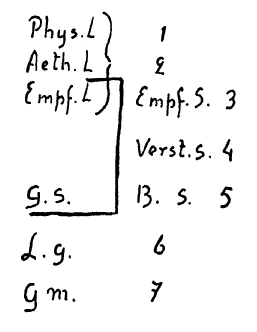
[ 23 ] If one wishes to observe what is at work within, what is taking shape, one must look at the process of formation in terms of the triad. Hence, the ancient Indian view held: the hot season, which would roughly correspond to our months of April, May, June, and July; the humid season, which would roughly correspond to our months of August, September, October, and November; and the cold season, which would correspond to our months of December, January, February, and March—though the boundaries need not be strictly defined by months but are only approximate. These can be thought of as shifting. But the course of the year was conceived in terms of the triad. And so the human soul’s disposition would be permeated by the inclination to observe this primordial triad in all that weaves and works, and thereby also to weave this primordial triad into all human creation and all human shaping. One might even say that having clear ideas—whether about the life of the free spirit, the legal life, or the socio-economic life—is only possible if one deeply comprehends this threefold rhythm of world activity, which must also permeate human activity.
[ 24 ] Today, anything that appeals to such things is regarded as a kind of superstition, whereas simply counting—one, then one again, two, three, and so on—is considered a form of profound wisdom. But that is not how nature works. However, if one limits one’s perspective solely to observing that in which everything is interwoven—for example, focusing solely on the qualities of spring, which one naturally must observe to see how everything is interwoven—then one simply cannot capture the threefold rhythm. But if one follows the entire course of the year, if one sees how the Three is structured—how spiritual and physical-material life exist as a duality and the rhythmic interweaving of both as the Third—then one perceives this Three in One, One in Three, and learns to recognize how human beings can place themselves within this cosmic process: three to one, one to three.
[ 25 ] This would become a human state of mind—one that permeates the world and unites with the worlds—if the Michael idea, as a festival idea, could awaken in such a way that a Michael Festival would truly be established alongside the Easter Festival in the second half of September, if the idea of God’s resurrection after death could be complemented by the idea of human resurrection before death, brought about by the Michael force. So that through the Resurrection of Christ, human beings would find the strength to die in Christ—that is, to take the risen Christ into their souls during their earthly lives, so that they might die in him—that is, to die not dead, but alive.
[ 26 ] Such inner awareness would arise from the inspiration that would come from a Michael ministry. One can easily see how far removed our materialistic age—which is, in fact, an age that has become thoroughly philistine—is from such a thing. Certainly, one cannot expect anything of it if it remains dead and abstract. But if something like this were to happen again with the same enthusiasm with which festivals were once introduced into the world—when people had the strength to shape festivals—then it would have an inspiring effect. Then, however, it will also have an inspiring effect on our entire spiritual and social life. Then what we need will be present in life: not abstract spirit on the one hand, spiritless nature on the other, but nature imbued with spirit, spirit that shapes nature—the two being one— and which, in turn, will weave religion, science, and art into one, because they will understand how to grasp the trinity—in the sense of the Michael idea—in religion, science, and art, so that they can be united in the right way within the Easter idea, within anthroposophical creation, which can have a religious, artistic, and epistemological effect, and which, in turn, can also differentiate between the religious and the epistemological. So that, in fact, the anthroposophical impulse would consist in perceiving, during the Easter season, the unity of science, religion, and art; and in perceiving, during the Michaelmas season, how the three—who have one mother, the Easter Mother—become siblings and stand side by side, yet complement one another. And the Michael thought, which should come to life festively throughout the course of the year, could have an inspiring effect on all human life.
[ 27 ] One should immerse oneself in such matters, which certainly belong to the realm of true esotericism—at least initially on an intellectual level. If the time were to come when there are actively influential personalities, such a thing could indeed become an impulse that—given the nature of humanity—could, once again, replace the forces of decline with forces of ascent.