

The Annual Cycle as the Earth's Breathing Process
and the Four Major Festival Seasons
GA 223
7 April 1923, Dornach
Translated by Steiner Online Library
Fourth Lecture
[ 1 ] Lately, I have often had to point out the connection between the cycle of the year and various aspects of human life, and during the Easter holidays I did indeed draw attention to the connection between the cycle of the year and the celebration of human festivals. Today I would like to go back to very ancient times to say a few more words about this connection between the course of the year and human festivals, specifically in relation to the mystery traditions of humanity in ancient times—words that may perhaps deepen what we have already discussed in one way or another.
[ 2 ] For people in the very ancient times of Earth’s history, the festivities throughout the year actually represented a significant part of their entire lives. We know that in those ancient times, human consciousness functioned in a completely different way than it did later. One might describe this ancient consciousness as having a dreamlike quality. And it was indeed from this dreamlike quality that those insights of human consciousness—of the human soul—emerged, which then took on the form of myths and became mythology itself. Through this more dreamlike—one might even say instinctive-clairvoyant—consciousness, people looked more deeply into the spiritual realities surrounding them. But precisely because people participated so intensely in this way—not only in the sensory workings of nature, as is the case today, but also in spiritual events—precisely because of this, they were also more attuned to the phenomena of the cycle of the year, to the diversity of nature’s activity in spring and autumn. I have also pointed this out recently.
[ 3 ] Today, however, I would like to share some other insights with you: specifically, how the midsummer festival—which later became our St. John’s Day—and the midwinter festival—which became our Christmas—were observed in connection with the ancient mystery teachings. We must, however, realize that the humanity we speak of from earlier epochs on Earth did not attain full self-consciousness in the same way that we do today. Dream-like consciousness does not contain full “I”-consciousness; and when full “I”-consciousness is absent, people do not perceive what the humanity of the present day is so proud of. The people of that time did not perceive what lived within inanimate nature, within the mineral realm.
[ 4 ] Let us be quite clear about this: Consciousness was not one that took the form of abstract thoughts; it lived in images, but it was dreamlike. As a result, people immersed themselves much more deeply—than is the case today—in, say, the sprouting and budding plant life and plant beings of spring. Conversely, one might say they deeply felt the shedding of leaves in the fall, the withering of the foliage, the entire dying-off of the plant world; they also deeply empathized with the changes the animal world underwent over the course of the year, and perceived their entire human surroundings differently when the air was fluttered through by butterflies and buzzed by beetles. In a sense, they felt their own human weaving intertwined with the weaving and essence of plant and animal existence. But they had not only no interest in, but also no real awareness of, the mineral world—the dead world out there. That is one aspect of this ancient human consciousness.
[ 5 ] The other aspect is that this ancient humanity also had no interest in the human form in general. It is actually quite difficult to imagine today what human sensibilities were like in this regard; generally speaking, people did not have a strong interest in the human form as it appears in space. They did, however, have an intense interest in the racial characteristics of human beings. And the further back we go in ancient cultures, the less people in the general consciousness were actually interested in the human form; instead, they were interested in skin color and racial temperament. That is what these people focused on. On the one hand, therefore, these people were not interested in the dead, mineral realm, and on the other hand, they were not interested in the human form. As I said, there was an interest in racial characteristics, but not in what is generally human, nor in relation to outward appearance.
[ 6 ] The great teachers of the mysteries simply accepted this as a fact. I would like to illustrate their thinking on this matter with a diagram. They said: Human beings have a dreamlike consciousness; through this, they are able to perceive plant life in their surroundings with great clarity. — Through their dream images, these people did indeed experience plant life, but this dream-like consciousness did not extend to the perception of the mineral realm. Thus, the Mystery teachers said to themselves: On the one hand, human consciousness extends to the plant realm (see diagram), which is experienced in a dream-like way, but not to the mineral realm; that lies outside human consciousness. And on the other hand, human beings feel within themselves that which still connects them to the animal realm—the racial, the animalistic (see diagram). In contrast, that which actually makes a human being a human being—through their upright form and the spatial structure of their being—lies outside human consciousness.
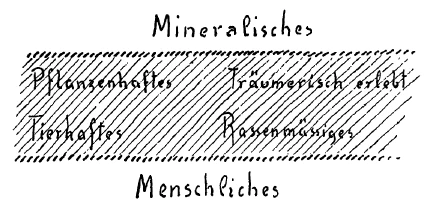
[ 7 ] So what is truly human lies outside the scope of what interested these people in ancient times. We can therefore describe human consciousness by conceiving of it as enclosed within this space in the sense of that ancient humanity (see diagram, hatched area), while the mineral and what is truly human lay outside the realm of what that ancient humanity—which lived its existence outside the mysteries—actually knew anything about.
[ 8 ] But what I have just said applied only in a general sense. Through his own powers—through what a human being experienced in his very being—he could not penetrate beyond this realm to the mineral realm on the one hand, or to the human realm on the other. But there were institutions stemming from the mysteries which, over the course of the year, brought people—at least to some extent—something akin to human ego-consciousness on the one hand and an insight into the mineral realm in general on the other. As strange as it may sound to people today, it is nevertheless true that the ancient mystery priests established festivals through whose special rites people were lifted beyond the plant realm to the mineral realm, and thereby experienced a certain “illumination of the ‘I’” at a specific time of year in ancient times. It was as if the “I” were shining into the dream consciousness. You know that even in the dreams of people today, the “I” that they then perceive sometimes still forms a part of the dream.
[ 9 ] And so, on the Feast of St. John, through the ceremonies organized for that portion of humanity that wished to participate in them, self-consciousness shone forth at this very height of summer. And at this height of summer, people were able to perceive the mineral realm at least to the extent that, with the help of this perception of the mineral realm, they attained a kind of sense of self—though the “I” appeared to them as something that entered their dreams from outside. And to bring this about, in the oldest midsummer festivals—the festivals celebrating the summer solstice, which later became our St. John’s Day celebrations—the participants were guided to unfold a musical-poetic element full of song-accompanied, strictly rhythmic circle dances. Certain performances and presentations were filled with distinctive musical recitatives accompanied by primitive instruments. Such a festival was thoroughly steeped in musical and poetic expression. People poured what they held in their dream consciousness out into the cosmos in a musical, song-like, and dance-like manner.
[ 10 ] Modern people cannot have a direct understanding of what was achieved musically and in terms of song for such powerful, widespread folk festivals of ancient times, under the guidance of those who, in turn, derived their guidance from the Mysteries. For what later became music and poetry stands far removed from that primitive, elemental, simple musical-poetic expression that unfolded during midsummer under the guidance of the Mysteries in those ancient times. Everything was aimed at ensuring that, while people performed their circle dances accompanied by singing and primitive poetic performances, they would enter a state of mind through which precisely what I have just called “the shining in of the ‘I’ into the human sphere” would take place.
[ 11 ] But if one had asked those elderly people who possessed the instructions: “Well, how did you actually come up with the idea of creating such songs and dances through which what I have described can come about?”—then those elderly people would, in turn, have given an answer that would seem highly paradoxical to modern people. They would have said, for example: “Well, much has been handed down, much is already here—even older generations did this! —But in certain ancient times, people would have said: One can still learn it today, without relying on tradition, if one simply develops further what reveals itself. One can still learn today how to use primitive instruments, how to shape the dances, how to master the singing voice. — And now comes the paradox—what these ancient people would have said. They would have said: You learn that from songbirds. — But they understood, in a profound way, the whole meaning of why songbirds actually sing.
[ 12 ] Humanity has long since forgotten why songbirds sing. In an age when the intellect dominates everything, when people have become intellectualistic—certainly, people have preserved the art of song and the art of poetry—but they have forgotten the connection between singing and the entire universe in this age of intellectualism. And even someone who is enthusiastic about the arts, who elevates the arts above all that is philistine and human, says from within this later age of intellectualism:
I sing as the bird sings,
The one that dwells in the branches.
The song that flows from my throat,
Is a reward that richly repays.
[ 13 ] Yes, that is what a person of a certain age would say. The bird itself, however, would never say that. The bird would never say: “The song that flows from my throat is a reward that richly repays.” Nor would the ancient mystery school students have said it. For when, at a certain time of year, the larks and nightingales sing, what is being created there does not pass through the air, but through the ethereal element out into the cosmos, vibrating out into the cosmos up to a certain limit; then it vibrates back to Earth, and the animal world receives what vibrates back—only now the divine-spiritual essence of the cosmos has united with it. And so it is that the nightingales and larks direct their voices out into the universe (red), and that what they send out returns to them etherically (yellow) during the times when they are not singing—but this is then permeated by the content of the divine-spiritual. The larks send their songs out into the world, and the Divine-Spiritual—which participates in the formation and the entire structure of the animal realm—flows back into the earth on the waves of what flows back from the songs of the larks and nightingales.
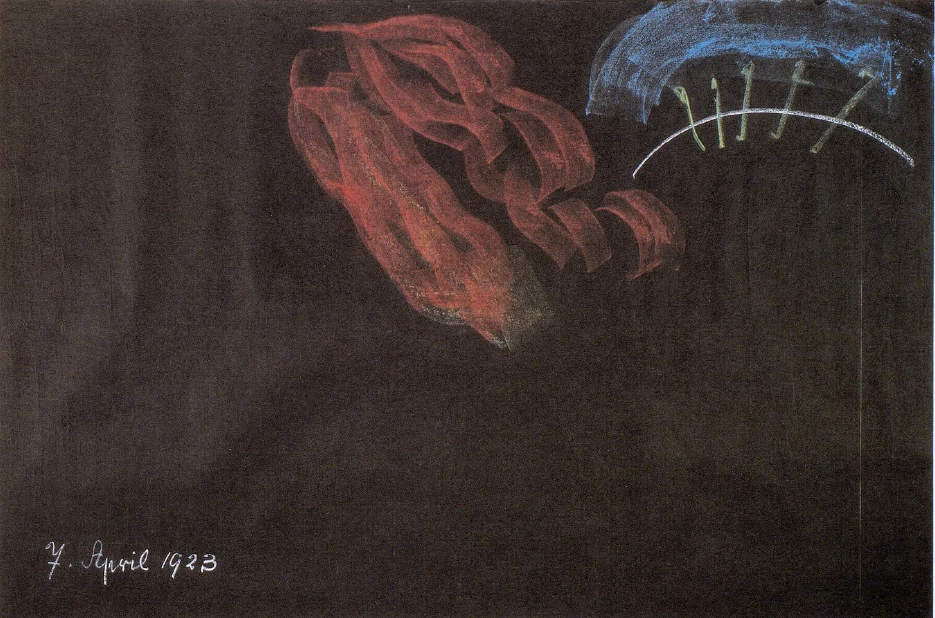
[ 14 ] So, if one speaks not from the intellectualistic age but from true, all-encompassing human consciousness, one cannot really say: “I sing as the bird sings that dwells in the branches. The song that flows from the throat is a reward that richly repays,” but one would then have to say: I sing as the bird sings that dwells in the branches. The song that flows out from the throat into the vastness of the world returns to the earth as a blessing, fertilizing earthly life with the impulses of the divine-spiritual, which then continue to work in the world of birds—and which can work in the world of birds on earth only because they find their way in on the waves of that which is sung out into the world for them.
[ 15 ] Now, of course, not all animals are nightingales and larks; nor, naturally, do they all sing out loud, but something similar—even if it is not quite as beautiful—is sent out into the cosmos by the entire animal world. People understood this in those ancient times, and that is why the students of the mystery schools were instructed to learn such singing and dancing, which they could then perform at the Festival of St. John, if I may use that modern term. People sent this out into the cosmos—not in an animal form, of course, but in a humanized form—as a further development of what the animals send out into the cosmos.
[ 16 ] And there was something else that was part of those festivals: not just the dancing, not just the music, not just the singing, but the listening that followed. First, the festivals were actively performed; then the instructions were given for people to become listeners to what came back to them. Through their dances, their songs, and all the poetic expressions they had performed, they had directed the great questions toward the divine-spiritual realm of the cosmos. This had, so to speak, flowed upward into the vastness of the cosmos, just as water flows upward from the earth, forming clouds above and dripping back down as rain. Thus the effects of human festival rituals rose up and now returned—not as rain, of course, but as something that revealed itself to human beings as the power of the “I.” And people had a subtle sense of that peculiar transformation that occurs precisely around the time of the St. John’s Festival with the air and warmth surrounding the Earth.
[ 17 ] Of course, people today—in this age of intellectualism—overlook this. They have other things to do than the people of old. These days, just as in other times, they have to go for five o’clock tea, go to cafés, go to the theater, and so on. They simply have other things to do that do not depend on the season. Amid all these activities, one forgets the subtle transformation taking place in the Earth’s atmospheric environment.
[ 18 ] The fact is that these people of ancient times sensed how the air and warmth change around St. John’s Day, around midsummer, and how they take on a plant-like quality. Just imagine what kind of sensation that was: a subtle sensitivity to everything that takes place in the plant world. Let’s suppose this is the earth, and plants are sprouting up from the earth everywhere; people had a subtle sense of everything that develops in the plant, of what lives within the plant. In spring, there was a general sense of nature that is preserved, if at all, only in language. You’ll find the word “grunelt” in Goethe’s Faust. Who notices today when it “grunelt,” when the greenness that emerges from the earth in spring wafts through the air and ripples through it? Who notices when it “grunelt” and when it blooms! Well, yes, people see that today. They like the red and the yellow that are blooming there; but they don’t notice that the air becomes something entirely different when it blooms, or even more so when it bears fruit. So this shared experience with the plant world is gone in our intellectualized age. For these people, however, it was present. That is why they could also sense it—not when the rumbling, the blooming, and the bearing of fruit came to them from the earth, but when it came to them from their surroundings, from the air—when air and warmth themselves radiated something plant-like from above (hatched). And this “becoming plant-like” of air and warmth transported consciousness into that sphere where the “I” then descended in response to what was sent out into the cosmos in musical and poetic form.
[ 19 ] So these festivals had a wonderfully intimate, human essence. They were a question posed to the divine-spiritual universe. One received the answer because, just as one perceives the fruiting, the blooming, and the rumbling of the earth, one sensed something plant-like descending from above out of the otherwise purely mineral air. Through this, the dream of the “I” also entered into the dream of existence, into this dreamlike, ancient consciousness.
[ 20 ] And when the Feast of St. John was over and July and August came around again, people had the feeling: We have a “I”; but that “I” remains in heaven—it is up there, and it speaks to us only at the time of St. John. That is when we become aware that we are connected to heaven. Heaven has taken our “I” under its protection. He shows it to us when he opens the great window to heaven; at the time of St. John’s, he shows it to us! But we must ask for it. We must ask by performing the festive rites of the St. John’s season, by immersing ourselves in these incredibly intimate, musical-poetic celebrations during these rites. Thus, even these ancient festivals were the establishment of a communication, a connection between the earthly and the heavenly. And you can sense, my dear friends: This entire festival was steeped in music, in music and poetry; suddenly, for a few days in the height of summer—though it had been well prepared through the Mysteries—it became poetic everywhere in the simple settlements of early humanity. The whole of social life was steeped in this musical and poetic element. People simply believed they needed this—just as they needed daily food and drink—for life throughout the course of the year; that by entering into this dance-like, musical, and poetic mood, they established their communication with the divine-spiritual powers of the cosmos. What remained from this festival was what emerged in later times: that when a person composed poetry, he would say, for example, “Sing to me, O Muse, of the wrath of Peleus’ son Achilles”—because people still remembered that once upon a time the great question had been posed to the divine, and the divine was to answer the question of humankind.
[ 21 ] Just as these festivals around St. John’s Day were carefully prepared to pose the great question to the cosmos—so that the cosmos might assure humanity at that time that it possesses a self that the heavens have just taken under their protection—so, in the same way, the winter solstice festival, the “Midwinter Festival,” which has now become our Christmas celebration, was prepared. But just as everything at the time of St. John was steeped in the musical-poetic element and the element of dance, so too was everything in the deep winter season initially prepared in such a way that people knew: they must become still; they must enter into a more contemplative state. And then everything was brought forth—all that existed in ancient times, of which external history reports nothing, of which one can only know through spiritual science—all the visual and sculptural elements that were present during the summer season in those ancient times, elements that reached their climax in those dance-filled, musical festivals of which I have just spoken to you. During that time, ancient humanity—which, in a sense, was stepping out of itself to unite with the “I” in the heavens—did not concern itself with what was being learned at that time. Outside of the festival, they were, of course, occupied with providing for all that nature required for human sustenance. The period of instruction took place during the winter months, and it also reached its culmination—its festive expression—precisely at the winter solstice, in the depths of winter, during the Christmas season.
[ 22 ] That is when they began to prepare the people—who, in turn, were under the guidance of the mystery school students—to perform all kinds of spiritual activities that were not carried out during the summer. It is difficult—because, of course, these practices differ greatly from what is done today—to describe in modern terms what people engaged in from our September–October period through to our Christmas season. But they were instructed in what we might call today “puzzle-solving”—answering questions presented in some veiled form, so that they were to derive meaning from what was given in symbols. Let’s say the initiates gave those who were to learn such things some symbolic image; they were to interpret it. Or they gave them what we would call a riddle; they were to solve it. They gave them some kind of incantation. They were to relate the meaning of the incantation to nature and thereby deduce its meaning. But in particular, what was carefully prepared—and which later took on the most diverse forms among different peoples—was, for example, in the Nordic countries, the practice of casting the runic sticks at a later time, so that they formed patterns which were then deciphered. People engaged in these activities during the depths of winter, but such practices were particularly cultivated—albeit in their ancient, primitive form—which then led to a certain primitive plastic art.
[ 23 ] The peculiar thing about these ancient forms of consciousness—as paradoxical as it may sound to people today—was this: As October approached, something within the human body would stir, urging the person to engage in some kind of activity. In the summer, people had to adapt the movement of their limbs to what the fields demanded of them; they had to put their hands to the plow; they had to do this or that. They had to adapt to the outside world. Once the harvest was over and the limbs were at rest, a need for some kind of activity stirred within them, and then the limbs yearned to knead. People derived particular satisfaction from all forms of sculptural creation. Just as an intense urge to dance and make music arose around St. John’s Day, so too did an intense urge emerge as Christmas approached—to knead, to shape, to create from all manner of soft materials that were at hand, making use of everything found in nature as well. In particular, one had a keen sense of the way, for example, water began to freeze. This gave rise to very special impulses. One would push in this or that direction. In the process, the ice formations that took shape in the water assumed a special form, and one managed to create shapes with one’s hand in the water while the hand itself froze, so that when the water froze beneath the ripples one created, it took on the strangest artistic forms, which then, of course, melted away again.
[ 24 ] In this age of intellectualism, nothing remains of all this except, at most, the pouring of molten lead on New Year’s Eve. Lead is still poured into water, and people observe that it takes on shapes which they are then supposed to interpret. But this is the last abstract remnant of those wonderful expressions of the inner human drive in nature, which manifested itself, for example, as I have described: that a person would dip their hand into water that was already freezing, their hand would become frozen, and they would then try to shape the water into waves, so that the freezing water would respond with the most wonderful forms.
[ 25 ] In this way, human beings were able to pose their questions to the Earth. Through music and poetry, they turned to the heavens with their questions in the height of summer, and the heavens answered them by sending the sense of “I” into their dreaming consciousness. In the depths of winter, however, when seeking what he now wished to know, he did not turn outward to the heavens, but rather turned to the earthly element, and he experimented with the forms that the earthly element could take. And through this, he noticed that the forms that emerged behaved in a certain way similar to the forms created by beetles and butterflies. This became clear to him through his observation. From the sculptural forms he extracted from the earth’s natural processes, he gained the insight that the various animal forms are, in fact, shaped out of the earthly element. At Christmas time, humankind understood the forms of animals. And as he worked, exerting his limbs, even jumping into the water, making certain leg movements, then leaping out and testing how the water responded—the water that was freezing—he perceived in the external world the form he himself had as a human being. But this was only at Christmas time, not at other times; at other times he had a sense only of the animal realm, of the racial characteristics. During the Christmas season, he was then also able to approach the experience of the human form.
[ 26 ] Just as, in those ancient times of the mysteries, self-consciousness was imparted from the heavens, so was the human sense of form imparted from the earth. At Christmas, people came to know the Earth in its formative power, in its plastic, creative power, and learned to recognize how the harmonies of the spheres resonated into their dream consciousness at the time of St. John’s Day in midsummer. And so, at special festival times, the ancient mysteries expanded the human being. On the one hand, the Earth’s surroundings extended upward into the heavens so that human beings could know how the heavens protect their “I,” how their “I” rests there. And at Christmas time, in response to people’s inquiries, the Mystery teachers had the Earth answer through the medium of sculptural art, so that human beings might gradually develop an interest in the human form and in the convergence of all animal forms into the human form. In midsummer, human beings came to know themselves inwardly in relation to their “I”; in the depths of winter, they learned to feel themselves outwardly in relation to their human development. And so what human beings perceived as their essence—how they actually felt—could not be attained merely by being human, but by living in harmony with the course of the year; so that, in order to attain self-consciousness, the heavens opened their windows to them, and so that, in order to attain an awareness of the human form, the Earth, as it were, unfolded its mysteries. Human beings were intimately, deeply connected to the cycle of the year—so intimately connected that they had to say to themselves: “I know what it means to be human only when I do not simply live a dull, unreflective existence, but when I allow myself to be lifted up to the heavens in summer, and when I allow myself to sink into the mysteries of the earth, into the secrets of the earth.”
[ 27 ] You can see from this that there was a time when the festivals, in their observances, were understood as something that was part of human life. Human beings did not merely see themselves as earthly beings; rather, they saw themselves as beings who belonged to the whole world, who were citizens of the whole world. Indeed, they felt so little like earthly beings that they actually had to be made aware of what they were through the earth itself by means of festivals that could only be celebrated at a specific time of year—because at other times of the year, people who more or less experienced the course of the year would not have been able to participate in them at all. Everything that could be experienced and witnessed through festivals was, in fact, tied to the respective season.
[ 28 ] In this way—as it once was in primitive times—humanity, having won its freedom in the age of intellectualism, certainly cannot return to experiencing the cosmos directly. But it can achieve this even with its present constitution, if it once again opens itself to the spiritual. Something has crept into the ego-consciousness—which humanity has now possessed for a long time—that could previously be attained only through the “window to the heavens” in summer. But for this very reason, human beings must acquire something else—something that in turn lies beyond the ego—through an understanding of the cosmos.
[ 29 ] Today, it is natural for people to speak of the human form in general. Those who have entered the intellectual age no longer have such a strong sense of the animalistic or racial. But just as this once came upon humanity as a force, as an impulse that could be sought only from the earth, so today, through an understanding of the earth—which cannot be provided by geology or mineralogy, but only in a spiritual way—humanity must once again arrive at something other than merely the human form.
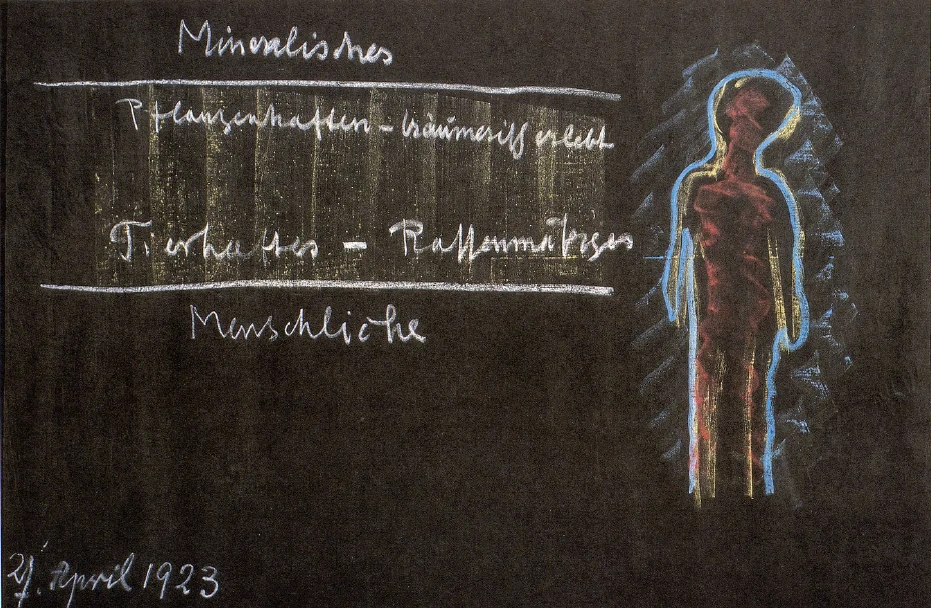
[ 30 ] If we take the human form as an example, we can say: In very ancient times, human beings felt within this form in such a way that they perceived only the external, racial characteristics inherent in the blood; they did not perceive anything as far as the skin (see drawing, red); they were not aware of the boundary. Today, human beings have reached the point where they are aware of this boundary. They perceive the boundary as the truly human aspect of their form. But human beings must now transcend themselves. They must come to know the etheric-astral realm outside themselves (blue). They can do this precisely through deepening their study of spiritual science.
[ 31 ] Thus we see that present-day consciousness has been achieved at the cost of losing much of the connection between consciousness and the cosmos; but once human beings have come to experience what their freedom and their world of thought are, they must once again reach out and experience the cosmos. This is what anthroposophy aims for when it speaks of a renewal of the festivals, and indeed of the creation of festivals such as the Michaelmas Festival in the fall, which was discussed recently. One must once again have an inner understanding of what the course of the year can mean for human beings in this regard. And it will then be able to be something higher than it once was for human beings in the manner described.