

The Annual Cycle as the Earth's Breathing Process
and the Four Major Festival Seasons
GA 223
8 April 1923, Dornach
Translated by Steiner Online Library
Fifth Lecture
[ 1 ] To broaden the perspective I presented here yesterday regarding the relationship that had developed in ancient times between human beings and the course of nature under the influence of the mysteries, I would like to discuss today what was believed in those ancient times concerning everything that human beings received from the universe through this course of nature. As you may have gathered from yesterday’s lecture—and perhaps also in recollection of some of what I was able to discuss regarding such matters around last Christmas at the Goetheanum, which has now been taken from us—the course of the year was experienced in its manifestations, and indeed can still be experienced today as a course of life, as something that, in terms of its outward course, is just as much the expression of a living being lying behind it as the manifestations of the human organism are such revelations of a being—the human soul itself.
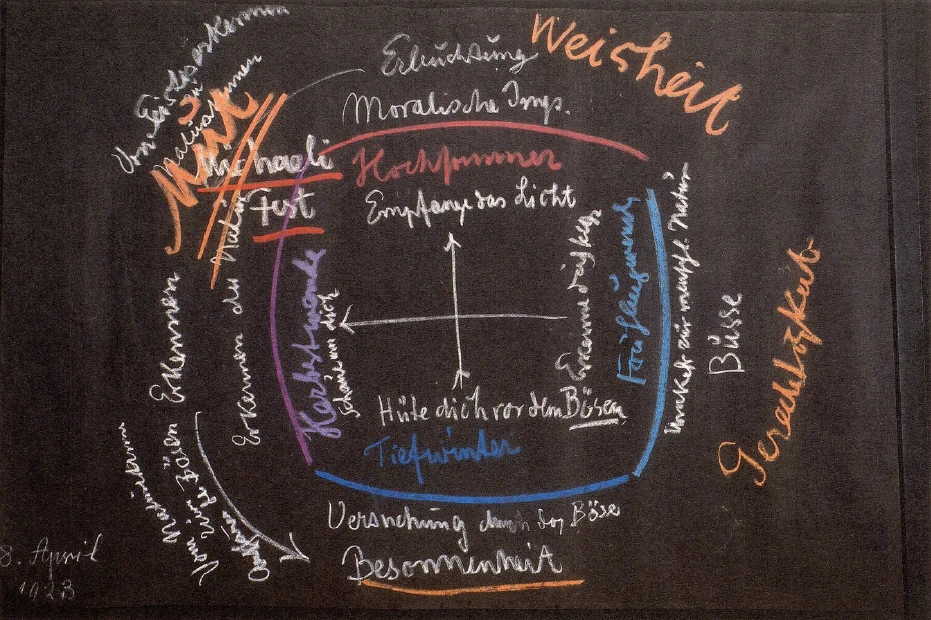
[ 2 ] Let us recall how, under the influence of these ancient mysteries, people in midsummer—the time we now regard as the St. John’s season—felt a certain connection to their “I”; not, however, to the “I” that they at that time did not yet attribute exclusively to themselves, but rather to the “I” they still placed within the bosom of the divine-spiritual. These people believed that through all these practices I have described, they drew closer to their “I” during midsummer—an “I” that remains hidden from them throughout the rest of the year. Naturally, people conceived of themselves as whole beings situated within the bosom of the divine-spiritual realm. However, they believed that during the remaining three-quarters of the year, nothing of what belongs to them as their “I” was revealed to them; only during this one quarter, which reached its peak at the time of St. John’s Day, was the essence of their own “I” revealed to them, as it were, through a window that had been opened from the divine-spiritual world.
[ 3 ] However, this essence of the individual “I” within the divine-spiritual world, in which it revealed itself, was not conceived of in such a neutral, indifferent—indeed, one might even say phlegmatic—way of knowing as is the case today. When people speak of the “I” today, they hardly think of any real connection to this or that world. They conceive of the “I,” so to speak, as a point from which what they do radiates out and into which what they perceive flows in. But it is certainly a kind of phlegmatic feeling that people today have toward their “I.” One cannot even say that modern people, in their “I”—even though this is, after all, the ego—experience true egoism; for if they are to be honest, they cannot possibly tell themselves that they are particularly fond of their “I.” They like their body, they like their instincts, they like this or that experience; but the “I” is, after all, just a little word that is perceived as a point, and in which all that has been hinted at is more or less summarized. But in that era, when the approach to this “I” was celebrated as a festival, when people had long been making preparations to, so to speak, encounter their “I” in the universe, in that era when they then felt how this “I” gradually withdrew and left the human being alone with his physical-soul being—what we would call today the physical-etheric-astral being — at that time, one truly sensed the “I” in relation to the entire cosmos, to the whole world.
[ 4 ] But what people felt above all else toward this “I” in its relationship to the world was not something “naturalistic”—to use today’s term—nor was it something perceived merely as an external phenomenon; rather, it was something that was essentially regarded as the center of the ancient, the primeval moral worldview. It was not assumed that great mysteries of nature were revealed to human beings at that time. Certainly, such mysteries of nature—as we mentioned yesterday—were not what people focused on first and foremost back then; rather, they had the sense that, above all, what they were meant to absorb as moral impulses was revealed during this height of summer, when light and warmth reach their peak. It was the time that people perceived as divine-moral enlightenment. And what they sought above all else as a response from the heavens through the musical, poetic, and dance performances that were cultivated at that time—what they expected—was that what the heavens demanded of human beings in moral terms would be revealed from the heavens in all seriousness.
[ 5 ] Whenever it happened that all these rituals I described yesterday were performed—that these festivals were celebrated during the sweltering summer months—and then a mighty thunderstorm broke out with lightning and thunder, people perceived the very outbreak of lightning and thunder as a moral admonition from the heavens to humanity on earth. What remains from these ancient times can be found, for example, in the conception of Zeus as the god of thunder, the god endowed with lightning. Something similar is associated with the German god Donar. That is on the one hand, and on the other hand, the following:
[ 6 ] One sensed there—I would say—that self-contained, warm, radiant nature; one sensed that which was the radiant, warming nature during the day, extending even into the night, and the only distinction one made was to say to oneself: During the day, the air is filled with the elements of warmth and light. Within these elements of warmth and light, the spiritual messengers weave and live—through whom the higher divine beings seek to reveal themselves to human beings and endow them with moral impulses. But at night, when the higher spiritual beings withdraw, the messengers remain and reveal themselves in their own way. — And so, especially during this height of summer, people sensed the workings and weaving of nature on summer nights and summer evenings. And what they experienced there was something like a summer dream lived in reality—a summer dream through which they had drawn particularly close to the divine-spiritual world; a summer dream in which one was convinced that everything that appeared as a natural phenomenon was at the same time the moral language of the gods, but that all manner of elemental beings were also at work and revealed themselves to human beings in their own way.
[ 7 ] Everything that constitutes the embellishment of A Midsummer Night’s Dream, the St. John’s Night dream, is what has remained of the wondrous creations that human imagination once fashioned for all that permeated this midsummer season spiritually and emotionally—but which, on both a grand and a small scale, was regarded as a spiritual, divine, and moral revelation of the cosmos to humankind. And so we may say that the underlying concept was this: During midsummer, the divine-spiritual world revealed itself through moral impulses that were implanted in human beings as enlightenment (see diagram). And what was felt there in a very special way—what had an effect on people—was perceived as something, I would say, superhuman, which played a role in the human order. Through their shared experience of these festivities that were being celebrated, people knew that, just as they were at that time, they were lifted beyond themselves into the superhuman realm; that, in a sense, the Deity took the hand that was extended to Her by human beings at that time. Everything that was believed to be of a divine-spiritual nature was attributed to the revelations of this St. John’s season.
[ 8 ] When summer drew to a close and autumn set in, when the leaves withered and the crops ripened—in other words, when the full, exuberant life of summer faded and the trees became bare—one sensed this, because the insights of the mysteries flowed into these very sensations: The divine-spiritual world withdraws once more from the human being. He feels himself being turned back upon himself; he grows, as it were, out of the spiritual and into nature. — Thus, human beings experienced this immersion into autumn as a withdrawal from the spiritual, as an immersion into nature. The leaves of the trees mineralized; the seeds withered and mineralized. Everything, as it were, was drawing toward the annual death of nature.
[ 9 ] In this intertwining with the mineralization of what was on Earth and surrounded the Earth, people sensed a intertwining of humanity itself with nature. At that time, in their inner experience, people were still closer to what was happening externally. And so they also thought and reflected in the same way that they experienced this intertwining with nature. Their entire way of thinking took on this character. If we wanted to express in our language today what people felt back then when autumn came, we would have to say the following. But I ask you to understand that I am speaking in today’s terms—that is, people back then would naturally not have been able to speak that way. Back then, everything was purely feeling; people did not characterize things through thought. But if one were to speak in today’s terms, in our own words, one would have to say: People experienced this transition in such a way that, through their mode of thinking and their way of feeling, they made the transition from spiritual knowledge to knowledge of nature (see diagram). This is what people sensed: that as autumn approached, they were no longer engaged in spiritual cognition, but that autumn demanded of them that they should come to know nature. Thus, at the turn of autumn, we no longer have moral impulses, but rather the cognition of nature. People began to reflect on nature.
[ 10 ] This was also the case in the time when people believed that human beings were creatures, beings within the cosmos. In those days, it would have been considered nonsense to introduce people to the study of nature in its then-current form during the summer. Summer is here to bring people into relationship with the spiritual aspect of the world. When the time began that we would today call the Michaelmas season, it was then that people said: From everything a person perceives around them in the forests, in the trees, in the plants—this is what inspires them to pursue knowledge of nature. — It was, in general, the time when people were meant to make knowledge and reflection their occupation. It was, after all, the time when external living conditions made this possible. Thus, human life moved from enlightenment to knowledge. It was the time of knowledge, of ever-increasing knowledge.
[ 11 ] When the initiates received their instruction from the mystery teachers, the latter imparted to them sayings such as those we later find, in a way, reflected in the sayings of the Greek sages. But these seven sayings of the seven Greek sages are not those of the original mysteries. In the original mysteries, the saying for midsummer was:
Receive the Light
[ 12 ] and the term “light” actually referred to spiritual wisdom. It referred to that within which one’s own human self shone.
[ 13 ] For the fall, this saying was coined in the Mysteries to remind souls of what they should do:
Look around you.
[ 14 ] As the year progressed—and with it, what people felt within themselves to be connected to that year—the winter season drew near. We are entering the depths of winter, which encompasses our Christmas season. Just as human beings felt themselves lifted above themselves in the height of summer toward the divine-spiritual existence of the cosmos, so too did they feel, in the depths of winter, as if they had regressed. They felt, as it were, as if they were being washed over by the forces of the earth, carried away by them. They felt as if their volitional nature, their instinctual and impulsive nature, were permeated and coursed through by gravity, destructive forces, and other forces present in the earth. In those ancient times, people did not experience winter the way we do—merely as a time when we get cold and, for example, put on boots to keep warm—but rather they perceived what rose up from the earth as something that now united with their own being. They felt, so to speak, the opposite of the sultry, luminous element as a frosty element rising up. We still feel that frosty quality today, for it relates to the physical body, but ancient humans felt, on a soul level, the darkness and gloom as a concomitant of the frost. He felt, as it were, as if wherever he went, the gloom were rising from the earth and enveloping him like a cloud—though only up to the middle of his body—but that is how people felt. And then they said to themselves—I must describe this again in somewhat more modern terms—then they said to themselves: During the height of summer, I am faced with enlightenment; then what is heavenly and super-earthly streams into this earthly world; now the earthly streams upward.
[ 15 ] But even during the autumn equinox, human beings had already experienced and sensed something of the earthly realm. At that time, however, they experienced and sensed something of the nature of the earth that was, in a sense, still in harmony with them—something that still had a connection to them. We could also say, for example: During the autumnal equinox, human beings felt the natural in their inner life, in their emotional world. Now, however, they felt as if the Earth were laying claim to them, as if they were being ensnared by the forces of the Earth with regard to their volitional nature. He felt this as the opposite of the moral world order. At the same time as this darkness, which enveloped him like a cloud, he felt the counterforces to the moral world ensnaring him. He felt the darkness rising from the earth like a serpent and winding itself around him. But at the same time as this, he felt something else as well. Already during the fall he had sensed that something was stirring within him—what we today call the intellect. While in summer the intellect dissipates and the moral and wisdom-filled enters from without, during the fall the intellect consolidates. The human being draws closer to evil, but his intellect consolidates. People certainly felt something like a serpentine revelation in the depths of winter, but at the same time they sensed the consolidation, the growing strength of cleverness and thoughtfulness—that which made humans shrewd and cunning, and spurred them on to pursue the principles of utility in life. All of this was experienced in this way. And just as the insight into nature gradually arose in the fall, so too did the temptation of hell—the temptation from the side of evil—come upon people during the depths of winter. That is how it was perceived. So that when we write here (see diagram): “Moral impulse, recognition of nature—,” we must now write here, in the depths of winter: “Temptation by the evil one.”
[ 16 ] And that was precisely the time when human beings had to develop what was, in any case, naturally inherent within them: the rational, the clever, the cunning, and that which was directed toward the useful. Human beings were to subdue this through prudence. It was precisely the time when human beings had to develop—not the open receptivity to wisdom that was demanded of them in the spirit of the ancient mystery wisdom during the Age of Enlightenment. Precisely at the time when evil revealed itself in the manner described, human beings could feel resistance to evil in a corresponding way: they were to become prudent. Above all, at this turning point he was now undergoing—having passed from enlightenment to knowledge, specifically from spiritual knowledge to knowledge of nature—he was to move from knowledge of nature to the contemplation of evil. That is how it was understood. And to the students of the Mysteries, to whom one wished to impart teachings that might serve as guiding words—just as one told them in midsummer, “Receive the light,” and in autumn, “Look around you”—one said to them in the depths of winter, “Beware of evil.”
[ 17 ] And it was hoped that through this prudence, through this guarding against evil, people would arrive at a kind of self-knowledge that would then lead them to realize how they had strayed from their moral impulses over the course of the year.
[ 18 ] Deviating from moral impulses by observing evil, and overcoming it through prudence—this was what people were to become aware of, especially during the period that followed the “deep winter.” That is why this wisdom incorporated all manner of teachings that guided people to repent for whatever they had come to recognize as deviating from the moral impulses they had received through enlightenment.
[ 19 ] We are approaching spring, the spring equinox. And just as we have here (see diagram: midsummer, fall, midwinter) enlightenment, insight, and prudence, so too do we have for the spring equinox that which was experienced as an act of repentance. And in place of insight—or rather, temptation by evil—there now arose what could be called repentance: a turning back to one’s higher nature through penance. Just as we have written here: enlightenment, insight, prudence—so must we write here: a turning back to human nature.
[ 20 ] If you look back once more at what, in the depths of winter, was the time of temptation by evil, you will have to say: At that time, human beings felt as if they were plunged into the chasms of the earth. They felt ensnared by the darkness of the earth. That was when—just as, in a sense, he had been torn out of himself during the height of summer, just as his soul had been raised above himself—his soul now freed itself inwardly so as not to be ensnared by evil during the depths of winter. Thus, during the depths of winter, I would say, there was a counter-image to what had been present during the height of summer.
[ 21 ] In the height of summer, natural phenomena spoke in a spiritual way. People sought, in particular, the language of the heavens in lightning and thunder. People looked to natural phenomena, but they sought a spiritual language within them. Even in the smallest details, during the time of St. John, people sought the spiritual language of the elemental beings—but outside of themselves. In a sense, they dreamed outside of themselves.
[ 22 ] In the depths of winter, people would turn inward and dream within themselves. By breaking free from the earth’s hold, they would dream within themselves if they could detach their soul from the physical world. And what has remained of this is that which is connected to the visions, to the inner seeing of the thirteen nights following the winter solstice. Memories of these ancient times have been preserved everywhere. One can indeed regard the Norwegian Olaf song as a later development of what was present to a very special degree in ancient times.
[ 23 ] Then springtime approached. Today, things have shifted somewhat; back then, springtime leaned more toward winter. In general, the whole cycle was viewed as divided into three annual periods. Things were also grouped together, but nevertheless, what I am sharing with you here was taught once again. Just as people used to say in midsummer: “Receive the light”—and in the fall, at Michaelmas: “Look around you”—and just as they used to say in the depths of winter, during the time of Christmas: “Beware of evil”—so too was there a saying for the time of repentance, which was considered effective only for that particular time back then:
Know Thyself
[ 24 ] in direct contrast to the perception of nature.
[ 25 ] Beware of evil—one could also put it this way: Beware, shrink back from the darkness of the earth. — But that is not what was said. While in midsummer people took the external natural phenomenon of light to be wisdom—that is, in midsummer they spoke, so to speak, in a natural way—in winter they would not have incorporated the saying “Beware of the darkness” into the sentence; instead, they expressed the moral interpretation: “Beware of evil.”
[ 26 ] Echoes of these festivals have remained everywhere, to the extent that people understood them. Of course, everything changed when the great event at Golgotha took place. The birth of Jesus occurred during the time of humanity’s deepest trial, in the depths of winter. The birth of Jesus took place at a time when humanity was gripped by the forces of the earth, as it were, plunged into the chasms of the earth. Among the legends associated with the birth of Jesus, you will also find one that speaks of Jesus being born in a cave, which points precisely to something that was perceived as wisdom in the most ancient mysteries: that human beings can find what they are seeking there, despite being gripped by the earthly darkness, which at the same time contains the reasons why human beings can fall prey to evil. And an echo of all this is that Lent is set during the time when spring is approaching.
[ 27 ] Of course, understanding of the midsummer festival has dwindled even more than that of the other half of the annual cycle. For the more materialism took hold of humanity, the less people felt drawn to enlightenment or the like. And what is of particular importance for humanity today is precisely that period leading from enlightenment—which at first remains unconscious to human beings—toward the autumn season. That is the point at which human beings, who must, after all, enter into the knowledge of nature, are to grasp in that knowledge the reflection of a knowledge of the divine spirit. There is no better festival to commemorate this than the Feast of Michaelmas. If celebrated in the proper way, this festival must give rise to a universal consideration of the question: How is spiritual knowledge found within the glorious knowledge of nature of the present day; how does one transform knowledge of nature in such a way that what humanity possesses as knowledge of nature becomes spiritual knowledge for them? — In other words, how can we overcome that which, if left to its own devices, would ensnare humanity in the subhuman?
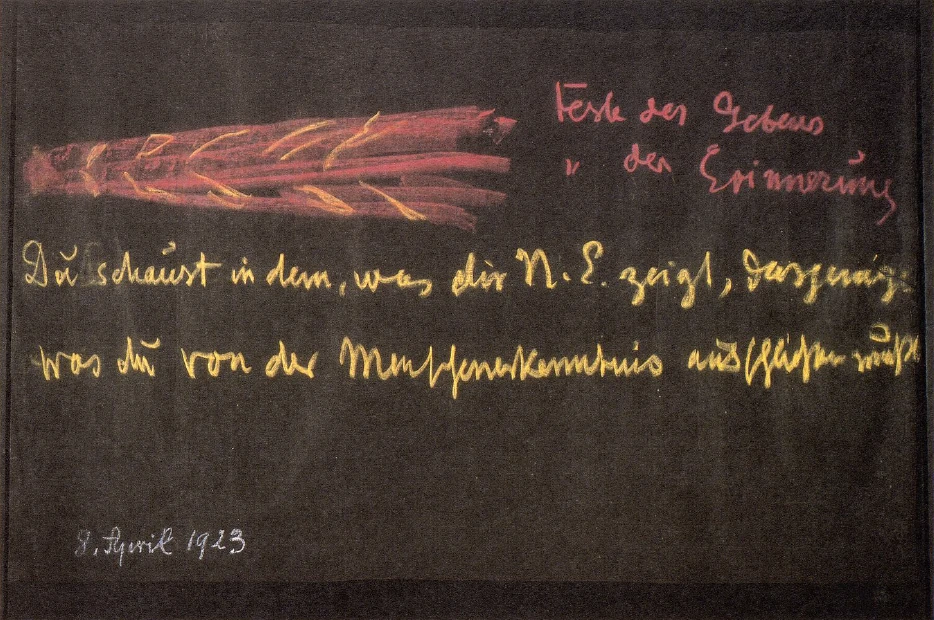
[ 28 ] A turning point must occur. The Feast of Michaelmas must take on a specific meaning. This meaning becomes clear when one can grasp the following: Natural science has led humanity to recognize one aspect of the world’s development—for example, that over the course of time, higher and more perfect organisms have emerged from lower animal organisms, and so on up to the human being, or that during embryonic development in the womb, the human being successively passes through the stages of animal forms. But this is only one side of the story. The other side is the one that presents itself to our soul when we say to ourselves: Human beings have had to develop out of their original divine-human constitution. If this (see drawing) is the original human constitution (light hatched), then human beings have had to develop into their present state of evolution. Step by step, he had to cast off first the lower animals, then, further and further, everything that exists in the realm of animal forms. He overcame this, set it aside, and cast it off (darkly hatched). Through this, he arrived at his original destiny. The same is true of his embryonic development. Human beings gradually shed everything they are not meant to be. Yet this alone does not reveal to us the true meaning of modern scientific understanding of nature. What is the meaning of modern scientific understanding of nature? It lies in the following statement: In what scientific understanding of nature reveals to you, you must discern that which you must exclude from your understanding of humanity. — What does that mean? It means: Human beings must study the natural sciences today. Why? When a person looks through a microscope, they know what is not spirit. When they look through a telescope into the vastness of outer space, what is not spirit is revealed to them. When they conduct experiments in the physical-chemical laboratory, what is not spirit is revealed to them. Everything that is not spirit is revealed to them in its pure form.
[ 29 ] In ancient times, when people looked at what we now call nature, they could still see the Spirit shining through. Today we must recognize nature in order to be able to say: All of this is not Spirit; it is winter wisdom. And everything that is summer wisdom must take on a different form. — In order for a person to receive the jolt, the impulse toward the spirit, they must recognize what is non-spiritual, what is opposed to the spirit. And one must come to understand such things that no one admits to today. Today, for example, everyone says: Well, if I have some tiny living being that cannot be seen with the naked eye, I put it under the microscope; there it magnifies before me, and then I see it. — Yes, but one will have to realize: This “size” is, after all, a lie; I’m stretching the living being out—I no longer have it; I have a phantom. What I see there is no longer reality. I have substituted a lie for the truth! — Of course, from today’s perspective, this is madness, but it is precisely the truth. When one comes to realize that we need the natural sciences so that, through this counter-image of the truth, we receive the impetus toward the truth, then the power will be developed that can be symbolically represented in Michael’s victory over the dragon.
[ 30 ] But this involves something that is, in a sense, already recorded—I would say—in a spiritual sense in the annals; however, it is recorded in such a way that, when people no longer had a true sense of what lives within the course of the year, they related the matter to human beings. Thus, the concept of wisdom was applied to that which leads to enlightenment; the concept of courage was applied to that which leads to knowledge; prudence remained as it was (see diagram); and the concept of justice was applied to that which corresponded to repentance. Here you have the four Platonic virtues: wisdom, courage, prudence, and justice. What human beings had previously received from the cycle of the year was internalized within them. But this will be particularly emphasized at the Feast of Michael: that it must be a feast in honor of human courage, the human manifestation of Michael’s courage. For what is it that holds people back from spiritual knowledge today? Spiritual despondency, not to say spiritual cowardice. People want to passively receive everything; they want to sit before the world as before a movie theater and have everything explained to them through the microscope and telescope. They do not want to temper the instrument of their own spirit, of their own soul, through active engagement. They do not want to be followers of Michael. This requires inner courage. This inner courage must find its celebration in the Michaelmas Festival. Then, from this festival of courage—from the festival of the inner, courageous human soul—will radiate that which will also give true meaning to the other festival times of the year.
[ 31 ] Yes, we must even continue along this path: we must incorporate into human nature what used to lie outside it. It is no longer the case today that human beings can develop their understanding of nature and so on only in the fall. The fact is that, in human beings today, these things are intertwined, for only in this way can they unfold their freedom. But it remains true, however, that—I would say—in a transformed sense, the celebration of festivals becomes necessary once again. Whereas festivals were once celebrations of the divine being bestowed upon earthly beings, and people once directly received the gifts of the heavenly powers during these festivals, today—now that they possess the inner capacities—the metamorphosis of the festival concept consists in the fact that these are festivals of remembrance. In this way, people inscribe within their souls that which they are to accomplish within themselves.
[ 32 ] And so it will once again be best to celebrate the Michaelmas Festival—the most powerful festival of remembrance, the one that marks the beginning of autumn—because at that time, all of nature speaks a meaningful cosmic language. The trees become bare, the leaves wither, and the animals—which fluttered through the air as butterflies and buzzed through the air as beetles throughout the summer—withdraw. Many animals fall into hibernation. Everything slows down. Nature, which through its own activity has helped human beings through spring and summer—nature, which has worked within human beings through spring and summer—withdraws. Humanity is left to its own devices. What must now awaken, now that nature has left us, is the courage of the soul. Once again, we are reminded that what we can understand as the Feast of Michael must be a celebration of the courage, strength, and activity of the soul.
[ 33 ] This is what will gradually give the concept of the feast a commemorative character—a character that has already been hinted at by a monumental phrase, which indicated that in the future, what were previously feasts of gifts will become, or are to become, feasts of remembrance. This monumental phrase, which must serve as the foundation for all concepts of celebration—including those that will emerge anew—is: “Do this in remembrance of me.” Here, the concept of the festival is turned toward the aspect of remembrance.
[ 34 ] Just as the other aspects of the Christ impulse must continue to work actively, must take shape, and must not remain merely a dead product upon which one looks back, so too must this thought continue to work in a way that generates feeling and thought; and one must understand that the festivals must remain, even though human beings change, and that the festivals, therefore, must also undergo metamorphoses. Anthroposophy and the Human Soul