The Human Soul in Its Relationship to Divine-Spiritual Individualities
Internalizing the Annual Festivals
GA 224
13 April 1923, Dornach
Translated by Steiner Online Library
10. Reclaiming the Living Source of Language Through the Christ Impulse
The Michael Concept as a Call of the Human Will
[ 2 ] If you recall various points I have raised here in the course of my previous reflections, you will be able to visualize the relationship between human language—the human ability to speak—and those beings whom we have come to regard, in the spiritual world, as belonging to the hierarchy of the Archangels. Remember how, in one of the preceding reflections, I explained the significance for human beings of shaping the words of their language in such a way that these words relate only to purely material things—so that language, in a sense, takes on a materialistic character—or of shaping language in such a way that they develop a certain idealism in their speech, so that language itself, every time a word is spoken, makes them feel: he belongs to a spiritual world, and what resounds in his language as the words of his soul must—precisely because it comes from the human soul—have some connection to spirits. Depending on whether one or the other is the case, I told you, human beings enter into the right or wrong relationship with the archangelic beings—the beings we call Archangeloi—between falling asleep and waking up. Human beings increasingly lose their necessary connection with these Archangeloi when they allow idealism to disappear from their language. I remind you of this fact because I would like to highlight at least one aspect of the relationship between human speech and the hierarchy of the Archangeloi that can be brought before your soul.
[ 3 ] Now, human speech—human language—has undergone a history in the course of human evolution, just as, in essence, all evolution has, insofar as it concerns human beings. We have come to understand this with regard to the most diverse aspects of human development. What I would like to discuss today does not pertain to any one specific language. The time periods to which we must refer in connection with the deepest developments of language are so long that even primitive languages today share the same characteristics—in relation to what we intend to discuss—as civilized languages. Thus, today we are not focusing on the differences that exist among individual languages, but rather on those transformations, those metamorphoses, that human speech as a whole has undergone in the course of human evolution on Earth.
[ 4 ] When we consider the relationship between human beings and their language today, we find that, in fact, the words of language are little more than signs for what lies outside of us and to which these words are meant to refer.
[ 5 ] As you know, in the course of our anthroposophical reflections we have also pointed to a more intimate relationship between the word and the thing it denotes. But such an intimate relationship is hardly felt by people today. Words are, more or less, merely external signs for what is meant by them. Who, for example, feels today that there is actually something inherent in the word “lightning”—something that, when the word is spoken, can be experienced by the human mind through its sound in the same way that the flash of lightning is experienced as it streaks across the sky? Today, people more or less perceive the matter in such a way that this very sound structure—“lightning”—serves as a sign for the flickering light phenomenon of lightning. But this was not always the case; rather, if we go back—and we need only go back to the earlier times of Greek civilization—we find that the relationship between human beings and language was not a purely symbolic or conceptual one, but that human beings themselves were in fact involved with their minds in the formation of the sounds of their words. For the northern languages, we do not even need to go back that far.
[ 6 ] Today, our sense of the fact that the word “plow” can be experienced in the same way as the activity performed with this farming tool has become dulled. The word has become a sign. But relatively recently—we need only think back to barely one and a half millennia—words were still experienced in the northern regions of Europe in such a way that the feeling one had while plowing was indeed similar to the inner feeling evoked by the word that designated the plow at that time. Thus, at that time, the perception of the word involved less of a thought and more of a human feeling.
[ 7 ] And if we go back to the very earliest times of humanity, we find that it is not only emotion that plays a role, but that the will is also intensely involved in word formation. But if we wish to consider that period when human beings, above all else, contemplated their relationship of will to the external natural world by living within language, we must go back as far as the later Atlantean epochs. These are indeed very long epochs during which language develops in the manner I have just indicated. And the linguistic genius lives within language. Language is not subject to human whim in its development; rather, the genius of language lives within language. And the genius of language essentially belongs to the hierarchy of the Archangels. When a human being speaks—that is, when they create, so to speak, an atmosphere around the Earth in which the sound formations articulated in human speech live—this linguistic atmosphere is the element of the Archangels. That is why the Archangels are the folk spirits, as you may know from a series of lectures I have given.
[ 8 ] So what actually appears in the development of human language on Earth is intimately connected with the development of the Archangels. One might say: What is expressed in the development of language is a reflection of the development of the Archangels. Even if we consider only what is earthly, we are by no means precluded from coming to know the development of the higher spiritual beings. We need only know, in the right way, how to relate certain phenomena and facts to certain higher spiritual beings. We need only look clearly to see how the ongoing development of the Archangels is expressed and revealed in the transformation of human language ability on Earth.
[ 9 ] If we now go back to those very ancient times when people expressed their volitional relationships through language—that is, to the final stages of Atlantean development—language, or rather that which lived within language as a being from the hierarchy of the Archangels, was something different from what later existed in this regard. Let us try to understand what language formation was like in those ancient times of human development on Earth. Back then, people were not yet very concerned with how it felt, for example, when flowers bloomed or when this or that kind of weather prevailed. They were interested in such things in a different context, but not in relation to that ability which causes the word to spring forth from the depths of their soul. When it came to forming words, what interested them was whether, for example, they were threatened by this or that external circumstance, whether they had to ward something off, or whether something had a favorable effect on them so that they wanted to incorporate it into their lives, or whether something was beneficial or harmful to their health. In short, he was interested in whether his will was stimulated in this or that direction. He was interested in what he was prompted to do under the influence of external circumstances, and the words were formed accordingly. In those ancient times, words were entirely expressions of human reaction processes—of what people felt compelled to do under the influence of the world. Expressions of the will were almost the only expressions that the most ancient languages possessed during humanity’s earthly evolution. And where did this come from? It came from the fact that the Archangels arrived at language through intuition.
[ 10 ] If you take the descriptions I have given in my various books regarding the nature of intuition, then you have also described, through this intuition, the activity that the Archangels carried out—let us say—during the final stages of Atlantean development, in order to convey to humanity the language of the will as it existed at that time. But then these Archangels advanced in their own evolution. I have, after all, referred to the evolution of the guides of the individual and of humanity who live in the spiritual world in the short treatise “The Spiritual Guidance of the Individual and of Humanity.” Today I would like to turn to an area that is given less attention there—the area of language.
[ 11 ] The progress of the Archangeloi with regard to language lies in the fact that, through their earlier capacity for intuition—especially in the worlds of higher hierarchies—they devoted themselves to those worlds, so that through language they actually attained something that was the very essence of higher hierarchies than the Archangel hierarchy itself. As long as their language-forming power was based on intuition, the Archangels devoted themselves to the next higher hierarchy—the Kyriotetes, Dynamis, and Exusiai. There they stood within it. And from what they experienced through their intuitive presence within this hierarchy, they were able to infuse earthly life with the language-forming power.
[ 12 ] In the next epoch, the Archangeloi progressed to the point where their language-forming power no longer flowed from intuition, but from inspiration. They no longer devoted themselves entirely to the next higher hierarchy; rather, what they received through their devotion to this higher hierarchy had become something different from what they conveyed to human beings as language. They now listened to the inspirations of the first hierarchy—the Thrones, Cherubim, and Seraphim—and from this inspiration they infused earthly life with the power to form language.
[ 13 ] If we go back to the earliest periods of post-Atlantean development—even as far back as the Egyptian and Chaldean eras—we find everywhere that inspiration is the source from which the archangels draw in order to impart language to humankind. There, language undergoes a metamorphosis such that, above all, words become expressions of human sympathy and antipathy, of human feelings and sensations in general. The old language of the will is replaced by a language of feeling. And this state prevails especially when what is felt in an external event or an external being is the same as what is felt when sounds articulated into words emerge from the depths of the human being through the speech organs.
[ 14 ] Thus we can say: This is a significant process in the development of humanity. The hierarchy of the Archangels is initially subject to intuitions, and from these intuitions, the language of the will is created by these beings. The Archangels move forward; they are then subject to inspiration. And from what they receive through the inspiration of the beings of the first hierarchy, the languages of feeling arise.

[ 15 ] It was, in fact, an extraordinarily profound sentiment that led Alerman Grimm, the art historian, to draw this dividing line between the Greeks and the Romans. Herman Grimm asserted, in fact: When one studies history today in school or at the university, one must ensure that one actually understands what one is learning. But when one studies history today, moving backward through human development, one understands history only up to the Roman era. Cicero, Caesar—one can still understand them because, to a certain extent, they are already quite similar to people today, although there is already much that is unnatural in the way we, let’s say, view Caesar. If we were not trained to do so, probably only students at military academies would be interested in Caesar. We are terribly conditioned in this regard. But on the whole, there is today a continuous current flowing back to Roman times. A certain philistine element—which is at its peak today but has gradually crept into humanity—is something we already find when we go back to Roman times. But, according to Herman Grimm, anyone who is honest in their understanding of the past cannot claim, for example, to understand Pericles or Alcibiades. One understands them in the same way one understands the characters in fairy tales. The inner life of these figures can only be understood through anthroposophical deepening. We have always tried to gain insight into the way a Greek thinks. Herman Grimm feels this as well. He senses the distance that lies between the inner life of a Greek and that of a modern person, who is still very close to the Romans; then there is an abyss.
[ 16 ] The way the Greeks are portrayed in today’s schools is terrible, because they are simply being modernized. That is not how they were; their entire inner life was different. One must resort to entirely different methods if one wishes to characterize the Greeks. This was best demonstrated by a specific case: how the highly erudite Wilamowitz set about translating the Greek tragedians. The whole affair is actually appalling, for naturally there is nothing of the Greek tragedians in Wilamowitz’s translations—absolutely nothing. And yet modern people like them immensely; they are completely enchanted by Wilamowitz’s translations. But the characters who appear in Wilamowitz’s work are not the same ones who appear in the works of the Greek tragedians.
[ 17 ] So when we return to Greece—as Herman Grimm sensed with unerring instinct—we enter a completely different world, not to mention the Oriental elements in this regard. It is, after all, pure mockery for modern humanity to believe that it can understand anything at all about what took place in the ancient Orient from Deussen’s translations. One must be able to penetrate this entire transformation and reshaping of the spiritual being.
[ 18 ] And if one looks at a specific element—language—it is precisely the case that, right up into the Greek era, the language of emotion prevailed, for example, among philosophers up to Plato. The first philosophical philistine is the great universal mind, Aristotle. You may be surprised that I mention these two attributes in succession, but one cannot understand Aristotle unless one conceives of him as both the first philosophical philistine and the universal mind at the same time. He is great in one respect, but in another respect he is precisely the first philosophical philistine who picks out the categories of thought from words. It would never have occurred to the ancient Greeks to pick out categories of thought from words, for they still had a sense that words are something that is inspired into human beings. They sensed the higher spirits as language came into being.
[ 19 ] Right up to the Greek era—and for the rest of humanity, which is certainly very backward in certain respects but in spiritual matters is often less backward than the philosophers—for this rest of humanity, which thus retained its inspiration regarding the power of language longer than the philosophers did, we can truly say: We still perceive everywhere in the language-forming power the inspiring element—which, however, lives in the soul of the archangels—all the way to the Mystery of Golgotha. Of course, this is an approximation. In one region of the earth it lasts longer; in another, shorter. In one region of the Earth, people still feel how the word pulses within them, just as blood pulses through the body; they feel this in the breath force. And in the breath force that sweeps through—that is, the breath force that sweeps through the body—they feel the Archangelos who is subject to inspiration.
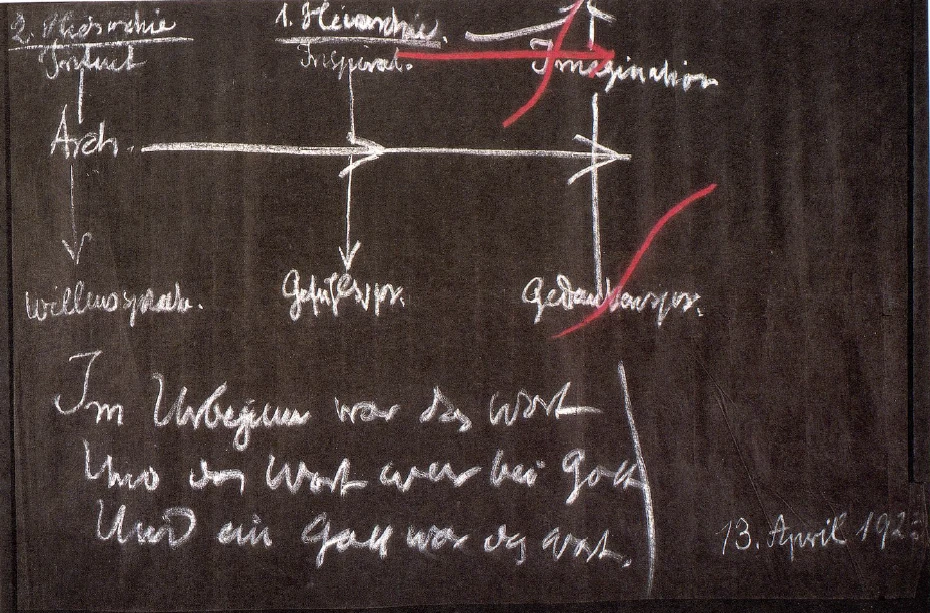
[ 20 ] Then we approach the historical epochs in which the archangels, by imparting language to humankind, are no longer subject to inspiration but to imagination (see diagram). And language becomes the language of thought. People speak more and more from their thoughts; language, so to speak, approaches the abstract element of the human being.
[ 21 ] There is something very significant underlying this. The Archangels received their intuitions from the second hierarchy; they themselves belong to the third hierarchy. They received their inspirations from the Seraphim, Cherubim, and Thrones—from the first hierarchy. Imagination—yes, at first there is no hierarchy beyond the first! At first, they could not receive these imaginations from the hierarchies that are, for example, still listed by Dionysius the Areopagite. There was no hierarchy beyond the first. Therefore, certain archangelic beings had to step in to retrieve the imaginations—that is, the images of the language-forming power, for that is what imaginations are—from the past, thus continuing what had gone before. The immediate, welling power to form language had ceased. An Ahrimanic element entered into language because it was carried over from an earlier stage. This is something of immense significance. And what the Archangels sensed above them in the higher realms was expressed in humanity in such a way that language became increasingly worn down and dulled, no longer existing as something as living as it had been in earlier times.

[ 22 ] Consider what an immensely significant truth is expressed in this fact. Something enters human life that actually required a higher hierarchy than the first hierarchy. One need only sense this in its immensely far-reaching significance, and one is made aware of how a time had come in which gods had to transcend what was contained within the first hierarchy.
[ 23 ] Now there is one thing the gods had not yet attained by that time, something that already existed here on earth in a symbolic form. What the gods had not yet attained is the experience of passing through death. This is a fact to which I have already referred on several occasions. The gods, who stand above human beings in the various hierarchies, have known only transformations, metamorphoses from one life form to another. The actual event of death in life was not an experience of the gods before the Mystery of Golgotha. Death entered into life through the Luciferic and Ahrimanic influences, through divine beings who had lagged behind or who were driving the forward march too quickly. But death is not actually something that existed as a life experience for the higher hierarchies. It becomes an experience for these higher hierarchies at the very moment when Christ passes through the Mystery of Golgotha—that is, through death—when Christ united himself with the destiny of humanity on Earth to such an extent that he wished to share with humanity the fact that he had undergone death. Thus, this event of Golgotha is not merely an event of earthly life; this event of Golgotha is an event of divine life. What took place on Earth, and what arises in the human mind as an understanding of the event of Golgotha, is the reflection of something immeasurably more comprehensive, more magnificent, more powerful, and more sublime that took place in the divine worlds themselves. And Christ’s passage through death on Golgotha is an event through which the First Hierarchy reached into a higher realm. That is why I have always had to tell you: The Trinity actually lies above the Hierarchies. But it has only come to this in the course of evolution. Evolution takes place everywhere.
[ 24 ] Thus, with regard to those very hierarchies described by Dionysius the Areopagite, the archangels lose the ability to form the imaginations from above. Human beings lose the ability to continue shaping their language in a living way. Something is taking place in the world of the gods, the earthly reflection of which is the event at Golgotha. And that is why, among many other things, the event at Golgotha is connected to the fact that as human beings gradually take in more and more of the Christ impulse, they in turn receive the living source of language through the Christ impulse.
[ 25 ] Today, one might say, we have natural languages that are in decline. And if one is open-minded enough, one can perceive in these declining natural languages—especially the farther one moves from the East toward the West—how these languages carry within them a dying element, how they are increasingly becoming mere shells. This is less the case in Asia, but as one moves toward the West, it becomes increasingly true that the languages carry within them a dying element.
[ 26 ] A revival of the creative power of language within the human being can only come about if people increasingly reclaim the Christ impulse as a living force, so that the Christ impulse itself becomes the creative power of language. And among all the points that must be raised when seeking to explain the significance of the Christ impulse for human development is this: that during the period in which humanity advanced toward freedom, it emerged from the state of being permeated and interwoven by the divine-spiritual in language. Had language remained as it was in ancient Greece, humanity would not have been able to develop toward freedom. It was necessary, I would say, for this absurdity to arise—that language exists only as a sign; that the Archangels lost the ability to form imaginations from the present and had to form them from the past. In this era, at the beginning of which Christ announced himself—the era in which he had the mystery of his being and his activity recorded in the Gospels—the knowledge of Christ did not, however, reach humanity in its fullness, because it was not spiritual enough; because it was often merely traditional. Only when the word of the Gospel is enlivened by an understanding of Christ that comes in the present itself from the Christ who continues to work and always influences human beings—only then will the language-forming power also emanate from this Christ impulse, from the living Christ impulse.
[ 27 ] But let’s now write down what I’ve hinted at here (see diagram). Let us be very clear that something is happening up above through which the gods are exalted, and that something is happening down below through which human beings increasingly receive the Christ impulse, but also advance ever further toward freedom. Let us simply imagine that, as human beings undergo an exaltation, this exaltation of human beings also constitutes an exaltation of the higher hierarchies. Let us be clear that the imaginations of the Archangels are currently becoming living imaginations as the Archangels increasingly take in the Christ who will have found his dwelling place in the hearts of people on Earth, and who enters the imaginations of the Archangels as an impulse.

[ 28 ] A completely different kind of language-forming power will then emerge. A special kind of language-forming power will indeed emerge. I have already hinted at this from certain other perspectives in earlier cycles, but now let us simply write down what I have explained to you here.
[ 29 ] Human beings can describe how things unfolded up in the heavens during the evolution that took place there, while the evolution of humanity was unfolding down here on Earth. But human beings can also describe the reflection of this process. They can describe the progression from the language of the will, through the language of feeling, to the languages of thought or signs. And they can know that in between lies the ascent—or descent—of the Archangels from intuition to inspiration to imagination. But as human beings look within themselves, what must they take into account if they wish to interpret the evolution of the Archangels and what is connected with it in the higher hierarchies? They take into account the evolution of language or the word; they focus on it; they recall it. I want to consider the development of a particular current within humanity, into which a divine current is woven. I go back to the origin, to the very beginning. “In the beginning was the Word.” Where, then, was the Word when we as humanity had a language of will? Yes, the Word was with God and had to be sought through intuition in God. “And the Word was with God.” But the Archangels had to immerse themselves, through intuition, into the essence of the second hierarchy. The essence they allowed to flow within themselves—that was the Word: “And the Word was God.”
In the very beginning was the Word,
And the Word was with God,
And the Word was God.
[ 30 ] We see how intimately connected was that which flowed forth in the development that reached its culmination in the Mystery of Golgotha with the Logos, or the Word. But the whole is, of course, connected with the universal event of the Incarnation and Christ’s passage through death. In the time when people said, “In the beginning was the Word, and the Word was with God, and the Word was God,” the Word was felt above all to be weaving within the soul. Now, through the Mystery of Golgotha, a time came when Christ was present in a human body—Christ was seen through the Word—when the Word had entered into the physical human being: “And the Word became flesh.”
[ 31 ] Profound truths of development, which are rediscovered through intensive work consisting of observation of the spiritual world, are found in what is written in the older literature. But one must be clear about this: this older literature must be approached with the reverence that leads one to say: I can penetrate ever deeper and deeper if I first investigate the things themselves. — That is how one enters into the deeper meaning of the ancient writings. And when one ascends into the deeper meaning of the ancient writings, one also ascends into spiritual life itself.
[ 32 ] And how much room would there be in our present day for a Michael culture—a culture that could be inspired by what I have called the “Michael idea” in my previous reflections! After all, the Michael idea is meant to come to life primarily through a harvest festival. The leaves, having withered, fall from the trees; the plants wither and die; life becomes mineralized. That which human beings have seen in the course of the past year as sprouting, growing, and living now takes within itself death, decay, and the process of mineralization. This is where the Michael force—the willpower—must spring forth within the human being, a force that is fully aware that the spiritual takes its place where the physical-material is weakened and gradually dies away. The autumnal Michaelmas Festival at the end of September should become a celebration of impulsiveness—a reflection of the human being who is placed within the withering processes of nature, yet whose soul is thereby stirred to all the greater activity. And if it becomes so, then all human activity will be enriched.
[ 33 ] Just think of all the things you can learn these days! You only need to look back a very short time. There is an abundance of experiences that people share with you. In all fields—for example, in the field of language—people tell you: “Yes, I should study languages, but nothing comes of it; everything just stands side by side; there’s nothing intellectual in it at all.”
[ 34 ] Well, it’s really true that, especially when people are young—let’s say, fresh out of high school—they haven’t quite come of age yet, but now they’re supposed to start thinking, go to college, and study languages. And now they’re wondering how to build on what they’ve already absorbed while studying languages: their heads start spinning at the thought of what lies ahead. Yes, all the foundations are in place to come to know those wonders that one encounters when one looks up from today’s language of thought, through the language of feeling, to the language of will; when one sees the divine, the archangelic, reigning and weaving there; when one sees how it reveals itself today, I might say, in the corpses of the languages. If the life of the very beginnings were to flow into them once more, that would be something magnificent!
[ 35 ] The Michaelmas ideal is not something that a few people can simply decide to do: “Let’s just have an autumn festival; that’s very nice, and then we’ll be the truly progressive ones.” - The Michael concept is something that must take into account the innermost and strongest impulses of the human will, and the festival can only be one that gives human life a powerful jolt, just as in earlier times, when people still possessed the forces that shaped festivals, and when the establishment of Christmas or Easter gave people a jolt of vitality.