

Insight from Initiation
GA 227
31 August 1923, Penmaenmawr
Translated by Steiner Online Library
Humanity's Entry into the Age of Freedom
[ 1 ] From yesterday’s discussion of the evolution of the world in connection with the evolution of humankind, you will have seen that the current stages of the development of the entire world and of humankind are such that humanity must gradually attain freedom. When we look back at the history of the world’s development, we see how human beings have been prepared—in regard to their most important activities—walking upright, speaking, and thinking—by divine-spiritual beings standing above them. We see how, between death and a new birth, human beings are repeatedly led back into the community of these beings, so that what these divine-spiritual beings have wrought within them—even if still unconsciously during their earthly existence—may take effect.
[ 2 ] I would just like to mention that I have just described how human beings are introduced, through the forces of the Sun, the Moon, and then—in the solar region—through Mars, Jupiter, and Saturn, into the world of the stars; that is to say, into that which spiritually corresponds to the world of the stars. And to add to that, I would like to say that when human beings, in this life between death and rebirth, must, so to speak, undertake the return journey after having advanced into the region of the minor planets—currently up to the perception of the Saturn impulses—they come into communion on this return journey with the initially highest divine-spiritual beings of the higher hierarchies: the Thrones, Cherubim, and Seraphim. These are spiritual beings whose impulses encompass both the spiritual and the natural realms; they simultaneously live through, enliven, and spiritualize the laws of nature, and they also seek to bring the moral life of the entire cosmos into a constant harmony with the laws of nature. These are beings who, while they never appear in any physical form of manifestation, possess in the spiritual world an immense power—one scarcely imaginable on Earth—through which the moral laws can be continually brought into harmony and accord with the laws of nature. Thus, by continually revitalizing the impulses of the past in extraterrestrial existence, human beings, in the course of their evolution, come to act in accordance with these extraterrestrial impulses.
[ 3 ] But we happen to be living in the present epoch of the evolution of the world and humanity, and our task within it is to incorporate into human freedom all that was, to a greater or lesser extent, unfree in the past—that which was brought about in human beings by a higher destiny.
[ 4 ] When we survey the evolution of the world and of humanity, we find that at a very specific point in time there lies, so to speak, the turning point that humanity had to pass through—from the earlier determination of its nature, from the earlier exclusive guidance by divine-spiritual beings, to the conscious striving upward in the knowledge of these spiritual beings and, through this, to the attainment of freedom.
[ 5 ] This point in time, which in a sense marks the great crisis for the entire evolution of humanity on Earth, occurs approximately 333 years after the Mystery of Golgotha. All these figures are approximate, of course, because the chronologies are not entirely accurate. So if we use the modern calendar, this point in time falls about 333 years after the Mystery of Golgotha. This, then, is the great critical moment.
[ 6 ] When we look back on this critical juncture in the evolution of the world and humanity, we can characterize it roughly as follows. We can say: If the evolution of humanity and of the Earth itself had continued as it was, if human beings had remained solely under the influence of those divine-spiritual powers that had guided humanity up to that point, then humanity—because this was the intention of these divine-spiritual beings—would have progressed toward freedom. But what would that mean? For humanity to have progressed toward freedom would mean that a balance between two parts of the astral human body would have been disrupted at precisely that moment.
[ 7 ] Consider for a moment the relationship between the physical and etheric bodies; I will not draw either of them for now. I want to draw only the astral body. Before the year 333, this astral body was essentially always such that I would have to draw it diagrammatically as follows:
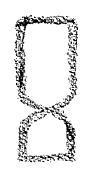
[ 8 ] In other words: The greater part of this astral body—the more active part—was located in the upper human being, while the less active part was in the lower human being. The middle human lies between the two. Because the upper part of the astral body was more powerful in those ancient times, the higher divine-spiritual beings exerted their great influence on human beings through this astral body. But it was part of the plan for the entire evolution of humanity that evolution should proceed as follows:
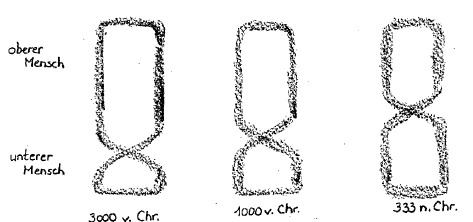
[ 9 ] If, for example, this was the state of the human astral body in, say, the year 3000 B.C., then this was roughly its state in 1000 B.C.—that is, the lower part of the astral body grew larger and larger, while the upper part became smaller and smaller in relation to it. And in the year 333, the upper part of the astral body became equal to the lower part. That was the crisis in the year 333 A.D. And since then, the upper part of the astral body has been steadily diminishing in human beings. This is the nature of its development.
[ 10 ] We cannot, therefore, truly trace the evolution of humanity unless we take into account what happens to the human astral body in the course of Earth’s evolution. If human beings had not experienced this shrinking of the upper part of their astral body, the “I” would not have been able to exert a sufficiently strong influence. Human beings would never be able to become free. This shrinking of the astral body, therefore, occurs to bring about freedom. As I have already said, things do not work in such a way that one can ask: Why did the gods not arrange everything in a way that pleases human beings? The gods had to arrange the universe in such a way that it became possible in and of itself, and many things that are most pleasing to human beings depend precisely on other things that human beings, unless they enlighten themselves, do not find pleasing. This shrinking of the astral body is connected to something else. For the strength with which a human being can control his physical and etheric bodies from the ego and the astral body depends on the size of the astral body in the higher self—not on the size of the whole being, but on that of the astral body in the higher self. Thus, humanity was truly facing a situation in which, as the astral body grew smaller, the health of all humanity would have been gradually weakened. We can only truly understand human evolution if we recognize that freedom had to be paid for with a widespread illness—not, of course, in the form of cholera or typhus, for example, but in the form of a general human ailment spreading across the entire Earth. Freedom cannot be attained except through—if I may use the expression—in a certain sense, the “falling ill” of all humanity.
[ 11 ] If all forces had simply continued in the same way, even after the year 333, as they had been before, the people on Earth would have grown weaker and weaker. They would have become more and more powerless. And the end of the world would have approached to the point where humanity would have completely declined.
[ 12 ] What has just occurred is what I would like to describe as follows: That assembly of divine-spiritual beings, which I have described to you as residing in the Sun, decided to send their emissary, the Christ, down to Earth and to have him undergo something that, in this particular way, those divine-spiritual beings connected with humanity experienced for the very first time. For, you see, in earthly life, human beings go through birth and death. Birth and death are, of course, not as the materialist imagines them to be, but they do enter into human earthly life. All the divine-spiritual beings standing above human beings—Angels, Archangels, and so on, all the way up to the highest ones—did not know death; they underwent only metamorphoses. They transformed from one form into another. They were not born, but transformed from one form into another. They did not die, but transformed again from one form into another. Human beings do this as well, but in the process they shed their physical and etheric bodies; and therefore the reality of birth and death is something more radical for them than for all other beings of the higher hierarchies. So the leaders of the solar harmonies and solar impulses decided to send the Christ to Earth so that he, as one of those beings who otherwise do not experience birth and death, might pass through these purely human destinies of birth and death. Thus, the Mystery of Golgotha is not merely a matter for humanity; it is a matter for the gods. It is a matter for the gods that can be put into words something like this: The gods of the Sun came together and deliberated on what they should do to avert from humanity the danger of becoming weaker and weaker through the diminution of the astral body.
[ 13 ] And so the Christ was sent to Earth, passing through birth and death—not, of course, as a human being, but as a divine being. And the result of this was that, through the event at Golgotha—through the fact of Christ’s death—healing forces entered into the Earth’s evolution to counteract what are, in the sense described above, disease-causing forces. Thus, in the truest sense of the word, the Christ became—in a cosmic-telluric sense—the great healer of humanity. That is to say, his forces entered into everything in human beings that needed to be healed, so that what now has, on the one hand, a tendency to decay but, on the other hand, is healed through the Christ, can now take its path toward freedom. Therefore, in the course of world development, provision was made so that the Mystery of Golgotha took place 333 years before the great crisis.
[ 14 ] The evolution of humanity on Earth thus unfolded—and could only have unfolded—in such a way that, in the year 333 of human history, the onset of decay loomed, the onset of a widespread illness across the Earth.
[ 15 ] Through the Mystery of Golgotha, the great, all-encompassing healing took place. Thus, everything that human beings do not bring about through their own self-awareness—but rather that which, in the deeper forces of humanity, is headed toward destruction in the future—can be healed through Christ, can be healed through union with Christ. This is how the Mystery of Golgotha is woven into the evolution of the Earth and humanity.
[ 16 ] Well into the 4th century A.D., some people who had absorbed the spiritual life of that time still knew something of the facts I have just explained. After all, in all the earlier times before the Mystery of Golgotha, there were those ancient mysteries in which the disciples were taught both about the past of human evolution on Earth and about the coming Christ—about what was to unfold in the future of human evolution.
[ 17 ] Through powerful, awe-inspiring images, the connection between human beings on Earth and the spiritual beings of the higher worlds was revealed to the initiates of the Mysteries. And at the time of the Mystery of Golgotha, there were still—albeit less advanced than the ancient mystery students—individuals scattered throughout the regions of the Near East, Africa, and southern Europe who, under the name of Gnosis — as it later became known — preserved in their knowledge and wisdom something of the processes actually taking place in Earth’s evolution and in the evolution of humanity, processes into which the Mystery of Golgotha had intervened so powerfully for the inhabitants of Earth. But these people, who still knew the secrets of the ancient mysteries, were filled with great concern. They knew that a crisis would befall humanity. They knew that in the future, human understanding would no longer be able to grasp the true, deeper foundations of evolution on Earth and within humanity.
[ 18 ] And so, in certain figures of the first four centuries of Christianity, one can perceive a sense of being filled with a certain concern—a concern that did not extend to earthly matters, but rather encompassed the affairs of the entire evolution of the world: Will humanity truly become ready—and appear ready—to receive within itself that which came through the Mystery of Golgotha? That was the great question of—I would say—the successors of the ancient initiates at the time of the Mystery of Golgotha, during the first four centuries following the Mystery of Golgotha.
[ 19 ] And from among those who were still initiated into Christianity during the first Christian centuries emerged, for example, a marvelous body of poetry from the first four centuries of the Christian era—a marvelous body of poetry in which the coming of Christ to Earth was first presented to humanity, but then, in moving figures, quite dramatically—though the work was actually written in an epic style—the people of the future, the near future, were presented in powerful images; people whose understanding will no longer be sufficient to grasp what they ought to understand precisely for the sake of human evolution. And after powerful images had depicted something of the gods’ solar counsel that I mentioned earlier—in which the descent of Christ into the human being Jesus of Nazareth was portrayed in a moving way in this epic—a third part described how, in a new metamorphosis, a revival of the ancient Demeter and Isis beings was to enter into human evolution. It was described how the essence of Demeter and Isis was to be sanctified in a special, powerfully portrayed human form. It was presented as something that was to come into play from the future, a kind of vow to humanity.
[ 20 ] These—I would say—poet-priests of the first four Christian centuries, at least the most outstanding among them, illustrated how a certain service, performed by all those who were to enter into scholarship and spiritual life, was to play a role in the further evolution of the Earth. A kind of sacrifice was offered for those who were to enter at all into scholarship and spiritual life.
[ 21 ] This epic then depicts a young person who is to find his way into a comprehensive understanding of the evolution of humanity during that time: it describes how, in his youth, he was to develop a kind of devotion to Mary as a transition from his younger years to his later years. This devotional attitude—which must actually come upon every scholar, every person seeking knowledge, and every person striving for wisdom if humanity is to find a connection with what came into humanity through the Mystery of Golgotha, that sacrifice—was depicted in vivid colors. A powerful, colorful body of poetry emerged during the first four centuries of Christianity. And among those who lived, to a greater or lesser extent, within the atmosphere of this poetry were painter-priests, who—though working in a simple, popular style of painting—nevertheless depicted these scenes in powerful, heartfelt images.
[ 22 ] This literature did exist. This literature, along with everything positive that stemmed from Gnosticism, was eradicated by the later Church. One need only recall that it was only through what one might call a coincidence that the writings of Scotus Eriugena were preserved, even from a later period, and one will no longer find it utterly absurd when, from the perspective of spiritual research, it must be stated that the greatest work of literature produced by the New Testament was simply eradicated root and branch by the later Church, so that nothing of it remained in the centuries that followed. But this work of poetry did exist. It was eradicated along with all the simple yet moving depictions that were associated with it. Enclosed within this work of poetry was also all the immense concern felt by these successors of the ancient initiates during the first centuries of Christianity. A solemn, elegiac tone pervaded this work of poetry.
[ 23 ] And we can say: The ability to understand these things was still present among a number of people well into the 4th century, and even into the early 5th century, among those who did not subsequently adopt the Augustinian school of thought, which represented a completely different current; the understanding of these things was still present among these people, but it simply could not be preserved in the direct way it had been at that time.
[ 24 ] The spiritual powers of the people in the southern part of the European world were already too weak; they could no longer grasp this understanding. And so what had served as the foundation of that understanding crystallized and solidified into the dogmas that have remained—dogmas that, in truth, could only be preserved because an increasingly lifeless language, Latin, preserved what was there. But this perpetuation of the Latin language in the Middle Ages among those who were now attaining wisdom served only to allow what was once a living understanding to become frozen in the language, so that eventually everything that was known about the Trinity, about the Incarnation of Christ, about the mission of the Holy Spirit, and about the great healing process of which I have spoken to you, became frozen into dogmas that were perpetuated in the Latin language; and the words themselves were no longer related to what the true content actually was. Thus, in the perpetuating Western scholarship that had Latin as its medium, what—for example—truly permeated that now-extinct poetry in a, shall I say, phosphorescent form gradually dried up.
[ 25 ] And then came all those young peoples of the North, who had been inspired more by the East; they received what was the Christ impulse already in a form that was, one might say, thoroughly Latinized, a form that was beginning to solidify.
[ 26 ] We must imagine the solidifying Christ impulse rising from the south, the peoples spreading out in the north who had already received a solidified Christianity, who, in their young spiritual powers, did not yet have the strength to, I might say, breathe life back into—from within the solidified dogmas—that which was of immense significance within them. The aftereffects of all these things are still present today. Even today, you can see forces in these northern regions that seem to — for it is all, after all, only an appearance — to have attained too late that which had dried up below as the Christ impulse, that which had absorbed the Christ impulse into the rigid dogmas, but which is called to rediscover, out of direct spiritual knowledge, the entire mystery of the event of Golgotha, of Christ’s entry into earthly life; but to discover it in complete freedom. For even this fact—that after the year 333, rigid Christianity spread northward from Italy, and young peoples came over, whose stragglers are found everywhere—in Russia, Sweden, Norway, Central Europe, and England—for everywhere today the peoples still live under this impulse—and all of this, the fact that it unfolded in this way, was ultimately intended to enable human beings to embrace the Christ impulse in freedom.
[ 27 ] It is therefore the task of those peoples among whom we must speak today primarily of anthroposophy in relation to their civilization—that they take in the entire context of Christ Jesus, that they learn to understand how, in a sense, humanity would have had to become frozen in the salt process without the Christ impulse. We can speak in these physical terms, for the Christ impulse extends all the way into the physical realm, even into the physical healing of humanity. And Christ has become the great Phosphorus, the spiritual Phosphorus, who, as such a great Phosphorus, must counteract this process of salinization in humanity. “Christus verus phosphorus”—that was one of the phrases spoken everywhere during the first three centuries of Christianity. This great phosphorus also runs as a leitmotif through the aforementioned lost poetic work.
[ 28 ] Thus, we must position ourselves in the present, between the past and the future. Thus, we must be able to look back. Of course, I will not impose on you as dogma what I have just said about a lost poetry and a lost scholarship. That is far from my intention. But the method that leads to the exploration of humanity’s true intellectual development leads to the recognition of such facts with the same certainty with which scientific facts are discovered today, and with far greater certainty than scientific hypotheses are formulated today. Just as little should someone who, from the outset, rejects these things out of the materialistic mindset of the present, should in any way be compelled to grapple with these matters; nor, however, can the one who knows these things as well as he knows his own life be prevented from speaking about them to those people who, perhaps, out of the entire course of human history and from a healthy sense of this human evolution, are able to recognize the truth of such an impulse within evolution.
[ 29 ] The poetry itself, of which I have spoken, no longer existed after the 4th century A.D., but all manner of accounts of it—not documented, but passed down orally, in certain circles, from person to person—still existed, and in certain circles the memory of that poetry lived on. However, those circles were prevented by the dominant, emerging church circles from even publicly mentioning anything at all about what had taken place in the first three to four centuries. But one of those who still sensed something—albeit in a greatly transformed form, no longer in the grandeur of the early centuries—of the poetry and the spirit of humanity from which this poetry had emerged was Dante’s teacher. And one can say that in this way, even in Dante’s Commedia—albeit already oriented toward the dogmatic side—an inspiration from what had taken place in the early Christian centuries found its way in, to a certain extent. I am, of course, aware of the objections that can be raised today against such a historical account, and I could, of course, raise the same objections myself that are made from this or that side. But as much as one must acknowledge the precision with which our history is constructed—that history which humanity learns today in schools at all levels, from the lowest to the highest—and as much as one may respect this precision, which is based on documents and conscientious historical criticism—what good does it do? Humanity will ultimately have to admit: That is not the true history, the real history, for this history does not include those documents that have been eliminated by humanity over the course of time. Therefore, no matter how critical or conscientious history may be with regard to documentary evidence, we can only gain the real history—just as we do with real natural science and astronomy—through spiritual research itself. Therefore, humanity must also find the courage not only to speak of the world of the stars as has been done here in recent days, but also to find the further courage to add to the conventional historical narrative that which must be missing from it, because certain circles had an interest in ensuring that the relevant documents would disappear completely from posterity. But in what lives within human souls, the impulses—even those that have been eradicated—live on; in what people of later times can yearn for, those impulses live on—impulses that are no longer written down today—because they have been eradicated—but that were once alive within humanity. It will therefore not only be necessary for humanity, in a certain sense, to re-educate itself regarding certain concepts if it is to progress in its evolution toward the future that lies before it, but also to re-educate itself regarding its attitude toward the truth.
[ 30 ] For, when all is said and done, we must find Christ again. He must return. And his return presupposes that there will be a humanity in this century that understands the manner in which he will reveal himself, the forms in which he will appear. Otherwise, under certain circumstances, the most terrible and tumultuous upheavals may arise, originating from people who, in the deepest subconscious regions of their being, sense something of the return of Christ—that is, of the Spirit of Christ—and who will represent this fact in humanity in an external, trivial, and terrifying manner. However, clarity regarding human evolution in the near future can only come about if the circle of those who, with a good disposition, wish to gain insight into the actual methods of spiritual research—and into how, through spiritual research, that which humanity specifically needs to shape its near future in the right way can be found in the supersensible world—continues to grow ever larger. Otherwise, we will sink deeper and deeper into that which can never truly approach the spiritual—not so much through ideas and concepts as through our inner attitude.
[ 31 ] In fact, in terms of concepts and ideas, much of what is happening today seems to be a straining toward, a reaching back toward, what should actually be the proper goal of knowledge in the present. But something prevents people from viewing the findings of the natural sciences in the proper way. They are, so to speak, groping in the dark when it comes to these facts. You see, as scientific and medical views of the human being are expanding today, we find that there are people who, later in life, develop nervous conditions that can extend into the physical constitution of the individual and lead to actual clinical pictures. Contemporary medicine then recognizes its powerlessness to effectively manage these clinical pictures in any meaningful way—to develop a pathology that leads to a therapy. I myself was a contemporary witness when the distinguished Viennese physician, the internist Breuer, was once confronted with such a case, in which something occurred in a patient that could no longer be grasped pathologically through physical research methods. Resort was made to hypnosis, which was becoming increasingly popular at the time. The patient was placed under hypnosis. By exploring the hypnotic state, they actually discovered that a terribly shocking, a terribly terrifying life event had occurred in an earlier period of the patient’s life. This life event had, so to speak—as was the only way to explain it at the time—been drawn down into the lower region of human life, where the subconscious and the unconscious reside. There it formed, so to speak, a “hidden province of the soul.” But even if a person knows nothing of such a thing, it is still there in their life. And it can even be present in a way that causes illness. Then there is something inside the person that was merely a psychological experience, something that continues to have an effect, that keeps rumbling on, something that is, so to speak, an isolated province in the life of the soul, of which the person is unaware.
[ 32 ] It was realized that if one reminds people of this—if one brings such things to their consciousness so that they consciously grasp them—it can lead to healing.
[ 33 ] Such facts, however, will be encountered more and more frequently in our present earthly life. But if one wishes to understand why humanity is afflicted by such conditions—and it will be afflicted by them more and more— one will have to understand, based on spiritual insight, what is happening with the ever-decreasing size of the upper part of the astral body, and how, in the ever-expanding lower part of the astral body, there is a tendency toward the accumulation of such subconscious regions of the soul. One will have to ascend from the soul-based understanding of the human being to historical spiritual understanding, to cosmic spiritual understanding, in order to be able to explain such phenomena at all. Breuer was a man of profound nature—I knew him very well—and, because he sensed that one cannot proceed further in this way with the mere knowledge of the present, he let the thread of research slip away, so to speak. Then others took up his work—Freud above all and his successors—and it developed into what is now known as psychoanalysis, which is practiced everywhere. It is based on something that is entirely true, for the phenomena are there. One is compelled to seek the soul-related basis of what manifests physically. The idea is correct; but we do not yet have the science to master it, for such a science would first and foremost be a science of the spirit.
[ 34 ] And so this form of psychoanalysis, which is based on the entirely natural, historically unfolding imperfection of the human upper astral body, is presented with these facts to people who are, first of all, dilettantes in the study of the soul and the spirit, but who are also dilettantes in the study of the body, for they do not know how to follow the spirit into the body. Thus, two forms of dilettantism come together that are truly alike, for these people know just as little about the actual soul and spiritual life of human beings as they do about the physical and etheric life. These two factors come together, and when two equal factors interact, they multiply each other: \(a \times a = a^2\) or \(D \times D = D^2\); dilettantism multiplied by dilettantism is dilettantism squared. It is indeed the case that something correct—something based on entirely sound foundations—appears as dilettantism precisely because of the inadequacy of current research. But one can see in such things the striving for what is true. One must not, in turn, dismiss something like psychoanalysis as something diabolical, but rather as something that reveals that our time desires what it is simply unable to achieve; therefore, something like what appears in psychoanalysis will only find its proper course when it flows into spiritual research. Otherwise, it will end up where Jung led it—the Swiss who drove psychoanalysis into a strange, curious logic.
[ 35 ] For example, in a work by such a man, you might read the following sentence: “Human beings are, one might say, predisposed—through the historically hidden realms of the soul—to conceive of a divine being.” — Now, the psychiatrist in question responds to this with the following: “But of course, a divine being cannot exist.” He [Jung] is, of course, of an atheistic disposition. But psychoanalysis demands: Human beings, just as they are predisposed, must—in order to maintain their psychological balance—accept a divine being. Yet this means nothing less than—if one is entirely conscientious (and I will always acknowledge the conscientiousness and precision of a man like Jung)—: You must live with untruth, for you cannot live with the truth. Theism is untruth. You must live with untruth, with theism. — It is simply that contemporary thought does not take these things entirely seriously. Yet they must be taken with the utmost seriousness.
[ 36 ] And so these longings arise everywhere, without people even realizing it—the subconscious longings. Some of you who have attended my other lecture series or read the lecture cycles will know that I have often pointed out, from a spiritual perspective, how it is incorrect to always say that light—emitting from the sun, for example—extends endlessly into infinite space. At most, people use the infinity symbol and say that it extends endlessly into outer space, diminishing in intensity in proportion to the square of the distance, so that the intensity becomes smaller and smaller; that is how the light extends.
[ 37 ] I also said: spiritual insight reveals something else; the idea that light, which radiates from a center, extends farther and farther out is not correct. Rather, just as a taut string, when pulled, moves only to a certain point in one direction and then snaps back, so light goes only to a certain point and then returns again and again. In its propagation, it is not merely expansive, but elastic and rhythmic. The sun not only radiates light but also repeatedly draws light back; however, because the intensities differ at the ends of the light paths, it is able to shape these light paths. I merely wish to hint at this, for it arises in connection with a higher understanding—with the cosmic understanding of the world, with a true understanding of spiritual science.
[ 38 ] Now the newspapers are reporting that Oliver Lodge has given a significant lecture in which he sought to demonstrate, based on the behavior of light rays, that a light ray, as it propagates, reaches a certain distance where it encounters the absence of matter—which, as Oliver Lodge assumes, it needs— as Oliver Lodge assumes, as something it collides with—that it then, with the help of the metamorphosis of the electron, falls back into itself—an idea that appears amateurish in light of the truth.
[ 39 ] Please don’t take these things to mean that I’m trying to speak disrespectfully about science. I fully acknowledge science. Compared to the truth, however, even these things—which cannot be praised highly enough and are recognized as ingenious in the present day—are also quite amateurish. But on the other hand, they show how human thinking itself drives us, with its abstract concepts of the propagation of light rays and the electron, to somehow enter a realm where the truth lies. After all, the whole point is simply to arrive at the truth, in order to infuse the ideas that arise everywhere—and with which one cannot make any sense—with that impulse which also carries contemporary research up into the spiritual realms. There is a form of nonsense in certain occult circles; people are taught all sorts of occult doctrines, but they are not led to the ultimate source from which these teachings actually originate. They are given only images, and they are not led to that which these images actually depict. As a result, the person’s soul becomes surrounded by a world of images, instead of gaining the sense that they must first come to know the universe through these images.
[ 40 ] You see, for this reason, after my Theosophy was published, I had to follow it up with The Occult Science of Theosophy. In it, what is depicted in images in Theosophy is carried out into the reality of the stellar world, into the evolution through Saturn, the Sun, the Moon, and so on. These two books complement each other.
[ 41 ] But if, in any field, one gives people only images, they become surrounded by those images. People who engage in occult nonsense do this to their students, whom they do not truly control; in this way, they lead them into what is called occult captivity. In this occult captivity, a person is surrounded by images that remain unclear to them as images, from which they cannot escape. They are in an image-prison. This is the very means by which much occult nonsense has been perpetrated by people and continues to be perpetrated even today. But there are also spiritual beings who bring people—or even parts of people—into such occult captivity. It is exactly the same psychological phenomenon. These are spiritual beings that are set loose in nature when one does not understand nature spiritually, when one looks at nature in such a way that one understands the atomic processes as merely naturalistic. Then one denies the spirit of nature. Then precisely those so-called Ahrimanic spirits in nature that strive against humanity become active, and they surround the human being with all manner of images, so that the human being can also be led into this occult captivity by these Ahrimanic spiritual beings.
[ 42 ] And a large part of what is today called the “scientific worldview”—not the facts of science, which are good, but what is called the “scientific worldview”—is nothing other than images of a universal occult captivity that is descending upon humanity as a danger. Such a danger of an encroaching occult captivity is present in the way human beings are surrounded on all sides by atomistic and molecularist images. Such occult captivity surrounds one with these images; one cannot look out into the free spiritual and celestial constellations, because the worldview of the atom stands before one like the psychological walls, the spiritual walls of a prison in which one finds oneself spiritually.
[ 43 ] This is what, as an image, can also show us—in the light of spiritual science—a true aspiration of the present, for the facts of natural science are fruitful everywhere and lead out into the realms of the spirit, provided one does not approach them with the prejudice of occult captivity, in which science is, in essence, trapped today. These are the things we must experience inwardly if we wish to place ourselves correctly within the present moment of Earth’s and humanity’s evolution, in harmony with Earth’s and humanity’s past and future. And this is what, I would say, is always called out to us whenever we encounter some ancient aspiration—but one now truly viewed with the spirit and the soul—before us.
[ 44 ] When we climb the mountains and find the Druid stones—those monuments to the spiritual striving of ancient times—it can serve as a reminder to us of the longings of those ancients, who sought the Spirit and, in their own way, looked forward to the coming Christ, will find their fulfillment only when we, in turn, attain spiritual knowledge through a spiritual vision, through which we will behold, in our own way, the coming Christ, who must return because he must first be recognized again by humanity in spiritual form, just as he once passed through life in physical form through the Mystery of Golgotha.
[ 45 ] This is something one feels particularly keenly here at this site, where such magnificent ancient monuments have been preserved.