

The Development of Human Consciousness
in the Past, Present, and Future
GA 228
29 July 1923, Dornach
Translated by Steiner Online Library
Measure, Number, and Weight—Weightless Color as a Requirement of New Developments in Painting
[ 1 ] During their earthly existence, human beings alternate between states of consciousness—which we have already examined from various perspectives in recent days—namely, the states of complete wakefulness, sleep, and dreaming. And I have just attempted to explore the full significance of dreaming in the short series of lectures given during the Delegates’ Assembly. Today, let us first consider the question: Is it an essential part of being human—as an earthly being—to live in these three states of consciousness?
[ 2 ] We must be clear that, within earthly existence, only human beings live in these three states of consciousness. Animals, after all, experience a fundamentally different cycle. Animals do not experience that deep, dreamless sleep that humans experience for most of the time between falling asleep and waking up; conversely, animals also do not experience the complete wakefulness that humans experience between waking up and falling asleep. The animal state of wakefulness is actually somewhat similar to human dreaming. However, the conscious experiences of higher animals are more definite—more saturated, I would say—than the fleeting human dreams. On the other hand, animals are never as unconscious as humans are during deep sleep.
[ 3 ] Animals, therefore, do not differ from their environment to the same extent as humans do. Animals do not have an external and internal world in the same way that humans do. If we translate what exists as a dim consciousness in higher animals into human language, the animal actually relates its entire inner being to the external world.
[ 4 ] When an animal sees a plant, its initial perception is not: “There is a plant on the outside, and I am a closed being on the inside.” Rather, the animal experiences a strong inner response to the plant—an immediate, intuitive sympathy or antipathy. In a sense, the animal feels within itself what the plant expresses. The fact that people in our present age are so unable to observe anything that does not present itself to observation in a very crude way—it is this circumstance alone that prevents them from simply seeing, from the animal’s movements and behavior, that it is just as I have described.
[ 5 ] Only human beings have this sharp, clear distinction between their inner world and the outer world. Why do human beings recognize an outer world? What leads human beings to speak of an inner world and an outer world in the first place? They come to do so because, whenever they are in the state of sleep, their “I” and their astral body are outside their physical and etheric bodies; they, so to speak, leave their physical and etheric bodies to their own devices during sleep and are among the things that constitute the external world. After all, during our state of sleep, we share the fate of external things. Just as tables and benches, trees and clouds are outside our physical and etheric bodies during the waking state—and we therefore call them the external world—so our own astral body and our own “I” belong to the external world during sleep. And when we, with our “I” and our astral body, belong to the external world during sleep, something happens.
[ 6 ] To understand what is happening here, let us first consider what actually happens when we face the world in a completely normal waking state. Objects exist outside of us. And scientific thinking has gradually led people to regard as certain, with regard to these physical things of the external world, only what can be measured, weighed, and counted. The content of our physical science is, after all, determined by weight, measure, and number.
[ 7 ] We perform the arithmetic operations that apply to earthly things; we weigh things; we measure them. And what we determine through weight, measure, and number is, in fact, the physical. We would not describe a body as physical if we could not somehow verify its reality with a scale. But that which, for example, colors are, that which sounds are, that which even sensations of heat and cold are—in other words, the actual sensory perceptions—hovers above the heavy, measurable, countable things. When we want to define any physical thing, what constitutes its actual physical essence is precisely that which can be weighed or counted—which is what the physicist is really only interested in. Regarding color, sound, and so on, he says: “Yes, something is happening out there that also has to do with weighing or counting.” — He himself says of color phenomena: “Out there are oscillating movements that make an impression on people, and this impression—when perceived by the eye—is designated by people as color; when perceived by the ear, as sound; and so on.” — In fact, one could say: The physicist today doesn’t know what to make of all these things—sound, color, warmth, and cold. He simply regards them as properties of that which can be determined by a scale, a ruler, or through calculation. Colors, so to speak, cling to the physical; sound breaks free from the physical; heat or cold ripples out from the physical. One says: That which has weight has a reddish hue, or it is red.
[ 8 ] When a person is in that state between falling asleep and waking up, things are different for the “I” and the astral body. At first, things do not exist at all in terms of measure, number, and weight. According to earthly measures of length, number, and weight, things are not present. When we sleep, we are not surrounded by things that can be weighed—as strange as that may seem—nor are we surrounded by things that can be counted or measured directly. One could not apply any standard of measurement to the “I” or the astral body in the state of sleep.
[ 9 ] But what is there, if I may put it that way, are the freely floating, freely weaving sensory perceptions. It is just that, at the present stage of human development, people do not have the ability to perceive the freely floating redness, the waves of the freely weaving sound, and so on.
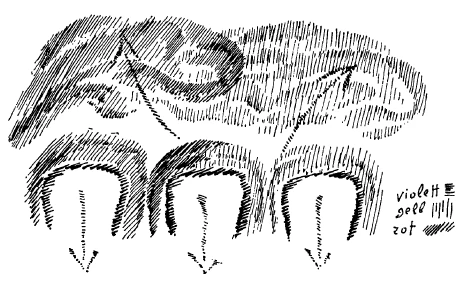
[ 10 ] If one were to sketch this concept schematically, one could do so as follows. One could say: Here on Earth, we have weighable, solid things [purple arcs], and attached to these weighable, solid things, as it were, are the red and the yellow—that is, what the senses perceive in the bodies. When we sleep, the yellow is a freely floating entity, the red is a freely floating entity—not bound to such conditions of weight, but freely weaving and floating. The same is true of sound: it is not the bell that rings, but the ringing that weaves.
[ 11 ] And isn’t it true that when we walk around in our physical world and see something, we pick it up; only then does it actually become a thing—otherwise, it could just as easily be an optical illusion. Weight must be a factor. That is why we are so inclined to regard something that appears in the physical world without feeling its weight—such as the colors of the rainbow—as an optical illusion. If you open a physics textbook today, you’ll find that it explains: “This is an optical illusion.” — The raindrop is regarded as what is actually real. And then lines are drawn into it that actually mean nothing in relation to what is actually there, but which one imagines extending through space; these are then called rays. But the rays aren’t actually there at all. Then one says: The eye projects them out. — This “projection” is, after all, something that is applied in a very peculiar way in physics today. So I’ll take up this idea: We see a red object. To convince ourselves that it is not an optical illusion, we pick it up, and it is heavy: thereby it attests to its reality.
[ 12 ] The one who now becomes conscious of the “I” and the astral body outside the physical and etheric bodies will eventually realize that something like this is already present within this freely floating and freely weaving world of colors and sounds; but it is different. In such a freely floating, colorful substance, there is a tendency to move out into the vastness of the world; it possesses a counteracting heaviness. These earthly things want to descend toward the center of the Earth [see drawing on page 200, downward arrows], while those [upward arrows] want to move freely out into outer space.
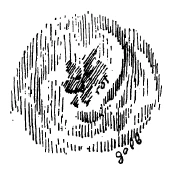
[ 13 ] And there’s already something like a measure there. You realize this when, for example, you have a small reddish cloud somewhere, and this small reddish cloud is, for my sake, bordered by a massive yellow formation: Then you measure—not with a ruler, but qualitatively—using the red, the brighter one, to measure the weaker, more faint yellow. And just as the ruler tells you, “That’s five meters”—so here the red [see drawing] tells you: If I were to expand, I would extend five times into the yellow. I must expand; I must become more powerful; then I, too, will become yellow. — That is how the measurements are made here.
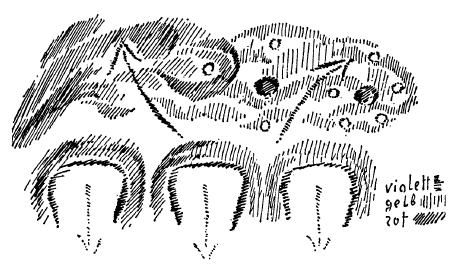
[ 14 ] It is even more difficult to explain counting here, because in everyday counting we usually count only peas or apples that lie indifferently side by side. And we always have the feeling that when we turn one into two, it is actually quite indifferent to that one whether there is a two next to it. In human life, of course, things are different; there it is sometimes the case that one depends on the other. But that already enters into the spiritual realm. In actual physical mathematics, however, the units are always indifferent to what joins them. That is not the case here.
[ 15 ] If there is a one here somewhere [see drawing] of a certain kind, it requires, say, three or five others, depending on the situation. This always has an inner connection to the others; there, the number is a reality. And when consciousness begins to grasp what it is like to be out there with the “I” and the astral body, one eventually arrives at determining something like measure, number, and weight—but in the opposite way.
[ 16 ] And then, when seeing and hearing out there is no longer just a dizzying swirl of red and yellow and sounds, but when one begins to perceive things as orderly within as well, then the perception of the spiritual beings who manifest themselves in these freely floating sensory impressions begins to take shape. Then we enter the positive spiritual world, into the life and activity of the spiritual beings. Just as we here on Earth enter into the life and activity of earthly things by determining them with scales, with rulers, and with our calculations, so, by appropriating the purely qualitative, opposite quality of heaviness—that is, by seeking to expand with lightness into the space of the universe, by measuring color through color, and so on—we enter into the perception of spiritual beings. Such spiritual beings now permeate everything that exists out there in the realms of nature.
[ 17 ] With his waking consciousness, a person sees only the outer appearance of minerals, plants, and animals. But when it comes to what lives as the spiritual essence within all these beings of the natural kingdoms, a person is asleep. And when they then turn inward again upon waking, their “I” and their astral body retain, so to speak, a tendency—an affinity—toward external things, causing them to recognize an external world. If human beings had an organism that were not adapted to sleep, they would not recognize an external world. Of course, it is not a matter of someone suffering from insomnia. For I am not saying this applies when a person does not sleep, but rather when a person did not have an organism adapted for sleep. It is a matter of being adapted to something. That is why a person becomes ill when suffering from insomnia—because it is simply not suited to their nature. But this is precisely how things are: It is precisely because a person, while asleep, remains with what is in the external world—with what they then, while awake, call their external world—that they also come to an external world, to a perception of the external world.
[ 18 ] This relationship between human beings and sleep is what defines the earthly concept of truth. In what sense? Well, we call it truth when we are able to correctly reproduce an external reality within ourselves, when we correctly experience an external reality internally. But for this, we need the mechanism of sleep. We would have no concept of truth at all if we did not have the mechanism of sleep. So we can say: We owe truth to the state of sleep. In order to surrender ourselves to the truth of things, we must also spend a certain amount of time with them. Things reveal something about themselves to us only by our being with them in spirit while we sleep.
[ 19 ] The situation is different with the dream state. As I explained to you in the short series of lectures during the Delegates’ Assembly, the dream is related to memory, to the inner life of the soul, to that which lives primarily in memory. When the dream is a freely floating world of sound and color, we are still half outside our bodies. When we immerse ourselves completely, the very same forces that we unfold in the dream—weaving and living—become forces of memory. Then we no longer distinguish ourselves from the external world in the same way. There, our inner world merges with the outer world; there, we live so intensely in the outer world with our sympathies and antipathies that we do not perceive things as sympathetic or antipathetic, but rather the sympathies and antipathies themselves manifest pictorially.
[ 20 ] If we did not have the ability to dream and the continuation of this power of dreaming within us, we would have no beauty. The fact that we possess an aptitude for beauty at all is due to our ability to dream. As for our prosaic existence, we must say: We owe our ability to remember to the power of dreaming; as for the artistic existence of human beings, we owe beauty to the power of dreaming. Thus: The state of dreaming is connected to beauty. The way we perceive and create beauty is, in fact, very similar to the weaving, active power of dreaming.
[ 21 ] When we experience beauty, when we create beauty—merely by making use of our physical body—we behave in much the same way as we do when we are outside our physical body, or half-connected to it, while dreaming. There is actually only a slight shift between dreaming and living in beauty. And it is only because people in today’s materialistic age are so coarse in their nature that they do not notice this shift that there is so little awareness of the full significance of beauty. One must necessarily surrender to this in a dream in order to experience this free floating and weaving. Whereas, when one surrenders to freedom, to inner spontaneity—that is, when one lives according to that leap—one no longer has the sensation that it is the same as dreaming, since it is precisely the same, only carried out through the use of the physical body’s powers.
[ 22 ] People today will ponder for a long time what was meant in earlier times when the word “chaos” was used. There are countless definitions of chaos. In reality, chaos can only be characterized by saying: When a person enters a state of consciousness in which the experience of heaviness—of earthly measure—ceases, and things begin to become half-light, but do not yet wish to venture out into the cosmos, instead remaining in the horizontal plane, in equilibrium; when fixed boundaries dissolve; when, in other words, the world’s weaving indeterminacy is beheld still with the physical body but already with the soul’s dream-like constitution—then one beholds chaos. And the dream is merely the shadowy approach of chaos to the human being.
[ 23 ] In ancient Greece, there was still the sense that one cannot truly make the physical world beautiful. The physical world is simply a natural necessity; it is what it is. One can only make that which is chaotic beautiful. When chaos is transformed into the cosmos, beauty emerges. That is why chaos and cosmos are interchangeable terms. One cannot create the cosmos—which actually means the beautiful world—from earthly things, but only from chaos, by giving form to chaos. And what one does with earthly things is merely an imitation, in material form, of the shaped chaos.
[ 24 ] This is true of all artistic expression. In Greece, where the culture of the mysteries still exerted a certain influence, people still had a very vivid conception of this relationship between chaos and the cosmos.
[ 25 ] But if one travels through all these worlds—the world in which a person is unconscious, when in a state of sleep; the world in which a person is semi-conscious, when in a state of dreaming—if one wanders through all of them, one will not find goodness. These beings that dwell there are wisely predestined from the very beginning of their life course. One finds wisdom reigning and weaving within them; one finds beauty within them. But it makes no sense, when it comes to getting to know these beings—which we, as earthly human beings, can reach—to speak of goodness in them. We can only speak of goodness when there is a distinction between the inner and outer worlds, so that the good of the spiritual world may or may not follow.
[ 26 ] Just as the state of sleep is associated with truth, and the state of dreaming with beauty, so the waking state is associated with goodness.
Sleep state: Truth
Dream state: Beauty, Chaos
Wakefulness: Kindness
[ 27 ] But this does not contradict what I have said in recent days: that when one leaves the earthly realm and ventures out into the cosmos, one is compelled to let go of earthly concepts as well in order to speak of a moral world order. For the moral world order is just as predetermined—necessarily predetermined—in the spiritual realm as causality is here on Earth. It is just that there it is spiritual: predetermination, being determined in and of itself. So there is no contradiction.
[ 28 ] But when it comes to human nature, we must be clear: if we want to grasp the idea of truth, we must turn to the state of sleep; if we want to grasp the idea of beauty, we must turn to the state of dreaming; if we want to grasp the idea of goodness, we must turn to the waking state.
[ 29 ] Thus, when a person is awake, their physical and etheric organisms are not governed by truth, but by goodness. This is all the more reason for us to turn to the idea of goodness.
[ 30 ] Now I ask you: What is the aim of contemporary science when it seeks to explain human beings? It does not seek to ascend by explaining to the awakened human being the path from truth through beauty to goodness; rather, it seeks to explain everything according to an external causal necessity that corresponds solely to the idea of truth. That approach does not lead to what is actively weaving and living within the human being; it leads only to what the sleeping human being is, at best. Therefore, if you read anthropological works today with an alert eye—alert to the soul’s characteristics and the forces of the world—you will gain the following impression. You will say to yourself: “Well, that’s all very nice—what modern science tells us about human beings.” But what is this human being actually like, the one this science tells us about? He lies in bed all the time. For he cannot walk. He cannot move. Movement, for example, is not explained at all. He lies in bed all the time.
[ 31 ] The human being that science explains can only be explained as a person lying in bed. There is simply no other way. Science explains only the sleeping person. If one wants to set him in motion, one would have to do so mechanically. That is why it is also a scientific mechanism. One must introduce a mechanism into this sleeping person that sets this sack of flab in motion when he is to get up and puts him back to bed in the evening.
[ 32 ] So this science tells us absolutely nothing about the human being who walks about in the world, who weaves and lives, who is awake. For what sets him in motion is contained in the idea of goodness, not in the idea of truth, which we initially derive from external things. This is something that is given very little thought. When today’s physiologists or anatomists describe human beings, one gets the feeling that one would like to say: Wake up, wake up—you’re asleep, you’re asleep! Under the influence of this worldview, people simply grow accustomed to a state of slumber. And what I have always had to point out—that people are actually sleeping through all sorts of things—is because they are obsessed with science. Today—because popular magazines spread everything far and wide—even the uneducated are obsessed with science. There have never been as many obsessed people as there are today; they are obsessed with science. It is quite peculiar how one must speak when describing the real conditions of the present day. One has to resort to tones quite different from those that are commonplace today.
[ 33 ] This is indeed the case when human beings are placed in an environment somewhat influenced by materialists. During the height of materialism, people wrote books such as one that, in a certain chapter, declared: “Human beings are, in and of themselves, nothing.” He is the result of the oxygen in the air; he is the result of the temperature—whether cold or hot—to which he is subjected. He is, in fact—so this materialistic description ends dramatically—the result of every movement of the air.
[ 34 ] If one considers such a description and imagines the person who truly is what the materialist researcher describes there, then that person is, in fact, a neurasthenic of the highest order. The materialists have never described other people. Even if they failed to notice that they were actually portraying people as if they were asleep—when, so to speak, they stepped out of character and wanted to move on—they have never described anyone other than severe neurasthenics who must die the very next day from sheer neurasthenia, who are utterly incapable of living. For this era of science has never truly grasped the living human being.
[ 35 ] These are the great tasks that must lead humanity out of the present conditions and back into conditions under which the continued existence of world history is the only possibility. What is needed is a penetration into the spiritual realm. The opposite pole to what has been achieved must be found. What, in fact, has actually been achieved, particularly in the course of the 19th century—a century that was so glorious for the materialistic worldview? What has actually been achieved?
[ 36 ] In a wonderful way—and this can be said quite sincerely and honestly—we have succeeded in defining the external world in terms of measure, number, and weight as the earthly world. In this regard, the 19th century and the early 20th century achieved something magnificent and monumental. But sensory perceptions—colors and sounds—flutter about in the realm of the indefinite. Physicists have, after all, completely stopped talking about colors and sounds; they speak of air vibrations and ether vibrations, which are neither colors nor sounds. Air vibrations are not sounds, after all; at most, they are the medium through which sounds propagate. And there is no real grasp whatsoever of what sensory qualities actually are. We must return to that. In fact, today we see only what can be determined by the scale, the ruler, and calculation. The rest has slipped away from us.
[ 37 ] And if the theory of relativity now introduces—as I described to you yesterday—that tremendous disorder into what can be measured, weighed, and counted, then everything becomes fragmented; everything falls apart. But ultimately, even this theory of relativity fails at certain limits. Not in relation to concepts—one cannot escape the theory of relativity with earthly concepts; I have already discussed this elsewhere—but with reality, one always escapes the concepts of relativity. For whatever can be measured, counted, or weighed enters into very specific relationships in external sensory reality through measure, number, and weight.
[ 38 ] It was in Stuttgart that a physicist—or rather, a group of physicists—took offense at the way the anthroposophists were treating the theory of relativity. Then, during a discussion, he demonstrated a simple experiment showing that it actually makes no difference whether I hold the matchbox here and strike the match against it—it burns—or whether I hold the match and strike the box against it—it burns just the same. It is relative.
[ 39 ] Certainly, here it is still relative. And with regard to everything that is related to a Newtonian space, or to a Euclidean space, it is all relative. But as soon as that reality comes into play—the one that manifests as gravity, as weight—things are no longer as straightforward as Einstein imagined, because real conditions then come into play. One really has to speak in paradoxical terms again. Relativity can only be applied when one confuses the whole of reality with mathematics, geometry, and mechanics. But when one delves into true reality, that no longer works. After all, it is not merely a matter of relativity whether one eats the veal roast or whether the veal roast eats one! With a matchbox, one can go back and forth, but one must eat the veal roast; one cannot let the veal roast eat one. There are simply things that set limits on these concepts of relativity. These things are such that, if they were explained to outsiders, people would say: “There isn’t the slightest understanding of this serious theory.” — But the logic is exactly as I describe it: It is no different; I cannot put it any other way.
[ 40 ] So the point is to see how, by taking weight into account—that is, what actually constitutes physical bodies—one finds, in reality, I would say, that colors, sounds, and so on have no place anywhere. But with this tendency, something extraordinarily important is lost. Namely, the artistic aspect is lost. As we become more and more physical, the artistic aspect takes its leave of us. No one today will find even a trace of art in what physics textbooks describe. There is nothing left of art there; everything, absolutely everything, must be stripped away. It is truly dreadful to study a physics textbook today if one still possesses even a trace of a sense of beauty. Precisely because everything from which beauty is woven—color and sound—is cast out, because it is only acknowledged when it clings to the heavy, material things, it is precisely through this that art is lost to people. Today, it is slipping away from us. And the more physical people become, the less artistic they become! Just think about it: We have a magnificent physics. We truly do not need to be told by our opponents that, in the field of anthroposophy, we say: We have a magnificent physics. — But physics thrives on the denial of the artistic. It thrives in each and every one of us through the denial of the artistic, for it has arrived at a way of treating the world in which the artist no longer cares at all about the physicist.
[ 41 ] For example, I don’t believe that musicians today place much value on studying the physical theories of acoustics. It’s too boring for them; they don’t care. Nor does the painter particularly enjoy studying that dreadful theory of color contained in physics. As a rule, if he concerns himself with colors at all, he still turns to Goethe’s theory of color. But that is, of course, incorrect in the view of physicists. The physicists turn a blind eye and say: Well, it’s not really that important whether the painter has a correct or incorrect theory of color. — The fact is that, under today’s physical worldview, art is bound to perish. Now we must ask ourselves: Why did art exist in earlier times?
[ 42 ] If we go back to very ancient times, to the days when people still possessed a primal clairvoyance, it was the case that people did not pay much attention to measure, number, and weight in earthly things. They did not place much importance on measurements, numbers, and weights; instead, they were more attuned to the colors and sounds of earthly things.
[ 43 ] Just think for a moment that chemistry has only been using weight as a measure since Lavoisier; that’s a little over a hundred years! Weight was only applied to a worldview at the end of the 18th century. Among the people of earlier times, there was simply no awareness that everything must be determined by earthly measures, numbers, and weight. People devoted themselves with their hearts to the tapestry of colors in the world, to the weavings and undulations of sound; not to air vibrations, but to the undulations and weavings of sound—to these they were devoted. They lived within it, even while living in the physical world.
[ 44 ] But what possibilities did living in this weightless, sensory perception actually offer? It offered the possibility that, when one approached a person, for example, one did not see that person at all as one sees them today, but rather viewed that person as a product of the entire universe. A human being was more of a convergence of the cosmos. He was more of a microcosm than simply what stands within his skin on that small patch of earth where he stands. People conceived of the human being more as a reflection of the world. There, colors flowed together from all sides, giving the human being his colors. The harmony of the worlds was present, resonating through the human being, giving him his form.
[ 45 ] And humanity today can hardly understand anything about the way in which the ancient mystery teachers spoke to their students. For when a person today wants to explain the human heart, they take an embryo and observe how the blood vessels bulge out, how a tube first forms, and then how the heart gradually takes shape. Yes, that is not what the ancient mystery teachers told their students! That would not have seemed much more important to them than knitting a sock, since, after all, the process looks quite similar. Instead, they emphasized something else—something of immense importance. They said: The human heart is the result of the gold that lives everywhere in the light, which flows in from the universe and actually forms the human heart. They held the vision that light weaves through the universe, and that light carries the gold. Everywhere in the light is the gold; the gold weaves and lives in the light. And when a person lives their earthly life, their heart—as you know, it changes after seven years—is not made up of the cucumbers, the lettuce, and the roast veal that the person has eaten in the meantime; rather, these ancient teachers knew that it is built from the gold of the light. And the cucumbers and the lettuce are merely the stimulus that enables the gold weaving in the light from the entire universe to build up the heart.
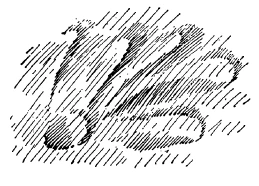
[ 46 ] Yes, people used to speak differently, and one must become aware of this contrast, for one must learn to speak that way again—only now at a different level of consciousness. That which once existed, for example, in the field of painting—which then disappeared, when people still painted from the cosmos itself because they were not yet weighed down by gravity—has left its final trace behind—let’s say, for example, in the work of Cimabue and especially in Russian icon painting. The icon is still painted from the outer world, from the macrocosm; it is, so to speak, a fragment of the macrocosm. But then a dead end was reached. One could go no further, because this perspective simply no longer exists for humanity. If one had wanted to paint the icon with inner participation—not merely out of tradition and prayer—then one would have had to know how to treat the gold. The treatment of gold in the painting was, after all, one of the greatest secrets of ancient painting. To bring forth that which is formed in the human being from the background of gold—that was ancient painting.
[ 47 ] There is a vast chasm between Cimabue and Giotto. For Giotto had already begun what Raphael would later elevate to extraordinary heights. Cimabue was still bound by tradition, while Giotto was already becoming something of a naturalist. He realized: Tradition no longer comes alive within the soul. Now one must take the physical human being; now one no longer has the cosmos. One can no longer paint from gold; one must paint from the flesh.
[ 48 ] Things have finally reached the point where painting has, in the end, returned to what it often was in the 19th century. Icons have no heaviness at all; they seem to have “shone in” from the world; they have no heaviness. It’s just that we can no longer paint them today, but if they were painted in their original form, they would have no weight at all.
[ 49 ] Giotto was the first to begin painting objects in such a way that they have weight. This led to the idea that everything one paints also has weight in the picture, and one then applies the paint from the outside; so that the colors relate to what is painted in the same way that, as the physicist explains, color arises on the surface through some particular wave vibration. Art, too, has ultimately taken weight into account. Only Giotto began this in an aesthetic and artistic way, and Raphael then brought it to its highest level.
[ 50 ] So that one can say: The universe has receded from within the human being, and the heavy human being became that which could now only be seen. And because the feelings of the old era were still present, the flesh, so to speak, became as light as possible—yet it still became heavy. And thus the Madonna emerged as the antithesis of the icon: the icon, which has no weight, and the Madonna, which does have weight, even though she is beautiful. Beauty has been preserved. But icons are no longer paintable at all, because people do not experience them. And it is a falsehood when people today believe that they experience icons. That is why icon culture was immersed in a certain sentimental falsehood. This is a dead end in art; it becomes schematic, it becomes traditional.
[ 51 ] Raphael’s painting—the style that is essentially built upon what Giotto developed from Cimabue—can remain art only as long as the old splendor of beauty continues to shine upon it. In a sense, it was the radiant Renaissance painters who still sensed something of the gold shimmering in the light and at least imbued their paintings with the radiance that allowed the gold shimmering in the light to outshine them from the outside.
[ 52 ] But that came to an end. And that is how naturalism came to be. And so today, humanity finds itself artistically caught between two stools on Earth—between the icon and the Madonna—and is dependent on discovering what pure, weaving color and pure, weaving sound are, with their opposing weight, in contrast to measurability and quantifiable countability. We must learn to paint from within the color itself. Even if we attempt this today only tentatively, however rudimentary and poorly, it is our task to paint from within the color itself, to experience the color itself, detached from its heaviness. In these matters, one must be able to proceed consciously—and artistically so.
[ 53 ] And if you look at what we have strived for in the simple experiments of our programs, you will see: even if it is only a beginning, the first step has indeed been taken—to free colors from their heaviness, to experience color as an element that sustains itself, and to make the colors speak. If this succeeds, then—in contrast to the non-artistic, physical worldview that causes all art to evaporate—an art will be created from the free elements of color and tone that is, in turn, free from heaviness.
[ 54 ] Yes, we, too, are caught between two stools—between the icon and the Madonna—but we must stand up. Physical science cannot help us with this. I have told you: One must always remain lying down if one applies only physical science to human beings. But now we must stand up! For this, we truly need spiritual science. It contains the element of life that carries us from heaviness to weightless color, to the reality of color, from being bound—even within musical naturalism—to free musical art, and so on.
[ 55 ] In every area, we see that this is a matter of pulling ourselves together, of a reawakening of humanity. This is why we should embrace this impulse toward awakening, toward looking outward, toward perceiving what is and what is not, and recognizing where the calls to move forward lie. That is why, just before this summer break—which is due to my trip to England—I felt compelled to conclude both the Delegates’ Assembly and these recent days with precisely the reflections I have shared with you. These matters strike a chord with the spirit of our times. And it is necessary to allow this other perspective to shine into our movement, as I have tried to suggest.
[ 56 ] I have described how the modern philosopher came to admit to himself: Where does this intellectualism lead? To building a gigantic machine that is placed at the center of the Earth, from which point the Earth is blown out into all the spaces of the universe! He admitted to himself that this is so. The others do not admit it!
[ 57 ] And so I have tried in various places—for example, when I showed you yesterday how the concepts that were still around thirty or forty years ago are now being dissolved by the theory of relativity, simply melting away like snow in the sun—I have tried to show you how everywhere there are calls to truly strive toward anthroposophy. For, as the philosopher Eduard von Hartmann says: If the world is as we must imagine it—that is, as he conceives it in the spirit of the nineteenth century—then we must actually, because we cannot endure it, blast it out into outer space, and it is simply a matter of our eventually reaching the point where we can carry this out. We must long for that time when we can scatter the world across the vastness of the universe. — Before that, the relativists will ensure that people no longer have any concepts! Space, time, and motion dissolve; then one can already fall into such despair that, under certain conditions, one sees the highest satisfaction precisely in this scattering out into the entire universe. But one must simply familiarize oneself clearly with what lies as certain impulses in our time.