The Development of Human Consciousness
in the Past, Present, and Future
GA 228
10 September 1923, Dornach
Translated by Steiner Online Library
The Druid Priest's Solar Initiation and His Understanding of Lunar Beings
[ 1 ] First of all, in order to elaborate on the observations I hinted at yesterday, I would like to recall some points I mentioned here in my lectures before my trip, which dealt with the spiritual nature of our planetary system. In a more spiritual context, reference had been made to something that has long been familiar to you from the descriptions in my Outline of Esoteric Science. We know, indeed, how intrinsically connected the development of the Earth, on the one hand, and the development of the Sun and the Moon, on the other, are. From a wide variety of perspectives—only one of which is the one discussed in An Outline of Esoteric Science—I have pointed out how, in a certain very early state of our planetary system, the Sun, the Moon, and the Earth—and indeed the other planets as well, though we shall not address that now—formed a single whole; how we must speak, so to speak, of a separation, of the Sun’s initial departure from the whole—Sun, Moon, Earth—and then, at a much later time, of the Moon’s departure.
[ 2 ] All these things, of course, have an external aspect, derived, so to speak, from sensory perceptions. But they also have an inner aspect, namely that certain beings are bound to each such existence—the existence of the Sun, the existence of the Moon—beings who, let us say, with the separation of the Sun from the Earth, now in turn detach themselves from this whole and attain a completely different kind of existence in the cosmos. Thus, when considering the later development of the Earth, one cannot speak merely of a detached Sun that exerts its physical and etheric effects upon the Earth; rather, when taking the spiritual aspect of the cosmos into account, one must indeed speak of a solar population, of solar beings who, while formerly connected to earthly evolution, now lead—outside of this earthly evolution—an existence that extends far beyond earthly life and is far more sublime.
[ 3 ] The same applies to what one might call the lunar population. And we had to point this out as well when we were discussing the spiritual aspect of such cosmic processes—namely, that there was once a primordial wisdom within Earth’s own evolution. But this primordial wisdom was, of course, not merely concepts floating about in the air; rather, it came from beings who, while not assuming a physical body in the human sense, nevertheless lived within human beings because of the instinctive clairvoyant powers that humans had developed at that time; it came from those beings who, after the Moon had separated from the Earth as an external celestial body, continued their existence on the Moon. So, as I already said back then in that lecture, one must speak of the fact that within the lunar being—not in the light that the Moon reflects back as sunlight, nor in what the Moon otherwise reflects back from the cosmos—but within the innermost core of this lunar being, there live beings who are the very same ones who were once the founders of primordial wisdom among Earth’s human beings. These are the beings who then passed into myths, legends, and mythology in general, and took on pictorial forms that are no longer comprehensible to ordinary consciousness: primordial wisdom to which we look back in wonder, even if we discover it only outwardly as the real foundation of myths, legends, and so on—primordial wisdom to which the intellectual forces of present-day humanity can only struggle their way through with great effort by once again developing imagination, inspiration, and intuition. But certainly, of all that was once connected to the Earth, at least within humanity itself, something remained as an unconscious memory. And then, in various epochs of human civilization—and I certainly include the earlier epochs of civilization in this—these unconscious memories emerge in human feeling and in the entire human state of mind, so that when we look at civilization, we can speak of a solar and a lunar civilization.
[ 4 ] These are, in a sense, memories in consciousness of something that once acted within human beings in a broader sense, like the forces of nature. And what human beings have perceived of them is merely an appendage, reminiscent of forces of growth and inner organizing forces.
[ 5 ] It is precisely when we reflect today on what I described to you before my trip to England that we can build on what was recounted here yesterday and, based on the insights we have thus gained, now delve a little deeper into what I described to you yesterday, from a more external perspective—the Druidic culture, traces of which are particularly conspicuous in the very regions where the lecture series described yesterday took place.
[ 6 ] Today, using the methods available to external science, one will ask in vain: What kind of state of mind did these Druid priests—I might just as well call them Druid scholars, for these are terms that are entirely appropriate for that time, even though such terms did not, of course, exist back then—what kind of state of mind did these Druid priests actually have? What was the source of the impulses through which they guided their community?
[ 7 ] What is often recounted in history—and what is, indeed, mentioned all too frequently—always refers only to what was active during periods of decadence and decline. What I wish to describe here always refers to that which precedes these periods of decline and was active during the periods of flourishing. For these cromlechs, these various sun circles I spoke of yesterday, in their true nature, are indeed reminiscent of what existed during the heyday of the Druidic mysteries. And even today, in a certain sense, using the tools provided by anthroposophical spiritual science, we can gain insight into the entire nature of how these Druid priests operated. In a certain sense, they were everything to their peoples—or rather, to their tribes. They were the ones who played a decisive role in meeting religious needs—insofar as one can speak of such needs at that time. They were the ones who shaped social impulses. But they were also the ones who played a decisive role, for example, in the healing methods of that era. They embodied all of this in one person—a role that later became distributed across many branches of human civilization. |
[ 8 ] We can only view this—we may well call it—Druidic culture correctly if we see its essence as belonging to an earlier epoch than the one from which those mythological concepts from the North, associated with the name of Wotan or Odin, have come down to us. What is associated with the name of Wotan actually dates from a time later than this golden age of Druidic culture. One must see in the circle of wisdom—so to speak—that points to the divine name of Wotan or Odin, something that initially came from the East from a mystery circle located near the Black Sea, and which then poured its spiritual content from the East to the West by establishing, so to speak, colonial mystery centers in a wide variety of ways, extending from the Black Sea westward.
[ 9 ] But all of this radiated into what, in a deeper sense, might be called a sublime culture, primordial wisdom, Druidic wisdom. This druidic wisdom was in fact an unconscious echo, something like an unconscious memory of all that the Earth had received from the Sun and Moon before the Sun and Moon had separated from the Earth. Initiation into the Druidic mysteries was essentially a solar initiation, combined with what could then become lunar wisdom through the solar initiation. What, then, was the actual purpose of these cromlechs, these Druidic circles? From yesterday’s presentation, it will be clear to you that they were essentially designed to contemplate, in a spiritual way, the relationship between the Earth and the Sun. If we look at the individual dolmens, we find that they actually contain something like instruments through which the external physical effects of the sun are excluded, so that the initiate endowed with the gift of clairvoyance can observe precisely what remains of the sun’s effects within the dark space. The inner qualities of the solar principle—how they permeate the Earth and how they in turn radiate back from the Earth into outer space—this is what the Druid priest observed through the individual cromlechs. So, I would say: The physical nature of sunlight was kept at bay. A dark space, as I told you yesterday, was created by the stones set into the earth, which were covered above by a capstone, and in this dark space, through the power of seeing through the stones, it was possible to observe the spiritual-essential nature of sunlight.
[ 10 ] Thus, the Druid priest, standing before his altar, actually engaged with the inner qualities of the solar principle, insofar as he needed what wisely flowed into him—but flowed in such a way that the wisdom was still like a force of nature—insofar as he needed it to govern his community.
[ 11 ] You just have to realize that we’re talking about a time when people couldn’t look in a calendar to find out when to sow properly, or when to entrust this or that seed to the earth. The calendar was what the priest deduced from the sun’s effects. People did not pick up a book to learn about the time. The only “book” that existed was the universe itself. And the “letters” that formed “words” arose from observations of how the sun affected this or that object that had been set up as a device. Today, you look something up if you want to know anything about this or that; the Druid priest observed what the sun did to his cromlechs. There he read the mysteries of the universe. There, from what revealed itself to him, he determined when to sow wheat, when to sow rye, and so on. These are just examples. For everything that was done, the impulses were read from the universe. The larger impulses needed to complete the annual calendar were derived from observations made in the shadow of the druidic circle. So that in this era, when there was nothing that sprang from human intellect, the universe itself was the only thing that existed. And instead of printing presses, they had the cromlechs to draw out the secrets contained within the cosmos.
[ 12 ] Thus, by reading the cosmic book in this way, so to speak, one was dealing with the solar aspect. And in contrast to the solar aspect, one perceived the lunar aspect. The forces that were then concentrated in the Moon were once connected to the Earth.
[ 13 ] But they have not completely departed; they have left something behind in the earth. If only solar forces existed, then only proliferating, growing cells, for example, would arise—living beings would always emerge with the characteristics of small or large cells. Diversity and form do not arise from the forces of the Sun, but from the forces of the Moon acting in conjunction with the forces of the Sun.
[ 14 ] And so it was that, as the Druid priest exposed himself to what his circles and his cromlechs revealed to him, he did not merely receive that abstract impression which we rightly experience today when we engage with the spiritual realm in our own way—that is, through intellectual means—but rather the forces of the sun spoke directly to him. In the shadow of the sun, the spiritual-solar force acted directly upon him, and it affected him much more intensely than a sensory perception affects us today, for it was connected to much deeper forces. As the priest stood before his place of worship, observing this solar quality, his breath changed as he observed: it became lifeless, it dulled, it undulated, so that one breath flowed into the next. He lived, through his breathing as a human being, within what emerged there as the effect of the sun. What arose for him was not abstract knowledge; what arose for him was something that worked within him just as the circulation of blood works—something that pulsed through him inwardly, something that stirred his humanity right down to the physical level. But this effect extending down to the physical level was, in fact, spiritual as well. And these inner stirrings that he experienced were, in fact, his knowledge.
[ 15 ] One must conceive of this knowledge as an experience in a much more vivid and intense way. He received this knowledge only at certain times. This knowledge could be aroused with lesser intensity every noon, but when the great mysteries were to be revealed, the priest had to expose himself to these influences during the time we now call the St. John’s period. Then, in addition to the small waves of knowledge that arose daily, the great wave set in. And as he experienced in this way—through the solar influences captured on Earth in a special, artificial manner—something he perceived as his initiation, as the solar initiation, he became capable of studying and understanding the forces that remained in the Earth as lunar forces when the Moon departed. This was his knowledge of nature, which he acquired under the influence of the solar initiation. What was revealed on the surface of things was not important to him. What surged up from below as the Earth’s lunar forces—that was what mattered to him. Just as he had, through the principle of initiation—traces of which are still preserved in these monuments today—enabled himself to perceive, so he then recognized—especially when the night sky revealed the stars above the Earth and the Moon traversed the celestial sphere—what is at work in nature.
[ 16 ] The solar initiation gave him the spiritual impetus, the spiritual impulse, and he then had his natural science. Our natural science is an earthly science; his natural science was a lunar science. He sensed the underlying lunar forces that radiated upward into the plants from the depths of the Earth, forces that were at work in the wind, weather, and the other elements. He did not perceive them in the abstract way that we do today—now that we have an Earth-based science—but rather in their liveliness, in their interplay and essence.
[ 17 ] And what presented itself to him there in all its liveliness, he perceived as the elemental beings that lived in the plants, in the stones, and in everything. These elemental beings, whose abode was in the trees, in the plants, and so on, were confined within boundaries. But they were not subject to the narrow boundaries that, for example, are imposed on human beings today; rather, their boundaries were broader. And so the Druid priest—whose natural science was a science of the moon—saw how these elemental beings could grow, could grow to gigantic proportions.
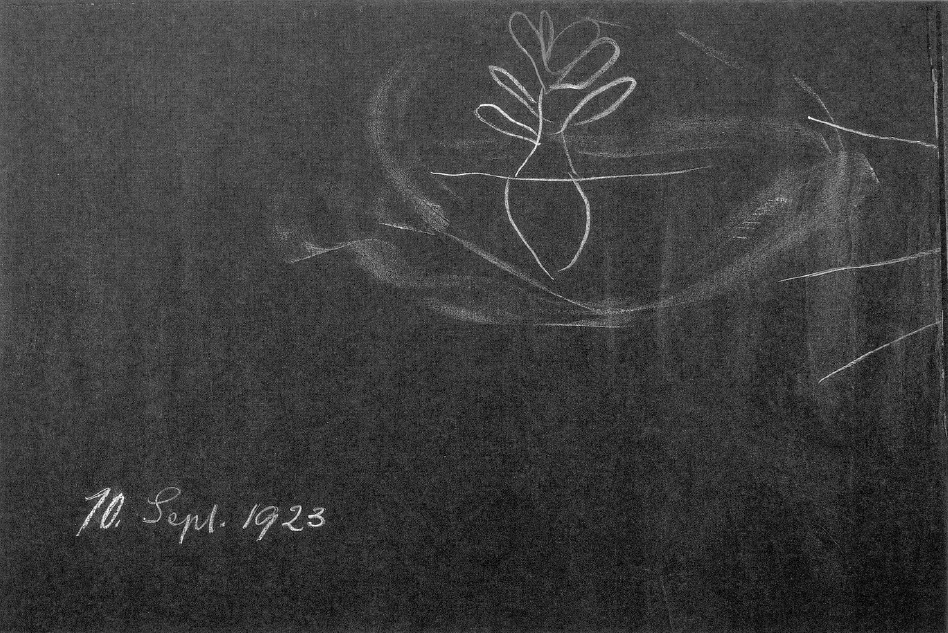
[ 18 ] From this arose the understanding of the giants, the Jötunns, the giant beings. If one looked into the root system of a plant beneath the earth, where the lunar principle dwelt, one perceived the elemental being within its proper bounds [it is depicted]. But these elemental beings had the urge to emerge and grow outward, to grow to gigantic proportions. When this kind of elemental being, which led its beneficent existence in the root system, grew into giants, it became the frost giants, who had their outer physical symbol in the frost, who lived in all that swept across the earth, for example, as devastating frost or other destructive frost forces. In a sense, the released root forces of the plants lived in the frost, lived in all that which flowed over the earth in gigantic form and then had a devastating effect, while at the same time unfolding its beneficial nature in the root realm. That which was present in leaf growth could also grow to gigantic proportions. It then lived as a gigantic, magnified elemental being in the fog storms that swept across the earth with all their contents during certain seasons, carrying the pollen of the plants and so on. And when that which lives in a quiet, modest way within the plant’s flowering power [see drawing, red] grows to gigantic proportions, it becomes a devastating fire.
[ 19 ] Thus, meteorological phenomena were seen as the forces—essential forces—that lived within natural beings within their proper limits, magnified to gigantic proportions. And even the locations of these ancient pagan places of worship show that what was once expressed through sun circles and dolmens was now developed into a knowledge of the earth made possible by them: developed in such a way that one could observe in the proper manner the mysterious workings and weaving, the sweeping and life of wind and weather—this interplay of the watery, the airy, the frost welling up from the earth, and the dewy—that one could observe all of this correctly. Thus, through solar initiation and knowledge of the lunar beings, this most ancient conception came into being, which we find—I would say—at the foundation of European civilization.
[ 20 ] The Druid priest thus interpreted what he was able to glean from the cosmos through his observations of cosmic events and his solar initiation, and what he was then able to gain in knowledge from his lunar natural science under the inspiration of this solar initiation. All of this, however, was connected to social life and the entire religious life. For what the priest could tell the people was, after all, content that extended to the spiritual foundation of the very situation in which the people found themselves. This becomes most evident when one points to what existed among these Druid priests as a kind of healing science. On the one hand, they observed the elemental beings confined within their boundaries in the various manifestations of the mineral, particularly the plant, and so on. Now they observed what happens to the plants when they are, let’s say, exposed to frost; when they are exposed to the effects carried through the air by the storm giants and the wind giants; and when they are exposed to the heat of the fire giants. And as they studied what the frost giants, the storm giants, and the fire giants would do to the plants if they were, so to speak, set loose, they came to take plants in their own way and, within certain limits, to imitate what is hinted at in nature as the effects of the giants: subjecting the plants to a specific process—the process of freezing, the process of cooling, the process of burning, and the process of dissolving and binding.
[ 21 ] And so these Druid priests said to one another: When we look out into nature, we see the devastating effects of the frost giants, the storm giants, and the fire giants. But we can take back from these giants, these Jötunns, what they are spreading clumsily across the world; we can wrest it from them. We can once again confine these unleashed lunar forces within tighter bounds.
[ 22 ] And by doing so—by studying what takes place in the thawing earth, in the storm, in the wind, and in the seething heat of the sun, and by applying this knowledge to the solar essence that lived within the plants and that they received during their initiation—they produced their remedies, medicinal herbs and the like, which were based on the reconciliation of the giants with the gods.
[ 23 ] In those days, every remedy was a testament to the reconciliation of the enemies of the gods with the gods themselves. Food was that which was consumed directly under the influence of the sun and moon, just as it appeared in nature. A remedy was that which humans produced by continuing nature’s work, by harnessing its immense power to place it in the service of the sun’s power.
[ 24 ] You see, this whole way of life is conceivable only if there is no intellectualistic inner knowledge—not a trace of it—if everything one wishes to know is recognized externally through that which expresses itself as spirit within the phenomena of nature themselves, or in what can be extracted from natural phenomena through special devices based on the principle of initiation—when everything is read from the book of the cosmos itself. Only then is such a life, such a kind of civilization, possible.
[ 25 ] We must imagine this civilization spreading across large parts of Northern and Central Europe about three or three and a half millennia ago. There was nothing at that time that resembled writing. There was only this cosmic script. And into this context, spreading from the East—initially from a mystery cult in the Black Sea region—came that which is now contained in Norse mythology in a form that ordinary consciousness can no longer unravel, insofar as this mythology is linked to Wotan.
[ 26 ] For what is Wotan? The mystery from which this Wotan culture emerged was a Mercury mystery—a mystery that added the impulses of Mercury to those of the Sun and Moon. So that, one might say, this ancient culture existed in a state of innocence and naivety bathed in the radiance of the Sun and Moon, untouched by what could be conveyed to humanity through the Mercury impulses. Only over in the East were these Mercury impulses already present. From there, they spread westward, colonizing the region. Wotan-Mercury extended his influence toward the West.
[ 27 ] And this simultaneously sheds light on the fact that Wotan is portrayed as the bringer of the art of the runes, of runic writing—that is, as the bringer of that which humanity creates from within itself, in the very first, entirely primitive intellectualistic way, as the art of deciphering the universe. Therein lies the very first intellectualistic influence—the Wotanic influence. And so one could say that the Mercury-like, the Wotanic, had now been added to the solar and lunar aspects.
[ 28 ] In the case of that which was truly and completely shaped by the Wotanic element, everything derived from earlier experiences was influenced by this Wotanic element. Everything took on a certain character, a certain impulse stemming from this Wotanic element. For one thing was a special mystery of Druidic culture. Of course, things sprout up everywhere—even those that do not belong in a particular place; “weeds” sprout in the fields. In Druidic civilization, only the solar and lunar aspects were recognized, so to speak, as the “good herbs” of culture. If, however—and I would say in anticipation of a later time—the intellectual aspect began to emerge, it was regarded as a weed. And among the various remedies the Druids possessed was one against brooding, against the Mercurial. As paradoxical as this may seem to people today, there was a remedy in those days against brooding, against this burying oneself in one’s inner self, in one’s own spiritual well-being. The Druids wanted people to live in harmony with nature, not to bury themselves within themselves, and they regarded as sick anyone who even attempted to express the natural in any way other than by imitating it in primitive art—anyone who, for example, made symbols. Someone who made symbols was considered sick; such a person had to be healed. And such a person was then regarded as a “black” human being—he was not a “white” human being. Indeed, if we were transported back to Druidic culture with our modern knowledge, we would all end up in the hospital and be cured!
[ 29 ] And now the Wotan civilization brought this “disease” over from the East. This Wotan civilization was perceived as a disease. But with a power that had now itself grown to something grand, even gigantic, it brought with it what had previously appeared merely as an abnormal form of brooding. That is what it brought. It introduced the rune into what had previously been derived only from cosmic writing. It introduced the idea that human beings would imbue the sign with their intellectual faculties; it introduced everything that was perceived as the Mercury culture. And so it was no wonder that what emerged from this Wotan culture—what was perceived as a distillation of the very best forces still present in the Wotan culture—the Baldur being, the sun being born later, could be conceived as united not with life, but only with death. Baldur had to journey to Hel, into the dark forces of death, into the abode of death.
[ 30 ] And yet again, what had been given the most thought at first—as is evident from the Eddaic traditions—was not how to free Baldur, this son of Wotan’s powers, from Hel—that is actually a later concept—but how to heal him. And this is so evident that it was said there were many remedies, but for Baldur—that is, for the intelligence that arises from Wotan’s runic power—there is no remedy; it can only lead to death.
[ 31 ] And so we see what I have drawn your attention to from various perspectives in our consideration of human evolution, when I told you: In earlier times, people’s instinctive understanding knew nothing of the significance of death, because they remembered their pre-earthly life and knew that death was merely a transformation. Death was not perceived as some profound turning point. Above all, there was no tragedy associated with death in earlier times. That tragedy only set in when the Mystery of Golgotha drew near, which became precisely a redemption from the fear of death. In the Baldur saga, you see the most vivid depiction of what the onset of intellectualism brings about—namely, a state of mind that anticipates death—which is thus what has entered human development. And so what had been seen in the death of Baldur—who could not rise again—was healed once more in a soul-spiritual way only when the figure of Christ, who could rise again, was set in contrast to him,
[ 32 ] It is truly marvelous how, in the North, the influence of the forces of Mercury on the forces of the Sun and Moon prepares the way for the perception of the Christ impulse. In Baldur, the god who falls to death and cannot rise again, we see, for the North, the forerunner of Christ, who also falls to death but can rise again because he comes directly from the Sun, whereas that which comes from Wotan as the solar force, is Baldur—the solar force reflected back by Mercury, the solar force radiating from the runes, the solar force radiating from the signs that human beings create through their intellect.
[ 33 ] And so one sees how everything in these northern regions develops—in a particularly vivid way—as human beings there still reveal themselves to us in their way of life, in their reading of the cosmos, in their search for religious, social, and healing concepts drawn from the cosmos, whereas later, human beings transition to living in harmony with the forces of the earth. The Druid priest looks down from his sacrificial stone at the way the shadow of the sun takes shape and how what appears in the shadow reveals itself as the spiritual essence of the sun; he interprets this. Later, we approach the time when the solar essence—which is, so to speak, captured in the dolmens and cromlechs—is depicted—horribile dictu for a higher perspective—with abstract lines called rays. And we approach that time when the kinship between what lives in roots, leaves, and blossoms and what lives in frost, wind, and fire is recognized solely in a chemical sense. The giants and the elemental beings transform into natural forces. Nevertheless, the forces of nature today contain nothing other than the giants of old; it is just that we do not realize it, and feel immensely exalted. The forces of nature have developed in a direct line from the giants: they are the late-born children. Because human beings today live, so to speak, in a completely derived culture, they should actually be deeply moved when their attention is drawn to these utterly degenerate remnants of the Druidic era. It is as if one were looking upon the forefathers of what lives in the present.
[ 34 ] And if we go into more detail: Today, for example, we also speak of remedies in a strangely abstract way, in a purely intellectual manner, describing the manufacturing process in a very abstract way. One must imagine this transformed into something truly alive if one wants to look back at the way the Druid priest viewed his remedies. There he sensed the forces of the sun—which he knew and worked with—in plants and other natural products, endowing them with immense power. For him, this was something truly alive. He drew forth from the giants the creative forces needed to transform the plant into a remedy. He knew that in doing so, he was contributing to the entire cosmos. And then he turned his attention to human beings. And through his unique insight into human nature, he saw how, from the innermost depths of natural human beings—namely through what emerged as dream imagery, as an indefinite, unconscious flickering of deeper human nature into consciousness—things take effect within people under the influence of these means of taming the giants’ powers, which had been instilled into their inner beings. And so, on the one hand, he had his Loki out there in the wild effects of fire; on the other hand, he had that which he had taken from Loki in order to transform this or that plant into a remedy through a process of combustion. And there, in the way this worked within the human being, he saw the power of Loki within the human being. There it was disarmed. And then he said to himself: What can have a destructive, threatening effect out there in the world of the giants becomes, when brought into the human interior in the right way, precisely a healing force. Poisonous forces, as it were, on a grand scale become healing forces when they are brought to the right place.
[ 35 ] And so, in his own way, he gained insight into the various forces and workings of nature. And so he was deeply immersed in the spiritual realm, through which he sent out religious, social, medical, and other impulses into his community. Thus, in those days, the ancient primordial wisdom—which the lunar beings had cultivated on Earth as long as they themselves were still present, and which was no longer directly present because these lunar beings had departed with the Moon—was preserved by such initiates, who explored and fathomed it with the help of a kind of solar initiation, in the manner I have described to you today.