Experiencing the Course of the Year
in Four Cosmic Imaginations
GA 229
6 October 1923, Dornach
Translated by Steiner Online Library
Second Lecture
[ 1 ] Yesterday we were presented with the image of Michael battling the dragon, as it arises from an inner understanding of the cycle of the year. And in fact, art can be nothing other than the representation of what human beings feel in connection with the universe. Of course, this will be possible to varying degrees and from different perspectives; but on the whole, the only work of art that truly means something to a person will be one that evokes in human feeling the impression that, through the work of art, the soul can open itself to the mysteries of the universe.
[ 2 ] Today, let us continue to follow the course of the year in the same spirit in which we considered it yesterday—a reflection that culminated in the depiction of Michael and the dragon.
[ 3 ] We know from the discussion so far that, as autumn approaches, a kind of inhalation of the Earth—a spiritual inhalation of the Earth—takes place; that the elemental beings who found their way out during the height of summer are drawn back into the Earth’s womb itself, and that they then move back again when the Feast of Michael arrives, and that they continue to move further and further back until, in the depths of winter, they are most intimately connected with the Earth’s bosom.
[ 4 ] Now, based on all this, we must form the idea that it is precisely during the winter season that the Earth is most of all a self-contained being. It has taken in from the universe everything that it had allowed to flow out—especially in the form of spiritual forces—during the summer season. The Earth is therefore most fully Earth during the “deep winter”; that is when its true essence is most fully present. And so, in order to establish a foundation for further considerations, we must focus specifically on the essence of the Earth in winter, while of course never forgetting that what is winter for one half of the Earth is summer for the other half. You must keep this fact in mind. But let us now imagine a part of the Earth where “deep winter” is approaching. There, the Earth unfolds that which, in the deepest sense, is its very essence—that which makes it wholly Earth.
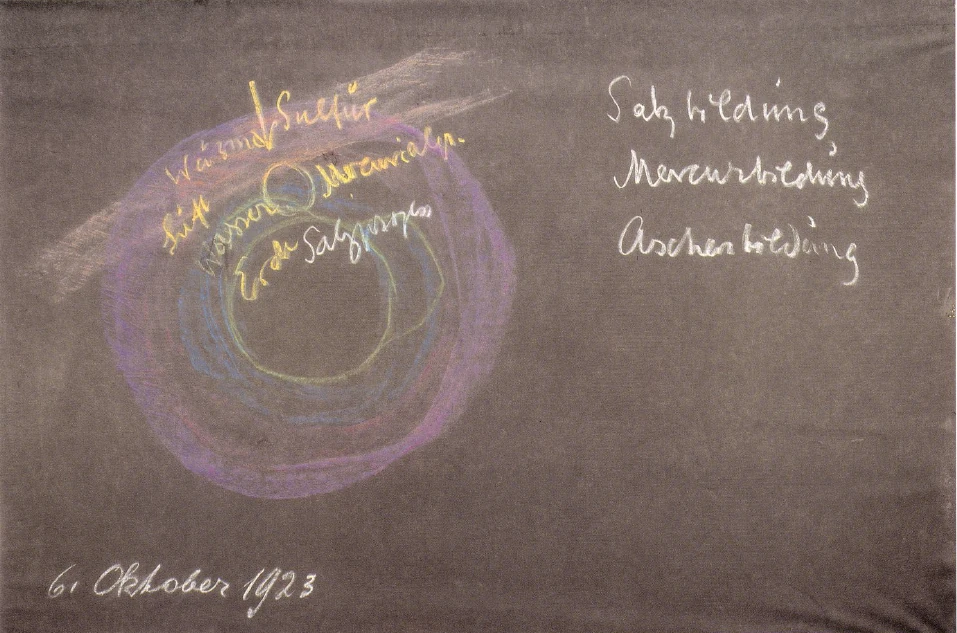
[ 5 ] Now let’s take a look at this Earth. It consists of a solid core, which at first appears to the outside world as nothing more than its surface; but this solid core is, for the most part, covered on the outside by the hydrosphere—the Earth’s body of water. The continents are, so to speak, merely floating within this body of water. And we can even imagine this body of water extending further into the atmosphere, for the atmosphere is also always filled with a watery substance—which is, admittedly, much thinner than the water of the oceans and rivers—but there is actually no distinct boundary in this watery substance as we ascend from the ocean into the atmosphere. So that, if we were to sketch schematically what the Earth is in this regard, we would have to draw it as follows: In the center we have the solid Earth’s core (see Plate I, green). Surrounding this solid Earth’s core is the watery region (blue). Now, of course, I would have to draw the continents there, showing how they protrude and so on. All of this is drawn in a caricatured way, for the protrusions should not give a different impression than, say, the ridges of an orange. But now I must draw around it what I have designated as the hydrosphere, the mass of water within the atmosphere. Let’s take a look at this structure (blue) and ask ourselves: What exactly is it? This formation has not simply arisen out of itself, but rather this formation is water within the entire cosmos. This formation is what it reveals to us as a form, emerging from the entire cosmos. And only because the cosmos is actually a sphere—a spherical entity—in all directions does that which rises upward as water or as a mass of air also appear to us as round, delimited in a spherical shape.
[ 6 ] But this exerts powerful forces on the entire Earth. So that, if we were to look at Earth from some distant planet, it would appear to us as a large—let me say, for the sake of argument—drop of water in the vastness of the universe, with all sorts of protrusions—the continents—that would appear to be slightly different in color; but it would still appear to us as a large drop of water in the vastness of the universe.
[ 7 ] Now let’s talk about the whole matter from a cosmic perspective. What exactly is this drop that drifts through the cosmos as a drop of water? It is something that takes on the form of a drop through the interplay of all cosmic forces. If we approach the matter from a spiritual scientific perspective—especially as we enter into the realms of imagination and inspiration—we gain an experience of what this drop actually is. This drop is nothing other than a gigantic drop of mercury—truly a gigantic drop of mercury—except that the mercury is present in an extraordinary dilution, an immense dilution.
[ 8 ] The fact that such dilutions are possible has now been precisely proven by the work of Dr. Kolisko. It was at our biological institute in Stuttgart that the first attempt was made to establish this on a precise scientific basis. There, it has become possible to produce dilutions of substances in a ratio of one to one trillion, and they have indeed succeeded in precisely determining the effects that the individual substances have in such dilutions. Thus, what until now may have been mere belief regarding the effects of individual substances in homeopathy has thereby actually been elevated to the status of an exact science. Indeed, based on the curves that have been plotted, there can be no doubt today that the effects of the smallest particles proceed in a rhythmic manner. Well, I do not wish to go into further detail; the work has been published, and the findings can be verified anywhere today. But I would just like to mention here that even within the realm of the physical world, one must reckon with immense dilutions that exhibit effects.
[ 9 ] Here we are indeed dealing with something about which one can say: If we enjoy it on a small scale, we have water. We draw water from the river or from the spring with our vessels and use this water. Well, yes, that is water, but there is no such thing as water that consists solely of hydrogen and oxygen. It would be nonsense for anyone to believe that water consists only of hydrogen and oxygen. In the case of iron-rich waters or other types of water, it is, of course, very obvious that there is something else in them. But water consisting solely of hydrogen and oxygen does not exist; that is merely an approximation. Every form of water found anywhere is mixed with something else. Essentially, the Earth’s total water mass is mercury for the universe. Water, as we know it, consists only of the small quantities we have. For the universe, this water is not water, but mercury.
[ 10 ] So we can say: First of all, insofar as the hydrosphere consists of water, we are dealing with a drop of mercury in the vastness of the universe. Embedded within this drop of mercury, of course, are the mineral substances—in short, everything that is earthy, so to speak. These constitute what is then the solid earth’s mass. They have a tendency to assume their own specific forms. So that when we look at the structure, we must indeed see the general spherical shape, which is the shape of mercury—ordinary metallic mercury is, I would say, merely the symbol intended by nature for what mercury does in general—and the spherical shape emerges in a very specific way. Embedded within this is that which takes on its own forms in the most varied and differentiated ways: the mineral crystalline forms. This is embedded within it. So we can say: We now have this structure before us—earth, water, air—and it possesses the tendency toward formation that I have just described to you: individual, differentiated crystal forms within, and overall, the striving to become spherical (see Plate I).
[ 11 ] Even if we consider the air (dark red) that surrounds the Earth as its atmosphere, we can never speak of it as mere air; rather, this air always tends to possess heat in some way, to some degree. It is permeated by heat (violet). So we must also include the fourth element: heat, which is stored in the air.
[ 12 ] Well, this warmth that enters the air from above is, above all, that which carries within itself—conveyed, so to speak, from the universe—the sulfur process. We could also say: The sulfur process is conveyed from the universe. The sulfur process is followed by the mercurial process, just as I have, so to speak, described it to you for water-air. Air-heat: sulfur process; water-air: mercurial process.
[ 13 ] If we now turn our attention more toward the Earth, toward the Earth’s interior, we see that the process of acid formation—and specifically, since salts are derived from acids, the process of salt formation—is central to what the Earth actually seeks to become. So that when we look up into the cosmos, we are actually looking up at the process of sulfurization, the process of sulphurization. When we observe this tendency of the Earth to form itself into a cosmic drop, we are actually looking into the mercurial process. If we turn our gaze downward to the earth, which in spring sends up to us all growing, sprouting, and budding life, then we are looking at the process of salt formation.
[ 14 ] This salt process is also of the utmost importance for sprouting, emerging life, for the roots of the plant, as they form from the seeds, are simply dependent for their entire growth on the relationship they have with the salts—with the salt formations in the soil. What the soil contains in terms of salts in the broadest sense of the word—what is present in the form of sedimentary formations within the soil—is the substance that permeates the roots; it is what actually makes the root a root, that is, the earthly foundation of the plant.
[ 15 ] So, as we approach the Earth, we encounter the salt process. This is, so to speak, what the Earth produces from within itself during the depths of winter, whereas in summer, for example, things on Earth are, I would say, quite mixed. Sulfurization processes flash through the air; after all, a sulfurization process is also at work in lightning and thunder; it reaches far down, which is why that which follows the course of the year is itself sulfurized. And then, around Michaelmas, we experience the process in which iron counteracts this sulfurization process, as I explained yesterday. And then the salt process is once again mixed into the atmosphere during the summer, for as the plants unfold and grow—through their leaves, flowers, and all the way up to their seeds—they carry the salts. We find these salts, of course, in the most diverse parts of the plants; they then become etheric, are stored in essential oils and so on, and draw closer to the sulfurization process. But the salts are carried upward by the plants. Their essence also flows out, becoming the essence of the atmosphere.
[ 16 ] So that in midsummer we have a mixture of the mercurial principle—which is always present in the earth—with the sulfuric and the saline principles. When we stand on the earth in midsummer, our head actually plunges into a mixture of sulfur, mercury, and salt, whereas the onset of deep winter means that each of these principles—salt, mercury, and sulfur, assumes its own inner constitution; the salts are withdrawn into the earth’s interior; and the hydrosphere—the watery realm—is permeated by the striving to smooth itself into a spherical form, creating, as it were, in the spherical or at least spherically zoned snow cover, an outward sign of the roundness, of the sphericity of the watery realm. The sulfur process, so to speak, recedes, so that at this time there is no strong need to consider the sulfur process as something special. Instead, something else takes the place of the sulfur process during this deep winter period.
[ 17 ] The plants have developed from spring through fall. They have gone to seed. What exactly is the process of seed formation? As the plants go to seed, something takes place in nature that we—I would say in a rather amateurish human way, but which we nevertheless continue—carry out when we use the plants as food: we cook them. Now, this ascent into bloom, this production of seed, is a natural cooking process; it is a counteraction to the sulfur process. The plants have grown into the sulfur process. They are, so to speak, most heavily sulfured when midsummer has reached its full development. As autumn approaches, the burning processes come to an end.
[ 18 ] Of course, in the organic realm, everything is different from what we see out there in the coarse inorganic processes, but what results from every combustion is ash. And to what occurs in a completely different way in salt formation—what occurs, so to speak, in the salt formation required within the Earth’s interior—is added what has, in a sense, fallen to the ground from the fertilization of the plants, from their flowering, from this cooking process, from this combustion process of every single plant. This plays a major role that is usually not taken into account at all. What happens in our stove—the ash falling down—plays a major role on Earth over the course of the year, for from everything that involves seed formation—which is, in essence, a process of combustion—the ashy substance continually falls down, and from October onward, the Earth is actually completely imbued with ash formation.
[ 19 ] So that when we observe the Earth in the depths of winter, we see the inner tendency toward salt formation; furthermore, we see the process of mercury formation—mercury formation—in its most definite and pronounced form; and while in the height of summer we must take into account the extraterrestrial cosmos in the process of sulfurization, we now have ash formation.
[ 20 ] What reaches its peak, so to speak, during the Christmas season begins to take shape starting with the Michaelmas season. The Earth is increasingly consolidated toward becoming, in the depths of winter, a cosmic body, unfolding through mercurial formation, salt formation, and ash formation. What does this mean for the universe?
[ 21 ] Well, if a flea were to become, say, an anatomist and examine a bone, it would be looking at an extraordinarily small section of bone, precisely because it is small itself—since it would be examining the bone from a flea’s perspective. Then the flea would conclude that we’re dealing with phosphoric acid calcium in an amorphous state, that we’re dealing with carbonic acid calcium, and so on. But it would never occur to him—if he were an anatomist as a flea—that this is just a tiny fragment of a skeletal structure. True, it does jump, but if it were to examine this tiny specimen, it would certainly remain stuck at the microscopic level. It wouldn’t help a human—even if he were a geologist or mineralogist—if he could jump like a giant earth flea; he would still do the same thing he normally does on a small scale when examining the Earth’s mountain ranges, which in their entirety represent a skeletal system. So the flea wouldn’t describe the skeletal system; instead, he would tap out a small piece with his hammer. Let’s say, with its little flea hammer, it would chip off a tiny piece of the clavicle: nothing in this tiny piece of carbonate limestone, phosphate limestone, and so on would reveal to it that the whole thing is a clavicle, let alone that it belongs to the entire skeletal system. He would simply have chipped off a small piece with his little hammer and would then describe it from his flea’s point of view, just as a human describes the Earth when he chips off a piece of Jurassic limestone somewhere—say, on the Dornacher Berg. Right? Then he simply describes that piece, and it is then analyzed in mineralogy, geology, and so on. It does remain somewhat magnified, of course, but it’s still that flea’s perspective.
[ 22 ] Of course, that is not the way to arrive at the truth; that is not how one should approach the matter. Rather, the point is to truly come to the realization that the Earth is a unified entity and is most consolidated during the depths of winter into its salt form, its mercurial form, and its ash formation.
[ 23 ] And what does that mean in the context of the Earth as a whole, when one considers the cosmic perspective—not the flea’s perspective—what does that mean? Well, you see, everything that is, in the broadest sense of the word, salt formation—salt formation in the sense that it settles as a deposit in the physical sense, just as dissolved table salt, for example, can settle in a small container of water— everything that constitutes salt formation in this way in the broadest sense—I don’t want to go into the chemical details now, but the result would be no different—all of this has the property of being, so to speak, permeable to the spiritual. Where there is salt, the spiritual has, so to speak, free space. The spiritual can enter where there is salt. Thus, because the Earth consolidates in terms of its salt formation during the depths of winter, first of all, the elemental beings that connect with the Earth have, shall we say, a pleasant abode within the Earth; but other spiritual forces of the cosmos are also drawn to it and can, so to speak, dwell in what is there as a salt crust immediately beneath the Earth’s surface. And within this salt crust, which lies immediately beneath the Earth’s surface, the lunar forces—the remnant of the lunar forces of which I have often spoken to you in these reflections, and which remained behind after the Moon emerged from the Earth—become particularly active.
[ 24 ] These lunar forces are primarily active within the Earth because the Earth contains salt. Thus, immediately beneath the Earth’s surface—precisely in the layer that is solidifying beneath the snow cover, which on one side already tends toward the mercurial but transitions downward into the saline—we find, in all this, Earthly matter: salt permeated by spirituality. In winter, the earth truly becomes spiritual within itself through its salt content, which consolidates there in a special way.
[ 25 ] Water—which is actually cosmic mercury—takes on the inner tendency to form a sphere. This inner tendency to form spheres then manifests everywhere. And because this happens, the Earth, during this deep winter season, is enabled not only to solidify in salt and to permeate this solidified salt with spirit, but it is also enabled to enliven this spirit-infused matter, to transform it into the living. Beneath its surface, the Earth as a whole comes to life during the depths of winter. In the spirit and salt principles, the mercury principle actively stimulates the tendency to become alive everywhere. During the winter, the Earth undergoes an immense strengthening as it unfolds life beneath its surface.
[ 26 ] But this life would become a lunar life, for, as I have said, it is primarily the lunar forces that are at work within it. However, because the ash has fallen from the seeds—because everything I have just described is impregnated with the ash—this means that what this entire formation requires for the Earth is contained within the whole.
[ 27 ] The plant has striven upward into the process of sulfurization; from this process of sulfurization, the ash has fallen back down. This is what the plant, after having striven upward into what I would call the ethereal-spiritual realm, brings back down to the earth. So that during the depths of winter, on the Earth’s surface, we have the tendency to take in spirit, to become enlivened, but to transform the lunar into the earthly. Here, the Moon is compelled—through the earthly-ash test of what has fallen there—to unfold life not in a lunar way, but in an earthly way.
[ 28 ] Now let us move on from what we have seen regarding the Earth’s surface to what lies in the Earth’s atmosphere—to the ethereal realm. For the air, what is of greatest importance in every season—but especially in the depths of winter—is that the sun radiates through this air with its warmth and its light—though the light is of less concern to us at this moment—that the sun radiates through this air.
[ 29 ] In science, people tend to view everything in such isolation, even though that’s not how it really is. People say that the air contains oxygen, nitrogen, and other things. But that’s not how it really is. Air isn’t merely oxygen and nitrogen; rather, air is always permeated by the sun’s rays. That is the reality: air is always that which carries the sun’s effects during the day. So the sun’s effect is carried by the air. Yes, this sun’s effect, carried by the air—what does that mean? It means that, in fact, what is up there is constantly striving to be torn away from the earth. If what I described earlier—the formation of salt, mercury, and ash—were to develop on its own, then only earthly elements would exist. But because what is up there—that which seeks to emerge from the Earth—is received by the sun’s influence on the air, what seeks to be an earthly influence is transformed into a cosmic form. The Earth is deprived of the power to act alone in the living-spiritual realm. The Sun exerts its influence on everything that sprouts upward. And so, viewed spiritually, one observes that here, at a certain distance above the Earth (see Plate I), a particular tendency is actually always present. On the Earth itself, everything tends to become spherical (dark red); up here, there is a constant tendency for the sphere to expand into a plane (reddish). This tendency is, of course, counteracted in turn; the Earth is made spherical again, but in reality, what is up there—the spherical—always wants to “become” flat. In fact, what is up there would most like to take the Earth apart down below, tear it apart, so that everything would be a flat surface standing within the cosmos.
[ 30 ] If that were to come about, the Earth’s influences would disappear completely, and up there we would have more of a kind of air in which the stars would exert their influence. This is very strongly reflected in human beings. What do we, as human beings, gain from what is up there as sun-bearing air? We breathe it in, and as it is inhaled into us, the sun’s influence does indeed extend downward to a certain extent, but primarily upward. Through our head, we are continually withdrawn from earthly influences. This is what enables our head, in the first place, to participate in the entire cosmos. Our head actually always wants to reach out into this formation of planes. If our head were occupied solely by earthly influences—especially during the winter—then our entire experience of thinking would be different. For then we would have the feeling that all thoughts want to become round. They do not become round, but rather possess a certain lightness, suppleness, and fluidity. This stems from this peculiar manifestation of the sun’s influence.
[ 31 ] There you have the second tendency: the solar principle intervenes in the earthly principle. It is weakest during the depths of winter. If we were to go further out, something else would come into play. Then we would no longer be dealing with the influence of the sun, but with the influence of the stars alone, which in turn has a great influence on our head. As the sun, so to speak, returns us to the cosmos, the stars then exert their profound influence on our head and, through that, on our entire human development.
[ 32 ] What I have described to you is no longer the case today—for reasons I will discuss tomorrow—because humankind has, in a certain sense, emancipated itself; because, in its growth and overall development, it has emancipated itself from earthly influences. But if we were to go back to the ancient Lemurian era—or, more specifically, to the Polar era that preceded it—we would find the situation to be quite different. There we would indeed find the great influence of everything that happens on Earth on the entire formation of the human being. You are familiar with this from the description I gave of Earth’s evolution in my Outline of Esoteric Science. There we would find that human beings are, in fact, completely immersed in the influences I described there. As I said, I will describe tomorrow how humanity has emancipated itself from this; today I will describe the matter as if humanity were still situated within this formation. And here we encounter the following: something that is entirely paradoxical from today’s perspective presents itself to us.
[ 33 ] We can, in fact, raise the question: What becomes of the mother as she approaches the development of a new human being? Originally, in the connection between the human being and the Earth, it is the case that those forces—which are the salt-forming lunar forces—have a preferential influence on the female organism, insofar as it prepares to form the new human being within itself, following all that must precede the emergence of a new human being on Earth. We can therefore say: While a woman is, in every other respect, simply a human being in general, during the time when she is approaching the development of a new human being, the lunar forces—insofar as they are the salt-forming forces in the Earth—become strongest within her. And from a spiritual-scientific perspective, this can be expressed as follows: A woman becomes lunar, just as the Earth as a whole, as it approaches the Christmas season, becomes most lunar immediately beneath its surface.
[ 34 ] But not only does the Earth become most like the Moon when the depths of winter prevail, but this process of the Earth becoming like the Moon—which occurs again and takes place in the same way—is similar to how a woman prepares to give birth to a new human being. And it is precisely because a woman prepares herself to give birth to a new human being through this process of becoming lunar that the influence of the sun also changes—just as the sun’s influence is different in the depths of winter than it is in the height of summer. And what is formed within the woman as a new human being is entirely under the influence of the sun’s influence. Because the woman herself absorbs the moon’s influence so strongly within herself—absorbing the salt-like influences—she thereby becomes capable of separately absorbing the sun’s influences within herself. In ordinary life, the sun’s influences are absorbed by the human organism through the heart and distributed throughout the entire organism. At the moment when a woman prepares to bring forth a new human being, the solar influences are concentrated on the formation of this new human being. So we can say, schematically: A woman becomes lunar so that she can absorb the solar influences within herself. And the new human being that arises there as an embryo is, in this sense, entirely a solar influence. It is that which can arise through the concentration of the solar influences.
[ 35 ] Older, instinctive-clairvoyant worldviews knew this in their own way. At a certain time, a remarkable belief spread throughout ancient Europe. It held that a child was something entirely different when it was born and had not yet taken in any earthly nourishment, and became something entirely different with the first drop of milk the child consumed—with its very first earthly nourishment. According to these ancient Germanic beliefs, the newborn child and the child that had already ingested some earthly nourishment outside the mother’s body were entirely different beings—two distinct entities—because people had an instinctive sense of this: The newborn child is the sun. Through its first earthly nourishment, it becomes an earthly being. It is a solar being that becomes an earthly being. — Therefore, the newborn child, which had not yet consumed any food, did not belong to the earth at all. According to occult laws—which I would like to touch upon another time—the father, in the ancient Germanic conception of law, had the right to decide, upon seeing the child that was always laid at his feet upon birth, whether to let it grow up or to abandon it, to destroy it, for it was not yet an earthly being. If the child had consumed even a single drop of milk, the father was no longer permitted to destroy it; it had to remain an earthly creature, because it was thereby naturally, cosmically, and earthily destined to be an earthly creature. Something immensely profound is expressed in such ancient customs. And this is the basis for the saying: “The child is sun-like.” Thus, one now has the opportunity to regard the woman who gave birth to the child as a being who, in the deepest sense, is thoroughly connected to all earthly processes—for the Earth prepares itself during the depths of winter in such a way that it possesses the salty, that is, the lunar quality—so that it is precisely there that it can best enter into the possibility of receiving the solar. And then she rises above the solar realm into the heavenly, to which the human head also belongs.
[ 36 ] So that we might say, for example: To truly bring the spirit of Christmas before our souls, let us immerse ourselves in the essence of the human being. The spirit of Christmas, after all, expresses the birth of the infant Jesus, who is destined to receive Christ within himself. Let us take a close look at this. If we look at this in the figure of Mary, we are first compelled to depict Mary’s head in such a way that it conveys something heavenly in its entire expression, in her entire gaze. We must then suggest that this Mary is preparing to receive the sun within herself—the Child, the sun, as it shines through the atmosphere. And as we move further down in the figure of Mary, we find the lunar-earthly aspect.
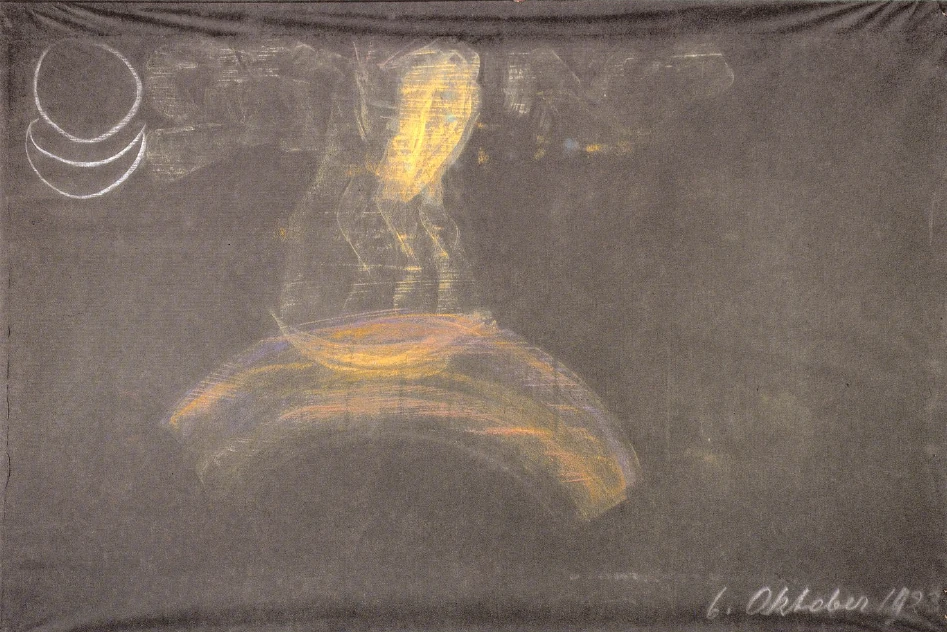
[ 37 ] Imagine it this way, if I were to describe it visually: the lunar-earthly aspect—it is that which smolders beneath the Earth’s surface. If one were to go out into the vastness of the universe, one would see what appears up there, where the human being radiates out into the universe, as—I would say—a heavenly radiance of the Earth and the stars, which the Earth sends out into the vastness of space. The head of Mary, too, must be radiant with starlight—that is, in human terms—so that we see the expression of this starlight in her physiognomy and in her entire demeanor (see Plate II).
[ 38 ] If we then proceed to the chest, we must consider that which is connected to the respiratory process: the sun-like being—the child—that forms from the clouds through which the sun’s rays pass in the atmosphere.
[ 39 ] And further down we have what is determined by the lunar-salt-forming principle, which is expressed outwardly by bringing the limbs into the dynamics of the earthly realm and allowing them to rise up from the salt-forming, lunar aspect of the Earth. We have the Earth, insofar as it is, if I may say so, internally permeated by the Moon.
[ 40 ] One would actually have to depict it as if we were applying a kind of rainbow color. For when one looks down at Earth from outer space, it would appear as though one were seeing through the starlight onto Earth itself, as if the Earth were shimmering inward in rainbow colors beneath its surface. Upon this, shaped first by Earth’s dynamics—by the limbs, the Earth, gravity, and so on—lies that which can actually only be expressed through human clothing, which is folded in such a way that it follows the Earth’s forces. So down there we would have the clothing in accordance with the Earth’s forces. We would continue upward and would have to draw what now takes shape within the entire earth-like, moon-like structure. One could also draw the moon if one wanted to be symbolic, but this moon-like quality is already expressed in the earth-like structure.
[ 41 ] We then ascend further, take in what comes from the moon-like realm, and see how the clouds are permeated by many human heads striving downward; one of these human heads is condensed into the Sun—the Child Jesus—sitting on Mary’s arm. And we must complete the whole scene from above with Mary’s face, whose features express the radiance of the stars.
[ 42 ] If we understand the depths of winter as they reveal to us the connection between the cosmos and humankind—humankind that absorbs the creative forces within the earth— then there is no other way—right down to the shaping of the clouds—than to depict the woman endowed with the forces of the Earth, with the forces of the Moon below, the forces of the Sun in the center, and the forces of the stars above her head. This image of Mary with the infant Jesus arises for us from the cosmos itself.
[ 43 ] And just as, when we understand the cosmos in the fall and incorporate into an image all the formative forces we find within it, we inevitably arrive at an artistic depiction of Michael’s battle with the dragon, as I described yesterday, so, too, everything we can feel around Christmas time converges in the image of the Virgin Mary with the Child—an image that, in earlier times, particularly in the first centuries of Christianity, often came to mind for artists, and whose final echoes in the development of humanity are preserved precisely in Raphael’s Sistine Madonna. This Sistine Madonna by Raphael was born out of the great, naive insights into nature and the spirit of an ancient time. For it is the image of that imagination which a person must truly possess—one who, through inner contemplation, immerses themselves so deeply in the mysteries of the Christmas cycle that this cycle itself becomes an image for them.
[ 44 ] Thus we can say: The course of the year must unfold for inner contemplation in very specific, magnificent imaginings. When one goes out into the world with one’s whole being, the beginning of autumn becomes the magnificent imagination of Michael’s battle with the dragon. And just as the dragon can only be depicted as sulfuric—the mass of sulfur that takes on the form of the dragon—and just as Michael’s sword comes into being when we think of meteoric iron concentrated and united into this sword, then from what we can feel during the Christmas season arises for us the image of the Virgin Mary, whose robe is folded in the forces of the earth, while the garment—the painting proceeds in a certain way right down to these details—must round out inwardly, must become mercurial, so that one has an inner unity in the form of the chest. But there the forces of the sun make their entrance. And the innocent infant Jesus, who must be conceived as having not yet partaken of earthly nourishment, is the very effect of the sun itself, sitting in Mary’s arms; above, the effect of the stars’ radiance. So that we must depict him—as if glowing from within in his eyes and head—shining toward humanity, Mary’s head—so that we must depict the Infant Jesus in Mary’s arms as emerging, as it were, in lovely gentleness from the cloud formations in a spherical curve, inwardly self-contained; and then, moving downward, the garment, imbued with earthly heaviness, expressing in the garment that which can become earthly heaviness (Plate II).
[ 45 ] And we’d do best to express this through colors as well. Then we have that image that dawns on us as a cosmic vision during the Christmas season, one that can sustain us until Easter, when, once again, a similar Easter vision can emerge from the cosmic context—which is what we’ll discuss tomorrow.
[ 46 ] As you can see from this, human beings draw art from the heavens, as they are connected to the Earth. True art is that which a person experiences through the physical, soul, and spiritual universe, which unfolds for them in magnificent imaginings. Thus, a person cannot visualize all that is necessary in the inner struggle to develop self-consciousness from nature consciousness in any other way than by having the magnificent image of Michael’s struggle with the dragon; that human beings can bring before their very souls everything that can work its way from nature into their souls during the depths of winter by placing before their souls, in an artistic and imaginative way, the image of the mother with the child, as I have just described it.
[ 47 ] Observing the cycle of the year means walking alongside the great cosmic Artist and allowing those things that the heavens imprint upon the earth to come alive within us once more through powerful images—images that then become realities for the human soul. In this way, the course of the year can unfold in four imaginations: the Michael Imagination, the Mary Imagination, and—as we will see tomorrow and in the upcoming lectures—the Easter Imagination and the St. John Imagination.
[ 48 ] Tomorrow, I'll start by figuring out the path from Christmas to Easter.