Experiencing the Course of the Year
in Four Cosmic Imaginations
GA 229
6 October 1923, Dornach
Translate the original German text into any language:
Versions Available:
Anthroposophy as Cosmosophy I, tr. SOL
Zweiter Vortrag
Second Lecture
[ 1 ] Gestern stand vor uns das Bild des Michael im Streite mit dem Drachen, wie es sich ergibt aus einem inneren Verständnis des Jahreslaufes heraus. Und eigentlich kann ja die Kunst nichts anderes sein als die Wiedergabe desjenigen, was der Mensch im Zusammenhange mit dem Weltenall empfindet. Natürlich wird das in verschiedenen Graden, von verschiedenen Standpunkten aus möglich sein; aber im ganzen wird nur das ein Kunstwerk sein können, das dem Menschen wirklich etwas ist, was in der menschlichen Empfindung den Eindruck hervorruft, daß vom Kunstwerke aus sich die Seele öffnen kann für die Geheimnisse des Weltenalls.
[ 1 ] Yesterday we were presented with the image of Michael battling the dragon, as it arises from an inner understanding of the cycle of the year. And in fact, art can be nothing other than the representation of what human beings feel in connection with the universe. Of course, this will be possible to varying degrees and from different perspectives; but on the whole, the only work of art that truly means something to a person will be one that evokes in human feeling the impression that, through the work of art, the soul can open itself to the mysteries of the universe.
[ 2 ] Nun wollen wir heute einmal aus demselben Geiste, aus dem heraus wir gestern den Jahreslauf betrachtet haben, so daß diese Betrachtung gipfeln konnte in der Darstellung des Bildes Michaels mit dem Drachen, den Jahreslauf weiter verfolgen.
[ 2 ] Today, let us continue to follow the course of the year in the same spirit in which we considered it yesterday—a reflection that culminated in the depiction of Michael and the dragon.
[ 3 ] Wir wissen aus der bisherigen Darstellung, daß, wenn der Herbst herankommt, gewissermaßen eine Einatmung der Erde, eine geistige Einatmung der Erde stattfindet, daß hereingeholt werden in den Erdenschoß selber die Elementarwesen, die ihren Weg hinausgefunden haben in der Zeit des Hochsommers und die dann sich wiederum zurückbewegen, wenn eben das Michael-Fest da ist, und die sich dann immer weiter und weiter zurückbewegen, bis sie im Tiefwinter am intimsten mit dem Schoße der Erde verknüpft sind.
[ 3 ] We know from the discussion so far that, as autumn approaches, a kind of inhalation of the Earth—a spiritual inhalation of the Earth—takes place; that the elemental beings who found their way out during the height of summer are drawn back into the Earth’s womb itself, and that they then move back again when the Feast of Michael arrives, and that they continue to move further and further back until, in the depths of winter, they are most intimately connected with the Earth’s bosom.
[ 4 ] Nun müssen wir uns ja aus alledem die Vorstellung machen, daß gerade zur Winterzeit die Erde am allermeisten ein in sich geschlossenes Wesen ist. Sie hat aus dem Weltenall all das hereingenommen, was sie insbesondere an Geistigem hat hinausströmen lassen während der Sommerzeit. Die Erde ist also während der 'Tiefwinterzeit am meisten Erde; ihre eigentliche Wesenheit ist sie da. Und wir werden daher, um eine Grundlage bekommen zu können für weitere Betrachtungen, gerade das Wesen der Erde zur Winterzeit ins Auge zu fassen haben, werden natürlich dabei niemals vergessen dürfen, wie das, was für die eine Hälfte der Erde Winterzeit, für die andere Hälfte Sommerzeit ist. Das müssen Sie im Hintergrunde haben, daß dies so ist. Aber wir stellen uns jetzt einen Teil der Erde vor, wo heranrückt die 'Tiefwinterzeit. Da entfaltet die Erde dasjenige, was gerade in tiefstem Sinne ihr eigenes Wesen ist, was sie ganz zur Erde macht.
[ 4 ] Now, based on all this, we must form the idea that it is precisely during the winter season that the Earth is most of all a self-contained being. It has taken in from the universe everything that it had allowed to flow out—especially in the form of spiritual forces—during the summer season. The Earth is therefore most fully Earth during the “deep winter”; that is when its true essence is most fully present. And so, in order to establish a foundation for further considerations, we must focus specifically on the essence of the Earth in winter, while of course never forgetting that what is winter for one half of the Earth is summer for the other half. You must keep this fact in mind. But let us now imagine a part of the Earth where “deep winter” is approaching. There, the Earth unfolds that which, in the deepest sense, is its very essence—that which makes it wholly Earth.
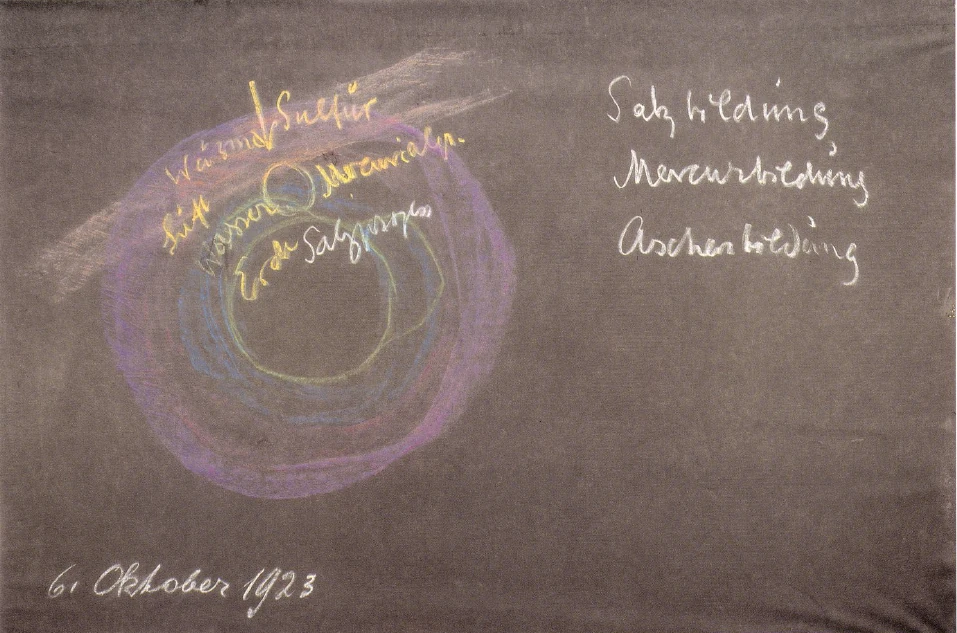
[ 5 ] Nun schauen wir uns diese Erde einmal an. Sie ist der feste Erdkern, der nach außen zunächst nur seine Oberfläche zeigt; aber dieser feste Erdkern ist ja zum großen Teil überhaupt nach außen bedeckt von der Hydrosphäre, von der Wassermasse der Erde. Die Kontinente sind gewissermaßen nur darinnen schwimmend in dieser Wassermasse. Und wir können uns sogar diese Wassermasse noch weiter in den Luftkreis hinein fortgesetzt denken, denn der Luftkreis ist ja auch immer mit Wässerigem angefüllt, das allerdings viel dünner ist als das Wasser des Meeres und der Flüsse, aber eine feste Grenze im Wässerigen, wenn wir aufsteigen von dem Meere in den Luftkreis, ist eigentlich nicht da. So daß, wenn wir schematisch hinzeichnen, was in dieser Beziehung die Erde ist, wir diese Erde so zeichnen müssen: Wir haben in der Mitte den festen Erdkern (siehe Tafel I, grün). Um diesen festen Erdkern herum haben wir das wässerige Gebiet (blau). Nun müßte ich natürlich da die Kontinente zeichnen, wie sie hervorragen und so weiter. Es ist das alles karikiert gezeichnet, denn die Ausbuchtungen dürften nicht einen andern Eindruck machen als etwa die Erhabenheiten einer Orange. Nun muß ich aber ringsherumgehen lassen dasjenige, was ich als Hydrosphäre, als die Wassermasse in dem Luftkreis bezeichnet habe. Schauen wir uns dieses Gebilde einmal an (blau) und fragen wir uns: Was ist denn das eigentlich? Dieses Gebilde ist nicht etwa bloß aus sich herausgebildet, sondern dieses Gebilde ist ein Wasser im ganzen Kosmos. Dieses Gebilde ist das, was es als Form uns zeigt, aus dem ganzen Kosmos heraus. Und nur weil der Kosmos eigentlich nach allen Seiten hin eine Sphäre, ein Kugelartiges ist, erscheint uns auch dasjenige, was als Wasser, als Luftmasse nach oben geht, eben rund, kugelförmig abgegrenzt.
[ 5 ] Now let’s take a look at this Earth. It consists of a solid core, which at first appears to the outside world as nothing more than its surface; but this solid core is, for the most part, covered on the outside by the hydrosphere—the Earth’s body of water. The continents are, so to speak, merely floating within this body of water. And we can even imagine this body of water extending further into the atmosphere, for the atmosphere is also always filled with a watery substance—which is, admittedly, much thinner than the water of the oceans and rivers—but there is actually no distinct boundary in this watery substance as we ascend from the ocean into the atmosphere. So that, if we were to sketch schematically what the Earth is in this regard, we would have to draw it as follows: In the center we have the solid Earth’s core (see Plate I, green). Surrounding this solid Earth’s core is the watery region (blue). Now, of course, I would have to draw the continents there, showing how they protrude and so on. All of this is drawn in a caricatured way, for the protrusions should not give a different impression than, say, the ridges of an orange. But now I must draw around it what I have designated as the hydrosphere, the mass of water within the atmosphere. Let’s take a look at this structure (blue) and ask ourselves: What exactly is it? This formation has not simply arisen out of itself, but rather this formation is water within the entire cosmos. This formation is what it reveals to us as a form, emerging from the entire cosmos. And only because the cosmos is actually a sphere—a spherical entity—in all directions does that which rises upward as water or as a mass of air also appear to us as round, delimited in a spherical shape.
[ 6 ] Das übt aber starke Kräfte aus auf die Gesamterde. So daß, wenn wir etwa von irgendeinem fremden Planeten die Erde uns anschauen würden, sie uns erscheinen würde als ein großer, meinetwillen, sage ich jetzt, Wassertropfen im Weltenall, in dem allerlei Hervorragungen wären, die Kontinente, die etwas anders gefärbt sich ausnehmen würden; aber es würde uns das wie ein großer Wassertropfen im Weltenall erscheinen.
[ 6 ] But this exerts powerful forces on the entire Earth. So that, if we were to look at Earth from some distant planet, it would appear to us as a large—let me say, for the sake of argument—drop of water in the vastness of the universe, with all sorts of protrusions—the continents—that would appear to be slightly different in color; but it would still appear to us as a large drop of water in the vastness of the universe.
[ 7 ] Nun wollen wir einmal über den ganzen Tatbestand kosmisch sprechen. Was ist denn das eigentlich, dieser Tropfen, der da als ein Wassertropfen im Weltenall dahingeht? Das ist etwas, was durch die ganzen kosmischen Zusammenhänge die Tropfenform erhält. Geht man geisteswissenschaftlich auf die Sache ein, so bekommt man, gerade wenn man in die Imagination und Inspiration hineinrückt, die Erfahrung davon, was dieser Tropfen eigentlich ist. Dieser Tropfen ist gar nichts anderes als ein riesiger Quecksilbertropfen, wahrhaftig ein riesiger Quecksilbertropfen, nur daß die Quecksilbersubstanz in einer außerordentlichen Verdünnung da ist, in einer ungeheuren Verdünnung.
[ 7 ] Now let’s talk about the whole matter from a cosmic perspective. What exactly is this drop that drifts through the cosmos as a drop of water? It is something that takes on the form of a drop through the interplay of all cosmic forces. If we approach the matter from a spiritual scientific perspective—especially as we enter into the realms of imagination and inspiration—we gain an experience of what this drop actually is. This drop is nothing other than a gigantic drop of mercury—truly a gigantic drop of mercury—except that the mercury is present in an extraordinary dilution, an immense dilution.
[ 8 ] Daß solche Verdünnungen möglich sind, ist ja jetzt exakt bewiesen durch die Arbeit von Frau Dr. Kolisko. Es ist eben in unserem biologischen Institut in Stuttgart zum erstenmal der Versuch gemacht worden, dies auf eine exakte Grundlage zu bringen. Es ist da möglich geworden, Verdünnungen von Substanzen in dem Verhältnis von eins zu einer Trillion herzustellen, und es ist gelungen, in der Tat die Wirkungen exakt festzustellen, die in solchen Verdünnungen die einzelnen Substanzen haben. Dasjenige also, was bisher über die Wirkungen der einzelnen Substanzen in der Homöopathie ein bloßer Glaube sein konnte, ist dadurch tatsächlich zum Range einer exakten Wissenschaft erhoben worden. Es kann ja heute nach den Kurven, die da gezogen worden sind, gar nicht gezweifelt werden daran, daß die Wirkungen der kleinsten Teile in der rhythmischen Art verlaufen. Nun, auf das Genauere will ich nicht eingehen, die Arbeit ist ja erschienen, und die Dinge können heute überall nachgeprüft werden. Aber ich will hier nur das erwähnen, daß also gerechnet werden muß auch schon im Bereich des Irdischen mit ungeheuren Verdünnungen, die Wirkungen zeigen.
[ 8 ] The fact that such dilutions are possible has now been precisely proven by the work of Dr. Kolisko. It was at our biological institute in Stuttgart that the first attempt was made to establish this on a precise scientific basis. There, it has become possible to produce dilutions of substances in a ratio of one to one trillion, and they have indeed succeeded in precisely determining the effects that the individual substances have in such dilutions. Thus, what until now may have been mere belief regarding the effects of individual substances in homeopathy has thereby actually been elevated to the status of an exact science. Indeed, based on the curves that have been plotted, there can be no doubt today that the effects of the smallest particles proceed in a rhythmic manner. Well, I do not wish to go into further detail; the work has been published, and the findings can be verified anywhere today. But I would just like to mention here that even within the realm of the physical world, one must reckon with immense dilutions that exhibit effects.
[ 9 ] Hier haben wir es tatsächlich zu tun mit etwas, von dem man sagen kann: Genießen wir die Sache im Kleinen, so haben wir Wasser. Wir schöpfen mit unserem Gefäße Wasser aus dem Flusse oder aus dem Quell, verwenden dieses Wasser. Nun ja, das ist Wasser, aber es gibt kein Wasser, das nur Wasserstoff und Sauerstoff ist. Es wäre Unsinn, wenn jemand glauben würde, es gibt nur Wasser, das aus Wasserstoff und Sauerstoff besteht. Bei den Eisensäuerlingen oder bei andern Wassern ist das natürlich sehr auffällig, daß da noch etwas anderes drinnen ist. Aber ein Wasser, das nur aus Wasserstoff und Sauerstoff besteht, das gibt es nicht, das ist nur eine Annäherungsform. Jedes Wasser, das irgendwo vorkommt, ist mit etwas durchsetzt. In der Hauptsache ist die Gesamtwassermasse der Erde Quecksilber für das Weltenall. Wasser sind nur die kleinen Mengen für uns, die wir haben. Für das Weltenall ist dieses Wasser nicht Wasser, sondern Quecksilber.
[ 9 ] Here we are indeed dealing with something about which one can say: If we enjoy it on a small scale, we have water. We draw water from the river or from the spring with our vessels and use this water. Well, yes, that is water, but there is no such thing as water that consists solely of hydrogen and oxygen. It would be nonsense for anyone to believe that water consists only of hydrogen and oxygen. In the case of iron-rich waters or other types of water, it is, of course, very obvious that there is something else in them. But water consisting solely of hydrogen and oxygen does not exist; that is merely an approximation. Every form of water found anywhere is mixed with something else. Essentially, the Earth’s total water mass is mercury for the universe. Water, as we know it, consists only of the small quantities we have. For the universe, this water is not water, but mercury.
[ 10 ] So daß wir also sagen können: Zunächst, insofern die Hydrosphäre an Wasser in Betracht kommt, haben wir es mit einem Quecksilbertropfen im Weltenall zu tun. Diesem Quecksilbertropfen sind natürlich die mineralischen Substanzen, kurz, alles das, was erdig ist, sozusagen eingelagert. Die stellen dasjenige dar, was dann die feste Erdenmasse ist. Die haben die Tendenz, ihre eigenen speziellen Formen anzunehmen. So daß, wenn wir das Gebilde anschauen, wir ja sehen müssen auf die allgemeine Kugelform, die die Quecksilberform ist — das gewöhnliche metallische Quecksilber ist nur, ich möchte sagen, das naturgewollte Symbolum für das, was Quecksilber überhaupt tut —, es ergibt sich in einer ganz bestimmten Weise die Kugelform. Da ist nun eingelagert dasjenige, was sich in der mannigfaltigsten, differenziertesten Weise eigene Formen gibt: die mineralischen Kristallisationsformen. Das ist eingelagert. So daß wir sagen können: Wir haben jetzt dieses Gebilde vor uns, Erde, Wasser, Luft, und das hat diejenige Tendenz zur Formung, von der ich Ihnen eben gesprochen habe: einzelne differenzierte Kristallformen im Inneren, im ganzen das Bestreben, kugelförmig zu werden (siehe Tafel I).
[ 10 ] So we can say: First of all, insofar as the hydrosphere consists of water, we are dealing with a drop of mercury in the vastness of the universe. Embedded within this drop of mercury, of course, are the mineral substances—in short, everything that is earthy, so to speak. These constitute what is then the solid earth’s mass. They have a tendency to assume their own specific forms. So that when we look at the structure, we must indeed see the general spherical shape, which is the shape of mercury—ordinary metallic mercury is, I would say, merely the symbol intended by nature for what mercury does in general—and the spherical shape emerges in a very specific way. Embedded within this is that which takes on its own forms in the most varied and differentiated ways: the mineral crystalline forms. This is embedded within it. So we can say: We now have this structure before us—earth, water, air—and it possesses the tendency toward formation that I have just described to you: individual, differentiated crystal forms within, and overall, the striving to become spherical (see Plate I).
[ 11 ] Schon wenn wir die Luft (dunkelrot) nehmen, wie sie die Erde als Atmosphäre umgibt, können wir wiederum niemals von einer bloßen Luft sprechen, sondern diese Luft hat immer die Tendenz, Wärme zu haben in irgendeiner Weise, in irgendeinem Grade. Sie ist von Wärme durchdrungen (violett). Wir müssen also auch das vierte Element dazu haben: Wärme, die sich in die Luft einlagert.
[ 11 ] Even if we consider the air (dark red) that surrounds the Earth as its atmosphere, we can never speak of it as mere air; rather, this air always tends to possess heat in some way, to some degree. It is permeated by heat (violet). So we must also include the fourth element: heat, which is stored in the air.
[ 12 ] Nun, diese Wärme, die da von oben in die Luft hereinkommt, die ist vor allen Dingen dasjenige, was in sich trägt, gewissermaßen aus dem Weltenall herein vermittelt, den Schwefelprozeß, den Sulfurprozeß. Wir könnten auch sagen: Vom Weltenall herein wird der Sulfurprozeß vermittelt. An den Sulfurprozeß schließt sich an der Merkurialprozeß, so wie ich es Ihnen gewissermaßen dargestellt habe für Wasser-Luft. Luft-Wärme: Sulfurprozeß, Wasser-Luft: Merkurialprozeß.
[ 12 ] Well, this warmth that enters the air from above is, above all, that which carries within itself—conveyed, so to speak, from the universe—the sulfur process. We could also say: The sulfur process is conveyed from the universe. The sulfur process is followed by the mercurial process, just as I have, so to speak, described it to you for water-air. Air-heat: sulfur process; water-air: mercurial process.
[ 13 ] Gehen wir jetzt mehr der Erde zu, ins Innere der Erde, so kommt für das, was die Erde eigentlich sein will, der Prozeß der Säurebildung, und namentlich — aus den Säuren kommen ja wieder die Salze — der Salzbildung in Betracht. So daß, wenn wir hinaufschauen in das Weltenall, wir eigentlich hinaufzuschauen haben in den Sulfurisierungsprozeß, in den Verschwefelungsprozeß. Wenn wir diese Tendenz der Erde, sich zum kosmischen Tropfen zu bilden, anschauen, dann sehen wir eigentlich hinein in den Merkurialprozeß. Wenden wir den Blick hinunter auf den Erdboden, der uns im Frühling dann alles wachsende, sprießende, sprossende Leben emporschickt, dann schauen wir auf den Salzprozeß.
[ 13 ] If we now turn our attention more toward the Earth, toward the Earth’s interior, we see that the process of acid formation—and specifically, since salts are derived from acids, the process of salt formation—is central to what the Earth actually seeks to become. So that when we look up into the cosmos, we are actually looking up at the process of sulfurization, the process of sulphurization. When we observe this tendency of the Earth to form itself into a cosmic drop, we are actually looking into the mercurial process. If we turn our gaze downward to the earth, which in spring sends up to us all growing, sprouting, and budding life, then we are looking at the process of salt formation.
[ 14 ] Dieser Salzprozeß ist auch das Allerwichtigste für das sprossende, sprießende Leben, denn die Wurzeln der Pflanze, indem sie sich aus den Keimen bilden, sind für ihr ganzes Wachstum einfach angewiesen auf die Beziehung, in der sie zu den Salzen, zu den Salzbildungen im Erdboden stehen. Was der Erdboden an Salzen enthält im weitesten Sinne des Wortes, was an Ablagerungsgebilden innerhalb des Erdbodens vorhanden ist, das ist dasjenige, was die Wurzeln mit einer Substanz durchdringt, was die Wurzel zur Wurzel, das heißt zu der irdischen Grundlage des Pflanzenhaften eigentlich macht.
[ 14 ] This salt process is also of the utmost importance for sprouting, emerging life, for the roots of the plant, as they form from the seeds, are simply dependent for their entire growth on the relationship they have with the salts—with the salt formations in the soil. What the soil contains in terms of salts in the broadest sense of the word—what is present in the form of sedimentary formations within the soil—is the substance that permeates the roots; it is what actually makes the root a root, that is, the earthly foundation of the plant.
[ 15 ] Wir haben also, wenn wir gegen die Erde hin kommen, den Salzprozeß. Das ist nun dasjenige, was sozusagen die Erde aus sich selbst macht in der Tiefwinterzeit, während es zum Beispiel im Sommer sehr gemischt, möchte ich sagen, auf Erden zugeht. Sulfurisierungsprozesse durchzucken die Luft, ein Sulfurisierungsprozeß lebt ja auch in Blitz und Donner; das geht weit herunter, daher eben wird dasjenige, was den Jahreslauf mitmacht, auch selber sulfurisiert. Und wir bekommen dann um die Michaelizeit den Prozeß, wo das Eisen diesen Sulfurisierungsprozeß zurückdrängt, wie ich gestern ausgeführt habe. Und dann ist wieder der Salzprozeß hineingemischt in die Atmosphäre während des Sommers, denn die Pflanzen tragen, indem sie sich entfalten, indem sie heranwachsen, durch ihre Blätter, Blüten, bis in die Samen hinauf die Salze. Wir finden sie natürlich in den verschiedensten Teilen, die Salze; sie ätherisieren sich dann, sie werden eingelagert in ätherische Öle und so weiter, sie nähern sich dem Sulfurisierungsprozeß. Aber es werden die Salze durch die Pflanzen hinaufgetragen. Ihr Wesen strömt auch aus, wird das Wesen der Atmosphäre.
[ 15 ] So, as we approach the Earth, we encounter the salt process. This is, so to speak, what the Earth produces from within itself during the depths of winter, whereas in summer, for example, things on Earth are, I would say, quite mixed. Sulfurization processes flash through the air; after all, a sulfurization process is also at work in lightning and thunder; it reaches far down, which is why that which follows the course of the year is itself sulfurized. And then, around Michaelmas, we experience the process in which iron counteracts this sulfurization process, as I explained yesterday. And then the salt process is once again mixed into the atmosphere during the summer, for as the plants unfold and grow—through their leaves, flowers, and all the way up to their seeds—they carry the salts. We find these salts, of course, in the most diverse parts of the plants; they then become etheric, are stored in essential oils and so on, and draw closer to the sulfurization process. But the salts are carried upward by the plants. Their essence also flows out, becoming the essence of the atmosphere.
[ 16 ] So daß wir in der Hochsommerzeit ein Durcheinandergemischtsein haben des Merkurialischen, das in der Erde immer da ist, mit dem Sulfurmäßigen und mit dem Salzmäßigen. Stehen wir im Hochsommer auf der Erde, so taucht eigentlich unser Haupt hinein in eine Mischung des Sulfur, Merkur und Salz, während tatsächlich das Eintreten der Tiefwinterzeit bedeutet, daß jedes dieser Prinzipien, Salz, Quecksilber, Schwefel, seinen eigenen inneren Bestand annimmt, daß die Salze zurückgezogen sind ins Innere der Erde, daß in die Hydrosphäre, in das Wassermäßige eindringt das Bestreben, sich zur Kugelform zu glätten, gewissermaßen in der kugeligen oder wenigstens kugelzonigen Schneedecke auch ein äußeres Zeichen für die Rundung, für die Kugelung des Wassermäßigen zu erzeugen. Der Schwefelprozeß zieht sich sozusagen zurück, so daß dann um diese Zeit keine starke Notwendigkeit besteht, den Schwefelprozeß als etwas Besonderes ins Auge zu fassen. Dagegen tritt an die Stelle des Schwefelprozesses in dieser Tiefwinterzeit etwas anderes.
[ 16 ] So that in midsummer we have a mixture of the mercurial principle—which is always present in the earth—with the sulfuric and the saline principles. When we stand on the earth in midsummer, our head actually plunges into a mixture of sulfur, mercury, and salt, whereas the onset of deep winter means that each of these principles—salt, mercury, and sulfur, assumes its own inner constitution; the salts are withdrawn into the earth’s interior; and the hydrosphere—the watery realm—is permeated by the striving to smooth itself into a spherical form, creating, as it were, in the spherical or at least spherically zoned snow cover, an outward sign of the roundness, of the sphericity of the watery realm. The sulfur process, so to speak, recedes, so that at this time there is no strong need to consider the sulfur process as something special. Instead, something else takes the place of the sulfur process during this deep winter period.
[ 17 ] Die Pflanzen haben sich entwickelt vom Frühling bis zu dem Herbst hin. Sie sind in die Samen geschossen. Was ist eigentlich der Samenprozeß? Indem die Pflanzen in den Samen schießen, findet in der Natur draußen etwas statt, was wir, ich möchte sagen, in einer menschlich stümperhaften Weise, aber immerhin doch fortsetzen, wenn wir uns die Pflanzen zu unserem Nahrungsmittel machen: Wir kochen die Pflanzen. Nun, dieses Hinaufgehen in die Blüte, dieses Erzeugen des Samens ist eine Naturkochung, ist ein Entgegengehen dem Schwefelprozeß. Die Pflanzen sind hinausgewachsen in den Schwefelprozeß. Sie sind am stärksten sozusagen verschwefelt, wenn der Hochsommer seine volle Entwickelung erlangt hat. Wenn der Herbst herannaht, dann gelangen die Verbrennungen zu ihrem Ende.
[ 17 ] The plants have developed from spring through fall. They have gone to seed. What exactly is the process of seed formation? As the plants go to seed, something takes place in nature that we—I would say in a rather amateurish human way, but which we nevertheless continue—carry out when we use the plants as food: we cook them. Now, this ascent into bloom, this production of seed, is a natural cooking process; it is a counteraction to the sulfur process. The plants have grown into the sulfur process. They are, so to speak, most heavily sulfured when midsummer has reached its full development. As autumn approaches, the burning processes come to an end.
[ 18 ] Natürlich ist im Organischen alles anders, als wir es draußen in den groben anorganischen Prozessen sehen, aber was sich ergibt bei jeder Verbrennung, ist Asche. Und zu dem, was auf ganz anderem Wege in der Salzbildung auftritt, was in der sozusagen im Inneren der Erde geforderten Salzbildung auftritt, zu dem tritt dasjenige hinzu, was gewissermaßen von der Besamung der Pflanzen, von dem Blühen der Pflanzen, von diesem Kochprozeß, von diesem Verbrennungsprozeß von jeder einzelnen Pflanze heruntergefallen ist auf den Erdboden. Das spielt eine große Rolle, die man gewöhnlich gar nicht berücksichtigt. Was in unserem Ofen geschieht, daß die Asche hinunterfällt, das spielt im Jahreslauf eine große Rolle auf Erden, denn von alledem, was Samenbildung ist, was im Grunde genommen eine Verbrennung ist, fällt fortwährend das Aschenhafte hinunter, und es ist die Erde vom Oktober an eigentlich ganz imprägniert mit Aschenbildung.
[ 18 ] Of course, in the organic realm, everything is different from what we see out there in the coarse inorganic processes, but what results from every combustion is ash. And to what occurs in a completely different way in salt formation—what occurs, so to speak, in the salt formation required within the Earth’s interior—is added what has, in a sense, fallen to the ground from the fertilization of the plants, from their flowering, from this cooking process, from this combustion process of every single plant. This plays a major role that is usually not taken into account at all. What happens in our stove—the ash falling down—plays a major role on Earth over the course of the year, for from everything that involves seed formation—which is, in essence, a process of combustion—the ashy substance continually falls down, and from October onward, the Earth is actually completely imbued with ash formation.
[ 19 ] So daß wir, wenn wir im Tiefwinter die Erde betrachten, die innerliche Tendenz der Salzbildung haben, wir ferner haben in seiner bestimmtesten, ausgeprägtesten Form den Merkurbildungsprozeß, die Merkurbildung, und während wir in der Hochsommerzeit Rücksicht nehmen müssen auf den außerirdischen Kosmos in der Sulfurisierung, haben wir jetzt die Aschenbildung.
[ 19 ] So that when we observe the Earth in the depths of winter, we see the inner tendency toward salt formation; furthermore, we see the process of mercury formation—mercury formation—in its most definite and pronounced form; and while in the height of summer we must take into account the extraterrestrial cosmos in the process of sulfurization, we now have ash formation.
[ 20 ] Das, was da gewissermaßen seinen Gipfel erreicht zur Weihnachtszeit, das bereitet sich von der Michaelizeit an vor. Immer mehr und mehr wird die Erde daraufhin konsolidiert, eigentlich in der Tief winterzeit ein kosmischer Körper zu sein, sich zu entfalten in Merkurialbildung, in Salzbildung, in Aschenbildung. Was bedeutet das für das Weltenall?
[ 20 ] What reaches its peak, so to speak, during the Christmas season begins to take shape starting with the Michaelmas season. The Earth is increasingly consolidated toward becoming, in the depths of winter, a cosmic body, unfolding through mercurial formation, salt formation, and ash formation. What does this mean for the universe?
[ 21 ] Nun, wenn ein Floh einmal, sagen wir, ein Anatom würde und er würde einen Knochen untersuchen, so hätte er ja eine außerordentlich kleine Knochenpartie vor sich, weil er eben selber klein ist, weil er von der Flohperspektive aus den Knochen untersuchen würde. Dann würde der Floh konstatieren, daß wir es da mit phosphorsaurem Kalk zu tun haben in amorphem Zustand, daß wir es zu tun haben mit kohlensaurem Kalk und so weiter. Er würde aber gar nicht darauf kommen, wenn er als Floh Anatom wäre, daß das nur ein Teilchen von einem Knochengerüst ist. Allerdings, er springt ja, aber wenn er eben das Kleine untersuchen würde, würde er durchaus nur im Kleinen steckenbleiben. Es würde dem Menschen, wenn er Geologe oder Mineraloge ist, auch nichts helfen, wenn er so springen könnte wie ein großer Erdfloh, er würde trotzdem das Gleiche machen, was er sonst im Kleinen macht, wenn er die Gebirgsmasse der Erde untersucht, die in ihrer Ganzheit ein Knochensystem darstellt. Da würde der Floh also nicht das Knochensystem beschreiben, sondern er würde mit seinem Hammer ein Stückchen herausklopfen. Sagen wir, mit seinem kleinen Flohhammer würde er ein Stückchen vom Schlüsselbein abklopfen: es würde nichts in diesem kleinen Stückchen kohlensaurem Kalk, phosphorsaurem Kalk und so weiter ihm verraten, daß das Ganze ein Schulterschlüsselbein ist, geschweige denn, daß es zum ganzen System des Knochengebildes gehört. Er würde halt ein kleines Stückchen mit seinem kleinen Hammer abgeklopft haben und würde das dann beschreiben von seinem Flohstandpunkt aus, so wie der Mensch die Erde beschreibt, wenn er irgendwo, sagen wir, am Dornacher Berg ein Stückchen vom Jurakalk abklopft. Nicht wahr, dann beschreibt er halt dieses Stück, und das wird dann verarbeitet in Mineralogie, in Geologie und so weiter. Es bleibt ja allerdings etwas vergrößert, aber es bleibt eben dieser Flohstandpunkt.
[ 21 ] Well, if a flea were to become, say, an anatomist and examine a bone, it would be looking at an extraordinarily small section of bone, precisely because it is small itself—since it would be examining the bone from a flea’s perspective. Then the flea would conclude that we’re dealing with phosphoric acid calcium in an amorphous state, that we’re dealing with carbonic acid calcium, and so on. But it would never occur to him—if he were an anatomist as a flea—that this is just a tiny fragment of a skeletal structure. True, it does jump, but if it were to examine this tiny specimen, it would certainly remain stuck at the microscopic level. It wouldn’t help a human—even if he were a geologist or mineralogist—if he could jump like a giant earth flea; he would still do the same thing he normally does on a small scale when examining the Earth’s mountain ranges, which in their entirety represent a skeletal system. So the flea wouldn’t describe the skeletal system; instead, he would tap out a small piece with his hammer. Let’s say, with its little flea hammer, it would chip off a tiny piece of the clavicle: nothing in this tiny piece of carbonate limestone, phosphate limestone, and so on would reveal to it that the whole thing is a clavicle, let alone that it belongs to the entire skeletal system. He would simply have chipped off a small piece with his little hammer and would then describe it from his flea’s point of view, just as a human describes the Earth when he chips off a piece of Jurassic limestone somewhere—say, on the Dornacher Berg. Right? Then he simply describes that piece, and it is then analyzed in mineralogy, geology, and so on. It does remain somewhat magnified, of course, but it’s still that flea’s perspective.
[ 22 ] So kommt man natürlich nicht zur Wahrheit, so kann man die Sache nicht machen, sondern es handelt sich darum, daß man wirklich darauf kommt, daß die Erde ein einheitliches Gebilde ist und am meisten konsolidiert ist zur Tiefwinterzeit in ihre Salzgestaltung, in ihre Merkurialgestaltung und in ihre Aschenbildung.
[ 22 ] Of course, that is not the way to arrive at the truth; that is not how one should approach the matter. Rather, the point is to truly come to the realization that the Earth is a unified entity and is most consolidated during the depths of winter into its salt form, its mercurial form, and its ash formation.
[ 23 ] Und was bedeutet das nun im Ganzen des Erdenwesens, wenn man den kosmischen Standpunkt, nicht den Flohstandpunkt ins Auge faßt, was bedeutet das? Nun, sehen Sie, alles das, was im weitesten Sinne des Wortes Salzbildung ist, Salzbildung in dem Sinne, daß es als Ablagerung im physikalischen Sinne sich festlegt, wie das aufgelöste Kochsalz meinetwillen im kleinen Wassergefäße sich ablagernd festsetzen kann, alles das, was in dieser Weise Salzbildung ist im weitesten Sinne — ich will jetzt nicht auf das Chemische eingehen, aber dabei würde sich nichts anderes ergeben —, alles das hat die Eigenschaft, daß es gewissermaßen für das Geistige durchlässig ist. Wo Salz ist, da hat das Geistige gewissermaßen freien Raum. Das Geistige kann da hinein, wo Salz ist. So daß dadurch, daß die Erde sich zur Tiefwinterzeit in bezug auf ihre Salzbildung konsolidiert, erstens die Elementarwesen, die sich mit der Erde verbinden, einen, sagen wir angenehmen Aufenthalt innerhalb der Erde haben, daß aber auch anderes Geistiges des Kosmos herangezogen wird und gewissermaßen wohnen kann in dem, was da als Salzkruste unmittelbar unter der Oberfläche der Erde ist. Und in dieser Salzkruste, die da unmittelbar unter der Oberfläche der Erde ist, werden besonders tätig die Mondenkräfte, der Rest der Mondenkräfte, von denen ich Ihnen in diesen Betrachtungen öfters gesprochen habe, der zurückgeblieben ist, nachdem der Mond aus der Erde herausgegangen ist.
[ 23 ] And what does that mean in the context of the Earth as a whole, when one considers the cosmic perspective—not the flea’s perspective—what does that mean? Well, you see, everything that is, in the broadest sense of the word, salt formation—salt formation in the sense that it settles as a deposit in the physical sense, just as dissolved table salt, for example, can settle in a small container of water— everything that constitutes salt formation in this way in the broadest sense—I don’t want to go into the chemical details now, but the result would be no different—all of this has the property of being, so to speak, permeable to the spiritual. Where there is salt, the spiritual has, so to speak, free space. The spiritual can enter where there is salt. Thus, because the Earth consolidates in terms of its salt formation during the depths of winter, first of all, the elemental beings that connect with the Earth have, shall we say, a pleasant abode within the Earth; but other spiritual forces of the cosmos are also drawn to it and can, so to speak, dwell in what is there as a salt crust immediately beneath the Earth’s surface. And within this salt crust, which lies immediately beneath the Earth’s surface, the lunar forces—the remnant of the lunar forces of which I have often spoken to you in these reflections, and which remained behind after the Moon emerged from the Earth—become particularly active.
[ 24 ] Diese Mondenkräfte werden vorzugsweise in der Erde dadurch tätig, daß die Erde das Salz in sich birgt. So daß wir unmittelbar unter der Oberfläche der Erde, gerade in dem sich Befestigenden unter der Schneedecke, die ja schon auf der einen Seite nach dem Quecksilberigen strebt, nach unten hin aber übergeht in das Salzartige, so daß wir da in alledem Erdenmaterie haben, Salz, durchsetzt von Geistigkeit. Die Erde wird wirklich zur Winterzeit in sich geistig durch ihren Salzgehalt, der sich da besonders konsolidiert.
[ 24 ] These lunar forces are primarily active within the Earth because the Earth contains salt. Thus, immediately beneath the Earth’s surface—precisely in the layer that is solidifying beneath the snow cover, which on one side already tends toward the mercurial but transitions downward into the saline—we find, in all this, Earthly matter: salt permeated by spirituality. In winter, the earth truly becomes spiritual within itself through its salt content, which consolidates there in a special way.
[ 25 ] Das Wasser, das heißt eigentlich das kosmische Quecksilber, das nimmt auf die innere Tendenz, sich in Kugelform zu bilden. Da tritt dann überall diese innere Tendenz hervor, sich als Kugel zu bilden. Und dadurch, daß das geschieht, ist die Erde in dieser Tiefwinterzeit befähigt, nun nicht bloß zu erstarren im Salze und dieses erstarrte Salz mit Geist zu durchziehen, sondern sie ist befähigt, dieses durchgeistigte Materielle zu verlebendigen, ins Lebendige überzuführen. Die Erde lebt unter ihrer Oberfläche im Ganzen auf zur Tiefwinterzeit. Im Geist- und Salzprinzip ist durch das Quecksilberprinzip überall regsam die Tendenz, lebendig zu werden. Es ist während des Winters eine ungeheure Erkraftung der Erde, unter ihrer Oberfläche Leben zu entfalten.
[ 25 ] Water—which is actually cosmic mercury—takes on the inner tendency to form a sphere. This inner tendency to form spheres then manifests everywhere. And because this happens, the Earth, during this deep winter season, is enabled not only to solidify in salt and to permeate this solidified salt with spirit, but it is also enabled to enliven this spirit-infused matter, to transform it into the living. Beneath its surface, the Earth as a whole comes to life during the depths of winter. In the spirit and salt principles, the mercury principle actively stimulates the tendency to become alive everywhere. During the winter, the Earth undergoes an immense strengthening as it unfolds life beneath its surface.
[ 26 ] Aber dieses Leben würde ein Mondenleben werden, denn vorzugsweise die Mondenkräfte, wie ich gesagt habe, sind darinnen tätig. Dadurch aber, daß die Asche heruntergefallen ist von den Samen, daß das alles, was ich jetzt beschrieben habe, imprägniert ist mit der Asche, dadurch ist dasjenige in dem Ganzen drinnen, was diese ganze Bildung für die Erde in Anspruch nimmt.
[ 26 ] But this life would become a lunar life, for, as I have said, it is primarily the lunar forces that are at work within it. However, because the ash has fallen from the seeds—because everything I have just described is impregnated with the ash—this means that what this entire formation requires for the Earth is contained within the whole.
[ 27 ] Die Pflanze hat hinaufgestrebt in den Sulfurisierungsprozeß; aus diesem Sulfurisierungsprozeß ist die Asche heruntergefallen. Das ist dasjenige, was die Pflanze, nachdem sie hinaufgestrebt hat in das, ich möchte sagen Ätherisch-Geistige, wieder zurückführt zur Erde. So daß wir da zur Tiefwinterzeit auf der Erdenoberfläche die Tendenz haben, Geist in sich aufzunehmen, sich zu verlebendigen, aber das Mondenhafte ins Erdenhafte umzusetzen. Der Mond wird hier gezwungen durch die Erdenaschenteste dessen, was da heruntergefallen ist, nicht auf mondenhafte, sondern auf erdenhafte Weise das Lebendige zu entfalten.
[ 27 ] The plant has striven upward into the process of sulfurization; from this process of sulfurization, the ash has fallen back down. This is what the plant, after having striven upward into what I would call the ethereal-spiritual realm, brings back down to the earth. So that during the depths of winter, on the Earth’s surface, we have the tendency to take in spirit, to become enlivened, but to transform the lunar into the earthly. Here, the Moon is compelled—through the earthly-ash test of what has fallen there—to unfold life not in a lunar way, but in an earthly way.
[ 28 ] Nun gehen wir über von dem, was sich uns da gezeigt hat in bezug auf die Erdenoberfläche, zu dem, was im Erdenumkreise ist, zu dem Luftförmigen. Für die Luft hat die größte Bedeutung zu jeder Jahreszeit, aber eben besonders zur Tiefwinterzeit, daß die Sonne diese Luft durchstrahlt mit ihrer Wärme, mit ihrem Lichte — aber das Licht kommt jetzt weniger für uns in Betracht —, daß die Sonne diese Luft durchstrahlt.
[ 28 ] Now let us move on from what we have seen regarding the Earth’s surface to what lies in the Earth’s atmosphere—to the ethereal realm. For the air, what is of greatest importance in every season—but especially in the depths of winter—is that the sun radiates through this air with its warmth and its light—though the light is of less concern to us at this moment—that the sun radiates through this air.
[ 29 ] Man betrachtet in der Wissenschaft eigentlich alles so abgesondert, wie es gar nicht in Wirklichkeit ist. In der Luft, sagen die Leute, sind Sauerstoff und Stickstoff und noch andere Dinge drinnen. Aber so ist es ja nicht in Wirklichkeit. Luft ist ja nicht bloß da als Sauerstoff und Stickstoff, sondern die Luft ist immer von der Sonne durchstrahlt. Das ist die Realität: Luft ist immer das, was die Sonnenwirkungen trägt bei Tag. Also es ist die Sonnenwirkung von der Luft getragen. Ja, diese Sonnenwirkung, von der Luft getragen, was bedeutet das? Es bedeutet, daß eigentlich fortwährend das, was da oben ist, entrissen werden will der Erde. Wenn das, was ich vorhin beschrieben habe als Salzbildung, Merkurialbildung und Aschenbildung, für sich gedeihen würde, dann würde lediglich Irdisches da sein. Aber weil da oben dasjenige, was herauswill aus der Erde, empfangen wird von der SonnenLuftwirkung, wird umgestaltet das, was Erdenwirkung sein will, in kosmische Gestaltung. Es wird der Erde die Macht genommen, allein im Lebendig-Geistigen zu wirken. Die Sonne macht ihre Wirkung geltend in allem, was da nach oben sproßt. Und so bemerkt man, geistig angesehen, daß fortwährend hier, eine gewisse Strecke über der Erde (siehe Tafel I), eigentlich eine besondere Tendenz vorhanden ist. Auf der Erde selber will sich alles kugelig machen (dunkelrot); hier oben wirkt fortwährend die Tendenz, daß sich die Kugel zur Ebene ausweitet (rötlich). Diese Tendenz wird natürlich wiederum bezwungen, die Erde wird wieder zur Kugel gemacht, aber eigentlich will das, was da oben ist, das Kugelige, immer eben ‘werden. Es möchte eigentlich das, was da oben ist, am liebsten da unten die Erde auseinandernehmen, auseinanderreißen, so daß alles eine im Kosmos stehende ebene Fläche wäre.
[ 29 ] In science, people tend to view everything in such isolation, even though that’s not how it really is. People say that the air contains oxygen, nitrogen, and other things. But that’s not how it really is. Air isn’t merely oxygen and nitrogen; rather, air is always permeated by the sun’s rays. That is the reality: air is always that which carries the sun’s effects during the day. So the sun’s effect is carried by the air. Yes, this sun’s effect, carried by the air—what does that mean? It means that, in fact, what is up there is constantly striving to be torn away from the earth. If what I described earlier—the formation of salt, mercury, and ash—were to develop on its own, then only earthly elements would exist. But because what is up there—that which seeks to emerge from the Earth—is received by the sun’s influence on the air, what seeks to be an earthly influence is transformed into a cosmic form. The Earth is deprived of the power to act alone in the living-spiritual realm. The Sun exerts its influence on everything that sprouts upward. And so, viewed spiritually, one observes that here, at a certain distance above the Earth (see Plate I), a particular tendency is actually always present. On the Earth itself, everything tends to become spherical (dark red); up here, there is a constant tendency for the sphere to expand into a plane (reddish). This tendency is, of course, counteracted in turn; the Earth is made spherical again, but in reality, what is up there—the spherical—always wants to “become” flat. In fact, what is up there would most like to take the Earth apart down below, tear it apart, so that everything would be a flat surface standing within the cosmos.
[ 30 ] Würde das zustande kommen können, so würden die Erdenwirkungen überhaupt vollständig verschwinden, und wir würden da oben mehr eine Art Luft haben, in der die Sterne wirken würden. Das drückt sich am Menschen sehr stark aus. Was haben wir als Menschen von dem, was da als sonnentragende Luft oben ist? Das atmen wir ein, und indem das in uns eingeatmet wird, erstreckt sich die Sonnenwirkung allerdings in einer gewissen Weise nach unten, aber vorzugsweise nach oben. Wir werden mit unserem Haupte fortwährend den Erdenwirkungen entzogen. Dadurch ist unser Haupt überhaupt erst in die Möglichkeit versetzt, teilzunehmen an dem ganzen Kosmos. Unser Haupt möchte eigentlich immer in diese Ebenenbildung hinaus. Würde unser Haupt nur von der Erdenbildung, namentlich zur Winterzeit, in Anspruch genommen, dann würde all unser Denkerlebnis anders sein. Dann würde man nämlich das Gefühl haben, daß alle Gedanken rund werden wollen. Sie werden nicht rund, sondern sie haben eine gewisse Leichtigkeit, Anschmiegbarkeit, eine gewisse Flüssigkeit. Das rührt von diesem eigentümlichen Auftreten der Sonnenwitkung her.
[ 30 ] If that were to come about, the Earth’s influences would disappear completely, and up there we would have more of a kind of air in which the stars would exert their influence. This is very strongly reflected in human beings. What do we, as human beings, gain from what is up there as sun-bearing air? We breathe it in, and as it is inhaled into us, the sun’s influence does indeed extend downward to a certain extent, but primarily upward. Through our head, we are continually withdrawn from earthly influences. This is what enables our head, in the first place, to participate in the entire cosmos. Our head actually always wants to reach out into this formation of planes. If our head were occupied solely by earthly influences—especially during the winter—then our entire experience of thinking would be different. For then we would have the feeling that all thoughts want to become round. They do not become round, but rather possess a certain lightness, suppleness, and fluidity. This stems from this peculiar manifestation of the sun’s influence.
[ 31 ] Da haben Sie die zweite Tendenz, da greift das Sonnenmäßige in das Erdenmäßige ein. Es ist am schwächsten zur Tiefwinterzeit. Würden wir weiter hinauskommen, so würde sich noch anderes einstellen. Da würden wir es dann nicht mehr mit der Sonnenwirkung, sondern mit der bloßen Sternenwirkung zu tun haben, die ja wiederum einen großen Einfluß auf unser Haupt hat. Indem uns die Sonne sozusagen zurückgibt dem Kosmos, haben dann die Sterne eben ihren tiefgehenden Einfluß auf unser Haupt und dadurch auf unsere ganze Menschenbildung.
[ 31 ] There you have the second tendency: the solar principle intervenes in the earthly principle. It is weakest during the depths of winter. If we were to go further out, something else would come into play. Then we would no longer be dealing with the influence of the sun, but with the influence of the stars alone, which in turn has a great influence on our head. As the sun, so to speak, returns us to the cosmos, the stars then exert their profound influence on our head and, through that, on our entire human development.
[ 32 ] Das, was ich Ihnen da beschrieben habe, ist heute ja aus Gründen, die ich morgen auseinandersetzen werde, nicht mehr so, weil der Mensch sich in einer gewissen Weise emanzipiert hat, weil er in seinem Wachstum, in seiner ganzen Entwickelung sich emanzipiert hat von den Erdenwirkungen. Aber wenn wir zurückgehen würden in die alte lemurische Zeit oder namentlich in die polarische Zeit, die der lemurischen vorangegangen ist, dann würden wir die Sache ganz anders finden. Da würden wir eben den großen Einfluß von alledem, was auf Erden geschieht, auf die ganze menschliche Bildung finden. Sie kennen das aus der Darstellung, die ich in meiner «Geheimwissenschaft im Umriß» von der Erdenevolution gegeben habe. Da würden wir finden, daß der Mensch eigentlich ganz hineingestellt ist in die Wirkungen, die ich da beschrieben habe. Wie gesagt, wie er sich davon emanzipiert hat, werde ich morgen beschreiben; heute werde ich die Sache so beschreiben, wie wenn der Mensch noch hineingestellt wäre in diese Bildung. Und da tritt uns denn folgendes entgegen; etwas, was für die heutige Auffassung ganz paradox ist, tritt uns da entgegen.
[ 32 ] What I have described to you is no longer the case today—for reasons I will discuss tomorrow—because humankind has, in a certain sense, emancipated itself; because, in its growth and overall development, it has emancipated itself from earthly influences. But if we were to go back to the ancient Lemurian era—or, more specifically, to the Polar era that preceded it—we would find the situation to be quite different. There we would indeed find the great influence of everything that happens on Earth on the entire formation of the human being. You are familiar with this from the description I gave of Earth’s evolution in my Outline of Esoteric Science. There we would find that human beings are, in fact, completely immersed in the influences I described there. As I said, I will describe tomorrow how humanity has emancipated itself from this; today I will describe the matter as if humanity were still situated within this formation. And here we encounter the following: something that is entirely paradoxical from today’s perspective presents itself to us.
[ 33 ] Wir können nämlich die Frage aufwerfen: Was wird die Mutter, wenn sie sich der Entwickelung eines neuen Menschen nähert? Ursprünglich, in der Verknüpfung des Menschen mit der Erde, ist das so, daß diejenigen Kräfte, die da Salzbildungs-Mondenkräfte sind, nach alledem, was vorangehen muß, damit ein neuer Mensch auf Erden entsteht, vorzugsweise Einfluß haben auf den weiblichen Organismus, insofern er sich vorbereitet, den neuen Menschen in sich auszubilden. Wir können also sagen: Während die Frau im übrigen eben im allgemeinen Mensch ist, so werden in der Zeit, wo sie der Entwickelung eines neuen Menschen entgegengeht, in ihr die Mondenkräfte, insofern sie die salzbildenden Kräfte in der Erde sind, am stärksten. Und man kann das geisteswissenschaftlich so ausdrücken: Die Frau wird Mond, wie die Erde im ganzen, wenn sie sich der Weihnachtszeit nähert, unmittelbar unter ihrer Oberfläche am meisten Mond wird.
[ 33 ] We can, in fact, raise the question: What becomes of the mother as she approaches the development of a new human being? Originally, in the connection between the human being and the Earth, it is the case that those forces—which are the salt-forming lunar forces—have a preferential influence on the female organism, insofar as it prepares to form the new human being within itself, following all that must precede the emergence of a new human being on Earth. We can therefore say: While a woman is, in every other respect, simply a human being in general, during the time when she is approaching the development of a new human being, the lunar forces—insofar as they are the salt-forming forces in the Earth—become strongest within her. And from a spiritual-scientific perspective, this can be expressed as follows: A woman becomes lunar, just as the Earth as a whole, as it approaches the Christmas season, becomes most lunar immediately beneath its surface.
[ 34 ] Aber nicht nur, daß die Erde am meisten Mond wird, wenn die Tiefwinterzeit waltet, sondern dieses Mondwerden der Erde, das geschieht wieder, das geht wieder vor in der Art und Weise, wie sich die Frau vorbereitet, den neuen Menschen zu bekommen. Und nur dadurch, daß sich die Frau durch das Mondenwerden vorbereitet, den neuen Menschen zu bekommen, wird auch die Sonnenwirkung eine andere, wie in der Tiefwinterzeit die Sonnenwirkung eben eine andere ist als im Hochsommer. Und was da ausgebildet wird in der Frau als neuer Mensch, das steht ganz unter dem Einfluß der Sonnenwirkung. Dadurch, daß die Frau selber in sich so stark die Mondenwirkung aufnimmt, die Salzwirkungen aufnimmt, dadurch wird sie fähig, in sich abgesondert wiederum die Sonnenwirkungen aufzunehmen. Im gewöhnlichen Leben werden die Sonnenwirkungen vom menschlichen Organismus durch das Herz aufgenommen und verteilen sich in den ganzen Organismus. In dem Augenblicke, wo die Frau sich anschickt, einen neuen Menschen hervorzubringen, werden die Sonnenwirkungen konzentriert auf die Bildung dieses neuen Menschen. So daß wir schematisch sagen können: Die Frau wird deshalb Mond, damit sie die Sonnenwirkungen in sich aufnehmen kann. Und der neue Mensch, der da entsteht als Embryo, ist ganz und gar in diesem Sinne Sonnenwirkung. Er ist dasjenige, was entstehen kann durch die Konzentration der Sonnenwirkungen.
[ 34 ] But not only does the Earth become most like the Moon when the depths of winter prevail, but this process of the Earth becoming like the Moon—which occurs again and takes place in the same way—is similar to how a woman prepares to give birth to a new human being. And it is precisely because a woman prepares herself to give birth to a new human being through this process of becoming lunar that the influence of the sun also changes—just as the sun’s influence is different in the depths of winter than it is in the height of summer. And what is formed within the woman as a new human being is entirely under the influence of the sun’s influence. Because the woman herself absorbs the moon’s influence so strongly within herself—absorbing the salt-like influences—she thereby becomes capable of separately absorbing the sun’s influences within herself. In ordinary life, the sun’s influences are absorbed by the human organism through the heart and distributed throughout the entire organism. At the moment when a woman prepares to bring forth a new human being, the solar influences are concentrated on the formation of this new human being. So we can say, schematically: A woman becomes lunar so that she can absorb the solar influences within herself. And the new human being that arises there as an embryo is, in this sense, entirely a solar influence. It is that which can arise through the concentration of the solar influences.
[ 35 ] Das haben ältere, instinktiv-hellseherische Weltanschauungen in ihrer Art gewußt. Durch das alte Europa ging in einer gewissen Zeit eine merkwürdige Anschauung. Die schloß das in sich, daß das Kind etwas ganz anderes war, wenn es geboren war und noch gar nichts vom Erdenmäßigen als Nahrung in sich aufgenommen hatte, und etwas ganz anderes wurde mit dem ersten Milchtropfen, den das Kind aufnahm, mit der allerersten Erdennahrung. Für diese alten germanischen Anschauungen waren das ganz verschiedene Wesen, das eben geborene Kind und das Kind, das nun schon außerhalb des Leibes der Mutter irgend etwas von Erdennahrung aufgenommen hatte, zwei verschiedene Wesen, weil man ein instinktives Gefühl dafür hatte: Das geborene Kind ist Sonne. Es wird durch die erste Erdennahrung Erdengeschöpf. Es ist Sonnengeschöpf, wird Erdengeschöpf. — Daher gehörte das eben geborene Kind, das noch keine Nahrung aufgenommen hatte, gar nicht der Erde an. Nach wiederum okkulten Gesetzen, die ich ein anderes Mal berühren möchte, hatte der Vater im alten germanischen Rechtsbewußtsein das Recht, das Kind, das ihm immer, wenn es geboren war, zu Füßen gelegt wurde, nach dem Anblicke entweder aufwachsen zu lassen oder es auszusetzen, zu vernichten, denn es war noch nicht Erdengeschöpf. Hatte es nur ein Tröpfchen Milch genossen, so durfte er es nicht mehr vernichten, es mußte Erdengeschöpf bleiben, weil es naturhaft, weltenhaft, erdenhaft, kosmoshaft zum Erdengeschöpf dadurch bestimmt war. In solchen alten Gebräuchen lebt sich etwas ungeheuer tief Bedeutsames aus. Das aber begründet, daß man sagt: Das Kind ist sonnenhaft. So daß man also jetzt die Möglichkeit hat, auf die Frau, die das Kind geboren hat, hinzuschauen als auf ein Geschöpf, das im tiefsten Sinne mit allen Prozessen des Erdenhaften gründlich verwandt ist — denn die Erde bereitet sich selber zur Tiefwinterzeit so vor, daß sie das Salzhafte, das heißt, das Mondenhafte hat —, daß sie am besten eben da eintreten kann in die Möglichkeit, das Sonnenhafte aufzunehmen. Und dann ragt sie hinauf über dem Sonnenhaften in das Himmlische, dem ja auch das menschliche Haupt angehört.
[ 35 ] Older, instinctive-clairvoyant worldviews knew this in their own way. At a certain time, a remarkable belief spread throughout ancient Europe. It held that a child was something entirely different when it was born and had not yet taken in any earthly nourishment, and became something entirely different with the first drop of milk the child consumed—with its very first earthly nourishment. According to these ancient Germanic beliefs, the newborn child and the child that had already ingested some earthly nourishment outside the mother’s body were entirely different beings—two distinct entities—because people had an instinctive sense of this: The newborn child is the sun. Through its first earthly nourishment, it becomes an earthly being. It is a solar being that becomes an earthly being. — Therefore, the newborn child, which had not yet consumed any food, did not belong to the earth at all. According to occult laws—which I would like to touch upon another time—the father, in the ancient Germanic conception of law, had the right to decide, upon seeing the child that was always laid at his feet upon birth, whether to let it grow up or to abandon it, to destroy it, for it was not yet an earthly being. If the child had consumed even a single drop of milk, the father was no longer permitted to destroy it; it had to remain an earthly creature, because it was thereby naturally, cosmically, and earthily destined to be an earthly creature. Something immensely profound is expressed in such ancient customs. And this is the basis for the saying: “The child is sun-like.” Thus, one now has the opportunity to regard the woman who gave birth to the child as a being who, in the deepest sense, is thoroughly connected to all earthly processes—for the Earth prepares itself during the depths of winter in such a way that it possesses the salty, that is, the lunar quality—so that it is precisely there that it can best enter into the possibility of receiving the solar. And then she rises above the solar realm into the heavenly, to which the human head also belongs.
[ 36 ] So daß wir etwa sagen können: Versetzen wir uns, um so recht das Weihnachtshafte vor unsere Seele hinzustellen, in das Wesen des Menschen. Im Weihnachtshaften drückt sich ja aus das Geborenwerden des Jesuskindes, das bestimmt ist, den Christus in sich aufzunehmen. Schauen wir uns das so recht an. Schauen wir uns das in der Gestalt der Maria an, so haben wir zunächst die Nötigung, das Haupt der Maria so darzustellen, daß es wiedergibt etwas Himmlisches in seinem ganzen Ausdruck, im ganzen Blick. Wir haben dann anzudeuten, daß sich diese Maria bereitet, die Sonne in sich aufzunehmen, das Kind, die Sonne, wie sie durch den Luftkreis erstrahlt. Und wir haben, weiter nach unten gehend in der Gestalt der Maria, das Monden-Erdenhafte.
[ 36 ] So that we might say, for example: To truly bring the spirit of Christmas before our souls, let us immerse ourselves in the essence of the human being. The spirit of Christmas, after all, expresses the birth of the infant Jesus, who is destined to receive Christ within himself. Let us take a close look at this. If we look at this in the figure of Mary, we are first compelled to depict Mary’s head in such a way that it conveys something heavenly in its entire expression, in her entire gaze. We must then suggest that this Mary is preparing to receive the sun within herself—the Child, the sun, as it shines through the atmosphere. And as we move further down in the figure of Mary, we find the lunar-earthly aspect.
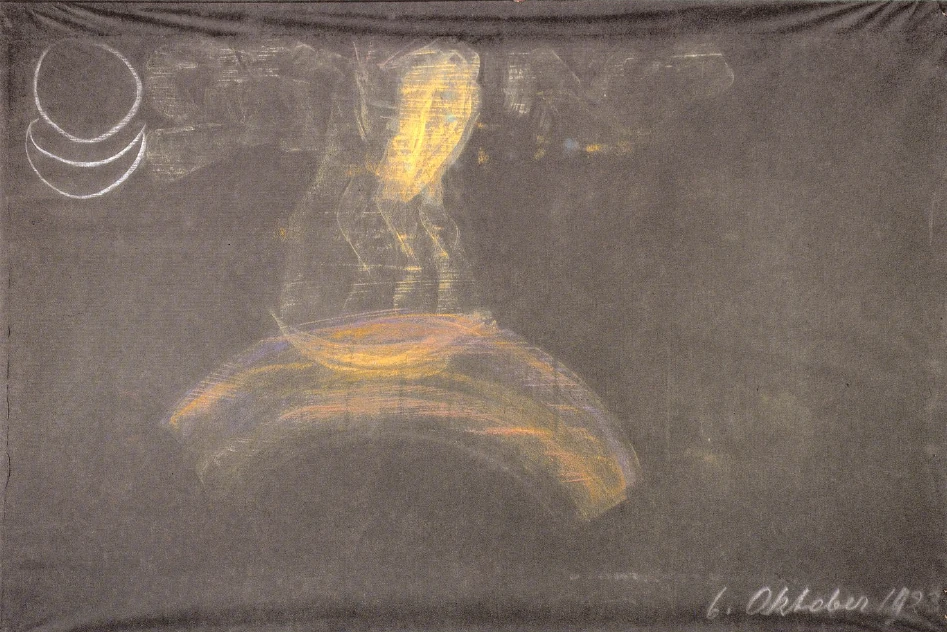
[ 37 ] Denken Sie sich das, wenn ich es bildhaft darstellen würde, so: Das Mondenhaft-Erdenhafte, es ist dasjenige, was unter der Erdoberfläche schwelt. Würde man hinausgehen in die Weiten des Weltenalls, so würde man das, was sich da oben darstellt, wo der Mensch hinausstrahlt in das Weltenall, schauen wie, ich möchte sagen, eine verhimmlischte Erde-Sternenstrahlung, welche die Erde in den weiten Weltenraum hinaussendet. Sternenstrahlend muß auch das Haupt der Maria sein, das heißt im menschlichen Ausdruck, so daß wir in der Physiognomie, in der ganzen Gebärde den Ausdruck des Sternenstrahlenden haben (siehe Tafel II).
[ 37 ] Imagine it this way, if I were to describe it visually: the lunar-earthly aspect—it is that which smolders beneath the Earth’s surface. If one were to go out into the vastness of the universe, one would see what appears up there, where the human being radiates out into the universe, as—I would say—a heavenly radiance of the Earth and the stars, which the Earth sends out into the vastness of space. The head of Mary, too, must be radiant with starlight—that is, in human terms—so that we see the expression of this starlight in her physiognomy and in her entire demeanor (see Plate II).
[ 38 ] Gehen wir dann bis zu der Brust, so müssen wir dasjenige haben, was mit dem Atmungsprozesse verbunden ist: das aus den Wolken, die die Sonnenstrahlung in der Atmosphäre durch sich strömen haben, heraus sich bildende Sonnenhafte, das Kind.
[ 38 ] If we then proceed to the chest, we must consider that which is connected to the respiratory process: the sun-like being—the child—that forms from the clouds through which the sun’s rays pass in the atmosphere.
[ 39 ] Und wir haben weiter unten das, was von dem Mondenhaft-Salzbildnerischen bestimmt wird, was man äußerlich dadurch ausdrückt, daß man die Gliedmaßen in die Dynamik des Irdischen hineinbringt und sie aufsteigen läßt aus dem Salzbildnerisch-Mondenhaften der Erde. Wir haben die Erde, insofern sie innerlich, wenn ich so sagen darf, durchmondet ist.
[ 39 ] And further down we have what is determined by the lunar-salt-forming principle, which is expressed outwardly by bringing the limbs into the dynamics of the earthly realm and allowing them to rise up from the salt-forming, lunar aspect of the Earth. We have the Earth, insofar as it is, if I may say so, internally permeated by the Moon.
[ 40 ] Man müßte es eigentlich so darstellen, daß wir eine Art Regenbogenfarbe anbringen. Wenn man nämlich vom Weltenall nach der Erde herschaut, so würde sich das so darstellen, daß man durchschaut durch die Sternenstrahlung auf die Erde selbst, wie wenn die Erde unter ihrer Oberfläche in Regenbogenfarben nach innen schimmern würde. Darauf steht dann, von der Erdendynamik zunächst, von den Gliedmaßen, von der Erde, der Schwerkraft und so weiter in Anspruch genommen, dasjenige, was sich eigentlich nur durch die menschliche Gewandung ausdrücken läßt, die so gefaltet wird, daß sie den Erdenkräften folgt. Wir würden also da unten die Gewandung haben im Sinne der Erdenkräfte. Wir würden weiter hinaufgehen und würden zu zeichnen haben, was sich nun in dem ganzen Erdenhaft-Mondenhaften ausbildet. Man könnte auch den Mond noch zeichnen, wenn man symbolisch sein wollte, aber dieses Mondenhafte ist ja schon in dem Erdengebilde ausgedrückt.
[ 40 ] One would actually have to depict it as if we were applying a kind of rainbow color. For when one looks down at Earth from outer space, it would appear as though one were seeing through the starlight onto Earth itself, as if the Earth were shimmering inward in rainbow colors beneath its surface. Upon this, shaped first by Earth’s dynamics—by the limbs, the Earth, gravity, and so on—lies that which can actually only be expressed through human clothing, which is folded in such a way that it follows the Earth’s forces. So down there we would have the clothing in accordance with the Earth’s forces. We would continue upward and would have to draw what now takes shape within the entire earth-like, moon-like structure. One could also draw the moon if one wanted to be symbolic, but this moon-like quality is already expressed in the earth-like structure.
[ 41 ] Wir kommen dann weiter hinauf, nehmen auf dasjenige, was aus dem Mondenhaften kommt, sehen, wie die Wolken durchdrungen werden von vielen Menschenköpfen, die herunterstreben; einer der Menschenköpfe ist verdichtet zu der auf dem Arm der Maria sitzenden Sonne, dem Jesuskinde. Und wir müssen das Ganze nach oben ergänzen durch das in der Physiognomie die Sternenstrahlung ausdrückende Mariengesicht.
[ 41 ] We then ascend further, take in what comes from the moon-like realm, and see how the clouds are permeated by many human heads striving downward; one of these human heads is condensed into the Sun—the Child Jesus—sitting on Mary’s arm. And we must complete the whole scene from above with Mary’s face, whose features express the radiance of the stars.
[ 42 ] Verstehen wir die Tiefwinterzeit, wie sie uns den Zusammenhang des Kosmos mit dem Menschen darstellt, mit dem Menschen, der aufnimmt, was in der Erde an Gebärungskräften ist, dann gibt es keine andere Möglichkeit, wiederum bis auf die Formgebung aus den Wolken heraus hin, als die mit den Kräften der Erde, nach unten mit den Mondenkräften, nach der Mitte mit den Sonnenkräften, nach dem Haupte oben mit den Sternenkräften begabte Frau darzustellen. Aus dem Kosmos selber heraus entsteht uns dieses Bild der Maria mit dem Jesuskindlein.
[ 42 ] If we understand the depths of winter as they reveal to us the connection between the cosmos and humankind—humankind that absorbs the creative forces within the earth— then there is no other way—right down to the shaping of the clouds—than to depict the woman endowed with the forces of the Earth, with the forces of the Moon below, the forces of the Sun in the center, and the forces of the stars above her head. This image of Mary with the infant Jesus arises for us from the cosmos itself.
[ 43 ] Und so wie wir, wenn wir den Kosmos im Herbst verstehen und alles das, was wir in ihm an gestaltenden Kräften haben, in ein Bild hineinlegen, notwendig zur künstlerischen Ausgestaltung des Streites des Michael mit dem Drachen kommen, wie ich es gestern dargestellt habe, so strömt uns alles das, was wir um die Weihnachtszeit empfinden können, zusammen in dem Bilde der Marienmutter mit dem Kinde, das in älteren Zeiten, namentlich in den ersten Jahrhunderten des Christentums, Künstlern vielfach vorgeschwebt hat, und dessen letzte Nachklänge in der Entwickelung der Menschheit eben in der Raffaelischen Sixtinischen Madonna noch erhalten sind. Diese Raffaelische Sixtinische Madonna ist noch aus den großen naiven Naturund Geist-Erkenntnissen einer alten Zeit heraus geboren. Denn sie ist das Bild jener Imagination, die der Mensch eigentlich haben muß, der sich mit innerer Schauung in die Geheimnisse des Weihnachtswebens so hineinversetzt, daß ihm dieses Weihnachtsweben eben zum Bilde wird.
[ 43 ] And just as, when we understand the cosmos in the fall and incorporate into an image all the formative forces we find within it, we inevitably arrive at an artistic depiction of Michael’s battle with the dragon, as I described yesterday, so, too, everything we can feel around Christmas time converges in the image of the Virgin Mary with the Child—an image that, in earlier times, particularly in the first centuries of Christianity, often came to mind for artists, and whose final echoes in the development of humanity are preserved precisely in Raphael’s Sistine Madonna. This Sistine Madonna by Raphael was born out of the great, naive insights into nature and the spirit of an ancient time. For it is the image of that imagination which a person must truly possess—one who, through inner contemplation, immerses themselves so deeply in the mysteries of the Christmas cycle that this cycle itself becomes an image for them.
[ 44 ] So können wir sagen: Der Jahreslauf, er muß sich für die innere Schauung in ganz bestimmten grandiosen Imaginationen ausleben. Geht man seelisch mit seinem ganzen Menschen hinaus in die Welt, so wird einem der Herbstesbeginn zu der grandiosen Imagination des Streites des Michael mit dem Drachen. Und wie der Drache nur sulfurisch dargestellt werden kann — die Schwefelmasse, die sich in die Drachengestalt hineinfindet —, wie da das Schwert Michaels entsteht, wenn wir uns das Meteoreisen zu diesem Schwerte konzentriert, vereinigt denken, so entsteht uns aus dem, was wir in der Weihnachtszeit empfinden können, das Bild der Marienmutter, deren Kleid in den Kräften der Erde gefaltet ist, während das Gewand — bis in diese Einzelheiten geht da die Malerei in einer bestimmten Weise vor — sich innerlich runden muß, quecksilbrig werden muß, so daß man eine innere Geschlossenheit in dem Brustgebilde hat. Da aber halten die Sonnenkräfte ihren Einzug. Und das unschuldige Jesuskind, das so gedacht werden muß, daß es noch keine Erdennahrung genossen hat, das ist die auf dem Arm der Maria sitzende Sonnenwirkung selber; oben die Sternenstrahlungswirkung. So daß wit, wie von innen heraus leuchtend in Auge und Haupt selbst, darzustellen haben, dem Menschen entgegenglänzend, das Haupt der Maria, daß wir‘ wie in lieblicher Milde aus den Wolkengebilden in sphärischer Rundung, innerlich geschlossen, das Jesuskind auf dem Arm der Maria darzustellen haben, und dann nach unten gehend die Gewandung, von der Erdenschwere übernommen, in der Gewandung ausdrückend dasjenige, was Erdenschwere werden kann (Tafel II).
[ 44 ] Thus we can say: The course of the year must unfold for inner contemplation in very specific, magnificent imaginings. When one goes out into the world with one’s whole being, the beginning of autumn becomes the magnificent imagination of Michael’s battle with the dragon. And just as the dragon can only be depicted as sulfuric—the mass of sulfur that takes on the form of the dragon—and just as Michael’s sword comes into being when we think of meteoric iron concentrated and united into this sword, then from what we can feel during the Christmas season arises for us the image of the Virgin Mary, whose robe is folded in the forces of the earth, while the garment—the painting proceeds in a certain way right down to these details—must round out inwardly, must become mercurial, so that one has an inner unity in the form of the chest. But there the forces of the sun make their entrance. And the innocent infant Jesus, who must be conceived as having not yet partaken of earthly nourishment, is the very effect of the sun itself, sitting in Mary’s arms; above, the effect of the stars’ radiance. So that we must depict him—as if glowing from within in his eyes and head—shining toward humanity, Mary’s head—so that we must depict the Infant Jesus in Mary’s arms as emerging, as it were, in lovely gentleness from the cloud formations in a spherical curve, inwardly self-contained; and then, moving downward, the garment, imbued with earthly heaviness, expressing in the garment that which can become earthly heaviness (Plate II).
[ 45 ] Und wir tun am besten, wenn wir das auch in den Farben ausdrükken. Dann haben wir jenes Bild, das uns aufdämmert als eine kosmische Imagination zur Weihnachtszeit, mit dem wir hinüberleben können bis zur Osterzeit, wo uns wiederum aus dem kosmischen Zusammenhange eine ebensolche Osterimagination aufgehen kann, von der wir dann morgen sprechen wollen.
[ 45 ] And we’d do best to express this through colors as well. Then we have that image that dawns on us as a cosmic vision during the Christmas season, one that can sustain us until Easter, when, once again, a similar Easter vision can emerge from the cosmic context—which is what we’ll discuss tomorrow.
[ 46 ] Sie sehen daraus, Kunst holt sich der Mensch aus den Himmeln, wie sie zusammenhängen mit der Erde. Wahre Kunst ist dasjenige, was der Mensch mit dem physisch-seelisch-geistigen Weltenall erlebt, das sich für ihn in grandiosen Imaginationen ergibt. So daß der Mensch all das, was an innerlichem Streit zur Herstellung des Selbstbewußtseins aus dem Naturbewußtsein notwendig ist, nicht anders sich vor Augen stellen kann, als indem er das grandiose Bild des Streites des Michael mit dem Drachen hat; daß der Mensch alles, was zur Tiefwinterzeit aus der Natur heraus in seine Seele wirken kann, vor seine Seele selbst stellen kann, indem er das Bild der Mutter mit dem Kinde, wie ich es jetzt beschrieben habe, künstlerisch-imaginativ vor seine Seele hinstellt.
[ 46 ] As you can see from this, human beings draw art from the heavens, as they are connected to the Earth. True art is that which a person experiences through the physical, soul, and spiritual universe, which unfolds for them in magnificent imaginings. Thus, a person cannot visualize all that is necessary in the inner struggle to develop self-consciousness from nature consciousness in any other way than by having the magnificent image of Michael’s struggle with the dragon; that human beings can bring before their very souls everything that can work its way from nature into their souls during the depths of winter by placing before their souls, in an artistic and imaginative way, the image of the mother with the child, as I have just described it.
[ 47 ] Jahreslaufbeobachtung heißt, mit der großen kosmischen Künstlerin mitgehen, und diejenigen Dinge, die der Himmel der Erde einprägt, in mächtigen Bildern, die aber dann Realitäten werden für das menschliche Gemüt, in sich wieder lebendig werden zu lassen. So kann einem der Jahreslauf in vier Imaginationen aufgehen: MichaelImagination, Marien-Imagination, und wir werden morgen und in den nächsten Vorträgen sehen: Oster-Imagination, Johanni-Imagination.
[ 47 ] Observing the cycle of the year means walking alongside the great cosmic Artist and allowing those things that the heavens imprint upon the earth to come alive within us once more through powerful images—images that then become realities for the human soul. In this way, the course of the year can unfold in four imaginations: the Michael Imagination, the Mary Imagination, and—as we will see tomorrow and in the upcoming lectures—the Easter Imagination and the St. John Imagination.
[ 48 ] Morgen werde ich dann zunächst den Weg suchen von Weihnachten zu Ostern.
[ 48 ] Tomorrow, I'll start by figuring out the path from Christmas to Easter.