Humanity as the harmony of the
creative, formative, and shaping Word of the World
GA 230
20 October 1923, Dornach
Translate the original German text into any language:
Versions Available:
Humanity as the harmony of the creative, formative, and shaping Word, tr. SOL
Zweiter Vortrag
Second Lecture
[ 1 ] Nachdem wir gestern das Verhältnis der Tiere der Höhe, die im Adler repräsentiert sind, der Tiere der Mitte, die im Löwen repräsentiert sind, und der Tiere der Erdentiefe, die im Rind, in der Kuh repräsentiert sind, kennengelernt haben, können wir ja gerade heute des Menschen Beziehung zum Weltenall ins Auge fassen von dem Gesichtspunkte aus, der sich eben aus der inneren gestaltmäßigen Beziehung des Menschen zu diesen Repräsentanten der Tierwelt ergibt.
[ 1 ] Now that we have explored yesterday the relationship between the animals of the heights—represented by the eagle—the animals of the middle—represented by the lion— and the animals of the depths of the earth, represented by the ox and the cow, we can now turn our attention to the human being’s relationship to the universe from the perspective that arises precisely from the human being’s inner, structural relationship to these representatives of the animal world.
[ 2 ] Richten wir einmal den Blick hinauf in diejenigen Regionen, von denen wir gestern sagen mußten: wenn sie die Regionen sind, aus denen heraus das Tier seine besonderen Kräfte zieht, daß sie dann eigentlich das ganze Tier zur Kopfesorganisation machen. Richten wir den Blick hinauf in diese Regionen. Wir sehen da, wie das Tier das, was es ist, der sonnendurchglänzten Atmosphäre verdankt. Die sonnendurchglänzte Atmosphäre muß es sein, alles das, was gewissermaßen von dem Tiere dadurch bezogen werden kann, daß es die Hauptsache seines Daseins der Atmosphäre, die sonnendurchströmt ist, verdankt. Ich habe Ihnen gestern gesagt: Davon rührt ja die eigentliche Gestaltung des Gefieders her. Das Tier hat gewissermaßen sein Wesen im Äußeren. Was die Außenwelt aus ihm macht, verkörpert sich in seinem Gefieder. Und wenn dasjenige, was aus dieser sonnendurchglänzten Luft gemacht werden kann, nicht von außen an das Wesen herangetragen wird wie beim Adler, sondern im Inneren erregt wird, wie aus dem menschlichen Nervensystem heraus, dann entstehen, sagte ich Ihnen, die Gedanken, die Gedanken des Augenblicks, die Gedanken der unmittelbaren Gegenwart.
[ 2 ] Let us now turn our gaze upward to those regions about which we had to say yesterday: if these are the regions from which the animal draws its special powers, then they actually constitute the entire animal’s head organization. Let us turn our gaze upward to these regions. There we see how the animal owes what it is to the sun-drenched atmosphere. It must be the sun-drenched atmosphere—everything that the animal can, so to speak, derive from it—since it owes the very essence of its existence to the atmosphere through which the sun streams. I told you yesterday: This is, in fact, the source of the actual structure of the plumage. The animal, so to speak, has its essence in its exterior. What the external world makes of it is embodied in its plumage. And when that which can be made from this sun-drenched air is not brought to the being from the outside, as in the case of the eagle, but is aroused from within—as if from the human nervous system—then, as I told you, thoughts arise: the thoughts of the moment, the thoughts of the immediate present.
[ 3 ] Nun, wenn wir unseren Blick in dieser Weise, ich möchte sagen, beschwert mit alledem, was sich durch eine solche Betrachtung ergibt, in die Höhe wenden, werden wir eben verwiesen auf die ruhende Atmosphäre und auf das durchströmende Sonnenlicht. Aber wir können in einem solchen Falle nicht die Sonne so für sich betrachten. Die Sonne erhält ja ihre Kraft dadurch, daß sie in Beziehung tritt zu den verschiedenen Gegenden des Universums. Ausgedrückt wird diese Beziehung dadurch, daß der Mensch mit seinen Erkenntnissen die Sonnenwirkungen bezieht auf den sogenannten Tierkreis, so daß, wenn der Sonnenschein zur Erde fällt aus dem Löwen, aus der Waage, aus dem Skorpion, er immer etwas anderes für die Erde bedeutet. Aber er bedeutet auch etwas anderes für die Erde, je nachdem er verstärkt oder entkräftet wird durch die anderen Planeten unseres Planetensystems. Und da bestehen verschiedene Beziehungen zu den verschiedenen Planeten unseres Planetensystems. Es bestehen andere Beziehungen zu den sogenannten äußeren Planeten Mars, Jupiter, Saturn, und andere Beziehungen zu den sogenannten inneren Planeten Merkur, Venus und dem Mond.
[ 3 ] Now, when we turn our gaze upward in this way—I would say, weighed down by all that arises from such contemplation—we are immediately drawn to the still atmosphere and the sunlight streaming through it. But in such a case, we cannot consider the sun in isolation. After all, the sun derives its power from its relationship to the various regions of the universe. This relationship is expressed by the fact that, through human knowledge, the effects of the sun are related to the so-called zodiac, so that when sunlight falls upon the Earth from Leo, from Libra, or from Scorpio, it always means something different for the Earth. But it also means something different for the Earth depending on whether it is strengthened or weakened by the other planets in our solar system. And there are different relationships with the various planets in our solar system. There are different relationships with the so-called outer planets—Mars, Jupiter, and Saturn—and different relationships with the so-called inner planets—Mercury, Venus, and the Moon.
[ 4 ] Wenn wir nun die Organisation des Adlers ins Auge fassen, dann haben wir vor allen Dingen darauf zu sehen, inwiefern dieSonnenkräfte modifiziert werden, verstärkt oder geschwächt werden durch das Zusammenwirken der Sonne mit Saturn, Jupiter, Mars. Nicht umsonst spricht die Legende davon, daß der Adler eigentlich Jupiters Vogel ist. Der Jupiter steht überhaupt da als Repräsentant für die äußeren Planeten. Wenn wir uns schematisch das hinzeichnen, um was es sich dabei handelt, dann müssen wir uns hinzeichnen die Sphäre, die im Weltenraum, im Kosmos der Saturn hat, die Sphäre, die der Jupiter hat, die Sphäre, die der Mars hat.
[ 4 ] When we now consider the structure of the eagle, we must pay particular attention to the extent to which the forces of the Sun are modified, strengthened, or weakened by the interaction of the Sun with Saturn, Jupiter, and Mars. It is no coincidence that legend holds that the eagle is actually Jupiter’s bird. Jupiter stands there, in general, as the representative of the outer planets. If we sketch out schematically what this involves, we must draw the sphere that Saturn occupies in outer space, in the cosmos; the sphere that Jupiter occupies; and the sphere that Mars occupies.
[ 5 ] Stellen wir das einmal vor unser Auge hin: die Saturnsphäre, die Jupitersphäre, die Marssphäre; dann finden wir den Übergang zur Sonnensphäre, und wir haben sozusagen im KÄußersten unseres Planetensystems ein Zusammenwirken von Sonne, Mars, Jupiter, Saturn. Und wenn wir den Adler in den Lüften kreisen sehen, dann sprechen wir durchaus eine Realität aus, wenn wir sagen: Diejenigen Kräfte, die von der Sonne aus die Luft durchströmen, so daß sie zusammengesetzt sind aus dem Zusammenwirken von Sonne mit Mars, Jupiter und Saturn, die sind es, die in der ganzen Gestalt, in der Wesenheit des Adlers leben. Sie leben aber zugleich in dem Gebilde des menschlichen Hauptes. Und wenn wir den Menschen hineinstellen in bezug auf sein wirkliches Dasein — man möchte sagen, auf Erden ist er ja nur in seinem Miniaturbilde — in das Weltenall, dann müssen wir ihn hineinstellen in die Adlersphäre seinem Haupte nach. Wir müssen uns also den Menschen seinem Haupte nach hineingestellt vorstellen in die Adlersphäre, und haben damit dasjenige im Menschen gegeben, was mit den Kräften nach oben zusammenhängt.
[ 5 ] Let’s picture this in our minds: the sphere of Saturn, the sphere of Jupiter, the sphere of Mars; then we find the transition to the sphere of the Sun, and we have, so to speak, at the very outermost edge of our planetary system, an interplay between the Sun, Mars, Jupiter, and Saturn. And when we see the eagle circling in the skies, we are certainly expressing a reality when we say: The forces that flow through the air from the Sun—so that they are composed of the interaction of the Sun with Mars, Jupiter, and Saturn—are the very forces that live in the entire form, in the essence of the eagle. But they also live in the structure of the human head. And when we place the human being—in relation to his true existence (one might say that on Earth he is, after all, only a miniature image of himself)—into the cosmos, we must place him, by virtue of his head, within the sphere of the eagle. We must therefore imagine the human being, as represented by his head, placed within the eagle’s sphere, and in doing so we have identified that aspect of the human being which is connected with the forces directed upward.
[ 6 ] Der Löwe ist der Repräsentant desjenigen Getiers, das im eigentlichen Sinne Sonnengetier ist, wo die Sonne gewissermaßen ihre eigene Kraft entfaltet. Der Löwe gedeiht am besten, wenn die Gestirne über der Sonne, die Gestirne unter der Sonne so in Konstellation vorhanden sind, daß sie am wenigsten Einfluß auf die Sonne selber ausüben. Dann entsteht jenes Eigentümliche, was ich Ihnen gestern beschrieben habe, daß die Kräfte der Sonne selber, die die Luft durchdringen, gerade ein solches Atmungssystem in dem Löwen anregen, daß dieses Atmungssystem in seinem Rhythmus in vollständigem Gleichgewichte ist mit dem Blutzirkulationsrhythmus, nicht der Zahl nach, aber der Dynamik nach. Das gleicht sich beim Löwen wunderschön aus. Der Löwe setzt der Blutzirkulation die Atmungshemmung entgegen, und die Blutzirkulation regt fortwährend die Atmungsströmung an. Ich sagte Ihnen, daß man das der Form nach sogar in der Gestaltung des Löwenmauls sehen kann. Da drückt sich diese wunderbare Beziehung des Blutrhythmus und des Atmungsrhythmus der Form nach schon aus. Man kann es sehen aus dem eigentümlichen, in sich ruhenden und doch wiederum kühn nach auswärts gewendeten Blick des Löwen. Aber dasjenige, was da im Löwen im Blick lebt, lebt wiederum angeschlossen an die anderen Elemente der Menschennatur, an die Hauptesorganisation, an die Stoffwechselorganisation, in der Brust- oder Herzorganisation, in der rhythmischen Organisation des Menschen.
[ 6 ] The lion represents the animal that is, in the truest sense, a solar creature, through which the sun, so to speak, unfolds its own power. The lion thrives best when the celestial bodies above the sun and those below it are arranged in such a constellation that they exert the least influence on the sun itself. This gives rise to that peculiar phenomenon I described to you yesterday: the forces of the sun itself, which permeate the air, stimulate precisely such a respiratory system in the lion that the rhythm of this respiratory system is in perfect balance with the rhythm of blood circulation—not in terms of frequency, but in terms of dynamics. This balances out beautifully in the lion. The lion counterbalances blood circulation with respiratory inhibition, and blood circulation continuously stimulates the flow of respiration. I told you that this can even be seen in the shape of the lion’s muzzle. This wonderful relationship between the rhythm of the blood and the rhythm of respiration is already expressed in its form. One can see it in the lion’s distinctive gaze—calm within itself, yet boldly turned outward. But what lives in the lion’s gaze is, in turn, connected to the other elements of human nature: to the head organization, to the metabolic organization, to the chest or heart organization, and to the rhythmic organization of the human being.
[ 7 ] Stellen wir daher vor uns hin die eigentliche Sonnenwirkung, so müssen wir der Sonnensphäre entsprechend den Menschen uns so einzeichnen, daß wir sein Herz, die dazugehörige Lunge in die Region der Sonnenwirksamkeit stellen, und wir haben in diesem Gebiete die Löwennatur des Menschen.
[ 7 ] If we therefore visualize the actual effect of the sun, we must map the human being onto the solar sphere in such a way that we place the heart and the corresponding lungs in the region of the sun’s influence; in this region, we find the lion-like nature of the human being.
[ 8 ] Wenn wir übergehen zu den inneren Planeten, zu den erdennahen Planeten, dann haben wir zunächst die Merkursphäre, welche es nun schon zu tun hat namentlich mit den feineren Partien des Stoffwechselsystems, des Stoffwechselorganismus des Menschen, da wo die Nahrungsstoffe umgewandelt werden in den Iymphartigen Stoff, wo sie dann übertragen werden in die Blutzirkulation hinein.
[ 8 ] When we turn to the inner planets, the planets close to Earth, we first encounter the sphere of Mercury, which is specifically concerned with the finer aspects of the human metabolic system—the metabolic organism—where nutrients are transformed into a lymph-like substance and then transported into the bloodstream.
[ 9 ] Wenn wir dann weitergehen, kommen wir in die Region des Venuswirkens. Wir kommen zu den etwas gröberen Partien des Stoffwechselsystems des Menschen, wir kommen zu dem, was im menschlichen Organismus die aufgenommenen Nahrungsmittel zunächst verarbeitet vom Magen aus. Wir kommen dann in die Sphäre des Mondes. Ich zeichne diese Folge so, wie sie heute in der Astronomie üblich ist; ich könnte sie auch anders zeichnen. Wir kommen also nun in die Sphäre des Mondes und kommen da in diejenige Region, wo auf den Menschen wirkt und gewirkt wird in jenen Stoffwechselvorgängen, die mit dem Monde zusammenhängen.
[ 9 ] As we proceed, we enter the region of Venus’s influence. We come to the somewhat coarser parts of the human metabolic system; we come to that which, in the human organism, initially processes the ingested food, starting with the stomach. We then enter the sphere of the Moon. I am depicting this sequence as it is commonly understood in astronomy today; I could also depict it differently. So we now enter the sphere of the Moon and arrive in the region where the Moon acts upon and is acted upon by the human being in those metabolic processes associated with the Moon.
[ 10 ] Wir haben den Menschen auf diese Weise hineingestellt in das gesamte Weltenall. Indem wir uns an diejenigen kosmischen Wirkungen wenden, die die Sonne im Verein mit Merkur, Venus, Mond vollführt, kommen wir dann hinein in das Gebiet, das die Kräfte enthält, die jenes Getier aufnimmt, das uns repräsentiert wird durch die Kuh in dem Sinne, wie ich das gestern auseinandergesetzt habe. Da haben wir das, was die Sonne nicht durch sich selbst machen kann, sondern was die Sonne machen kann, wenn sie durch die erdennahen Planeten in ihren Kräften gerade an die Erde herangeführt wird. Wenn diese Kräfte alle dann wirken, wenn sie nicht nur die Luft durchströmen, sondern die Oberfläche der Erde in verschiedener Art durchsetzen, dann wirken diese Kräfte herauf aus den Erdentiefen. Und das, was da heraufwirkt aus den Erdentiefen, das gehört der Region an, die wir äußerlich verkörpert sehen eben in der Organisation der Kuh.
[ 10 ] In this way, we have placed human beings within the entire universe. By turning our attention to those cosmic influences that the Sun exerts in conjunction with Mercury, Venus, and the Moon, we then enter the realm that contains the forces which sustain that creature represented to us by the cow, in the sense I explained yesterday. There we have what the Sun cannot accomplish on its own, but what the Sun can accomplish when its forces are directed toward the Earth through the inner planets. When all these forces are at work—not merely flowing through the air but permeating the Earth’s surface in various ways—they act upward from the depths of the Earth. And what acts upward from the depths of the Earth belongs to the region that we see embodied externally in the very structure of the cow.
[ 11 ] Die Kuh ist das Verdauungstier. Aber die Kuh ist zugleich dasjenige Tier, welches die Verdauung in einer solchen Weise ausführt, daß in diesem Verdauungsvorgange die irdische Abbildung eines wirklich Überirdischen liegt, daß dieser ganze Verdauungsvorgang der Kuh durchsetzt ist von einer Astralität, hell und wunderbar abbildend den ganzen Kosmos. Es ist — wie ich schon gestern sagte — eine ganze Welt in diesem astralischen Organismus der Kuh, aber alles getragen von Schwere, alles so eingerichtet, daß die Schwere der Erde sich auswirken kann. Sie brauchen nur zu bedenken, daß die Kuh genötigt ist, jeden Tag etwa ein Achtel ihres Körpergewichtes an Nahrungsstoffen aufzunehmen. Der Mensch kann sich mit einem Vierzigstel begnügen und gesund bleiben dabei. Die Kuh braucht also, damit sie ihre Organisation voll ausfüllen kann, Erdenschwere. Ihre Organisation ist daraufhin orientiert, daß die Stoffe Schwere haben. Ein Achtel muß jeden Tag an Schwere ausgewechselt werden bei der Kuh. Das bindet die Kuh mit ihren Materien an die Erde, während sie durch ihre Astralität zu gleicher Zeit eben ein Abbild der Höhen, des Kosmos ist.
[ 11 ] The cow is the digestive animal. But the cow is also the animal that carries out digestion in such a way that this digestive process embodies the earthly reflection of something truly supernatural—that the entire digestive process of the cow is permeated by an astral quality, brightly and wonderfully reflecting the entire cosmos. It is—as I said yesterday—an entire world within the cow’s astral organism, but everything is supported by heaviness, everything arranged so that the heaviness of the earth can take effect. You need only consider that the cow is compelled to consume about one-eighth of its body weight in food every day. A human being can make do with one-fortieth and remain healthy. The cow, therefore, needs the gravity of the Earth in order to fully sustain its organism. Its organism is oriented toward substances that possess gravity. One-eighth of its weight must be replaced every day in the cow. This binds the cow to the Earth through its physical matter, while at the same time, through its astral nature, it is a reflection of the heights, of the cosmos.
[ 12 ] Deshalb ist die Kuh für den Bekenner der Hindureligion — wie ich gestern sagte — ein so verehrungswürdiges Objekt, weil er sich sagen kann: Die Kuh lebt hier auf der Erde; allein indem sie hier auf der Erde lebt, bildet sie in der physischen Schwere-Materie ab, man kann schon sagen, ein Überirdisches, wenn man im Sinne des Bekenners der Hindureligion redet. Und es ist durchaus so, daß die menschliche Natur dann ihre Normalorganisation hat, wenn der Mensch diese drei in Adler, Löwe und Kuh vereinseitigten kosmischen Wirkungen in Harmonie bringen kann, wenn er also wirklich der Zusammenfluß der Adler-, Löwen- und Kuh- oder Stierwirkungen ist.
[ 12 ] That is why the cow is such a revered object for followers of the Hindu religion—as I said yesterday—because they can say to themselves: The cow lives here on Earth; simply by living here on Earth, she manifests—in physical, dense matter—what one might call a supermundane reality, if one speaks in the sense of a follower of the Hindu religion. And it is certainly true that human nature has its normal organization when a person can bring these three cosmic forces—manifested in the eagle, the lion, and the cow—into harmony; that is, when he is truly the confluence of the forces of the eagle, the lion, and the cow or bull.
[ 13 ] Aber nach dem allgemeinen Weltengang leben wir in einer Zeit, in welcher der Entwickelung der Welt eine gewisse — wenn ich mich so ausdrücken darf — Gefahr droht: die Gefahr, daß die einseitigen Wirkungen auch wirklich im Menschen einseitig zum Ausdrucke kommen. Seit dem 14.,15. Jahrhundert, bis in unsere Tage sich immer mehr und mehr verstärkend, ist die Sache so in der irdischen Menschheitsentwikkelung, daß die Adlerwirkungen das menschliche Haupt einseitig in Anspruch nehmen wollen, die Löwenwirkungen den menschlichen Rhythmus einseitig in Anspruch nehmen wollen, die Kuhwirkungen den menschlichen Stoffwechsel und das ganze menschliche Wirken auf Erden einseitig in Anspruch nehmen wollen.
[ 13 ] But according to the general course of world history, we are living in a time in which the development of the world is threatened by a certain—if I may put it this way—danger: the danger that these one-sided influences will indeed find one-sided expression in human beings. From the 14th and 15th centuries to the present day, with this trend intensifying more and more, the situation in humanity’s earthly development has been such that the eagle forces seek to dominate the human head in a one-sided way, the lion forces seek to dominate the human rhythm in a one-sided way, and the cow forces seek to dominate the human metabolism and all human activity on earth in a one-sided way.
[ 14 ] Das ist die Signatur unserer Zeit, daß der Mensch sozusagen durch die kosmischen Mächte dreigeteilt werden soll, und daß immer die eine Form der kosmischen Mächte das Bestreben hat, die anderen Elemente zu unterdrücken. Der Adler hat das Bestreben, Löwe und Kuh in die Geltungslosigkeit hinunterzuwerfen; ebenso haben die anderen das Bestreben, jeweilig die beiden anderen Elemente in die Bedeutungslosigkeit versinken zu lassen. Und auf dasjenige, was menschliches Unterbewußtsein ist, wirkt eigentlich fortwährend gerade in der heutigen Zeit außerordentlich Verlockendes; verlockend schon aus dem Grunde, weil es auch in gewisser Beziehung schön ist. Im Oberbewußtsein nimmt es der Mensch heute nicht wahr, aber für sein Unterbewußtsein durchwellt und durchtönt die Welt eine Dreiheit der Rufe, die den Menschen locken wollen. Und ich möchte sagen, es ist das Geheimnis der heutigen Zeit, daß aus der Adlerregion herunter dasjenige tönt, was den Adler eigentlich zum Adler macht, was dem Adler sein Gefieder gibt, was den Adler astralisch umschwebt. Die Adlerwesenheit selber ist es, die hörbar wird für das Unterbewußtsein des Menschen. Das ist der verlockende Ruf:
[ 14 ] This is the hallmark of our time: that human beings are, so to speak, to be divided into three parts by the cosmic forces, and that one form of these cosmic forces always strives to suppress the other elements. The eagle strives to cast the lion and the cow into insignificance; likewise, the other two strive to cause the other two elements to sink into insignificance. And in today’s world, something extraordinarily alluring is constantly acting upon the human subconscious—alluring precisely because, in a certain sense, it is beautiful. In the conscious mind, people today do not perceive it, but for their subconscious, the world is permeated by a triad of calls that seek to entice them. And I would say that the secret of our time is that from the region of the eagle resounds that which actually makes the eagle an eagle, that which gives the eagle its plumage, that which hovers astral around the eagle. It is the eagle’s very being that becomes audible to the human subconscious. That is the enticing call:
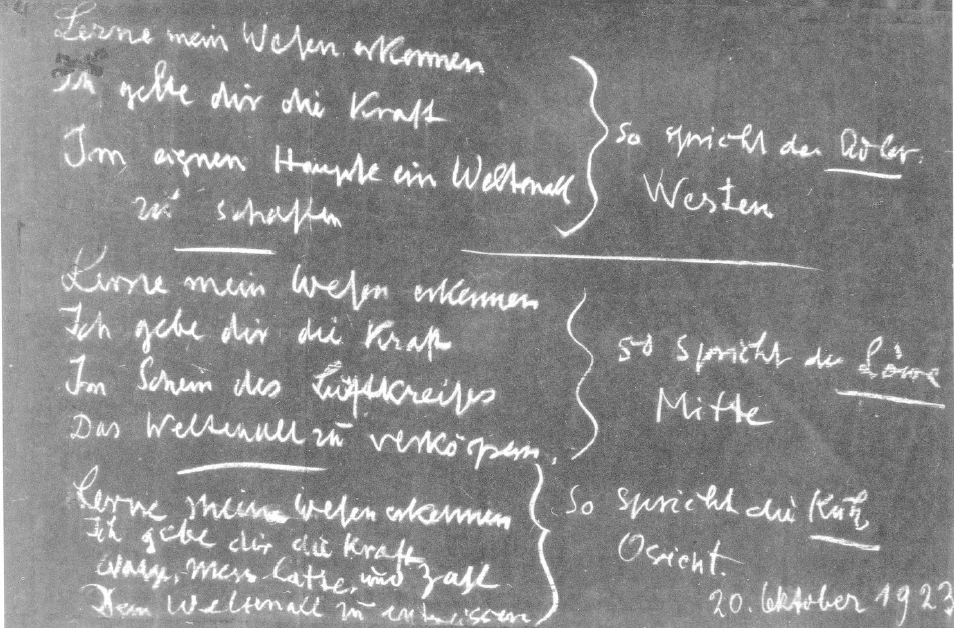
Lerne mein Wesen erkennen!
Ich gebe dir die Kraft,
Im eignen Haupte
Ein Weltenall zu schaffen.
Learn to recognize my essence!
I give you the power,
Within your own mind
To create a universe.
[ 15 ] So spricht der Adler. Das ist der Ruf von oben, der heute die Menschen vereinseitigen will.
[ 15 ] Thus speaks the eagle. This is the call from above that seeks to polarize people today.
[ 16 ] Und es gibt einen zweiten Lockruf. Das ist derjenige, der aus der mittleren Region kommt, da, wo die Kräfte des Kosmos die Löwennatur formen, da, wo die Kräfte des Kosmos aus dem Zusammenflusse von Sonne und Luft jenes Gleichmaß der Rhythmen, der Atmung und der Blutzirkulation bewirken, wie es die Löwennatur konstituiert. Was da die Luft durchzittert, ich möchte sagen, im Löwensinne, was des Menschen eigenes rhythmisches System vereinseitigen will, das spricht zum Unterbewußtsein des Menschen heute verlockend also:
[ 16 ] And there is a second call. This is the one that comes from the middle region, where the forces of the cosmos shape the nature of the lion, where the forces of the cosmos, through the confluence of sun and air, bring about that balance of rhythms, breathing, and blood circulation that constitutes the nature of the lion. What makes the air tremble there—I would say, in the sense of the lion—what seeks to polarize the human being’s own rhythmic system, speaks enticingly to the human subconscious today as follows:
Lerne mein Wesen erkennen!
Ich gebe dir die Kraft,
Im Schein des Luftkreises
Das Weltenall zu verkörpern.
Learn to recognize my essence!
I give you the strength,
In the glow of the circle of air
To embody the entire universe.
[ 17 ] So spricht der Löwe.
[ 17 ] Thus speaks the lion.
[ 18 ] Und mehr als man glaubt, haben diese Stimmen, die zum Unterbewußtsein des Menschen sprechen, Wirkung. Ja, meine lieben Freunde, es sind verschiedene Menschenorganisationen auf Erden besonders dazu organisiert, diese Wirkungen aufzunehmen. So zum Beispiel ist besonders organisiert, verlockt zu werden, verführt zu werden durch die Stimme des Adlers alles, was den Westen bewohnt. Namentlich die amerikanische Kultur ist durch die besondere Organisation ihrer Menschheit ausgesetzt der Verführung dessen, was der Adler spricht. Die europäische Mitte, die vieles von dem in sich enthält, was antike Kultur ist, die vieles von dem in sich enthält, was Goethe zum Beispiel veranlaßt hat, zur Befreiung seines Lebens den Zug nach Italien zu machen, die ist besonders ausgesetzt dem, was da spricht der Löwe.
[ 18 ] And these voices, which speak to the human subconscious, have a greater effect than one might think. Yes, my dear friends, there are various human organizations on Earth specifically structured to absorb these influences. For example, everything that inhabits the West is specifically organized to be enticed and seduced by the voice of the eagle. American culture, in particular, is—due to the specific organization of its people—exposed to the seduction of what the eagle speaks. The European center, which embodies much of what constitutes ancient culture—much of what, for example, prompted Goethe to make the journey to Italy to liberate his life—is particularly exposed to what the lion speaks.
[ 19 ] Die orientalische Zivilisation ist vor allen Dingen ausgesetzt dem, was da spricht die Kuh. Und ebenso, wie die beiden anderen Tiere in ihrer kosmischen Repräsentanz ertönen, ertönt, man möchte sagen, unten aus Erdentiefen heraus wie grollend, gröhlend der Ruf dessen, was in der Schwere der Kuh lebt. Es ist wirklich so, wie ich es Ihnen gestern schon beschrieben habe: daß man die Herde, die gesättigt weidet, in ihrer eigentümlichen, sich der Erdenschwere hingebenden Art lagern sieht in einer Gestalt, welche ausdrückt dieses der Erdenschwere Unterliegen, dieses dem Umstande Unterliegen, daß es jeden Tag ein Achtel seines eigenen Körpergewichtes zu seiner Beschwerung in sich auswechseln muß. Zu dem kommt hinzu, daß die Tiefen der Erde, die unter dem Einfluß von Sonne, Merkur, Venus und Mond all das in der Ernährungsorganisation der Kuh bewirken, daß diese Tiefen der Erde wie mit dämonisch grollender Kraft eine solche Herde durchtönen mit den Worten:
[ 19 ] Oriental civilization is, above all, subject to what the cow expresses. And just as the other two animals resound in their cosmic representation, so too—one might say—rises from the depths of the earth, like a rumbling, bellowing call, the voice of that which lives within the cow’s heaviness. It is truly as I described to you yesterday: that one sees the herd, grazing to satiety, resting in its peculiar manner—surrendering to the earth’s gravity—in a posture that expresses this submission to the earth’s gravity, this submission to the fact that every day it must replace one-eighth of its own body weight within itself to sustain its weight. Added to this is the fact that the depths of the earth, which—under the influence of the Sun, Mercury, Venus, and the Moon—bring about all these effects in the cow’s digestive system, resonate through such a herd with a demonic, rumbling force, as if saying:
Lerne mein Wesen erkennen!
Ich gebe dir die Kraft,
Waage, Meßlatte und Zahl
Dem Weltenall zu entreißen.
Learn to recognize my essence!
I will give you the strength
To wrest the scales, the measuring rod, and the number
From the universe.
[ 20 ] So spricht die Kuh. Und ausgesetzt ist dem Lockruf besonders der Orient. Nur ist die Sache so gemeint, daß der Orient zwar zunächst ausgesetzt ist diesem Lockruf der Kuh, weil er die alte Kuhverehrung hat in dem Hinduismus, daß aber, wenn dieser Lockruf wirklich die Menschheit so ergreifen würde, daß dasjenige, was aus diesem Lockruf entsteht, siegen würde, dann würde gerade dasjenige, was aus dem Orient wirkt, über die Mitte und den Westen sich als eine den Fortschritt hemmende, Niedergang bewirkende Zivilisation kundgeben. Einseitig würden die erdendämonischen Kräfte auf die Erdenzivilisation wirken. Denn, was würde dann eigentlich geschehen?
[ 20 ] Thus speaks the cow. And the Orient, in particular, is exposed to this alluring call. However, the point is this: while the Orient is initially exposed to this call of the cow—because of the ancient worship of cows in Hinduism—if this call were to truly take hold of humanity to such an extent that what arises from it were to prevail, then it is precisely that which emanates from the Orient that would manifest itself in the center and the West as a civilization that hinders progress and and bringing about decline. The earth-demonic forces would act one-sidedly upon earthly civilization. For what would actually happen then?
[ 21 ] Was dann geschehen würde, das ist das Folgende: Wir haben auf der Erde im Laufe der letzten Jahrhunderte eine unter dem Einfluß der äußeren Wissenschaft stehende Technik bekommen, ein äußeres technisches Leben. Wunderbar ist ja unsere Technik auf allen Gebieten. Die Naturkräfte wirken in der Technik in ihrer leblosen Gestaltung. Und was da gilt, um diese Naturkräfte ins Spiel zu bringen, sozusagen ganz und gar zu einer Zivilisationsschichtung über der Erde zu machen, das ist Waage, Meßlatte und Zahl.
[ 21 ] What would happen then is this: Over the course of the last few centuries, we have developed a technology on Earth that is influenced by external science—an external technical life. Our technology is indeed marvelous in all fields. The forces of nature operate within technology in their lifeless form. And what is required to bring these natural forces into play—to turn them, so to speak, entirely into a layer of civilization covering the Earth—is the scale, the measuring rod, and numbers.
[ 22 ] Waage, der Maßstab, Wägen, Zählen, Messen, das ist das Ideal des heutigen Wissenschafters, des heutigen Technikers, der von der äußeren Wissenschaft eigentlich seinen ganzen Beruf heute hat. Wir haben es so weit gebracht, daß ein bedeutender Mathematiker der Gegenwart auf die Frage: Was verbürgt das Sein? — die folgende Antwort gibt. Nun, die Philosophen aller Zeiten haben versucht, die Frage: Was ist denn eigentlich wirklich? -zu beantworten. Dieser bedeutende Physiker sagt: Dasjenige ist wirklich, was man messen kann; was man nicht messen kann, ist nicht wirklich. — Es ist das Ideal sozusagen, alles Sein so anzusehen, daß man es in das Laboratorium hereinbringen und wiegen, messen und zählen kann, und aus dem, was gewogen und gemessen und gezählt ist, wird dann eigentlich das zusammengestellt, was man als Wissenschaft, die dann in die Technik ausströmt, noch gelten läßt. Zahl, Maß und Gewicht ist dasjenige geworden, was sozusagen orientierend für die ganze Zivilisation wirken soll.
[ 22 ] Scales, standards, weighing, counting, measuring—that is the ideal of today’s scientist and engineer, whose entire profession is now based on external science. We have reached the point where a prominent contemporary mathematician, when asked, “What guarantees existence?”—gives the following answer. Well, philosophers of all ages have attempted to answer the question: “What is actually real?” This prominent physicist says: That which can be measured is real; that which cannot be measured is not real. — It is, so to speak, the ideal to view all existence in such a way that it can be brought into the laboratory and weighed, measured, and counted; and from what has been weighed, measured, and counted, what is then actually compiled is what is still regarded as science—which then flows into technology. Numbers, measures, and weights have become, so to speak, the guiding principles for the entire civilization.
[ 23 ] Nun, solange die Menschen nur allein mit ihrem Verstande das Messen, Zählen und Wiegen anwenden, so lange ist es nicht besonders schlimm. Die Menschen sind zwar sehr gescheit, aber so gescheit wie das Weltenall eben noch lange nicht. Daher kann es nicht besonders schlimm werden, solange nur sozusagen dem Weltenall gegenüber herumdilettiert wird in bezug auf Messen, Wiegen und Zählen. Aber wenn sich gerade die heutige Zivilisation in Einweihung verwandeln würde, dann würde es schlimm, wenn sie bei ihrer Gesinnung bliebe. Und das kann entstehen, wenn die Zivilisation des Westens, die ganz im Zeichen von Waage, Maßstab und Zählen steht, überflutet würde von dem, was immerhin im Orient passieren könnte: daß durch Initiationswissenschaft ergründet werden könnte, was eigentlich geistig in der Organisation der Kuh lebt. Denn dringen Sie in die Organisation der Kuh ein, lernen Sie erkennen, wie da dieses Achtel an Nahrungsstoffen, belastet mit irdischer Schwere, mit alledem, was man wägen, messen und zählen kann, lernen Sie das, was geistig dieses Erdenschwere in der Kuh organisiert, lernen Sie diesen ganzen Organismus der Kuh erkennen, wie er auf der Weide liegt und verdaut und in seiner Verdauung Wunderbares aus dem Weltenall astralisch zur Offenbarung bringt: dann lernen Sie erkennen, einzuspannen das Gewogene, Gemessene, Gezählte in ein System, mit dem Sie überwinden können alles andere an Zivilisation, und dem ganzen Erdball einzig und allein eine Zivilisation geben, die nur mehr wiegt, zählt und mißt und alles andere aus der Zivilisation verschwinden macht. Denn, was würde die Initiation der Kuhorganisation ergeben? Das ist eine tief eingreifende Frage, eine ungeheuer bedeutungsvolle Frage. Was würde die ergeben?
[ 23 ] Well, as long as people rely solely on their intellect to measure, count, and weigh things, it’s not particularly bad. People are indeed very clever, but they are still nowhere near as clever as the universe itself. Therefore, things cannot get particularly bad as long as they are merely, so to speak, dabbling in measurement, weighing, and counting in relation to the universe. But if today’s civilization were to transform into an initiatory civilization, then it would be bad if it were to cling to its current mindset. And this could happen if Western civilization—which is entirely characterized by scales, standards, and counting—were to be flooded by what might, after all, happen in the East: that through the science of initiation, one might fathom what actually lives spiritually within the organization of the cow. For if you penetrate the organization of the cow, you will learn to recognize how this eighth of nutrients, burdened with earthly heaviness—with everything that can be weighed, measured, and counted—you will learn what spiritually organizes this earthly heaviness within the cow; you will learn to recognize the cow’s entire organism as it lies in the pasture, digesting, and through its digestion astral-ly revealing wondrous things from the universe: then you will learn to recognize how to integrate what is weighed, measured, and counted into a system with which you can overcome all other forms of civilization, and give the entire globe, solely and exclusively, a civilization that does nothing but weigh, count, and measure, causing everything else to vanish from civilization. For what would the initiation into the cow’s organization yield? This is a profoundly far-reaching question, a question of immense significance. What would it result in?
[ 24 ] Ja, die Art und Weise, wie man zum Beispiel Maschinen konstruiert, die ist sehr verschieden, je nach den einzelnen Maschinen; aber alles tendiert darauf hin, daß die noch unvollkommenen, primitiven Maschinen allmählich solche werden, die auf Schwingungen beruhen: wo irgend etwas schwingt, und wo durch Schwingungen, durch Oszillation, durch periodisch verlaufende Bewegungen der Effekt der Maschine erzielt wird. Auf solche Maschinen läuft alles hinaus. Wenn man aber einmal diese Maschinen in ihrem Zusammenwirken wird so konstruieren können, wie man es lernen kann an der Verteilung der Nahrungsmittel in der Organisation der Kuh, dann werden die Schwingungen, die auf dem Erdball durch die Maschinen erzeugt werden, diese kleinen Erdenschwingungen werden so verlaufen, daß mittönt, mitschwingt mit dem, was auf der Erde geschieht, dasjenige, was über der Erde ist; daß unser Planetensystem in seinen Bewegungen mitschwingen wird müssen mit unserem Erdensystem, wie mitklingt eine entsprechend gestimmte Saite, wenn eine andere in demselben Raum angeschlagen wird.
[ 24 ] Yes, the way in which, for example, machines are designed varies greatly depending on the individual machine; but everything points to the fact that the still imperfect, primitive machines are gradually becoming ones based on vibrations: where something vibrates, and where the machine’s effect is achieved through vibrations, through oscillation, through periodic movements. Everything boils down to such machines. But once we are able to design these machines in their interaction—as we can learn from the distribution of nutrients in the cow’s body—then the vibrations generated by the machines across the globe, these small terrestrial vibrations, will proceed in such a way that what is above the Earth will resonate and vibrate in unison with what is happening on Earth; so that our planetary system will have to resonate in its movements with our Earth system, just as a string tuned to the same pitch resonates when another string is plucked in the same space.
[ 25 ] Das ist das furchtbare Gesetz des Zusammenklingens der Schwingungen, welches sich erfüllen würde, wenn der Lockruf der Kuh den Orient verführen würde, so daß er dann in überzeugender Weise durchdringen könnte die geistlose, rein mechanistische Zivilisation des Westens und der Mitte, und dadurch auf der Erde ein mechanistisches System erzeugt werden könnte, das genau eingepaßt ist in das mechanistische System des Weltenalls. Damit würde alles, was Luftwirkung ist, Umkreiswirkung ist, und alles, was Sternenwirkung ist, in der Menschheitszivilisation ausgerottet werden. Das, was der Mensch zum Beispiel erlebt durch den Jahreslauf, das, was er erlebt, indem er mitmacht das sprießende, sprossende Leben des Frühlings, das sich ertötende, erlähmende Leben des Herbstes, das alles würde seine Bedeutung für den Menschen verlieren. Es würde die menschliche Zivilisation durchtönen das Geklimmgeklapper der schwingenden Maschinen und das Echo dieses Geklimmgeklappers, das aus dem Kosmos herein auf die Erde als eine Reaktion des Erdenmechanismus strömen würde.
[ 25 ] This is the terrible law of the resonance of vibrations, which would come to pass if the cow’s call were to seduce the Orient, so that it could then convincingly penetrate the spiritless, purely mechanistic civilization of the West and the Center, thereby creating on Earth a mechanistic system that fits precisely into the mechanistic system of the universe. As a result, everything that is an effect of the air, an effect of the surroundings, and everything that is an effect of the stars would be eradicated from human civilization. What a person experiences, for example, through the cycle of the year—what they experience by participating in the sprouting, budding life of spring and the withering, stagnating life of autumn—all of that would lose its meaning for humanity. Human civilization would be permeated by the clatter of vibrating machines and the echo of this clatter, which would stream down from the cosmos onto the Earth as a reaction of the Earth’s mechanism.
[ 26 ] Wenn Sie einen Teil dessen, was in der Gegenwart wirkt, betrachten, dann werden Sie sich sagen: Ein Teil unserer gegenwärtigen Zivilisation ist durchaus auf dem Wege, dieses furchtbare Niedergangsmäßige als Ziel zu haben.
[ 26 ] If you consider some aspects of what is happening today, you will say to yourself: Part of our present civilization is certainly on the path toward making this terrible decline its goal.
[ 27 ] Nun denken Sie sich einmal, wenn die Mitte verlockt würde durch dasjenige, was der Löwe spricht, dann würde zwar die Gefahr nicht vorhanden sein, die ich eben geschildert habe. Es würden die Mechanismen allmählich wiederum vom Erdboden verschwinden. Die Zivilisation würde keine mechanische werden, aber der Mensch würde in einer einseitigen Stärke hingegeben werden alldem, wasin Wind und Wetter, was im Jahreslauf lebt. Der Mensch würde eingespannt werden in den Jahreslauf, und er würde dadurch insbesondere in der Wechselbeziehung seines Atmungsrhythmus und Zirkulationsrhythmus leben müssen. Er würde dasjenige in sich ausbilden, was sein unwillkürliches Leben ihm geben kann. Er würde gewissermaßen die Brustnatur besonders ausbilden. Dadurch aber würde beim Menschen ein solcher Egoismus über die Erdenzivilisation kommen, daß eigentlich jeder nur sich selbst leben wollte, daß kein Mensch sich auch kümmerte um etwas anderes als um das Wohlsein der Gegenwart. Dem ist ausgesetzt die Zivilisation der Mitte, die durchaus ein solches Leben über die Erdenzivilisation verhängen könnte.
[ 27 ] Now just imagine: if the middle ground were tempted by what the lion says, then the danger I just described would indeed no longer exist. The mechanisms would gradually disappear from the face of the earth once again. Civilization would not become a mechanical one, but human beings would be surrendered, in a one-sided way, to all that lives in the wind and weather and in the course of the year. Human beings would be integrated into the cycle of the year, and as a result, they would have to live in particular in harmony with the interplay of their breathing rhythm and circulatory rhythm. They would develop within themselves what their involuntary life processes can provide. In a sense, they would develop their “chest nature” in particular. As a result, however, such egoism would come over human civilization that, in fact, everyone would want to live only for themselves, and no one would care about anything other than the well-being of the present moment. Opposed to this is the civilization of the middle, which could very well impose such a way of life upon human civilization.
[ 28 ] Undhinwiederum, wenn der Lockruf des Adlers verlocken würde den Westen, so daß es ihm gelingen würde, seine Denkweise und Gesinnung über die ganze Erde zu verbreiten und sich selber in dieser Denkweise und Gesinnung zu vereinseitigen, dann würde überhaupt in der Menschheit der Drang entstehen, sich in der Weise unmittelbar mit der überirdischen Welt in Verbindung zu setzen, die einmal da war, die da war am Erdenausgang, am Erdenanfang. Man würde den Drang bekommen, auszulöschen, was der Mensch in seiner Freiheit und Selbständigkeit errungen hat. Man würde dazu kommen, ganz nur in jenem unbewußten Willen zu leben, der die Götter in den menschlichen Muskeln, Nerven leben läßt. Man würde zu primitiven Zuständen, zu ursprünglichem, primitivem Hellsehen zurückkommen. Der Mensch würde suchen, von der Erde dadurch loszukommen, daß er an den Erdenanfang zurückkehrte.
[ 28 ] And yet, if the eagle’s call were to entice the West, so that it succeeded in spreading its way of thinking and its mindset across the entire Earth and in isolating itself within that way of thinking and mindset, then a urge would arise within humanity to connect directly with the supersensible world in the manner that once existed—that which existed at the end of the Earth, at the beginning of the Earth. People would feel the urge to erase what humanity has achieved through its freedom and independence. They would come to live entirely within that unconscious will which allows the gods to live in human muscles and nerves. They would return to primitive states, to original, primitive clairvoyance. Humanity would seek to break free from the Earth by returning to the beginning of the Earth.
[ 29 ] Ich möchte sagen, für den exakt clairvoyanten Blick wird das noch erhärtet dadurch, daß ihn eigentlich die weidende Kuh immer fort und fort wiederum mit einer Art von Stimme durchdringt, die da sagt: Schaue nicht nach oben; alle Kraft kommt von der Erde. Mache dich bekannt mit alledem, was in den Erdenwirkungen liegt. Du wirst der Herr der Erde. Du wirst dasjenige zum Dauernden machen, was du dir auf Erden erarbeitest. — Ja, wenn der Mensch unterliegen würde diesem Lockruf, dann würde eben jene Gefahr nicht beseitigt werden können, von der ich gesprochen habe: die Mechanisierung der Erdenzivilisation. Denn das Astralische des Verdauungstieres will das Gegenwärtige dauernd machen, das Gegenwärtige verewigen. Aus der Löwenorganisation geht dasjenige hervor, was nicht das Gegenwärtige dauernd machen will, aber was die Gegenwart so flüchtig als möglich machen will, was alles zu einem Spiel des Jahreslaufes, der sich immer wiederholt, machen will, was aufgehen will in Wind und Wetter, in dem Spiel des Sonnenstrahls, in den Lüften. Diesen Charakter würde auch die Zivilisation annehmen.
[ 29 ] I would like to say that, for the truly clairvoyant eye, this is further confirmed by the fact that the grazing cow actually penetrates him again and again with a kind of voice that says: Do not look upward; all power comes from the earth. Familiarize yourself with all that lies within the workings of the earth. You will become the master of the earth. You will make lasting what you achieve on earth. — Yes, if human beings were to succumb to this lure, then the very danger I have spoken of—the mechanization of earthly civilization—could not be averted. For the astral nature of the ruminant seeks to make the present permanent, to eternalize the present. From the lion’s organization emerges that which does not seek to make the present permanent, but rather seeks to make the present as fleeting as possible; that which seeks to turn everything into a play of the ever-repeating cycle of the year; that which seeks to dissolve into wind and weather, into the play of the sun’s rays, into the air. Civilization, too, would take on this character.
[ 30 ] Der Adler, wenn man ihn wirklich verständnisvoll betrachtet, wie er die Lüfte durchschwebt, erscheint so, wie wenn er auf seinem Gefieder trüge das Gedächtnis von dem, was am Erdenausgangspunkte da war. Er hat bewahrt in seinem Gefieder die Kräfte, die von oben gewirkt haben noch in die Erde herein. Man möchte sagen, jedem Adler sieht man die Erdenjahrtausende an, und er hat die Erde mit seinem Physischen nicht berührt als höchstens zum Erfassen der Beute, jedenfalls nicht zum Befriedigen des Eigenlebens. Er aber kreist in den Lüften, wenn er dieses Eigenleben pflegen will, weil ihm dasjenige, was auf der Erde geworden ist, gleichgültig ist, weil er seine Freude und seine Begeisterung von den Kräften der Lüfte hat, weil er das Erdenleben sogar verachtet und leben will in demjenigen Element, in dem die Erde selber gelebt hat, als sie noch nicht Erde war, sondern als sie im Beginn ihres Erdendaseins noch mit himmlischen Kräften sich selber durchsetzte. Der Adler ist das stolze Tier, das nicht mitmachen wollte die feste Erdenentwickelung, das sich entzog dem Einflusse dieser festeren Erdenentwickelung, und das nur mit denjenigen Kräften vereint bleiben wollte, die am Erdenausgangspunkte waren.
[ 30 ] When one truly contemplates the eagle as it soars through the skies, it appears as if its plumage bears the memory of what existed at the Earth’s very beginning. It has preserved within its plumage the forces that once acted upon the Earth from above. One might say that in every eagle one can see the millennia of the Earth, and that it has not touched the Earth with its physical form—at most to seize prey, but certainly not to satisfy its own life. Yet it circles in the skies when it wishes to nurture this life of its own, because what has come to be on Earth is of no concern to him, because he derives his joy and enthusiasm from the forces of the air, because he even despises earthly life and wishes to live in that element in which the Earth itself lived when it was not yet Earth, but when, at the beginning of its earthly existence, it was still permeated by heavenly forces. The eagle is the proud creature that did not wish to participate in the solid development of the Earth, that withdrew from the influence of this more solid earthly development, and that wished to remain united only with those forces that were present at the Earth’s point of origin.
[ 31 ] Das sind die Lehren, die uns dieses Dreigetier gibt, wenn wir es betrachten können als eine große, mächtige Schrift, die zur Erklärung der Weltenrätsel in das Weltenall hineingeschrieben ist. Denn imGrunde genommen ist jegliches Ding im Weltenall ein Schriftzeichen, wenn wir es lesen können; namentlich, wenn wir den Zusammenhang lesen können, dann verstehen wir die Rätsel des Weltenalls.
[ 31 ] These are the teachings that this triune being imparts to us when we view it as a great, powerful text inscribed into the universe to explain the mysteries of the world. For, when it comes down to it, every single thing in the universe is a character, if we can read it; specifically, if we can read the context, then we understand the mysteries of the universe.
[ 32 ] Wie ist es doch bedeutungsvoll, sich sagen zu müssen: Was wir da tun, wenn wir messen mit dem Zirkel oder Maßstab, wenn wir mit der Waage wiegen, wenn wir zählen —, da stellen wir eigentlich etwas zusammen, was ja alles nur Fragment ist; ein Ganzes wird es, wenn wir die Kuhorganisation begreifen in ihrer inneren Geistigkeit. Das heißt lesen in den Geheimnissen des Weltenalls. Und dieses Lesen in den Geheimnissen des Weltenalls führt hinein in das Verständnis des Weltenund des Menschendaseins. Das ist moderne Initiationsweisheit. Das ist, was heute aus den Tiefen des Geisteslebens heraus gesprochen werden muß.
[ 32 ] How meaningful it is to have to say to ourselves: What we do when we measure with a compass or a ruler, when we weigh with a scale, when we count—we are actually putting together something that is, after all, nothing but fragments; it becomes a whole when we comprehend the cow’s organization in its inner spirituality. This means reading the mysteries of the universe. And this reading of the mysteries of the universe leads to an understanding of the existence of the world and of human beings. This is modern initiatory wisdom. This is what must be spoken today from the depths of spiritual life.
[ 33 ] Es ist dem Menschen heute eigentlich schwer, Mensch zu sein. Denn, ich möchte sagen, der Mensch nimmt sich heute gegenüber dem Dreigetier aus wie die Antilope in der gestrigen Fabel, die ich Ihnen erzählt habe. Was sich vereinseitigen will, das nimmt besondere Form an. Der Löwe bleibt als Löwe, aber er will seine Raubtiergenossen als Metamorphosen haben für das andere Getier. Er verwendet für das, was eigentlich Adler ist, einen Raubtiergenossen, die Hyäne, die im Grunde genommen von dem Toten lebt, von jenem Toten, das in unserem Haupte erzeugt wird, das zu unserem Sterben fortwährend atomistische Stücke in jedem Augenblicke liefert. So daß diese Fabel den Adler durch die Hyäne ersetzt, durch die Verwesung verzehrende Hyäne, und an die Stelle der Kuh setzt der Löwe, dem Niedergange entsprechend — die Legende konnte aus der Negerkultur heraus entstehen —, seinen Raubtiergenossen, den Wolf. Und so haben wir in der Fabel das andere Dreigetier: den Löwen, die Hyäne, den Wolf. Wie heute sich die Lockrufe gegenüberstehen, so eigentlich steht sich gegenüber, ich möchte sagen, der kosmische Symbolismus, indem allmählich, wenn die Lockrufe ertönen, der Adler sich zur Erde senkt und zur Hyäne wird, und das Rind nicht mehr in heiliger geduldiger Art das Weltenall abbilden will, sondern zum reißenden Wolfe wird.
[ 33 ] It is actually difficult for people today to be human. For, I would say, compared to the Triune Beast, people today resemble the antelope in yesterday’s fable that I told you. That which seeks to become one-sided takes on a particular form. The lion remains a lion, but he wants his fellow predators to serve as metamorphoses for the other creatures. For what is actually the eagle, he uses a fellow predator, the hyena, which essentially feeds on the dead—on that death that is generated within our heads, which, as we die, continually supplies atomistic fragments at every moment. Thus, this fable replaces the eagle with the hyena—the hyena that feeds on decay—and, in keeping with the decline, substitutes the lion for the cow—the legend may have originated in African culture—with its fellow predator, the wolf. And so we have in the fable the other trio of animals: the lion, the hyena, and the wolf. Just as the calls of the birds stand in opposition to one another today, so too, I would say, does cosmic symbolism stand in opposition, in that gradually, as the calls ring out, the eagle descends to the earth and becomes a hyena, and the cow no longer seeks to represent the universe in a sacred, patient manner, but becomes a ravenous wolf.
[ 34 ] Dann haben wir die Möglichkeit, jene Legende, die ich Ihnen gestern am Schlusse erzählt habe, zu übersetzen aus der Negersprache in unsere moderne Zivilisationssprache. Gestern mußte ich Ihnen, ich möchte sagen, in der Negergesinnung erzählen: Es gingen auf die Jagd Löwe, Wolf und Hyäne. Sie erlegten eine Antilope. Die Hyäne sollte zunächst teilen; sie teilte nach Hyänenlogik und sagte: Ein Drittel einem jeden; ein Drittel dem Löwen, ein Drittel dem Wolf, ein Drittel mir. — Da wurde die Hyäne gefressen. Jetzt sagte der Löwe zum Wolf: Nun teile du. — Der Wolf sagte jetzt: Das erste Drittel bekommst du, weil du die Hyäne getötet hast, so gebührt dir auch der Anteil der Hyäne. Das zweite Drittel bekommst du, weil du ja ohnedies ein Drittel bekommen hättest nach dem Ausspruch der Hyäne, jeder hätte ein Drittel zu bekommen, so bekommst du also ein zweites Drittel. Das dritte Drittel bekommst auch du, weil du der Weiseste und Tapferste der Tiere bist. Und der Löwe sagte zum Wolf: Wer hat dich so vorzüglich das Teilen gelehrt? — Der Wolf sagte: Das hat mich die Hyäne gelehrt. — Die Logik ist bei beiden gleich, aber es kommt in der Wirklichkeitsanwendung etwas ganz anderes heraus, je nachdem die Hyäne, oder, mit den Erfahrungen der Hyäne, der Wolf die Logik anwendet. In der Anwendung der Logik auf die Wirklichkeit liegt das Wesentliche.
[ 34 ] Then we have the opportunity to translate that legend I told you at the end of yesterday’s session from the “Negro” language into the language of our modern civilization. Yesterday I had to tell you the story—I might say—from the “Negro” perspective: A lion, a wolf, and a hyena went hunting. They killed an antelope. The hyena was to divide the spoils first; she divided them according to hyena logic and said: One-third for each of us; one-third for the lion, one-third for the wolf, and one-third for me. — Then the hyena was eaten. Now the lion said to the wolf: Now you divide it. — The wolf then said: You get the first third because you killed the hyena, so you’re also entitled to the hyena’s share. You get the second third because you would have gotten a third anyway according to the hyena’s ruling—that everyone should get a third—so you get a second third. You also get the third third because you are the wisest and bravest of the animals.” And the lion said to the wolf, “Who taught you to divide so excellently?” — The wolf said: “The hyena taught me that.” — The logic is the same for both, but when applied to reality, the result is something entirely different, depending on whether the hyena—or, drawing on the hyena’s experience, the wolf—applies the logic. The essence lies in the application of logic to reality.
[ 35 ] Nun, wir können auch, ich möchte sagen, ins modern Zivilisatorische übersetzt, etwas anders die Sache erzählen. Aber ich erzähle immer, beachten Sie das, ich erzähle immer dasjenige, worum es sich im großen Gang der Kultur handelt. Und da möchte ich sagen, modern ausgedrückt ließe sich die Erzählung vielleicht so machen: Die Antilope wird erlegt. Die Hyäne zieht sich zurück und gibt ein stummes Urteil ab; sie wagt es nicht, erst den Groll des Löwen zu erregen: sie zieht sich zurück. Sie gibt ein stummes Urteil ab, wartet im Hintergrunde. Der Löwe und der Wolf fangen nun an zu kämpfen um die Beute der Antilope, und kämpfen und kämpfen, und kämpfen so lange, bis sie sich so stark verwundet haben, daß sie beide an den Wunden sterben. Nun kommt die Hyäne und verzehrt Antilope und Wolf und Löwen, nachdem sie in die Verwesung übergegangen sind. Die Hyäne verbildlicht dasjenige, was im menschlichen Intellekt liegt, was das Ertötende in der Menschennatur ist. Sie ist die Kehrseite, die Karikatur der Adlerzivilisation.
[ 35 ] Well, we could also—I’d say, translated into modern civilizational terms—tell the story a little differently. But I always tell—please note this—I always tell what is at the heart of the grand course of culture. And here I’d like to say that, expressed in modern terms, the story might go something like this: The antelope is killed. The hyena retreats and passes silent judgment; it doesn’t dare to provoke the lion’s wrath just yet—it retreats. It passes silent judgment and waits in the background. The lion and the wolf now begin to fight over the antelope’s carcass, and they fight and fight, and fight until they have wounded each other so severely that they both die from their wounds. Now the hyena comes and devours the antelope, the wolf, and the lion, after they have begun to decompose. The hyena symbolizes that which lies within the human intellect—the destructive force in human nature. It is the flip side, the caricature of the eagle civilization.
[ 36 ] Wenn Sie fühlen, was ich mit dieser Europäisierung der alten Negerfabel sagen will, dann werden Sie verstehen, daß heute eigentlich diese Dinge richtig verstanden werden sollten. Sie werden nur richtig verstanden, wenn dem dreifachen Lockruf, dem des Adlers, dem des Löwen, dem der Kuh, der Mensch entgegensetzen lernt seinen Spruch, den Spruch, der heute das Schibboleth des menschlichen Kraftens und Denkens und Wirkens sein sollte:
[ 36 ] If you sense what I mean by this “Europeanization” of the old Negro fable, then you will understand that these things really ought to be properly understood today. They will only be properly understood if humanity learns to counter the threefold call—that of the eagle, that of the lion, and that of the cow—with its own maxim, the maxim that today should be the shibboleth of human strength, thought, and action:
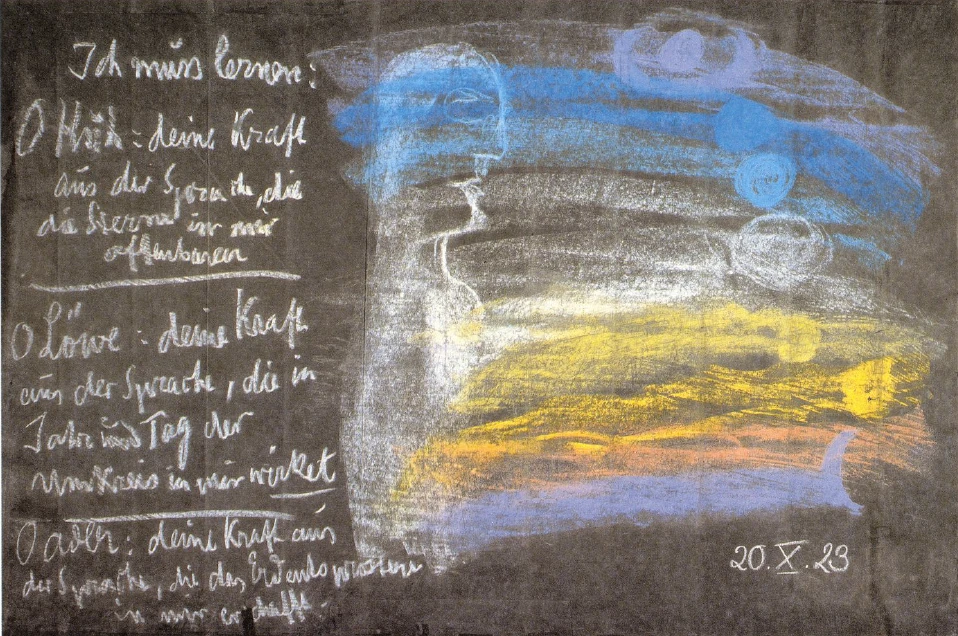
Ich muß lernen:
O Kuh,
Deine Kraft aus der Sprache,
Die die Sterne in mir offenbaren.
I must learn:
O cow,
Your power from language,
Which the stars reveal within me.
[ 37 ] Nicht Erdenschwere, nicht bloß Wiegen, Zählen und Messen, nicht bloß dasjenige lernen, was in der physischen Organisation der Kuh liegt, sondern dasjenige, was in ihr verkörpert ist, das scheue Abwenden des Blicks von der Kuhorganisation zu dem, was sie verkörpert; hinaufwenden den Blick in die Höhen: dann, dann wird vergeistigt, was sonst mechanistische Zivilisation der Erde würde.
[ 37 ] Not earthly heaviness, not merely weighing, counting, and measuring; not merely learning what lies in the physical organization of the cow, but rather what is embodied in her—the shy turning of the gaze away from the cow’s physical organization toward what she embodies; to turn one’s gaze upward toward the heights: then, then what would otherwise become the mechanistic civilization of the earth is spiritualized.
[ 38 ] Das Zweite, wovon der Mensch sich sagen muß:
[ 38 ] The second thing a person must tell himself:
Ich muß lernen:
O Löwe,
Deine Kraft aus der Sprache,
Die in Jahr und Tag
Der Umkreis in mir wirket.
I must learn:
O Lion,
Your power comes from language,
Which, year after year and day after day,
Works within me.
[ 39 ] Achten Sie auf das «offenbaren», auf das «wirken»! Und das Dritte, was der Mensch lernen muß, ist:
[ 39 ] Pay attention to the “revealing” and the “acting”! And the third thing a person must learn is:
O Adler:
Deine Kraft aus der Sprache,
Die das Erd-Entsprossene in mir erschafft.
O Eagle:
Your power comes from language,
Which creates within me that which springs from the earth.
[ 40 ] So muß der Mensch seinen Dreispruch entgegensetzen den einseitigen Lockrufen, jenen Dreispruch, dessen Sinn die Einseitigkeiten zum harmonischen Ausgleich bringen kann. Er muß lernen, zur Kuh zu schauen, aber von der Kuh, nachdem er sie gründlich empfunden hat, aufzuschauen zu dem, was die Sprache der Sterne offenbart. Er muß lernen, aufzurichten den Blick zum Adler, und, nachdem er die Natur des Adlers gründlich in sich empfunden hat, mit dem Blick, mit dem, was ihm die Natur des Adlers gegeben hat, hinunterzuschauen auf das, was in der Erde sprießt und sproßt und auch im Menschen in seiner Organisation wirkt von unten herauf. Und er muß lernen, den Löwen so anzuschauen, daß ihm vom Löwen geoffenbart wird, was ihn umweht im Winde, anblitzt im Blitze, was um ihn herum grollt im Donner, was Wind und Wetter im Jahreslaufe in dem ganzen Erdenleben, in das der Mensch eingespannt ist, bewirken. Wenn der Mensch also — physischen Blick nach aufwärts mit nach abwärts gerichtetem Geistesblick, physischen Blick nach abwärts mit nach aufwärts gerichtetem Geistesblick, geradeaus nach Osten gerichteten physischen Blick mit geradeaus entgegengesetzt nach Westen gerichtetem Geistesblick —, wenn der Mensch also imstande ist, oben und unten und vorne und rückwärts, Geistesblick und physischen Blick einander durchdringen zu lassen, dann vermag er die wirklichen, die ihn kräftigenden und nicht schwächenden Rufe des Adlers aus den Höhen, des Löwen aus dem Umkreis, der Kuh aus dem Inneren der Erde zu vernehmen.
[ 40 ] Thus, human beings must counter the one-sided lures with their threefold saying—that threefold saying whose meaning can bring these one-sidednesses into harmonious balance. They must learn to look at the cow, but—after having thoroughly sensed it—to look up from the cow to what the language of the stars reveals. He must learn to raise his gaze to the eagle, and, after having thoroughly internalized the nature of the eagle, to look down with that gaze—with what the nature of the eagle has given him—upon what sprouts and grows in the earth and also works within the human being, rising from below. And he must learn to look at the lion in such a way that the lion reveals to him what sweeps around him in the wind, flashes in the lightning, what rumbles around him in the thunder, and what wind and weather bring about over the course of the year in the entire life of the earth, into which human beings are woven. So when a person—with their physical gaze directed upward and their spiritual gaze directed downward, with their physical gaze directed downward and their spiritual gaze directed upward, with their physical gaze directed straight ahead toward the east and their spiritual gaze directed straight ahead in the opposite direction toward the west—when a person is thus able to allow their spiritual and physical gazes to interpenetrate one another in all directions—up and down, forward and backward— to allow the spiritual gaze and the physical gaze to interpenetrate one another, then he is able to hear the true, life-strengthening—rather than life-weakening—calls of the eagle from on high, the lion from the surrounding wilderness, and the cow from the interior of the earth.
[ 41 ] Das ist es, was der Mensch lernen soll über sein Verhältnis zum Weltenall, auf daß er immer geeigneter werde im Wirken für die Erdenzivilisation, und nicht dem Niedergange, sondern dem Aufgange diene.
[ 41 ] This is what human beings should learn about their relationship to the universe, so that they may become increasingly capable of working for the benefit of Earth’s civilization and serve not its decline but its rise.
Lerne mein Wesen erkennen!
Ich gebe dir die Kraft,
Im eignen Haupte
Ein Weltenall zu schaffen.
Learn to recognize my essence!
I give you the power,
Within your own mind
To create a universe.
[ 42 ] —So spricht der Adler (Westen)
[ 42 ] —Thus Speaks the Eagle (West)
Lerne mein Wesen erkennen!
Ich gebe dir die Kraft,
Im Schein des Luftkreises
Das Weltenall zu verkörpern.
Learn to recognize my essence!
I give you the strength,
In the glow of the circle of air
To embody the entire universe.
[ 43 ] —So spricht der Löwe (Mitte)
[ 43 ] —Thus Speaks the Lion (Center)
Lerne mein Wesen erkennen
Ich gebe dir die Kraft,
Waage, Meßlatte und Zahl
Dem Weltenall zu entreißen.
Learn to recognize my essence
I give you the strength
To wrest the scales, the measuring rod, and the number
From the universe.
[ 44 ] So spricht die Kuh (Orient)
[ 44 ] Thus Speaks the Cow (Orient)
[ 45 ] Ich muß lernen
[ 45 ] I have to study
O Kuh: deine Kraft
Aus der Sprache,
Die die Sterne in mir offenbaren —O Löwe: deine Kraft
Aus der Sprache,
Die in Jahr und Tag
Der Umkreis in mir wirketO Adler: deine Kraft
Aus der Sprache,
die das Erd-Entsprossene in mir erschafft.
O Cow: your power
From the language,
That the stars reveal within me —O Lion: your power
From the language,
That in year and day
The cycle works within meO Eagle: your power
From the language,
that creates within me what springs from the earth.