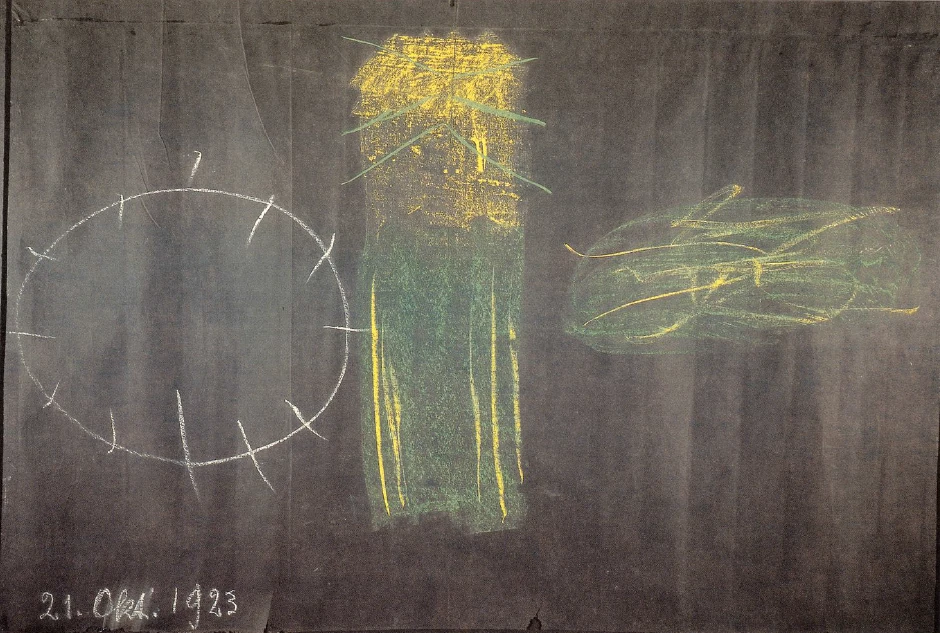
Humanity as the harmony of the
creative, formative, and shaping Word of the World
GA 230
21 October 1923, Dornach
Translate the original German text into any language:
Versions Available:
Man as Symphony of the Creative Word, tr. Compton-Burnett
Dritter Vortrag
Lecture III
[ 1 ] Wir haben versucht, den Menschen wiederum von einem gewissen Gesichtspunkte aus in das Weltenall hineinzustellen. Wir wollen heute eine Betrachtung anstellen, die das Ganze, ich möchte sagen, zusammenfassen kann. Wir leben innerhalb unseres physischen Lebens auf der Erde, sind umgeben von denjenigen Ereignissen und Tatsachen, welche da sind durch den physischen Stoff der Erde, der in der verschiedensten Weise geformt, gestaltet wird zu den Wesen der Naturreiche, zu der menschlichen Gestalt selber. In alledem west eben der physische Stoff der Erde. Nennen wir ihn heute einmal, diesen physischen Stoff, weil wir gleich nachher von seinem Gegensatze werden sprechen müssen, die Physische Substanz der Erde, dasjenige also, was den verschiedenen Gestaltungen der Erde stofflich zugrunde liegt, und unterscheiden wir davon das, was als der Gegensatz dieser physischen Substanz im Weltenall vorhanden ist, die geistige Substanz, die zum Beispiel unserer eigenen Seele zugrunde liegt, die aber auch sonst im Weltenall denjenigen Gestaltungen zugrunde liegt, die sich als geistige mit den physischen Gestaltungen verbinden.
[ 1 ] We have tried, again from a particular aspect, to place the human being into the universe. Today we wish to put the subject forward in a way which will, as it were, weld everything into a whole. During our physical life we live upon the earth; we are surrounded by those events and facts which are there because of the physical matter of the earth. This matter is moulded and shaped in the most varied manner so as to be adapted to the beings of the kingdoms of nature, up to the human form itself. The essential element in all this is the physical matter of the earth. Today—because we shall immediately have to speak about its opposite—let us call this matter the physical substance of the earth, comprising all that provides the material basis for the various earthly forms; and then let us differentiate from it everything in the universe which is the opposite of this physical substance, namely spiritual substance. This last is the basis not only of our own soul, but also of all those formations in the universe which, as spiritual formations, are connected with physical formations.
[ 2 ] Man kommt nicht zurecht, wenn man nur von einem physischen Stoff oder einer physischen Substanz spricht. Sie brauchen ja nur daran zu denken, daß wir in das Gesamtbild unserer Welt hineinstellen mußten die Wesenheiten der höheren Hierarchien. Diese Wesenheiten der höheren Hierarchien haben nicht Erdensubstanz, nicht physische Substanz in dem, was wir bei ihnen Leiblichkeit nennen würden. Sie haben eben geistige Substanz. So daß wir sehen können auf das Irdische, und wir werden physische Substanz gewahr; so daß wir sehen können auf das Außerirdische, und wir werden geistige Substanz gewahr.
[ 2 ] It is not right to speak only of physical matter or physical substance. Think only of the fact that we must place into the total picture of the world the beings of the higher hierarchies. These beings of the higher hierarchies have no earthly substance, no physical substance, in what in their case we would call their bodily nature. What they have is spiritual substance. When we look upon what is earthly, we become aware of physical substance; when we can look upon what is outside the earthly, we become aware of spiritual substance.
[ 3 ] Heute kennt man wenig von geistiger Substanz, und so spricht man auch von demjenigen Erdenwesen, das zugleich der physischen und der geistigen Welt angehört, von dem Menschen, so, als ob er eben nur physische Substanz hätte. Das ist aber nicht der Fall. Der Mensch trägt durchaus in sich geistige und physische Substanz, und er trägt sogar diese geistige und physische Substanz in einer so eigenartigen Weise in sich, daß es zunächst überraschend sein muß für denjenigen, der auf solche Dinge nicht gewöhnt ist zu achten. Wenn wir nämlich dasjenige am Menschen in Betracht ziehen, was gerade den Menschen überführt in die Bewegung, was also am Menschen Gliedmaßen sind, und was sich dann von den Gliedmaßen aus nach innen fortsetzt als die Stoffwechseltätigkeit, so ist es unrichtig, wenn wir da in der Hauptsache von physischer Substanz reden. Sie werden gleich nachher das noch genauer durchschauen. Wir reden von dem Menschen nur richtig, wenn wir gerade seine sogenannte niedere Natur so sehen, daß ihr eine im Grunde genommen geistige Substanz zugrunde liegt. So daß, wenn wir uns schematisch den Menschen aufzeichnen wollen, wir das in der folgenden Weise tun müssen.
[ 3 ] Today people know little of spiritual substance. That is why they also speak of that earth-being, who belongs both to the physical and the spiritual—the human being—as though he, too, only possessed physical substance. This, however, is not the case. Man bears both spiritual and physical substance in himself in so remarkable a way as to astonish anyone who is not accustomed to pay heed to such matters. If, for example, we consider that element in man which leads him into movement, namely what is connected with the human limb-system and its continuation inwards as digestive activity, then it is incorrect to speak primarily of physical substance. You will soon understand this still more exactly. We only speak correctly about the human being when we regard the so-called lower part of his nature as having as its basis what is in fact spiritual substance.
[ 4 ] Wir müssen sagen: Der untere Mensch stellt uns eigentlich ein Gebilde in geistiger Substanz vor, und je weiter wir gegen das Haupt des Menschen zu kommen, desto mehr ist der Mensch aus physischer Substanz gebildet. Das Haupt ist im wesentlichen aus physischer Substanz gebildet. Aber die Beine, von denen müssen wir doch sagen, trotzdem es grotesk klingt: sie sind im wesentlichen aus geistiger Substanz gebildet; wie gesagt, so grotesk es klingt. So daß, wenn wir gegen das Haupt zu gehen, wir den Menschen so zeichnen müssen (es wird gezeichnet), daß wir die geistige Substanz in die physische Substanz übergehen lassen; und insbesondere ist die physische Substanz in dem Haupte des Menschen enthalten. Dagegen ist die geistige Substanz besonders schön ausgebreitet, möchte ich sagen, da, wo der Mensch seine Beine in den Raum hineinstreckt, oder seine Arme in den Raum hineinstreckt. Es ist wirklich so, wie wenn das für Arm und Bein die Hauptsache wäre, daß da diese geistige Substanz sie erfüllt, ihr Wesentliches ist. Es ist wirklich so, daß für Arm und Bein die physische Substanz gewissermaßen da nur in der geistigen Substanz drinnen schwimmt, während das Haupt in der Tat sozusagen ein kompaktes Gebilde aus physischer Substanz ist. — Wir haben aber an einem solchen Gebilde, wie der Mensch es ist, nicht bloß zu unterscheiden die Substanz, sondern wir haben in seiner Gestaltung die Kräfte zu unterscheiden. Auch da müssen wir wiederum unterscheiden zwischen geistigen Kräften und irdisch-physischen Kräften.
[ 4 ] So that, if we were to represent the human being schematically, we would have to say: The lower man actually shows us a formation in spiritual substance, and the more nearly we approach the human head, the more is man formed of physical substance. Basically the head is formed out of physical substance; but of the legs—grotesque though this may sound—it must be said that essentially they are formed of spiritual substance. So that, when we approach the head, we must represent the human being in such a way that we allow spiritual substance to pass over into physical substance; in the human head where in particular physical substance is contained. Spiritual substance, on the other hand, is diffused in a particularly beautiful way just where—if I may put it so—man stretches out his legs, stretches out his arms, into space. It is really as though the most important matter for arm and leg is precisely this being filled with spiritual substance, as if this is their essence. In the case of arm and leg it is really as though the physical substance were only swimming in the spiritual substance, whereas the head presents a compact formation composed of physical substance. In a form such as man possesses, however, we must differentiate not only the substance, but also the forces. And here again we must distinguish between spiritual forces and earthly, physical forces.
[ 5 ] Nun ist es bei den Kräften gerade umgekehrt. Während für Gliedmaßen und Stoffwechsel die Substanz geistig ist, sind die Kräfte da drinnen, zum Beispiel für die Beine die Schwere, physisch. Und während die Substanz des Hauptes physisch ist, sind die Kräfte, die darinnen spielen, geistig. Geistige Kräfte durchspielen das Haupt, physische Kräfte durchspielen die geistige Substanz des Gliedmaßen-Stoffwechselmenschen. Nur dadurch kann der Mensch völlig verstanden werden, daß man in ihm unterscheidet seine oberen Gebiete, sein Haupt und auch die oberen Brustgebiete, welche eigentlich physische Substanz sind, durcharbeitet von geistigen Kräften — ich möchte sagen, die niedersten geistigen Kräfte arbeiten in der Atmung —, und den unteren Menschen müssen wir ansehen als ein Gebilde von geistiger Substanz, in der physische Kräfte drinnen arbeiten. Nur müssen wir natürlich uns klar darüber sein, wie es sich bei diesen Dingen eigentlich beim Menschen verhält. Der Mensch erstreckt nämlich seine Hauptesnatur in seinen ganzen Organismus, so daß der Kopf allerdings auch dasjenige, was er dadurch ist, daß er physische Substanz, durcharbeitet von geistigen Kräften, ist, daß er dies sein ganzes Wesen auch in das Untere des Menschen hinein erstreckt. Das, was der Mensch durch seine Geistessubstanz ist, in der physische Kräfte arbeiten, wird wiederum heraufgespielt nach dem oberen Menschen. Was da im Menschen wirkt, das durchdringt sich gegenseitig. Aber verstehen kann man den Menschen doch nur, wenn man ihn in dieser Weise als physisch-geistiges Substantielles und Dynamisches, das heißt Kräftewesen, betrachtet.
[ 5 ] In the case of the forces, things are completely reversed. Whereas for the limb-system and digestion the substance is spiritual, the forces in the limbs, for instance in the legs, are heavy, physical forces. And whereas the substance of the head is physical, the forces active within it are spiritual. Spiritual forces play through the head; physical forces play through the spiritual substance of the limb and metabolic system in man. The human being can only be fully understood when we distinguish in him the upper region, his head and also the upper part of the breast, which are actually physical substance worked through by spiritual forces (I must mention that the lowest spiritual forces are active in the breathing). And we must regard the lower part of man as a formation composed of spiritual substance, within which physical forces are working. Only we must be clear as to how these things are interrelated in man, for the human being also projects his head-nature into his whole organism, so that the head—which is what it is because it is composed of physical substance worked through by spiritual forces—the head also projects its entire nature into the lower part of the human being; and what man is because of his spiritual substance, in which physical forces are at work, this, on the other hand, plays upwards into the upper part of the organism. In these activities in the human being there is mutual interaction. Man can in fact only be understood when he is regarded in this way, as composed of physical-spiritual substantiality and physical-spiritual dynamics, that is to say what is of the nature of forces.
[ 6 ] Das hat schon auch seine große Bedeutung. Denn wenn man von den äußeren Erscheinungen absieht und auf das innere Wesen eingeht, so zeigt sich uns zum Beispiel, daß keine Unregelmäßigkeit eintreten darf in dieser Verteilung des Substantiellen und des Kräftemäßigen beim Menschen.
[ 6 ] This is something of great significance. For if we look away from external phenomena, and enter into the inner being, it becomes clear to us, for instance, that no irregularities can be allowed to enter into this apportioning of what is of the nature of substance and of forces in the human being.
[ 7 ] Dringt zum Beispiel in dasjenige, was reine Substanz, rein geistige Substanz sein soll beim Menschen, der physische Stoff, die physische Substanz ein, macht sich also zum Beispiel im Stoffwechselsystem die physische Substanz zu stark geltend, die eigentlich nach dem Haupte hinführt, wird gewissermaßen der Stoffwechsel zu stark von der Haupteswesenheit durchdrungen, dann wird der Mensch krank, dann entstehen ganz bestimmte Krankheitstypen. Und die Aufgabe der Heilung besteht dann darin, diese im geistig Substantiellen sich breitmachende physische Substanzgestaltung wiederum zu paralysieren, herauszutreiben. Andererseits, wenn das Verdauungssystem des Menschen in seiner eigentümlichen Art, durcharbeitet zu sein von physischen Kräften in geistiger Substanz, wenn dieses hinaufgeschickt wird nach dem Haupte, dann wird das menschliche Haupt zu stark, wenn ich mich so ausdrücken darf, spiritualisiert, dann tritt eine zu starke Spiritualisierung des Hauptes ein. Dann muß man dafür sorgen, weil das einen Krankheitszustand darstellt, genügend physischeErnährungskräfte dem Haupte zuzusenden, so daß diese beim Haupte so ankommen, daß sie nicht spiritualisiert werden.
[ 7 ] If, for example, what should be pure substance, pure spiritual substance in man, is too strongly penetrated by physical matter, by physical substance—if, that is to say, physical substance which should in fact tend upwards towards the head makes itself too strongly felt in the metabolism—then digestion becomes too strongly affected by the head-system, and man becomes ill; certain quite definite types of illness then arise. And then the task of healing consists in paralyzing, in driving out, the physical substance-formation which is intruding into the spiritual substantiality. On the other hand, when man's digestive system, in its peculiar manner of being worked through by physical forces in spiritual substance, when this digestive system is sent up towards the head, then the head becomes, as it were, too strongly spiritualised, then there sets in a too strong spiritualisation of the head. And now, because this also presents a condition of illness, care must be taken to send enough physical forces of nourishment to the head, so that they reach the head in such a way that they do not become spiritualized.
[ 8 ] Wer auf den gesunden und kranken Menschen blickt, wird die Nützlichkeit dieser Unterscheidung sehr bald einsehen können, wenn es ihm überhaupt um die Wahrheit, nicht bloß um den äußeren Schein zu tun ist. Aber in dieser Sache spielt noch etwas wesentlich anderes. Das, was da spielt, als was der Mensch sich fühlt dadurch, daß er ein so geartetes Wesen ist, wie ich es dargestellt habe, das bleibt zunächst bei dem gewöhnlichen heutigen Bewußtsein eben im Unterbewußtsein. Da ist es schon vorhanden. Da tritt es als eine Art Stimmung, Lebensstimmung des Menschen auf. Aber zum vollen Bewußtsein bringt es doch nur die geistige Anschauung, und diese geistige Anschauung kann ich Ihnen nur so schildern: Derjenige, der aus der heutigen Initiationswissenschaft heraus dieses Geheimnis vom Menschen weiß, daß eigentlich das hauptsächlichste, das wesentlichste Organ, welches der physischen Substanz bedarf, das Haupt ist, damit es diese physische Substanz mit den geistigen Kräften durcharbeiten kann, und wer weiter weiß, daß im Gliedmaßen-Stoffwechselmenschen das Wesentliche die geistige Substanz ist, die der physischen Kräfte bedarf, der Schwerkräfte, der Gleichgewichtskräfte und der anderen physischen Kräfte, um zu bestehen, derjenige, der so dieses Geheimnis des Menschen geistig durchschaut und dann zurückblickt auf dieses menschliche irdische Dasein, der kommt eigentlich sich als Mensch selber wie ein ungeheurer Schuldner gegenüber der Erde vor. Denn auf der einen Seite muß er sich sagen, er bedarf, damit er sein Menschenwesen aufrecht erhalten kann, gewisser Bedingungen; aber durch diese Bedingungen wird er eigentlich der Schuldner der Erde. Er entzieht fortwährend etwas der Erde. Er kommt nämlich darauf, sich sagen zu müssen: das, was er an geistiger Substanz in sich trägt während des Erdendaseins, das braucht eigentlich die Erde. Das sollte er eigentlich, wenn er durch den Tod geht, der Erde zurücklassen, denn die Erde bedarf zu ihrer Erneuerung fortwährend geistiger Substanz. Er kann es nicht, denn er würde seinen Menschenweg durch die Zeit nach dem Tode nicht zurücklegen können. Er muß diese geistige Substanz mitnehmen für das Leben zwischen dem Tode und einer neuen Geburt, weil er sie braucht, weil er sozusagen verschwinden würde nach dem Tode, wenn er diese geistige Substanz nicht mitnehmen würde durch den Tod.
[ 8 ] Anyone who turns his attention to man in health and sickness will very soon be able to perceive the usefulness of this differentiation, if he is really concerned with truth, and not with external illusion. But something essentially different also plays into this matter. What here plays in—the fact that man feels himself as a being constituted in the way I have described—this at first remains for the ordinary consciousness of today below in the unconscious. There, certainly, it is already present; and there it emerges as a kind of mood, a kind of life-mood of man. But it is spiritual vision alone that brings it to full consciousness, and I can only describe this spiritual vision to you thus: The man who knows from present-day initiation-science this secret of the human being, namely that the head is the most important, the most essential organ which needs physical substance with spiritual forces; who knows further that the most essential thing in the system of limbs and metabolism is spiritual substance which needs physical forces—the forces of gravity, of balance, and the other physical forces in order to exist; who can thus penetrate with spiritual vision into this secret of the human being and who then turns his gaze back to this human, earthly existence—this man must acknowledge himself as a tremendous debtor to the world. For he must admit that in order to maintain his human existence he requires certain conditions; but through these very conditions he becomes a debtor to the earth. He is continually withdrawing something from the earth. And he finds himself obliged to say that the spiritual substance, which as man he bears within himself during earthly existence, is actually needed by the earth. When man passes through death, he should in fact leave this spiritual substance behind him for the earth, for the earth continually needs spiritual substance for its renewal. But this man cannot do, for he would then be unable to traverse his human path through the period after death. He must take this spiritual substance with him for the life between death and a new birth; he needs it, for he would disappear, so to speak, after death, if he did not take this spiritual substance with him.
[ 9 ] Nur dadurch kann er jene Veränderungen durchmachen, die er durchmachen muß, daß er diese geistige Substanz seines Gliedmaßen-Stoffwechselmenschen durch die Pforte des Todes hinüberträgt in die geistige Welt. Und so würde der Mensch nicht künftigen Inkarnationen unterliegen können, wenn er der Erde das, was er ihr eigentlich schuldet, diese geistige Substanz, geben würde. Er kann es nicht. Er bleibt ein Schuldner. Das ist etwas, was zunächst durch nichts zu verbessern ist, soweit die Erde in ihrem Mittelzustande ist. Am Ende des Erdendaseins wird es anders sein.
[ 9 ] Only by carrying this spiritual substance of his limb-metabolic system through the gate of death can man undergo those transformations which he must there undergo. He would be unable to meet his future incarnations if he were to give back to the earth this spiritual substance which he actually owes to it. He cannot do this. He remains a debtor. And this is something which there is no means of bettering as long as the earth remains in its middle period. At the end of earth-existence things will be otherwise.
[ 10 ] Es ist einmal so, meine lieben Freunde, daß derjenige, der mit der Geistesschau das Leben ansieht, nicht allein jene Schmerzen und Leiden, meinetwillen auch jenes Glück und jene Freude hat, die so das gewöhnliche Leben gibt, sondern daß mit dem Schauen des Geistigen kosmische Gefühle, kosmische Leiden und Freuden auftreten. Und Initiation ist nicht trennbar von dem Auftreten solcher kosmischer Leiden, zum Beispiel wie das ist, daß man sich sagt: Einfach dadurch, daß ich mein Menschenwesen aufrecht erhalte, muß ich mich zum, Schuldner der Erde gestalten. Ich kann der Erde das nicht geben, was ich ihr eigentlich, wenn ich kosmisch ganz rechtschaffen wäre, geben müßte.
[ 10 ] It is indeed the case, my dear friends, that one who beholds life with spiritual vision has not only those sufferings and sorrows—perhaps also that happiness and joy—which are offered by ordinary life, but, with the beholding of the spiritual, cosmic feelings, cosmic sufferings and joys, make their appearance. And initiation is inseparable from the appearance of such cosmic suffering as, for example, the fact that one has to admit: Simply because I must maintain my humanity I must make of myself a debtor to the earth. I cannot give to the earth what I really should give if, in a cosmic sense, I were to act with complete rectitude.
[ 11 ] Ein Ähnliches ist mit dem, was in der Kopfsubstanz da ist. Dadurch, daß das ganze Erdenleben hindurch geistige Kräfte in der materiellen Kopfsubstanz arbeiten, dadurch wird diese Kopfsubstanz der Erde entfremdet. Der Mensch muß ja die Substanz für seinen Kopf der Erde entnehmen. Aber er muß auch, um Mensch zu sein, diese Substanz seines Kopfes fortwährend mit den geistigen Kräften des Außerirdischen durchdringen. Und wenn der Mensch stirbt, ist es für die Erde etwas außerordentlich Störendes, daß sie jetzt zurücknehmen muß die Kopfmaterie des Menschen, die ihr so fremd geworden ist. Wenn der Mensch durch die Pforte des Todes gegangen ist und er seine Hauptessubstanz der Erde übergibt, dann wirkt diese Hauptessubstanz, die eigentlich durchaus vergeistigt ist, die geistige Ergebnisse in sich trägt, im Grunde genommen im Ganzen des Erdenlebens vergiftend, eigentlich störend dieses Erdenleben. Der Mensch muß sich eigentlich sagen, wenn er diese Dinge durchschaut: rechtschaffen wäre es von ihm, diese Substanz nun mitzunehmen gerade durch die Pforte des Todes, weil sie eigentlich viel besser passen würde in die geistige Region hinein, die der Mensch durchschreitet zwischen dem Tode und einer neuen Geburt. Das kann er nicht. Denn der Mensch würde, wenn er diese vergeistigte Erdensubstanz mitnehmen würde, sich fortwährend einen Feind schaffen für all seine Entwickelung zwischen dem Tode und einer neuen Geburt. Es wäre das Furchtbarste, was dem Menschen passieren könnte, wenn er diese vergeistigte Kopfsubstanz mitnehmen würde. Das würde fortwährend an der Vernichtung seiner geistigen Entwickelung zwischen dem Tod und einer neuen Geburt arbeiten.
[ 11 ] Matters are similar as regards the substance which is present in the head. Because throughout the entire course of earth-life spiritual forces are working in the physical substance of the head, this head-substance becomes estranged from the earth. Man must take away from the earth the substance for his head. But he must also, in order to be man, continually imbue this substance of his head with extra-terrestrial spiritual forces. And when the human being dies, this is something extremely disturbing to the earth, because it must now take back the substance of the human head which has become so foreign to it. When the human being passes through the gate of death and yields up his head-substance to the earth, then this head-substance—which is entirely spiritualized, which bears within itself what results from the spiritual—does in fact act as a poison, as a really disturbing element, in the totality of the life of the earth. When man sees into the truth of these matters, he is obliged to say to himself that the honest thing would be to take this substance with him through the gate of death, for it would in fact be much better suited to the spiritual region which man traverses between death and a new birth. He cannot do this. For if man were to take this spiritualized earth-substance with him, he would continually create something adverse to all his development between death and a new birth. It would be the most terrible thing that could happen to man if he were to take this spiritualized head-substance with him. It would work incessantly upon the negation of his spiritual development between death and rebirth.
[ 12 ] So muß man sich sagen, wenn man diese Dinge durchschaut: Man wird auch dadurch ein Schuldner an der Erde; denn etwas, was man ihr verdankt, aber unbrauchbar für sie gemacht hat, muß man fortwährend zurücklassen, kann es nicht mitnehmen. Das, was man ihr lassen soll, entzieht man ihr; dasjenige, was man mitnehmen soll, was man unbrauchbar für sie gemacht hat, das übergibt man mit seinem Erdenstaub dieser Erde, die in ihrem Gesamtleben, als Gesamtwesen ungeheuer darunter leidet.
[ 12 ] One must therefore acknowledge, when one sees into the truth of these things, that here, too, man becomes a debtor to the earth; for something for which he is indebted to the earth but has made useless for it, this he must continually leave behind, he cannot take it with him. What man should leave for the earth he takes from it; what man should take with him, what he has made useless for it, this man gives over to the earth with his earthly dust, thus causing the earth immense suffering in its entire life, in its whole collective being.
[ 13 ] Es ist schon so, daß sich zunächstgerade durch die Geistesschau etwas auf die Menschenseelen lagert, was wie eine ungeheure tragische Empfindung ist. Und nur wenn man größere Zeiträume übersieht, die Entwickelung ganzer Systeme überschaut, dann stellt sich einem der Ausblick dar, daß man zum Beispiel, wenn die Erde einmal ihrem Ende entgegengegangen sein wird, diese Schuld in den späteren Stufen der Menschheitsentwickelung, in der Jupiter-, Venus-, Vulkanstufe, sozusagen wird ausgleichen, ablegen können,
[ 13 ] It is indeed the case that at first, just through spiritual vision, something weighs heavily upon the human soul, something like a tremendous feeling of tragedy. And only when one surveys wider epochs of time, when one beholds the development of entire systems, only then is the prospect revealed that, when the earth will have approached its end, in later stages of human evolution—in the Jupiter, Venus, Vulcan stages—will man be able to restore the balance, to annul the debt.
[ 14 ] Also nicht nur dadurch, daß man ein einzelnes Erdenleben durchmacht, schafft man Karma, sondern man schafft Karma, Weltenkarma, kosmisches Karma überhaupt dadurch, daß man Erdenmensch ist, daß man die Erde bewohnt und aus der Erde seine Substanzen zieht.
[ 14 ] Thus it is not only by passing through the experiences of a single life that man fashions karma, but man creates karma, world karma, cosmic karma, just through the fact that he is an earthly human being, that he is an inhabitant of the earth, and draws his substance from the earth.
[ 15 ] Da ist es dann möglich, von dem Menschen hinwegzuschauen und auf die übrige Natur zu schauen und zu sehen, wie zwar der Mensch, ich möchte sagen, diese Schuld auf sich laden muß, von der ich Ihnen eben jetzt erzählt habe, wie aber dennoch fortwährend durch die kosmischen Wesenheiten ein Ausgleich geschaffen wird. Da dringt man ein in wunderbare Geheimnisse des Daseins, in Geheimnisse, die in der Tat, wenn man sie zusammenfaßt, erst das werden, was man als Vorstellung bekommt von der Weisheit der Welt.
[ 15 ] Here it is possible to look away from man, to look towards the rest of nature and see how—though man must burden himself with the debt of which I have just told you—balance is nevertheless continually restored by cosmic beings. And here one penetrates into wonderful secrets of existence, into secrets which, when taken in conjunction with each other, become something from which one can first gain a conception of the wisdom of the world.
[ 16 ] Wenden wir den Blick vom Menschen weg auf etwas, worauf wir in den letzten Tagen vielfach diesen Blick gewendet haben, wenden wir den Blick zur Vogelwelt, die uns repräsentiert war in den letzten Tagen durch den Adler. Wir sprachen von dem Adler als dem Repräsentanten der Vogelwelt, als demjenigen Tier, das sozusagen zusammenfaßt die Eigenschaften und Kräfte der Vogelwelt. Und indem wir den Adler betrachten, betrachten wir eigentlich dasjenige, was im kosmischen Zusammenhange der ganzen Vogelwelt obliegt. Ich werde also in Zukunft einfach vom Adler sprechen. — Ich habe Ihnen davon gesprochen, wie eigentlich der Adler dem Kopf des Menschen entspricht, und wie diejenigen Kräfte, die im Menschenkopf die Gedanken auslösen, bei dem Adler das Gefieder auslösen. So daß eigentlich in dem Adlergefieder die sonnendurchströmten Luftkräfte, die lichtdurchströmten Luftkräfte wirken. Das schimmert in dem Adlergefieder: die Luftkraft lichtdurchdrungen.
[ 16 ] Let us turn our gaze away from man and towards something which has claimed much of our attention during the last few days, let us turn our gaze to the world of the birds, represented for us by the eagle. We spoke of the eagle as the representative of the bird-world, as the creature which synthesizes the characteristics and forces of the bird-kingdom. When we consider the eagle, we are in fact considering, in their cosmic connection, all the attributes which prevail in the bird-world as a whole. In future, therefore, I shall simply speak of “the eagle”. I have told you how the eagle actually corresponds to the head of man, and how those forces which give rise to thoughts in the human head give rise in the eagle to his plumage. So that the sun-irradiated forces of the air, the light-imbued forces of the air, are actually working in the eagle's plumage. This is what shimmers in the eagle's plumage—the light-irradiated power of the air.
[ 17 ] Nun hat der Adler, dem man ja manche schlimmen Eigenschaften zuschreiben kann, eben doch die merkwürdige Eigenschaft in bezug auf sein kosmisches Dasein, daß gewissermaßen außerhalb seiner Haut, in der Gestaltung des Gefieders alles dasjenige bleibt, was diese sonnendurchwirkten Luftkräfte an ihm bilden. Was da geschieht, merkt man nämlich erst, wenn der Adler stirbt.
[ 17 ] Now the eagle—to whom many bad qualities may certainly be ascribed—does nevertheless possess, as regards his cosmic being, the remarkable attribute that outside his skin, in the structure of his plumage, everything is retained which is formed in it by the sun-irradiated forces of the air. What takes place here is, in fact, only to be noticed when the eagle dies.
[ 18 ] Wenn der Adler stirbt, wird einem erst klar, was für eine merkwürdige, ich möchte sagen, oberflächliche Verdauung der Adler hat gegenüber der gründlichen Verdauung der Kuh mit ihrem Wiederkäuen. Die Kuh ist wirklich das Verdauungstier — wiederum als Repräsentant für viele aus dem Tiergeschlechte. Da wird gründlich verdaut. Der Adler verdaut wie jeder Vogel oberflächlich. Es wird alles nur angefangen sozusagen, das Verdauungsgeschäft nur angefangen. Und ich möchte sagen, es ist im Adlersein dieses Verdauen, wenn wir auf das Ganze sehen, eigentlich ein Nebengeschäft des Daseins; es wird überall im Adler als ein Nebengeschäft behandelt. Dagegen verläuft gründlich im Adler alles, was auf sein Gefieder verwendet wird. Bei anderen Vögeln ist gerade das noch stärker. Da wird mit ungeheurer Sorgfalt alles in den Federn ausgearbeitet. Und solch eine Vogelfeder ist eigentlich ein wunderbares Gebilde. Da kommt nämlich am stärksten zustande dasjenige, was man irdische Materie nennen möchte, die der Adler der Erde entnimmt, und die von den oberen Kräften durchgeistigt wird, aber so, daß es nicht angeeignet wird von dem Adler; denn der Adler macht keinen Anspruch auf Reinkarnation. Ihn braucht es daher nicht zu genieren, was dann geschieht durch das, was da durch die oberen geistigen Kräfte an der irdischen Materie in seinem Gefieder bewirkt wird; ihn braucht nicht zu genieren, wie das nun weiterwirkt in der geistigen Welt.
[ 18 ] For it is only when the eagle dies that one becomes aware of what a remarkable superficial digestion he has compared with the thorough-going digestion of the cow, with its process of chewing the cud. The cow is really the animal of digestion—again as representative of many creatures of the animal kingdom. Here digestion is thoroughly performed. The eagle, like all birds, digests in a superficial way; the business of digestion is only begun. In the eagle, compared with his whole existence, digestion is merely a subsidiary process and is treated as such. On the other hand, everything in the eagle which has to do with plumage proceeds in a thorough way. (In the case of some other birds this is even more so.) Everything to do with the feathers is worked out with immense care. Such a feather is indeed a wonderful structure. Here we find most strongly in evidence what may be called earthly matter, which the eagle has taken from the earth, spiritualized by the forces of the heights, but in such a way that the eagle does not assimilate it; for the eagle makes no claim to reincarnation. He need not, therefore, be troubled about what is being brought about in the earthly matter of his plumage through the spiritual forces of the heights; he need not be troubled about how this works on in the spiritual world.
[ 19 ] So sehen wir denn, wenn der Adler stirbt und sein Gefieder nun auch zugrunde geht — wie gesagt, es gilt das für jeden Vogel —, daß da die vergeistigte irdische Materie in das Geisterland hinausgeht, zurückverwandelt wird in geistige Substanz.
[ 19 ] Now, when the eagle dies and his feathers fall into decay—as already mentioned this holds good for every bird—the spiritualized earthly matter ascends into spirit-land and becomes changed back into spiritual substance.
[ 20 ] Sie sehen, wir haben eine merkwürdige verwandtschaftliche Beziehung in bezug auf unser Haupt zum Adler. Was wir nicht können, der Adler kann es: Der Adler schafft fortwährend von der Erde fort dasjenige, was in der Erde durch die geistigen Kräfte an physischer Substanz vergeistigt wird.
[ 20 ] You see we have a remarkable relative interplay as regards the relationship of our head to the eagle. What we cannot do, the eagle can; he can continually conjure forth from the earth what becomes spiritualized in the earth through spiritual forces working on earthly substance.
[ 21 ] Das ist es auch, weshalb wir mit unserer Empfindung so merkwürdig den Adler in seinem Flug betrachten. Wir empfinden ihn als etwas Erdenfremdes, als etwas, was mit dem Himmel mehr zu tun hat als mit der Erde, obwohl er ja von der Erde seine Substanz holt. Aber wie holt er sie? Er holt sie so, daß er für die Erdensubstanz nur ein Räuber ist. Ich möchte sagen, es ist nicht im gewöhnlichen banalen Gesetz des Erdendaseins vorgesehen, daß der Adler auch noch etwas bekommt. Er stiehlt sich, er raubt sich seine Materie, wie überhaupt das Vogelgeschlecht vielfach die Materie raubt. Aber er gleicht aus, der Adler. Er raubt sich seine Materie, aber er läßt sie vergeistigen von den Kräften, die als geistige Kräfte in den oberen Regionen sind, und er entführt nach seinem Tode diese vergeisteten Erdenkräfte, die er geraubt hat, ins Geisterland. Mit den Adlern zieht die vergeistigte Erdenmaterie hinaus ins Geisterland.
[ 21 ] This, too, is why we experience such a remarkable sensation when we observe an eagle in its flight. We feel him as something foreign to the earth, something which has more to do with the heavens than with the earth, although he draws his substance from the earth. But how does he do this? He obtains his substance in such a way that, as regards the earth, he is just a robber. For according to what may be called the ordinary, commonplace law of earth-existence no provision was made for the eagle to get anything. He becomes a robber; he steals his substance, as is done in all sorts of ways by the bird-kingdom as a whole. But the eagle restores the balance. He steals his material substance, but allows it to be spiritualized by the forces which exist as spiritual forces in the upper regions; and after death he carries off into spirit-land those spiritualized earth-forces which he has stolen. With the eagles the spiritualized earth-matter withdraws into spirit-land.
[ 22 ] Das Leben der Tiere ist auch nicht abgeschlossen, wenn sie sterben. Sie haben ihre Bedeutung im Weltenall. Und fliegt der Adler als physischer Adler, so ist er gewissermaßen nur ein Sinnbild seines Daseins; so fliegt er als physischer Adler. Oh, er fliegt weiter nach seinem Tode! Es fliegt die vergeistigte physische Materie der Adlernatur hinein in die Weiten, um sich zu vereinigen mit der Geistmaterie des Geisterlandes.
[ 22 ] Now the life of animals also does not come to an end when they die. They have their significance in the universe. And the eagle in flight is only a symbol of his real being. He flies as physical eagle—Oh, but he flies further after his death! The spiritualized physical matter of the eagle nature flies into the universe in order to unite itself with the spiritual substance of spirit-land.
[ 23 ] Sie sehen, man kommt auf wunderbare Geheimnisse im Weltenall, wenn man diese Dinge durchschaut. Dann erst sagt man sich, warum denn eigentlich diese verschiedenen Tier- und anderen Gestaltungen der Erde da sind. Sie haben alle ihre große, ihre ungeheure Bedeutung im ganzen Weltenall.
[ 23 ] You see what wonderful secrets of the universe one comes upon when one enters into the reality of these things. Only then does one really learn why the various animal and other forms of the earth are there. They all have their great, their immense significance in the whole universe.
[ 24 ] Gehen wir jetzt zu dem anderen Extrem, das wir auch in diesen Tagen betrachtet haben, gehen wir zu der von dem Hindu so verehrten Kuh. Da haben wir allerdings das andere Extrem. Wie der Adler dem menschlichen Kopfe sehr ähnlich ist, ist die Kuh sehr ähnlich dem menschlichen Stoffwechselsystem. Sie ist das Verdauungstier. Und, so sonderbar es klingt, dieses Verdauungstier besteht eigentlich wesenhaft aus geistiger Substanz, in die nur eingespannt und eingestreut ist die physische Materie, die aufgezehrt wird. Da ist in der Kuh die geistige Substanz (es wird gezeichnet), und die physische Materie dringt hier überall ein und wird von der geistigen Substanz aufgenommen, verarbeiter. Damit das ganz gründlich geschieht, ist das Verdauungsgeschäft der Kuh ein so ausführliches, gründliches. Es ist das gründlichste Verdauungsgeschäft, das man sich denken kann, und in dieser Beziehung besorgt wirklich die Kuh am gründlichsten das Tiersein. Die Kuh ist gründlich Tier. Sie bringt tatsächlich das Tiersein, diesen Tieregoismus, diese Tier-Ichheit aus dem Weltenall auf die Erde in den Bereich der Schwerkraft der Erde herunter.
[ 24 ] And now let us turn to the other extreme, to something which we have also studied during these days, let us turn to the cow, so venerated by the Hindu. There we have the opposite extreme. Just as the eagle is very similar to the head, so is the cow very similar to the human digestive system. The cow is the animal of digestion. And, strange as it sounds, this animal of digestion consists essentially of spiritual substance into which the physical matter consumed is merely scattered and diffused. In the cow is the spiritual substance and everywhere the physical substance penetrates into it, and is absorbed, made use of by the spiritual substance. It is in order that this may happen in a really thorough way that the process of digestion in the cow is so comprehensive, so fundamental. It is really the most fundamental digestive process that can be conceived, and in this respect—if I may put it so—the cow fosters what is fundamental to animal nature more thoroughly than any other animal in the absolute sense. She actually brings animal-nature—this animal egoism, this animal egoity—out of the universe down on to the earth, down into the region of earth-gravity.
[ 25 ] Kein anderes Tier hat dasselbe Verhältnis zwischen dem Blutgewichte und dem gesamten Körpergewichte wie die Kuh; entweder hat es weniger oder mehr Blut im Verhältnis zum Körpergewichte als die Kuh; und Gewicht hat mit der Schwere zu tun, und das Blut mit der Egoität. Nicht mit dem Ego, das hat ja nur der Mensch, aber mit der Egoität, mit dem Einzelsein. Das Blut macht auch das Tier zum Tiere, das höhere Tier wenigstens. Man möchte sagen: die Kuh hat das Weltenrätsel gelöst, wie man gerade das richtige Verhältnis hält zwischen der Schwere des Blutes und der Schwere des ganzen Körpers, wenn man so gründlich wie möglich Tier sein will.
[ 25 ] No other animal has the same proportion between the blood-weight and the entire body-weight as the cow; other animals have either less or more blood than the cow in proportion to the weight of the body. And weight has to do with gravity and the blood with egoity; not with the ego, for this is only possessed by man, but with egoity, with separate existence. The blood also makes the animal, animal—the higher animal at least. And I must say that the cow has solved the world-problem as to the right proportion between the weight of the blood and the weight of the whole body—when there is the wish to be as thoroughly animal as possible.
[ 26 ] Sehen Sie, die Alten haben nicht umsonst den Tierkreis «Tierkreis» genannt. Der ist zwölfgliedrig, verteilt gewissermaßen sein gesamtes Sein auf zwölf einzelne Teile. Diese Kräfte, die aus dem Kosmos, von dem Tierkreis kommen, die gestalten sich eben aus in den Tieren. Aber die anderen Tiere richten sich nicht so genau darnach. Die Kuh hat das Zwölftel ihres Körpergewichtes in ihrem Blutgewicht. Das Gewicht des Blutes bei der Kuh ist das Zwölftel ihres Körpergewichtes, beim Esel nur das Dreiundzwanzigstel, beim Hund das Zehntel. Alle anderen Tiere haben ein anderes Verhältnis. Beim Menschen ist das Blut ein Dreizehntel des Körpergewichtes.
[ 26 ] You see, it was not for nothing that the ancients called the zodiac “the animal circle”. The zodiac is twelvefold; it divides its totality into twelve separate parts. Those forces, which come out of the cosmos, from the zodiac, take on form and shape in the animals. But the other animals do not conform to the zodiacal proportion so exactly. The cow has a twelfth part of her body-weight in the weight of her blood. With the cow the blood-weight is a twelfth part of the body-weight; with the donkey only the twenty-third part; with the dog the tenth part. All the other animals have a different proportion. In the case of man the blood is a thirteenth of the body-weight.
[ 27 ] Sie sehen, die Kuh hat es abgesehen darauf, in der Schwere das ganze Tiersein auszudrücken, so gründlich als möglich Kosmisches auszudrücken. Was ich in diesen Tagen immer gesagt habe, daß man es am astralischen Leib der Kuh sieht, daß sie eigentlich das Obere im Physisch-Materiellen verwirklicht, das drückt sich selbst darin aus, daß sie in ihrem eigenen inneren Gewichtsverhältnisse die Zwölfteilung aufrecht erhält. Da ist sie kosmisch drinnen. Alles an der Kuh ist so, daß in die geistige Substanz hineingearbeitet werden die Kräfte der Erde. Der Erdenschwere wird es aufgedrungen, sich im Tierkreisverhältnis in der Kuh zu verteilen. Die Erdenschwere muß sich fügen, ein Zwölftel auf die Egoität entfallen zu lassen. Alles zwingt die Kuh herein in die irdischen Verhältnisse, was sie an geistiger Substanz hat. So ist die Kuh, die auf der Weide liegt, in der Tat geistige Substanz, welche die Erdenmaterie in sich aufnimmt, absorbiert, sich ähnlich macht.
[ 27 ] You see, the cow has seen to it that, in her weight, she is the expression of animal nature as such, that she is as thoroughly as possible the expression of what is cosmic. A fact I have mentioned repeatedly during these days—namely that one sees from the astral body of the cow that she actually manifests something lofty in physical-material substance—this comes to expression of itself through the fact that the cow maintains the partition into twelve in her own inner relationships of weight. The cosmic in her is at work. Everything to do with the cow is of such a nature that the forces of the earth are working into spiritual substance. In the cow earth-heaviness is obliged to distribute itself according to zodiacal proportion. Earth-heaviness must accommodate itself to allow a twelfth part of itself to fall away into egoity. What the cow possesses as spiritual substance has necessarily to enter into earthly conditions. Thus the cow, lying in the meadow, is in actual fact spiritual substance, which earth-matter takes up, absorbs, makes similar to itself.
[ 28 ] Wenn die Kuh stirbt, dann ist diese geistige Substanz, die die Kuh in sich trägt, fähig, mit der Erdenmaterie zur Wohltat des Lebens der ganzen Erde von dieser Erde aufgenommen zu werden. Und man tut recht, wenn man der Kuh gegenüber die Empfindung hat: Du bist das wahre Opfertier, denn du gibst im Grunde genommen der Erde fortwährend das, was sie braucht, ohne das sie nicht weiter bestehen könnte, ohne das sie verhärten und vertrocknen würde. Du gibst ihr fortwährend geistige Substanz und erneuerst die innere Regsamkeit, die innere Lebendigkeit der Erde.
[ 28 ] When the cow dies, this spiritual substance which the cow bears within herself can be taken up by the earth, together with the earthly matter, for the well-being of the life of the whole earth. And man is right when he feels in regard to the cow: You are the true beast of sacrifice, for you continually give to the earth what it needs, without which it could not continue to exist, without which it would harden and dry up. You continually give spiritual substance to the earth, and renew the inner mobility, the inner living activity of the earth.
[ 29 ] Und wenn Sie schauen auf der einen Seite die Weide mit den Kühen, auf der anderen Seite den fliegenden Adler, dann haben Sie da merkwürdige Gegenbilder: der Adler, der die für die Erde unbrauchbar gewordene Erdenmaterie — weil diese Materie vergeistigt ist — hinausträgt in die Weiten des Geisterlandes, wenn er stirbt; die Kuh, wenn sie stirbt, welche die Himmelsmaterie der Erde gibt und so die Erde erneuert. Der Adler entnimmt der Erde das, was sie nicht mehr brauchen kann, was zurück muß ins Geisterland. Die Kuh trägt in die Erde das herein, was die Erde fortwährend an erneuernden Kräften aus dem Geisterland braucht.
[ 29 ] When you behold on the one hand the meadow with its cattle, and on the other hand the eagle in flight, then you have their remarkable contrast: the eagle who, when he dies, carries away into the expanses of spirit-land that earth-matter, which—because it is spiritualized—has become useless for the earth; and the cow, who, when she dies, gives to the earth heavenly matter and thus renews the earth. The eagle takes from the earth what it can no longer use, what must return into spirit-land. The cow carries into the earth what the earth continually needs as renewing forces from spirit-land.
[ 30 ] Sie sehen hier etwas wie das Auftauchen von Empfindungen aus der Initiationswissenschaft heraus. Denn man hat so gewöhnlich den Glauben: diese Initiationswissenschaft, nun, die studiert man halt, aber sie gibt eigentlich nichts als Begriffe, als Ideen. Man füllt sich seinen Kopf mit Ideen über das Übersinnliche an, wie man seinen Kopf sonst anfüllt mit Ideen über das Sinnliche. Aber so ist es nicht. Immer weiterdringend in dieser Initiationswissenschaft kommt man dazu, Empfindungen, von denen man früher keine Ahnung hatte, die aber unbewußt doch in jedem Menschen sind, aus den Tiefen der Seele heraufzuholen; man kommt dazu, alle Wesen anders zu empfinden, als man sie vorher empfunden hat. So kann ich Ihnen eine Empfindung schildern, die eben zum lebendigen Ergreifen der Geisteswissenschaft, der Initiationswissenschaft, dazugehört. Das ist diese, daß man sich sagen muß: Wenn nur der Mensch auf Erden wäre, dann müßte man, wenn man die wahre Natur des Menschen erkennt, eigentlich daran verzweifeln, daß die Erde überhaupt das bekommt, was sie braucht, daß ihr in der richtigen Zeit die vergeistete Materie entnommen wird und Geistmaterie gegeben wird. Man müßte eigentlich einen solchen Gegensatz zwischen dem menschlichen und dem irdischen Dasein empfinden, der sehr, sehr weh tut, der deshalb sehr, sehr weh tut, weil man sich sagt: Soll der Mensch richtig Mensch sein auf Erden, so kann die Erde nicht richtig Erde sein durch den Menschen. Mensch und Erde brauchen einander, Mensch und Erde können sich nicht gegenseitig stützen! Was das eine Wesen braucht, geht dem anderen verloren; was das andere braucht, geht dem einen verloren. Und man hätte keine Sicherheit für den Lebenszusammenhang zwischen Mensch und Erde, wenn nicht auftauchen würde die Umwelt und man sich sagen müßte: Was der Mensch nicht vermag in bezug auf die Hinausführung der vergeistigten Erdensubstanz ins Geisterland, das vollbringt die Vogelwelt. Und was der Mensch nicht vermag der Erde zu geben an geistiger Substanz, vollbringen die wiederkäuenden Tiere, und als ihr Repräsentant: die Kuh.
[ 30 ] Here you become aware of something like an upsurging of feelings and perceptions from out of initiation-science. It is usually believed about this initiation-science, well, that one certainly studies it, but that it results in nothing but concepts, ideas. One fills one's head with ideas about the super-sensible, just as one otherwise fills one's head with ideas about the things of the senses. But this is not how it is. Penetrating ever further into this initiation-science, we reach the point of drawing forth from the depths of the soul feelings and perceptions, the existence of which we formerly did not even surmise, but which nevertheless are there unconsciously in every human being; we reach the point of experiencing all existence differently from the way we experienced it before. And so I can describe to you an experience which actually belongs to the living comprehension of spiritual science, of initiation science. It is an experience which would make us acknowledge that if man alone were upon the earth, we should—if we recognize his true nature—have to despair of the earth ever receiving what it needs, namely, that at the right time spiritualized matter should be withdrawn and spirit-substance bestowed. We should have to experience an opposition between man and the being of the earth, which causes great, great pain, and causes that pain because we have to admit that, if man is to be rightly man upon the earth, the earth cannot be rightly earth because of man. Man and earth have need of each other, but man and earth cannot mutually support each other. What the being of the one requires is lost to the other; what the other needs is lost to the one. And we should have no security as regards the life-relationship between man and earth, were it not that the surrounding world enables us to say: What the human being is unable to achieve as regards the carrying of spiritualized earth-substance over into spirit-land, this is accomplished by the bird-kingdom; and what man is unable to do as regards giving spiritual substance to the earth, this is accomplished by the animals which chew the cud, as represented by the cow.
[ 31 ] Sehen Sie, dadurch rundet sich die Welt sozusagen zu einem Ganzen. Schaut man bloß auf den Menschen, bekommt man Unsicherheit in seine Empfindung herein über das Erdendasein; schaut man auf das, was den Menschen umgibt, gewinnt man wieder die Sicherheit.
[ 31 ] In this way, you see, the world is rounded into a whole. If we look only at man, uncertainty enters our feelings as regards the being of the earth; if we look at what surrounds man our feeling of certainty is restored.
[ 32 ] Jetzt werden Sie sich noch weniger wundern, daß eine so tief ins Geistige hineingehende religiöse Weltanschauung, wie der Hinduismus, die Kuh verehrt; denn sie ist das Tier, das die Erde fortwährend vergeistigt, fortwährend der Erde jene Geistsubstanz gibt, welche sie selber aus dem Kosmos entnimmt. Und man müßte eigentlich tatsächlich das Bild real werden lassen, wie unter einer weidenden Kuhherde unten die Erde freudig erregt lebt, die Elementargeister drunten jauchzen, weil sie ihre Nahrung aus dem Kosmos versprochen erhalten durch das Dasein der Wesen, die da weiden. Man müßte eigentlich den tanzendjauchzenden Luftkreis der Elementargeister malen, umschwebend den Adler. Dann hätte man geistige Realitäten wiederum gemalt, und man würde das Physische in den geistigen Realitäten drinnen sehen; man würde den Adler fortgesetzt sehen in seiner Aura, und in die Aura hereinspielend das Jauchzen der elementaren Luftgeister und Feuergeister der Luft.
[ 32 ] And now you will wonder even less that a religious world-conception, which penetrates so deeply into the spiritual as does Hinduism, venerates the cow, for she is the animal which continually spiritualizes the earth, which continually gives to the earth that spiritual substance which she herself takes from the cosmos. And we must learn to accept as actual reality the picture that, beneath a grazing herd of cattle, the earth below is quickened to joyful, vigorous life, that there below the elemental spirits rejoice, because they are assured of their nourishment from the cosmos through the existence of the creatures grazing above them. And we would have to make another picture of the dancing, rejoicing airy circle of the elemental spirits hovering around the eagle. Then again one would portray spiritual realities, and in the spiritual realities one would see the physical; one would see the eagle extended outwards in his aura, and playing into the aura the rejoicing of the elemental air-spirits and fire-spirits of the air.
[ 33 ] Man würde diese merkwürdige Aura der Kuh sehen, die so sehr widerspricht dem irdischen Dasein, weil sie ganz kosmisch ist, und man würde das erregt Heitere der Sinne der irdischen Elementargeister sehen, die hier dessen ansichtig werden, was ihnen dadurch verlorengegangen ist, daß sie in der Finsternis der Erde ihr Dasein fristen müssen. Das ist ja für diese Geister Sonne, was in den Kühen erscheint. Diese in der Erde hausenden Elementargeister können sich nicht über die physische Sonne freuen, aber über die Astralleiber der Wiederkäuer.
[ 33 ] And one would see that remarkable aura of the cow, which so strongly contradicts her earthly nature, because it is entirely cosmic; and one could see the lively merriment in the senses of the elemental earth-spirits, who are thus able to perceive what has been lost to them because they are sentenced to live out their existence in the darkness of the earth. For these spirits what here appears in the cows is sun. The elemental spirits, whose dwelling place is in the earth, cannot rejoice in the physical sun, but they can rejoice in the astral bodies of the animals which chew the cud.
[ 34 ] Ja, meine lieben Freunde, es gibt eben noch eine andere Naturgeschichte als diejenige, die heute in den Büchern steht. Und was ist denn schließlich das Endergebnis der Naturgeschichte, die heute in den Büchern steht?
[ 34 ] Yes, my dear friends, there does indeed exist a natural history which is different from what is to be found today in books. What is actually the end and aim of the natural history found today in books?
[ 35 ] Es ist eben erschienen die Fortsetzung jenes Buches von Albert Schweitzer, das ich einmal besprochen habe. Sie erinnern sich vielleicht an meine Besprechung dieses Büchelchens über die gegenwärtigen Kulturzustände vor einiger Zeit im «Goetheanum». Die Vorrede dieser Fortsetzung ist eigentlich ein ziemlich trauriges Kapitel gegenwärtiger Geistesproduktion; denn, hat das erste Bändchen, das ich damals besprochen habe, wenigstens noch eine gewisse Kraft und eine Einsicht, um das zuzugeben, was unserer Kultur fehlt, so ist diese Vorrede wirklich ein recht trauriges Kapitel. Denn da renommiert Schweitzer damit, daß er der erste sei, der eingesehen habe, daß im Grunde genommen das Wissen gar nichts geben könne, daß man von irgendwo anders Weltanschauung und Ethik gewinnen müsse als von der Erkenntnis.
[ 35 ] There has just appeared the sequel to that book by Albert Schweitzer which I discussed some time ago. You may remember my article dealing with this little book on present-day conditions of civilization, which appeared some time back in “The Goetheanum”.1See Das Goetheanum, No. 47 of 1923. The preface to this sequel is in fact a somewhat sorry chapter in the spiritual productions of the present day; for whereas the first booklet, which I then discussed, possessed at least a certain force and the insight to admit what our civilization lacks, this preface is a really sorry chapter. For Schweitzer here takes credit to himself for being the first to perceive that, fundamentally speaking, knowledge alone can provide absolutely nothing, and that ethics and a world-conception must be gained from somewhere other than knowledge.
[ 36 ] Nun, erstens ist ja von Grenzen der Erkenntnis viel gesprochen worden, und es gehört schon ein bißchen, wie soll ich sagen, Kurzsichtigkeit dazu, zu glauben, daß man der erste ist, der von Grenzen der Erkenntnis gesprochen hat. Das haben doch die Naturforscher in allen möglichen Tonarten getan. Also man braucht sich nicht zu rühmen, daß man diesen kolossalen Irrtum zuerst gefunden hat.
[ 36 ] Now in the first place much has been said about the boundaries of knowledge, and it is—how shall I put it?—a trifle short-sighted to believe that one has been the first to speak about the boundaries of knowledge. This has been done by the natural scientists in every possible key. So one has no need to pride oneself upon being the first to discover the colossal error.
[ 37 ] Aber wenn man davon absieht, so zeigt sich eben gerade dieses, daß ein so ausgezeichneter Denker wie Schweitzer — denn ein ausgezeichneter Denker ist er ja doch nach diesem ersten Bändchen — dazu kommt, zu sagen: Wenn wir Weltanschauung haben wollen, wenn wir Ethik haben wollen, da sehen wir ganz ab von Wissen und Erkenntnis; denn die geben uns doch nichts. Wissen und Erkenntnis, wie sie eben heute in den Büchern stehen und offiziell anerkannt sind, diese Wissenschaften und diese Erkenntnisse führen nicht dazu, einen Sinn — wie Schweitzer sagt — in der Welt zu entdecken. Denn im Grunde, wenn man so hinschaut, wie diese Persönlichkeiten hinschauen auf die Welt, kann einem ja nichts aufgehen, als: es ist sinnlos, daß Adler fliegen, abgesehen davon, daß man Wappentiere aus ihnen machen kann; es ist irdisch nützlich, daß Kühe Milch geben und so weiter. Aber da der Mensch auch nur ein physisches Wesen ist, so hat es nur eine physische Nützlichkeit; irgendeinen Sinn für das Weltenganze gibt das ja nicht.
[ 37 ] Seen apart from this, however, the fact appears that such an excellent thinker as Schweitzer—for he is an excellent thinker as his first little volume certainly shows—has reached the conclusion that if we wish to have a world-conception, if we wish to have ethics, then we must look right away from science and knowledge, for these in fact give us nothing. Recognized science and knowledge, as put forward today in books, these aspects of science and knowledge, do not enable us—as Schweitzer says—to discover meaning in the universe. For, indeed, if one looks upon the world as these personalities do, one cannot avoid the conclusion that eagles in their flight have no purpose, apart from the fact that they can be used in making armorial crests; cows are physically useful because they give milk, and so on. But because man also is regarded only as a physical being, he only possesses physical usefulness; and all this has no meaning for the world as a whole.
[ 38 ] Allerdings, wenn man eben nicht weitergehen will, so steht man nicht auf dem Niveau, wo ein Sinn der Welt erscheinen kann. Man muß eben übergehen zu dem, was einem das Geistige, was einem die Initiationswissenschaft über die Welt sagen kann; dann findet man schon diesen Sinn der Welt. Dann findet man diesen Sinn der Welt sogar, indem man wunderbare Geheimnisse in allem Dasein entdeckt, solche Geheimnisse wie jenes, das sich abspielt mit dem sterbenden Adler und der sterbenden Kuh, zwischen denen der sterbende Löwe drinnensteht, der wiederum so in sich geistige Substanz und physische Substanz im Gleichgewichte hält durch seinen Gleichklang zwischen Atmungs- und Blutrhythmus, daß er es nun ist, der durch seine Gruppenseele regelt, wieviel Adler notwendig sind und wieviel Kühe notwendig sind, um den richtigen Prozeß nach oben und nach unten, wie ich Ihnen geschildert habe, vor sich gehen zu lassen.
[ 38 ] If people are unwilling to go further than this, they will certainly not reach the level where a world-meaning can appear; we must pass on to what the spiritual, to what initiation-science can say to us about the world; then we shall certainly discover the meaning of the world. Then we shall find this meaning of the world as we discover wonderful mysteries in all existence—mysteries such as that which unfolds itself in connection with the dying eagle and the dying cow; and there between them the dying lion, which in his turn so holds spiritual substance and physical substance in balance within himself, through the harmony he establishes in the rhythm of breathing and of blood, that it is he who regulates, through his group-soul, how many eagles are necessary, and how many cows are necessary, to enable the correct process both upwards and downwards to take its course in the way I have described to you.
[ 39 ] Sie sehen, die drei Tiere, Adler, Löwe, Stier oder Kuh, sie sind aus einer wunderbaren instinktiven Erkenntnis heraus eben geschaffen. Ihre Verwandtschaft mit dem Menschen ist gefühlt. Denn der Mensch müßte sich eigentlich sagen, wenn er diese Dinge durchschaut: Der Adler nimmt mir ab die Aufgaben, die ich nicht selber erfüllen kann durch mein Haupt; die Kuh nimmt mir ab die Aufgaben, die ich nicht selber erfüllen kann durch meinen Stoffwechsel, durch mein Gliedmaßensystem; der Löwe nimmt mir ab diejenigen Aufgaben, die ich nicht selber erfüllen kann durch mein rhythmisches System. So wird aus mir und den drei Tieren ein Ganzes im kosmischen Zusammenhange.
[ 39 ] You see, the three animals, eagle, lion, ox or cow, they were created out of a wonderful intuitive knowledge. Their connection with man is imbued with feeling. For the human being, when he sees into the truth of these things, must really admit: The eagle takes from me the tasks which I myself cannot fulfil through my head; the cow takes from me the tasks which I myself cannot fulfil through my metabolism, through my limb system; the lion takes from me those tasks which I myself cannot fulfil through my rhythmic system. And thus from myself and the three animals something complete is established in the cosmos.
[ 40 ] So lebt man sich hinein in den kosmischen Zusammenhang. So fühlt man die tiefe Verwandtschaft in der Welt und lernt erkennen, wie weise eigentlich diejenigen Kräfte sind, welche das Dasein durchwalten, in das der Mensch hineinverwoben ist, und von dem der Mensch wiederum umwallt und umwogt ist.
[ 40 ] Thus one lives one's way into cosmic relationships. Thus one feels the deep connections in the world, and learns to know how wise are those powers which hold sway in the world of being into which man is woven, and which live and move around him.
[ 41 ] Sie sehen, wir konnten in dieser Weise zusammenfassen, was uns da entgegengetreten ist, indem wir aufgesucht haben die Beziehung des Menschen zu dem Dreigetier, von dem wir in den verflossenen Wochen gesprochen haben. Der innere Zusammenhang der Welterscheinungen und Weltwesen
[ 41 ] In this way, you see how we were able to weld together into a whole the diverse matters which came to our knowledge when we sought to discover man's connection with the three animal representatives about whom we have spoken in recent weeks.