Humanity as the harmony of the
creative, formative, and shaping Word of the World
GA 230
26 October 1923, Dornach
Translate the original German text into any language:
Versions Available:
Man as Symphony of the Creative Word, tr. Compton-Burnett
Vierter Vortrag
Lecture IV
[ 1 ] Wir haben den Zusammenhang der Erdenverhältnisse, der Weltenverhältnisse und der Tierwelt mit dem Menschen in einer gewissen Weise betrachtet. Wir werden an kommenden Tagen gerade in diesen Betrachtungen fortfahren; heute möchte ich aber den Übergang finden zu weiteren Bereichen, die uns in der Zukunft werden beschäftigen müssen. Und da möchte ich zunächst hinweisen darauf, wie ja schon in meiner «Geheimwissenschaft im Umriß» die Entwickelung der Erde im Kosmos so dargestellt worden ist, daß wir den Ausgangspunkt zu nehmen haben, wenn diese Erdenentwickelung in Frage kommt, von der uralten Saturnmetamorphose der Erde. Diese Saturnmetamorphose ist ja so vorzustellen, daß in ihr noch alles das enthalten ist, was überhaupt zu unserem Planetensystem gehört. Die einzelnen Planeten unseres Planetensystems vom Saturn bis herein zum Mond sind damals noch im alten Saturn — der, wie Sie wissen, nur aus Wärmeäther bestand — aufgelöste Weltenkörper. Also der Saturn, der noch nicht einmal die Luftdichtigkeit erlangt hat, sondern eben Wärmeäther ist, der enthält ebenfalls ätherisch aufgelöst alles das, was sich später selbständig gestaltet, individualisiert in den einzelnen Planeten.
[ ] We have studied certain aspects of the connection between earth-conditions, world-conditions, animals and man. We shall continue with these studies during the coming days. Today, however, I wish to find the transition to those wider spheres which we shall have to consider later. I should like, in the first place, to draw attention to what has already been described in my “Occult Science” as the evolution of the Earth in the cosmos—beginning with the primordial Saturn-metamorphosis of the Earth. This Saturn-condition must be thought of as already containing within itself everything belonging to our planetary system. The separate planets of our planetary system, from Saturn onwards to the Moon, were at that time still within old Saturn—which, as you know, consisted only of warmth-ether—as undifferentiated world-bodies. Saturn, which had not even attained to the density of air, but was merely warmth-ether, contained in an undifferentiated etheric condition everything which later took on independent form, becoming individualized in the separate planets.
[ 2 ] Wir unterscheiden dann als die zweite Metamorphose der Erdenentwickelung, was zusammenfassend von mir genannt wird die alte Sonnenmetamorphose der Erde. Da hat man es damit zu tun, daß allmählich aus der Feuerkugel des Saturn sich herausgestaltet die Luftkugel, die lichtdurchströmte, lichtdurchglänzte und -durchglitzerte Luftkugel Sonne.
[ ] We then distinguish as the second metamorphosis of earth-evolution, what, in a comprehensive sense, I have called the Sun-condition of the Earth. Here we have to do with the gradual formation—from the fire-globe of Saturn—of the air-globe, the light-permeated, light-irradiated, glittering air-globe, Sun.
[ 3 ] Dann haben wir eine dritte Metamorphose, wo sich herausbildet, nachdem die alten Zustände wiederholt worden sind, auf der einen Seite das Sonnenhafte, das dazumal noch die Erde und den Mond umspannt, und dasjenige, was äußerlich ist — nun, Sie haben es ja in der «Geheimwissenschaft» beschrieben —, wozu dann eben der Saturn in seiner Abspaltung gehört.
[ ] Then we have a third metamorphosis, out of which, after the ancient conditions had been recapitulated, there took form on the one hand all that was of a Sun-nature, which at that time still comprised the earth and moon—all this is described in “Occult Science”—and on the other hand all that was already externalized, and to which Saturn in its state of separation belonged.
[ 4 ] Aber wir haben es zu gleicher Zeit damals in dieser Mondenmetamorphose damit zu tun, daß die Sonne und dasjenige, was dann ein Zusammenhang ist zwischen Erde und Mond, sich trennen. Und ich habe ja öfters beschrieben, wie die Reiche der Natur, die wir heute kennen, damals nicht vorhanden waren, wie namentlich die Erde nicht eine Mineralmasse einschloß, sondern — wenn ich mich so ausdrücken darf hornartig war, so daß die festen Bestandteile hornartig sich ablösten, hornige Felsen gewissermaßen herausragten aus der schon wässerig gewordenen Mondmasse. Dann sind die Verhältnisse entstanden in der vierten Metamorphose, die unsere heutigen irdischen Verhältnisse sind.
[ ] At the same time, however, during this period of the Moon-metamorphosis, we meet the fact that the sun separated from what was now a blend of earth and moon. I have often described how the kingdoms of nature which we know today did not then exist, how the earth did not enclose a mineral mass, but was, if I may so express myself, of the nature of horn, so that the solid constituents freed themselves, forming rock-like projections of horny substance, jutting out from the Moon-mass, which was now of the consistency of water. And then there arose the conditions of the fourth metamorphosis, which are the Earth conditions of today.
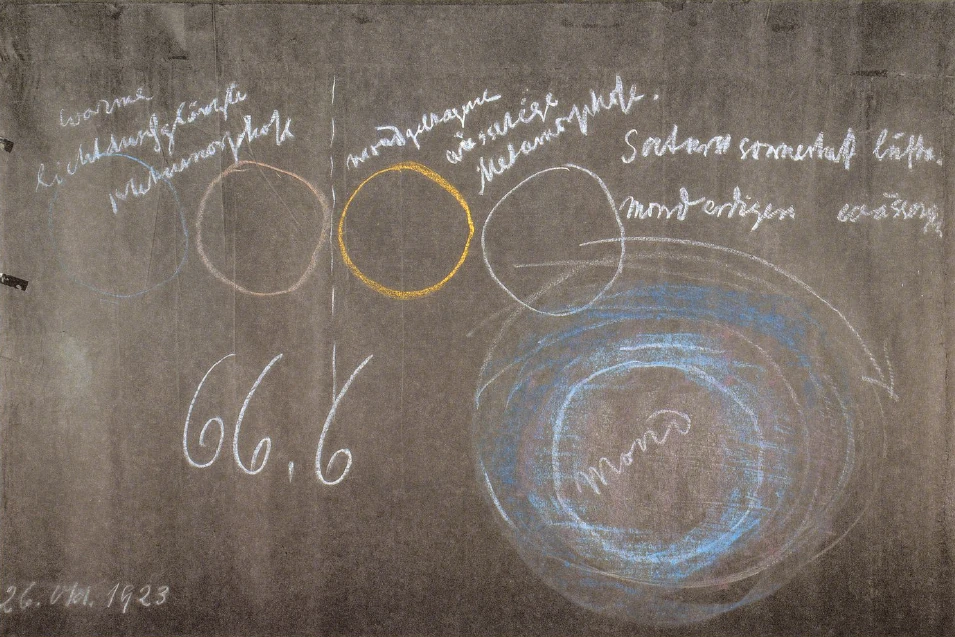
[ 5 ] Nun haben wir, wenn wir diese vier Metamorphosen hintereinander aufzeichnen, zunächst also die Saturnmetamorphose, den Wärmekörper, der noch alles aufgelöst hat, was später in unserem Planetensystem enthalten ist, die Sonnenmetamorphose, die Mondenmetamorphose und die Erdenmetamorphose. Wir können in dieser Vierheit zweierlei voneinander unterscheiden. (Es wird gezeichnet.)
[ ] Now when we depict these four metamorphoses in their sequence, we have first the Saturn-condition, which still contained dissolved within it everything later contained in our planetary system; then we have the Sun-metamorphosis, the Moon-metamorphosis, and the Earth-metamorphosis. These four manifestations fall into pairs.
[ 6 ] Bedenken Sie nur, wie wir es bei der Entwickelung des Saturn bis zur Sonne hin zu tun haben mit dem, was erst bis zur luftartigen Substanz vorgerückt ist! Von der Feuerkugel geht die Entwickelung aus; die Feuerkugel metamorphosiert, verdichtet sich bis zur Luftkugel, die aber bereits lichtdurchsetzt, lichterglitzernd ist. Da haben wir den ersten Teil der Entwickelung.
[ ] Just consider how things were during the evolution of Saturn and on into the Sun-epoch, where even then substance had only advanced to a gaseous state! Evolution takes its start from the globe of fire; the fire-globe becomes metamorphosed, densified to a globe of air, which is, however, imbued with light, glittering with light. Here we have the first part of evolution.
[ 7 ] Dann haben wir diesen Teil der Entwickelung, wo der Mond seine erste Rolle spielt. Denn der Mond spielt eben die Rolle, die es ihm möglich machte, jene hornigen Felsengebilde zu gestalten. Der Mond tritt ja während der Erdenmetamorphose heraus, wird Nebenplanet und läßt der Erde die inneren Erdenkräfte zurück. Zum Beispiel sind die Kräfte der Schwere durchaus etwas, was vom Monde zurückgeblieben ist in physischer Beziehung. Die Erde würde nicht die Kräfte der Schwere entwickeln, wenn nicht zurückgeblieben wären die Reste des alten Mondeneinschlusses; er selber ist fortgegangen. Der Mond ist jene Kolonie im Weltenraum, von der ich Ihnen vom geistigen Aspekte aus in den jüngst verflossenen Tagen gesprochen habe. Er hat eine ganz andere Substantialität als die Erde, aber er hat in der Erde zurückgelassen das, was man im weiteren Sinne den Erdenmagnetismus nennen kann; die Kräfte der Erde, namentlich die Schwerkräfte der Erde, die Wirkungen, die man als die Gewichtswirkungen bezeichnet, sind vom Monde zurückgeblieben. So können wir sagen: Wir haben hier (zwei Kreise links) Saturn- und Sonnenzustand, die im wesentlichen warme, lichtdurchglänzte Metamorphose, wenn wir die beiden zusammennehmen; wir haben hier (zwei Kreise rechts), Monden- und Erdzustand, die mondgetragene, wässerige Metamorphose, das Wäßrige, das sich herausbildet während der Mondmetamorphose und dann während der Erdenmetamorphose bleibt; das Feste wird ja gerade durch die Schwerkräfte hervorgerufen.
[ ] Then we have that part of evolution in which the Moon first plays its own role. For it is the role played by the Moon which enables it to fashion those horny rock-formations. And during the Earth-metamorphosis the moon separates off, becomes a subsidiary planet, leaving behind for the Earth the inner-earth-forces. The forces of gravity, for instance, are essentially forces which, in a physical connection, have remained behind from the Moon. The Earth would never have developed the forces of gravity had not the residue of what was contained in old Moon been left behind; the moon itself departed. The present moon is that colony in cosmic space about which I spoke to you from its spiritual aspect only a few days ago. Its substantiality is quite different from that of the earth, but it left behind in the earth what, speaking in the widest sense, may be called earth-magnetism. The forces of the earth, namely the earthly forces of gravity, the activities described as the effects of weight, these have remained over from the moon. And thus we can say: on the one hand we have (Saturn-and-Sun-condition) the essentially warm, light-irradiated metamorphosis, when the two conditions are taken together; on the other we have (Moon-and-Earth-condition) the moon-sustained, watery metamorphosis, the watery condition which evolved during the Moon-metamorphosis, and which then remained during the Earth-metamorphosis; the solid element is called forth by the forces of gravity.
[ 8 ] Diese beiden Metamorphosen unterscheiden sich eigentlich beträchtlich voneinander, und man muß sich klar darüber sein, daß alles, was einmal war, in dem Späteren wiederum drinnensteckt. Dasjenige, was die alte Feuerkugel Saturn war, blieb als Wärmesubstanz in allen folgenden Metamorphosen drinnen, und wenn wir heute innerhalb des Erdengebietes herumgehen und überall noch auf Wärme auftreffen, so ist die Wärme, die wir überall finden, der Rest der alten Saturnentwickelung. Überall, wo wir Luft oder nur luftförmige Körper finden, haben wir die Reste der alten Sonnenentwickelung. Wenn wir hinaussehen in die sonnendurchglänzte Luft, dann sollten wir eigentlich, indem wir uns mit Empfindungen von dieser Evolution durchdringen, uns sagen: In dieser sonnendurchglänzten Luft haben wir die Überreste der alten Sonnenentwickelung; denn wäre diese alte Sonnenentwickelung nicht gewesen, es wäre nicht die Verwandtschaft unserer Luft mit den Sonnenstrahlen vorhanden, die nun draußen sind. Nur dadurch, daß die Sonne einmal mit der Erde verbunden war, daß das Licht der Sonne in der Erde, die noch luftförmig war, selber erglänzte, so daß die Erde eine Luftkugel war, welche inneres Licht in den Weltenraum hinausstrahlte, nur dadurch konnte die spätere Metamorphose eintreten, die jetzige Erdenmetamorphose, wo die Erde von einer Luftatmosphäre umschlungen wird, in die von außen die Sonnenstrahlen hineinfallen. Aber diese Sonnenstrahlen haben eine tiefe innere Verwandtschaft zur Erdenatmosphäre. Diese Sonnenstrahlen treffen nicht etwa so, wie die heutigen Physiker grobschlächtig sagen, wie Strahlen, so wie kleine Geschoßkugeln etwa durch die gasige Atmosphäre durch, sondern diese Sonnenstrahlen haben eine tiefe innere Verwandtschaft mit der Atmosphäre. Und diese Verwandtschaft ist eben die Nachwirkung des einstmaligen Beisammenseins während der Sonnenmetamorphose. So ist alles miteinander dadurch verwandt, daß die früheren Zustände immer wiederum in die späteren Zustände auf eine mannigfaltige Weise hineinspielen. Aber während der Zeit, wo im großen und ganzen die Erdenentwickelung so vor sich gegangen ist, wie Sie es in der «Geheimwissenschaft» finden und wie ich es Ihnen hier kurz skizziert habe, hat sich alles dasjenige entwickelt, was auf der Erde und um die Erde herum ist, was auch innerhalb der Erde ist.
[ ] These two pairs of metamorphosis differ from each other to a marked degree, and we must be clear about the fact that everything present in an earlier condition is again inherent in the later one. What constituted the ancient fire-globe of Saturn remained as warmth-substance in all the subsequent metamorphoses; and when today we move about in the regions of the earth, and everywhere encounter warmth, this warmth which is everywhere to be found is the remains of the ancient Saturn condition. Wherever we find air, or gaseous bodies, we have the remains of the ancient Sun-evolution. When, having imbued ourselves with feeling and understanding for this epoch of evolution, we look out into the sun-irradiated atmosphere, we can say to ourselves with truth: In this sun-irradiated atmosphere we have remains of the ancient Sun-evolution; for had this ancient Sun-evolution not taken place, the relationship of our air with the rays of the sun, which are now there outside, would not have existed. Only through the fact that the sun was once united with the earth, that the light of the sun itself shone in the earth which was still in a gaseous condition—so that the earth was an air-globe radiating light into cosmic space—only through this could the later metamorphosis appear, the present Earth-metamorphosis, in which the earth is enveloped by an atmosphere of air, into which the sun's rays fall from outside. But these sun-rays have a deep inner connection with the earth's atmosphere. They do not, however, behave—as present-day physicists somewhat crudely state—as though projected like small shot through the gaseous atmosphere; but the rays of the sun have a deep inner relationship with the air. And this relationship is actually the after-effect of their one-time union during the Sun-metamorphosis. Thus everything is mutually inter-related through the fact that the earlier conditions ever and again play into the later conditions in manifold ways. But during the time in which, speaking generally, earth-evolution took its course—as you find in “Occult Science”, and as I have briefly sketched it for you here—everything on and around the earth, everything also within the earth, has been evolved.
[ 9 ] Und nun können wir sagen, wenn wir die heutige Erde anschauen, so haben wir innerhalb der Erde das, was das Feste bewirkt, den inneren Mond, wesentlich verankert im Erdenmagnetismus; den inneren Mond, der ja bewirkt, daß es überhaupt Festes gibt, daß es etwas gibt, was Gewicht hat, und die Gewichtskräfte sind es ja, die aus dem Flüssigen das Feste machen. Wir haben dann das eigentliche Erdengebiet, das Wäßrige, das in der mannigfaltigsten Weise wieder vorkommt, als Grundwasser zum Beispiel, aber auch als dasjenige Wasser, welches in den Dunstmassen ist, die aufsteigen, in den Regenmassen, die herabfallen und so weiter. Wir haben weiter im Umkreise das, was luftförmig ist, und haben das alles durchdrungen von dem Feurigen, den Resten des alten Saturn. So daß wir auch in der heutigen Erde anzugeben haben etwas, was da oben Sonne-Saturn oder Saturn-Sonne ist. Wir können uns immer sagen, alles, was da in der warmen Luft ist, die von Licht durchglänzt ist, ist Saturn-Sonne. Und wir schauen hinauf und finden eigentlich unsere Luft durchsetzt von dem, was Saturnwirkung ist, was Sonnenwirkung ist, und was dann sich im Laufe der Zeit als der eigentliche Luftkreis entwickelt hat, der aber auch nur eine Nachwirkung der Sonnenmetamorphose ist. Das haben wir gewissermaßen, wenn wir den Blick aufwärts richten. (Es wird gezeichnet.)
[ ] And now we can say: When we contemplate the present-day earth, we have within it what produces the solid element, the inner moon, actually anchored in earth-magnetism; the inner moon, whose action is such that it is the cause of the solid-element, the cause which produces everything which has weight. And it is the forces of weight which form the solid element out of the fluid. We have next the actual earth-realm, the watery element which appears in manifold ways—as underground water, for instance, but also in the water which is present in the rising mist-formations, in the descending rain clouds, and so on. And further we have in the circumference what is of the nature of air. Moreover all this is permeated by the element of fire, the remains of old Saturn. So that we also have to ascribe to our present-day earth what, there above, is Sun-Saturn or Saturn-Sun. We can always say to ourselves: Everything which is present in the warm air, which is irradiated with light, is Saturn-Sun. We look up and actually find our air imbued with what is Saturn-activity, what is Sun-activity, evolving in the course of time into the actual atmosphere of the earth, which, however, is only an after-effect of the Sun-metamorphosis. Broadly speaking, this is what we find when we direct our gaze upwards.
[ 10 ] Richten wir den Blick abwärts, dann haben wir mehr die Nachfolge dessen, was während der zwei letzten Metamorphosen eingetreten ist. Wir haben das Schwere, Feste, besser gesagt das Schwere Wirkende, ins Feste Gehende; wir haben das Flüssige, wir haben die Mond-Erde. Diese zwei Partien sozusagen des Erdendaseins können wir streng voneinander unterscheiden. Wenn Sie die «Geheimwissenschaft» noch einmal daraufhin durchlesen, so werden Sie sehen, daß dort einfach durch die ganze Stilisierung ein tiefer Einschnitt gemacht ist an der Stelle, wo die Sonnenmetamorphose in die Mondenmetamorphose übergeht. So ist auch heute noch eine Art scharfer Kontrast zwischen dem, was oben ist, dem Saturnhaften, und dem, was unten ist, dem Irdisch-Mondhaft-Wäßrigen. Wir können also ganz gut unterscheiden zwischen dem Saturn-Sonnenhaften-Luftartigen und dem Mond-Erdigen-Wäßrigen. Das eine ist oben, das andere ist unten.
[ ] When we direct our gaze downwards, it is more a question of what arose from the last two metamorphoses. We have what is heavy, the solid element, or better expressed, the working of the forces of weight into what is becoming solid; we have the fluid element, we have the Moon-Earth. These two parts of earth-existence can be strictly differentiated from each other. If you read “Occult Science” again with this in mind, you will see that the whole style alters at the place where the Sun-metamorphosis passes over into the Moon-metamorphosis. Even today there is still a kind of sharp contrast between what is above, what is of the nature of Saturn, and what is below, what is of the nature of Earth-Moon-watery condition. Thus we can quite well differentiate between the Saturn-Sun-gaseous element and the Moon-Earth fluidic element.
[ 11 ] Indem sich in der Erdenentwickelung im großen ganzen auch alles das mitentwickelt hat, was zur Erde gehört, fällt der Blick desjenigen, der in diese Dinge mit der Initiationswissenschaft hineinschaut, zunächst auf die Mannigfaltigkeit der Insektenwelt. Man sollte glauben, daß schon das bloße Gefühl diese flatternde, flimmernde Insektenwelt in einen gewissen Zusammenhang bringen müßte mit dem Oberen, mit dem Saturn-Sonnenhaft-Luftartigen. Es ist das durchaus der Fall. Wenn wir uns den Schmetterling ansehen: er flattert in der Luft, in der lichtdurchflossenen, lichtdurchglänzten Luft mit seinen schillernden Farben. Er wird getragen von den Wogen der Luft. Er berührt eigentlich kaum, was mond-erdig-wäßrig ist. Sein Element ist dasjenige, was oben ist. Wenn man dann nachforscht, wie eigentlich die Entwickelung ist, so kommt man gerade bei dem kleinen Insekt merkwürdigerweise in sehr frühe Zeiten der Erdenmetamorphose. Was heute in der lichtdurchglänzten Luft als Schmetterlingsflügel schimmert, das hat sich zuerst in der Anlage gebildet während des alten Saturn, hat sich weiter entwickelt während der alten Sonnenzeit. Da ist das entstanden, was heute noch dem Schmetterling möglich macht, eigentlich ein Licht-Luft-Geschöpf zu sein. Die Sonne verdankt die Gabe, daß sie Licht verbreitet, sich selbst. Die Sonne verdankt die Gabe, daß ihr Licht in den Substanzen Feuriges, Schimmerndes hervorruft, der Saturn-Jupiter-Mars-Einwirkung. Und eigentlich versteht derjenige die Schmetterlingsnatur nicht, der sie auf Erden sucht. Die Kräfte, die wirksamen Kräfte in der Schmetterlingsnatur müssen wir oben suchen, müssen wir bei Sonne, Mars, Jupiter, Saturn suchen. Wenn wir genauer eingehen auf diese wunderbare Schmetterlingsentwickelung — ich habe sie im Zusammenhange mit dem Menschen gewissermaßen als die kosmische Verkörperung des Gedächtnisses hier schon einmal geschildert —, aber wenn wir genauer eingehen, so finden wir: der Schmetterling flattert zunächst lichterschimmernd, luftgetragen oben über der Erde. Er legt sein Ei ab. Ja, der grobmaterialistische Mensch sagt: Der Schmetterling legt sein Ei ab —, weil die hauptsächlichsten Dinge überhaupt nicht studiert werden unter dem Einflusse der gegenwärtigen Unwissenschaft. Die Frage ist diese: Wem vertraut der Schmetterling eigentlich sein Ei an, wenn er esablegt?
[ ] When someone who sees into these things with initiation science contemplates the general course of earth-evolution—everything also which has developed along with the earth, which belongs to it—his gaze falls first upon the manifold variety of the insect world. One can well imagine that the very feeling engendered by the fluttering, glittering insect world would bring us into a certain connection with what is above, with what is of the nature of the Saturn-Sun-gaseous condition. And this is indeed the case. When we look at the butterfly with its shimmering colours, we see it fluttering in the air, in the light-flooded, light-irradiated air. It is upborne by the waves of the air. It hardly contacts what is of an Earth-Moon-fluid nature. Its element is in the upper regions. And when one investigates the course of earth-evolution, it is a remarkable thing that just in the case of the small insect one arrives at very early epochs of earth-metamorphosis. What today shimmers in the light-irradiated air as the butterfly's wings was first formed in germ during old Saturn, and developed further during the time of old Sun. It was then that there arose what still today makes it possible for the butterfly to be in its very nature a creation of light and air. The sun owes the gift of diffusing light to itself. The sun owes the gift that its light can call forth in substances what is fiery, shimmering, to the working-in of Saturn-Jupiter-Mars. The butterfly-nature cannot indeed be understood by one who seeks for it on the earth. The forces active in the nature of the butterfly, must be sought above, must be sought in Sun, Mars, Jupiter, Saturn. And when we enter more exactly into this wonderful evolution of the butterfly—I have already described it, in its connection with the human being, as what may be called the cosmic embodiment of memory—when we enter into this more exactly, we find in the first place the fluttering butterfly shimmering with light, carried up above the earth by the air. It then deposits its egg. Yes, the crude materialist says: “The butterfly deposits its egg”, because, under the influence of present-day unscientific science, the things of greatest importance are simply not studied. The question is this: To what does the butterfly entrust its egg when it deposits it?
[ 12 ] Nun, durchforschen Sie alles, wo Schmetterlingseier abgelegt werden; überall werden Sie finden: das Schmetterlingsei wird so abgelegt, daß es dem Sonneneinfluß nicht entzogen werden kann. Der Sonneneinfluß auf die Erde ist ja nicht nur da, wenn die Sonne unmittelbar auf die Erde scheint. Ich habe schon öfter aufmerksam darauf gemacht, wie die Bauern ihre Kartoffeln im Winter in die Erde hineinlegen, zudecken mit Erde, weil dasjenige, was als Sonnenwärme und Sonnenlichtkraft herankommt während des Sommers, gerade während des Winters im Inneren der Erde drinnen ist. Die Kartoffeln erfrieren auf der Oberfläche der Erde. Die Kartoffeln erfrieren nicht, sondern bleiben richtige gute Kartoffeln, wenn man sie in einer Grube eingräbt und Erde darüber legt, weil die Sonnenwirkung den Winter über in der Erde drinnen ist. Den Winter hindurch müssen wir die Sonnenwirkung des Sommers unter der Erde suchen. Kommen wir zum Beispiel im Dezember in eine gewisse Tiefe der Erde, dann haben wir im Dezember die Juliwirkung der Sonne. Im Juli strahlt die Sonne ihr Licht und ihre Wärme auf die Oberfläche. Die Wärme und das Licht dringen allmählich tiefer ein. Wollen wir im Dezember dasjenige suchen, was wir an Sonnenkräften auf der Erdoberfläche der Erde im Juli erleben, dann müssen wir eine Grube graben, und dann ist in einer gewissen Tiefe das, was im Juli auf der Oberfläche der Erde war, im Dezember unter der Erde. Da ist die Kartoffel eingebettet in die Julisonne. Also die Sonne ist nicht etwa nur da, wo man sie mit grobmaterialistischem Verstande sucht, sondern die Sonne ist eigentlich in vielen Gebieten da; nur eben ist das nach den Jahreszeiten im Kosmos streng geregelt.
[ ] Now investigate any place where the butterfly deposits its egg; everywhere you will find that the egg is deposited in such a way that it cannot be withdrawn from the influence of the sun. The sun's influence upon the earth is in fact not only present when the sun is shining directly on to the earth. I have often drawn attention to the fact that in winter peasants put their potatoes into the earth, cover them with earth, because what comes towards the earth during summer as the sun's warmth and the power of the sunlight, is, just during winter, within the earth. On the surface of the earth potatoes become frosted; they do not become frosted but remain really good potatoes if they are buried in a pit and covered with a layer of earth, because throughout the winter the activity of the sun is inside the earth. Throughout the whole winter we must look for the sun-activity of summer under the earth. In December, for example, at a certain depth within the earth, we have the July-activity of the sun. In July the sun radiates its light and warmth on to the surface. The warmth and light gradually penetrate deeper. And if in December we wish to look for what we experience in July on the surface of the earth, we must dig a pit, and then what was on the surface of the earth in July will be found in December at a certain depth within it. There the potato is buried in the July sun. Thus the sun is not only where crude materialistic understanding looks for it; the sun is actually present in many spheres. Only this is strictly regulated according to the seasons of the year in the cosmos.
[ 13 ] Aber der Schmetterling legt nirgends sein Ei hin, wo nicht das Ei in irgendeiner Weise im Zusammenhang bleiben kann mit der Sonne. So daß man schlecht sich ausdrückt, wenn man sagt, der Schmetterling legt sein Ei in das Erdengebiet. Das tut er gar nicht. Er legt sein Ei ins Sonnengebiet. Der Schmetterling geht gar nicht bis zur Erde herunter. Überall, wo im Irdischen Sonne ist, da sucht er seine Orte auf, um seine Eier hinzulegen, so daß dieses Schmetterlingsei durchaus nur unter dem Einfluß der Sonne steht. Es kommt gar nicht unter den Einfluß der Erde.
[ ] The butterfly never deposits its eggs where they cannot remain in some way or other in connection with the sun. Consequently one expresses oneself badly when one says that the butterfly lays its eggs in the realm of the earth. This it does not do at all. It lays its eggs in the realm of the sun. The butterfly never descends as far down as the earth. Where ever the sun is present in what is earthly, there the butterfly seeks out the place to deposit its eggs, so that they remain entirely under the influence of the sun. In no way do they come under the influence of the earth.
[ 14 ] Dann wissen Sie, daß aus diesem Schmetterlingsei die Raupe auskriecht. Die Raupe kommt also heraus und bleibt unter dem Einfluß der Sonne, aber gerät nun unter einen anderen Einfluß mit. Die Raupe würde nicht kriechen können, wenn sie nicht noch unter einen anderen Einfluß mit käme. Und das ist der Marseinfluß.
[ ] Then, as you know, out of this butterfly's egg creeps the caterpillar. When it emerges, it remains under the influence of the sun, but it now comes under another influence as well. The caterpillar would be unable to crawl did it not also come under another influence. And this is the influence of Mars.
[ 15 ] Wenn Sie sich die Erde vorstellen (es wird gezeichnet) und den Mars sie umkreisend, so sind die Marsströmungen oben überall und bleiben auch. Es kommt nicht darauf an, daß der Mars irgendwo ist, sondern wir haben die ganze Marssphäre, und wenn die Raupe dahinkriecht, so kriecht sie im Sinne der Marssphäre dahin. Dann verpuppt sich die Raupe, bildet um sich einen Kokon. Wir bekommen einen Kokon. Ich habe Ihnen beschrieben, wie das eine Hingabe der Raupe an die Sonne ist, wie der Faden, der da gesponnen wird, in der Richtung der Lichtlinie gesponnen wird. Die Raupe ist dem Lichte ausgesetzt, verfolgt die Lichtstrahlen, spinnt, hält an, wenn es dunkel ist, spinnt weiter. Das alles ist eigentlich kosmisches Sonnenlicht, Sonnenlicht, das mit Materie durchdrungen ist. Wenn Sie also zum Beispiel den Kokon der Seidenraupe haben, der zu Ihren Seidenkleidern verwendet wird, dann ist das, was in der Seide liegt, durchaus Sonnenlicht, hineingesponnen die Materie der Seidenraupe. Aus ihrem eigenen Leib heraus spinnt die Seidenraupe ihre Substanz in die Sonnenstrahlenrichtung hinein, und dadurch bildet sie den Kokon um sich. Aber es bedarf, damit das geschieht, der Jupitereinwirkung. Die Sonnenstrahlen müssen modifiziert sein durch die Jupitereinwirkung.
[ ] If you picture the earth with Mars circling around it, what emanates from Mars in the upper region pervades everything, and remains everywhere. It is not a question of Mars itself being anywhere in particular, but we have the whole Mars sphere, and when the caterpillar crawls in some direction, it does so in the sense of the Mars sphere. Then the caterpillar becomes a chrysalis, building around itself a cocoon. We get a cocoon. I described to you how this is a sacrifice to the sun on the part of the caterpillar, how the threads which are spun into it are spun in the direction of the line of light. The caterpillar is exposed to the sun, follows the rays of light, spins, stops when it is dark, spins on further. The whole cocoon is actually cosmic sunlight, sunlight which is interwoven with matter. Thus when you have the cocoon of the silkworm, for example—which is used to make your silk garments—what is present in the silk is actually sunlight, into which is spun the substance of the silkworm. Out of its own body the silkworm spins its matter in the direction of the sun's rays, and in this way forms the cocoon around itself. But that this may happen it needs the intervention of the Jupiter activity.
[ 16 ] Dann kriecht, wie Sie wissen, aus dem Kokon, aus der Puppe, der Schmetterling aus, der Falter, der ja lichtgetragen, lichterglänzend ist. Er verläßt die Dunkelkammer, in die nur das Licht so hineingekonnt hat, wie in die Kromlechs, wie ich Ihnen das beschrieben habe bei den Kromlechs der alten Druiden. Da kommt die Sonne unter den Einfluß des Saturn, und nur mit dem Saturn zusammen kann die Sonne das Licht so in die Luft senden, daß der Falter in der Luft erglänzen kann in seinen mancherlei Farben.
[ ] And then, as you know, the butterfly creeps out of the cocoon, out of the chrysalis—the butterfly which is upborne by light, radiant with light. It leaves the dark chamber into which the light only entered as it did into the cromlechs, in the way I described this to you, in the case of the cromlechs of the ancient Druids. The sun, however, comes under the influence of Saturn, and it is only in conjunction with Saturn that it can send its light into the air in such a way that the butterfly can shine in the radiance of its variegated colours.
[ 17 ] So sehen Sie, wenn wir uns jenes wunderbare Meer der fliegenden Schmetterlinge in der Atmosphäre anschauen, so haben wir darinnen etwas, wovon wir sagen müssen: Das ist im Grunde genommen gar nicht Erdengebilde. Das wird in die Erde hineingeboren von oben her. Der Schmetterling geht mit seinem Ei gar nicht weiter hinunter als bis zu dem, was von der Sonne zur Erde kommt. Der Kosmos schenkt der Erde das Schmetterlingsmeer. Saturn gibt die Farben der Schmetterlinge. Die Sonne gibt die Kraft des Fliegens, hervorgerufen durch die tragende Kraft des Lichtes und so weiter.
[ ] And thus, when we behold that wonderful sea of fluttering butterflies in the atmosphere, we must say: That is in truth no earthly creation, but is born into the earth from above. The butterfly nowhere goes deeper with its egg than to where influences come to the earth from the sun. The cosmos bestows on the earth the sea of butterflies, Saturn bestows their colours. The sun bestows the power of flight, called forth by the sustaining power of the light, and so on.
[ 18 ] Wir haben also in dem Schmetterling tatsächlich, ich möchte sagen, die kleinen Wesen zu sehen, die wie auf die Erde hereingestreut werden durch dasjenige, was Sonne und über der Sonne in unserem Planetensystem ist. Die Schmetterlinge, die Insekten überhaupt, die Libellen, ebenso die anderen Insekten sind durchaus die Gaben von Saturn, Jupiter, Mars und Sonne. Und die Erde könnte kein einziges Insekt hervorbringen, nicht einmal einen Floh, wenn nicht die über der Sonne befindlichen Planeten mit der Sonne zusammen der Erde diese Gabe des Insektenwesens schenken würden. Tatsächlich, daß Saturn, Jupiter und so weiter so freigebig sein können, daß sie hereinflattern lassen können die Insektenwelt, das ist verdankt den ersten beiden Metamorphosen, welche die Erdenentwickelung erlebt hat. (Siehe Zeichnung.)
[ ] Thus I might say that we actually have to see in the butterflies little creatures, strewn down, as it were, upon the earth by the sun, and by what is above the sun in our planetary system. The butterflies, the dragonflies, the insects in general, are actually the gift of Saturn, Jupiter, Mars and Sun. And not a single insect could be produced by the earth, not so much as a flea, were it not that the planets beyond the sun, together with the sun, bestow upon the earth the gift of insect life. And we do in truth owe the fact that Saturn, Jupiter, etc. could so generously allow the insect world to flutter in upon us to the first two metamorphoses experienced by earth-evolution.
[ 19 ] Und schauen wir uns jetzt an, wie mitgewirkt haben die zwei letzten Metamorphosen, die Mondenmetamorphose und die Erdenmetamorphose. Nun, wenn das Schmetterlingsei eben nicht der Erde anvertraut wird, so muß doch darauf hingewiesen werden, daß in der Zeit, als die Mondenmetamorphose, die dritte Metamorphose, in ihrem Anfange war, die Schmetterlinge noch nicht so waren wie heute. Es war auch die Erde nicht so abhängig von der Sonne. Die Sonne war eigentlich im Beginn der dritten Metamorphose noch mit der Erde zusammen, hat sich erst dann getrennt. Daher waren die Schmetterlinge auch noch nicht so spröde, daß sie der Erde gar nicht ihre Keime anvertraut hätten. Sie vertrauten sie ja zugleich der Sonne an, indem sie sie der Erde anvertrauten. So kam da eine Differenzierung zustande. Hier, bei den ersten beiden Metamorphosen, kann nur gesprochen werden von den Urahnen der Insektenwelt. Aber dem Kosmos, den äußeren Planeten und der Sonne anvertrauen, bedeutete damals noch der Erde anvertrauen. Erst als die Erde dicht wurde, Wasser bekam, als sie die magnetischen Kräfte des Mondes bekam, da wurde die Sache anders, und da trat eine Differenzierung ein.
[ ] And now let us look at the way in which the two last metamorphoses—the Moon-condition and the Earth-condition—have played their part. In view of the fact that the butterfly's egg is never actually entrusted to the earth, it must be pointed out that at the time when the Moon-metamorphosis, the third condition, was in its beginning, the butterflies were not as yet as they are today. The earth, too, was not so dependent upon the sun. At the beginning of the third metamorphosis the sun was actually still united with the earth, and only later became separated. The butterfly, therefore, was not so averse to entrusting its germ to the earth. When it entrusted it to the earth, it was at the same time entrusting it to the sun. Thus here there arose a differentiation. In the case of the first two metamorphoses one can only speak of a primal foreshadowing of the insect world. But at that time to entrust something to the outer planets, to the sun, still signified entrusting it to the earth. Only when the earth condensed, when it acquired water, acquired the magnetic forces of the moon, did matters change, and then it was that a differentiation appeared.
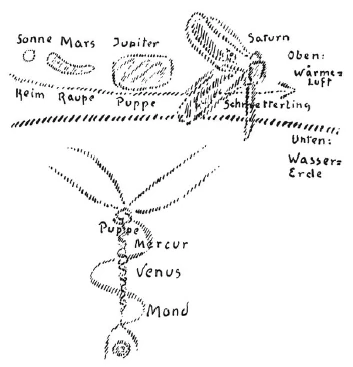
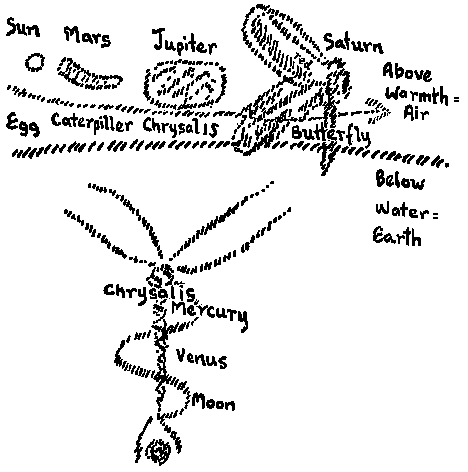
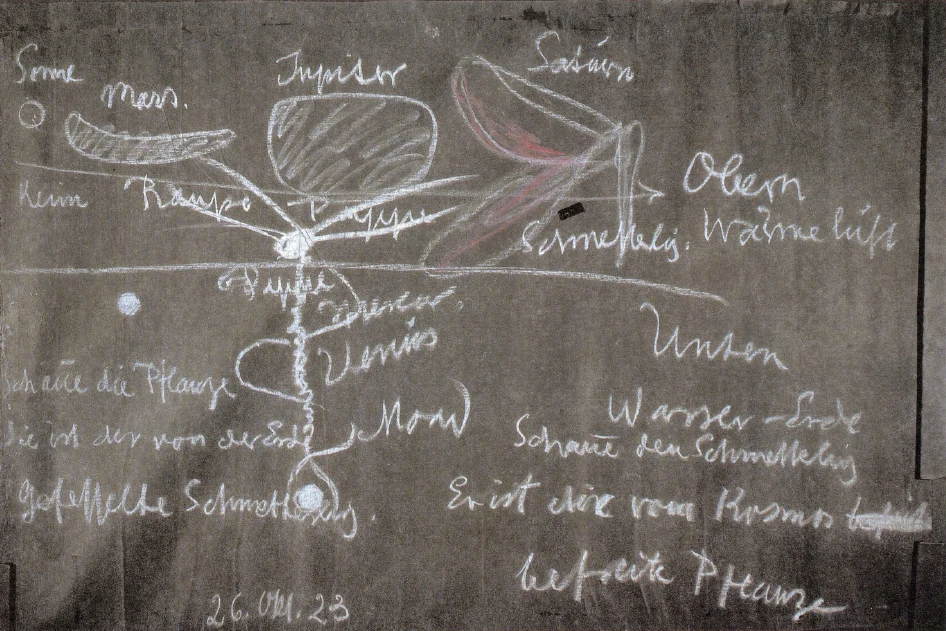
[ 20 ] Nun, nehmen wir an, das alles gehört dem Oberen an: Wärme-Luft; jetzt nehmen wir das Untere: Wasser-Erde. Nehmen wir diejenigen Keime, die das Schicksal hatten, nun der Erde anvertraut zu werden, Tafel 6 Mitte während eben andere zurückgehalten wurden und nicht der Erde, sondern nur der Sonne innerhalb des Irdischen anvertraut wurden.
[ ] Let us take everything to do with warmth-air as belonging to what is above; and let us take what is below: water-earth. And let us consider those germs whose destiny it was to be entrusted to the earth, whereas others were held back and not entrusted to the earth, but only to the sun within the earthly.
[ 21 ] Nehmen wir nun diejenigen Keime, die der Erde anvertraut wurden in der Zeit, als die dritte Metamorphose, die Mondenmetamorphose, entstand. Sehen Sie, diese Keime, die kamen nun ebenso unter den Einfluß der Erdenwirkung, der wäßrigen Erd-Mondwirkung, wie die Insektenkeime nur unter den Einfluß der Sonnenwirkung und dessen, was über der Sonne ist, kamen. Und dadurch, daß diese Keime in den Bereich der Erden-Wasserwirkungen kamen, wurden sie Pflanzenkeime. Und diejenigen Keime, die zurückblieben im Oberen, die blieben Insektenkeime. Und als die dritte Metamorphose dann begann, entstanden so durch das, was dazumal aus dem, was sonnenhaft war, umgewandelt wurde zum Mondig-Irdischen, die Pflanzenkeime innerhalb der dritten Metamorphose der Erdenentwickelung. Was Sie nun hier haben unter dem Einflusse des außerirdischen Kosmos, diese ganze Entwickelung vom Keim durch Raupe, durch Puppe zum Schmetterling, das können Sie nun da verfolgen: Indem der Same irdisch wird, entwickelt sich nicht der Schmetterling, sondern indem der Same irdisch wird, der Erde anvertraut wird — nun nicht der Sonne —, entwickelt sich die Pflanzenwurzel, das erste, was aus dem Keim entsteht. Und statt daß die Raupe kriecht in den Kräften, die vom Mars ausgehen, entsteht das Blatt, das in Spiralstellung heraufkriecht. Das Blatt ist die unter den irdischen Einfluß gekommene Raupe. Sehen Sie sich die kriechende Raupe an, dann haben Sie dasjenige, was im Oberen entspricht dem Unteren, dem Pflanzenblatte, das sich herausmetamorphosiert aus dem, was Wurzel geworden ist durch den Samen, der aus dem Sonnenbereich in den Erdenbereich versetzt worden ist.
[ ] Now let us consider these other germs which were entrusted to the earth at the time when the third metamorphosis, the Moon-condition, arose. These germs, you see, now came under the influence of earth-activity—of the watery earth-moon activity—just as the insect germs had formerly come under the influence of the sun-activity and of what is beyond the sun. And through the fact that these germs came under the influence of earth-water-activity, they became the plant-germs. And the germs which remained behind in the upper regions, these remained insect-germs. When the third metamorphosis began—through what at the time was of a sun-nature becoming transformed into what was of the nature of moon-earth—the plant-germs came into being, during this third metamorphosis of earth-evolution. And what you now have in the butterfly, under the development of the extraterrestrial cosmos, this whole development from the germ, through the caterpillar, through the chrysalis to the butterfly—this you are now in a position to follow in the plant. In that the seed became earthly it was not the butterfly which developed; but when the seed became earthly, entrusted to the earth—not now to the sun—the plant root developed, the first thing to arise out of the germ. And instead of the caterpillar creeping out, under the influence of the forces which proceed from Mars, the leaf arises, creeping upwards in spiral formation. The leaf is the caterpillar which has come under the influence of what is earthly. When you see the creeping caterpillar, you have, in the upper regions, what corresponds, below, to the leaf of the plant; the leaf develops out of what became root through the fact that the seed was transplanted from the region of the sun to the region of the earth.
[ 22 ] Gehen Sie weiter hinauf, dann haben Sie, zusammengezogen immer mehr bis oben, wo der Kelch ist, dasjenige, was Puppe ist. Und endlich entwickelt sich der Falter in der Blüte, die ebenso farbig ist wie der Falter oben in den Lüften. Der Kreislauf ist geschlossen. Wie der Schmetterling sein Ei legt, so entwickelt sich in der Blüte wiederum der Same zu dem Künftigen. Sie sehen: wir blicken hinauf in die Luft zum Schmetterling, wir verstehen ihn als die in die Luft erhobene Pflanze. Der Schmetterling, vom Ei bis zum Falter, ist dasselbe unter dem Einfluß der Sonne mit den oberen Planeten, was unten die Pflanze unter dem Erdeneinfluß ist. Wenn das zum Blatte kommt (siehe Zeichnung), haben wir von der Erde den Mondeinfluß, dann den Venuseinfluß und den Merkureinfluß. Dann geht es wieder zum Erdeneinfluß zurück. Der Same ist wieder der Erdeneinfluß.
[ ] Proceeding further upwards, we find contracted to the calyx what is of the nature of the chrysalis. And finally the butterfly develops in the blossom, which is coloured, just like the butterfly in the air. The circle is completed. Just as the butterfly lays its egg, so does the blossom develop within itself the new seed for the future. So you see, we look up towards the butterfly, and we understand it to be the plant raised up into the air. What the butterfly becomes from egg to full development under the influence of the sun with the upper planets, the plant becomes here below under the influence of the earth. When the plant comes into leaf (see diagram) we have from the earth-aspect the influence of the moon, then the Venus-influence and the Mercury-influence. Then there is a return to the earth-influence. The seed is again under earth-influence.
[ 23 ] Sie sehen also, wir können zwei Sätze vor uns hinstellen, die ein großes Geheimnis der Natur ausdrücken:
[ ] We can, therefore, place before ourselves two verses, which give expression to a great secret of nature:
Schaue die Pflanze
Sie ist der von der Erde
gefesselte Schmetterling.Schaue den Schmetterling
Er ist die vom Kosmos
befreite Pflanze.
Behold the plant:
It is the butterfly
Fettered by the earth.Behold the butterfly:
It is the plant
Freed by the cosmos.1Coleridge describes the butterfly as Flos libertus vel libertinus. Ed.
[ 24 ] Die Pflanze — der durch die Erde gefesselte Falter! Der Falter — die durch den Kosmos von der Erde befreite Pflanze!
[ ] If one looks at the butterfly, indeed at any insect, from the stage of the egg to when it is fluttering away, it is the plant raised up into the air, fashioned in the air by the cosmos.
[ 25 ] Schaue man den Schmetterling, das Insekt überhaupt, von dem Keim bis zum flatternden Insekt hin an: es ist die in die Luft hinaufgehobene, vom Kosmos in der Luft gestaltete Pflanze. Schaue man die Pflanze an: es ist der Schmetterling, der unten gefesselt wird. Das Ei wird von der Erde in Anspruch genommen. Die Raupe wird metamorphosiert in die Blattbildungen. In das, was zusammengezogen ist, wird die Puppenbildung metamorphosiert. Dann wird das, was sich im Falter entfaltet, in der Blüte bei der Pflanze entwickelt. Kein Wunder, daß jene innige Beziehung besteht zwischen der Schmetterlings- und Insektenwelt überhaupt und der Pflanzenwelt. Denn eigentlich müssen ja jene geistigen Wesenheiten, welche den Insekten, den Schmetterlingen zugrunde liegen, sich sagen: Hier unten sind unsere Verwandten, mit denen müssen wir es halten, wir müssen uns mit ihnen verbinden, wir müssen, genießend ihre Säfte und so weiter, uns mit ihnen verbinden, denn sie sind unsere Brüder. Sie sind die Brüder, die hinuntergewandelt sind in das Erdenbereich, die von der Erde gefesselt sind, die das andere Dasein gewonnen haben.
[ ] If one looks at the plant, it is the butterfly fettered to what is below. The egg is claimed by the earth. The caterpillar is metamorphosed into leaf-formation. In what is contracted in the plant we have the metamorphosis of the chrysalis-formation. And then what unfolds into the butterfly itself, in the plant develops into the blossom. Small wonder that such an intimate relationship exists between the world of the butterflies, the insect-world in general, and the world of the plants. For in truth those spiritual beings which are behind the insects, the butterflies, must say to themselves: There below are our relatives; we must have intercourse with them, unite ourselves with them—unite ourselves with them in the enjoyment of their juices, and so on, for they are our brothers. They are our brothers who have wandered down into the domain of the earth, who have become fettered to the earthly, who have won another existence.
[ 26 ] Und wiederum, es könnten die Geister, welche die Pflanzen beseelen, hinaufschauen zu den Schmetterlingen und könnten sagen: Das sind die Himmelsverwandten der Erdenpflanze.
[ ] And again, the spirits who ensoul the plants can look up to the butterflies and say: These are the heavenly relatives of the earthly plants.
[ 27 ] Sehen Sie, man kann schon sagen: Verständnis der Welt kann nicht entstehen mit Abstraktionen, denn die Abstraktionen reichen nicht zum Verständnisse hin. Denn das, was im Kosmos wirkt, ist schon die größte Künstlerin. Der Kosmos gestaltet alles nach Gesetzen, die im tiefsten Sinne auch den Künstlersinn befriedigen. Niemand kann den in die Erde versenkten Falter verstehen anders, als indem er im Künstlersinne metamorphosiert, was abstrakte Gedanken sind. Niemand kann verstehen den in die Luft vom Lichte und von den kosmischen Kräften hinaufgehobenen Pflanzenblüteninhalt in dem Schmetterling, der nicht wiederum in künstlerische Bewegung bringen kann die abstrakten Gedanken. Es bleibt aber immerhin etwas ungeheuer Erhebendes, wenn wir diese tiefe innere Verwandtschaft der Naturdinge und Naturwesen ins Auge fassen.
[ ] You see, one must really say that understanding of the world cannot come about through abstractions, for abstractions do not attain to understanding. Cosmic activity is indeed the greatest of artists. The cosmos fashions everything according to laws which bring the deepest satisfaction to the artistic sense. And no-one can understand the butterfly, which has sunk down into the earth, unless he metamorphoses abstract thoughts into artistic sense. No-one can understand the nature of the blossoming plant, which, as the butterfly, has been uplifted into the air by the light and by cosmic forces, unless once again he can bring artistic movement into abstract thoughts. Nevertheless there always remains something immensely uplifting when we turn our minds to the deep, inward connection between the things and beings of nature.
[ 28 ] Es ist etwas ganz Eigenes, das Insekt auf der Pflanze sitzen zu sehen, und zu gleicher Zeit dann zu sehen, wie über der Pflanzenblüte das Astralische waltet. Da strebt die Pflanze aus dem Irdischen hinaus. Die Sehnsucht der Pflanze nach dem Himmel waltet über den farbenschimmernden Blütenblättern. Die Pflanze selber kann diese Sehnsucht nicht befriedigen. Da strahlt ihr entgegen aus dem Kosmos dasjenige, was der Schmetterling ist. In dem sieht sie, ihn anschauend, die Befriedigung ihrer eigenen Wünsche. Das ist jene wunderbare Verbindung innerhalb der Erdenumgebung, daß die Sehnsuchten der Pflanzenwelt gestillt werden im Anblicke der Insekten, namentlich der Schmetterlingswelt. Das, was die Blumenblütenfarbe ersehnt, indem sie hinausstrahlt in den Weltenraum ihre Farbe, das wird ihr wie eine Erkenntniserfüllung ihrer Sehnsucht, indem ihr der Falter mit seinem Farbenschimmer entgegenkommt. Ausstrahlende, Wärme ausstrahlende Sehnsucht, vom Himmel hereinstrahlende Befriedigung: das ist der Verkehr der Pflanzenblütenwelt mit der Schmetterlingsfalterwelt. Das ist dasjenige, was wir sehen sollen in der Erdenumgebung.
[ ] It is a unique experience to see an insect poised on a plant, and at the same time to see how the astrality holds sway above the blossom. Here the plant is striving outwards from the earthly. The plant's longing for the heavenly works and weaves above the iridescent petals of the blossom. The plant cannot of itself satisfy this longing. Thus there radiates towards it from the cosmos what is of the nature of the butterfly. In beholding this the plant realizes the satisfaction of its own desires. And this is the wonderful relationship existing in the environment of the earth, namely that the longings of the plant-world are assuaged in looking up to the insects, in particular the world of the butterflies. What the blossoming flower longs for, as it radiates its colour out into world-space becomes for it fulfillment in knowledge when the butterfly approaches it with its shimmer of colours. Out-streaming warmth, out-streaming longing: in-streaming satisfaction from the heavens—this is the interplay between the world of the blossoming plants and the world of the butterflies. This is what we should see in the environment of the earth.
[ 29 ] Ich werde nun, nachdem der Übergang zur Pflanzenwelt gewonnen ist, in der Lage sein, die Betrachtungen, die vom Menschen bis zu den Tieren gegangen sind, in der nächsten Zeit zu erweitern. Wir können nun die Pflanzenwelt einbeziehen und werden so allmählich zu dem Verhältnis des Menschen zu der ganzen Erde kommen. Aber dazu war es notwendig, daß sozusagen die Brücke geschlagen wurde von der flatternden Pflanze der Luft, dem Schmetterling, zu dem in der Erde festsitzenden Schmetterling, zu der Pflanze hin. Die Erdenpflanze ist der festsitzende Schmetterling. Der Schmetterling ist die fliegende Pflanze. Haben wir diesen Zusammenhang zwischen der erdgebundenen Pflanze und dem himmelbefreiten Schmetterling erkannt, dann haben wir eben erst die Brücke geschlagen zwischen der Tierwelt und der Pflanzenwelt, und dann können wir ganz gewiß mit einer gewissen Gleichgültigkeit auf all die Trivialitäten herunterschauen, die immerzu wiederum sagen, wie die Urzeugung und dergleichen war. Mit diesen Prosabegriffen reicht man nicht in die Gebiete des Universums hinein, in die man hineinreichen muß. Da hinein reicht man erst, wenn man die Prosabegriffe überführen kann in künstlerische Begriffe und dann zu der Vorstellung kommen kann, wie von dem himmelentsprungenen Schmetterlingsei, das nur der Sonne anvertraut wird, die Pflanze erst später entsteht, indem dieses Schmetterlingsei metamorphosiert wird dadurch, daß es, während es früher nur sonnenvertraut war, jetzt erdenvertraut wird.
[ ] Having thus established the connection with the plant-world, I shall now be in the position to extend still further in the near future the studies which lead from the human being to the animals. We can already include the plant-world, and thus we shall gradually come to man's connection with the whole earth. But for this it was necessary to build, as it were, a bridge from the fluttering plant of the air, the butterfly, to the butterfly firmly rooted in the earth, the plant. The earthly plant is the firmly rooted butterfly. The butterfly is the flying plant. Having recognized this connection between the earth-bound plant and the heaven-freed butterfly, we have now established the bridge between the animal-world and the plant-world, and thus we can now look down with a certain unconcern upon all the trivialities which are always saying how spontaneous generation, and the like took place. These prosaic concepts will never lead us into those regions of the universe to which we must attain. Those spheres are only reached when prosaic concepts can be led over into artistic concepts, so that we may then arrive at the picture of how, from the heaven-born butterfly which is only entrusted to the sun, the plant later arose through this butterfly's egg becoming metamorphosed in such a way that, whereas it was formerly entrusted to the sun, it now became entrusted to the earth.