

Anthroposophy as Cosmosophy I
Human Traits in the Earthly and Cosmic Realms
GA 231
17 November 1923, The Hague
Translated by Steiner Online Library
Third Lecture
[ 1 ] In the first lecture, we tried to form a conception of how human beings, while on Earth, relate to extraterrestrial beings and forces. In the second lecture, we then tried to form a conception of what a human being’s passage through the supersensible world—viewed from a certain perspective—is like in the time between death and the next birth. In this lecture, I would now like to add a few things to what has already been said—to elaborate on these matters further, so to speak. We will then come to round out the whole subject and arrive at a harmonious picture as the lectures progress.
[ 2 ] We have seen that when a person has passed through the gate of death—that is, when they have arrived in the supersensible world—they initially still reveal themselves to imaginative perception as a spiritual form. Of course, you must be aware that this perception of the spiritual is, after all, something different from the perception of the sensory. For example, anyone who has had a vision of the spiritual will tell you: “Yes, I saw this, but I could not say how ‘large’ the apparition was”—and so on. So, of course, these things are not quite as spatial as a sensory visual image. Nevertheless, if you want to describe them, you must describe them in such a way that the thing looks entirely like a sensory visual image or like what is otherwise used to describe it. In this sense, I also ask that you understand the descriptions I will give of these things.
[ 3 ] Once a person has passed through the gate of death, the head in this image of the spiritual form gradually fades; the form of the head fades. In contrast, the rest of the human figure becomes a physiognomy—and, as I have already described, a physiognomy such that it expresses the extent to which the person, in the earthly life that unfolded up to the passage through the gate of death, was a more or less good or evil person, a wise man or a fool, and so on. All that a person can conceal in the sensory world—where one can be a villain with the most innocent of faces—is no longer possible once one has passed through the gate of death. It cannot be done through the face, because that face fades; and it cannot be denied through the rest of the figure, which takes on an increasingly physiognomic expression. But the point is that when a person enters the spiritual world, their entire relationship to the world is different. You must understand that what is most highly valued on Earth—thinking, specifically abstract thinking—is not valued at all in the spiritual world. That which the head is the instrument for is not valued at all in the spiritual world; it cannot even be applied there. We must leave behind this proud thinking through which we form concepts of the sensory things on Earth. Philosophers exist only on Earth, for it is precisely philosophy—which consists of abstract thinking—that must be left behind on Earth. The further we enter the spiritual, supersensible world, the more and more all soul life becomes a pictorial imagination, a beholding—and indeed, a beholding such that the thoughts contained within things come with the act of beholding. Here on Earth we form our own thoughts; over there, thoughts are revealed to us through the things themselves; they come to us. Thus, thought is attained there through contemplation. The point is that, even in contemplation, everything that a person is now meant to experience in the spiritual world comes to them.
[ 4 ] Now we do have certain points of reference even for sensory perception that we can build upon when we wish to describe the spiritual world through which a human being passes between death and rebirth. In the sensory world, we see the stars. The stars—and also the planets of our solar system—show us, I would say, from the perspective of sensory perception here on Earth, essentially only their outer appearance. Inside, they are something entirely different. Inside, they are a gathering of spiritual beings—spiritual beings who have gathered in the most diverse ways at the locations where these stars are found. And when we look at a star somewhere with the naked eye, it means: In this direction there is a colony of spiritual beings in the universe, and what I see there as a physical star merely gives me the direction, so to speak; it is a marker, a signpost. What physical science describes about the stars is all of very little significance, for it deals with nothing other than markers, signposts, and directional signs. The fact that we see a star somewhere means nothing other than that the dwelling place of spiritual beings lies in that direction.
[ 5 ] The first realm a person enters after passing through the Gate of Death is the realm of the Moon—that is, they enter the realm of those beings who dwell in the Moon. What kind of beings are these?
[ 6 ] From my account in Occult Science, you know that the Moon was not always where it is now. There is, in fact, a strange peculiarity about this Moon. For example, it is quite strange that the standard textbooks, schoolbooks, and handbooks make no mention whatsoever of the fact that the Moon is currently in a state where it is drawing a little closer to us every year. Most people do not realize this because they do not find it in these handbooks, but it is nevertheless true. The fact is, however, that this moon was not always out there in the cosmos as it is now; rather, as you can read in my Occult Science, its substance was once inside the Earth. It split off from the Earth and then ascended into the cosmos, so that only in the course of Earth’s evolution did it form itself into a dwelling place for spiritual beings. Who, then, are these spiritual beings?
[ 7 ] In my books and lectures, I have often described how, in the very early stages of Earth’s evolution, humankind stood before the great primordial teachers of earthly existence. Indeed, when we look back on Earth’s evolution with true understanding, we are inwardly filled with immense reverence for that immense wisdom that was once bestowed upon humanity on Earth by great, superhuman teachers. The first teachers of the human race on Earth were not human beings, but beings who stand higher than humans, who did not appear in the Mysteries in a physical body at all, but in an etheric body—which they have since largely shed, so that they now exist in an astral body. These Primordial Teachers then underwent the exodus from the Earth and, for their part, went out into the cosmos toward the Moon; so that today this celestial body, which we refer to as the Moon, is the colony of humanity’s Primordial Teachers out in the cosmos. That is where they are. When we look at the outer surface of the Moon, to the coarse eye it actually reflects only the light of the Sun; but to the finer eye, it reflects an immense sum of the forces of the universe as a whole. But what we receive from the Moon—reflected from the forces of the universe onto Earth—is connected to everything in human beings that is actually subhuman, to what human beings today share with animal nature. Thus, strangely enough, the Moon unites within itself these high spiritual beings, who were once the primordial teachers of humanity, with the animal forces of human nature.
[ 8 ] This is the realm into which a person first enters after passing through the gate of death. There, they have their first experiences. So imagine very vividly how a person, with their moral or even immoral physiognomy, enters the realm of lunar radiation—both the physical and the spiritual lunar radiation—and imagine how they initially perceive themselves and other people through this physiognomy. But it is not with physical, sensory eyes that they see; rather, it is a sensation—a kind of feeling, so to speak—but a feeling at a distance, just as a person perceives those beings who enter their realm. If I were to describe to you what this is like, I would describe it in the following way. Suppose a person in this realm actually approaches another being. He has his own physiognomy, which is, however, malleable—soft, so to speak. When another being is near him, he tries to adopt a physiognomy similar to that of the other being. But if a person who was a true villain in earthly life has passed through the gate of death, arrived on the other side, and were now to attempt this process in the presence of a very good person—so that he might perceive what that good person’s physiognomy is like—he would be unable to do so. He can only assume the physiognomy of villains once again. He cannot succeed in the other. — From this you can see that, for a certain time after death, a person can see only those other human beings who have already passed through the gate of death and who, in moral terms, were like him here on Earth. This is the first—I would say, judgmental—impression a person experiences. This impression metes out sharp justice, for the person is constantly under the impression: Just as they are, so are you! You can only move among people who are just like you! — The others are not seen; at first, they are not even perceived.
[ 9 ] However, due to the special powers it possesses, this environment of the Moon does not immediately send the angels in their beautiful forms into the vicinity of human beings; rather, the Moon is that which the Earth has cast off—it is the celestial body that the Earth has sent out into the cosmos—though, of course, the great, holy primordial teachers and sages of humanity went with it— but just as the Moon now stands alone out there in the cosmos, so the Ahrimanic figures are certainly present in its vicinity. Ahrimanic figures can be seen there. And this is how it is: When a person sees other people with unkind features, they have the peculiar impression that they are seeing themselves in those they can see in this way—and this resembles, to the point of despair, all the Ahrimanic figures that appear there. They cannot yet see the Angeloi, because these beings have forms with which they cannot yet identify. Thus, a person sees other people in certain forms of evil, and can then draw the comparison of how similar this is to the Ahrimanic figures. This is the second impression a person receives in the lunar sphere: “You are so similar to the Ahrimanic figures!” — Once again, a very effective form of justice after death.
[ 10 ] And the third point is that one cannot escape the distinct impression: In the first region I must pass through, there are the wise ones, the good primordial teachers of humanity. — One must gain this impression, for there is a peculiar relationship between the Ahrimanic beings who approach one in the manner described and these primordial teachers of humanity.
[ 11 ] From a human perspective, it is quite understandable that people would judge these matters in much the same way as that well-known king of Spain, who was once shown a diagram of the movements of the stars and the entire structure of the solar system. This was difficult for him to grasp, and so he said: If God had entrusted him with the creation of the universe, he would have made it much simpler. — He found it too complicated. It is not surprising that many people express something similar in their judgments; they are always eager to make some corrections to the divine plan for the universe. People generally have an immense amount of confidence in their own insight. There was even a philosopher who once said: “Give me matter, and I will shape a universe out of it!”—Kant, to be precise. It is just as well that no one gave him any matter, for he would have made something dreadful out of it.
[ 12 ] It is also true that when people hear about Ahrimanic beings and figures, they cannot understand how these Ahrimanic figures have not long since lost all hope of achieving, in their own sense, a victory over the earth spirits. For people know full well that the Ahrimanic beings will not prevail. But Ahriman does not know this. He constantly strives for victory. And out of this striving for victory arises a peculiar relationship between those Ahrimanic entities that belong primarily to the lunar sphere and the wise primordial teachers of humanity; I would say it is a terrible flattery on the part of these Ahrimanic entities toward these primordial teachers of humanity—they wish to win them over to their side. For what do these Ahrimanic beings strive for? They wish to hold the Earth back at a certain point in its development; they do not want to let it progress further. It is always Ahriman who says: “Human beings have come this far in their development; now they must remain at this stage and not develop any further.” I want them to harden their hearts at this stage and then embark on their further journey through the worlds as hardened beings, not as people who continue to develop. — That is what the Ahrimanic beings whisper into people’s ears every night. And that is, after all, what the Ahrimanic beings want for the Earth in general; they want to hold it back at a certain point in its development.
[ 13 ] Now, on this point, think of the great primordial teachers of humanity. These primordial teachers left behind on Earth what we know as the ancient primordial wisdom—a wisdom that has faded over time, that people today no longer understand, but that was once taught to people in the ancient mystery temples. This ancient wisdom could no longer be taught. For if people had continued to receive this wisdom, they would not have progressed; above all, they would not have advanced toward freedom, nor would they have been able to attain their free will. This wisdom was of a nature that could speak only to people’s instincts, not to their full, self-aware discernment. Therefore, for the sake of humanity, these teachers withdrew from it at a certain point in time. Humanity would not have been able to find a starting point, a beginning, for its development if these primordial teachers had not been there. But once they had provided the initial impetus—so that humanity could use this impetus to develop independently—they withdrew from the Earth and went to the lunar colony. And since the Ahrimanic beings, back when these Primordial Teachers were still on Earth, went to great lengths to keep them on Earth and to leave humanity at the level of instinctive wisdom, they still believe today that once a human being has passed through the gate of death and reached the lunar sphere, they can at least still do something there; and so, through their flattery, they constantly try to persuade these Primordial Teachers of humanity to approach those who have just died. But this cannot be achieved, especially not with people who bear the physiognomy of evil within themselves. But the fact is that the Ahrimanic beings also constantly approach people and incite them by saying: “That was once there!” — And so a third factor now arises for these evil people: the Ahrimanic beings describe the Primordial Teachers to them, but they cannot see them with their own nature; they are looking into a void.
[ 14 ] This, too, is a very significant, judgmental impression that people gain from this. And then the feeling weighs heavily on the human soul: I do not see those from whom humanity took its starting point; I have been cast aside! — This is a very strong, vivid feeling experienced by those who do not display the physiognomy of goodness.
[ 15 ] These, then, are the three impressions a person must have when, bearing the physiognomy of evil, they cross over into the world they are entering after passing through the gate of death.
[ 16 ] Now, it must be said: In a certain sense, there is not only good in human beings; even in the best of earthly people, there is much evil, so that many people receive, at least in part, the impressions of which I have spoken. But the more a person is able to take on the physiognomy of goodness, the more he will also see, on the other side after death, those whom he has come to resemble through goodness; and the more he crosses over with the physiognomy of goodness, the less he will have any sense of the Ahrimanic figures. As a result, everything I have described—everything that emanates from the Ahrimanic figures—will fade away, and the human being will then have a greater affinity for the angelic figures who then enter his sphere. And this instills within the human being that which now permeates him as forces, and initially these are forces of will. The fact is that after death, one’s primary activity is not thinking but willing. Willing becomes feeling; it becomes one’s entire world of experience. You see: one must will if one is to perceive at all. If one wishes to see such things, one must shape oneself accordingly. One must therefore will. One must become like that which one wishes to perceive. It is primarily the will that is developed once a person has passed through the gate of death, and the impressions of good and evil that I have described for the lunar realm also act upon the will.
[ 17 ] The next realm into which the human being enters is the Mercury realm. In this Mercury realm, the human being has already adapted his physiognomy to the powers and forces of the supersensible world to such an extent that—sometimes amid intense pain—he has shed his evil physiognomy and has gradually come to resemble—although for many people this process of becoming like them does not proceed very quickly—the forms of the Angeloi, Archangeloi, and Archai. But in any case, the human being now enters the realm of Mercury and thus the realm of the beings of the third hierarchy; he must live among them and must undergo what I have already described. This is the realm where one gradually acquires an understanding of what was previously a mere, more or less blind perception—but a blind perception that had a very strong effect precisely on the human sphere of the will. In the realm of Mercury, one gradually acquires this understanding. — Today, in our own age, it is truly the case that anyone who looks at these things with imaginative insight experiences quite tragic feelings. For how one finds oneself in this Mercury sphere as a deceased person depends to some extent on whether, here on Earth as a materialist, one rejected everything supersensible in thought and action, or whether one acquired an understanding of the supersensible here. One stands before the beings in the Mercury sphere quite at a loss if, here on Earth, one has rejected everything that goes beyond the material. And one likewise stands before the beings in the next realm—who also belong to the category of the Angeloi, Archangeloi, and Archai, though are somewhat more highly developed—in a state of bewilderment if one was a materialist during one’s earthly life and now enters the Venus realm, for there one is literally overwhelmed by the forces of cosmic love. If one has not acquired the power to love while on Earth, one enters a realm that is utterly alien. And what would otherwise—if one had acquired the capacity for love on Earth—radiate upon one with forces of love in the Venus realm is transformed into forces of anger in a person who has hated much or unconsciously on Earth. The secret of the stay on Venus is that the one who brings with them from Earth many remnants of forces of hatred that have raged within them will then find themselves in the realm of Venus as if the transformed forces of love—which are forces of anger and rage—were rising up from their own will. There he looks upon himself in that which compels him to say: all of this must be tempered, must be brought into harmony with the universe. And fundamentally, it is always the will that, in this realm—I might say—receives special care; the will that, after all, is also situated in the earthly human being within the metabolic-limb human, within the lower human. But it is precisely after death that this becomes the overall physiognomy, and so it is already the will that finds expression there.
[ 18 ] But in the meantime, human beings continue to evolve in such a way—with everything else I have already described coming into play as well, though this in turn raises new points that must be discussed later—that they gradually become similar to the beings that exist in the spiritual cosmos, and they gradually enter the solar realm. In this solar realm, the forces act primarily upon everything on Earth that is a reflection of feeling. The Sun, however, is only what it appears to be on the outside—what we see when we look up at it with our physical eyes. Inwardly, the Sun is the great world gathering place for all those spiritual beings who, from this very center, direct and guide the destinies of the Earth and its inhabitants, along with everything associated with them. Above all, the Sun is the colony of the beings of the second hierarchy: the Exusiai, Kyriotetes, and Dynameis. As the human being enters the solar realm, everything I described last time comes to him. Whereas before he was in the company only of those beings with whom he is fatefully linked, now others also approach him. His “supersensory circle of acquaintances,” if one may put it that way, grows larger and larger. All of this now takes place in the solar realm.
[ 19 ] It is also in this solar region that a particularly intense inner experience occurs within the human being. Down there is another world—the Earth—which he has left but must enter again. In this solar region, what I have described as the “transformation of the human being” takes place: the lower nature of the human being is transformed into the higher nature in preparation for the next earthly life, so that the legs are transformed into the spiritual form of the lower jaw, the arms into the form of the upper jaw with the cheekbones, and so on. All of this represents a marvelous work in the spiritual realm, compared to which everything that people do in the most diverse fields on Earth is utterly insignificant. The work performed there by the human being in union with the higher spiritual beings becomes a great, majestic work on the mystery of the human being. All of this takes place within the solar realm in the broader sense of the word.
[ 20 ] But it is precisely in this solar realm that human beings have yet another inner experience. When we live here on Earth, if we are truly completely healthy in soul and spirit, the feeling must arise within us that there is another, spiritual world, even if we cannot penetrate it through our intellect. We take the spiritual world for granted, so to speak; we speak of a supersensible world existing beyond the world we experience through our senses. Now, during the solar phase between death and rebirth, the opposite is true. It is precisely during this solar phase that something comes over the human being, causing them to speak of a world beyond. But that is the Earth. And it is then that the most vivid sense emerges—not so much of one’s own destiny, but of the entire nature of the earthly realm. There is a certain quality to it that you can discover for yourselves. You just have to try it once—as a rule, modern human beings are generally not yet able to do this on their own.
[ 21 ] If you read history, if you have studied it, then by tracing history back, you will always come to the following realization. What I mean is, suppose you are living in the year 1923. You then go back through history, through the World War and everything that came before: If you study history, you can find a period—let’s say, for example, the year 1500 or 1550 or something like that—where you might have the feeling that it seems familiar to you.

[ 22 ] Just take a moment to look at such intimate human insight. Something from the past—something that existed a few or several centuries ago—seems familiar to you. You tell yourself that you must have experienced it. Superficial people then immediately claim that they were living in this very year during a previous earthly life. That is usually not the case; rather, it is most often the year in which the person, between death and a new birth, had the most vivid connection with earthly life while in the solar existence—where earthly life now approaches the person in the beyond, just as, conversely, on Earth, the supersensible life approached the person as something of the beyond.
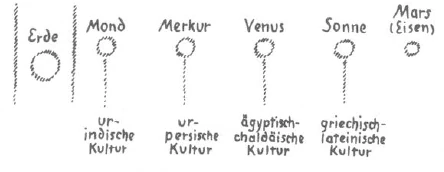
[ 23 ] If we pause for a moment to consider this development, we can say that a human being completes the lunar phase of existence once they have left Earth; they then enter the Mercury phase, the Venus phase, and the Solar phase, and the process continues. — We will speak of this later. — All these things are, in essence, not merely isolated entities and processes in the spiritual world; rather, they are all connected to what happens on the physical Earth, and this gives rise to a very special connection. This lunar existence is, after all, completely permeated by those great primordial teachers of humanity whom I have mentioned to you frequently today. At a time long ago, they left earthly existence and entered the cosmic worlds, the cosmic colony of the Moon. But even afterward, certain individuals—initiates in the mysteries—still possessed a quite vivid inner hearing and vision for what had once existed on Earth among these primordial initiates. Thus, in the ancient Indian era, a very living knowledge of the wisdom of the lunar initiates still existed within the Mysteries. Precisely what can still be admired today in the echoes of ancient Indian wisdom came about in this way.
[ 24 ] Then a twofold process took place. Even in the various ages, influences from this supernatural realm—which human beings pass through between death and rebirth—still exist; however, these influences are felt less and less, meaning that human beings become less and less aware of them. The influences of Mercury, for example, were particularly strong during the ancient Persian period, but people were less aware of them, and so they developed the myth of Ahura Mazda, which was still a veiled understanding of Mercury’s influence on Earth. During the Egyptian-Chaldean culture, the influences of Venus were predominantly at work. And then came the wonderful Greek culture, which continued into the Latin era; the Greco-Latin culture, in which the influence of the Sun from the supersensible world upon the Earth is strongest, yet least noticed by people. And it was also during this time that two things coincided: on the one hand, that when a human being passes through the existence between death and rebirth and enters the solar sphere, they have the greatest tendency to perceive the Earth from the perspective of solar existence—on the other hand, the Greeks were particularly influenced by everything of a solar nature, which made a great impression on them. What the forces of the solar realm bestow upon the Earth also meant an immense deal to the Greeks, especially to those Greeks who are usually referred to as the Athenians—Athenians as opposed to Spartans—but in general, the solar realm, even as a spiritual force emanating from the cosmos, exerted an extraordinarily profound influence on the entire configuration of Greek civilization. Throughout this entire period of development, the ability to perceive the spiritual—the purely spiritual aspect of the starry sky—was particularly strong on Earth. It is actually only in our fifth post-Atlantean cultural epoch that the perception of the material aspect of the starry sky begins to emerge more fully.
[ 25 ] Our fifth post-Atlantean epoch begins, after all, with the 15th century A.D., so it is only a few centuries old. However, we have already moved beyond those influences from the region where people on Earth feel a kinship with this experience within the solar existence between death and new birth. Today, we feel rather what follows from that. And indeed, after living through the solar phase for a time, the human being enters the realm of the Mars phase. The greatest influence on humanity today from the universe comes from the impulses of the Mars phase. And we can become acquainted with these Martian influences as soon as we, having passed the zenith of the existence between death and new birth, approach earthly existence once more. But the fact is that the solar existence, with its effects, does not cease for human beings when they enter the Martian existence between death and new birth. The Sun extends the sphere of its influence even beyond the subsequent planetary states. This remains the case, but the Martian existence now takes on significance for what is happening on Earth.
[ 26 ] I will continue to describe humanity’s passage through the Martian stage, but I would now like to move on from what we have thus far learned about the spiritual world to what is currently at work in our fifth post-Atlantean epoch.
[ 27 ] One learns to recognize what a cosmic struggle is. One senses it. Most people cannot fathom it, but in the existence of the world, a cosmic struggle is taking place between all manner of good and all manner of evil spirits. And what we have called the “sun existence” takes on special significance for this age. After all, it is so difficult today to counter what constitutes external, materialistic science with spiritual insights. People are so proud that they have physically investigated the sun. They describe the solar existence in their scientific handbooks, but these descriptions are not intended to give one a correct conception of what the sun is; rather, they are designed to distract one from the correct conceptions. How, then, does the sun exert its influence today, particularly in relation to life on Earth? — Now I would like to hint at just one of these modes of influence. In doing so, I am apparently entering very material realms that seem out of place within the spiritual-mental realm I have described, but these things will be important to us as we proceed with the reflections to which we will then devote ourselves.
[ 28 ] As you know, sunspots appear on the sun with a certain regularity. Dark spots appear on the Sun. There is much debate in the external material sciences about these sunspots and what significance they hold. But if one were to investigate more closely the meaning of these sunspots, one would discover: A continuous impulse emanates from the Sun’s interior, causing solar substance to be ejected through these dark gates into the cosmos. And what is thus ejected from the Sun as solar substance into the cosmos then appears within our solar system as comets and meteors, as well as the familiar shooting stars. The beings who govern the world within the Sun are, especially in our age, casting these things into our time. They have done so before; these phenomena did not first appear today, but they now take on a different significance than they had in the past. That is why I said: In earlier ages, it was primarily the spiritual impulses present in the star system that were at work. Now these impulses, which lie within the ejected iron, are beginning to take on a special significance for human beings. It is these impulses that a particular spirit—which is regaining its special significance here and which we call the Michael Spirit—is now applying in the cosmos—in the service of the spiritual in the cosmos. Thus, what has come into being in the cosmos for our age—something that was not present to the same degree in earlier ages—is that cosmic iron, in its spiritual significance, gives the Michael Spirit the ability to mediate between the supersensible and the sensible realms of the Earth. And so, on the one hand, we have a kind of warlike spirit in the world that one enters when, in our age, one goes beyond the sensory realm. When, in our age, a person attains supersensible vision—when they cross the threshold and direct their gaze not toward the things that initially concern them on a human-personal level, but toward the great world affairs that underlie our entire civilization—then their gaze penetrates into this world, and there they behold struggle, conflict, and spiritual battle. There is strife and conflict behind the scenes of existence in the spiritual realm. And what the Sun Spirits cast into the cosmos—with the physical clarity of iron—becomes, in the broadest sense, the cosmic armor of Michael, who now has his task in this cosmic struggle: to help humanity move forward in the right sense in the face of these forces of strife and war behind the scenes of human civilization. Thus, on the one hand, we encounter strife and battle, and on the other, the efforts of Michael.
[ 29 ] But all of this is, in turn, connected to the development of human freedom. For you see, as earthly human beings, we have iron in our blood. If we were beings without iron in our blood, the feeling of freedom—the impulse toward freedom—might well arise in our souls, but we would never have a body we could use to put this impulse into action. The fact that we can not only grasp the idea of freedom, the impulse toward freedom, but that we also feel within our bodies the strength to make this body a vessel for the impulse toward freedom—this stems from the fact that in our age we can learn how Michael is able to put the cosmic iron, which was also cast out in the past, to work in his service, and that, as we come to understand the Michael impulse more and more, we can learn to place the inner iron within us in the service of the impulse toward freedom. The outer material world only acquires meaning when we learn to understand it as an expression of the spiritual in the world. And in this age, we must learn to use the iron in our blood in the right way, for wherever iron appears, the impulse is given—from the cosmos and from within the human being—for freedom to develop. Out of a deep instinct, therefore, the ancient initiates attributed iron to Mars, which, through its significance in the blood, also acquires significance in the cosmos.
[ 30 ] Today, through the rediscovered spiritual science, we can gain insight into these things. This is not a renewal of old traditions, but a rediscovery of these things from within spiritual science itself. And by harmonizing with the ancient times, anthroposophy does not merely revive something old in a historical sense, but seeks to understand these things from their very essence. They regain their significance when one sees how human beings once knew these things under the influence of the ancient divine wisdom possessed by those beings who then brought about their migration to the Moon, and who today inhabit the cosmic colony of the Moon. And so our age, too, is connected precisely with what the human being experiences between death and new birth. That is why the sense of what is on Earth is strongest during the passage through the solar sphere, but it is actually more or less always present. At all times, the human being also looks down upon the earthly realm from the supersensible realm through which he passes during the existence between death and rebirth. For if he did not look down upon the earthly realm, it would become alien to him during his passage through the time between death and rebirth, which, after all, lasts a long time.
[ 31 ] Thus, one can describe in a wide variety of ways what a human being experiences in the supersensible world. In the previous lecture, I described it to you in a different way; now I am describing it to you in connection with the world of the stars, and also in connection with what takes place on Earth throughout the successive ages. All these things must be gradually synthesized. No one should come along and say: “Well, he has described the human being’s passage through the time between death and a new birth one way one time, and another way another time!” — When someone travels to a city—once, a second time, and so on—they also describe things differently, depending on how they come to know the city. One must then synthesize the details. Similarly, the various descriptions of human experiences in the supersensible world must be synthesized, viewed together, and thought through together. Only then does one gain an impression of what the supersensible world is and what the human being experiences in this supersensible world.
[ 32 ] That is as far as I wanted to go in describing this matter for now. I will then pick up where I left off in today’s second lecture and explain what a person continues to experience as they pass through the state of existence between death and rebirth.