

The Composition of the Mysteries
GA 232
2 December 1923, Dornach
Translate the original German text into any language:
Versions Available:
The Composition of the Mysteries, tr. SOL
Sechster Vortrag
Sixth Lecture
[ 1 ] Wenn der Mensch heute vom Worte redet, dann meint er ja gewöhnlich nur das schwache, im Grunde gegenüber der Majestät des Weltalls wenig bedeutende Menschenwort. Aber wir wissen, daß das JohannesEvangelium beginnt mit den bedeutungsvollen Worten: «Im Urbeginne war das Wort — der Logos. Und das Wort war bei Gott. Und ein Gott war das Wort.» Und wer nachsinnt über diesen bedeutungsvollen Eingang des Johannes-Evangeliums, der wird sich fragen müssen: Auf was wird da eigentlich verwiesen, wenn im Urbeginne aller Dinge das Wort angesetzt wird? Was ist eigentlich mit diesem Logos, mit diesem Worte gemeint? Und wie hängt dies Gemeinte zusammen mit dem schwachen, gegenüber der Majestät des Weltenalls unbeträchtlichen Menschenworte?
[ 1 ] When people today speak of the Word, they usually mean only the feeble human word, which is, in essence, of little significance in the face of the majesty of the universe. But we know that the Gospel of John begins with the significant words: “In the beginning was the Word—the Logos. And the Word was with God. And the Word was God.” And anyone who reflects on this profound opening of the Gospel of John will have to ask themselves: What exactly is being referred to here when the Word is placed at the very beginning of all things? What exactly is meant by this Logos, by this Word? And how does this meaning relate to the feeble human word, which is insignificant in the face of the majesty of the universe?
[ 2 ] Nun ist ja auch der Name des Johannes verknüpft mit der Stadt Ephesus. Und derjenige, der, ausgerüstet mit dem imaginativen Anschauen der Weltgeschichte, herantritt an diese bedeutungsvollen Worte: «Im Urbeginne war der Logos. Und der Logos war bei Gott. Und ein Gott war der Logos», der wird durch einen inneren Weg immer und immer wiederum verwiesen nach dem alten Tempel der Diana in Ephesus. Und für dasjenige, was als ein Rätsel aus den ersten Versen des Johannes-Evangeliums herausklingt, für das wird gerade der in die Weltgeheimnisse bis zu einem gewissen Grade Eingeweihte verwiesen auf die Mysterien des Artemis-, des Dianen-Tempels in Ephesus. So daß es ihm scheinen muß, als ob aus der Erkundung der Mysterien von Ephesus etwas fließen könnte für das Verständnis des Beginnes des Johannes-Evangeliums.
[ 2 ] After all, the name of John is also linked to the city of Ephesus. And anyone who, equipped with an imaginative view of world history, approaches these meaningful words: “In the beginning was the Logos. And the Logos was with God. And the Logos was God,” will, through an inner path, be led again and again to the ancient temple of Diana in Ephesus. And regarding what resonates as a riddle from the first verses of the Gospel of John, it is precisely the one who has been initiated to a certain degree into the mysteries of the world who is directed toward the mysteries of the Temple of Artemis—the Temple of Diana—in Ephesus. So that it must seem to him as if something might flow from the exploration of the mysteries of Ephesus toward an understanding of the beginning of the Gospel of John.
[ 3 ] Schauen wir deshalb heute einmal, ausgerüstet mit demjenigen, was wir gerade in den letzten zwei Tagen hier als Betrachtungen vor unsere Seele haben treten lassen, in die Geheimnisse, in die Mysterien des Dianen-Tempels in Ephesus hinein, schauen wir hinein für die Zeit des etwa sechsten oder siebenten vorchristlichen Jahrhunderts oder noch früher, um zu sehen, was da in dieser den Alten so geheiligten Stätte getrieben worden ist. Da finden wir, daß der Mysterien-Unterricht in Ephesus allerdings zunächst verwies auf dasjenige, was in der menschlichen Sprache erklingt. Wir können erfahren, nicht aus einer historischen Darstellung, für deren Vernichtung hat ja der Barbarismus der Menschheit genügend gesorgt, wohl aber aus der dem geistigen Erkennen zugänglichen, gedanklich-ätherischen Chronik, in welcher die Ereignisse des Weltgeschehens aufgezeichnet sind, wie es zugegangen ist innerhalb dieser ephesischen Mysterien.
[ 3 ] So today, armed with the insights we have allowed to arise in our souls here over the past two days, let us look into the secrets, the mysteries of the Temple of Diana in Ephesus, let us look back to the time of roughly the sixth or seventh century B.C. or even earlier, to see what took place in this site so sacred to the ancients. There we find that the mystery teachings in Ephesus did indeed initially refer to that which resounds in human language. We can learn—not from a historical account, for the barbarism of humanity has sufficiently ensured its destruction—but rather from the intellectual-etheric chronicle accessible to spiritual cognition, in which the events of world history are recorded, how things unfolded within these Ephesian Mysteries.
[ 4 ] Da tritt uns immer wieder und wieder für das Schauen entgegen, wie der Schüler von dem Lehrer verwiesen worden ist zunächst auf die menschliche Sprache; wie er ermahnt worden ist, immer wieder und wieder ermahnt worden ist: Fühle in deinen eigenen Sprachwerkzeugen, was da eigentlich vorgeht, indem du sprichst. — Die Vorgänge im Sprechen sind nicht durch grobe Empfindung wahrzunehmen, denn sie sind fein und intim. Aber bedenken wir zunächst das Äußerliche des Sprechens. Und von diesem Äußerlichen des Sprechens wurde ja bei den ephesischen Mysterien im Unterrichte zunächst ausgegangen.
[ 4 ] Time and again, we are confronted with the fact that the student has been directed by the teacher, first and foremost, toward human language; that he has been admonished—admonished time and again—to feel, within his own speech organs, what is actually happening as he speaks. — The processes involved in speech cannot be perceived through coarse sensation, for they are subtle and intimate. But let us first consider the outward aspects of speech. And it was precisely these outward aspects of speech that served as the starting point for instruction in the Ephesian Mysteries.
[ 5 ] Da wurde der Schüler aufmerksam gemacht, wie das Wort aus dem Munde erklingt. Es wurde ihm immer wieder und wiederum gesagt: Merke auf, was du empfindest, wenn das Wort aus dem Munde erklingt. — Und der Schüler sollte zunächst merken, wie gewissermaßen vom Worte etwas nach oben sich wendet, um den Gedanken desHauptes in sich aufzunehmen; und wie dann wiederum von demselben Worte etwas nach unten im Menschen sich wendet, um den Empfindungsgehalt des Wortes innerlich zu erleben.
[ 5 ] The student was made aware of how the word sounds as it comes out of the mouth. He was told again and again: Pay attention to what you feel when the word comes out of your mouth. — And the student was first to notice how, as it were, something from the word turns upward to take in the thought of the head; and how then, in turn, something from the same word turns downward within the person to experience the emotional content of the word inwardly.
[ 6 ] Immer wieder und wieder wurde der Schüler darauf verwiesen, die äußersten Extreme des Sprechens sich durch die Kehle zu drängen und dabei das Auf- und Abwogende, das im Worte, das aus der Kehle dringt, wahrzunehmen ist, zu beobachten. Ich bin, ich bin nicht: eine positive, eine negative Behauptung sollte in einer möglichst artikulierten Weise der Schüler sich durch die Kehle dringen lassen und dann beobachten, wie gefühlt wird im: Ich bin — mehr das Aufsteigen, im: Ich bin nicht — das Abwärtsdringende.
[ 6 ] Time and time again, the student was instructed to force the utmost extremes of speech through the throat and, in doing so, to observe the rising and falling motion that can be perceived in the word as it emerges from the throat. “I am,” “I am not”: the student should allow a positive and a negative assertion to push through the throat in as articulated a manner as possible, and then observe how it is felt—in “I am,” more of a rising sensation; in “I am not,” a downward pressure.
[ 7 ] Aber nun wurde der Schüler mehr noch auf die intimen inneren Empfindungen und Erlebnisse des Wortes verwiesen, wie er wahrnehmen konnte: Vom Worte steigt etwas auf wie Wärme nach dem Kopfe hin, und diese Wärme, dieses Feuer, fängt den Gedanken ab. Und nach unten fließt etwas wie wäßriges Element; das ergießt sich nach unten, wie sich eine Drüsenabsonderung in den Menschen ergießt. Und so bedient sich der Mensch — wurde dem Schüler in den ephesischen Mysterien klar gemacht — so bedient sich der Mensch der Luft, um das Wort erklingen zu lassen; aber die Luft verwandelt sich im Sprechen in das nächste Element, in das Feuer, in die Wärme und holt den Gedanken von den Höhen des Hauptes herunter, verleibt sich ihm ein. Und wiederum, indem ein Wechselzustand eintritt: Hinaufsenden des Feuers, Hinuntersenden desjenigen, was im Worte liegt, träufelt gewissermaßen die Luft wie eine Drüsenabsonderung nach unten als Wasser, als Flüssiges. Dadurch wird das Wort dem Menschen innerlich fühlbar. Das Wort träufelt als flüssiges Element nach unten.
[ 7 ] But now the student was directed even more toward the intimate inner sensations and experiences of the word, as he could perceive: Something rises from the word, like warmth, toward the head, and this warmth, this fire, captures the thought. And something like a watery element flows downward; it pours downward, just as a glandular secretion pours forth in human beings. And so the human being—as was made clear to the student in the Ephesian Mysteries—uses the air to make the word resound; but in speaking, the air transforms into the next element, into fire, into warmth, and draws the thought down from the heights of the head, incorporating it into itself. And again, as a state of transition sets in—the sending upward of fire and the sending downward of that which lies within the word—the air, as it were, drips downward like a glandular secretion, as water, as a liquid. Through this, the word becomes inwardly perceptible to the human being. The word drips downward as a liquid element.
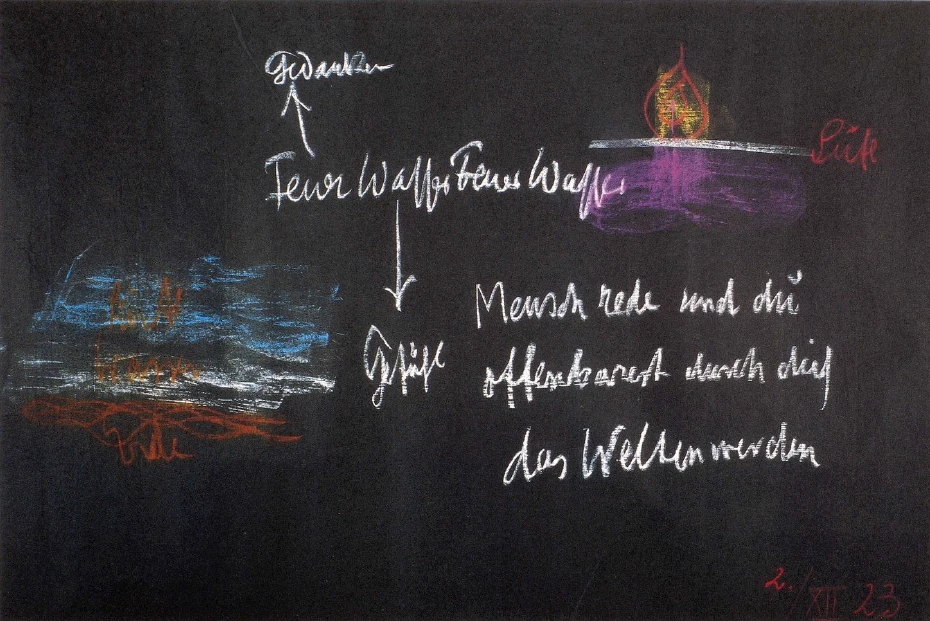
[ 8 ] Und dann wurde der Schüler eingeführt in das eigentliche Geheimnis des Sprechens. Aber dieses Geheimnis hängt zusammen mit dem Geheimnis des Menschen. Dieses Geheimnis des Menschen ist heute für wissenschaftliche Menschen geradezu verbarrikadiert; denn die Wissenschaft setzt die unglaublichste Karikatur einer Wahrheit heute an die Spitze von allem Nachdenken: nämlich das sogenannte Gesetz von der Erhaltung der Kraft und des Stoffes. Im Menschen wird der Stoff fortwährend umgewandelt. Er bleibt nicht. Dasjenige, was als Luft aus der Kehle dringt, verwandelt sich im Herausdringen abwechselnd in das nächste, höhere Element, in das Wärme- oder Feuerelement — und wiederum in das Wasserelement: Feuer, Wasser — Feuer, Wasser.
[ 8 ] And then the student was introduced to the true mystery of speech. But this mystery is connected to the mystery of the human being. Today, this mystery of the human being is virtually barricaded off from scientists; for science places the most incredible caricature of a truth at the forefront of all thinking: namely, the so-called law of the conservation of energy and matter. In the human being, matter is constantly being transformed. It does not remain the same. That which emerges from the throat as air is transformed, as it emerges, alternately into the next, higher element—the element of heat or fire—and again into the element of water: fire, water—fire, water.
[ 9 ] So wurde der Schüler zu Ephesus darauf aufmerksam gemacht: indem er spricht, dringt ein Wellenzug aus seinem Munde — Feuer, Wasser — Feuer, Wasser. Das aber ist nichts anderes, als das Hinauflangen des Wortes nach dem Gedanken, das Hinunterträufeln des Wortes nach dem Gefühle. Und so webt im Sprechen Gedanke und Gefühl, indem die lebendige Wellenbewegung des Sprechens als Luft zu Feuer sich verdünnt, zu Wasser sich verdichtet und so fort.
[ 9 ] This is how the student in Ephesus was made aware of it: as he speaks, a wave of sound emanates from his mouth—fire, water—fire, water. But this is nothing other than the word reaching upward toward thought, the word trickling downward toward feeling. And so, in speech, thought and feeling intertwine, as the living wave-like movement of speech thins out like air into fire, condenses into water, and so on.
[ 10 ] Feuer => Gedanke Wasser => Gefühl Feuer Wasser
[ 10 ] Fire => Thought Water => Feeling Fire Water
[ 11 ] Und das sollte der Schüler fühlen, wenn ihm im Mysterium zu Ephesus die große Wahrheit aus seinem eigenen Sprechen heraus vor die Seele geführt wurde:
[ 11 ] And this is what the student should feel when, in the Mystery of Ephesus, the great truth was brought before his soul through his own speech:
Mensch, rede, und du
offenbarest durch dich
das Weltenwerden.
Man, speak, and you
reveal through yourself
the becoming of the world.
[ 12 ] Ja, es war geradezu in Ephesus so, daß, wenn der Schüler zum Tore des Mysteriums hineinging, er immerzu ermahnt wurde mit diesem Spruch:
[ 12 ] Yes, it was indeed the case in Ephesus that when a student entered the Gate of the Mystery, he was constantly reminded of this saying:
Mensch, rede, und du
offenbarest durch dich
das Weltenwerden.
Man, speak, and you
reveal through yourself
the becoming of the world.
[ 13 ] Und wenn er wieder herausging, wurde ihm der Spruch in der anderen Form gesagt: Das Weltenwerden offenbart sich durch dich, o Mensch, wenn du redest. Und der Schüler fühlte allmählich, wie wenn er mit seinem eigenen Leibe als einer Hülle das Weltengeheimnis, das aus seiner Brust tönt und im Sprechen lebt, umschließen würde.
[ 13 ] And when he went out again, the saying was spoken to him in another form: “The becoming of the world is revealed through you, O human, when you speak.” And the student gradually felt as if, with his own body as a vessel, he were to encompass the mystery of the world—which resounds from his breast and lives in speech.
[ 14 ] Es wurde dies als Vorbereitung für das eigentlichetiefere Geheimnis an den Schüler herangebracht. Denn dadurch kam der Schüler in die Lage, das eigene menschliche Wesen als innerlich mit dem Weltengeheimnisse verbunden zu wissen. Das «Erkenne dich selbst» bekam einen heiligen Sinn dadurch, indem es nicht nur theoretisch gesprochen wurde, indem es innerlich feierlich gefühlt und empfunden werden konnte.
[ 14 ] This was presented to the student as a preparation for the actual, deeper mystery. For through this, the student was enabled to recognize that his or her own human being is inwardly connected to the mysteries of the world. The phrase “Know thyself” took on a sacred meaning in this way, not merely as a theoretical statement, but as something that could be felt and experienced with inner solemnity.
[ 15 ] Und dann konnte der Schüler, wenn er in dieser Weise gewissermaBen seinen Menschen geadelt und erhoben hatte, indem er ihn fühlte als eine Hülle, die das Weltengeheimnis umschließt, dann konnte er weiter eingeführt werden in dasjenige, was das Weltengeheimnis gewissermaßen hinaus ausbreitet über die Weiten des Kosmos. Und da gedenken wir desjenigen, was gestern vor unsere Seele getreten ist.
[ 15 ] And then, once the student had, in a sense, ennobled and elevated his fellow human being in this way—by perceiving him as a vessel that encloses the mystery of the world—he could be further initiated into that which, in a sense, extends the mystery of the world out across the vastness of the cosmos. And here we recall what came before our soul yesterday.
[ 16 ] Ich habe Ihnen einen Weltwerdezustand geschildert, in dem das Folgende geschieht. Wir haben in diesem damaligen Zustand die Erde. Wir wissen, in der Erde ist vorhanden, schon als ein Wesentliches für die damalige Etappe des Erdenwerdens, alles das, was wir in dem unscheinbaren Kalk, den wir auch im Jura haben, antreffen. Im Kalkgebirge, in den Kalkeinsätzen der Erde haben wir das, was wir da beachten wollen. Und wir haben die Erde umgeben mit dem, was ich gestern genannt habe das flüssige Eiweiß. Und wir wissen, daß die kosmischen Kräfte in dieses flüssige Eiweiß so hereinwirken, daß in bestimmten Formen dieses flüssige Eiweiß gerinnt. Und wir haben gehört, während dieses Zustandes des Erdenwerdens findet in einem erhöhten Maße, in einem dichteren Maße das statt, was wir heute im Aufsteigen der Regendünste, im Herabkommen des Wassers haben. Das Kalkige steigt nach oben, durchsetzt das, was sich da in dem flüssigen Eiweiß verdichtet hat, mit Kalkigem, füllt es so aus, daß es Knochiges als Inhalt bekommt, und wir haben die Tierwerdung im Laufe des Erdenwerdens. Das Tier wird gewissermaßen durch die Geistigkeit, die im Kalkigen lebt, heruntergeholt aus der noch eiweißartigen Atmosphäre.
[ 16 ] I have described to you a stage in the Earth’s development in which the following occurs. In that stage, we have the Earth. We know that the Earth already contained—as an essential element for that stage of its development—everything we find in the unremarkable limestone that we also have in the Jurassic period. In the limestone mountains, in the limestone formations of the Earth, we find what we wish to consider here. And the Earth is surrounded by what I referred to yesterday as the liquid protein. And we know that the cosmic forces act upon this liquid protein in such a way that it coagulates into specific forms. And we have heard that during this stage of Earth’s formation, what we experience today as the rising of rain vapors and the descent of water takes place to a greater extent, in a denser form. The calcareous element rises upward, permeates what has condensed within the liquid protein with calcareous matter, and fills it in such a way that it acquires a bony substance as its content; and thus we have the emergence of animals in the course of Earth’s formation. The animal is, so to speak, drawn down from the still protein-like atmosphere by the spiritual force that lives within the calcareous element.
[ 17 ] Aber ich habe auch noch etwas anderes gesagt. Ich habe gesagt: Der Mensch fühlt alles das, was da geschehen ist, wenn er sich mit der Metallität der Erde verbindet, wie sein eigenes Wesen, wie eine in ihm befindliche Erinnerung. Und für dieses Stadium fühlt er sich noch nicht als der kleine Mensch in seiner Haut eingeschlossen, sondern er fühlt sich als umfassend den ganzen Erdenplaneten. Wenn ich es grotesk schematisch zeichnen will, so müßte ich sagen: Der Mensch fühlt ja zunächst hauptsächlich sein Haupt als den Erdenplaneten umfassend.
[ 17 ] But I also said something else. I said: When a person connects with the metallic nature of the Earth, he feels everything that has happened there as if it were his own being, as if it were a memory within him. And at this stage, they do not yet feel confined within their own skin as a small human being, but rather feel that they encompass the entire Earth. If I were to sketch this out in a grotesquely schematic way, I would have to say: At first, a person mainly feels that their head encompasses the Earth.
[ 18 ] Die Vorgänge also, die ich schildern konnte, die fühlt der Mensch als Vorgänge in sich. Aber wie fühlt er sie in sich? Schen Sie, alles das, was ich Ihnen hier geschildert habe als Aufsteigen des Kalkigen, Verbinden des Kalkigen mit dem Eiweißgeronnenen, wieder Herunterkommen, Herunterholen des Tierwesens auf die Erde, das erlebt der Mensch in dieser Zeit so, daß er es hört. Der Mensch erlebt es ja innerlich. Sie müssen sich nur vorstellen, der Mensch erlebt es innerlich. Er hört es. Diese Bildung, die da entsteht, indem der Kalk das Eiweißgetinnsel ausfüllt, knochig, knorpelig macht, das, was da sich bildet, das ist etwas wie im Ohr Gefühltes, Gehörtes. Das Weltengeheimnis wird gehört.
[ 18 ] The processes I have described, then, are felt by the human being as processes within themselves. But how does a person feel them within themselves? Everything I have described to you here—the rising of the calcareous substance, its combination with the coagulated protein, and the descent, the bringing down of the animal nature to the earth—a person experiences this during this time in such a way that they hear it. After all, a person experiences it inwardly. You need only imagine that a person experiences it inwardly. He hears it. This formation that arises as the calcium fills the protein coagulum, making it bony and cartilaginous—what is formed there is something like what is felt and heard in the ear. The mystery of the worlds is heard.
[ 19 ] Tatsächlich vernimmt man auch in der Erinnerung, in dieser metallinisch erzeugten Erinnerung, diese Vergangenheit der Erde so, als ob man dies, was ich beschrieben habe, erklingen hörte. Und in diesem Erklingen webt und lebt doch das Weltengeschehen drinnen.
[ 19 ] In fact, even in memory—in this memory created by the Metallic Force—one perceives the Earth’s past as if one were hearing what I have described resound. And within this resounding, the events of the world are woven and come to life.
[ 20 ] Ja, was ist denn das, was man da hört? Dieses Weltgeschehen, als was enthüllt es sich, als was offenbart es sich denn? Es offenbart sich als das Wort der Welt, als der Logos. Es erklingt der Logos, das Weltenwort in dem aufsteigenden und abwogenden Kalkigen. Und man vernimmt schon, wenn man diese Sprache in sich vernehmen kann, noch etwas anderes. Da wird einem das zu etwas durchaus Möglichem.
[ 20 ] Yes, what is it, then, that one hears there? These world events—as what do they reveal themselves, as what do they manifest themselves? They manifest themselves as the Word of the world, as the Logos. The Logos, the Word of the world, resounds in the rising and ebbing chalky sound. And if one can hear this language within oneself, one already perceives something else as well. Then this becomes something entirely possible for one.
[ 21 ] Meine lieben Freunde, man steht vor einem menschlichen, vor einem tierischen Skelett. Das, was äußere Anatomie darüber sagt, ist ja etwas so Äußerliches, etwas so schändlich Äußerliches diesen Formen gegenüber. Was sagt man sich, wenn man in innerlichem Zusammenhang mit dem Natur- und Geisteswesen dieses Skelett anschaut? Man sagt sich: Schaue das doch nicht bloß an. Es ist entsetzlich, das bloß in seinen Formen anzuschauen, dasjenige, was da steht als Wirbelsäule mit den wunderbar gebildeten, aufeinandergeschichteten Wirbelknochen, mit den Rippen, die herauskommen und sich nach vorne beugen und biegen, mit der wunderbaren Artikulierung, wie sich die Wirbel umsetzen in die Schädelknochen, und der noch schwerer zu durchschauenden Artikulierung, wie sich die Rippen, die sich nur wie gleichförmige Bögen um die Brust herumschlingen, dann gewissermaßen scharf artikulierend ausbilden zu den Armknochen, zu den Beinknochen. Diesem Geheimnis des Skelettes gegenüber kann man gar nicht anders, als sich etwas ganz Bestimmtes zu sagen. Es ist tatsächlich so, daß man sich sagt: Höre doch das alles, schaue es dir doch nicht bloß an, höre das alles — höre, wie ein Knochen in den andern sich verwandelt. Das spricht ja.
[ 21 ] My dear friends, we are standing before a human skeleton, before an animal skeleton. What external anatomy tells us about it is, after all, something so superficial, something so shamefully superficial in relation to these forms. What do we say to ourselves when we look at this skeleton in inner connection with the natural and spiritual being? One says to oneself: Do not merely look at it. It is appalling to view it merely in its forms—that which stands there as the spine with its wonderfully formed, stacked vertebrae, with the ribs that protrude and curve forward, with the marvelous articulation of how the vertebrae transition into the skull bones, and the even more difficult-to-fathom articulation of how the ribs—which simply wrap around the chest like uniform arches—then, in a sense, form with sharp articulation into the arm bones and the leg bones. Faced with this mystery of the skeleton, one cannot help but say something very specific to oneself. It is indeed the case that one says to oneself: Just listen to all this, don’t just look at it, listen to it all—listen to how one bone transforms into another. It speaks, after all.
[ 22 ] Wenn ich hier eine persönliche Bemerkung machen darf, so müßte es diese sein. Es tritt einem etwas ganz Wunderbares entgegen, wenn man mit einem Gefühl für diese Dinge ein naturhistorisches Kabinett oder Museum betritt. Denn das ist eine wunderbare Zusammenstellung von Instrumenten zu einem großartigen Orchester, das symphonisch in der wunderbarsten Weise erklingt, wenn Sie hineingehen in ein solches Museum. Ich mußte es einmal besonders tief empfinden, als ich das Museum in Triest besuchte, und da durch eine besondere Aufstellung von Tierskeletten, die instinktiv gemacht worden ist, tatsächlich hintereinander einem immer erklangen an dem einen Ende des Tieres die Mondengeheimnisse, an dem anderen Ende des Tieres die Sonnengeheimnisse. Und das Ganze war durchsetzt wie mit den erklingenden Sonnen und Planeten. Da fühlt man schon den Zusammenhang zwischen diesem im Kalk lebenden Knochensystem, dem Skelett, und demjenigen, was da aus dem webenden Weltenall dereinst dem Menschen, der selber noch eins war mit diesem Weltenall, herausklang, herausklang als das Weltengeheimnis, herausklang zugleich als sein eigenes Geheimnis.
[ 22 ] If I may make a personal remark here, this is what it would be. Something truly wonderful greets you when you enter a natural history collection or museum with a sense for these things. For it is a marvelous assembly of instruments forming a magnificent orchestra that resounds symphonically in the most wonderful way when you step into such a museum. I once felt this particularly deeply when I visited the museum in Trieste, where, thanks to a special arrangement of animal skeletons—one that had been created instinctively—the mysteries of the moon actually resounded one after another at one end of the animal, and the mysteries of the sun at the other end. And the whole scene was interwoven as if with the resounding suns and planets. There one already senses the connection between this bone system living within the limestone—the skeleton—and that which once resounded from the weaving cosmos to humanity, which was itself still one with this cosmos; it resounded as the mystery of the world, and at the same time as humanity’s own mystery.
[ 23 ] Die Wesen, die da entstanden zunächst, die tierischen Wesen, die sagten ja damit, was sie sind. Denn in dem Logos, in dem tönenden Weltengeheimnis lebte doch das Wesen dieses Tierischen. Es war ja nicht zweierlei, was man währnahm. Man nahm nicht da die Tiere wahr und dann auf irgendeine Weise das Wesen der Tiere. Das Werden und Weben der Tiere selber in ihrem Wesen, das war es, was sprach.
[ 23 ] The beings that first came into being—the animal beings—were thereby expressing what they are. For the essence of the animal realm lived within the Logos, within the resounding mystery of the world. What one perceived was not two separate things. One did not perceive the animals and then, in some way, the essence of the animals. It was the very becoming and weaving of the animals themselves within their essence that spoke.
[ 24 ] Sehen Sie, in der richtigen Weise, wie man es in diesem Altertum forderte, konnte eben der Schüler der ephesischen Mysterien das in seine Seele, in sein Herz aufnehmen, was da klar gemacht werden konnte für den Urbeginn, wo das Wort, der Logos, als Wesen der Dinge webte. Er konnte das aufnehmen, weil er vorbereitet war dazu dadurch, daß er seine Menschheit geadelt und gehoben hatte, indem er sich als Hülle fühlen konnte für den kleinen Abglanz dieses Weltengeheimnisses, das in seinem eigenen Sprach-Erklingen lag. Und nun fühlen wir, wie das Werden der Welt gewissermaßen von einem Niveau zu dem anderen übergegangen ist. Schauen wir uns das an. Wir haben hier in dem Kalkigen durchaus noch etwas, das ein Flüssiges war; es stieg als Dunst auf, träufelte als Regen herab. Das Kalkige war ein Flüssiges; indem es aufstieg, wandelte es sich in Luft, indem es abstieg, wandelte es sich in Erde. Wir haben hier Wasser, Luft, Erde. Es ist um ein Niveau tiefer als hier im menschlichen Abbilde:
[ 24 ] You see, in the proper way—as was required in those ancient times—only the initiate of the Ephesian Mysteries could absorb into his soul, into his heart, what could be made clear regarding the very beginning, when the Word, the Logos, wove itself as the essence of all things. He was able to take this in because he had been prepared for it by having ennobled and elevated his humanity, so that he could feel himself to be a vessel for the small reflection of this world mystery, which lay in the resonance of his own speech. And now we sense how the becoming of the world has, so to speak, passed from one level to another. Let us look at this. Here in the calcareous substance, we still have something that was once a liquid; it rose as vapor, dripped down as rain. The calcareous substance was a liquid; as it rose, it transformed into air; as it descended, it transformed into earth. Here we have water, air, earth. It is one level lower than here in the human image:
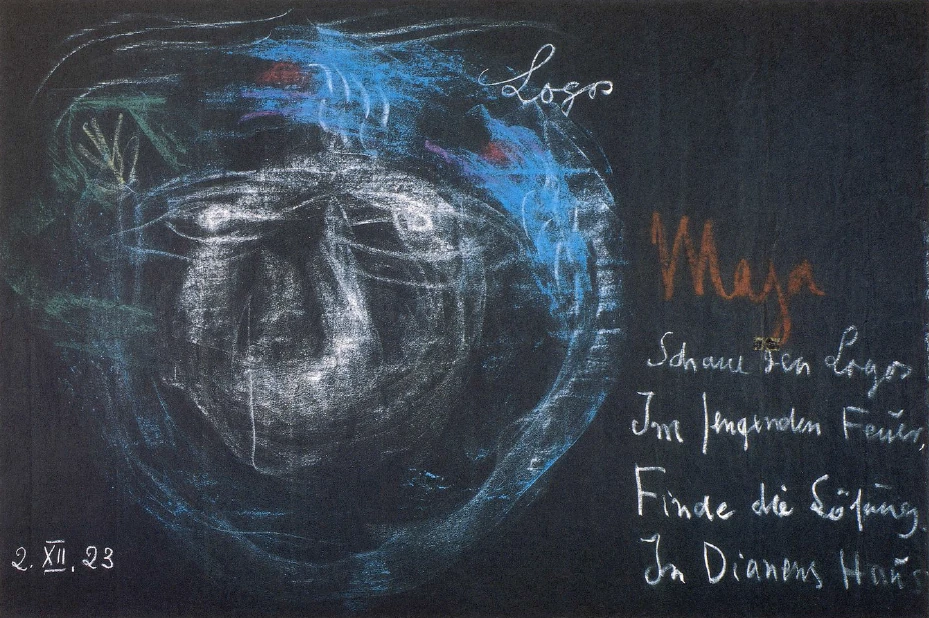
[ 25 ] Luft, Wärme, Wasser. Damals in diesem Urzustande webt das Wasser: das heißt, der noch flüssige Kalk verdünnt sich zu Luft, verdichtet sich zur Erde, wie sich heute in unserer Kehle die Luft zum Feuer, zur Wärme verdünnt, verdichtet zum Wasser. Dasjenige, was in der Welt lebte, ist von dem Wasser in die Luft aufgestiegen. Früher lebte es im Wasser, verdichtete sich zur Erde, verdünnte sich zur Luft. Es ist aufgestiegen zur Luft, verdünnt sich zur Wärme, verdichtet sich zum Wasser. Dadurch ist es möglich, daß wir Menschen dieses Weltgeheimnis im Kleinen umschließen. Als es noch groß war, als es die mächtige Maja der Welt war, da war es ein Niveau tiefer. Die Erde verdichtete alles. Der Kalk wurde dichter, und so weiter. Das hätten wir nicht bergen können, auch wenn es in Miniaturausgabe an uns herangekommen wäre. Wir konnten es nur bergen dadurch, daß es um ein Niveau höher gestiegen ist, vom Wasser in die Luft hinauf und damit in seinem Auf- und Abwogen in die Wärme und in das Wasser hinein, das jetzt das Dichtere ist. So wurde das, was große Welt war, das makrokosmische Mystezium, zum mikrokosmischen Mysterium der Menschensprache. Und auf dieses makrokosmische Mysterium, die Übersetzung in die Maja, in die große Welt, deutet der Beginn des Johannes-Evangeliums hin: «Im Urbeginne war der Logos. Und der Logos war bei Gott. Und ein Gott war der Logos». Denn das war dasjenige, was lebte und webte noch in der Tradition zu Ephesus, auch als der Evangelist, der Schreiber des Johannes-Evangeliums, in der Akasha-Chronik zu Ephesus lesen konnte dasjenige, wonach sein Herz dürstete: die richtige Einkleidung für das, was er als das Geheimnis des Weltenwerdens der Menschheit sagen wollte.
[ 25 ] Air, heat, water. Back then, in that primordial state, water was weaving: that is to say, the still-liquid lime diluted into air and condensed into earth, just as today, in our throats, air dilutes into fire and heat and condenses into water. That which lived in the world rose from the water into the air. It used to live in the water, condensed into earth, and diluted into air. It rose into the air, thinned into heat, and condensed into water. This makes it possible for us humans to encompass this mystery of the world on a small scale. When it was still vast, when it was the mighty Maja of the world, it existed at a lower level. The earth condensed everything. Lime became denser, and so on. We could not have encompassed that, even if it had come to us in miniature form. We could only encompass it because it rose one level higher—up from water into air and, through its ebb and flow, into heat and into water, which is now the denser substance. Thus, what was the great world—the macrocosmic mystery—became the microcosmic mystery of human language. And the beginning of the Gospel of John points to this macrocosmic mystery, the translation into the Maja, into the great world: “In the beginning was the Logos. And the Logos was with God. And the Logos was God.” For this was what still lived and wove within the tradition at Ephesus, even as the evangelist, the writer of the Gospel of John, was able to read in the Akashic Records at Ephesus that which his heart longed for: the proper expression for what he wished to convey as the mystery of humanity’s emergence into the world.
[ 26 ] Aber wir können noch einen Schritt weitergehen. Wir können uns daran erinnern, daß wir ja gestern gesagt haben: Vorangegangen dem Kalkigen ist das Kieselige, das im Quarz erscheint. Da drinnen erschienen die Pfanzenformen, wie, ich sagte grünende, vergrünende Wolkengebilde. Und wenn man damals schon, sagte ich, hätte hinausschauen können in die Weiten des Kosmos, dann hätte man geschaut dieses Werden des Tierwesens und diese grünende und vergrünende Urpflanze. Aber das alles nahm man ja als ein Inneres wahr. Man nahm es als Eigenwesen des Menschen wahr. Neben dem, daß man hörte, wie etwas, was in einem selbst lebte, das Erklingen des tierischen Werdens, konnte man innerlich in einem gewissen Sinne gehen mit dem, was man da klingen hörte, wie wenn man im eigenen menschlichen Haupte, in der menschlichen Brust und dem Haupt, mit den Worten durch die Wärme hinaufgeht, um den Gedanken zu erfassen; so konnte man gehen mit demjenigen, was man hörte aus der Tierwerdung, nach demjenigen, was man erlebte in der Pflanzenwerdung. Und da war das Eigentümliche: das Weben und Wesen des Tierwerdens erlebte man im verdunsteten und heruntersickernden Kalk; und wenn man dann weiterspürte nach demjenigen, was im Kieseligen als das grünende und entgrünende, vergrünende Pflanzenwesen war, dann wurde das Weltenwort zum Weltengedanken, und die Pflanze im kieseligen Elemente fügte den Gedanken hinzu zu dem tönenden Worte. Man ging gewissermaßen um einen Schritt nach oben, und zu dem tönenden Logos wurde der Weltengedanke gefügt, so wie heute zu dem im Sprachlichen ertönenden Worte, indem das Sprachliche hinauswellt: Feuer, Wasser, Feuer, Wasser — im Feuer der Gedanke erfaßt wird.
[ 26 ] But we can go one step further. We can recall that we said yesterday: Preceding the calcareous stage is the siliceous stage, which appears in quartz. Within it, plant forms appeared—as I said, greening, verdant cloud-like formations. And if, I said, people back then had been able to look out into the vastness of the cosmos, they would have seen this emergence of the animal realm and this greening, verdant primordial plant. But all of this was perceived as something inner. It was perceived as an essence inherent to the human being. In addition to hearing, as something living within oneself, the resounding of the animal’s becoming, one could, in a certain sense, walk inwardly with what one heard resounding there—just as when, within one’s own human head, in the human chest and head, one ascends through the warmth with words to grasp a thought; so one could move with what one heard from the animal stage toward what one experienced in the plant stage. And there lay the peculiarity: one experienced the weaving and essence of the animal stage in the evaporated and seeping-down lime; and when one then sensed further into what was present in the siliceous element as the greening, degreening, and re-greening plant being, then the world-word became the world-thought, and the plant in the siliceous element added the thought to the resounding word. One took, so to speak, a step upward, and the world-thought was added to the resounding Logos, just as today the world-thought is added to the word resounding in language, as language ripples outward: fire, water, fire, water—in the fire the thought is grasped.
[ 27 ] Meine lieben Freunde, wenn Sie heute nachsehen, wie man gerade denjenigen krankhaften Zuständen beikommt, die sich auf das Sinnessystem des Hauptes und überhaupt auf das Sinnessystem beziehen, so werden Sie die heilsamen Wirkungen der Kieselsäure erfahren. Und hier tritt Ihnen innerhalb der Weltengcheimnisse das Kieselsäure-Element als dasjenige entgegen, was in den ursprünglichen grünenden und vergrünenden Pflanzenformen gerade das gedankenhafte Element ist, von dem ich Ihnen aber auch sagen konnte: das ist ja die Wahrnehmung, die Sinneswahrnehmung der Erde gegenüber dem Weltengebäude. In einer wunderbaren Weise tatsächlich drückt sich im heutigen Menschen mikrokosmisch dasjenige aus, was im Makrokosmischen war, was Werden und Weben der Welt war.
[ 27 ] My dear friends, if you look today into how to treat precisely those pathological conditions that relate to the sensory system of the head and to the sensory system in general, you will discover the healing effects of silicic acid. And here, within the mysteries of the world, the silicic acid element presents itself to you as that which, in the original greening and vegetating plant forms, is precisely the element of thought—about which I could also tell you: this is, after all, the perception, the sensory perception of the Earth in relation to the structure of the world. In a truly wondrous way, what existed in the macrocosm—the becoming and weaving of the world—is expressed microcosmically in modern human beings.
[ 28 ] Denken Sie sich nur einmal, wie da der Mensch lebte, lebte noch eins mit dem Kosmos, in Einheit mit dem Kosmos. Heute, wenn der Mensch denkt, muß er sich isoliert denken mit seinem Haupte. Da sind drinnen die Gedanken, da heraus kommen die Worte. Das Weltenall ist draußen. Die Worte können nur das Weltenall bedeuten; die Gedanken können nur das Weltenall abbilden. Es war nicht so, als der Mensch noch eins war mit dem Makrokosmischen; da erlebte er das Weltenall als in sich. Das Wort war zu gleicher Zeit die Umgebung; der Gedanke war dasjenige, was diese Umgebung durchsetzte und durchströmte. Der Mensch hörte, und das Gehörte war Welt. Der Mensch schaute auf von dem Gehörten, aber er schaute in sich selber auf. Das Wort war zunächst Ton. Das Wort war zunächst dasjenige, was nach Enträtselung rang. Im Tier-Entstehen offenbarte sich etwas, was nach Enträtselung rang. Wie eine Frage entstand das Tierreich innerhalb des Kalkigen. Ins Kieselige sah man hinein: da antwortete das Pflanzenwesen mit demjenigen, was es aufgenommen hat als das Sinneswesen der Erde, und enthüllte die Rätsel, die das Tierreich aufgab. Die Wesen selbst waren es, die sich gegenseitig enträtselten. Das eine Wesen, hier das Tierische, gibt die Frage auf, die anderen Wesen, hier das Pflanzliche, geben die Antwort darauf. Und die ganze Welt wird zur Sprache. Und man darf schon sagen: Das ist die Realität vom Beginn des Johannes-Evangeliums. Denn wir sind da zunächst zu einem Urbeginne desjenigen, was jetzt überhaupt da ist, zurückgekehrt. In diesem Urbeginne, in diesem Prinzip, war das Wort. Und das Wort war bei Gott. Und ein Gott war das Wort. Denn es war das schöpferische Wesen in alledem.
[ 28 ] Just imagine for a moment how human beings used to live—they were still at one with the cosmos, in unity with the cosmos. Today, when a person thinks, they must think in isolation, within their own head. That is where the thoughts are; that is where the words come from. The universe is outside. Words can only signify the universe; thoughts can only reflect the universe. It was not so when human beings were still one with the macrocosm; back then, they experienced the universe as being within themselves. The word was, at the same time, the environment; the thought was that which permeated and flowed through this environment. Humanity heard, and what was heard was the world. Humanity looked up from what was heard, but looked up within itself. The word was, at first, sound. The word was, at first, that which strove for unraveling. In the emergence of the animal kingdom, something revealed itself that strove for unraveling. Like a question, the animal kingdom arose within the calcareous realm. One looked into the siliceous realm: there the plant being responded with that which it had taken in as the sensory being of the Earth, and unveiled the mysteries posed by the animal kingdom. It was the beings themselves who unraveled one another. One being—here, the animal—poses the question; the other beings—here, the plant—provide the answer. And the whole world becomes language. And one may well say: This is the reality of the beginning of the Gospel of John. For we have first returned to a primal beginning of that which now exists at all. In this primal beginning, in this principle, was the Word. And the Word was with God. And the Word was God. For it was the creative being in all of this.
[ 29 ] Es ist wahrhaftig so, daß in dem, was da gerade den ephesischen Mysterienschülern gelehrt wurde von dem Urworte, dasjenige liegt, was dann zum Anfang des Johannes-Evangeliums geführt hat. Und man möchte schon sagen, daß das Hinschauen auf diese Geheimnisse, die im Schoße der Zeiten ruhen, unter Anthroposophen heute recht, zecht zeitgemäß ist. Denn sehen Sie, in einem gewissen Sinne, in einem sehr, sehr eigentlichen Sinne war eben doch das, was hier auf dem Dornacher Hügel als das Goetheanum stand, der Mittelpunkt des anthroposophischen Wirkens geworden. Das, was heute als Schmerz in uns lebt, muß als Schmerz weiterleben und wird es bei jedem, der eben fühlen konnte, was das Goetheanum sein sollte. Aber alles das, was in der physischen Welt sich abspielt, es muß ja für denjenigen, der aufstrebt in seiner Erkenntnis zum Geistigen, zugleich eine äußere Offenbarung, ein Bild werden von tieferem Geistigen. Und wenn wir das Schmerzliche auf der einen Seite hinnehmen müssen, so müssen wir ja gerade aber als Menschen, die nach geistiger Erkenntnis streben, auch wiederum das, was im Schmerz geschehen ist, zum Anlaß nehmen können, in eine Offenbarung hineinzuschauen, die tiefer und immer tiefer geht. Ist doch dieses Goetheanum eine Stätte gewesen, in der gesprochen hat werden wollen, immer wieder und wiederum auch gesprochen worden ist, über diejenigen Dinge, die zusammenhängen mit dem Beginne des Johannes-Evangeliums: «Im Urbeginne war das Wort. Und das Wort war bei Gott. Und ein Gott war das Wort».
[ 29 ] It is indeed true that what was taught to the students of the Ephesian Mysteries regarding the Primordial Word is precisely what later led to the beginning of the Gospel of John. And one might well say that looking into these mysteries, which lie dormant in the bosom of time, is quite timely among anthroposophists today. For you see, in a certain sense—in a very, very real sense—what stood here on the hill in Dornach as the Goetheanum had indeed become the center of anthroposophical activity. What lives within us today as pain must continue to live as pain, and it will do so for everyone who was able to feel what the Goetheanum was meant to be. But everything that takes place in the physical world must, for those who strive in their knowledge toward the spiritual, simultaneously become an outer revelation, an image of something deeper and more spiritual. And while we must accept the pain on the one hand, we must also—precisely as people who strive for spiritual knowledge—be able to take what has happened in the pain as an opportunity to look into a revelation that goes deeper and ever deeper. For this Goetheanum has been a place where people have sought to speak—and have indeed spoken, time and again—about those things connected with the beginning of the Gospel of John: “In the beginning was the Word. And the Word was with God. And the Word was God.”
[ 30 ] Und dann ist dieses Goetheanum im Feuer aufgegangen. Und dieses furchtbare Bild des Goetheanum-Brandes kann vor uns stehen. Und aus dem Schmerze heraus kann sich gebären die Aufforderung, nun immer tiefer und tiefer zu sehen, hineinzuschauen in das, was für unsere Gedankenkraft noch immer dasteht: dieses in der Neujahrsnacht abbrennende Goetheanum. Aber das ist ein, wenn auch so schmerzliches, so doch in die Tiefe und immer größere Tiefe führendes Ereignis. Dasjenige, was darinnen hat ergründet werden sollen und was so, wie einiges von dem, was ich gestern und vorgestern gesagt habe, zusammenhängt mit dem Johannes-Evangelium, das bildete schon einen Einschluß in die versengenden und verzehrenden Flammen. Und es ist ein Wichtiges, ein wichtiger Impuls, meine lieben Freunde, den wir fassen können: Lassen wir doch diese Flammen zum Anlaß sein, durch sie hindurchzuschauen auf andere Flammen, auf jene Flammen, die einstmals den Tempel zu Ephesus verzehrt haben. Und lassen wir das die Aufforderung sein, einen Sinn zu haben für die Ergründung desjenigen, was im Johannes-Evangelium-Anfang liegt. Schauen wir, gerade aufgefordert durch diese schmerzlich heiligen Impulse, von dem Johannes-Evangelium zurück zu dem Tempel zu Ephesus, der auch einstmals gebrannt hat, und wir werden dann in den ja so schmerzlich sprechenden Goetheanum-Flammen eine Mahnung haben an das, was mit den versengenden Flammen des Ephesustempels in die Akasha hineingeströmt ist.
[ 30 ] And then the Goetheanum went up in flames. And this terrible image of the Goetheanum fire can stand before us. And out of this pain can arise the call to look ever deeper and deeper, to gaze into what still stands before our power of thought: this Goetheanum burning down on New Year’s Eve. But this is an event—painful as it may be—that leads us into ever greater depths. That which was meant to be fathomed within it, and which, like some of what I said yesterday and the day before, is connected to the Gospel of John, was already enclosed within the scorching and consuming flames. And there is something important—an important impulse, my dear friends—that we can grasp: Let us allow these flames to be an occasion to look through them toward other flames, toward those flames that once consumed the temple at Ephesus. And let this be a call to cultivate a sense for fathoming what lies at the beginning of the Gospel of John. Let us look—prompted precisely by these painfully sacred impulses—from the Gospel of John back to the temple at Ephesus, which also once burned, and we will then find in the flames of the Goetheanum, which speak so painfully, a reminder of what flowed into the Akasha with the scorching flames of the Temple of Ephesus.
[ 31 ] Haben wir denn nicht heute noch, meine lieben Freunde, wenn wir das Auge gerichtet haben in jener Unglücksnacht auf die versengenden Flammen dieses Goetheanum-Brandes, darinnen die schmelzenden Metalle von den Musikinstrumenten? Haben wir nicht darinnen diese so laut und so heilig sprechenden schmelzenden Metalle gerade der Musikinstrumente, die in die Flammen die merkwürdigsten Farben hineinzauberten? Vielsprechende Farben, Farben, die dem Metallischen nahestehen! Und durch das Verbinden mit dem Metallischen ersteht schon etwas wie Erinnerung im Irdischen. Dieses Erinnernde, wir haben es hier an das, was mit dem Tempel zu Ephesus verbrannte. Und zusammenschließen kann sich, wie diese beiden Brände, so die Sehnsucht, zu ergründen so etwas, wie: «Im Urbeginne war das Wort, und das Wort war bei Gott, und ein Gott war das Wort» — mit demjenigen, was immer wieder und wiederum dem Schüler zu Ephesus klar gemacht wurde: Studiere das Menschengeheimnis in dem kleinen Worte, in dem Mikrologos, damit du reif wirst, in dir zu empfinden das Geheimnis des Makrologos.
[ 31 ] Do we not still see today, my dear friends, when we cast our eyes back to that fateful night and the scorching flames of the Goetheanum fire, the melting metals of the musical instruments within them? Did we not see within them those melting metals—precisely those of the musical instruments—speaking so loudly and so sacredly, conjuring the most wondrous colors into the flames? Promising colors, colors that are close to the metallic! And through this connection with the metallic, something like memory arises in the earthly realm. This act of remembering—we have it here in what burned with the temple at Ephesus. And just as these two fires can be linked, so too can the longing to fathom something like: “In the beginning was the Word, and the Word was with God, and the Word was God” — with what was made clear to the disciple in Ephesus time and again: Study the mystery of humanity in the little word, in the Mikrologos, so that you may become mature enough to perceive within yourself the mystery of the Makrologos.
[ 32 ] Der Mensch ist der Mikrokosmos gegenüber der Welt, die der Makrokosmos ist, aber er trägt auch die Weltengeheimnisse in sich. Und jenes Weltengeheimnis, das in den ersten drei Versen des JohannesEvangeliums liegt, wir ergründen es, wenn wir im rechten Sinne dasjenige, wozu sich auch, wie zu so vielem anderen, die GoetheanumFlammen wie zu Schriftzeichen verdichten, wenn wir das ins Auge fassen:
[ 32 ] Human beings are the microcosm in relation to the world, which is the macrocosm, but they also carry the mysteries of the world within themselves. And that mystery of the world, which lies in the first three verses of the Gospel of John—we will fathom it when we truly grasp that which, like so many other things, the flames of the Goetheanum condense into written characters; when we take this to heart:
Schaue den Logos
Im sengenden Feuer;
Finde die Lösung
In Dianens Haus.
Look at the logos
In the scorching fire;
Find the solution
In Dianen's house.
[ 33 ] Die Feuer-Akasha vom Silvesterabend spricht schon sehr deutlich diese Worte neben vielem anderen. Und sie fordert uns auf, zu ergründen im Mikrokosmos den Mikrologos, damit der Mensch Verständnis gewinne für dasjenige, woraus er seinem Wesen nach selber ist: für den Makrokosmos durch den Makrologos.
[ 33 ] The Fire-Akasha of New Year’s Eve speaks these words very clearly, among many other things. And it calls upon us to fathom the Micro-Logos within the microcosm, so that human beings may gain an understanding of that from which they themselves, in their very essence, are made: the macrocosm through the Macro-Logos.