

Mystery Sites of the Middle Ages
Rosicrucianism and the Modern Principle of Initiation
GA 233a
5 January 1924, Dornach
Translate the original German text into any language:
Versions Available:
Rosicrucianism and Modern Initiation, tr. Adams
Zweiter Vortrag
2. Hidden Centres of the Mysteries in the Middle Ages
[ 1 ] Gestern begann ich zu Ihnen von den geisteswissenschaftlichen Bestrebungen vom 9., 10. nachchristlichen Jahrhundert zu sprechen, bis in die Zeit hinein, solange es im Ernste noch solche geisteswissenschaftlichen Bestrebungen gegeben hat: was eigentlich bis zum Ende des 18. Jahrhunderts, Anfang des 19. Jahrhunderts dauerte, und ich versuchte gestern, einiges von dem Inhalte solcher Bestrebungen zu Ihnen zu sprechen. Heute möchte ich nun mehr das Historische berühren. Es handelt sich nämlich darum, daß ja durch das alte eigentliche Mysterienwesen in den Mysterienstätten in der Art, wie ich das während der Weihnachtstagung in den Abendvorträgen dargelegt habe, wirklich eine Begegnung der Menschen, der Initiierten und der zu Initiierenden, mit den Göttern stattfinden konnte, daß gewissermaßen in den Initiationsstätten die Möglichkeit vorhanden war, wenn ich den pedantischen Ausdruck gebrauchen darf, offizielle Orte zu finden, die eigens ihrer Lokalität nach dazu eingerichtet waren, eine solche Begegnung herbeizuführen.
[ 1 ] Yesterday I began to speak to you of the spiritual-scientific strivings of the ninth or tenth century after Christ. We learnt how such strivings were still seriously followed as late as the end of the eighteenth and beginning of the nineteenth centuries; and I endeavoured to tell you something of the content of these strivings. Today I should like to touch more on their historical aspect. We have to remember that the Mysteries of ancient times were of such a nature and character that in the places of the Mysteries an actual meeting with the Gods was able to take place. I described in the lectures recently given at the Christmas Foundation how the human being who was an Initiate or was about to receive Initiation could verily meet with the Gods. And it was also possible, in the Mysteries, to discover places which by their very locality were expressly fitted and prepared to induce such meeting with the Gods.
[ 2 ] Diese Einrichtungen, die zugrunde liegen als die eigentlichen Impulsgeber allen alten Zivilisationen, sind nach und nach hingeschwunden, und man kann sagen: In der alten Form fanden sie sich eigentlich nicht mehr seit dem 4. nachchristlichen Jahrhundert. Da und dort waren noch Nachzügler vorhanden, aber in dieser strengen alten Form fanden sie sich nicht mehr. Dagegen hat ja die Initiation im Grunde genommen niemals aufgehört; die Formen, in denen die zu Initiierenden ihren Weg fanden, die änderten sich. Und ich habe ja auch schon darauf hingewiesen, wie im Mittelalter die Sache so war, daß einzelne anspruchslose, in aller Bescheidenheit lebende Menschen da oder dort vorhanden waren, die nicht gerade offizielle Schülerkreise an bestimmten Orten um sich sammelten, sondern die so, wie es das Menschheits- und Volkskarma ergab, da oder dort ihre Schüler hatten. Ich habe ja einen solchen Fall bei der Besprechung des Johannes Tauler in meiner «Mystik im Aufgange des neuzeitlichen Geisteslebens» charakterisiert. Über diesen brauche ich nicht zu sprechen. Dagegen möchte ich einen anderen Fall gerade heute besprechen als einen, ich möchte sagen, charakteristisch-typischen Fall, einen Fall, der von einem großen Einflusse war, der vom 12., 13. Jahrhundert an bis ins 15. Jahrhundert vieles bewirkt hat, was an spirituellen Strömungen bis ins 15. Jahrhundert vorhanden war. Ich möchte diesen Fall skizzenhaft charakterisieren.
[ 2 ] The preparation of these centres and the adoption of them as the official places—if I may use so crude an expression—is at the foundation of the impulses for all the older civilisations. Gradually, however, knowledge and understanding of these places disappeared; we may even say that from the time of the fourth century it is no longer to be found in its old form. Here and there we can still find survivals, but the knowledge is no longer so strict and exact. Notwithstanding this, however, Initiation never ceased; it was only the form in which the candidates found their way that changed. I have already indicated how things were in the Middle Ages. I have told you how here and there were individuals, living simple, humble unpretentious lives, who did not gather around them a circle of official pupils in one particular place, but whose pupils were scattered in various directions in accordance with the karma of mankind or the karma of some people or nation. I have described one such instance in what I said about Johannes Tauler in my book Mysticism and Modern Thought. There is no need for me to speak about that here. I should like however to tell you of another typical example, one that had very great influence, lasting from the twelfth and thirteenth on into the fifteenth century. The spiritual streams that were working during these centuries are in large measure to be traced to the events of which I would like now to speak. Let me give you first, as it were, a sketch of the situation.
[ 3 ] Die Zeit, in der er stattgefunden hat, ist um das Jahr 1200 herum. Es gab in jener Zeit wirklich eine größere Anzahl von Menschen, jungen Menschen, die in sich den Drang nach höherem Wissen verspürten, nach einer Verbindung mit der geistigen Welt, man kann schon sagen, nach einer Begegnung mit den Göttern. Und es war ja eben durchaus nach der Lage der Zeitverhältnisse so, daß es oftmals fast wie zufällig aussah, wenn solch ein strebender Mensch seinen Lehrer fand, was ja damals nicht durch Bücher geschehen konnte, sondern was damals nur ganz persönlich geschehen konnte. Es war natürlich tiefe Schicksalsfügung darin und sah nur äußerlich wie ein Zufall aus. Von einem solchen Schüler möchte ich sprechen.
[ 3 ] The time when these events took place is round about the year 1200 A.D. There were at that time a great number of people, especially younger people, who felt within them the urge for higher knowledge, for a union with the spiritual world—one may truthfully say, for a meeting with the Gods. And the whole situation and condition of the times was such that very often it looked as though a man who was searching and striving in this way found his teacher almost by chance. In those days one could not find a teacher by means of books, it could only come about in an entirely personal way. And often it looked from without like a chance happening, although in reality deep connections of destiny were at work in the event. And it was so in the case of the pupil of whom I am now going to tell you.
[ 4 ] Er fand durch einen solchen scheinbaren Zufall in einem Orte des mittleren Europa einen Lehrer. Er traf mit einem älteren Menschen zusammen, demgegenüber er alsbald das Gefühl entwickelte, der könne ihn weiterleiten in dem Streben, das den tiefsten Drang seiner Seele bildete. Und ich möchte Ihnen zunächst sozusagen ein Gespräch skizzieren. Natürlich hat nicht nur ein solches Gespräch zwischen dem Lehrer und dem Schüler stattgefunden, aber ich fasse verschiedene Gespräche in eines zusammen.
[ 4 ] This pupil found a teacher in a place in Middle Europe through just such an apparently chance event. He met an older man of whom he at once had the feeling: He will be able to lead me farther in that search which is the deepest impulse of my soul. And now let me give you the gist of a conversation between them. I do not of course mean that only one such conversation took place between teacher and pupil, but I am compressing several into one.
[ 5 ] Der Schüler sprach zu dem Lehrer, er strebe darnach, in die geistige Welt hinein Blicke tun zu können, aber es sei ihm so, als ob in der Tat die Menschennatur, so wie sie nun einmal in jener Zeit sei — im 12. Jahrhundert ist es ungefähr, wovon ich spreche —, als ob die Menschennatur nicht vordringen könne zu den geistigen Welten. Man müsse doch, sagte der Schüler, in der Natur etwas sehen, was Werk, Schöpfung der göttlich-geistigen Wesenheiten sei. Man müsse aus dem, wie die Naturdinge seien in ihrem tieferen Sinne, wie die Naturvorgänge verlaufen, erkennen können, wie hinter diesen Naturdingen und Naturschöpfungen das Wirken von göttlich-geistigen Wesenheiten stehe. Aber es sei so, als ob die Menschennatur in der Gegenwart nicht durchkönne. Und schon hatte es sich in dem Schüler, in dem jungen Menschen — ich meine, jungen Menschen von fünfundzwanzig oder achtundzwanzig Jahren — stark geformt zu Gefühlen: Das gegenwärtige Menschentum, der physische Leib in seiner besonderen Verbindung mit der Seele, könne nicht vordringen, habe in sich selber Hindernisse.
[ 5 ] The pupil speaks to the teacher and tells him of his earnest desire to be able to see into the spiritual world; but it seems to him as though the nature of man as it is in that time—it is about the twelfth century—does not allow him to penetrate to the spiritual worlds. Nevertheless, he feels that in Nature one has something that is the work, the creation of divine-spiritual Beings. When one looks at what the objects of Nature are in their deeper meaning, when one observes how the processes of Nature take their course, one cannot but recognise that behind these creations stands the working of divine-spiritual Beings. But man cannot come through to these spiritual Beings. The pupil, who was a young man somewhere between 25 and 28 or so, felt strongly and definitely that the humanity of the time, because of the kind of connection of the physical body with the soul, cannot come through, it has hindrances in itself.
[ 6 ] Da sagte ihm zunächst der Lehrer, um ihn auf die Probe zu stellen: Nun ja, du hast doch deine Augen, du hast doch deine Ohren; sieh mit deinen Augen hin auf die Naturdinge, höre mit deinen Ohren dasjenige, was geschieht, und du wirst durch Farbe und Ton, in denen sich ja Geistiges offenbart, du wirst durch sie hindurch das Geistige sich offenbaren fühlen müssen. — Da sagte der Schüler: Ja, wenn ich meine Augen gebrauche, wenn ich hinausschaue in die Welt, die farbig ist, da ist es mir, als wenn mein Auge die Farbe aufhielte, als wenn die Farbe an meinen Augen erstarrte. Und wenn ich hinhorche mit meinen Ohren auf die Töne, ist es, als wenn die Töne in meinen Ohren verknöcherten und wie wenn die erstarrten Farben und die verknöcherten Töne durch meine Sinne den Geist der Natur nicht hindurchließen. — Da sagte der Lehrer: Sieh aber doch, es gibt doch auch eine Offenbarung; es gibt die Offenbarung des religiösen Lebens. Da wird dir erzählt, wie Götter die Welt gestaltet haben, wie in die Zeitentwickelung der Christus eingetreten ist, Mensch geworden ist. Es gibt also außer der Natur noch die Offenbarung. Was dir die Natur nicht geben kann, kann dir denn das nicht die Offenbarung geben? — Da sagte der Schüler: Die Offenbarung spricht ja sehr stark zu meinem Herzen, aber eigentlich kann ich sie nicht fassen, eigentlich ist es mir unmöglich, dasjenige, was draußen in der Natur ist, in Verbindung zu bringen mit dem, was mir die Offenbarung sagt. Und so, indem ich die Natur nicht verstehe, indem die Natur mir nichts offenbart, verstehe ich auch die religiöse Offenbarung nicht.
[ 6 ] The teacher began by putting him to the test. He said to him: You have your eyes, you have your ears: look with your eyes on the things of Nature, hear with your ears what goes on in Nature; the Spiritual reveals itself through colour and through tone, and as you look and listen, you cannot help feeling how it reveals itself in these. Then the pupil replied: Yes, but when I use my eyes, when I look out into the world, with all its colour, then it is as though my eye stops the colour, as though the colour suddenly turns numb and cold when it reaches the eye. When I listen with my ear to tones, it is as though the sounds turn to stone in my ear; the frozen colours and the dead, hard sounds will not let the spirit of Nature through. And the teacher said: But there is still the Revelation of the religious life. In Religion you are taught how Gods made and fashioned the world, and how the Christ entered into the evolution of time and became Man. What Nature cannot give you, does not Revelation give? And the pupil said: Revelation does indeed speak powerfully to my heart, but I cannot really comprehend it, I cannot connect what is out there in Nature with what Revelation says to me. It is impossible to bring them into relation with one another. And so, since I do not understand Nature, since Nature reveals nothing to me, neither do I understand the Revelation of Religion.
[ 7 ] Da sagte der Lehrer: Nun gut, so wie du jetzt in der Welt drinnenstehst, so wirst du allerdings — wenn du so sprechen mußt, wenn es dir so ums Herz und um die Seele ist, daß du so sprechen mußt weder Natur noch Offenbarung verstehen können. Denn du lebst eben in einem Menschenleibe, der von der Sünde befallen ist — so war ja die Redensart dazumal —, und dieser von der Sünde befallene Menschenleib, der paßt eigentlich nicht zu der irdischen Umgebung, in der du lebst. Die irdische Umgebung gibt dir nicht die Bedingungen dazu, so deine Sinne zu gebrauchen und dein Gemüt zu gebrauchen, daß du Natur und Offenbarung als Erleuchtung, die von den Göttern kommt, ansehen könntest. Ich werde, wenn du willst, dich aus der Natur deiner irdischen Umgebung, die einfach nicht angepaßt ist an dein Wesen, hinwegführen und werde dir Gelegenheit geben, Offenbarung und Natur besser zu verstehen.
[ 7 ] And the teacher made answer: I understand you well; it is even so. If you must speak thus, if it is with your heart and soul as you say, then you, as you stand in the world today, will not be able to understand either Nature or Revelation: for you live in a body that has undergone the Fall—such was the manner of speaking in those days—and this “fallen” body is not suited to the earthly environment in which you are living. The earthly environment does not afford the conditions for using your senses and your feeling and your understanding in such a way that you may behold in Nature and in Revelation a light, an enlightenment that comes from the Gods. If you are willing, I will lead you away out of the Nature of your earthly environment, which is simply unsuited to your being, I will lead you away from it and give you the opportunity to understand Revelation and Nature better. And the teacher and the pupil discussed together when this should take place.
[ 8 ] Und es wurde verabredet, wann der Lehrer den Schüler führen sollte. Und er führte ihn zunächst eines Tages einen hohen Berg hinauf, einen sehr hohen Berg, einen Berg hinauf, von dem aus man die gewöhnliche Erdoberfläche mit ihren Bäumen, Fluren und so weiter nicht mehr sehen konnte; sondern als der Schüler mit seinem Lehrer oben stand, konnte man nur noch — wie Sie das ja wohl auch aus dem Gebirge kennen — unten etwas wie ein Nebelmeer sehen, welches die gewöhnliche Erde bedeckte, und oben war man, wenigstens andeutungsweise, wie symptomatisch entrückt dem irdischen Treiben. Man sah nur hinschauend den Weltenraum mit seinen Wolkengebilden und unten etwas wie ein Meer, wie ein wogendes Meer, das eben aus Wolken bestand; Morgennebel, Morgenstimmung. Der Lehrer sprach Verschiedenes. Er sprach von Weltenweiten, von kosmischen Fernen, sprach davon, wie die Weite, in die der Blick herausgerichtet ist, in der Nachtzeit die Sterne aus sich herausleuchten läßt, sprach Verschiedenes, wodurch das Gemüt des Schülers ganz hingegeben ward an die Eigentümlichkeit des Naturdaseins, gewissermaßen erdentrückt ward.
[ 8 ] One day, the teacher led the pupil up a high mountain, whence the surface of the Earth with its trees and flowers could no longer be seen at all—you know how this is so on high mountains—but as the pupil stood there with his teacher he could see below him as it were a sea of cloud, which completely covered the Earth with which he was familiar; up there one was far removed from the affairs of Earth—at all events, the situation suggested this. One looked out into space with its great masses of cloud, and one saw below as it were a sea, a moving, surging sea composed entirely of cloud. Morning mist, and the breath of morning in the air! Then the teacher began to speak to the pupil. He spoke of the wide spaces of the worlds, he spoke of the cosmic distances, of how, when one gazes out into these vastnesses in the night time, one sees the stars shining forth from thence. He told him many things, so that gradually the heart of the pupil, removed as it were far away from the Earth, became wholly given up to Nature and the manner of Nature's existence.
[ 9 ] Und so lange dauerte die Vorbereitung, bis in der Tat etwas von jener Seelenstimmung da war bei dem Schüler, die man damit vergleichen könnte, daß dem Schüler erschien — nicht für einen Augenblick, sondern für längere Zeit — alles das, was er jemals während seines irdischen Lebens in dieser Inkarnation auf Erden erlebt hatte, wie wenn er es geträumt hätte. Und so wenig mannigfaltig eigentlich dasjenige war, was er da überblickte — das wallende wogende Nebelmeer, Wolkenmeer, wenige in der Nähe befindliche Gipfel, die Weltenweiten, höchstens da und dort eben mit Wolkenbildungen auch besetzt, aber kaum, nur am Ende —, so arm an Inhalt gegenüber der Mannigfaltigkeit dessen, was er unten auf dem Erdboden immer hatte erleben können, dies alles war, so war ihm das doch wie der Inhalt seines tagwachen Bewußtseins. Und alles, was er jemals auf der Erde erlebt hatte, war ihm, wie wenn er es so in der Nacherinnerung eines Traumes hätte. Er kam sich wie erwacht vor. Und während er also immer mehr und mehr erwachte in dieser Situation, trat ihm aus einer Felsenspalte, die er vorher nicht bemerkt hatte, ein junger Knabe von etwa zehn, elf Jahren entgegen, der auf ihn einen merkwürdigen Eindruck machte; denn alsbald erkannte er in diesem Knaben sich selber in seinem zehnten, elften Jahre. Was ihm da erschienen war, es war der Geist seiner Jugend. Und Sie erraten wohl, meine lieben Freunde, daß in dieser Szene eine der Anregungen war, die mich veranlaßt haben, in dem einen Mysteriendrama die Gestalt von Johannes’ Jugend einzuführen. Das Motiv nur liegt da; Sie müssen nicht an Photographie denken. Die Mysterien sind auch kein okkulter Schlüsselroman.
[ 9 ] The preparation continued until the pupil came into a mood of soul which may be indicated by the following comparison. It was as though, not for a moment only, but for quite a long time, all that he had ever experienced during his earthly life in this incarnation were something he had dreamed. The scene now spread out before him, the rolling waves of cloud, the wide sea of cloud, with here and there a drift rising up like the crest of a wave; the far spaces of the worlds, broken here and there by rising shapes of cloud—and scarcely even that, for there was no more than a glimpse here and there of cloud forms at the farthest end of space—this whole scene showing so little variation, having so little content in comparison with the manifold variety of all his experiences down below on the surface of the Earth, was now for the pupil like the content of his day-waking consciousness. And everything he had ever experienced on Earth was for him no more than the memory of a dream he had dreamed. Now, now, so it seemed to him, he had woken up. And whilst he continued to grow more and more awake, behold, from a cleft in the rock which he had not hitherto noticed, came forth a boy of 10 or 11 years old. This boy made a strange impression upon him, for he at once recognised in him his own self in the 10th or 11th year of his age. What stood before him was the Spirit of his Youth. You will easily guess, my dear friends, that to this scene is due one of the impulses that made me introduce into the Mystery Plays the figure of the Spirit of Johannes' Youth. [Footnote: The Soul's Awakening. Scene 6. Four Mystery Plays.] It is the “motif” alone you must think of, certainly not of anything like photography. The Mystery Plays are no occult romances where you have but to find the key, and all is plain!
[ 10 ] Und er stand gegenüber dem Geiste seiner Knabenzeit, sich selber. Und er war auch da, mit seinen fünfundzwanzig bis achtundzwanzig Jahren war er da, neben dem Geiste seiner Jugend. Und ein Gespräch konnte stattfinden, das der Lehrer führte, das aber eigentlich stattfand zwischen dem Schüler und seinem eigenen jüngeren Selbst. Solch ein Gespräch verläuft — Sie können das aus dem Mysteriendrama, aus dem Stil, der dort beobachtet ist, ja ersehen —, solch ein Gespräch verläuft in einer recht eigenartigen Weise. Denn wenn man, was ja immer sein kann, dem Geiste seiner Jugend entgegentritt, dann gibt man etwas vom reifen Verstande den kindlichen Vorstellungen, die der Geist der Jugend hat, und der Geist der Jugend gibt etwas von seiner Frische, von seiner Kindlichkeit demjenigen, was man in älteren Jahren ist. Und gerade dadurch, daß solch ein Austausch stattfindet, wird ein solches Gespräch ganz besonders fruchtbar. Und dieses Gespräch, das führte dazu, daß der Schüler lernte, die Offenbarung, die religiöse Offenbarung zu verstehen.
[ 10 ] The pupil stood before the Spirit of his boyhood, his very self. He, with his 15 or 28 years, stood face to face with the Spirit of his youth. And a conversation could take place, guided by the teacher, but in reality taking place between the pupil and his own younger self. Such a conversation has a unique character; you may see that for yourselves in the Mystery Plays, from the style that is there followed. For when a man is face to face with the Spirit of his own youth—and such a thing is always possible—then he gives something of his ripe understanding to the childlike ideas of the Spirit of his youth, and at the same time the Spirit of his youth gives something of his freshness, his childlikeness, to what the man of older years possesses. The meeting becomes fruitful in a spiritual way through the very fact of this mutual interchange. And this conversation had the result that the pupil came to understand Revelation, the Revelation that is given in religion.
[ 11 ] Das Gespräch wurde vorzugsweise geführt über die Genesis, über den Anfang des Alten Testaments, und wurde geführt über die Menschwerdung Christi. Unter der Leitung des Lehrers und unter der besonderen Art der Fruchtbarkeit, die in diesem Gespräche waltete, endete eben dieses Gespräch für den Schüler damit, daß er sagte: Jetzt verstehe ich, welcher Geist in der Offenbarung waltet. Nur dann, wenn man in die Lage kommt, fern von dem Irdischen, wie in Ätherhöhen versetzt zu sein, um die Ätherhöhen ideell zu ergreifen mit der in die spätere Lebenszeit heraufragenden Kindheitskraft, nur dann versteht man recht die Offenbarung. Und jetzt verstehe ich, daß die Götter den Menschen die Offenbarung gegeben haben, weil die Menschen in der Lage, in der sie auf der Erde sind, durch die Werke der Natur hindurch nicht die Werke der Götter erforschen können. Und so gaben sie ihnen die Offenbarung, die ja natürlich gar nicht zu verstehen ist gerade im reifen Lebensalter, die aber verstanden werden kann, wenn real lebendig wird Kindheit im reifen Lebensalter. Also eigentlich ist es etwas Abnormes, die Offenbarung zu verstehen. — Das machte einen gewaltigen Eindruck auf den Schüler. Der Eindruck blieb. Er blieb ihm unvergeßlich. Der Geist der Jugend verschwand wiederum. Die erste Phase der Unterweisung war das.
[ 11 ] The conversation turned especially on Genesis, the beginning of the Old Testament, and on the Christ becoming Man. Under the guidance of the teacher and because of the special kind of fruitfulness that worked in the conversation it ended with the pupil saying these words: “Now I understand what Spirit it is that works in the Revelation. Only when one is transplanted, as it were, far away from the earthly into the heights of the Ether, there to comprehend the Ether-heights with the help of the power of childhood—this power of childhood being projected into the later years of life—only then does one understand Revelation aright. And now I understand wherefore the Gods have given to man Revelation—for the reason that men are not able, in the state in which they are on Earth, to see through the works of Nature and discover behind them the works of the Gods. Therefore did the Gods give them the Revelation which is ordinarily quite incomprehensible in the mature years of life, but which can be understood when childhood becomes real and living in the years of maturity. Thus it is really something abnormal, to understand the Revelation.” All this made a powerful impression on the pupil. And the impression remained; he could not forget it. The Spirit of his youth vanished. The first phase of the instruction was over.
[ 12 ] Es sollte eine zweite folgen. Die zweite, die verlief in der folgenden Art. Wiederum führte der Lehrer den Schüler einen Weg. Jetzt führte er ihn nicht einen Berg hinauf, sondern jetzt führte er ihn an einen Berg, zu dem der Lehrer den Eingang durch ein Höhle wußte, in tiefe innere Bergesklüfte, weit hinunter bis in Bergwerksschächte, so daß der Schüler mit dem Lehrer in der Erdentiefe war, jetzt nicht in Ätherhöhen hoch oben über der Oberfläche der Erde, sondern in Erdentiefen, wie versenkt gegenüber der Oberfläche der Erde.
[ 12 ] A second had now to come. And the second took its course in the following way. Once more the teacher led the pupil forth, but this time on a different path. He did not now lead him to a mountain top, but he took him to a mountain where there was a cave, through which they passed to deep, inner clefts, going down as far as the strata of the mines. There the pupil was with the teacher in the deep places of the Earth, not now in the Ether-heights raised high above the Earth, but in the depths, far down below the surface of the Earth.
[ 13 ] Wiederum wurde es dem Bewußtsein des Schülers so, als ob ihm nachging alles dasjenige, was er auf der Erde jemals erlebt hatte, wie Träume. Denn er lebte unten in einer Umgebung, in der jetzt sein Bewußtsein besonders erwachte. Verwandt wurde er mit den Erdentiefen. Sehen Sie, es spielte sich da etwas ab, was dann zugrunde lag solchen Sagen wie etwa die von dem Leben des Kaisers Barbarossa im Kyffhäuser oder des Kaisers Karl des Großen im Untersberg bei Salzburg. So etwas spielte sich, wenn auch für kurze Zeit, wirklich ab, solch ein Leben in den Erdentiefen, fern von dem irdischen Leben des Menschen. Und wiederum konnte der Lehrer durch besondere Redeführung dieses Verbundensein mit den Erdentiefen ins Bewußtsein des Schülers hineinbringen. Aus einer Wand kam jetzt dem Schüler ein Greis entgegen, der ihm allerdings weniger bekannt war als der Geist seiner eigenen Jugend, den er aber fühlte als den, der er sein wird nach Jahrzehnten. Er fühlte sich selber im zukünftigen Greisenalter.
[ 13 ] Once again it was for the consciousness of the pupil as though all that he had ever experienced on Earth went past him like dreams. For he was living down there in an environment in which his consciousness was particularly awakened to perceive his relation with the depths of the Earth. What took place for him was really none other than what lies behind such legends as are told, for example, of the Emperor Barbarossa and his life in Kyffhauser, or of Charles the Great and his life beneath a mountain near Salzburg. It was something of this nature that took place now, if only for a short time: it was a life in the depths of the Earth, far removed from the earthly life of man. And again the teacher was able, by speaking with the pupil in a special way, to bring to his consciousness the fact—this time—of his union with the Earth-depths. And now there came forth out of a wall an old man, who was less recognisable to the pupil than the Spirit of his Youth, but of whom he nevertheless felt that after many years he would himself become that old man. He knew that there stood before him his own self in future old age. And now followed a similar conversation, this time between the pupil and his own older self—himself as an old man—once more a conversation under the guidance of the teacher.
[ 14 ] Und nun entspann sich ein ähnliches Gespräch zwischen dem Schüler und seinem eigenen älteren Selbst, seinem greisenhaften Selbst, wiederum unter der Führung des Lehrers. Und nun kam aber aus diesem Gespräch etwas ganz anderes hervor als aus dem ersten Gespräche, denn jetzt fing an, in dem Schüler ein Bewußtsein aufzusteigen von seiner eigenen physischen Organisation. Er fühlte wie sein Blut in sich kreisen, jedes einzelne Blutteilchen, so war es ihm, fühlte er in sich kreisen, er begleitete die Blutäderchen, die Nervenstränge, und die einzelnen Organe des menschlichen Organismus fühlte er in ihrer sinnvollen Bedeutung für den gesamten Organismus. Und er fühlte in sich dasjenige hereinwirken, was draußen im Kosmos ist und verwandt mit dem Menschen ist. Er fühlte in sich hereinwirken das Blühende in den Pflanzen, das Wurzelhafte in den Pflanzen, das Mineralische in dem Erdboden in seinen Wirkungen im menschlichen Organismus. Er fühlte da in den Erdentiefen die Kräfte der Erde selber, in Organisation gebracht, in seinem eigenen Wesen zirkulierend, schaffen, sich umwandeln, Substanzen vernichten und gestalten. Er fühlte das Schaffen und Weben und Wesen der Erde in sich selber. Und das Ergebnis dieses Gespräches war, daß der Schüler, nachdem der alte Mann, der er selbst war, verschwunden war, sagen konnte: Jetzt hat wirklich die Erde, in der ich inkarniert bin, durch ihre Wesenhaftigkeit zu mir gesprochen, jetzt habe ich einen Moment gehabt, durch den ich hindurchgesehen habe durch die Naturdinge und Naturprozesse auf dasjenige, was Werk der Götter hinter diesen Erdendingen und hinter diesen Erdenprozessen ist.
[ 14 ] What resulted from this second conversation was different from what came from the first; for now there began to arise within the pupil a consciousness of his own physical organisation. He felt how his blood flowed, he felt every single vein in his body; he went with it, went with the nerve fibres; he was made aware of all the single organs of his human organisation and the meaning and significance of each for the whole. And he felt too how all that is related to man out in the Cosmos works into him. He felt the inworking of the plant-world, in its blossoming, in its rooting; he felt how the mineral element in the Earth works in the human organism. Down there in the depths he felt the forces of the Earth—how they are organised and how they circulate within his being; he felt them creating there within him, undergoing change, destroying and building substances; he felt the Earth creating, and weaving and being, in man. The result of this conversation was that when the old man, who was himself, had disappeared, the pupil could say: “Now has the Earth, in which I have been incarnated, at last really spoken to me through her beings; now a moment has been mine when I have seen through the things and processes of Nature, seen through them to the work of the Gods that is behind these things and processes of Nature.”
[ 15 ] Der Lehrer führte den Schüler wieder heraus, und ehe er ihn für diesmal verabschiedete, sagte er ihm: Sieh einmal, so wenig passen der heutige Mensch und die heutige Erde zusammen, daß du die Offenbarung der Religion empfangen mußt von dem Geiste deiner eigenen Jugend hoch auf dem Berge über der Erde und daß du die Offenbarung der Natur empfangen mußt tief unter der Erde, in den Klüften der Erde unter ihrer Oberfläche. Und wenn es dir gelingt, mit dem Lichte, das deine Seele vom Berge geholt hat, zu beleuchten dasjenige, was deine Seele empfunden hat in der Erde Höhlenklüften, dann wirst du zur Weisheit gelangen.
[ 15 ] The teacher then led the pupil out again on to the Earth, and as he took leave of him, said: Behold now! The man of today and the Earth of today are so little suited to one another that you must receive the Revelation of Religion from the Spirit of your own Youth, receiving it on the mountain high up above the Earth, and you must receive the Revelation of Nature deep below the Earth, in clefts that are far down below the surface of the Earth. And if you can succeed in illuminating what your soul has felt in the hollow clefts of the Earth, with the light your soul has brought from the mountain, then you will attain unto wisdom.
[ 16 ] Sehen Sie, in dieser Form wurde dazumal — um das Jahr 1200 war es, wovon ich spreche — die Vertiefung, die Weisheitserfüllung der menschlichen Seele bewirkt. Dieser Schüler war dadurch ja tatsächlich in die Einweihung, in die Initiation hineingestellt, und er wußte nun, welche Kraft er anwenden müsse in der Seele, um regsam zu machen das Licht der Höhen und das Gefühl der Tiefen. Und einige weitere Anleitungen gab ihm der Lehrer, die im wesentlichen darinnen bestanden, daß er dem Schüler sagte: Selbsterkennen besteht eigentlich immer darin, daß man im eigenen Menscheninnern dasjenige auf der einen Seite wahrnimmt, was hoch über demErdenmenschen liegt, und dasjenige, was tief unter dem Erdenmenschen liegt. Die müssen sich im Menscheninnern begegnen. Dann findet der Mensch in seinem eigenen Innern die Kraft des schaffenden Gottes.
[ 16 ] Such was the path by which a deepening of the soul was brought about in those times—it was about the year 1200 A.D.—this is how the soul became filled with wisdom. The pupil of whom I have told you was thereby brought verily to Initiation, and he now knew what power he must put forth in his soul to arouse to activity the light of the heights and the feeling of the depths. Further instruction was then given him by the teacher, showing him how self-knowledge really always consists in this:—one perceives on the one hand that which lies high above Earth-man, and on the other hand that which lies deep below Earth-man: these two must meet in man's own inner being. Then does man find within his own being the power of God the Creator.
[ 17 ] Von solchen Einweihungen, wie die ist, die ich Ihnen hier als eine charakteristisch-typische erzählt habe, ging das Bestreben aus, das man dann mittelalterliche Mystik nennen kann in der späteren Zeit, das hintendierte nach Selbsterkenntnis, aber um im eigenen Selbst den Weg zum Göttlichen zu finden. Es ist nur diese Mystik dann in der späteren Zeit abstrakt geworden. Jene konkrete Verbindung mit der Außenwelt, wie sie gegeben war für diese Schüler in dem Entrücktsein in Ätherhöhen und in Erdentiefen, die wurde nicht mehr gesucht. Daher wurde auch die innere Erschütterung, die ganze Intensität des inneren Erlebnisses nicht mehr erreicht. Aber gesucht wurde dennoch unter solchen Anregungen, unter solchen Impulsen im Innern. Im Innern wurde der Gott, das göttliche Schaffen gesucht. Und im Grunde genommen ist alles das, was gesucht worden ist von dem Meister Eckhart, von Johannes Tauler und den späteren Mystikern, die ich dargestellt habe in meinem Buche «Die Mystik im Aufgange des neuzeitlichen Geisteslebens», impulsiert von solchen wirklichen mittelalterlichen Einweihungen. Aber diejenigen, die nun wahrhaftig im Sinne solcher mittelalterlichen Einweihungen gewirkt haben, die wurden vielfach verkannt. Und man gerät eigentlich nur sehr schwer an dasjenige heran, was diese Schüler der mittelalterlichen Eingeweihten in Wirklichkeit waren.
[ 17 ] The Initiation that I have described to you is a characteristic example of the Initiations which led afterwards to what we may designate as “mediaeval Mysticism.” It was a mysticism that sought for self-knowledge, but always in order to find in the self the way to the divine. In later times this mysticism became abstract. The concrete union with the external world, as it was given for these pupils who were carried up into the Ether-heights and down into the Earth-depths, was no longer sought for. Consequently there was not the same deep stirring of the soul, nor did the whole experience attain to such a degree of intensity. And yet there was still the search, there was still the inner impulse to seek within for the God, for God the Creator. Fundamentally speaking, all the seeking and striving of Meister Eckhart, of Johannes Tauler and of the later mystics whom I have described in my book Mysticism and Modern Thought owes its impulse to these earlier mediaeval Initiates. Those who worked faithfully in the sense of such mediaeval forms of Initiation were however very much misunderstood, and it is by no means easy for us to find out what these pupils of the mediaeval Initiates were really like.
[ 18 ] Man kann ja wirklich ziemlich weit kommen in der Verfolgung der Wege in die geistige Welt hinein. Und diejenigen, welche solche Dinge wirklich ganz energisch befolgen, wie sie in meinem Buche «Wie erlangt man Erkenntnisse der höheren Welten?» stehen, die finden schon den Weg in die geistigen Welten hinein. Alles, was in der Vergangenheit physisch real war, ist ja natürlich heute nur durch die geistige Welt zu finden, also auch solche Szenen, wie ich sie eben geschildert habe, denn es gibt ja keine physischen Dokumente, die über solche Szenen berichten würden. Aber es gibt eben solche Gebiete, die schwer zugänglich sind auch für ein schon weit vorgeschrittenes geistiges Vermögen. Man muß wirklich, um diese Gebiete zu erforschen, dahin gekommen sein, mit den Wesenheiten der geistigen Welt in selbstverständlicher Weise Umgang zu haben wie mit Menschen. Dann ergibt sich aber auch der Zusammenhang zwischen diesen Eingeweihten, von denen ich Ihnen eben erzählt habe, und ihren Schülern, zum Beispiel einem solchen Schüler, der durch das, was historisch vermittelt ist, ja recht fragwürdig erscheint, Raimundus Lullus, der vom Jahre 1234 bis 1315 lebte.
[ 18 ] It is, as you know, possible to come a considerable distance along the path into the spiritual world. Those who follow thoroughly and actively what is given in my book Knowledge of the Higher Worlds and its Attainment do find the way into the spiritual worlds. Everything that has been physically real in the past is of course only to be found now by way of the spiritual world—therefore also such scenes as I have now described, for there are no material documents that record such scenes. There are however regions of the spiritual world which are hard of access even for a very advanced stage of spiritual power. In order to research into these regions, we must have come to the point of actually having intercourse with the Beings of the spiritual world, in a quite simple, natural way, as we have with men on Earth. When we have attained so far, we shall come to perceive and understand the connection between these Initiates of whom I have told you, and their pupils, e.g., such a pupil as Raimon Lull, who lived from 1235 to 1315 and who, in what history can tell of him, seems to leave us full of doubts and questions.
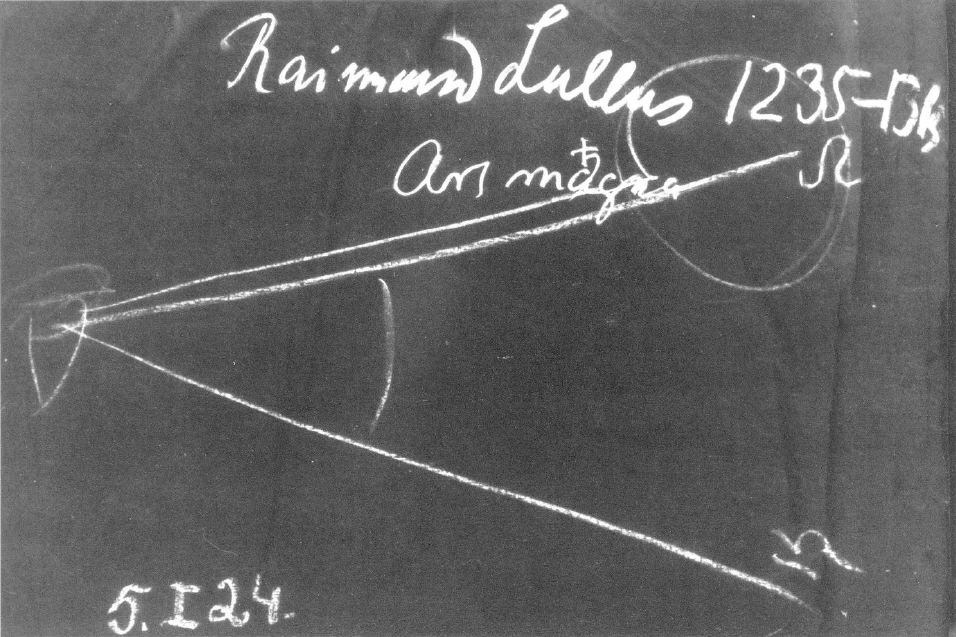
[ 19 ] Was Sie von Raimundus Lullus durch historische Dokumente kennenlernen können, ist ja herzlich wenig. Aber was man von ihm kennenlernen kann, wenn man — verzeihen Sie, daß ich den paradoxen Ausdruck gebrauche, aber Sie werden nach dem, was ich in den letzten Tagen und seit vierzehn Tagen hier dargestellt habe, den Ausdruck doch nicht mehr als paradox empfinden —, wenn man sozusagen ein persönliches Verhältnis gewinnt zu Raimundus Lullus, dann stellt er sich doch noch als etwas anderes dar, als das ist, was die historischen Dokumente aus ihm machen. Da stellt er sich in der folgenden Weise dar. Er ist im eminentesten Sinne eine Persönlichkeit, die unter Anregung gerade desjenigen Eingeweihten, von dem ich hier als dem Schüler des anderen gesprochen habe, dazu kam, mit aller Kraft wiederum so etwas in seiner Zeit erneuern zu wollen, wie es im Altertum die Mysterien des Wortes, des Logos waren. Er wollte die Mysterien des Logos wieder erneuern. Und er wollte sie wieder erneuern durch die Selbsterkenntnis, von der ich Ihnen ja gesagt habe, daß sie in einer so mächtigen Weise angeregt worden ist im 12., im 13. Jahrhundert. Und von diesem Gesichtspunkte aus ist die sogenannte «Ars magna» des Raimundus Lullus zu beurteilen. Er sagte sich: Wenn der Mensch spricht, so ist im Sprechen eigentlich auch ein Mikrokosmos gegeben. Dasjenige, was der Mensch spricht, ist eigentlich der ganze Mensch, konzentriert auf die Sprachorgane. Aber das Geheimnis jedes Wortes liegt im ganzen Menschen, und wiederum, weil es im ganzen Menschen liegt, liegt es eigentlich in der Welt.
[ 19 ] What you can learn of Raimon Lull by studying historical documents is indeed very scanty. But if you are able to enter into a personal relationship with Raimon Lull—you will allow me to use the expression: perhaps, in the light of all I have been telling you lately, it will not sound so paradoxical to you after all—if you are able to do this, then he shows himself to you as someone quite different from what the historical documents make him out to be. For he shows himself to be pre-eminently a personality who, under the influence and inspiration of the very Initiate of whom I have spoken to you as the “pupil,” made the resolve to use all his power to bring about a renewal in his own time of the Mysteries of the World, of the Logos, as they had been in olden times. He set himself to renew the Mysteries of the Logos by means of that self-knowledge for which so powerful an impulse was working in the twelfth and thirteenth centuries. The so-called Ars Magna of Raimon Lull is to be adjudged from this point of view. He said to himself: When man speaks, then we really have in speech a microcosm. That which man utters in speech is in truth the whole man, concentrated in the organs of speech; the secret and mystery of each single word is to be sought in the whole human being, and therefore in the world, in the Cosmos.
[ 20 ] Und so kam er darauf, daß man eigentlich das Geheimnis der Sprache erst im Menschen suchen müsse, indem man tief untertaucht von den bloßen Sprachorganen zu der Gesamtorganisation des Menschen, und dann im Kosmos, indem man wiederum die Gesamtorganisation des Menschen aus dem Kosmos heraus begreift. Zum Beispiel, sagen wir, jemand wolle den Laut A in seiner wirklichen Bedeutung begreifen. Da handelt es sich darum, daß der Mensch darauf kommt, daß der Laut A, der im geformten Aushauch zum Vorschein kommt, auf einer gewissen inneren Attitüde des Ätherleibes beruht, auf einer Attitüde des Ätherleibes, die Sie heute kennenlernen können. Durch die Eurythmie sehen wir, auf welcher Attitüde des Ätherleibes der Laut A beruht, denn diese Attitüde wird auf den physischen Leib übertragen und gilt dann als die eurythmische Geste für den A-Laut.
[ 20 ] And so the idea came to Raimon Lull that one must look for the secret of speech first in the human being, by diving down, as it were, from the speech organs into the whole organism of the human being; and then in the Cosmos, for the whole human organism is to be explained and understood out of the Cosmos. Let us suppose, for example, we want to understand the true significance of the sound A (as in “father”). The point is that the sound A, which comes about through the forming and shaping of the outgoing breath, depends on a certain inner attitude of the etheric body, which you can easily learn to know today. Eurhythmy will show it you; for this attitude of the etheric body is carried over in Eurhythmy to the physical body and becomes the Eurhythmic movement for the sound A.
[ 21 ] Ganz klar wurde das dem Raimundus Lullus nicht, sondern alles blieb bei ihm Ahnung. Aber seine Ahnung kam so weit, daß er nun die innere Attitüde, die innere Geste des Menschen gewissermaßen hinausverfolgte in den Kosmos, zum Beispiel daß er sagte: Richtest du die Blickrichtung nach dem Löwen, nach dem Sternbilde des Löwen, und richtest du die Blickrichtung nach der Waage, dann gibt dir der Zusammenhang der beiden Blickrichtungen das A. Richtest du den Blick nach dem Saturn, so hält der Saturn deine Blickrichtung auf. Und wenn der Saturn zum Beispiel vor dem Widder steht, so mußt du mit dem Saturn dich um den Widder herumdrehen. Das gibt dir aus dem Kosmos heraus die Empfindung des O.
[ 21 ] All this was not by any means fully clear to Raimon Lull; with him it was more of a dim, intuitive feeling. He did however get so far as to follow the inner attitude or gesture of the human being out into the Cosmos and say, for example: If you look in the direction of the constellation of the Lion (Leo), and then look in the direction of the Balance (Libra), the connection between the two lines of vision will give you A. Or again, turn your eye in the direction of Saturn. Saturn stops your line of vision, comes in the way. And if Saturn, for example, stands in front of the Ram (Aries), you have, as it were, to go round the Ram with Saturn. And then you have from out of the Cosmos the feeling of O. [Footnote: Readers unfamiliar with the movements in Eurhythmy for the sounds of speech, are recommended to turn to the first three chapters of the book Eurhythmy as Visible Speech (15 lectures) by Rudolf Steiner]
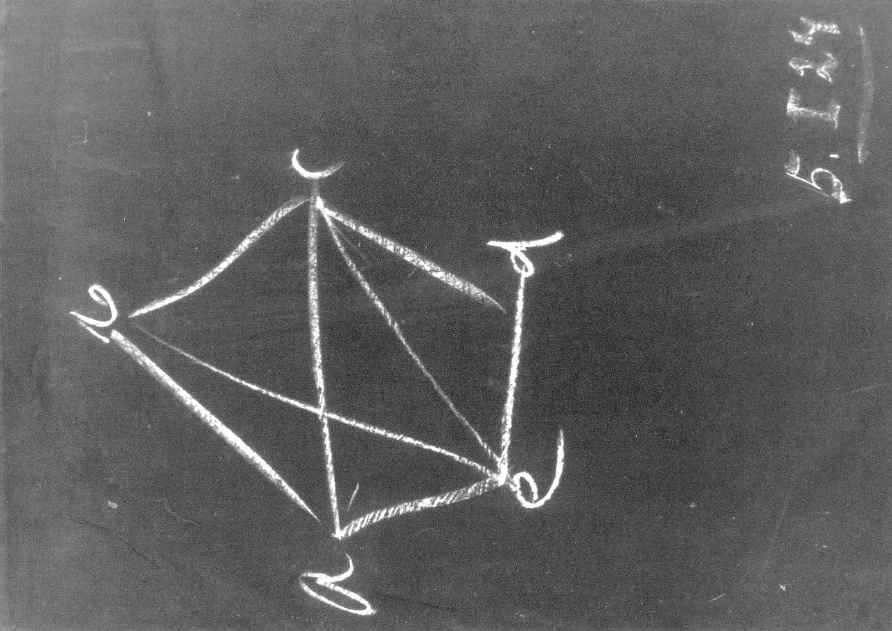
[ 22 ] Und aus solchen Ahnungen heraus fand Raimundus Lullus gewisse Figuren, an deren Ecken und Seiten er die Buchstaben schrieb. Und nun war er sich klar darüber: Wenn man aus seinen Empfindungen heraus Linien zieht in den Figuren, durch Diagonalen oder dergleichen meinetwegen in einem Fünfeck a b c d e irgendwie verbindet — das ist nur schematisch —, dann muß man darin Lautverbindungen sehen, und diese Lautverbindungen sprechen gewisse Geheimnisse des Weltenalls, des Kosmos aus.
[ 22 ] From ideas like these, though dimly perceived, Raimon Lull went on to find certain geometrical figures, the corners and sides of which he named with the letters of the alphabet. And he was quite sure that when one experiences a feeling and impulse to draw lines in the figures—diagonals, for instance, across a pentagon, uniting the five points in different ways—then one has to see in these lines different combinations of sounds, which combinations of sounds express certain secrets of the World-All, of the Cosmos.
[ 23 ] Also Raimundus Lullus suchte eine Art Renaissance der Geheimnisse des Logos, wie sie üblich waren in den alten Mysterien. Diese Sache wird ja entstellt dargestellt in den historischen Dokumenten. Aber wenn man eben nach und nach sozusagen in ein persönliches Verhältnis zu Raimundus Lullus kommt, so kommt man darauf, daß Raimundus Lullus versuchte, durch solche Bestrebungen das Weltenwort wiederum zu enträtseln. Und in diesen Bestrebungen lebten eigentlich die Schüler der mittelalterlichen Eingeweihten noch einige Jahrhunderte fort. Es war ein ganz intensives Bemühen, erst in den Menschen unterzutauchen und dann durch das Untertauchen in den Menschen hinauszukommen über den Menschen in die Geheimnisse des Kosmos hinein.
[ 23 ] Thus did Raimon Lull look for a kind of renaissance of the secrets of the Logos, as they were known and spoken of in the Ancient Mysteries. You will find it all quite misrepresented in the historical documents. When however one enters little by little into a personal relationship with Raimon Lull, then one comes to see how in all these efforts he was trying to solve once more the riddle of the Cosmic Word. And it is a fact that the pupils of the mediaeval Initiates continued for several centuries to spend their lives in endeavours of this kind. It was an intensive striving, first to immerse oneself in man, and then to come forth as it were, to rise out of the human being into the secrets of the Cosmos.
[ 24 ] In dieser Weise versuchten diese — man darf sie Weise nennen —, diese Weisen, zu verbinden die Offenbarung mit der Natur. Und sie glaubten, auf diese Weise — und vieles von ihrem Glauben war ja tief begründet —, sie glaubten, auf diese Weise hinter die Offenbarung des Religiösen und hinter die Offenbarung der Natur zu kommen. Denn sie waren sich klar darüber, daß eben der Mensch, so wie er nun einmal in ihrer Zeit auf der Erde lebte, eigentlich bestimmt war, die vierte Hierarchie zu werden, daß er aber einen Fall getan habe, durch den er unter sein eigentliches Wesen heruntergekommen ist und tiefer drinnen steckt in dem physischen Dasein, als er eigentlich sollte, daß er aber dennoch wiederum für dieses tiefe Drinnenstecken nicht die Kraft hat, sein Geistig-Seelisches entsprechend spirituell auszubilden. Und aus solchen Bestrebungen heraus entstand ja dann das Rosenkreuzer-Bestreben.
[ 24 ] Thus did these wise men—for we may truly call them so—seek to unite Revelation with Nature. They believed—and much of their belief was well-founded—that in this way they could come behind the Revelation of Religion and behind the Revelation of Nature. For it was quite clear to them that man, as he is now living on the Earth, was destined and intended to become the Fourth Hierarchy, but that he has “fallen” from his true and proper nature, and become more deeply involved in physical existence than he should be, thereby at the same time losing the power adequately to develop his soul and spirit. It was from such strivings that there arose, later on, what we know as the Rosicrucian Movement.
[ 25 ] An einer Lehrstätte der Rosenkreuzer, der ersten ursprünglichen Rosenkreuzer, war es, daß einmal gerade die Szenen, die ich Ihnen heute schilderte, die Szene hoch oben auf dem Berge zwischen dem Lehrer und dem Schüler und unten tief in den Erdenklüften, daß diese Szenen wie in einer Art zeitlicher Fata Morgana auftauchten, man möchte sagen, wie als Gespenst wiederkamen, sich spiegelten als Vision innerhalb einer Rosenkreuzer-Lehrstätte. Und daraus erkannte man, daß der Mensch durch innerliches Streben zweierlei erreichen müsse, um zur wirklichen Selbsterkenntnis zu kommen, um wiederum seine Anpassung an die Erde zu finden, um dahin zu gelangen, wirklich ein Angehöriger der vierten Hierarchie zu werden. Denn aus alledem, was nun innerhalb der Rosenkreuzer-Schule möglich war, erkannte man, was mit dem Schüler, als er den Geist seiner eigenen Jugend leibhaftig vor sich gesehen hat, vorgegangen war. Mit dem war vorgegangen eine Loslösung des astralischen Leibes, die stärker ist, als sie sonst irgendwie im menschlichen Leben ist. Und in dieser Loslösung des astralischen Leibes hat er den Sinn der Offenbarung erkannt. Und wiederum wurde in dieser Rosenkreuzer-Schule klar, was vorgegangen war mit dem Schüler in den Tiefen der Erde. Da war der astralische Leib ganz in das Innere zurückgezogen. Da war er völlig zusammengezogen, so daß der Schüler die Geheimnisse des eigenen Menscheninnern wahrnahm. Und jetzt wurden innerhalb der Rosenkreuzerei Exerzitien, Übungen gefunden, die verhältnismäßig einfach waren, die in symbolischen Figuren bestanden, denen man das Gemüt hingab, über die man meditierte. Und durch die Kraft, die in den menschlichen Seelenbesitz kam durch die Hingabe an solche Figuren, erreichte man, daß man auf der einen Seite den astralischen Leib loslöste und wurde wie der Schüler auf Bergeshöhe, in Ätherhöhen, daß man auf der andern Seite, indem sich der astralische Leib zusammenkrampfte, zusammenzog, wurde wie der Schüler in Erdenklüften. Und dann konnte man, indem man nicht die äußere Umgebung hatte, sondern eine starke innere Übung machte, in das menschliche Innere kommen.
[ 25 ] It was at a place of instruction of the Rosicrucians, of the first, original Rosicrucians, that the scene I have depicted to you today, the scene between the teacher and the pupil, at first upon a high mountain and then down in a deep cleft of the Earth, emerged like a kind of Fata Morgana, came again as it were like a ghost, reflected within a Rosicrucian school as knowledge. And it taught the pupils to recognise how man has by inner effort and striving to attain to two things, if he would come to a true self-knowledge, if he would find again his adjustment to the Earth and be able at last to become in actual reality a member of the Fourth Hierarchy. For within the Rosicrucian School the possibility was given to recognise what it was that had taken place with the pupil when he had seen before him in bodily form the Spirit of his Youth. A loosening of the astral body had taken place; the astral body, that was stronger at that moment than it otherwise ever is in life, was loosened. And in this loosening of the astral body the pupil had come to know the meaning and significance of Revelation. And again, what took place with the pupil in the depths of the Earth was also made clear and comprehensible in the Rosicrucian School. This time the astral body was drawn right back within. It was contracted and drawn together, so that the pupil was able to perceive and apprehend the certainty of man's own inner being. And now exercises were found within Rosicrucianism, comparatively simple exercises, consisting in symbolic figures, to which one gave oneself up in devotion and meditation. The force and power of which the soul became possessed through devotion to these figures, enabled the students on the one hand to loosen the astral body and become like the pupil on the mountain top in the Ether-heights, and on the other hand, through the compression and contraction of the astral body, to become like the pupil in the clefts of the Earth. And it was then possible, without the help, as before, of external environment, simply through performing a powerful inner exercise, to enter into the inner being of man.
[ 26 ] Sehen Sie, ich schildere Ihnen damit etwas, was ich nur ganz leise angedeutet habe in dem neuen Vorwort zu der letzten Auflage meiner «Mystik im Aufgange des neuzeitlichen Geistesleben». Da habe ich ja gesagt, daß dasjenige, was aufgetreten ist bei Meister Eckhart, Johannes Tauler, bei Nikolaus Cusanus, dem Kardinal, bei Valentin Weigel und den anderen, das Spätprodukt war eines kolossalen ursprünglichen Menschheitsstrebens, das vorangegangen ist. Und dieses ursprüngliche Menschheitsstreben, das dem Streben des Meister Eckhart, dem Streben des Johannes Tauler vorangegangen ist, dieses konkrete Streben im Geiste, dieses Suchen nach Selbsterkenntnis beim Menschen im Zusammenhange mit Offenbarung und Naturerleuchtung, dieses wollte ich Ihnen heute schildern als eine der Strömungen, die da liefen im sogenannten finsteren Mittelalter, wo es aber wirklich in der Finsternis, die der moderne Mensch heute hineinphantasiert, recht erleuchtete Geister gab, so erleuchtete Geister, daß die heute erleuchtetsten Geister das Licht dieser Erleuchteten eben nicht verstehen und daher finster bleiben. Aber das ist ja überhaupt vielfach das Charakteristikum der heutigen Zeit, daß man das Licht finster und die Finsternis hell findet.
[ 26 ] I have given you here a picture of something to which I have made a slight allusion in my preface to the new edition of the book Mysticism and Modern Thought. I said there that what we find in Meister Eckhart, in Johannes Tauler, in Nicolas Cusa, in Valentine Wiegel and the rest, is a late product of a great and mighty striving of mankind, an earlier, original striving that preceded them all. And this earlier striving in the Spirit, this search for self-knowledge, in connection on the one hand with Revelation and on the other hand with the illumination of Nature—I wanted to show you today how this is one of the currents that take their course in the so-called “Dark Ages.” The man of modern times conjures darkness into the Middle Ages out of his own imagination. In reality there were in those times many enlightened spirits, of such a kind however, that the “enlightened” spirits of today cannot understand their light and consequently remain in the dark. It is indeed characteristic of modern times, that men take light for darkness and darkness for light.
[ 27 ] Aber ein merkwürdiger, gewaltiger Eindruck bleibt zurück, wenn man in die Hintergründe desjenigen schaut, was in der Literatur wie in einem Abglanze dieser Zeit gelebt hat. Einiges von dem wollte ich Ihnen heute schildern; einiges von dem, was dann das Bild ergänzen, zu einem Ganzen abrunden wird, werde ich Ihnen morgen schildern.
[ 27 ] If however we can look into what lies behind the literature of those earlier times and are able to see that of which the literature gives only a dim reflection, then we may receive a powerful and lasting impression. Something of this I wanted to show you today: tomorrow we will complete the picture.