

Mystery Sites of the Middle Ages
Rosicrucianism and the Modern Principle of Initiation
GA 233a
22 April 1924, Dornach
Translate the original German text into any language:
Versions Available:
Das Osterfest als Stück Mysteriengeschichte der Menschheit IV
Easter as a Chapter in the History of Humanity's Mysteries IV
[ 1 ] Wir haben gesehen, wie aus den Mysterien herausgewachsen ist dasjenige, was im Bewußtsein die Menschen mit der Welt so verbindet, daß diese Verbindung zur Darstellung kommen kann in dem festlichen Jahreslaufe, und wir haben ja insbesondere gesehen, wie das Osterfest herausgewachsen ist aus dem Initiationsprinzip. Aus der ganzen Darstellung wird Ihnen hervorgegangen sein, welche bedeutsame Rolle das Mysterienwesen in der ganzen Entwickelung der Menschheit gespielt hat.
[ 1 ] We have seen how, out of the mysteries, that which connects human beings to the world in their consciousness has developed in such a way that this connection can be expressed in the festive cycle of the year, and we have seen in particular how the Easter festival has grown out of the principle of initiation. From this entire account, it will have become clear to you what a significant role the mystery traditions have played in the entire development of humanity.
[ 2 ] Es ist ja mit diesem Mysterienwesen so, daß im Grunde genommen alles, was geistig durch die Welt ging, durch die Menschheit sich entwickelte, daß das in alten Zeiten alles hervorgegangen ist aus den Mysterien. Wenn man ein heutiges Wort anwenden möchte, so müßte man sagen: Die Mysterien waren sehr mächtig in bezug auf die ganze Lenkung des geistigen Lebens.
[ 2 ] The fact is that, when it comes to these mysteries, essentially everything that has taken place spiritually in the world and developed through humanity originated in the mysteries in ancient times. If one were to use a modern term, one would have to say: The mysteries were very powerful in terms of the overall guidance of spiritual life.
[ 3 ] Nun war die Menschheit von vornherein dazu bestimmt, die Freiheit zu entwickeln. Zur Entwickelung der Freiheit war es notwendig, daß das alte Mysterienwesen zurückgegangen ist und eine Zeitlang die Menschen weniger im Zusammenhang standen mit einer solchen mächtigen Lenkung, wie sie von den Mysterien ausging, und gewissermaßen mehr sich selbst überlassen waren. Man kann ganz gewiß nicht sagen, daß heute der Zeitpunkt bereits herangerückt sei, in dem die Menschen sich ihre wahre innere Freiheit schon erobert haben und nun reif wären, zum Nächsten überzugehen, was auf das Zeitalter der Freiheit folgen soll. Gewiß, das kann man nicht sagen. Aber immerhin, es sind genügend viele Menschen durchgegangen durch Inkarnationen, in denen weniger die Macht der Mysterien gespürt worden ist als in früheren Zeiten. Und wenn auch die Saat des Durchgehens durch diese Inkarnationen heute noch nicht aufgegangen ist, sie ist in den Menschen. Sie steckt in den Menschenseelen drinnen.
[ 3 ] Now, humanity was destined from the very beginning to develop freedom. For freedom to develop, it was necessary for the ancient mystery cults to decline and for people, for a time, to be less bound by the powerful guidance that emanated from the mysteries and, in a sense, to be left more to their own devices. One certainly cannot say that the time has already come when people have already attained their true inner freedom and are now ready to move on to the next stage, which is to follow the age of freedom. Certainly, one cannot say that. But at any rate, a sufficient number of people have passed through incarnations in which the power of the Mysteries was felt less than in earlier times. And even if the seed of having passed through these incarnations has not yet sprouted today, it is within people. It lies within human souls.
[ 4 ] Wenn nun ein Zeitalter heranrückt, welches wieder geistiger ist, so werden schon die Menschen das entwickeln, was sie heute in der Dumpfheit noch nicht entwickelt haben. Aber es wird vor allen Dingen notwendig sein, daß dem Erkennen, dem Schauen, dem Erleben des Geistigen, die aus der heutigen Initiation geholt werden können, entgegengebracht werde auch aus der Freiheit heraus Schätzung, Ehrfurcht. Denn ohne Schätzung, ohne Ehrfurcht ist eine wirkliche Erkenntnis, ist ein geistiges Leben der Menschheit eigentlich nicht möglich. Es ist doch so, daß wir die Festeszeiten richtig anwenden, wenn wir gerade sie dazu gebrauchen, diese Schätzung, diese Ehrfurcht vor dem Geistigen, wie es sich entwickelt hat im Laufe der Menschheitsgeschichte, ein wenig versuchen, in unsere Seele einzupflanzen, wenn wir möglichst intim hinzuschauen lernen auf die Art und Weise, wie die äußeren geschichtlichen Ereignisse Geistiges bedeuten, Geistiges von einem Zeitalter in das andere tragen. Zunächst ist es ja so, daß die Menschen in wiederholten Erdenleben immer wiederum ins Erdendasein kommen. Dadurch tragen sie dasjenige, was sie in früheren Epochen erlebt haben, in spätere Epochen herüber. Die Menschen sind das wichtigste Glied in bezug auf das Weiterentwickeln dessen, was innerhalb der Menschheitsgeschichte geschieht. Aber die Menschen leben doch zu allen Zeiten in einer bestimmten Umgebung. Und eine wichtigste Umgebung ist schon die Mysterienumgebung. Ein Wichtigstes im Menschheitsfortschritt ist das Herübertragen dessen, was Menschen in Mysterien erlebt haben und wiedererleben, sei es wiederum in Mysterien, wo es hinauswirkt in die Menschheit, sei es sonst irgendwie im Erkennen. Heute muß es ja sonst irgendwie im Erkennen sein, denn das eigentliche Mysterienwesen ist mehr oder weniger für die heutige Außenwelt zurückgegangen, muß erst wiederum auftreten.
[ 4 ] When an age approaches that is once again more spiritual, people will develop what they have not yet developed today in their spiritual dullness. But above all, it will be necessary that the knowledge, insight, and experience of the spiritual—which can be drawn from today’s initiation—be met with appreciation and reverence, arising from a place of freedom. For without appreciation, without reverence, true knowledge and a spiritual life for humanity are actually impossible. After all, we make proper use of the festival times when we use them precisely to try, even if only a little, to instill in our souls this appreciation, this reverence for the spiritual as it has developed throughout human history; when we learn to look as intimately as possible at the way in which external historical events signify the spiritual and carry the spiritual from one age to the next. To begin with, it is true that human beings, through repeated earthly lives, return time and again to earthly existence. Through this, they carry over into later epochs what they have experienced in earlier ones. Human beings are the most important link in the further development of what takes place within human history. But human beings live, after all, in a specific environment at all times. And one of the most important environments is indeed the environment of the mysteries. One of the most important aspects of human progress is the transmission of what people have experienced and relive in the mysteries—whether again within the mysteries themselves, where it radiates out into humanity, or in some other way through spiritual insight. Today, this must indeed take place in some other way through spiritual insight, for the true essence of the mysteries has more or less receded from the modern outer world and must first re-emerge.
[ 5 ] Wir müssen ja sagen: Es ist schon so, daß, wenn jener Impuls, der durch die Weihnachtstagung von hier, vom Goetheanum, ausgegangen ist, wirklich sich einlebt in der Anthroposophischen Gesellschaft, dann wird die Anthroposophische Gesellschaft, indem sie weiter hinführt zu den Klassen, die einzurichten sind — zum Teil hat diese Einrichtung ja schon begonnen —, die Grundlage sein für das weitere Mysterienwesen. Es muß das weitere Mysterienwesen bewußt gepflanzt werden durch diese Anthroposophische Gesellschaft. Diese Anthroposophische Gesellschaft hat ja vor sich ein Ereignis, das ebenso in der Entwickelung verwertet werden kann, wie einstmals verwertet worden ist ein ähnliches Ereignis: der Brand des Tempels von Ephesus. Da und dort lag ein bedeutsames Unrecht zugrunde. Allein die Dinge nehmen sich ja auf den verschiedenen Niveaus eben verschieden aus, und es kann dasjenige, was auf einem Niveau ein furchtbares Unrecht ist, in der Freiheit der Menschen dann verwendet werden in dem Sinne, daß gerade durch solche schauderhaften Ereignisse ein wirklicher Menschheitsfortschritt hervorgerufen werde.
[ 5 ] We must indeed say: It is certainly true that if that impulse which went out from here, from the Goetheanum, during the Christmas Conference truly takes root in the Anthroposophical Society, then the Anthroposophical Society, by leading the way toward the classes that are to be established—the establishment of which has, in part, already begun—will be the foundation for the further development of the mystery tradition. The future mystery tradition must be consciously planted by this Anthroposophical Society. This Anthroposophical Society now faces an event that can be utilized in its development just as a similar event was once utilized: the burning of the Temple of Ephesus. Here and there, a significant injustice lay at the root of it. However, things appear differently on different levels, and what is a terrible injustice on one level can then be utilized within the freedom of human beings in the sense that it is precisely through such horrific events that genuine human progress is brought about.
[ 6 ] Nun muß man aber, wenn man auf solche Dinge verständnisvoll eingehen will, möglichst intim, wie ich schon sagte, die Dinge fassen. Man muß hineinschauen in die besondere Art, wie in den Mysterien das Geistige der Welt gelebt hat. Ich habe gestern darauf hingedeutet, wie aus Sonnen- und Mondenkonstellation, wenn man sie geistig nimmt, herauswächst die Festsetzung des jährlichen Osterfestes, und ich habe darauf hingedeutet, daß vom Mondengesichtspunkte aus die anderen Planeten geschaut werden. Und nach dem, was man erfährt im Schauen der anderen Planeten, wird der Mensch angeleitet beim Heruntersteigen aus dem vorirdischen Dasein in das irdische Dasein, wie er sich seinen Lichtätherleib bildet.
[ 6 ] However, if one wishes to approach such matters with understanding, one must, as I have already said, grasp them as intimately as possible. One must look into the particular way in which the spiritual aspect of the world was lived out in the Mysteries. Yesterday I pointed out how the setting of the annual Easter festival grows out of the constellations of the Sun and Moon, when viewed spiritually, and I pointed out that the other planets are observed from the Moon’s perspective. And based on what one experiences in observing the other planets, a person is guided—as they descend from pre-earthly existence into earthly existence—in how to form their light-etheric body.
[ 7 ] Nun, wenn man die Anschauung gewinnen will, wie dieser Lichtätherleib durch die Mondenkräfte, durch die Mondenbeobachtungen, ich möchte sagen durch das geistige Mondenobservatorium, wie diese Ätherkräfte dem Menschen überliefert werden, wenn man das recht verstehen will, so kann man es so beobachten, wie wir es nun versucht haben, aus dem Kosmos heraus, wo es eingeschrieben ist, wo es als ein Faktum existiert. Aber es ist auch wichtig, den menschlichen Anteil, der in den verschiedenen Zeiten an einer solchen Wahrheit da ist, auf das Gemüt wirken zu lassen.
[ 7 ] Well, if one wants to gain an understanding of how this light-etheric body is conveyed to human beings through the forces of the Moon and through observations of the Moon, I would say through the spiritual lunar observatory—how these etheric forces are imparted to human beings—if one wishes to understand this correctly, one can observe it as we have now attempted to do, from within the cosmos itself, where it is inscribed, where it exists as a fact. But it is also important to allow the human element present in such a truth at various times to take effect on the soul.
[ 8 ] Und in der Tat, niemals war der Anteil, den menschliche Gemüter genommen haben an diesem Heruntersteigen vom vorirdischen Dasein in das irdische in bezug auf die letzte Etappe, die Umkleidung des Menschen mit dem Ätherleib, niemals war ein so intimer, inniger Anteil an dieser Tatsache genommen worden als gerade in den Mysterien von Ephesus. In den Mysterien von Ephesus war es so, daß der ganze Dienst, welcher der exoterisch Artemis genannten Göttin von Ephesus dargebracht wurde, eigentlich darauf gerichtet war, das geistige Weben und Leben innerhalb des Äthers der Welt, innerhalb des Äthers des Kosmos, mitzuerleben. Man kann schon sagen, wenn die Angehörigen des Mysteriums von Ephesus sich dem Götterbilde nahten, dann war es eine Empfindung, die sich aber steigerte bis zum Anhören und die etwa so auszudrücken ist, wie wenn es die Sprache der Göttin wäre: Ich freue mich über alles Fruchttragende im weiten Weltenäther.
[ 8 ] And indeed, never has the human mind played such an intimate and profound role in this descent from pre-earthly existence into earthly life—specifically with regard to the final stage, the clothing of the human being with the etheric body—as it did in the Mysteries of Ephesus. In the Mysteries of Ephesus, the entire ritual dedicated to the goddess of Ephesus—known exoterically as Artemis—was actually aimed at experiencing the spiritual weaving and life within the ether of the world, within the ether of the cosmos. One might even say that when the initiates of the Mystery of Ephesus approached the divine image, they experienced a sensation that intensified to the point of hearing—a sensation that might be expressed as if it were the voice of the goddess herself: “I rejoice in all that bears fruit in the vast ether of the world.”
[ 9 ] Es war ein tiefer Eindruck, der ausgeübt wurde durch dieses Aussprechen inniger Freude der Tempelgött in über alles Wachsende, Sprießende, Sprossende im weiten Weltenäther. Und innig verwandtes Fühlen mit dem Sprießen und Sprossen war ja insbesondere etwas, was wie ein Zauberhauch die Atmosphäre, die geistige Atmosphäre von dem ephesischen Heiligtum durchströmte. Es war dieses Mysterium schon so angeordnet, so eingerichtet, daß man sagen kann, nirgends ist eigentlich so mitgelebt worden mit dem Wachsen des Pflanzenwesens, mit dem Sprießen und Sprossen der Erde in das Pflanzenwesen hinein, als in Ephesus.
[ 9 ] It was a profound impression that was made by this expression of the temple goddess’s heartfelt joy in all that grows, sprouts, and shoots forth in the vast ether of the world. And this deep, intimate connection with sprouting and budding was, in particular, something that, like a magical breath, permeated the atmosphere—the spiritual atmosphere—of the Ephesian sanctuary. This mystery was already so arranged, so structured, that one can say: nowhere else has there actually been such a shared experience of the growth of the plant kingdom, of the earth’s sprouting and budding into the plant kingdom, as in Ephesus.
[ 10 ] Das führte denn auch dazu, daß gerade in diesem ephesischen Mysterium mit besonderer Deutlichkeit der Unterricht gegeben werden konnte, wenn ich es so nennen darf, der darauf hinausging, besonders dieses Mondengeheimnis, von dem ich gestern sprach, an das Gemüt der zu Ephesus Gehörigen heranzubringen.
[ 10 ] This led to the fact that, particularly within this Ephesian mystery, the teaching—if I may call it that—could be imparted with special clarity, a teaching aimed specifically at bringing this mystery of the moon, of which I spoke yesterday, to the hearts of the people of Ephesus.
[ 11 ] Es war etwas, was jeder wie sein eigenes Erlebnis hatte, sich zu fühlen als Lichtgestalt, weil das so lebendig gemacht wurde vor den ephesischen Schülern und Initiierten: dieses Durch-den-Mond-seine-Licht-gestalt-Bekommen. Und es war eine Einrichtung in Ephesus, die etwa so war: Derjenige, der diese Einrichtung in der Weihestätte auf sich wirken lassen konnte, der wurde wirklich ganz hineinversetzt in dieses Sichherausbilden aus dem den Mond umwandelnden Sonnenlichte. Dann tönte es an ihn heran, wie wenn es von der Sonne herübertönte: \(J O A\).
[ 11 ] It was something that everyone experienced as their own personal experience—feeling like a being of light—because it was brought to life so vividly before the Ephesian disciples and initiates: this process of becoming a being of light by passing through the moon. And there was a ritual in Ephesus that went something like this: Whoever was able to allow this ritual to take effect upon them in the place of consecration was truly transported entirely into this process of emerging from the sunlight that transforms the moon. Then a sound reached them, as if it were resonating from the sun: \(J O A\).
[ 12 ] Dieses \(J O A\), von dem wußte er, daß es regsam macht sein Ich, seinen astralischen Leib. \(J O\) — Ich, astralischer Leib, und das Herankommen des Lichtätherleibes in dem \(A\) — \(J O A\). Jetzt fühlte er sich, indem vibrierte in ihm das \(J O A\), jetzt fühlte er sich als Ich, als astralischen Leib, als ätherischen Leib.
[ 12 ] This \(J O A\)—he knew that it made his “I,” his astral body, active. \(J O\)—the “I,” the astral body, and the approach of the light-etheric body in the \(A\)—\(J O A\). Now, as the \(J O A\) vibrated within him, he felt himself as the “I,” as the astral body, and as the etheric body.
[ 13 ] Und dann war es, wie wenn von der Erde heraufklänge, denn der Mensch war versetzt in das Kosmische, wie wenn von der Erde heraufklänge dasjenige, was das \(J O A\) durchsetzte, \(eh-v\). Das waren die Kräfte der Erde, die heraufkamen in dem \(eh-v\).
[ 13 ] And then it was as if a sound were rising from the Earth, for the human being had been transported into the cosmic realm, as if that which permeated the \(J O A\), \(eh-v\), were rising from the Earth. These were the forces of the Earth that rose up in the \(eh-v\).

[ 14 ] Und nun fühlte er, in dem JehOvA fühlte er den ganzen Menschen. Das Vorgefühl des physischen Leibes, den er erst auf der Erde hatte, fühlte er angedeutet in den Konsonanten, die hinzugehörten zu dem Vokalischen, was in dem \(J O A\) andeutet Ich, astralischen Leib, ätherischen Leib. Dieses Sicheinleben in dem \(Jeh\) \(Ov\) \(A\), das war es, was den ephesischen Schüler erfühlen ließ die letzten Schritte für das Heruntersteigen aus der geistigen Welt.
[ 14 ] And now he felt, in JehOvA, he felt the whole human being. He sensed a hint of the physical body—which he had only acquired on Earth—in the consonants that accompanied the vowels, which in \(J O A\) signify the “I,” the astral body, and the etheric body. This immersion in the \(Jeh\) \(Ov\) \(A\)—that was what allowed the Ephesian disciple to sense the final steps in descending from the spiritual world.
[ 15 ] Aber es war zu gleicher Zeit dieses Erfühlen des \(J O A\) so, daß man sich fühlte im Lichte drinnen als dieser Klang \(J O A\). Dann war man Mensch: klingendes Ich, klingender astralischer Leib, in licht-glänzendem Ätherleib. Dann war man Klang im Licht. So ist man als kosmischer Mensch.
[ 15 ] But at the same time, this sensing of \(J O A\) was such that one felt oneself to be within the light as this sound \(J O A\). Then one was human: a resonant “I,” a resonant astral body, within a luminous etheric body. Then one was sound within the light. That is what it means to be a cosmic human being.
[ 16 ] Und so ist man fähig, aufzunehmen dasjenige, was man im Kosmos draußen sieht, wie man durch sein Auge hier auf der Erde fähig ist, aufzunehmen, was im physischen Umkreise der Erde geschieht.
[ 16 ] And so one is able to perceive what one sees out in the cosmos, just as one is able, through one’s eyes here on Earth, to perceive what happens within the physical surroundings of the Earth.
[ 17 ] Dann fühlte sich der ephesische Schüler wirklich, wenn er in sich trug dieses \(J O A\), wie versetzt in die Mondensphäre. Er nahm teil an demjenigen, was beobachtet werden konnte vom Gesichtspunkte des Mondes aus.
[ 17 ] Then the Ephesian disciple, carrying within himself this \(J O A\), truly felt as if he had been transported into the lunar sphere. He participated in what could be observed from the moon’s perspective.
[ 18 ] Da war der Mensch noch Mensch im allgemeinen. Er wurde erst Mann und Weib beim Heruntersteigen auf die Erde. Da aber fühlte der Mensch sich hinaufversetzt in diese Region des vorirdischen Daseins, aber eben des Herankommens an das Irdische. Den ephesischen Schülern wurde dieses Sichhinaufversetzen in die Mondensphäre eben ganz besonders intim möglich. Dann trugen sie in ihrem Herzen, in ihrer Seele dasjenige, was sie miterlebt haben und was etwa in der folgenden Weise dem ephesischen Schüler erklang:
[ 18 ] At that time, human beings were still simply human beings in the general sense. They only became men and women upon descending to Earth. But then, human beings felt themselves transported upward into this region of pre-earthly existence—yet one that was approaching the earthly realm. For the Ephesian disciples, this feeling of being transported upward into the lunar sphere became possible in a particularly intimate way. Then they carried within their hearts, within their souls, what they had witnessed—and what resounded to the Ephesian disciple in roughly the following manner:
Weltentsprossenes Wesen, du in Lichtgestalt,
Von der Sonne erkraftet in der Mondgewalt,Dich beschenket des Mars erschaffendes Klingen
Und Merkurs gliedbewegende Schwingen,Dich erleuchtet Jupiters erstrahlende Weisheit
Und der Venus liebetragende Schönheit —Daß Saturns weltenalte Geist-Innigkeit
Dich dem Raumessein und Zeitenwerden weihe!
Being born of the world, you in a form of light,
Empowered by the sun within the moon’s might,You are gifted with Mars’s creative resonance
And Mercury’s limbs-stirring wings,Enlightened by Jupiter’s radiant wisdom
And Venus’s love-bestowing beauty—May Saturn’s age-old spiritual intimacy
Consecrate you to the essence of space and the unfolding of time!
[ 19 ] Das war dasjenige, von dem jeder Epheser durchdrungen war. Das rechnete er zum Wichtigsten, was seinen Menschen durchpulste (der Text wurde an die Tafel geschrieben):
[ 19 ] That was what every Ephesian was deeply imbued with. He considered it the most important thing coursing through his people (the text was written on the blackboard):
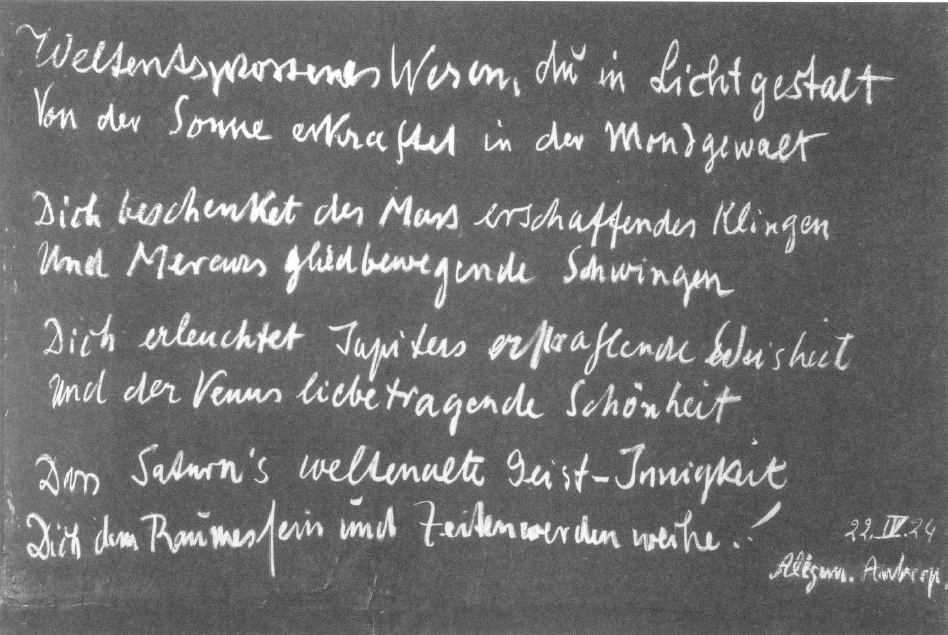
[ 20 ] Man kann schon sagen: Es war für den zu den ephesischen Mysterien Gehörigen etwas wie sich so recht als Mensch fühlen, wenn ihm — ich will mich etwas trivial ausdrücken —, wenn ihm in den Ohren klang das, was in diesen Sprüchen liegt. Denn er fühlte ja: damit ist ihm das Bewußtsein von dem aufgegangen, wie er mit dem Planetensystem zusammenhängt in den Kräften seines Ätherleibes. Und prägnant kam das zum Ausdruck. Das ist zum Ätherleib vom Weltenall gesprochen:
[ 20 ] One could certainly say that for those who belonged to the Ephesian Mysteries, it was something like truly feeling human when—to put it somewhat trivially—the meaning contained in these sayings resounded in their ears. For they felt that through this, an awareness dawned upon them of how they are connected to the planetary system through the forces of their etheric body. And this was expressed succinctly. This refers to the etheric body in relation to the universe:
Weltentsprossenes Wesen, du in Lichtgestalt,
Von der Sonne erkraftet in der Mondgewalt.
Beings born of the world, you in forms of light,
Empowered by the sun within the moon’s might.
[ 21 ] Nun ist der Mensch sich fühlend in der Gewalt des Mondenlichtes:
[ 21 ] Now, feeling the power of the moonlight, man is:
Dich beschenket des Mars erschaffendes Klingen.
Mars bestows upon you the creative power of the sword.
[ 22 ] Das Klingen, das etwas Erschaffendes, etwas Schöpferisches hatte, klang herüber vom Mars. Und dasjenige, was dem Menschen die Glieder erkraftet, daß er ein bewegliches Wesen wurde:
[ 22 ] The sound, which had something creative, something generative about it, echoed from Mars. And that which gave humans the strength in their limbs, enabling them to become beings capable of movement:
Und Merkurs gliedbewegende Schwingen.
And Mercury’s limbs-stirring wings.
[ 23 ] Vom Jupiter leuchtet es herüber:
[ 23 ] It shines down from Jupiter:
Dich erleuchtet Jupiters erstrahlende Weisheit.
You are enlightened by Jupiter's radiant wisdom.
[ 24 ] Von der Venus leuchtet es herüber:
[ 24 ] It shines over from Venus:
Und der Venus liebetragende Schönheit.
And the beauty that rivals Venus's.
[ 25 ] Damit dann Saturn alles zusammenfassen kann, was den Menschen abrundet innerlich und äußerlich und ihn bereitet, daß er heruntersteigen kann auf die Erde, sich mit einem physischen Leibe umkleidet und als dieses physisch umkleidete Wesen, das den Gott in sich trägt, auf der Erde weiterleben kann:
[ 25 ] So that Saturn may then bring together everything that completes the human being, both inwardly and outwardly, and prepares him to descend to Earth, clothe himself in a physical body, and, as this physically clothed being who carries God within himself, continue to live on Earth:
Daß Saturns weltenalte Geist-Innigkeit
Dich dem Raumessein und Zeitenwerden weihe!
May Saturn’s age-old spiritual intimacy
Consecrate you to the essence of space and the unfolding of time!
[ 26 ] Nun, aus dem, was ich da beschreibe, können Sie ja entnehmen, daß das Leben, das geistige Leben in Ephesus ein innerlich helles war, ein farbiges war. In diesem innerlich hellen, farbigen Leben war ja tatsächlich dasjenige enthalten, was im Ostergedanken zusammenfaßte alles, was man je gewußt hat über des Menschen wahre Würde im ganzen Kosmos, im ganzen Weltenall. Und mannigfache von denjenigen Wanderern — ich habe sie gestern erwähnt —, die von Mysterium zu Mysterium gingen, um das Ganze des Mysterienwesens auf sich wirken zu lassen, mannigfache von diesen Wanderern haben doch immer wieder versichert: So hell, so innig, wie ihnen in Ephesus erklungen ist die Sphärenharmonie aus diesem Wahrnehmen vom Mondesgesichtspunkte aus, wo ihnen erschienen ist das leuchtendste Astrallicht der Welt, indem sie es verspürt haben in dem den Mond umglimmenden Sonnenlichte, das durchgeistigt ist, so wie der Mensch beseelt ist, durchgeistigt ist vom Astrallichte, so haben sie an anderen Orten das nicht, wenigstens nicht mit jener Freudigkeit, mit jener inneren Künstlerauffassung wahrnehmen können.
[ 26 ] Well, from what I am describing here, you can see that life—spiritual life—in Ephesus was inwardly luminous, full of color. This innerly luminous, colorful life indeed contained what the idea of Easter encapsulates: everything that has ever been known about the true dignity of the human being within the entire cosmos, within the entire universe. And many of those wanderers—I mentioned them yesterday—who went from mystery to mystery in order to allow the whole essence of the mysteries to take effect upon them, many of these wanderers have repeatedly affirmed: Just as brightly and deeply as the harmony of the spheres resounded to them in Ephesus from this perception of the moon’s perspective—where the brightest astral light in the world appeared to them as they sensed it in the sunlight shimmering around the moon, which is spiritualized just as the human being is animated, spiritualized by the astral light— they have not been able to perceive this in other places, at least not with that same joy, with that same inner artistic perception.
[ 27 ] Das alles war ja gebunden an diejenige Tempelstätte, die dann durch Verbrecherhand oder Wahnsinnigenhand in Flammen aufging. Aber Eingeweihte der ephesischen Mysterien waren ja, wie ich während der Weihnachtstagung erwähnte, wiederverkörpert in Aristoteles und Alexander. Und diese Individualitäten sind dann nahegekommen dem, was in jener Zeit noch zu verspüren war an den Mysterien von Samothrake.
[ 27 ] All of this was, of course, connected to that very temple site, which was then set ablaze by the hand of a criminal or a madman. But initiates of the Ephesian Mysteries were, as I mentioned during the Christmas Conference, reincarnated in Aristotle and Alexander. And these individualities then came close to what could still be sensed at that time in the Mysteries of Samothrace.
[ 28 ] Nun ist ja ein scheinbar äußerlich zufälliges Ereignis von einer großen geistigen Bedeutung in der Weltentwickelung. Es ist schon erwähnt worden unter uns, sogar seit vielen Jahren erwähnt worden: Als der Tempel von Ephesus brannte, war das die Geburtsstunde Alexanders des Großen. Aber indem dieser Tempel brannte, spielte sich ja etwas ab.
[ 28 ] Now, an event that appears to be a mere coincidence on the surface is of great spiritual significance in the development of the world. It has already been mentioned among us—in fact, for many years now: When the Temple of Ephesus burned, that was the moment of Alexander the Great’s birth. But as that temple burned, something was indeed taking place.
[ 29 ] Oh, wie ungeheuer viel war für diejenigen, die zu diesem Tempel gehörten, im Laufe von Jahrhunderten geschehen! Wie viel Geistiges an Licht und Weisheit ist durch diese Tempelräume gegangen. Und alles, was da durch diese Tempelräume ging, ist ja mitgeteilt worden, während die Flammen herausschlugen aus dem Tempel zu Ephesus, ist ja mitgeteilt worden dem Weltenäther. So daß man sagen kann: Das kontinuierliche Osterfest zu Ephesus, das in den Tempelräumen eingeschlossen war, ist seither eingeschrieben, wenn auch mit weniger deutlich wahrnehmbaren Lettern, in den ganzen Weltendom, insofern der Weltendom ätherisch ist.
[ 29 ] Oh, how much had happened over the centuries to those who belonged to this temple! How much spiritual light and wisdom has passed through these temple chambers. And everything that passed through these temple chambers—as the flames burst forth from the temple at Ephesus—has indeed been communicated to the world-ether. So one can say: The continuous Easter celebration in Ephesus, which was enclosed within the temple halls, has since been inscribed—albeit in less clearly perceptible letters—into the entire world dome, insofar as the world dome is ethereal.
[ 30 ] Und so ist es überhaupt mit vielem. Vieles von dem, was menschliche Weisheit ist, war in alten Zeiten umschlossen von Tempelwänden. Es ist den Tempelwänden entflohen, ist in den Weltenäther eingeschrieben und wird da sofort sichtbar, wenn der Mensch zur wirklichen Imagination aufsteigt. Diese Imagination ist gewissermaßen die Interpretin der Sternengeheimnisse. Man kann so sagen: In den Weltenäther ist eingeschrieben dasjenige, was einstmals Tempelgeheimnis war, und man kann es mit der Imagination daraus lesen.
[ 30 ] And so it is with many things. Much of what constitutes human wisdom was once enclosed within temple walls. It has escaped from the temple walls, is inscribed in the world-ether, and becomes immediately visible there when a person rises to true imagination. This imagination is, so to speak, the interpreter of the mysteries of the stars. One might say: What was once a temple mystery is inscribed in the world-ether, and one can read it from there through imagination.
[ 31 ] Man kann aber auch anders sagen, und es ist dasselbe, wenn man anders sagt. Man kann auch sagen: Ich stelle mich in sternheller Nacht auf, beschaue mir den Sternenhimmel, lasse seinen Eindruck auf mich wirken. Und es verwandelt sich, wenn der Mensch dazu die Fähigkeit hat, das, was in den Formen der Sternbilder ist, was in den Bewegungen der Wandelsterne ist, es verwandelt sich wie in eine große Weltenschrift. Und liest man diese Weltenschrift, so kommt etwas heraus von der Art, wie ich es gestern auseinandergesetzt habe für das Mondengeheimnis. Diese Dinge sind durchaus zu lesen in der Weltenschrift, wenn einem die Sterne nicht mehr bloß sind das mathematisch und mechanisch Errechenbare, sondern wenn sie einem sind die Lettern der kosmischen Schrift.
[ 31 ] But one can also put it another way, and it amounts to the same thing. One could also say: I stand out on a starry night, gaze at the starry sky, and let its impression work its way into me. And if a person has the ability to do so, what is contained in the forms of the constellations and in the movements of the wandering stars transforms—as it were—into a great cosmic script. And when one reads this cosmic script, something emerges similar to what I explained yesterday regarding the mystery of the Moon. These things can certainly be read in the cosmic script when the stars are no longer merely mathematically and mechanically calculable, but when they become the letters of the cosmic script.
[ 32 ] Nun aber möchte ich noch das Folgende für die Weiterentwickelung der Sache sagen. Gerade beim Herantreten an die kabirischen Geheimnisse in Samothrake in der Zeit, als nun schon die alten Mysterien zurückgingen — Samothrake war ja noch als Erinnerungsstätte und auch noch als Pflegestätte, als Arbeitsstätte da, aber im allgemeinen ging das Mysterienwesen schon zurück in der Alexanderzeit —, da war eben ein Moment, wo für Alexander und Aristoteles durch den Einfluß der Kabirenmysterien etwas entstand wie eine Erinnerung an die alte ephesische Zeit, die ja von beiden mitgemacht war in einem bestimmten Jahrhundert. Wieder erklang da das \(J O A\)-Wort, und wieder erklang das:
[ 32 ] But now I would like to add the following regarding the further development of this matter. Precisely when approaching the Kabiric mysteries in Samothrace at a time when the ancient mysteries were already in decline—Samothrace was, after all, still a place of remembrance and also a place of cultivation, a place of work, but in general the mystery tradition was already in decline during the time of Alexander— there was a moment when, through the influence of the Kabiric mysteries, something arose for Alexander and Aristotle that was like a recollection of the ancient Ephesian era, which both of them had experienced in a certain century. Once again, the \(J O A\) word resounded there, and once again this resounded:
Weltentsprossenes Wesen, du in Lichtgestalt,
Von der Sonne erkraftet in der Mondgewalt,Dich beschenket des Mars erschaffendes Klingen
Und Merkurs gliedbewegende Schwingen,Dich erleuchtet Jupiters erstrahlende Weisheit
Und der Venus liebetragende SchönheitDaß Saturns weltenalte Geist-Innigkeit
Dich dem Raumessein und Zeitenwerden weihe!
Being born of the world, you in a form of light,
Empowered by the sun within the moon’s might,You are gifted with Mars’s creative resonance
And Mercury’s limbs-stirring wings,Enlightened by Jupiter’s radiant wisdom
And Venus’s love-bestowing beautyMay Saturn’s age-old spiritual intimacy
Consecrate you to the essence of space and the unfolding of time!
[ 33 ] Aber in dieser Erinnerung, in dieser historischen Erinnerung an Altes lag eine gewisse Kraft, Kraft, ein Neues zu schaffen. Und von jenem Moment ging die Kraft aus, ein Neues zu schaffen, aber ein merkwürdiges Neues, das die Menschheit wenig beachtet hat. Denn Sie müssen eigentlich erst verstehen, wie dieses Neue-Schaffen, das aus dem Zusammenwirken von Alexander und Aristoteles ausging, nun seiner Art nach beschaffen war.
[ 33 ] But in this memory—this historical memory of the past—lay a certain power: the power to create something new. And from that moment emanated the power to create something new—but a strange new thing that humanity has paid little attention to. For you must first understand what this new creation, which arose from the collaboration between Alexander and Aristotle, was actually like.
[ 34 ] Nehmen Sie irgendein bedeutendes Dichtwerk oder anderes Werk — und Sie können die schönsten Werke nehmen —, nehmen Sie meinetwillen eine deutsch übersetzte Bhagavad Gita, nehmen Sie Goethes «Faust», nehmen Sie die Iphigenie oder irgend etwas, was Sie hochschätzen, und denken Sie an den reichen, gewaltigen Inhalt, sagen wir, an den reichen, gewaltigen Inhalt von Goethes «Faust». Und jetzt, wodurch wird denn Ihnen, meine lieben Freunde, dieser reiche Inhalt vermittelt? Nehmen wir an, er würde Ihnen so vermittelt, wie er für die meisten Menschen ja vermittelt wird. Sie lesen den «Faust» irgendeinmal in Ihrem Leben. Was tritt Ihnen denn da auf dem physischen Plane entgegen? Was ist denn auf dem Papiere? Nichts anderes ist auf dem Papiere als Kombinationen von \(a b c d e\) fund so weiter. Alles, wodurch einem der große, gewaltige Inhalt des «Faust» aufgeht, sind ja nur Kombinationen von \(a b c d e f\) und so weiter. Wenn Sie das Alphabet kennen, so gibt es nichts auf dem Papier, was dasteht, was nicht zusammenfällt mit einem der etlichen zwanzig Buchstaben. Aus diesen etlichen zwanzig Buchstaben ist etwas hervorgezaubert auf dem Papier, was Ihnen hervorruft, wenn Sie eben lesen können, den ganzen reichen Inhalt des «Faust». Und es steht Ihnen sogar etwas frei. Es steht Ihnen frei, das Hersagen von \(a b c d e\) fund so weiter furchtbar langweilig zu finden, zu sagen, das ist ja eigentlich das Aller-Allerabstrakteste. Und dennoch, dieses Aller-Allerabstrakteste, in richtiger Weise kombiniert, gibt den ganzen «Faust»!
[ 34 ] Take any significant work of poetry or other literature—and you can choose the most beautiful works—take, for my sake, a German translation of the Bhagavad Gita, take Goethe’s Faust, take Iphigenia or anything else you hold in high esteem, and think of the rich, powerful content—let’s say, the rich, powerful content of Goethe’s Faust. And now, my dear friends, through what means is this rich content conveyed to you? Let’s assume it is conveyed to you in the same way it is conveyed to most people. You read Faust at some point in your life. What do you encounter on the physical plane? What is actually on the page? There is nothing on the page but combinations of \(a b c d e\) and so on. Everything through which the great, powerful content of Faust becomes apparent to us is, after all, nothing but combinations of \(a b c d e f\) and so on. If you know the alphabet, there is nothing on the page that does not correspond to one of the twenty-odd letters. From these twenty-odd letters, something has been conjured up on the page that, if you can read, evokes for you the entire rich content of Faust. And you even have some freedom. You are free to find the recitation of \(a b c d e\) and so on terribly boring, to say that this is actually the most abstract thing of all. And yet, this most abstract thing of all, when combined in the right way, yields the entire Faust!
[ 35 ] Und nun entstand, als jenes Monden-Weltenerklingen wieder da war, in dem erkannt wurde von Aristoteles und Alexander, was das Feuer von Ephesus bedeutete, wie dieses Feuer hinausgetragen hat in Welten-Ätherfernen dasjenige, was das Geheimnis von Ephesus war, da war es, daß in diesen beiden entstand die Inspiration, die Weltenschrift zu begründen. Nur, die Weltenschrift wird nicht begründet mit \(a b c d e f\), sondern die Weltenschrift wird begründet, wie die Buchschrift mit Buchstaben, so diese mit Gedanken. Und es entstanden die Lettern der Weltenschrift.
[ 35 ] And now, when that resounding of the lunar worlds returned—in which Aristotle and Alexander recognized the significance of the fire of Ephesus, and how this fire had carried forth into the distant ether of the worlds that which was the mystery of Ephesus—it was then that inspiration arose in these two to establish the world script. However, the cosmic script is not founded on \(a b c d e f\), but rather, just as written language is founded on letters, so too is the cosmic script founded on thoughts. And thus the letters of the cosmic script came into being.
[ 36 ] Wenn ich es Ihnen aufschreibe, sind sie ebenso abstrakt wie \(a b c e d\):
[ 36 ] If I write them down for you, they are just as abstract as \(a b c e d\):
Quantität, also Menge
Qualität, Eigenschaft
Relation
Raum
Zeit
Lage
Tun
Leiden
Quantity, i.e., amount
Quality, property
Relation
Space
Time
Location
Action
Suffering
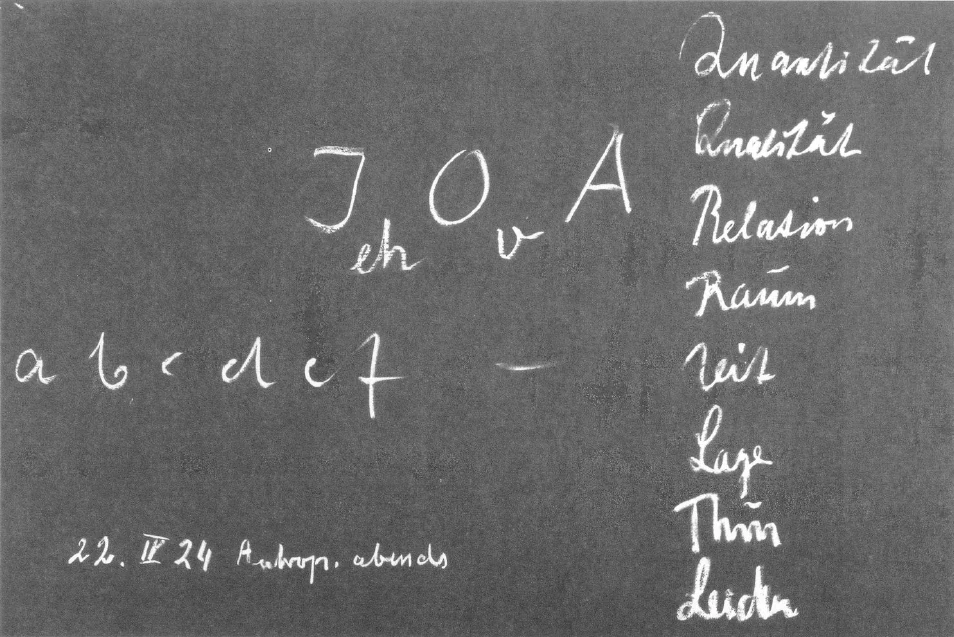
[ 37 ] Da haben Sie eine Anzahl von Begriffen. Lernen Sie mit diesen Begriffen, die zuerst Aristoteles dem Alexander vorgeführt hat, lernen Sie mit diesen Begriffen dasselbe vollführen, was Sie gelernt haben mit \(a b c d\), dann lernen Sie aus Qualität, Quantität, Relation, Raum, Zeit, Lage, Tun, Leiden —, aus dem lernen Sie lesen im Kosmos.
[ 37 ] Here you have a number of concepts. Use these concepts—which Aristotle first demonstrated to Alexander—to accomplish the same thing you learned with \(a b c d\); then, through quality, quantity, relation, space, time, location, action, and suffering—from these, you will learn to read the cosmos.
[ 38 ] In der Schullogik ist in der Zeit der Abstraktivität etwas Besonderes geschehen. Denken Sie nur einmal, wenn in irgendeiner Schule die Gepflogenheit wäre, die Leute nicht lesen zu lehren, sondern meinetwillen nur Bücher zu fabrizieren, in denen sie immer \(a b c d\) lernen müßten in allen möglichen Kombinationen: \(a c, a b, b e\) und so weiter — aber nicht dazu kämen, diese Buchstaben zu verwenden, um reiche Inhalte sich vor die Seele zu stellen, dann wäre das dasselbe, was die Welt mit Aristoteles’ Logik gemacht hat. In den Logiken ist es so, daß ja diese, man nennt es Kategorien, aufgeführt werden. Man lernt sie auswendig, aber man weiß mit ihnen nichts anzufangen. Das würde entsprechen dem, daßmanabcde auswendig lernte und nichts mit ihnen anzufangen wüßte. Zurück auf etwas so Einfaches, wie der Inhalt des «Faust» in \(a b c d\) — was man nur lernen muß — geht dasjenige, was Lesen in der Weltenschrift ist. Und im Grunde genommen ist das, was Anthroposophie hervorgebracht hat und jemals hervorbringen kann, aus diesen Begriffen so erlebt, wie das Gelesene des «Faust» erlebt wird aus den Buchstaben. Denn alle Geheimnisse der physischen und geistigen Welt sind in diesen einfachen Begriffen als dem Weltenalphabet enthalten.
[ 38 ] Something unusual happened in the logic of schooling during the era of abstract thinking. Just imagine for a moment if, in some school, the custom were not to teach people to read, but—for the sake of argument—only to produce books in which they would always have to learn \(a b c d\) in every possible combination: \(a c, a b, b e\) and so on—but they never got around to using these letters to bring rich content to mind, then that would be the same thing the world did with Aristotle’s logic. In logic, these—what are called categories—are listed. One memorizes them, but doesn’t know what to do with them. That would be like memorizing \(a b c d\) and not knowing what to do with them. Returning to something as simple as the content of Faust expressed in \(a b c d\)—which one simply has to learn—is what reading in the world’s script entails. And, fundamentally speaking, what anthroposophy has produced and can ever produce is experienced through these concepts in the same way that what is read in Faust is experienced through the letters. For all the mysteries of the physical and spiritual worlds are contained in these simple concepts as the world alphabet.
[ 39 ] Es ist in der Weltentwickelung das geschehen, daß gegenüber dem früheren unmittelbaren Wahrnehmen, für das die Tatsachen von Ephesus noch etwas Allercharakteristischstes sind, etwas getreten ist, was von der Alexanderzeit aus den Anfang nimmt, was sich dann später erst besonders entwickelt durch das Mittelalter hindurch, was tief verborgen ist, was tief esoterisch ist. Tief esoterisch ist der Sinn, der lebt in diesen acht, oder man kann sie auch auf zehn erweitern, in diesen acht oder zehn einfachen Begriffen. Und wir lernen eigentlich immer mehr in diesen einfachen Begriffen leben, aber wir müssen streben, sie so lebendig in der Seele zu erleben, wie man in der Seele lebendig erlebt das Abc, wenn man eben einen reichgegliederten, geisterfüllten Inhalt hat.
[ 39 ] What has happened in the development of the world is that, in contrast to the earlier form of direct perception—for which the events at Ephesus are still among the most characteristic—something has emerged that began in the time of Alexander, that later developed in a distinctive way throughout the Middle Ages, that is deeply hidden, and that is deeply esoteric. Deeply esoteric is the meaning that lives within these eight—or one could extend them to ten—within these eight or ten simple concepts. And we are actually learning more and more to live within these simple concepts, but we must strive to experience them as vividly in the soul as one experiences the ABCs vividly in the soul when one possesses a richly structured, spirit-filled content.
[ 40 ] So sehen Sie, wie in zehn Begriffe, deren innere Leuchte- und Wirkekraft erst wiederum enthüllt werden muß, hineinlief dasjenige, was eine gewaltige, instinktive Weisheitsoffenbarung durch Jahrtausende war. Und es wird schon einstmals dahin kommen, daß man dasjenige, was eigentlich wie im Grabe ruht, die Weltenweisheit, das Weltenlicht, wiederum finden wird, wenn man wieder lesen lernen wird im Weltenall, wenn man erleben wird die Auferstehung dessen, was in der Zwischenzeit der Menschheitsentwickelung zwischen den zwei geistigen Epochen verborgen worden ist.
[ 40 ] Thus you can see how, within these ten concepts—whose inner radiance and power of action must first be revealed anew—lies that which has been a mighty, instinctive revelation of wisdom throughout the millennia. And the time will come when what actually lies as if in a grave—world wisdom, the light of the world—will be rediscovered, when we learn once more to read the cosmos, when we experience the resurrection of that which has been hidden during the interim of human development between the two spiritual epochs.
[ 41 ] Wir sind ja da, meine lieben Freunde, um das, was verborgen worden ist, wieder offenbar zu machen. Wir sind ja da, um Ostern als Menschheitserlebnis zu gestalten. Und so, wie bei anderen Gelegenheiten gesagt werden konnte: Anthroposophie ist ein Weihnachtserlebnis, so ist Anthroposophie selber in ihrem ganzen Wirken ein Ostererlebnis, ein Auferstehungserlebnis, verbunden mit dem Grabeserlebnis. Es ist wichtig, daß wir gerade bei diesem Osterzusammensein empfinden — wenn ich mich so ausdrücken darf — die Feierlichkeit des anthroposophischen Strebens, indem wir etwas empfinden davon, daß wir gehen können heute zu einem geistigen Wesen, das uns vielleicht nahestehen kann, unmittelbar hinter der Schwelle nahestehen kann, und dem gegenüber wir sprechen: Ach, da war einmal die Menschheit gesegnet mit göttlich-geistiger Offenbarung, die besonders noch geleuchtet hat in Ephesus. Aber nun ist das alles begraben. Wie grabe ich aus das, was so begraben ist! Denn man möchte doch glauben, daß dasjenige, was war, irgendwie geschichtlich gefunden werden kann, gefunden werden kann in seinem Grabe.
[ 41 ] We are here, my dear friends, to bring to light once again that which has been hidden. We are here, after all, to shape Easter as an experience for humanity. And just as it has been said on other occasions—that anthroposophy is a Christmas experience—so too is anthroposophy itself, in its entirety, an Easter experience, an experience of resurrection, connected to the experience of the tomb. It is important that, especially during this Easter gathering, we feel—if I may put it this way—the solemnity of the anthroposophical striving, by sensing that we can go today to a spiritual being who may be close to us, standing immediately beyond the threshold, and to whom we say: “Ah, there was a time when humanity was blessed with divine-spiritual revelation, which shone particularly brightly in Ephesus. But now all of that is buried. How can I unearth what lies buried? For one would like to believe that what once was can somehow be found historically, can be found in its tomb.”
[ 42 ] Da wird uns das Wesen erwidern, wie einstmals im ähnlichen Fall das entsprechende Wesen erwidert hatte: Das, was ihr suchet, ist nicht mehr hie, das ist in euren Herzen, wenn ihr eure Herzen nur in der richtigen Weise erschließet.
[ 42 ] Then the being will reply to us, just as the corresponding being had replied in a similar case long ago: What you seek is no longer here; it is in your hearts, if only you open your hearts in the right way.
[ 43 ] Es ruht schon Anthroposophie in den Menschenherzen. Diese Menschenherzen müssen nur sich selber richtig erschließen können. Und das sollen wir empfinden, dann werden wir in voller Besonnenheit, nicht wie es in alten Zeiten instinktiv war, zurückgeführt zu jener Weisheit, welche in den Mysterien leuchtete und lebte.
[ 43 ] Anthroposophy already lies dormant in people’s hearts. These hearts simply need to be able to truly open up to themselves. And we should feel this; then, with full composure—not as was instinctively the case in ancient times—we will be led back to that wisdom which shone and lived in the mysteries.
[ 44 ] Das ist dasjenige, was ich gerne gerade um diese Osterzeit an Ihre Herzen heranbringen möchte. Denn sich durchdringen mit dem, was wie eine feierliche Stimmung aus Anthroposophie heraus in jedem Menschenherzen, das zur Anthroposophie gehört, sich entflammen kann, darin liegt durchaus etwas, was auch hinaufträgt in die geistige Welt und was verbunden sein muß mit dem Weihnachtsimpuls, der zu Dornach gegeben worden ist. Denn dieser Impuls darf kein bloß erdachter, kein intellektualistischer bleiben, dieser Impuls muß ein Herzensimpuls sein; dieser Impuls darf kein trocken-nüchterner sein, dieser Impuls muß, nicht in Sentimentalität, sondern aus der Sache selber heraus, ein feierlicher sein können. Ebenso wie durch Aristoteles und Alexander das Feuer von Ephesus benutzt worden ist, als es in ihren Herzen neu aufflammte, aber zunächst aufflammte im Äther draußen, von dem es ihnen erneut entgegentrug die Geheimnisse, die dann gefaßt werden konnten in Allereinfachstes, wie da benutzt werden konnte das Feuer von Ephesus, so obliegt es uns, und werden wir auch schon imstande sein können, zu benutzen dasjenige, was — man darf es in aller Bescheidenheit sagen — auch in den Äther als die Flammen des Goetheanum das hinausgetragen hat, was durch Anthroposophie gewollt worden ist, weiter gewollt werden soll.
[ 44 ] This is precisely what I would like to share with you, especially during this Easter season. For to be imbued with that which, like a festive mood arising from anthroposophy, can be kindled in every human heart that belongs to anthroposophy—in this lies something that truly lifts us up into the spiritual world and that must be connected to the Christmas impulse that was given at Dornach. For this impulse must not remain merely a figment of the imagination, nor an intellectual one; this impulse must be an impulse of the heart; this impulse must not be dry and sober; this impulse must be able to be a solemn one—not out of sentimentality, but out of the matter itself. Just as Aristotle and Alexander made use of the fire of Ephesus when it flared anew in their hearts—though it first flared in the ether outside, from which it conveyed to them once more the mysteries that could then be expressed in the simplest terms—just as the fire of Ephesus could be used in that way, so it is incumbent upon us—and we will already be able to do so—to make use of that which—it may be said in all modesty—has also carried out into the ether, as the flames of the Goetheanum, that which has been intended through anthroposophy and is to be intended in the future.
[ 45 ] Aber was geht denn daraus hervor, meine lieben Freunde? Es geht daraus hervor, daß wir durften als Jahrestrauerfeier um die Weihnachts-Neujahrszeit, welche dieselbe ist, in der uns das Unglück hier getroffen hat, daß wir da durften einen neuen Impuls ausgehen lassen vom Goetheanum. Warum? Weil wir fühlen dürfen: Was mehr oder weniger Erdensache vorher war, erarbeitet, begründet wurde als Erdensache, das ist mit den Flammen hinausgetragen in die Weltenweiten. Wir dürfen, gerade weil uns dieses Unglück getroffen hat, in dem Erkennen der Folgen dieses Unglückes sagen: Nunmehr verstehen wir es, daß wir nicht bloß eine Erdensache vertreten dürfen, sondern eine Sache der weiten ätherischen Welt, in der der Geist lebt. Denn es ist die Sache vom Goetheanum eine Sache des weiten Äthers, in dem geisterfüllte Weisheit der Welt lebt. Es ist hinausgetragen worden, und wir dürfen uns von den Goetheanum-Impulsen als aus dem Kosmos hereinkommend durchdringen.
[ 45 ] But what does this tell us, my dear friends? It tells us that we were able, as part of our annual memorial service around the Christmas and New Year’s season—the very time when misfortune struck us here—to send out a new impulse from the Goetheanum. Why? Because we can feel that what was previously, to a greater or lesser extent, an earthly matter—developed and established as such—has been carried out into the vastness of the worlds by the flames. Precisely because this misfortune has befallen us, we can say, in recognizing the consequences of this misfortune: We now understand that we are not merely to represent an earthly matter, but a matter of the vast etheric world in which the spirit lives. For the cause of the Goetheanum is a matter of the vast ether in which the spirit-filled wisdom of the world lives. It has been carried out into the cosmos, and we may allow ourselves to be permeated by the impulses of the Goetheanum as if they were coming to us from the cosmos.
[ 46 ] Nehmen wir das, wie wir wollen, nehmen wir es als Bild. Das Bild bedeutet aber eine tiefe Wahrheit. Und diese tiefe Wahrheit wird eben in einfachen Worten dadurch ausgedrückt, daß man sagt: Das anthroposophische Wirken soll seit dem Weihnachtsimpuls mit einem esoterischen Zug durchdrungen sein. Dieser esoterische Zug ist deshalb da, weil das, was irdisch war, durch das, was mitgewirkt hat im physischen Feuer, aber als Astrallicht, welches hinausstrahlt in den Weltenraum — weil das wiederum zurückwirkt hinein in die Impulse der anthroposophischen Bewegung, wenn wir nur in der Lage sind, diese Impulse aufzunehmen.
[ 46 ] Let us take this however we wish; let us take it as a metaphor. But this metaphor conveys a profound truth. And this profound truth is expressed in simple terms by saying: Since the Christmas impulse, anthroposophical work is to be permeated by an esoteric element. This esoteric element is present because what was earthly—through what participated in the physical fire, but as astral light radiating out into the cosmos—has in turn a retroactive effect on the impulses of the anthroposophical movement, provided we are able to receive these impulses.
[ 47 ] Dann, wenn wir das vermögen, dann empfinden wir in alledem, was in Anthroposophie lebt, ein wichtiges Glied darinnen. Und dieses eine wichtige Glied darinnen, das ist die anthroposophische Osterstimmung, jene anthroposophische Osterstimmung, die da niemals der Überzeugung sein kann, daß der Geist stirbt, sondern daß, wenn er stirbt durch die Welt, er immer wieder aufersteht. Und an den aus ewigen Gründen immer wieder auferstehenden Geist muß sich Anthroposophie halten.
[ 47 ] Then, if we are able to do this, we will perceive an important link within everything that lives in anthroposophy. And this one important link within it is the anthroposophical Easter spirit—that anthroposophical Easter spirit which can never be convinced that the Spirit dies, but rather that, when it dies through the world, it rises again and again. And anthroposophy must hold fast to the Spirit that rises again and again for eternal reasons.
[ 48 ] Das nehmen wir auf, nehmen wir auf als Ostergedanke und Osterempfindung in unsere Herzen. Und wir werden, meine lieben Freunde, von diesem Zusammensein Gefühle wegtragen, die uns Arbeitsmut, Arbeitskraft geben, wenn wir wiederum an anderer Stätte stehen.
[ 48 ] Let us take this to heart—let us embrace it as an Easter thought and an Easter feeling. And, my dear friends, we will carry away from this gathering feelings that will give us the courage and strength to work when we find ourselves in a different place.