

Mystery Sites of the Middle Ages
Rosicrucianism and the Modern Principle of Initiation
GA 233a
20 April 1924, Dornach
Translated by Steiner Online Library
Easter as a Chapter in the History of Humanity's Mysteries II
[ 1 ] One can certainly say that the original idea behind the festival is to lead people to look beyond their dependence on earthly things and toward their dependence on extraterrestrial things. And it is Easter, in particular, whose contemplation can bring these thoughts closer to people. Over the course of the last three, four, or five centuries, the civilized world has undergone a spiritual and psychological development that has increasingly led people away from contemplating their connection to cosmic forces and powers. Humanity has become increasingly limited to considering only those relationships that exist between itself and earthly forces and powers. It is indeed true that, with the means of knowledge recognized as valid today, other relationships cannot be taken into account at all. If anyone who had been closely associated with the mystery schools in pre-Christian times or even in the first centuries of Christianity were able to experience our present-day understanding, he would—if he approached these matters with the state of mind he had back then—be completely unable to understand how human beings are capable of living without an awareness of their extra-terrestrial, their cosmic connection.
[ 2 ] I would like to begin by outlining a few points that you will find described in greater detail in this or that cycle. Since these lectures are intended to bring the essence of Easter closer to us, I cannot, of course, go into all the details; I can only hint at how things are.
[ 3 ] If we look back at various older religious systems—we can take, for example, the one that is still closest to modern people: the Hebrew-Jewish religious system—we will find, in certain ancient religious systems, if they are monotheistic, the veneration and worship of the one deity. This is the deity whom, in the Christian view, we refer to as the first person of the Godhead, the Father.
[ 4 ] Now, in all those religions in which the concept of this Father God has survived—to a greater or lesser extent, and indeed in its full form among the priests of the mysteries—there has been a connection between this Father God and the cosmic forces of the Moon, and with all the forces that radiate down from the Moon to the Earth. Today, hardly anything remains of this ancient awareness of the connection between human beings and the lunar forces other than the inspiration that the poetic mind feels in its imagination through the lunar forces, and the counting of human embryonic months according to ten lunar months in medicine. But in older worldviews, there was a clear awareness that when a human being descends from the spiritual world—where, in pre-earthly existence, they were a spiritual-soul being—into their physical existence, they are then permeated and empowered by the impulses emanating from the Moon. When a human being looks at what gives him life—what lives within him as processes of nutrition, respiration, and so on, and generally as the forces of growth—he must not look to earthly forces, but rather to forces beyond the Earth. When a person looks at the earthly forces, they can indeed become aware of how these earthly forces relate to them. If our body were not held together by extra-earthly forces, if our body were not given its form precisely by extra-earthly forces, what could earthly forces possibly contribute to the cohesion of our body? The moment the extraterrestrial forces leave this body, the body is indeed exposed to earthly forces: then it decays, then it dissolves, then it becomes a corpse. Earthly forces can only turn a human being into a corpse; they cannot shape the human being. Those forces that live within the human being, so that they lift him out of the earthly realm, so that between birth and death he is a coherent, organized form within the earthly realm, not succumbing to the forces that seize him at death and destroy him, so that throughout his entire earthly life the human being possesses forces that fight against this destruction—for they must fight against this destruction— he owes this to the influence of the lunar power.
[ 5 ] If, on the one hand, we can theoretically state that the forces of the Moon are involved in the formation of the human body, then on the other hand we must recognize how ancient religions revered these forces—which, so to speak, brought human beings into physical existence at birth—as the fatherly forces, as the forces of the divine Father. And among the initiates of ancient Hebraism, there was a clear awareness that the Moon radiates those forces that bring human beings into earthly existence, sustain them in earthly existence, and from which they, as physical human beings, break free when they pass through the gate of death.
[ 6 ] Loving these divine paternal forces with all one’s heart, gazing upon them, and expressing that love through worship, prayer, and so on—that was the essence of certain ancient monotheistic religions. But these ancient monotheistic religions were more consistent than one might think. These matters are, after all, completely misrepresented in history, because history can only rely on external documents, not on what can be observed through spiritual vision.
[ 7 ] Such religions, which focused on the moon—on the spiritual beings present within it—are, in fact, later religions. The very earliest ones had, alongside this conception of the moon, a clear conception of the forces of the sun—and indeed, as we must also mention here, of the forces of Saturn.
[ 8 ] Here, however, we enter into a historical consideration for which no external documents remain, one that dates back many millennia before the founding of Christianity, we enter that era which I have described in my *Outline of a Secret Science* as “primordial Indian”—simply to have a term for it, since it unfolded on the soil of what would later become India—while the later civilization is the primordial Persian one. In these civilizations, human beings developed quite differently than they did later, and their religious beliefs were precisely shaped by this stage of their development.
[ 9 ] We humans have all been evolving in this way for more than two millennia, so that we actually do not notice—or, more accurately, do not truly notice—a rupture in our earthly development. It is also barely perceptible. What takes place internally in people around the age of thirty remains, for the most part, in the subconscious or unconscious for people today. For humanity living eight to nine millennia before the founding of Christianity, it was quite different. Back then, human beings developed up to about the age of thirty in such a way that their development was continuous. But at the age of thirty, a powerful metamorphosis took place within the human being. I would like to describe this metamorphosis in very radical terms. Of course, what I am about to say is somewhat radical; but this radical description nevertheless captures the reality we are dealing with.
[ 10 ] In those earlier times, the following could happen: A person had become acquainted, before turning thirty, with someone who was much younger than he was—perhaps three or four years younger. That person went through the metamorphosis, which occurred around the age of thirty, at a later time. It could happen that if these people had not seen each other for a long time and then met again—I’m speaking in today’s terms, which makes it sound even more radical—the person who had undergone the metamorphosis at age thirty would be addressed by the other person and not know who that person was. That is how thoroughly his memory had changed.
[ 11 ] And in those earliest times, there were institutions associated with the mystery schools, where, in the small communities that existed back then, the lives of young people were recorded—because they themselves would forget, because they were undergoing a profound transformation in their lives and had to learn what they had experienced in their earthly lives up until around the age of thirty. And then, when these people realized: “I have become a completely different person by the age of thirty; I must go to the ‘registry’—a modern term, of course—to find out what I had experienced before”—yes, it is so! — at that very moment, through the instruction they received, they also became aware that before the age of thirty, the lunar forces acted upon them exclusively; at the age of thirty, the solar forces entered into the development of their earthly life; and the solar forces act upon human beings in a completely different way than the lunar forces. What does modern man know of the solar forces! They know only the outward, physical aspects. They know that—forgive me—the forces of the sun make them sweat, that they feel warm; they know a few other things—after all, there are sunbathing and the like today—so they know a bit about therapeutic applications and so on, but only in a very superficial way. They cannot even begin to fathom what those forces that are spiritually connected to the sun do to them.
[ 12 ] Julian the Apostate, the last of the pagan Caesars, had learned something of these powers of the sun in the lingering echoes of the Mysteries. And because he wanted to restore them, he was assassinated on his way to Persia. So powerful were the forces that sought to eradicate knowledge of these things in the early Christian centuries. It is therefore no wonder that knowledge of these things cannot be attained even today. While the lunar forces are that which in the human being determines him, that which permeates him with an inner necessity so that he must act in accordance with his instincts, his temperament, his emotions, and indeed his entire physical-etheric body, the spiritual solar forces liberate the human being from this necessity. They melt away, so to speak, the forces of this necessity within him, and through the solar forces, the human being actually becomes a free being. In those ancient times, these were strictly separated in human development. It was precisely at the age of thirty that one became a solar human being, a free human being. Until the age of thirty, one was a lunar human being, an unfree human being.
[ 13 ] Today, these forces intertwine. Today, the forces of the Sun are already at work alongside the forces of the Moon during childhood, and the forces of the Moon continue to be active in later life, so that today these two elements—necessity and freedom—interact in a complex way. But it was not always like this. In the prehistoric times of which I am speaking here, the lunar and solar influences were strictly separated from one another throughout the course of a person’s life. And that is why, in those earlier times, it was said to most people—for it was regarded as something pathological, as something abnormal, if a person did not experience this metamorphosis, this turning point in their life at the age of thirty— it was said that a person is born not once, but twice. And as human development progressed to the point where this second birth—the solar birth of the human being (the first being called the lunar birth)—was no longer so noticeable, certain exercises, certain ritual acts, and certain practices in general were then applied to those who were initiated into the Mysteries. They then underwent what no longer existed for humanity at large. And they were the Twice-Born.
[ 14 ] When one encounters the term “twice-born” in Oriental writings today, this term is, in fact, already a derived one. Basically, I would really like to ask every Orientalist, every Sanskrit scholar—I believe our friend Professor Beckh is here among us; you can ask him whether this is the case, based on his specialized studies as well— one can ask any Sanskrit scholar whether today’s Oriental studies can clearly and unambiguously elucidate what the term “twice-born” actually means in its essence. Certainly, there are plenty of formal explanations, but what it means in its very essence is unknown; only those who know that it goes back to a reality—which I have just explained—can know this. In these matters, spiritual observation speaks first and foremost. And once spiritual observation has spoken, I would like to ask anyone who examines what is available in the documents—what can be brought to bear by external science—if they approach external science with an open mind, whether this external science does not then, piece by piece, confirm the findings of spiritual science. It will do so, provided that things are viewed in the proper light. But attention must be drawn to certain things that precede any documentary scholarship. For documentary scholarship alone does not enable us to understand human life.
[ 15 ] Thus we look back on an earlier time when people spoke of the “lunar birth” of humankind as the creation of humankind by the Father. With regard to the “solar birth,” it was clearly understood that the power of Christ, the Son, is at work in the spiritual rays of the sun, and that this power is what liberates humankind. For consider: what does this power—the power of the sun—accomplish? The power of the sun enables us, as human beings, to make something of ourselves on Earth at all. We would be strictly determined and placed within an unalterable necessity—not a necessity of fate, but a necessity of nature—if the liberating forces of the sun, those impulses that dissolve necessity, did not reach out to us.
[ 16 ] People of the older worldviews knew this when they looked up at the sun: This eye of the world, from which the power of Christ radiates—this eye of the world ensures that I need not remain subject to that iron necessity with which I was born out of the forces of the moon, a human being developing out of necessity throughout my entire life. These solar forces, these Christ forces, which look down through the cosmic eye of the sun—these Christ forces enable me, through my inner freedom during my earthly life, to become something I was not through the lunar forces when I was brought into earthly life.
[ 17 ] This awareness that human beings can transform themselves, that they can make something of themselves—that is what people saw in the forces of the sun.
[ 18 ] I would like to add, as a sort of aside, that attention was then turned to the Saturn forces. In the Saturn forces, people saw everything that sustains a human being when they pass through the gate of death—that is, when they undergo their third earthly metamorphosis.
Birth: Lunar Birth,
Second Birth: Solar Birth,
Third Birth: Saturn Birth, Death, Earthly Death.
[ 19 ] There he is sustained by the forces of Saturn, which at that time reigned at the very outer edge of Earth’s planetary system. These forces uphold him, carry him out into the spiritual world, and weave his being into a unified whole when the third metamorphosis occurs. This was certainly a worldview held in earlier times.
[ 20 ] But humanity is, after all, evolving. Thus there came a time when knowledge of how the forces of the sun affect human beings was known only within the Mysteries. Knowledge of the solar forces was preserved the longest in the medical sections of the Mysteries, because it is precisely those forces that give human beings, in their ordinary development, the freedom and the opportunity to make something of themselves—because these solar forces, the Christ forces, are at the same time re-lived in many respects in certain plants on Earth, as well as in other earthly beings, and thus serve as remedies. But in general, humanity has lost precisely this connection with the sun. While the awareness that human beings depend on the lunar forces—the fatherly forces—remained for a long time, the awareness of dependence on the solar forces—or rather, one might say, of liberation through the solar forces—was lost much earlier. And what we call natural forces today—which are almost the sole subject of our discussions in the realm of worldview—are, after all, nothing more than the lunar forces rendered entirely abstract.
[ 21 ] But it was precisely the bearer of Christ, Jesus of Nazareth, who was able to recognize the forces of the sun and align himself with them. And he had to know them for the very reason that he was destined to receive into his own body these solar forces—which in the ancient mysteries could be attained only by gazing up at the sun—as they streamed down to Earth. I explained this in detail yesterday. The essence of Christology in the founding of Christianity was precisely this: that at the age of thirty, a transformation took place within the body of Jesus of Nazareth—the very transformation that had taken place in all human beings in primeval times, except that, so to speak, the radiance of the spiritual sun had entered into all human beings back then, whereas now the primordial being of the sun, Christ himself, has descended into human evolution and taken up residence in the body of Jesus of Nazareth. This is precisely what underlies the Mystery of Golgotha as a primal event of all earthly life.
[ 22 ] One will see the full context of these things when one now looks at the way in which, in the ancient mysteries—I would say, the Easter festival as it existed in a very human sense at that time, for it was indeed the Easter festival that constituted the initiation—the initiation was actually carried out. The initiation initially proceeded through three stages. But the first requirement for attaining true knowledge—for attaining initiation—was that the individual, through everything presented to them by the mysteries, had been made so humble that today, in fact, no one can even conceive of this inner humility. Today, people believe that they are immensely humble with regard to these insights, whereas to the one who sees through these things, they are still possessed by true arrogance.
[ 23 ] Above all, the person undergoing initiation had to reach a point where he no longer considered himself a human being at all, where he said: “I must first become a human being!” Today, of course, one cannot expect a person to consider himself no longer a human being at any point in his life.
[ 24 ] But that was the very first requirement: to truly consider oneself not a human being and to say to oneself the following: Certainly, I was a human being before I descended into an earthly body; in my pre-earthly existence, I was a human being in spirit and soul. — There, the spiritual-soul aspect entered the physical body it received from the mother, from the parents. It did not “change clothes”—that is a misnomer—but rather permeated this physical body. People have no awareness of the way in which the spiritual-soul aspect, over the course of a long period of time, permeates the physical body—permeating the nervous-sensory system, the rhythmic system, and the metabolic-limb system. They perceive; they see through their senses; they see the physical environment. But what can a human being do once he has truly reached the point where his spiritual-soul aspect has permeated his physical body to such an extent that he now considers himself a fully developed, mature adult? What can they do then? They can only look out through their eyes, hear through their ears, and perceive warmth and cold, roughness and smoothness through their skin: they can only perceive outwardly; they cannot perceive inwardly. They cannot look inward through their eyes; at most, they can strain their physical body and then believe that they are looking inward. But in reality, he is not looking inward. It is childish to believe that.
[ 25 ] If I have a house in front of me: it has windows, but I don’t look inside; instead, if I’m strong enough, I take all kinds of tools and smash the house to pieces—then I have the individual bricks lying in front of me, and I look only at that pile. That’s how people do it today. We tear people apart, we dismember them in order to get to know them, but that’s not how we come to know them. It’s not the human being at all that we come to know in this way. If we want to get to know a human being, we must be able to look back in through the eyes—just as we look out through them today—and listen back in through the ears. All of this together—the eyes, the ears, the entire skin as an organ of touch and warmth, the sense of smell, and so on—was called in the ancient mysteries the gateway to the human being, the portal to the human being. And this was the very starting point of initiation: that someone came to realize: He knows nothing at all about the human being; therefore, since he has no self-awareness of the human being, he cannot be a human being either. He must first learn to look inward through the senses, just as he otherwise only looks outward.
[ 26 ] This was the first stage of initiation into the ancient mysteries. And at the very moment when a person learned to look within, at that very moment he also experienced his pre-earthly existence. For then he knew: I am in my spiritual-soul realm.
[ 27 ] Schematically depicted: So, the human being used to look outward (yellow lines pointing outward). Instead, he learned to look inward (red arrow pointing inward). But in this looking inward, he became aware of that which has been drawn into the human being as pre-earthly existence (green)—that which has been drawn in through the eye, the ear, the skin, and so on. There the human being became aware of it: there he had his pre-earthly existence. And now he was told that only now would he come to know that which we would today call natural science. When we study natural science today, how do we do it? We do it in such a way that we are guided to observe the things of nature, to describe them, and so on. But that is just as if I had known a person for a long time, were to see him again, and someone were to impose this on me: “But you must forget everything you have shared with this person when you see him again; you must not remember anything at all that you shared with them.”—Just imagine—it’s almost inconceivable—if, for example, this were imposed on a married couple, requiring them, whenever they see each other again after a long time, to forget everything they’ve ever gone through together! Yes, I can well imagine that it might even be pleasant at times; but life could not exist under such conditions. Yet this is simply imposed on modern human beings by the order of civilization. For human beings came to know the realms of nature—to know them from their spiritual side—before they descended to Earth. While today people are taught to forget everything they learned about minerals, plants, and animals before they descended, the ancient initiates were made aware of this in the so-called first degree of the mysteries: “You now see the quartz.” — And then every effort was made to help them remember what they had known about quartz—or about the lily or the rose—before they had descended. Recognition was what was taught as knowledge of nature. And if someone had learned natural science in this way—as a recognition of what he had beheld before descending into earthly life—then he was admitted to the second degree.
[ 28 ] In the second level, students studied music, what was then considered architecture, what was then considered geometry, metrology, and so on. For what did this second degree contain? This second degree contained everything that a person perceives when they no longer merely look into themselves through their eyes or listen to themselves through their ears, but when they truly descend into their inner being. Then they would say to the initiate: “You are entering the human temple grotto.” He came to know this human temple grotto. It was that which was physically permeated by the spiritual and soul forces of which the human being consisted before descending into earthly life. There he now penetrated into himself. “This temple grotto has three chambers,” they told him. One chamber was the chamber of thought: there one learned to recognize all of that—yes, when viewed from the outside, it is the head. It is small. But when one enters it and looks at it from within, it is as vast as the world, and then one comes to know one’s spiritual nature. That was the first chamber; the second chamber was where one came to know feeling. The third chamber was where one came to know the will. And there one learned to recognize how the human being is organized according to his organs of thought, feeling, and will; there one learned to recognize what holds sway on earth.
[ 29 ] Knowledge of nature is not limited to Earth. One acquires this knowledge even before descending to Earth. It is important to remember this. Houses are not built in the spiritual world in the same way as they are through earthly architecture. Music exists there, but it is spiritual melody. What earthly music is, is projected down into the earthly atmosphere; it is a projection of heavenly music, but as humans experience it, it is earthly. The same is true when we measure on Earth. We measure earthly space; the art of measurement, geometry, is an earthly science. It was important for the initiate in the second degree to be made fully aware that all talk of knowledge gained through mere earthly means—unless it relates to geometry, architecture, and the science of measurement—is nonsense. He came to recognize that true natural science must be the reawakened pre-earthly knowledge. And that for the Earth, geometry, architecture, music, and the science of measurement are precisely the sciences that can be learned here. Thus, the human being descended into his own being and came to know the three-chambered world-human in contrast to the single earthly organization that one otherwise knows when one gets to know the human being from the outside without entering into him.
[ 30 ] And in the third degree, one came to know the human being—not merely when he withdraws into himself and learns to recognize himself as a spiritual being, but when this spiritual being also comes to know the body. For this reason, this third stage was, in all the ancient mysteries, what had to be called the Gate of Death. There, the human being became aware of what one is like after having shed the earthly body. However, there is a difference between this actual dying and the initiate’s dying. I will explain why this difference must exist in the next lectures; for now, I simply wish to highlight the facts.
[ 31 ] When one truly dies, one sheds one’s physical body. One is no longer bound to it and no longer follows earthly forces; one is freed from them. But if one is still bound to one’s physical body—as was the case during initiation in ancient times—then one must attain through inner strength that which one possesses naturally at death: this freedom from the body; one must maintain this freedom for a certain period of time. It was necessary for initiation to attain these strong inner soul forces, through which one could maintain freedom from the physical body within the soul. And these forces, which thus gave one the power to remain free from the earthly body—these forces—bestowed higher knowledge regarding that which one can never see through the senses, nor ever conceive through the intellect. They transport one, as a human being, into the spiritual world, just as one is transported into the physical world through one’s physical body as a human being. But by then one had reached the point where, as a spiritual-soul being, as an initiate, one already recognized oneself as such during one’s earthly existence. From that point on, the Earth was, for the initiate, a star situated outside of the human being, and—especially in the ancient mysteries—one could live in harmony with the Sun rather than with the Earth. One knew what one received from the Sun and how the forces of the Sun worked within one.
[ 32 ] This third degree, which I have just described, was followed by the fourth. This fourth degree had the following effect on those being initiated. When you eat on Earth, you know you are eating cabbage, game, and drinking all sorts of things: you know that this is outside you now, and that it will then be inside you. You breathe air: it is first outside, then inside, then outside again. You are connected to the forces of the earth in such a way that you carry within yourself the forces and substances of the earth that are otherwise outside. Before you are initiated—as was made clear to the initiate of old—you are a bearer of the earth, a bearer of cabbage, a bearer of game, a bearer of pork, and so on. But once you have been initiated into the third degree and what can be imparted to you is now imparted—once you have been freed from the body—then you will no longer be a carrier of coal, a carrier of pork, or a carrier of veal; rather, you will be a carrier of what the solar forces give you. — And what the solar forces bestow spiritually was called Christos throughout the Mysteries. Therefore, the one who had gone beyond the three degrees and could now feel, just as he had felt on earth as a coal-bearer, that he was a bearer of the solar forces—he was called a Christophor, a Christophorus. In most of the ancient mysteries, this was the designation for the one who was now in the fourth degree.
[ 33 ] In the third degree, one had to grasp certain things. Above all, in this third degree one had to understand that the desire for the physical body must cease during moments of insight; that there must be a clear realization that, in terms of the physical body, human beings belong to the earth, but that the earth actually exists only to destroy this physical body, not to build it up. Now he learned to recognize the constructive forces that originate in the cosmos. But now he came to know something else as well. He came to know—precisely when he became a Christophor—that spiritual forces are also at work within the substances of the Earth, forces that are simply not visible to earthly perception. And if one were to speak to the people of that time in today’s terms—in essence, this is already how it was conveyed to them, but I can only explain these things to you using today’s language, not that of the past—the following would be made clear to them: If you want to understand the science of matter—how substances combine and separate from one another—you must look to the spiritual forces that permeate matter from the cosmos. You cannot do this at all if you are uninitiated. You must be initiated into the fourth degree. You must be able to see with the forces of the solar being; only then can you study chemistry.
[ 34 ] Now imagine if, today, a pharmacist or a chemist who wants to become a doctor were required to first relate to the forces of the sun in the same way he relates to the earth’s coal: just think how absurd that would seem! But those were, after all, realities. And this became clear to people: With all the powers that live within the body—and which we make use of in ordinary cognition—one can study only geometry, metrology, music, and architecture. One cannot study chemistry with these powers. When one studies chemistry today, one is merely speaking in an external way. But this is how it is: All talk of chemistry since the time when the ancient wisdom of initiation was lost is, after all, entirely superficial. For those who truly wish to understand, it is even a cause for despair to have to be familiar with today’s official chemistry, for it is based solely on data, not on an inner insight into the matter. If people were unbiased, they would simply say: There must be something else required here; one must be able to perceive things differently if one wants to study chemistry. And it is precisely today’s cowardice of perception—which is instilled in people—that prevents them from arriving at such an impulse.
[ 35 ] Then, when a person had reached that level of maturity, he was ready to become an astronomer, which was an even higher rank. For learning about the stars from the outside through calculations and the like was considered utterly meaningless. Spiritual beings dwell in the stars; one can perceive them only when one has transcended physical perception, but also when one has transcended geometry—when one can truly live in the universe and come to know the spiritual nature of the stars. Only then, however, was a person truly resurrected. Only then could they truly see how the forces of the moon and the sun also worked within earthly human beings.
[ 36 ] So today I had to explain to you from two perspectives how, in the ancient mysteries—not at a specific time of year, but at a specific stage of human development—Easter was experienced inwardly: Easter as the resurrection of the spiritual-soul human being from the physical body into the spiritual universe. Thus, those who still possessed some knowledge of the mysteries at the time of the Mystery of Golgotha viewed this Mystery of Golgotha in this light. They said: What would have become of humanity if the Mystery of Golgotha had not come to pass? In ancient times, it was possible to be initiated into the mysteries of the cosmos, for in very ancient times, human beings naturally experienced their second birth around the age of thirty. At that time, at least, there were still memories and a science of the Mystery Schools that had preserved in tradition what had been experienced in earlier times.
[ 37 ] By the time the Mystery of Golgotha took place, all of that had been swept away and forgotten. Humanity would have fallen completely into decadence had it not been for the power to which the initiates of the Mysteries had risen—when they became Christophers—had this power not descended into the One, Jesus of Nazareth, so that it has been present on Earth ever since, and so that human beings can be connected to this power through Christ Jesus.
[ 38 ] Thus, what we experience today in the Easter celebration is connected to a chapter of the history of the mysteries. One can truly grasp the meaning of Easter only by reviving this ancient chapter of the history of the mysteries. And one will then at least come close—this will be the subject of our further reflections—one will, as you can see, at least come close to what an ancient initiate once experienced. He could say to himself: How the sun and moon work within me in their mutual celestial relationship—this has become clear to me through initiation; for now I know that I am shaped in a certain way as a physical human being, that I have eyes of such-and-such a nature, a nose of such-and-such a nature, and a bodily form—both inwardly and outwardly—of such-and-such a nature; that this bodily form was able to grow—and still grows today through nourishment—depends on the forces of the Moon. All necessity depends on them. The fact that I, as a free inner being, can move within my physicality, can transform myself, and am in control of myself—this depends on the forces of the Sun, on the Christ forces. I must awaken these within myself if I wish to consciously shape within myself what the forces of the Sun would otherwise have to bring about in me out of necessity.
[ 39 ] In this way, we will also come to understand how people even today look up at the sun and moon and determine the date of Easter based on their relative positions. This is what remains: the calculation of when the first Sunday after the first full moon following the spring equinox occurs. Easter is set for the Sunday following the first full moon, thereby suggesting—and I will elaborate on this further tomorrow—that people see in the form and structure of Easter something that must be determined from above, from the cosmos.
[ 40 ] But the essence of Easter must be grasped anew. It can only be grasped by looking to the ancient mystery traditions, which first drew people’s attention to what it is like when they look within themselves: the gateway of the human being! — when one penetrates within oneself, living through one’s inner being: the three-chambered inner human being! when one frees oneself: the gate of death! — when one moves freely in the spiritual world: one becomes a Christophor.
[ 41 ] The Mysteries themselves, after all, declined during the period when human free development had to take hold. Now the time has come when the Mysteries must be rediscovered. They must be rediscovered. We must be fully aware that steps must be taken today to rediscover the Mysteries.
[ 42 ] It was out of this awareness that the Christmas Conference was held, for there is an urgent need for a place on Earth where the Mysteries can once again be established. As it moves forward, the Anthroposophical Society must become the path to the renewed Mysteries. That, my dear friends, will be your task: to participate in this process from a proper state of consciousness. To this end, however, human life will have to be viewed in terms of its three stages: the stage in which one looks into the human being, the stage in which one strives toward the inner being of the human being, and the stage in which one becomes, in consciousness, what is otherwise found in outer reality only in death.
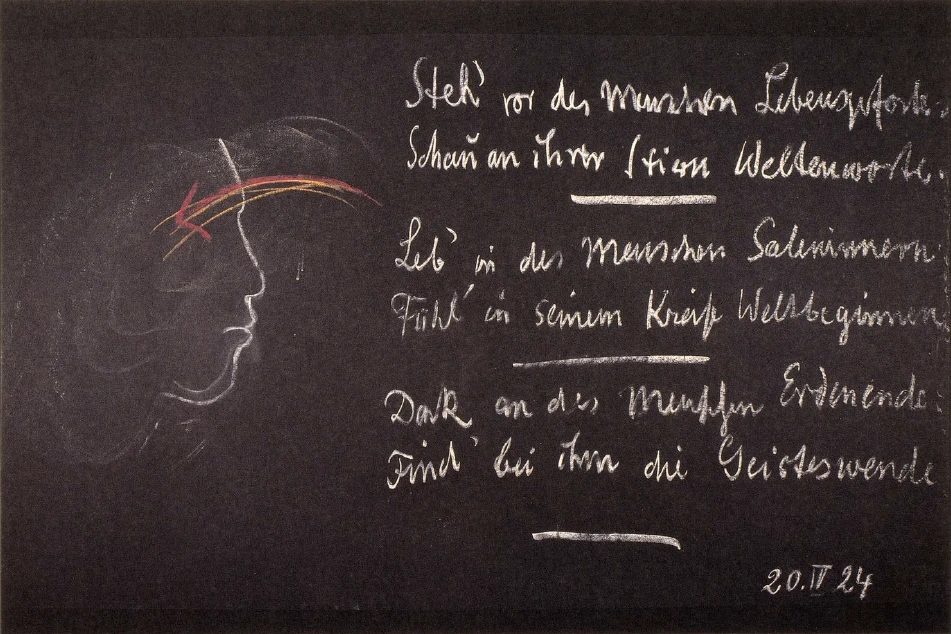
[ 43 ] And I would like to say that, as a memento of this service held today, let us take these words with us and allow them to take root in our souls:
Stand before the gateway to a person’s life:
Behold the words of the world upon their brow.Live within the depths of a person’s soul:
Feel the dawn of the world within their circle.Think of the end of a person’s earthly life:
Find in them the turning point of the spirit.
[ 44 ] (The saying was written on the blackboard):
Stand before the gateway to human life:
Behold the words of the world upon their brow.Live within the depths of the human soul:
Feel the beginnings of the world within their circle.
[ 45 ] One does not always see the beginning of the world, but only something within the world
Think of man's end on earth:
Find in him the turning point of the spirit.
[ 46 ] That, in a nutshell, is the gist of today's lesson:
Stand before the gateway to human life:
Behold the words of the worlds upon their brow.Live within the depths of the human soul:
Feel the dawn of the world within their circle.Think of the end of a person’s earthly life:
Find in them the turning point of the spirit.