

Mystery Sites of the Middle Ages
Rosicrucianism and the Modern Principle of Initiation
GA 233a
19 April 1924, Dornach
Translated by Steiner Online Library
Easter as a Chapter in the History of Humanity's Mysteries I
[ 1 ] Easter is perceived by many people as something connected, on the one hand, to the deepest feelings and emotions of the human soul, but also, on the other hand, to the mysteries and enigmas of the universe. One must indeed take note of the fact that Easter is connected to the mysteries and enigmas of the universe, precisely because it is a so-called movable feast that must be calculated annually according to the constellation of stars, which we intend to discuss in greater detail in the coming days. But one must also—when observing how, over the centuries, festive customs have become associated with Easter, ritual acts that resonate deeply with a vast number of people—recognize the immense value that humanity has gradually imbued in this Easter celebration in the course of its historical development.
[ 2 ] Now, in the first centuries of Christianity—not immediately upon its founding, but in the first centuries of Christianity—Easter became an important Christian festival, a Christian festival connected to the fundamental idea, the fundamental impulse of Christianity, to the impulse that arises for being a Christian through the fact of Christ’s resurrection.
[ 3 ] Easter is the feast of the Resurrection. But Easter points back to times even older than the Christian era. It points to festivals associated with the spring equinox—which, after all, has at least some connection to the calculation of the Lenten season—and to those festivals that celebrate nature’s reawakening and the sprouting life emerging anew from the earth.
[ 4 ] And this brings us to the point where, if we are to address the very topics that form the subject of these Easter lectures—Easter as a chapter in the history of humanity’s mysteries—we must address these matters immediately.
[ 5 ] Easter, as a Christian festival, is a celebration of the Resurrection. The corresponding pagan festival, which falls around the same time of year as Easter, is a kind of celebration of nature’s resurrection—a reemergence of that which, if I may put it this way, has been dormant throughout the winter. But this brings us to the point where we must emphasize that the Christian festival of Easter is by no means a festival that, in terms of its inner meaning and essence, coincides in any way with the pagan festivals of the spring equinox; rather, Easter, conceived as a Christian festival, actually coincides—if we are to go back to the ancient pagan times—with ancient festivals that grew out of the mysteries and that fall in the autumn season. The most remarkable thing regarding the dating of Easter—which, precisely because of its content, is quite obviously connected to a certain ancient mystery tradition—is this: it is precisely this Easter that reminds us of the radical, profound misunderstandings that have occurred in the worldview of the most significant matters in the course of human development. For nothing less than this has happened: over the course of the first Christian centuries, Easter was confused with an entirely different festival, and as a result, it was shifted from an autumn festival to a spring festival.
[ 6 ] This fact actually points to something immense in the development of humanity. But let us take a look at the meaning of this Easter celebration. What is its essence? Its essence is this: the being who stands at the center of Christian consciousness, Christ Jesus, passes through death, as Good Friday commemorates. Christ Jesus rests in the tomb for a period of three days, which symbolizes Christ’s connection to earthly existence. This period is observed within Christianity as a festive season—a season of mourning—between Good Friday and Easter Sunday. Easter Sunday is then the day on which this central figure of Christianity rises from the tomb. This is the day on which we commemorate that event.
[ 7 ] We have thus outlined the essential content of the Easter celebration: the death, the rest in the tomb, and the resurrection of Christ Jesus. And now let us first take a look at the corresponding ancient pagan festival in whatever form it may have taken. Only in this way can we gain a deep understanding of the connection between Easter and the nature of the mysteries. In many places and among many peoples, we find ancient pagan festivals that, in their outward structure—in the structure of their rituals—are quite similar to the structure of the Christian Easter narrative.
[ 8 ] Let us single out the Festival of Adonis from among the many ancient festivals. Among certain Near Eastern peoples, it was celebrated throughout much of pre-Christian antiquity. An image formed the centerpiece. This image depicted Adonis, the spiritual representative of all that is the burgeoning youthful vitality within human beings, the representative of all that manifests itself as beauty within human beings.
[ 9 ] Certainly, in many respects, the ancient peoples confused what an image contained with what the image represented. And so these ancient religions often have the character of fetishism. Many people saw in the image the present god of beauty, of human youthful vitality, of the developing vital force that reveals itself outwardly in a radiant existence—a radiant existence that reveals everything that a person possesses or is capable of possessing in terms of inner value, inner dignity, and inner greatness.
[ 10 ] This divine image was lowered into the sea—accompanied by chants and ritual acts that expressed the deepest human grief and suffering—if the ceremony took place near the sea; or, if it took place near a lake, it was submerged in the lake, where it was to remain for three days; otherwise, an artificial pond was even constructed near the site of the mysteries in order to submerge this divine image in it and leave it there for three days. During these three days, the deepest solemnity and the deepest silence reigned over the entire community that professed this cult and claimed it as their own. After three days, the image was retrieved from the water. The previous dirges were transformed into songs of jubilation, into hymns to the resurrected god, to the god who had come back to life.
[ 11 ] This was an external ceremony—a ceremony that deeply stirred the hearts of the broadest circles of people. And this ceremony, in turn, hinted—through an outward act, through the outward course of the rite—at what took place in the depths of the sacred mysteries with every person who was to come for initiation. In those ancient times, every person who was to undergo initiation was led into a special chamber within the Mysteries. The walls were black; the entire room, which contained nothing but a coffin—or at least a coffin-like structure—was gloomy and dark. And by this coffin, those who led the initiate inside would intone dirges, songs of death. The initiate was treated as one who was dying, and it was made clear to him that now, as he was laid in the coffin, he would have to undergo what a human being undergoes when passing through the gate of death and spending the next three days. The arrangement was also designed so that the initiate would gain complete inner clarity regarding what a human being experiences during the first three days after death.
[ 12 ] On the third day, at a specific spot that the one lying in the coffin could see, a twig sprouted, symbolizing the emergence of life. The earlier dirges gave way to hymns and songs of jubilation. The person in question rose from his grave with a transformed consciousness. He was taught a new language, a new script—the language of the spirits, the script of the spirits. He was now able to see; he could also view the world from the perspective of the spirit.
[ 13 ] If one compared what took place with those to be initiated in the depths of the Mysteries to what was performed as ritual acts outside, then the content of the ritual was symbolic, but in its entire structure similar to what took place there with the chosen people within the Mysteries. And as a representative of this cult, we take the specific Adonis cult—the cult was also explained to those who participated in it at the appropriate time. This cult took place in the fall, and those who participated in it were instructed in roughly the following manner: Behold, it is fall. The earth ‘loses its vegetation, its foliage. Everything withers away. In place of the verdant, sprouting life that began to cover the earth in spring, snow will envelop the earth—or at least the drought that lays the earth waste. Nature dies. But as everything around you dies, you are to experience what in human beings is, in part, similar to the dying that is all around in nature. Human beings, too, die. For them, too, an autumn comes. When life draws to a close, it is right that the hearts of those who remain should be filled with deep sorrow. And so that the full gravity of the passage through death may stand before your soul—so that you do not merely experience death when it approaches you, but so that you may remember it again and again— every autumn demonstrates how precisely that divine being—which is the embodiment of beauty, youth, and the greatness of humanity—how this divine being dies, how this divine being follows the path that all of nature follows. But precisely when nature enters its desolation, when death comes to nature, then you should remember something else. Then you should remember that the human being passes through the gate of death; that, while here in earthly existence he has experienced only things that are like those that wither in the fall, while here on earth he has experienced only things that are transitory, he is drawn away from the earth and lives his way out into the vastness of the world-ether. He sees himself growing ever larger and larger; he becomes such that the whole world becomes his own. He lives his way out over three days into the entire vast universe. And then, while the earthly eye here is fixed on the image of death, while the earthly eye is fixed on that which dies, on the transitory, the immortal human soul awakens over there in the spirit realm after three days. It rises over there. It rises to be born three days after death into the spirit realm.
[ 14 ] This was accomplished through a profound inner transformation experienced firsthand by the initiate within the depths of the mysteries. And the profound impact, the tremendous jolt that human life received through this ancient form of initiation—we shall see that this cannot take place in the same way in modern times, but rather in a completely different manner—awakened inner soul forces, awakened the power of vision, and led the human being to the realization: He now stands not merely in the sensory world, but in the spiritual world.
[ 15 ] And what, in turn, was conveyed at the appropriate time as instruction to those who were students of the Mysteries, I can summarize roughly in the following words. These students of the Mysteries were told: What takes place in the Mysteries is a reflection of what takes place in the spiritual world, of what takes place in the cosmos; the ritual is a reflection of what takes place in the Mysteries.” — For everyone who had been admitted to the Mysteries was well aware of this: The Mysteries encompassed earthly processes that unfolded within the human being and were indeed reflections of what is experienced by the human being in the vastness of the astral-spiritual cosmos in forms of existence other than the earthly one. Those who, in those ancient times, were not admitted to the Mysteries—because, given their level of spiritual maturity, they were not deemed ready to receive a direct perception of the spiritual world—were taught the corresponding truths through the cult, that is, through the image of what took place in the Mysteries.
[ 16 ] Thus, the corresponding mystery festival—which we have come to know through the example of the Adonis festival— intended to evoke in people, during the autumnal withering, during the autumnal desolation of the earthly realm, during the autumnal radical portrayal of the transience of earthly things, during the autumnal portrayal of dying and death, the certainty—or at least the realization—that: Death, which comes upon all of nature in the fall, also comes upon human beings; it also comes upon the embodiment of beauty, youth, and the grandeur of the human soul, which is represented in the god Adonis. The god Adonis, too, dies. He is absorbed into the earthly embodiment of the world-ether—into the water. But just as he rises from the water, just as he can be drawn from the water, so too is the human soul drawn from the waters of the world—that is, from the ether of the cosmos—about three days after the human being has passed through the gate of death here on earth.
[ 17 ] The mystery of death itself was to be represented in these ancient mysteries through the corresponding autumn festival. And this representation was to be made vivid by the fact that, on the one hand, the first half of the ritual coincided with dying—with the death of nature—while, on the other hand, it represented the opposite as the very essence of the human being. Human beings are meant to look upon the dying of nature—so the intention was—in order to become aware of how, outwardly, they die, but inwardly, in their inner being, they rise again, first into the spiritual world. To reveal the truth about death—that was the purpose of this ancient pagan festival, modeled on the mysteries.
[ 18 ] Now, in the course of human evolution, something significant occurred: what the initiate in the mysteries experienced at a certain level—the death and resurrection of the soul—took place, extending even to the body, in the person of Christ Jesus. For how does the Mystery of Golgotha appear to the initiate into the Mysteries? The initiate into the Mysteries looks into the ancient Mysteries. He sees how the initiate was led, through the soul, by death to the resurrection of the soul—that is, to the awakening of a higher consciousness within the soul. The soul died in order to rise again in a higher consciousness. What must be emphasized here is that the body did not die, but the soul did die in order to be awakened to a higher consciousness.
[ 19 ] What the soul of every initiate went through, Christ Jesus went through in his physical body—simply on a different level. Because Christ was not an earthly human being but a solar being in the body of Jesus of Nazareth, Christ Jesus was able to undergo on Golgotha, in terms of the whole of human nature, the very same process that the ancient initiate had undergone in the mysteries of his soul.
[ 20 ] Those who were still there as connoisseurs of the ancient mysteries, as those who knew this rite of initiation—they were surely the people, and indeed remain to this day the people, who understood most deeply what had happened on Golgotha. For what could they say to one another? They could say to one another: Throughout millennia, human beings have been guided into the mysteries of the spiritual world through the death and resurrection of their souls. The soul was kept separate from the body during the initiation rite. It was led through death to eternal life. What was experienced there by a select few was experienced right down into the body by a being who, at the baptism of John in the Jordan, descended from the sun and took possession of the body of Jesus of Nazareth. What had been a recurring initiation rite over long, long millennia has now become a historical fact.
[ 21 ] The essential point was this: Because it was a solar being that had taken possession of the body of Jesus of Nazareth, what in the case of those to be initiated took place only in relation to the soul and its experiences—that could now take place right down into physical existence. It could take place despite the death of the body, despite the body of Jesus of Nazareth sinking into the mortal earth—a resurrection of the Christ—because this Christ ascends higher than the soul of the initiate could ascend. The initiate could not bring the body into such deep regions of the sub-sensible as Christ Jesus had brought it. Therefore, the initiate could not ascend as high as Christ did through the Resurrection; but up to this distinction regarding the magnitude of the worlds, the ancient initiation rite appeared as a historical fact at the sacred site of Golgotha.
[ 22 ] Only a few in the early centuries of Christianity knew that a solar being, a cosmic being, lived within Jesus of Nazareth and that the Earth was thereby fertilized—that a being had truly descended from the Sun, a being who, prior to this, could only have been seen in the Sun from Earth through the methods of the initiation centers. And this was the essence of Christianity—insofar as even the true experts in the ancient mysteries accepted it—that it could be said: The Christ to whom we have ascended through our initiation, the Christ whom we were able to reach through our ascent to the sun in the ancient mysteries, has descended into a mortal body, into the body of Jesus of Nazareth. He has come down to earth.
[ 23 ] At first, I would say, there was a festive atmosphere—more than a festive atmosphere, a most sacred atmosphere—that filled the souls and minds of those who, at the time of the Mystery of Golgotha, understood something of this Mystery of Golgotha. What was then a living content of consciousness gradually became, through processes we are yet to learn about, a commemoration of the historical event on Golgotha.
[ 24 ] But as this memory took shape, people lost more and more awareness of who Christ was as a solar being. Those familiar with the ancient mysteries could not, of course, be in the dark about the nature of Christ. They knew, after all, that the true initiates, by being made independent of their physical bodies, passed through death in their souls, ascended into the solar sphere, sought out the Christ there, and received from him—the Christ in the Sun—the impulse for the resurrection of the soul; they knew who Christ is, because they had ascended to him. These ancient initiates, who were familiar with this initiation rite, knew from what took place on Golgotha that the very same Being who had previously had to be sought in the Sun had now descended to humanity on Earth. Why? Because that rite, which in the ancient mysteries was performed with the initiate to reach the Christ in the Sun, could no longer be performed in that way, since human nature had simply changed over the course of time. The ancient initiation ceremony had become impossible given the way human nature had evolved. It would no longer have been possible to seek the Christ in the sun through the ancient initiation ceremony. So he descended to perform an act on Earth that people could now look upon.
[ 25 ] That which is encompassed by this mystery belongs to the most sacred things that can be spoken of on earth.
[ 26 ] For how did the situation actually appear to the people of the centuries that followed the Mystery of Golgotha?
[ 27 ] If I were to draw a diagram of this, I would have to draw it like this: If this is the Earth, then one looked up from an ancient initiation site (on the right: red) toward the solar realm and, through initiation, became aware of the Christ in the Sun. One looked out into space in order to approach the Christ.
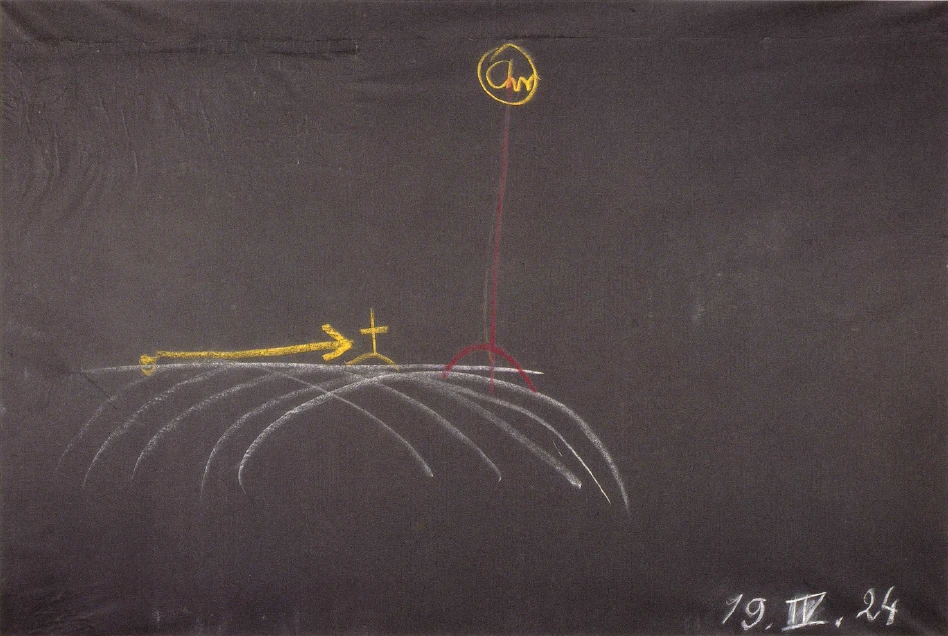
[ 28 ] If I want to illustrate schematically how developments unfolded in the period that followed, I must represent time—that is, the Earth—in a year, in the third year, and so on, moving forward in time; the Earth, of course, is always there in space, but this is how we represent the passage of time. The Mystery of Golgotha took place. A person living, say, in the 8th century, instead of looking toward the Sun from the Mystery to reach Christ, now looks back to the turning point in history leading up to the beginning of the Christian era, looking back in time toward the Mystery of Golgotha (see drawing, yellow arrow); he can find the Christ within the Mystery of Golgotha in an earthly act, in an earthly event.
[ 29 ] What had formerly been spatial perception was now to become temporal perception through the Mystery of Golgotha. That was the significance of what had happened.
[ 30 ] But precisely when we allow the soul to be moved by what took place in the Mysteries during initiation—which was a symbol of death and of the resurrection of the human being after death— and when we add to this the structure of the ritual acts—for example, the Adonis Festival—which in turn were a symbol of what took place in the Mysteries, then all of this—this threefold unity—appears to us as elevated to the highest degree, concentrated in the historical event at Golgotha.
[ 31 ] What took place deep within the sanctuary of the Mysteries now appears outwardly in history. What was previously available only to the initiated is now available to all people. There is no longer any need for an image that is plunged into the sea and symbolically rises from it. Rather, one should hold the thought, the memory of what truly happened on Golgotha. In place of the external symbol—which referred precisely to an event experienced in space—there should come the inner, sensually formless remembrance, the remembrance of the historical event on Golgotha experienced solely in the soul.
[ 32 ] Now we observe a remarkable development in humanity over the following centuries. People’s penetration into the spiritual realm is diminishing more and more. The spiritual content of the Mystery of Golgotha cannot take root in people’s minds. Development proceeds in accordance with the formation of the material sense. People lose the inner, heartfelt understanding of what follows; they lose the understanding that precisely where outer nature presents itself as transience, as a withering, desolate existence, the vitality of the spirit can be perceived. People are also losing their understanding of the outer festivity: that when autumn comes with its dying, one can best sense how the resurrection of the spiritual stands in contrast to the dying of the earthly-natural.
[ 33 ] Thus, autumn loses the opportunity to serve as a time for the Feast of the Resurrection. Autumn loses the opportunity to use nature’s transience to point specifically to the eternity of the spirit. We need to draw on the material world. One needs to rely on that which does not die in nature, that which sprouts in nature, that which rises in nature as the seed force that is buried in the earth in the fall. One takes the material as a symbol of the spiritual because one can no longer be inspired by the material to perceive the spiritual in its reality. Autumn no longer has the power to reveal, in contrast to the transience of the natural world, the immortality of the spiritual through the inner power of the human soul. We need to draw upon external nature, upon the external resurrection. We want to see how plants sprout from the earth, how the sun gains strength, how light and warmth, in turn, gain strength. We need the resurrection in nature in order to celebrate the idea of resurrection.
[ 34 ] But with this, that direct connection associated with the Festival of Adonis—which can be linked to the Mystery of Golgotha—also disappears. That inner experience loses its power—an experience that can occur at the time of every human being’s earthly death, when the human soul knows: the human being passes through the gate of death in the earthly sense, undergoes something over the course of three days that can indeed fill a person with solemnity; but then the soul must become inwardly joyful, inwardly festive and joyful, because it knows that it is precisely out of death that the human soul rises after three days into spiritual immortality.
[ 35 ] That power which lay in the Festival of Adonis has been lost. At first, it was destined for humanity that this power should arise with greater intensity. People looked upon the death of the god—all that is beautiful in humanity, all that is great, all that is youthful and vigorous. This god is plunged into the sea on the day of mourning, on Chartage. Chara means mourning. People entered into a solemn mood because they initially wanted to cultivate a sense of the transience of the natural world.
[ 36 ] But then, it was precisely this attitude toward the transience of the natural world that was to lead the human soul to an attitude toward the supernatural resurrection of the human soul after three days. When God—or rather, His image—was once again brought to the fore, the properly instructed believer then beheld the image of the human soul a few days after death: What happens in the spirit to those who have died—behold, it stands before your soul in the image of the risen God of beauty and youthful vitality.
[ 37 ] That which is so deeply connected to human destiny was awakened every year in the fall directly within the human spirit. At that time, it would not have been considered possible to link this to the external natural world. What could be experienced in the spirit was represented in the ritual act, in the symbolic act. But when the image of the ancient times was to be erased, and a memory—an image-less, inner, soulfully experienced memory of the Mystery of Golgotha, which represents the same thing—was to take its place, humanity initially lacked the strength to accomplish this, because the spirit had retreated into the depths of the human soul. Thus, right up to our own time, the situation remained such that people needed to rely on external nature. But external nature provides no symbol, no complete symbol of the human destiny in death. The idea of death, however, was able to live on. The idea of the Resurrection has faded more and more. And even though the Resurrection is spoken of as an article of faith, the reality of the Resurrection is not alive for humanity in modern times. It must become alive again; it must do so through the anthroposophical perspective reawakening human consciousness to the true idea of the Resurrection.
[ 38 ] Therefore, if—as has been said at the right time—the idea of Michael must be close to the anthroposophical mind as the heralding thought, and if the idea of Christmas must deepen within the anthroposophical mind, then the idea of Easter must become a particularly festive one. For anthroposophy must add the idea of resurrection to the idea of death. It must itself become like an inner festival of resurrection for the human soul. It must bring an Easter spirit into the human worldview. It will be able to do so when it is understood how the ancient mystery tradition can live on in a truly grasped concept of Easter, when a correct view arises of the human body, soul, and spirit, and of the destiny of the human body, soul, and spirit in the physical, soul, and spiritual-heavenly worlds.