

Mystery Sites of the Middle Ages
Rosicrucianism and the Modern Principle of Initiation
GA 233a
19 April 1924, Dornach
Translate the original German text into any language:
Versions Available:
Mystery Sites of the Middle Ages, tr. SOL
- The Festival of Easter, tr. Collison
- Easter as a Chapter in the Mystery Wisdom of Man, tr. Lockwood
- The Easter Festival in Relation to the Mysteries, tr. Adams
- The Easter Festival in the Evolution of the Mysteries, tr. Kelly
- Mystery Sites of the Middle Ages, tr. SOL
- Mysterienstätten Des Mittelalters
Das Osterfest als Stück Mysteriengeschichte der Menschheit I
Easter as a Chapter in the History of Humanity's Mysteries I
[ 1 ] Das Osterfest wird von zahlreichen Menschen als etwas empfunden, das zusammenhängt auf der einen Seite mit den tiefsten Gefühlen und Empfindungen der Menschenseele, zusammenhängt aber auf der anderen Seite auch mit Weltengeheimnissen und Weltenrätseln. Man muß ja aufmerksam werden auf die Tatsache des Zusammenhanges des Osterfestes mit Weltengeheimnissen und Weltenrätseln dadurch, daß das Osterfest ein sogenanntes bewegliches Fest ist, das alljährlich ausgerechnet werden muß nach jener Sternkonstellation, die wir in diesen Tagen noch genauer besprechen wollen. Man muß aber auch, wenn man verfolgt, wie durch die Jahrhunderte festliche Gebräuche an das Osterfest geknüpft worden sind, Kulthandlungen, die einer zahlreichen Menschenschaft außerordentlich nahegehen, man muß auch daraus sehen, welchen ungeheuren Wert die Menschheit allmählich im Verlaufe ihres geschichtlichen Werdens in dieses Osterfest hineingelegt hat.
[ 1 ] Easter is perceived by many people as something connected, on the one hand, to the deepest feelings and emotions of the human soul, but also, on the other hand, to the mysteries and enigmas of the universe. One must indeed take note of the fact that Easter is connected to the mysteries and enigmas of the universe, precisely because it is a so-called movable feast that must be calculated annually according to the constellation of stars, which we intend to discuss in greater detail in the coming days. But one must also—when observing how, over the centuries, festive customs have become associated with Easter, ritual acts that resonate deeply with a vast number of people—recognize the immense value that humanity has gradually imbued in this Easter celebration in the course of its historical development.
[ 2 ] Nun ist das Osterfest in den ersten Jahrhunderten des Christentums, nicht gleich bei der Begründung, aber in den ersten Jahrhunderten des Christentums, ein wichtiges christliches Fest geworden, ein christliches Fest, das zusammenhängt mit dem Grundgedanken, dem Grundimpuls des Christentums, mit dem Impuls, der sich ergibt für das Christsein durch die Tatsache der Auferstehung Christi.
[ 2 ] Now, in the first centuries of Christianity—not immediately upon its founding, but in the first centuries of Christianity—Easter became an important Christian festival, a Christian festival connected to the fundamental idea, the fundamental impulse of Christianity, to the impulse that arises for being a Christian through the fact of Christ’s resurrection.
[ 3 ] Das Osterfest ist das Auferstehungsfest. Aber das Osterfest weist hin auf ältere als die christlichen Zeiten. Es weist hin auf Feste, die mit der Zeit der Frühlings-Tagundnachtgleiche, die ja wenigstens mit der Berechnung der Österzeit etwas zu tun hat, zusammenhängen, mit jenen Festen, welche anknüpfen an die neuerwachende Natur, an das sprießende, der Erde wieder entwachsende Leben.
[ 3 ] Easter is the feast of the Resurrection. But Easter points back to times even older than the Christian era. It points to festivals associated with the spring equinox—which, after all, has at least some connection to the calculation of the Lenten season—and to those festivals that celebrate nature’s reawakening and the sprouting life emerging anew from the earth.
[ 4 ] Und damit stehen wir an dem Punkte, wo wir, wenn die Dinge gerade zur Sprache kommen sollen, die das Thema dieser Ostervorträge bilden: das Osterfest als ein Stück Mysteriengeschichte der Menschheit, wo wir diese Dinge sogleich berühren müssen.
[ 4 ] And this brings us to the point where, if we are to address the very topics that form the subject of these Easter lectures—Easter as a chapter in the history of humanity’s mysteries—we must address these matters immediately.
[ 5 ] Das Osterfest als christliches Fest ist ein Auferstehungsfest. Das entsprechende heidnische Fest, das ungefähr in dieselbe Jahreszeit fällt wie das Osterfest, ist eine Art Auferstehungsfest der Natur, ein Wiederherauskommen dessen, was naturhaft die Winterszeit hindurch, wenn ich mich so ausdrücken darf, geschlafen hat. Aber damit kommen wir an denjenigen Punkt, wo wir betonen müssen, daß das christliche Osterfest ganz und gar nicht ein Fest ist, das irgendwie seinem inneren Sinn und Wesen nach zusammenfällt mit den heidnischen Festen der Frühlings-Tagundnachtgleiche, sondern das Osterfest, als christliches Fest gedacht, fällt eigentlich zusammen, wenn wir schon zurückgehen wollen auf die alten Heidenzeiten, mit alten Festen, die aus den Mysterien herausgewachsen sind und die in die Herbsteszeit fallen. Das Allermerkwürdigste in bezug auf die Festsetzung des Osterfestes, das ja gerade durch seinen Inhalt ganz offensichtlich zusammenhängt mit gewissem altem Mysterienwesen, das Allermerkwürdigste ist: gerade dieses Osterfest erinnert uns daran, welch radikale, welch tiefe Mißverständnisse geschehen sind in der Weltauffassung allerbedeutendster Dinge im Verlaufe der Menschheitsentwickelung. Denn es ist ja nichts Getingeres geschehen, als daß das Osterfest verwechselt worden ist im Laufe der ersten christlichen Jahrhunderte mit einem ganz anderen Feste, daß es dadurch verlegt worden ist von einem Herbstesfeste zu einem Frühlingsfeste.
[ 5 ] Easter, as a Christian festival, is a celebration of the Resurrection. The corresponding pagan festival, which falls around the same time of year as Easter, is a kind of celebration of nature’s resurrection—a reemergence of that which, if I may put it this way, has been dormant throughout the winter. But this brings us to the point where we must emphasize that the Christian festival of Easter is by no means a festival that, in terms of its inner meaning and essence, coincides in any way with the pagan festivals of the spring equinox; rather, Easter, conceived as a Christian festival, actually coincides—if we are to go back to the ancient pagan times—with ancient festivals that grew out of the mysteries and that fall in the autumn season. The most remarkable thing regarding the dating of Easter—which, precisely because of its content, is quite obviously connected to a certain ancient mystery tradition—is this: it is precisely this Easter that reminds us of the radical, profound misunderstandings that have occurred in the worldview of the most significant matters in the course of human development. For nothing less than this has happened: over the course of the first Christian centuries, Easter was confused with an entirely different festival, and as a result, it was shifted from an autumn festival to a spring festival.
[ 6 ] Diese Tatsache weist eigentlich auf Ungeheures hin in der Menschheitsentwickelung. Aber sehen wir uns einmal den Inhalt dieses Osterfestes an. Was ist sein Wesentliches? Sein Wesentliches ist: Die Wesenheit, die in der Mitte des christlichen Bewußtseins steht, der Christus Jesus, geht durch den Tod, woran der Karfreitag erinnert. Der Christus Jesus ruht in dem Grabe die Zeit, welche in dreien Tagen verläuft und welche darstellt die Verbindung des Christus mit dem Erdendasein. Diese Zeit wird als Festeszeit, als Trauerfesteszeit begangen innerhalb des Christentums zwischen dem Karfreitag und dem Ostersonntag. Der Ostersonntag ist dann der Tag, an dem dieses Mittelpunktwesen des Christentums aus dem Grabe ersteht. Der Erinnerungstag daran ist es.
[ 6 ] This fact actually points to something immense in the development of humanity. But let us take a look at the meaning of this Easter celebration. What is its essence? Its essence is this: the being who stands at the center of Christian consciousness, Christ Jesus, passes through death, as Good Friday commemorates. Christ Jesus rests in the tomb for a period of three days, which symbolizes Christ’s connection to earthly existence. This period is observed within Christianity as a festive season—a season of mourning—between Good Friday and Easter Sunday. Easter Sunday is then the day on which this central figure of Christianity rises from the tomb. This is the day on which we commemorate that event.
[ 7 ] Damit haben wir den wesentlichen Inhalt des Osterfestes dargelegt: Tod, Grabesruhe, Auferstehung des Christus Jesus. Und nun sehen wir uns zunächst einmal das entsprechende alte heidnische Fest in irgendeiner Gestalt an. Nur dadurch kommen wir zu einer inneren Durchdringung des Zusammenhanges zwischen Osterfest und Mysterienwesen. Wir finden an vielen Orten, bei vielen Völkern alte heidnische Feste, welche in ihrer äußeren Struktur, in der Struktur des Kultus, durchaus ähnlich sind der Struktur des Osterinhaltes des Christentums.
[ 7 ] We have thus outlined the essential content of the Easter celebration: the death, the rest in the tomb, and the resurrection of Christ Jesus. And now let us first take a look at the corresponding ancient pagan festival in whatever form it may have taken. Only in this way can we gain a deep understanding of the connection between Easter and the nature of the mysteries. In many places and among many peoples, we find ancient pagan festivals that, in their outward structure—in the structure of their rituals—are quite similar to the structure of the Christian Easter narrative.
[ 8 ] Nehmen wir aus den mannigfaltigen alten Festlichkeiten das Adonisfest heraus. Bei gewissen vorderasiatischen Völkern wurde es begangen durch lange Zeiten des vorchristlichen Altertums. Ein Bild bildete den Mittelpunkt. Auf diesem Bilde war dargestellt Adonis, der geistige Repräsentant alles dessen, was im Menschen sprießende Jugendkraft ist, der Repräsentant alles dessen, was im Menschen sich als die Schönheit darstellt.
[ 8 ] Let us single out the Festival of Adonis from among the many ancient festivals. Among certain Near Eastern peoples, it was celebrated throughout much of pre-Christian antiquity. An image formed the centerpiece. This image depicted Adonis, the spiritual representative of all that is the burgeoning youthful vitality within human beings, the representative of all that manifests itself as beauty within human beings.
[ 9 ] Gewiß, die alten Völker haben in mancher Beziehung verwechselt das, was eine Abbildung enthielt, mit demjenigen, was die Abbildung darstellte. Und so haben ja diese alten Religionen vielfach den Charakter des Fetischismus. Viele Menschen sahen in dem Bilde den gegenwärtigen Gott der Schönheit, der Jugendkraft des Menschen, der sich entwickelnden Keimeskraft, die in glanzvollem Dasein nach außen sich offenbart, die alles das im glanzvollen Dasein nach außen offenbart, was der Mensch an innerem Wert, an innerer Würde, an innerer Größe in sich enthält oder auch enthalten kann.
[ 9 ] Certainly, in many respects, the ancient peoples confused what an image contained with what the image represented. And so these ancient religions often have the character of fetishism. Many people saw in the image the present god of beauty, of human youthful vitality, of the developing vital force that reveals itself outwardly in a radiant existence—a radiant existence that reveals everything that a person possesses or is capable of possessing in terms of inner value, inner dignity, and inner greatness.
[ 10 ] Dieses Götterbild wurde unter Gesängen, unter Kulthandlungen, die darstellten tiefste menschliche Trauer, tiefstes menschliches Leid, wenn es an einem Orte geschah, wo Meer in der Nähe war, in die Meeresfluten gesenkt, wo es drei Tage drinnen zu bleiben hatte, wo ein See war, in den See versenkt; sonst wurde sogar in der Nähe der Mysterienstätte ein künstlicher Teich angelegt, um dieses Götterbild in diesen Teich zu versenken und es drei Tage lang drinnen zu lassen. Während dieser drei Tage ruhte über dem Ganzen der Gemeinde, die sich zu diesem Kultus bekannte, die diesen Kultus ihr eigen nannte, tiefster Ernst, tiefste Stille. Nach dreien Tagen wurde das Bild aus dem Wasser geholt. Die vorherigen Trauergesänge wurden in Jubelgesänge, in Hymnen auf den wiedererstandenen Gott, auf den wiederum zum Leben gekommenen Gott verwandelt.
[ 10 ] This divine image was lowered into the sea—accompanied by chants and ritual acts that expressed the deepest human grief and suffering—if the ceremony took place near the sea; or, if it took place near a lake, it was submerged in the lake, where it was to remain for three days; otherwise, an artificial pond was even constructed near the site of the mysteries in order to submerge this divine image in it and leave it there for three days. During these three days, the deepest solemnity and the deepest silence reigned over the entire community that professed this cult and claimed it as their own. After three days, the image was retrieved from the water. The previous dirges were transformed into songs of jubilation, into hymns to the resurrected god, to the god who had come back to life.
[ 11 ] Das war eine äußerliche Zeremonie, das war eine Zeremonie, die weitesten Kreisen von Menschen das Gemüt tief aufrüttelte. Und diese Zeremonie deutete wiederum eben in einer äußeren Handlung, in einem äußeren Kultusverlauf an, was in den Tiefen der heiligen Mysterien sich abspielte mit jedem Menschen, der zur Initiation, zur Einweihung, kommen sollte. Jeder Mensch, der zur Initiation, zur Einweihung, kommen sollte, wurde in diesen alten Zeiten innerhalb der Mysterien in ein besonderes Gemach geführt. Die Wände waren schwarz, der ganze Raum, in dem nichts anderes enthalten war als ein Sarg oder wenigstens ein sargartiges Gebilde, war düster und dunkel. Und an diesem Sarg wurden von jenen, die den zu Initiierenden hineingeleiteten, Trauergesänge angestimmt, Todesgesänge angestimmt. Der zu Initiierende wurde behandelt wie einer, der da stirbt, und ihm wurde begreiflich gemacht, daß er nun, indem er in den Sarg gelegt wird, dasjenige durchzumachen habe, was der Mensch durchmacht, wenn er durch die Todespforte geht und die nächsten drei Tage verlebt. Die Anordnung war auch so getroffen, daß dem zu Initiierenden zur völligen inneren Klarheit kam, was der Mensch in den ersten drei Tagen nach dem Tode durchmacht.
[ 11 ] This was an external ceremony—a ceremony that deeply stirred the hearts of the broadest circles of people. And this ceremony, in turn, hinted—through an outward act, through the outward course of the rite—at what took place in the depths of the sacred mysteries with every person who was to come for initiation. In those ancient times, every person who was to undergo initiation was led into a special chamber within the Mysteries. The walls were black; the entire room, which contained nothing but a coffin—or at least a coffin-like structure—was gloomy and dark. And by this coffin, those who led the initiate inside would intone dirges, songs of death. The initiate was treated as one who was dying, and it was made clear to him that now, as he was laid in the coffin, he would have to undergo what a human being undergoes when passing through the gate of death and spending the next three days. The arrangement was also designed so that the initiate would gain complete inner clarity regarding what a human being experiences during the first three days after death.
[ 12 ] Am dritten Tage erhob sich an einer bestimmten Stelle, auf die hinschauen konnte der, der in dem Sarge lag, ein Zweig, darstellend das sprießende Leben. Die früheren Trauergesänge verwandelten sich in Hymnen, in Jubelgesänge. Der Betreffende erhob sich aus seinem Grabe mit verwandeltem Bewußtsein. Ihm wurde mitgeteilt eine neue Sprache, eine neue Schrift, die Sprache der Geister, die Schrift der Geister. Er durfte jetzt schauen, er konnte auch schauen die Welt vom Gesichtspunkte des Geistes.
[ 12 ] On the third day, at a specific spot that the one lying in the coffin could see, a twig sprouted, symbolizing the emergence of life. The earlier dirges gave way to hymns and songs of jubilation. The person in question rose from his grave with a transformed consciousness. He was taught a new language, a new script—the language of the spirits, the script of the spirits. He was now able to see; he could also view the world from the perspective of the spirit.
[ 13 ] Wenn man dieses mit den Einzuweihenden in den Tiefen der Mysterien Veranstaltete verglich mit dem, was als Kultushandlungen draußen vollzogen wurde, dann war der Inhalt des Kultus bildhaft, aber in seiner ganzen Struktur ähnlich dem, was da geschah mit den auserlesenen Menschen innerhalb der Mysterien. Und der Kultus nehmen wir als den Repräsentanten den speziellen Adoniskultus —, der Kultus wurde auch denjenigen, die daran teilnahmen, in entsprechender Zeit erklärt. Dieser Kultus fand ja statt zur Herbsteszeit, und diejenigen, die an diesem Kultus teilnahmen, wurden etwa in der folgenden Art belehrt: Seht, es ist Herbsteszeit. Die Erde ‚verliert ihren Pflanzen-, ihren Blattesschmuck. Alles welkt hinunter. An die Stelle des grünenden, sprießenden Lebens, das im Frühling begonnen hat die Erde zu bedecken, wird der die Erde einhüllende Schnee kommen oder wenigstens die die Erde verödende Dürre. Die Natur erstirbt. Aber indem um euch herum alles erstirbt, sollt ihr erleben, was im Menschen zur Hälfte ähnlich ist dem Sterben, das in aller Natur ringsherum ist. Auch der Mensch stirbt. Auch für ihn kommt ein Herbst. Wenn es mit dem Leben zu Ende geht, dann ist es recht, wenn das menschliche Gemüt derjenigen, die übrigbleiben, sich erfüllt mit tiefer Trauer. Und damit der ganze Ernst des Durchganges durch den Tod vor eure Seele trete, damit ihr nicht bloß den Tod erlebt, wenn er an euch herantritt, sondern damit ihr euch immer wieder und wiederum an ihn erinnern könnt, so wird eben allherbstlich gezeigt, wie gerade dasjenige göttliche Wesen, das da ist der Repräsentant der Schönheit, der Jugend, der Größe des Menschen, wie dieses göttliche Wesen stirbt, wie dieses göttliche Wesen den Gang macht, den alles Naturhafte macht. Aber gerade wenn die Natur in ihre Öde eingeht, wenn es in der Natur ins Sterben kommt, dann sollt ihr euch erinnern an etwas anderes. Dann sollt ihr euch erinnern, daß der Mensch durch die Pforte des Todes geht, daß, während er hier im irdischen Dasein nur Dinge erlebt hat, die gleich sind denen, die im Herbste ersterben, während er hier im Irdischen nur die Dinge erlebt hat, die vergänglich sind, daß er von der Erde abgezogen wird und in die Weiten des Weltenäthers sich hinauslebt. Er sieht sich immer größer und größer werden, er wird so, daß die ganze Welt sein eigen wird. Er lebt sich hinaus durch drei Tage in das ganze weite Weltenall. Und dann, während das irdische Auge hier hingelenkt ist auf das Bild des Todes, während das irdische Auge hingelenkt ist auf dasjenige, was stirbt, auf das Vergängliche, erwacht drüben im Geiste nach dreien Tagen die unsterbliche Menschenseele. Sie steht drüben auf. Sie steht auf, um drei Tage nach dem Tode geboren zu werden für das Geisterland.
[ 13 ] If one compared what took place with those to be initiated in the depths of the Mysteries to what was performed as ritual acts outside, then the content of the ritual was symbolic, but in its entire structure similar to what took place there with the chosen people within the Mysteries. And as a representative of this cult, we take the specific Adonis cult—the cult was also explained to those who participated in it at the appropriate time. This cult took place in the fall, and those who participated in it were instructed in roughly the following manner: Behold, it is fall. The earth ‘loses its vegetation, its foliage. Everything withers away. In place of the verdant, sprouting life that began to cover the earth in spring, snow will envelop the earth—or at least the drought that lays the earth waste. Nature dies. But as everything around you dies, you are to experience what in human beings is, in part, similar to the dying that is all around in nature. Human beings, too, die. For them, too, an autumn comes. When life draws to a close, it is right that the hearts of those who remain should be filled with deep sorrow. And so that the full gravity of the passage through death may stand before your soul—so that you do not merely experience death when it approaches you, but so that you may remember it again and again— every autumn demonstrates how precisely that divine being—which is the embodiment of beauty, youth, and the greatness of humanity—how this divine being dies, how this divine being follows the path that all of nature follows. But precisely when nature enters its desolation, when death comes to nature, then you should remember something else. Then you should remember that the human being passes through the gate of death; that, while here in earthly existence he has experienced only things that are like those that wither in the fall, while here on earth he has experienced only things that are transitory, he is drawn away from the earth and lives his way out into the vastness of the world-ether. He sees himself growing ever larger and larger; he becomes such that the whole world becomes his own. He lives his way out over three days into the entire vast universe. And then, while the earthly eye here is fixed on the image of death, while the earthly eye is fixed on that which dies, on the transitory, the immortal human soul awakens over there in the spirit realm after three days. It rises over there. It rises to be born three days after death into the spirit realm.
[ 14 ] In eindringlicher innerer Wandlung wurde dies vollzogen am eigenen Leibe des zu Initiierenden innerhalb der Tiefe der Mysterien. Und der bedeutsame Eindruck, der ungeheure Ruck, den das Menschenleben bekam durch diese alte Art der Initiation — wir werden sehen, daß das in der Neuzeit nicht so vor sich gehen kann, sondern in ganz anderer Weise —, der weckte innere Seelenkräfte, der weckte das Schauen, der brachte den Menschen dahin zu wissen: Er steht nunmehr nicht bloß in der Sinneswelt, er steht nunmehr in der geistigen Welt.
[ 14 ] This was accomplished through a profound inner transformation experienced firsthand by the initiate within the depths of the mysteries. And the profound impact, the tremendous jolt that human life received through this ancient form of initiation—we shall see that this cannot take place in the same way in modern times, but rather in a completely different manner—awakened inner soul forces, awakened the power of vision, and led the human being to the realization: He now stands not merely in the sensory world, but in the spiritual world.
[ 15 ] Und was wiederum zu einer entsprechenden Zeit als Belehrung an diejenigen herankam, die Schüler der Mysterien waren, das kann ich etwa in die folgenden Worte zusammenfassen. Diesen Schülern der Mysterien wurde gesagt: Was in den Mysterien vorgeht, ist Bild von dem, was in der geistigen Welt vorgeht, was im Kosmos vorgeht; Kultus ist Bild von dem, was in den Mysterien vorgeht. — Denn dessen war sich jeder, der zu den Mysterien zugelassen worden ist, klar: Die Mysterien umschlossen im Irdischen Vorgänge, die am Menschen sich abspielten und die durchaus Abbilder waren dessen, was in den Weiten des astralgeistigen Kosmos von dem Menschen in anderen Daseinsformen erlebt wird als in der irdischen. Denjenigen, die in diesen alten Zeiten nicht zugelassen worden sind zu den Mysterien, weil sie nach ihrer Lebensreife nicht ausersehen sein konnten, die Anschauung der geistigen Welt unmittelbar zu empfangen, denen wurde im Kultus, das heißt im Bilde dessen, was in den Mysterien vorging, das Entsprechende beigebracht.
[ 15 ] And what, in turn, was conveyed at the appropriate time as instruction to those who were students of the Mysteries, I can summarize roughly in the following words. These students of the Mysteries were told: What takes place in the Mysteries is a reflection of what takes place in the spiritual world, of what takes place in the cosmos; the ritual is a reflection of what takes place in the Mysteries.” — For everyone who had been admitted to the Mysteries was well aware of this: The Mysteries encompassed earthly processes that unfolded within the human being and were indeed reflections of what is experienced by the human being in the vastness of the astral-spiritual cosmos in forms of existence other than the earthly one. Those who, in those ancient times, were not admitted to the Mysteries—because, given their level of spiritual maturity, they were not deemed ready to receive a direct perception of the spiritual world—were taught the corresponding truths through the cult, that is, through the image of what took place in the Mysteries.
[ 16 ] So war das entsprechende Mysterienfest, das wir an dem Beispiel des Adonisfestes kennengelernt haben, dazu da, während des herbstlichen Welkens, während des herbstlichen Ödewerdens des Irdischen, während des herbstlichen radikalen Darstellens der Vergänglichkeit der irdischen Dinge, während des herbstlichen Darstellens des Sterbens und des Todes, in dem Menschen die Gewißheit oder wenigstens die Anschauung hervorzurufen: der Tod, der über die ganze Natur im Herbste kommt, der kommt auch über den Menschen, er kommt auch über den Repräsentanten der Schönheit, Jugend und Größe der Menschenseele, die im Gotte Adonis dargestellt wird. Auch der Gott Adonis stirbt. Er geht auf in den irdischen Repräsentanten des Weltenäthers, in das Wasser. Aber so, wie er sich erhebt aus dem Wasser, so wie er geholt werden kann aus dem Wasser, so wird des Menschen Seele geholt aus den Wassern der Welt, das heißt aus dem Äther des Kosmos, nach ungefähr dreien Tagen, nachdem der Mensch hier auf Erden durch die Todespforte gegangen ist.
[ 16 ] Thus, the corresponding mystery festival—which we have come to know through the example of the Adonis festival— intended to evoke in people, during the autumnal withering, during the autumnal desolation of the earthly realm, during the autumnal radical portrayal of the transience of earthly things, during the autumnal portrayal of dying and death, the certainty—or at least the realization—that: Death, which comes upon all of nature in the fall, also comes upon human beings; it also comes upon the embodiment of beauty, youth, and the grandeur of the human soul, which is represented in the god Adonis. The god Adonis, too, dies. He is absorbed into the earthly embodiment of the world-ether—into the water. But just as he rises from the water, just as he can be drawn from the water, so too is the human soul drawn from the waters of the world—that is, from the ether of the cosmos—about three days after the human being has passed through the gate of death here on earth.
[ 17 ] Das Geheimnis des Todes selber sollte dargestellt werden in diesen alten Mysterien durch das entsprechende Herbstesfest. Und anschaulich sollte das Dargestellte dadurch werden, daß der Kultus auf der einen Seite in seiner ersten Hälfte zusammenfiel mit dem Sterben, mit dem Tode der Natur, auf der anderen Seite aber das Gegenteil darstellte, als das Wesentliche des Menschenwesens selber. Der Mensch soll hinschauen auf das Sterben der Natur — so war es gemeint —, um gewahr zu werden, wie er nach dem äußeren Scheine stirbt, nach dem inneren Wesen aber aufersteht zunächst für die geistige Welt. Die Wahrheit über den Tod zu enthüllen, das war der Sinn dieses alten heidnischen, an die Mysterien angelehnten Festes.
[ 17 ] The mystery of death itself was to be represented in these ancient mysteries through the corresponding autumn festival. And this representation was to be made vivid by the fact that, on the one hand, the first half of the ritual coincided with dying—with the death of nature—while, on the other hand, it represented the opposite as the very essence of the human being. Human beings are meant to look upon the dying of nature—so the intention was—in order to become aware of how, outwardly, they die, but inwardly, in their inner being, they rise again, first into the spiritual world. To reveal the truth about death—that was the purpose of this ancient pagan festival, modeled on the mysteries.
[ 18 ] Nun geschah im Laufe der Menschheitsentwickelung dieses Bedeutsame, daß dasjenige, was auf einem gewissen Niveau der Einzuweihende in den Mysterien durchmachte, das Sterben und Wiederauferstehen der Seele, daß das bis zum Leibe hin sich vollzog mit dem Christus Jesus. Denn wie stellt sich für den Kenner der Mysterien das Mysterium von Golgatha dar? Der Kenner der Mysterien schaut in die alten Mysterien hinein. Er sieht, wie der Einzuweihende seiner Seele nach geführt wurde durch den Tod zur Auferstehung der Seele, das heißt zum Erwecken eines höheren Bewußtseins in der Seele. Die Seele starb, um aufzuerstehen in einem höheren Bewußtsein. Was hier festgehalten werden muß, das ist, daß der Leib nicht starb, daß die Seele aber starb, um zu einem höheren Bewußtsein erweckt zu werden.
[ 18 ] Now, in the course of human evolution, something significant occurred: what the initiate in the mysteries experienced at a certain level—the death and resurrection of the soul—took place, extending even to the body, in the person of Christ Jesus. For how does the Mystery of Golgotha appear to the initiate into the Mysteries? The initiate into the Mysteries looks into the ancient Mysteries. He sees how the initiate was led, through the soul, by death to the resurrection of the soul—that is, to the awakening of a higher consciousness within the soul. The soul died in order to rise again in a higher consciousness. What must be emphasized here is that the body did not die, but the soul did die in order to be awakened to a higher consciousness.
[ 19 ] Was die Seele eines jeden zu Initiierenden durchmachte, das machte der Christus Jesus bis zum Leibe durch, also einfach auf einem anderen Niveau. Weil der Christus kein irdischer Mensch, sondern ein Sonnenwesen im Leibe des Jesus von Nazareth war, konnte dasselbe, was der alte zu Initiierende in den Mysterien seiner Seele nach durchmachte, der ganzen Menschennatur nach durchmachen der Christus Jesus auf Golgatha.
[ 19 ] What the soul of every initiate went through, Christ Jesus went through in his physical body—simply on a different level. Because Christ was not an earthly human being but a solar being in the body of Jesus of Nazareth, Christ Jesus was able to undergo on Golgotha, in terms of the whole of human nature, the very same process that the ancient initiate had undergone in the mysteries of his soul.
[ 20 ] Diejenigen, die noch da waren als Kenner der alten Mysterien, als Wissende dieser Initiationshandlung, sie waren wohl die Menschen, auch bis heute diejenigen Menschen, welche am tiefsten verstanden, was auf Golgatha geschehen war. Denn, was konnten sie sich sagen? Sie konnten sich sagen: Durch Jahrtausende hindurch sind Menschen in die Geheimnisse der geistigen Welt durch den Tod und die Auferstehung ihrer Seele geführt worden. Die Seele ist von dem Leibe getrennt gehalten worden während der Einweihungshandlung. Sie ist durch den Tod zum ewigen Leben geführt worden. Was da erlebt worden ist von einer Anzahl von auserlesenen Menschen, das hat ein Wesen erlebt bis in den Leib hinein, das bei der Johannestaufe im Jordan heruntergestiegen ist von der Sonne und Besitz ergriffen hat von dem Leibe des Jesus von Nazareth. Geschichtliche Tatsache ist geworden, was sich wiederholende Einweihungshandlung durch lange, lange Jahrtausende hindurch gewesen war.
[ 20 ] Those who were still there as connoisseurs of the ancient mysteries, as those who knew this rite of initiation—they were surely the people, and indeed remain to this day the people, who understood most deeply what had happened on Golgotha. For what could they say to one another? They could say to one another: Throughout millennia, human beings have been guided into the mysteries of the spiritual world through the death and resurrection of their souls. The soul was kept separate from the body during the initiation rite. It was led through death to eternal life. What was experienced there by a select few was experienced right down into the body by a being who, at the baptism of John in the Jordan, descended from the sun and took possession of the body of Jesus of Nazareth. What had been a recurring initiation rite over long, long millennia has now become a historical fact.
[ 21 ] Das war das Wesentliche, daß man wußte: Weil es ein Sonnenwesen war, das Besitz ergriffen hatte von dem Leibe des Jesus von Nazareth, deshalb konnte das, was sich bei den zu Initiierenden nur vollzog in bezug auf die Seele und ihre Erlebnisse — es konnte sich vollziehen bis in das Leibesdasein hinein. Es konnte vollzogen werden trotz des Todes des Leibes, trotz des Aufgehens des Leibes des Jesus von Nazareth in der sterblichen Erde, eine Auferstehung des Christus, weil dieser Christus höher hinaufsteigt, als die Seele des zu Initiierenden hinaufsteigen konnte. Den Leib konnte der zu Initiierende nicht in so tiefe Regionen des Untersinnlichen bringen, wie ihn der Christus Jesus gebracht hat. Deshalb konnte der zu Initiierende nicht so hoch hinaufsteigen mit der Auferstehung wie der Christus; aber bis zu diesem Unterschiede hinsichtlich der Weltengröße ist die alte Einweihungshandlung als historische Tatsache erschienen auf der Weihestätte von Golgatha.
[ 21 ] The essential point was this: Because it was a solar being that had taken possession of the body of Jesus of Nazareth, what in the case of those to be initiated took place only in relation to the soul and its experiences—that could now take place right down into physical existence. It could take place despite the death of the body, despite the body of Jesus of Nazareth sinking into the mortal earth—a resurrection of the Christ—because this Christ ascends higher than the soul of the initiate could ascend. The initiate could not bring the body into such deep regions of the sub-sensible as Christ Jesus had brought it. Therefore, the initiate could not ascend as high as Christ did through the Resurrection; but up to this distinction regarding the magnitude of the worlds, the ancient initiation rite appeared as a historical fact at the sacred site of Golgotha.
[ 22 ] Es haben auch nur wenige in den ersten Jahrhunderten des Christentums gewußt, daß ein Sonnenwesen, ein kosmisches Wesen, in dem Jesus von Nazareth gelebt hat und die Erde dadurch befruchtet worden ist, daß von der Sonne wirklich heruntergekommen ist ein Wesen, das vorher von der Erde aus durch die Methoden der Initiationsstätten nur in der Sonne hat gesehen werden können. Und es war das Wesentliche des Christentums, insoferne es angenommen haben auch die rechten Kenner der alten Mysterien, daß gesagt werden konnte: Der Christus, zu dem wir uns erhoben haben dadurch, daß wir eingeweiht worden sind, der Christus, den wir durch unseren Aufstieg zur Sonne in den alten Mysterien haben erreichen können, der ist heruntergestiegen in einen sterblichen Leib, in den Leib des Jesus von Nazareth. Er ist zur Erde heruntergekommen.
[ 22 ] Only a few in the early centuries of Christianity knew that a solar being, a cosmic being, lived within Jesus of Nazareth and that the Earth was thereby fertilized—that a being had truly descended from the Sun, a being who, prior to this, could only have been seen in the Sun from Earth through the methods of the initiation centers. And this was the essence of Christianity—insofar as even the true experts in the ancient mysteries accepted it—that it could be said: The Christ to whom we have ascended through our initiation, the Christ whom we were able to reach through our ascent to the sun in the ancient mysteries, has descended into a mortal body, into the body of Jesus of Nazareth. He has come down to earth.
[ 23 ] Es war zunächst, ich möchte sagen, eine festliche Stimmung, mehr als eine festliche Stimmung, eine hochheilige Stimmung, welche diejenigen Seelen und Gemüter erfüllte, die in der Zeit des Mysteriums von Golgatha etwas von diesem Mysterium von Golgatha verstanden. Was da ein lebendiger Inhalt des Bewußtseins war, das wurde allmählich durch Vorgänge, die wir noch kennenlernen wollen, ein Erinnerungsfest an den historischen Vorgang auf Golgatha.
[ 23 ] At first, I would say, there was a festive atmosphere—more than a festive atmosphere, a most sacred atmosphere—that filled the souls and minds of those who, at the time of the Mystery of Golgotha, understood something of this Mystery of Golgotha. What was then a living content of consciousness gradually became, through processes we are yet to learn about, a commemoration of the historical event on Golgotha.
[ 24 ] Aber während sich diese Erinnerung herausbildete, verlor man immer mehr und mehr das Bewußtsein davon, wer der Christus als Sonnenwesen war. Die Kenner der alten Mysterien konnten sich ja nicht im Unklaren sein über die Wesenheit des Christus. Sie wußten ja, daß die wirklichen Eingeweihten, die wirklichen Initiierten dadurch, daß sie unabhängig gemacht wurden von ihrem physischen Leibe, in ihrer Seele durch den Tod gingen, sich erhoben bis in die Sonnensphäre und da den Christus aufsuchten und von ihm, von dem Christus in der Sonne, den Impuls zur Auferstehung der Seele empfingen; sie wußten, wer der Christus ist, weil sie sich zu ihm erhoben hatten. Diese alten Initiierten, die Kenner dieser Initiationshandlung, die wußten aus dem, was auf Golgatha vorging, daß dasselbe Wesen, das früher in der Sonne gesucht werden mußte, nun zu den Menschen auf die Erde niedergestiegen war. Warum? Weil jene Handlung, die in den alten Mysterien zum Erreichen des Christus in der Sonne mit dem zu Initiierenden vollzogen war, so nicht mehr vollzogen werden konnte, weil die Menschennatur einfach im Laufe der Zeit eine andere geworden ist. Die alte Einweihungszeremonie war nach der Entwickelungsart der Menschenwesenheit eine Unmöglichkeit geworden. Es hätte der Christus durch die alte Einweihungszeremonie in der Sonne nicht mehr gesucht werden können. Da stieg er denn herab, um auf der Erde eine Handlung zu vollziehen, nach welcher nun die Menschen hinschauen konnten.
[ 24 ] But as this memory took shape, people lost more and more awareness of who Christ was as a solar being. Those familiar with the ancient mysteries could not, of course, be in the dark about the nature of Christ. They knew, after all, that the true initiates, by being made independent of their physical bodies, passed through death in their souls, ascended into the solar sphere, sought out the Christ there, and received from him—the Christ in the Sun—the impulse for the resurrection of the soul; they knew who Christ is, because they had ascended to him. These ancient initiates, who were familiar with this initiation rite, knew from what took place on Golgotha that the very same Being who had previously had to be sought in the Sun had now descended to humanity on Earth. Why? Because that rite, which in the ancient mysteries was performed with the initiate to reach the Christ in the Sun, could no longer be performed in that way, since human nature had simply changed over the course of time. The ancient initiation ceremony had become impossible given the way human nature had evolved. It would no longer have been possible to seek the Christ in the sun through the ancient initiation ceremony. So he descended to perform an act on Earth that people could now look upon.
[ 25 ] Es gehört das, was sich in dieses Geheimnis schließt, zu dem Allerheiligsten, das man auf dem Erdenboden aussprechen kann.
[ 25 ] That which is encompassed by this mystery belongs to the most sacred things that can be spoken of on earth.
[ 26 ] Denn wie stellte sich eigentlich die Sache für die Menschen der auf das Mysterium von Golgatha folgenden Jahrhunderte dar?
[ 26 ] For how did the situation actually appear to the people of the centuries that followed the Mystery of Golgotha?
[ 27 ] Soll ich das schematisch zeichnen, so müßte ich es so zeichnen: Wenn das die Erde ist, so sah man aus einer alten Einweihungsstätte herauf (rechts: rot) zum Sonnendasein und wurde durch die Initiation den Christus in der Sonne gewahr. Man sah in den Raum hinaus, um an den Christus heranzutreten.
[ 27 ] If I were to draw a diagram of this, I would have to draw it like this: If this is the Earth, then one looked up from an ancient initiation site (on the right: red) toward the solar realm and, through initiation, became aware of the Christ in the Sun. One looked out into space in order to approach the Christ.
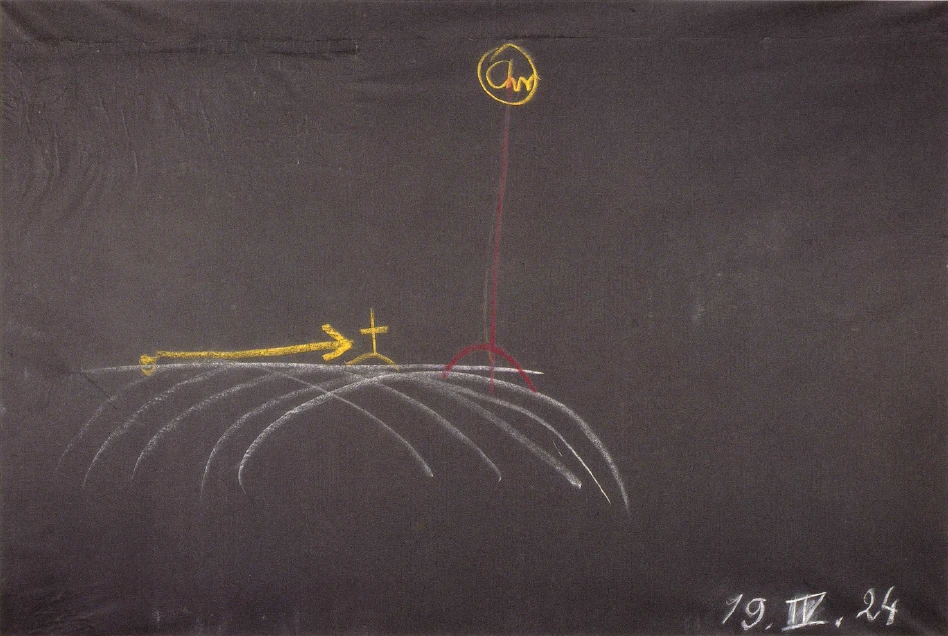
[ 28 ] Will ich schematisch darstellen, wie die Entwickelung nun in der Folgezeit war, so muß ich die Zeit darstellen, das heißt die Erde — in einem Jahr, im dritten Jahr, fortlaufend in der Zeit; die Erde räumlich ist ja immer da, aber den Zeitenlauf stellen wir so dar. Es hat sich abgespielt das Mysterium von Golgatha. Ein Mensch, der, sagen wir, im 8. Jahrhundert lebt, statt daß er vom Mysterium aus in die Sonne schaut, um zum Christus zu kommen, schaut jetzt auf die Zeitenwende bis zum Beginn der christlichen Zeitrechnung, schaut in der Zeit hin nach dem Mysterium von Golgatha (siehe Zeichnung, gelber Pfeil); er kann in einer Erdenhandlung, in einem Erdengeschehen den Christus innerhalb des Mysteriums von Golgatha finden.
[ 28 ] If I want to illustrate schematically how developments unfolded in the period that followed, I must represent time—that is, the Earth—in a year, in the third year, and so on, moving forward in time; the Earth, of course, is always there in space, but this is how we represent the passage of time. The Mystery of Golgotha took place. A person living, say, in the 8th century, instead of looking toward the Sun from the Mystery to reach Christ, now looks back to the turning point in history leading up to the beginning of the Christian era, looking back in time toward the Mystery of Golgotha (see drawing, yellow arrow); he can find the Christ within the Mystery of Golgotha in an earthly act, in an earthly event.
[ 29 ] Was früher räumliche Anschauung war, sollte nun zeitliche Anschauung werden durch das Mysterium von Golgatha. Das war das Bedeutsame, was geschehen war.
[ 29 ] What had formerly been spatial perception was now to become temporal perception through the Mystery of Golgotha. That was the significance of what had happened.
[ 30 ] Aber gerade, wenn wir auf die Seele wirken lassen, was in den Mysterien bei der Initiation sich abspielte und was ein Bild war vom Tod und von der Auferstehung des Menschen nach dem Tode, und wenn wir dazunehmen die Struktur der Kultushandlungen, zum Beispiel des Adonisfestes, die wiederum ein Bild waren dessen, was in den Mysterien vorging, so erscheint uns wie aufs Höchste hinaufgehoben das alles, dieses Dreifache vereinigt, konzentriert in der historischen Handlung auf Golgatha.
[ 30 ] But precisely when we allow the soul to be moved by what took place in the Mysteries during initiation—which was a symbol of death and of the resurrection of the human being after death— and when we add to this the structure of the ritual acts—for example, the Adonis Festival—which in turn were a symbol of what took place in the Mysteries, then all of this—this threefold unity—appears to us as elevated to the highest degree, concentrated in the historical event at Golgotha.
[ 31 ] Äußerlich in der Geschichte erscheint, was tief innerlich in dem Heiligtum der Mysterien sich vollzogen hat. Für alle Menschen ist da, was vorher nur für die Eingeweihten da war. Man braucht kein Bild mehr, das in das Meer versenkt wird, das symbolisch aus dem Meere aufersteht. Man soll vielmehr haben den Gedanken, die Erinnerung an das, was auf Golgatha wirklich geschehen ist. An die Stelle des äußeren Sinnbildes, das sich eben auf einen Vorgang, der im Raum erlebt wurde, bezog, sollte treten das innerlich sinnlich bildlose Gedenken, das bloß in der Seele erlebte Gedenken an die historische Handlung auf Golgatha.
[ 31 ] What took place deep within the sanctuary of the Mysteries now appears outwardly in history. What was previously available only to the initiated is now available to all people. There is no longer any need for an image that is plunged into the sea and symbolically rises from it. Rather, one should hold the thought, the memory of what truly happened on Golgotha. In place of the external symbol—which referred precisely to an event experienced in space—there should come the inner, sensually formless remembrance, the remembrance of the historical event on Golgotha experienced solely in the soul.
[ 32 ] Nun werden wir eine merkwürdige Entwickelung der Menschheit in den folgenden Jahrhunderten gewahr. Das Eindringen der Menschen in die Geistigkeit nimmt immer mehr und mehr ab. Der geistige Inhalt des Mysteriums von Golgatha kann nicht Platz greifen in den Gemütern der Menschen. Die Entwickelung geht nach der Ausbildung des materiellen Sinnes. Man verliert das innere Herzensverständnis für das Folgende, man verliert das Verständnis dafür, daß da, wo die äußere Natur sich als Vergänglichkeit, sich als ersterbendes ödes Sein darstellt, gerade die Lebendigkeit des Geistes erschaut werden kann. Man verliert auch das Verständnis für die äußere Festlichkeit: daß dann, wenn der Herbst mit seinem Sterben kommt, am besten empfunden werden kann, wie dem Sterben des Irdisch-Naturhaften gegenübersteht das Auferstehen des Geistigen.
[ 32 ] Now we observe a remarkable development in humanity over the following centuries. People’s penetration into the spiritual realm is diminishing more and more. The spiritual content of the Mystery of Golgotha cannot take root in people’s minds. Development proceeds in accordance with the formation of the material sense. People lose the inner, heartfelt understanding of what follows; they lose the understanding that precisely where outer nature presents itself as transience, as a withering, desolate existence, the vitality of the spirit can be perceived. People are also losing their understanding of the outer festivity: that when autumn comes with its dying, one can best sense how the resurrection of the spiritual stands in contrast to the dying of the earthly-natural.
[ 33 ] Damit verliert der Herbst die Möglichkeit, Zeit zu sein für das Auferstehungsfest. Der Herbst verliert die Möglichkeit, aus der Naturvergänglichkeit heraus gerade den Sinn hinzuweisen auf die Geist-Ewigkeit. Man braucht die Anlehnung an das Materielle. Man braucht die Anlehnung an das, was nicht stirbt in der Natur, was in der Natur aufsprießt, was in der Natur als die Samenkraft, die im Herbste in die Erde versenkt wird, aufersteht. Man nimmt das Materielle als ein Symbolum für das Geistige, weil man sich durch das Materielle nicht mehr anregen lassen kann, das Geistige in seiner Wirklichkeit zu empfinden. Der Herbst hat nicht mehr die Kraft, gegenüber dem Vergänglichen im Naturhaften die Unvergänglichkeit des Geistigen durch die innere Macht der Menschenseele zu offenbaren. Man braucht die Anlehnung an die äußere Natur, an die äußere Auferstehung. Man will sehen, wie die Pflanzen sprießen aus der Erde, wie die Sonne an Kraft gewinnt, wie das Licht und die Wärme wiederum an Kraft gewinnen. Man braucht die Auferstehung in der Natur, um den Auferstehungsgedanken zu feiern.
[ 33 ] Thus, autumn loses the opportunity to serve as a time for the Feast of the Resurrection. Autumn loses the opportunity to use nature’s transience to point specifically to the eternity of the spirit. We need to draw on the material world. One needs to rely on that which does not die in nature, that which sprouts in nature, that which rises in nature as the seed force that is buried in the earth in the fall. One takes the material as a symbol of the spiritual because one can no longer be inspired by the material to perceive the spiritual in its reality. Autumn no longer has the power to reveal, in contrast to the transience of the natural world, the immortality of the spiritual through the inner power of the human soul. We need to draw upon external nature, upon the external resurrection. We want to see how plants sprout from the earth, how the sun gains strength, how light and warmth, in turn, gain strength. We need the resurrection in nature in order to celebrate the idea of resurrection.
[ 34 ] Damit aber verschwindet auch jenes unmittelbare Verhältnis, das verbunden war mit dem Adonisfeste, das verbunden sein kann mit dem Mysterium auf Golgatha. Jenes innere Erlebnis verliert an Kraft, das auftreten kann beim irdischen Tode eines jeden Menschen, wenn die Menschenseele weiß: der Mensch geht irdisch durch die Pforte des Todes, macht durch drei Tage hindurch etwas durch, was den Menschen allerdings ernst stimmen kann; dann aber muß die Seele innerlich fröhlich werden, innerlich festlich und freudig gestimmt werden, weil sie weiß, daß gerade aus dem Tode heraus sich in geistiger Unsterblichkeit die Menschenseele nach dreien Tagen erhebt.
[ 34 ] But with this, that direct connection associated with the Festival of Adonis—which can be linked to the Mystery of Golgotha—also disappears. That inner experience loses its power—an experience that can occur at the time of every human being’s earthly death, when the human soul knows: the human being passes through the gate of death in the earthly sense, undergoes something over the course of three days that can indeed fill a person with solemnity; but then the soul must become inwardly joyful, inwardly festive and joyful, because it knows that it is precisely out of death that the human soul rises after three days into spiritual immortality.
[ 35 ] Jene Kraft, welche im Adonisfeste lag, sie ist verlorengegangen. Zunächst war für die Menschheit veranlagt, daß diese Kraft mit einer größeren Intensität erstehen sollte. Man sah hin auf den Tod des Gottes, alles Schönen in der Menschheit, alles Großen, alles Jugendkraftvollen. Dieser Gott wird in das Meer versenkt am Trauertag, am Chartage. Chara ist Trauer. Man kam in ernste Stimmung, weil man zunächst die Stimmung entwickeln wollte an der Vergänglichkeit des Naturhaften.
[ 35 ] That power which lay in the Festival of Adonis has been lost. At first, it was destined for humanity that this power should arise with greater intensity. People looked upon the death of the god—all that is beautiful in humanity, all that is great, all that is youthful and vigorous. This god is plunged into the sea on the day of mourning, on Chartage. Chara means mourning. People entered into a solemn mood because they initially wanted to cultivate a sense of the transience of the natural world.
[ 36 ] Dann aber sollte gerade diese Stimmung gegenüber der Vergänglichkeit des Naturhaften hinüberwandeln die Menschenseele zu der Stimmung gegenüber dem übersinnlichen Auferstehen der Menschenseele nach dreien Tagen. Als der Gott wieder herausgehoben wurde beziehungsweise sein Bild, da sah nun der richtig unterrichtete Gläubige das Bild der Menschenseele einige Tage nach dem Tode: Was im Geiste geschieht mit den gestorbenen Menschen, siehe da, es stellt sich vor deine Seele hin in dem Bilde des auferstandenen Gottes der Schönheit und Jugendkraft.
[ 36 ] But then, it was precisely this attitude toward the transience of the natural world that was to lead the human soul to an attitude toward the supernatural resurrection of the human soul after three days. When God—or rather, His image—was once again brought to the fore, the properly instructed believer then beheld the image of the human soul a few days after death: What happens in the spirit to those who have died—behold, it stands before your soul in the image of the risen God of beauty and youthful vitality.
[ 37 ] Dasjenige, was mit dem Menschenschicksal so tief verbunden ist, wurde alljährlich im Herbste unmittelbar im Geiste des Menschen erweckt. Man hätte es in der damaligen Zeit nicht für möglich gehalten, an die äußere Natur anzuknüpfen. Was im Geiste erlebt werden konnte, das stellte man in der Kultushandlung, in der symbolischen Handlung dar. Als aber gerade das Bild der alten Zeit getilgt werden sollte, als Erinnerung — bildlose, innere, seelisch erlebte Erinnerung an das Mysterium von Golgatha, das dasselbe darstellt — eintreten sollte, da hatte die Menschheit zunächst nicht die Kraft, das zu vollziehen, weil der Geist in die Untergründe der Seele des Menschen ging. Da blieb denn bis in unsere Zeit die Sache so, daß man die Anlehnung an die äußere Natur brauchte. Aber die äußere Natur gibt kein Sinnbild, kein vollständiges Sinnbild vom Schicksale des Menschen im Tode. Der Todesgedanke, er konnte fortleben. Der Auferstehungsgedanke ist immer mehr und mehr geschwunden. Und wenn auch von der Auferstehung als einem Glaubensinhalte gesprochen wird, lebendig ist die Auferstehungstatsache der Menschheit der neueren Zeit nicht. Sie muß es wieder werden, sie muß es dadurch werden, daß anthroposophische Anschauung den Menschensinn wieder erweckt für den wahren Auferstehungsgedanken.
[ 37 ] That which is so deeply connected to human destiny was awakened every year in the fall directly within the human spirit. At that time, it would not have been considered possible to link this to the external natural world. What could be experienced in the spirit was represented in the ritual act, in the symbolic act. But when the image of the ancient times was to be erased, and a memory—an image-less, inner, soulfully experienced memory of the Mystery of Golgotha, which represents the same thing—was to take its place, humanity initially lacked the strength to accomplish this, because the spirit had retreated into the depths of the human soul. Thus, right up to our own time, the situation remained such that people needed to rely on external nature. But external nature provides no symbol, no complete symbol of the human destiny in death. The idea of death, however, was able to live on. The idea of the Resurrection has faded more and more. And even though the Resurrection is spoken of as an article of faith, the reality of the Resurrection is not alive for humanity in modern times. It must become alive again; it must do so through the anthroposophical perspective reawakening human consciousness to the true idea of the Resurrection.
[ 38 ] Wenn daher auf der einen Seite, wie das zur rechten Zeit gesagt worden ist, dem anthroposophischen Gemüte der Michaelsgedanke naheliegen muß als der ankündigende Gedanke, wenn sich dem anthroposophischen Gemüte der Weihnachtsgedanke vertiefen muß, der Ostergedanke muß ein besonders festlicher werden. Denn Anthroposophie muß hinzufügen zu dem Todesgedanken den Auferstehungsgedanken. Sie muß selber werden wie ein inneres Auferstehungsfest der Menschenseele. Sie muß eine österliche Stimmung in die Weltanschauung des Menschen bringen. Sie wird es bringen können, wenn verstanden wird, wie der alte Mysteriengedanke in dem wahrhaft erfaßten Ostergedanken weiterleben kann, wenn eine richtige Anschauung ersteht von Leib, Seele und Geist des Menschen und von dem Schicksal von Leib, Seele und Geist des Menschen in der physischen, seelischen und geistig-himmlischen Welt.
[ 38 ] Therefore, if—as has been said at the right time—the idea of Michael must be close to the anthroposophical mind as the heralding thought, and if the idea of Christmas must deepen within the anthroposophical mind, then the idea of Easter must become a particularly festive one. For anthroposophy must add the idea of resurrection to the idea of death. It must itself become like an inner festival of resurrection for the human soul. It must bring an Easter spirit into the human worldview. It will be able to do so when it is understood how the ancient mystery tradition can live on in a truly grasped concept of Easter, when a correct view arises of the human body, soul, and spirit, and of the destiny of the human body, soul, and spirit in the physical, soul, and spiritual-heavenly worlds.