

Mystery Sites of the Middle Ages
Rosicrucianism and the Modern Principle of Initiation
GA 233a
13 January 1924, Dornach
Translated by Steiner Online Library
Sixth Lecture
[ 1 ] The Michael Period, which the world has in fact been in since the last third of the 19th century and into which human beings will increasingly have to enter with their consciousness, differs quite considerably from earlier Michael Periods. It is, after all, the nature of human development on Earth that from time to time the individual spirits of the seven great Archangels intervene in human life, so that after certain periods, a pattern of world guidance such as that exercised by Gabriel, Uriel, Raphael, Michael, and so on is repeated. But our present era is nevertheless fundamentally different from the earlier Michael period. This is because, since the first third of the 15th century, humanity has stood in a completely different relationship to the spiritual world than it ever has before. And this relationship to the spiritual world also entails a special relationship to the Spirit who guides human destiny, whom we can refer to by the ancient name Michael.
[ 2 ] What I have once again referred to as Rosicrucianism has, as I have pointed out, veered in all sorts of directions toward charlatanism, and most of what has come to humanity under the name of Rosicrucianism is, in fact, charlatanism. But as I have explained in earlier discussions, there was an individual who can be identified by the name Christian Rosenkreutz and who, in a certain sense, sets the tone for the way in which, with the advent of the newer phase of humanity, an enlightened spirit, a discerning spirit, can establish a relationship with the spiritual world.
[ 3 ] One might say that Christian Rosenkreutz was destined to pose the most diverse and highest conceivable questions—enigmatic questions about existence—in a completely new way, in contrast to humanity’s earlier experiences. For while Rosicrucianism was emerging and directing human consciousness toward the spiritual world through what would later be called Faustian striving—Faustian striving for the spiritual world—abstract and naturalistic science was simultaneously on the rise. And the proponents of this newer intellectual movement—Galileo, Giordano Bruno, Copernicus, and Kepler, who certainly deserve our respect—approached the world differently from those who sought to preserve not merely a formal, abstract understanding of things, but a true understanding. For the former sensed, in their very being as human beings, how the times—and with them, the relationship of the gods to humanity—had changed.
[ 4 ] It can be said that, although still in a rudimentary form well into the 12th and 13th centuries, human beings were able to draw real insights into the spiritual world from within themselves quite clearly as far back as the 4th century A.D. By undergoing the practices that constituted the ancient mysteries, human beings were able to draw the mysteries of existence from within themselves. And it was truly the case for this earlier humanity that the initiates drew what they had to say to humanity from the depths of their souls to the surface of their thinking, to their world of ideas. They were conscious that they drew their insights from within the human soul.
[ 5 ] The exercises that were undertaken were indeed intended to shake the human soul to its very core, to impart to the human soul experiences that one does not have in ordinary life. Through this, the mysteries of the divine world were, so to speak, drawn out from within the human being. But a person cannot perceive the mysteries that they draw out of themselves simply by drawing them out. And even during the time of ancient, instinctive clairvoyance, people did perceive the mysteries of the world—they perceived them through imagination, heard them through inspiration, and connected with them through intuition—but none of this is possible when a person stands, so to speak, all alone. It is just as impossible as my being able to draw a triangle if I have no blackboard. The triangle I draw on the blackboard makes tangible for me what I have purely mentally within myself. So the entire triangle, all the laws of the triangle, are within me, but I draw the triangle on the blackboard; in doing so, I bring closer to myself that which is actually within me. Now, that is an external act of drawing. When it comes to bringing forth real insights from within the human being in the manner of the ancient mysteries, then these insights must, in a certain sense, be written down somewhere. For they must be inscribed—so that they can be perceived—into what has been called since ancient times the astral light, into the subtle substance of the Akasha. Everything must be written there. But one must be able to develop this ability to write into the astral light.
[ 6 ] And this ability depended on various factors throughout the course of human development. I will first set aside the very ancient times. I will set aside the first post-Atlantean epoch, the Proto-Indian epoch, since things were somewhat different then. But I will begin with the Proto-Persian epoch, as I described it in my *Outline of a Secret Science*. At that time there was instinctive clairvoyance; there was knowledge of the divine-spiritual world, and this knowledge could be inscribed into the astral light so that human beings could also perceive it, because the Earth—the solid Earth—provided a resistance. The writing, of course, takes place through the spiritual organs, but the spiritual organs require a resistance. Of course, what is perceived in this way is not written onto the Earth itself; it is written into the astral light, but the Earth provides a corresponding resistance. And because the resistance of the Earth could be sensed by those who were enlightened during the Proto-Persian epoch, the insights they drew from within themselves had also become visions.
[ 7 ] In the next epoch—the Egyptian-Chaldean epoch—all the insights drawn from the soul by the initiates could be inscribed into the astral light through the liquid element. You just have to picture this correctly. The initiate of the Proto-Persian epoch looked upon the solid earth, and wherever there were plants, wherever there were stones, the astral light reflected his own vision back to him. The initiate of the Egyptian-Chaldean epoch looked into the sea, into the river; he also looked at the falling rain and the rising mist. When he looked into the river, when he looked into the sea, he saw the enduring mysteries—those mysteries that pertain to the transitory, to the gods’ creative work within the transitory—he saw them in the falling rain and in the rising mist. You simply must familiarize yourselves with the idea that the prosaic, matter-of-fact way in which we perceive rain and fog today was not that of the ancients. To the ancients, rain and fog spoke volumes; they revealed to them the mysteries of the gods.
[ 8 ] And during the Greco-Roman period, these visions were like a mirage in the air. The Greeks also saw their Zeus and their gods in the astral light, but they had the feeling that the astral light reflected the gods to them under the right circumstances. Therefore, they placed their gods in locations where the air itself could provide the necessary resistance for the images to be imprinted in the astral light. And so it remained until the 4th century A.D.
[ 9 ] Indeed, even among the early Church Fathers—particularly the Greek Fathers—there were many—as can even be demonstrated from their writings—who perceived this mirage of their own visions through the resistance of the air in the astral light; they thus had a clear understanding that the divine Word, the Logos, was revealed from within the human being through nature. But then this became weaker and weaker. And echoes of it were still present in some particularly gifted individuals well into the 12th and 13th centuries. But when abstract knowledge emerged—when the time came in which people relied solely on logical chains of thought and on what arises from sensory observation—it was neither earth, nor water, nor air that offered resistance to the astral light, but solely the element of the warmth-ether.
[ 10 ] You see, those who are completely absorbed in abstract thoughts naturally do not realize that these abstract thoughts are, in fact, also inscribed in the astral light. They are. But as they are inscribed, the element of the warmth ether is the only thing that offers resistance to them.
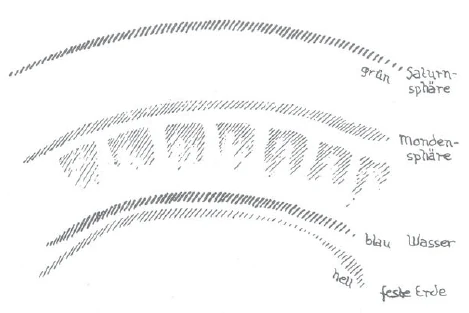
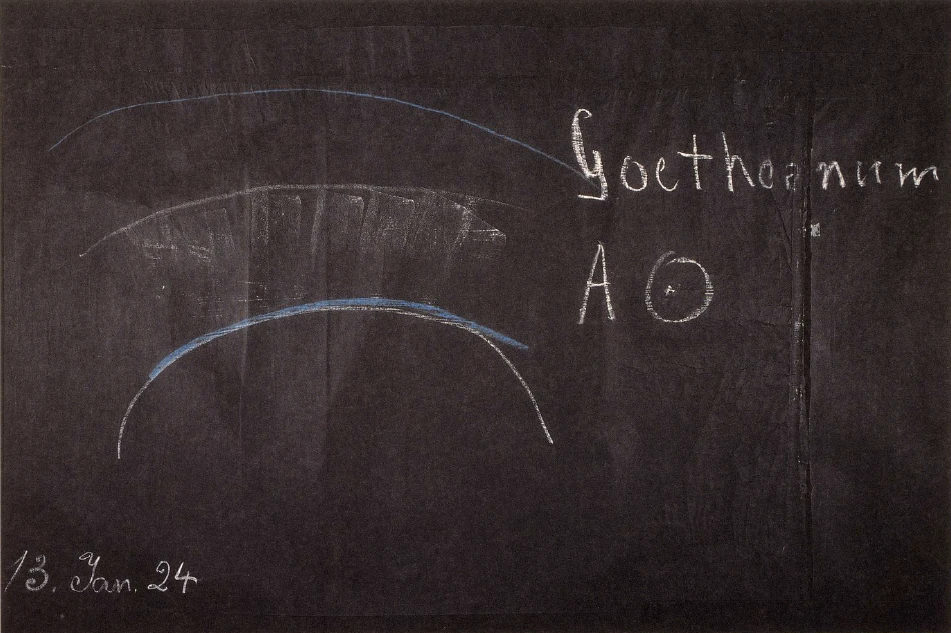
[ 11 ] Now, the following is the case. Let us recall that during the Proto-Persian epoch, human beings used the solid earth as a counterpoint from which to view the inscriptions in the astral light. That which is contained in the astral light in such a way that the solid Earth serves as a counterpoint continues to radiate (see diagram; bright). But it radiates only as far as the lunar sphere. It does not go any further. From there, it radiates back again, so that it remains, so to speak, near the Earth. One sees the mysteries reflected through the Earth. They remain because the lunar sphere exerts pressure. Let us move on to the Egyptian-Chaldean period: The water (blue) on the Earth reflects; what is reflected there extends as far as the Saturnian sphere. This sphere exerts pressure; as a result, it is possible for human beings to remain connected to the Earth with their visions.
[ 12 ] If we look at the Greco-Latin period—that is, up through the 12th and 13th centuries—visions in the astral light were carried through the air. This actually extends to the end of the world sphere, and then it reverses. It is the most fleeting, the most permeable, yet it is still the case that the human being remains united with his visions. The initiates of all these ages could say to themselves at any time: “What we have experienced as a vision through earth, water, and air—that is there; it exists.” —But when the most recent age arrived, only the element of the warmth-ether remained as the resisting force. But the element of the warmth-ether carries everything that is inscribed into it out into the vastness of the worlds, out of space and into the spiritual worlds. It is no longer there.
[ 13 ] And it is indeed true: If you see the most pedantic professor today who has ideas—he must have ideas, of course; that would always have to be examined on a case-by-case basis, because he very rarely has them—but if he has ideas, they are conveyed through the heat ether into the astral light. But the heat ether is something fleeting, something that flows away. Everything gets mixed up right away. Things flow out into the vastness of the universe.
[ 14 ] A figure such as Christian Rosenkreutz was aware of the fact that the initiates of ancient times lived in harmony with their visions, that they confirmed what they had seen by knowing: It is there; it is reflected somewhere in the heavens—be it in the lunar sphere, be it in the planetary sphere, be it at the very edge of the universe. It is reflected. — Yet now nothing was reflected. Nothing was reflected for direct, waking observation. People could now conceive of ideas about nature; the Copernican system of the world could emerge; all ideas could be conceived: they radiate out into the vastness of the universe through the warmth-ether.
[ 15 ] And so it came to pass that Christian Rosenkreutz, guided by the inspiration of a higher spirit, found a way to perceive the reflection, even though it was a reflection through the heat ether. This was achieved by drawing upon other dull, subconscious, sleep-like states of consciousness—states in which a person is normally out of their body. In these states, one could perceive that, while not in physical space, what is explored through modern abstract ideas about things is inscribed in the world—the spiritual world. And so it turned out, curiously enough, that the Rosicrucians, as if in a transitional stage, familiarized themselves with everything that could be researched about nature during that epoch. They absorbed this, processed it in the way that only a human being can. They had truly elevated to the level of wisdom what others had merely turned into science. Then they preserved it in their souls and sought, with the greatest possible purity, to drift off to sleep after deep meditation. And then it came to pass that the spiritual-divine worlds—not the end of the world, but the spiritual-divine worlds—returned to them what had been grasped in abstract ideas, in a spiritually concrete language.
[ 16 ] The Copernican system of the world was already being taught in Rosicrucian schools; but in certain states of consciousness, the ideas behind it emerged just as I have explained here in recent days. Thus, in fact, it was precisely the Rosicrucians who recognized that what is initially gained through modern knowledge must first, so to speak, be presented to the gods so that they may translate it into their language and convey it back to humanity.
[ 17 ] The fact that this is possible has remained true to the present day. For the fact is, my dear friends: If you are studying today—having been touched by the Rosicrucian principle of initiation referred to here—Haeckelism with all its materialism, study it, and allow yourselves to be permeated by what methods of knowledge are according to “How Does One Attain Knowledge of the Higher Worlds?”: What you learn in Haeckel’s *Anthropogeny* about human ancestors—in a way that you may find repulsive—learn it in this repulsive way; learn everything that can be learned through external natural science, and then offer it up to the gods, and you will receive what is described in my book *Esoteric Science* regarding evolution. That, you see, is the connection between the weak, feeble knowledge that human beings can acquire here with their physical bodies, and what the gods can give them—with the proper attitude and the proper preparation through what they have learned. But human beings must offer the gods what they can learn on Earth, for times have indeed changed.
[ 18 ] Yet another change has come about. Today, a person can strive as much as he wants: but he can no longer draw from within himself the way the ancient initiates did. The soul no longer gives forth in the same way as it did to the ancient initiates. Everything becomes impure; everything becomes permeated by instincts, as is evident in spiritualist mediums, and as is also evident in other pathological conditions. That which comes solely from within becomes impure, for the time for this drawing from within has passed. It had already passed by the 12th and 13th centuries, for what has happened can be expressed, roughly, in the following way:
[ 19 ] The initiates of the Proto-Persian epoch did, in fact, inscribe much into the astral light with the help of the Earth’s resistance. Thus, when the first initiate of the Proto-Persian epoch appeared, the entire astral light intended for human beings was, in effect, like a blank slate. As I said, I will speak later about the Proto-Indian epoch, but today I wish only to return to the Proto-Persian epoch. All of nature—all the elements, the solid, the liquid, the gaseous, and the thermal—was a blank slate. Now the initiates of the Proto-Persian epoch inscribed as much onto this slate as could be inscribed through the Earth’s resistance. First, the mysteries intended to be revealed to humanity by the gods were inscribed into the astral light. The tablet was inscribed to a certain extent, but remained blank to another extent. The initiates of the Egyptian-Chaldean epoch were able to come and continue writing in their own way, having attained their visions through the resistance of water. Another part of the tablet was inscribed.
[ 20 ] The Greek initiates arrived. They described the third part of the tablet. Now the tablet of nature is completely filled. It was completely filled by the 13th and 14th centuries. People began to write into the warmth ether. But it radiates outward. People wrote into the warmth ether for a time, well into the 19th century. They had no idea that this was also inscribed in the astral light. But now is the time when people must realize: They cannot discover the mysteries of the world from within themselves in the old sense, but rather by preparing their minds so that they can now read what is already fully inscribed on the tablet. To do this, one must prepare oneself today; one must become ready today—not to draw from within oneself as the ancient initiates did, but to be able to read in the astral light what is written there. Then it is precisely what one receives from the warmth ether that has an inspiring effect. And then what one receives from the warmth ether takes effect through the gods coming to meet one and bringing one, in reality, what one has worked out here on Earth; this, in turn, acts back upon what is written on the tablet through air, water, and earth.
[ 21 ] And so, in fact, natural science today is the foundation for seeing. Once we have come to know the characteristics of air, water, and earth through the natural sciences and have acquired the inner abilities, then—as we gaze into the airy, the watery, and the earthy—the astral light flows forth. But it does not flow forth like an indistinct mist; it flows forth in such a way that one can read within it the mysteries of the existence of the world and of human life. What, then, do we read?
[ 22 ] Today, as humanity, we are reading what we ourselves have written there. For what does it mean when it says that the ancient Greeks, the ancient Egyptians and Chaldeans, and the ancient Persians inscribed it? It means that we ourselves wrote it there during our earlier earthly lives.
[ 23 ] You see, just as our memory—our inner memory of the ordinary things we experience in earthly life—preserves us, so too does the astral light, with what we have inscribed into it, spread out around us, representing a written tablet in relation to the mysteries we ourselves have inscribed into it. This is also what we must read if we wish to return to these mysteries. It is a kind of evolutionary memory that must emerge within humanity. And a gradual awareness must arise that such an evolutionary memory exists—that, in fact, humanity today must read in the astral light about its earlier cultural epochs just as we, in later life, read about our youth through our ordinary memory. Because this is to come into people’s consciousness, I deliberately structured the lectures I gave here during the Christmas season in such a way that you could see: It is truly a matter of drawing out of the astral light the mysteries we need today. — Thus, the old initiation focused essentially on the subjective. The new initiation focuses on the objective.
[ 24 ] That is the great difference. For the subjective realm consists of everything inscribed into the outer world that the gods have instilled within human beings. What they instilled into his sensory body emerged during the Proto-Persian epoch. What they have instilled in the soul of sensation emerged during the Egyptian-Chaldean period. What they have instilled in the soul of feeling or intellect emerged during the Greek epoch. But the soul of consciousness, which we are now to develop, is independent; it no longer projects anything outward from itself. Yet it stands in contrast to what already exists. As human beings, we must rediscover our humanity in the astral light. This is the distinctive feature of Rosicrucianism: that during a transitional period, Rosicrucianism had to remain in a state of entering certain dreamlike states and, in a sense, dreaming the higher truth of what science soberly discovers here in nature. But this has been the distinctive feature since the beginning of the Michael Epoch—since the end of the 1870s in the last third of the 19th century—that the very same thing which had been attained during the old Rosicrucian era in the manner described can now be attained consciously. So that today we can say: We no longer need that other, semi-conscious state, but we do need a higher, conscious state. And then—then, with the knowledge of nature that one acquires, one can plunge into the higher world, and what one has acquired as knowledge of nature emerges toward one from the higher world; as one re-reads what is inscribed in the astral light, it emerges toward one in spiritual reality. And what one does there—carrying out into a spiritual world the knowledge of nature gained here, or the creations of naturalistic art, or even the feelings of a religion that works naturalistically within the soul—for, after all, religion, too, has essentially become naturalistic—by carrying all of this upward, one does indeed encounter Michael, provided one develops the abilities to do so. And so one can say: Rosicrucianism is characterized by the fact that its most enlightened spirits had a strong longing to encounter Michael. They could do so only as if in a dream. Since the end of the last third of the 19th century, people have been able to consciously encounter the spirit of Michael.
[ 25 ] But Michael is, after all, a peculiar being. Michael is a being who actually reveals nothing unless one offers him something in return through diligent spiritual work from Earth. Michael is a silent spirit. Michael is a spirit who keeps to himself. While the other ruling archangels are talkative spirits—in the spiritual sense, of course—Michael is a thoroughly reserved spirit, a spirit who speaks little and gives only sparse directives at most. For what one learns from Michael is not actually the word, but—if I may put it this way—the gaze, the power of the gaze. And this is because Michael is actually most concerned with what human beings create from the spiritual realm. He lives in the consequences of what human beings have created. The other spirits are more concerned with the causes; Michael is more concerned with the consequences. The other spirits inspire in human beings what they are meant to do. Michael will be the true spiritual hero of freedom. He allows human beings to act, but then takes up what results from their actions to carry it further into the cosmos, so that what human beings cannot yet bring about through their actions may continue to unfold in the cosmos.
[ 26 ] One has the feeling, with regard to other beings in the hierarchy of the Archangels, that the impulses to do this or that come from them; to a greater or lesser degree, the impulses come from them. But Michael is the Spirit from whom no impulses come at first, because his true, representative period of rule is the one that is now coming, when things arise from human freedom. But when a human being, out of his or her own freedom and inspired by reading the astral light, consciously or unconsciously does this or that, Michael carries what is a human deed on Earth out into the cosmos so that it becomes a cosmic deed. He concerns himself with the consequences; other spirits are more concerned with the causes.
[ 27 ] But Michael is not merely a reserved, taciturn spirit; when Michael approaches human beings, he does so with a clear rejection of much of what characterizes human life as it is lived on Earth today. For example, all the insights that arise in human, animal, or plant life and are based on inherited characteristics—on that which is passed down in physical nature—give the impression that Michael rejects them outright. He wishes to show that such insights cannot bear fruit for human beings in the spiritual world. Only what human beings find independently of what is purely inherited in humanity, in the animal kingdom, and in the plant kingdom can be carried up before Michael. And there one does not receive that telling, dismissive gesture of the hand, but rather the approving glance that tells one: This is rightly conceived in the light of the cosmos’s guidance. — For this is what one learns to strive for more and more: to contemplate, as it were, in order to break through to the astral light, to behold the mysteries of existence, and then to step before Michael and receive the approving glance that tells one: “This is right; this is just in the eyes of the cosmos.”
[ 28 ] And so it is with Michael that he has a strict rejection of everything that, for example, divides human languages. As long as one merely wraps one’s insights in language, rather than elevating them into thought, one does not come close to Michael. That is why, even today, a profound struggle is essentially taking place in the spiritual world. For on the one hand, the Michael impulse has indeed entered human evolution: it is there; but on the other hand, there is much within human evolution that simply does not want to receive this Michael impulse, that wants to reject it. And among the forces that seek to reject this Michael impulse are, for example, nationalistic sentiments today. They flared up in the 19th century and grew ever stronger in the 20th century. In recent times, much has been—one cannot say “ordered,” but rather “disordered”—according to the principle of nationality. It has truly become disordered. All of this runs counter to the Michael principle in the most terrible sense. All of this contains Ahrimanic forces that strive against the influence and the impetus of the Michael forces entering human life on Earth. And so today we witness this struggle waged by Ahrimanic spirits storming down from above, who wish to carry upward what arises from the inherited impulses of nationality—and which Michael strictly rejects and repels.
[ 29 ] Indeed, the most intense spiritual struggle today is taking place in this direction, because a great portion of humanity has fallen into the trap of thinking not in thoughts, but in words. But thinking in words is not the path to Michael. One reaches Michael only by going beyond the words to true inner spiritual experiences—not by clinging to the words, but by attaining true inner spiritual experiences. This is, in fact, the secret of modern initiation: to go beyond words to the experience of the spiritual. This is not something that conflicts with the appreciation of the beauty of language. For it is precisely when one no longer thinks in language that one begins to feel language and to have it flow within oneself and from oneself as an element of feeling. But this is something that people today must first strive to achieve.
[ 30 ] Perhaps language cannot be attained by people at first, but only through writing. For even with regard to writing, it is the case that people do not possess writing, but rather writing possesses people. What does it mean that writing possesses people? It means that one has a certain style of handwriting in one’s wrist and hand. One writes mechanically, as if by instinct. This binds a person. A person becomes unbound when they write the way they paint or draw, when each letter, side by side with the next, becomes something they are drawing:
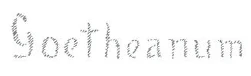
[ 31 ] where what is usually called a handwriting does not exist, but rather where the form of the letter is drawn—that is, where one relates to the letter objectively, so that the essential aspect is the act of looking.
[ 32 ] This was the reason why — as paradoxical as it may seem today — in certain Rosicrucian schools, learning to write was prohibited until the age of fourteen or fifteen, so that this form, this mechanism that manifests itself in writing, did not enter the human organism; rather, only once the power of perception had been developed did the individual begin to engage with the form of letters; and then, as soon as they learned the conventional letters needed for human interaction, they were also to learn others—the specific Rosicrucian letters—which are regarded as a secret script, about which it is said, “This is a secret script.” It was not intended as a secret script; rather, the intention was that, for an “A,” one should simultaneously learn another symbol: O, so that one would not become fixated on a single symbol, but would detach oneself from the symbols, and, in a sense, the “A” as a sound would become something higher than this “A” and this “O” symbol, whereas otherwise the letter “A” is identified with what, as an “A,” floating and weaving as a sound, eludes us.

[ 33 ] And with the Rosicrucian movement, much of this also found its way into the hearts of the people. For it was a fundamental principle of the Rosicrucian movement that members of the small circles in which people were united would go out into the world—as I have already said—mostly practicing medicine, but while they were doctors, they spread their insights far and wide wherever they went. It was the case, however, that along with this knowledge, certain attitudes also spread—attitudes that one encounters everywhere where traces of the Rosicrucian movement can be found. These attitudes sometimes take on grotesque forms. But in fact, one of these attitudes was expressed in the view that this entire modern way of approaching writing and printing was regarded as a black art. For in fact, nothing hinders one more from reading in the astral light than ordinary writing. This artificial fixation—it really does hinder one greatly from reading in the astral light. One must always first overcome this writing if one wishes to read in the astral light.
[ 34 ] And this brings together two things, one of which I mentioned some time ago: that the whole person, with inner activity, should be involved in the process of producing spiritual insights. I confessed to you that I have many notebooks in which I write down or record whatever comes to me. I usually don’t look at them again afterward. But by engaging not just the head but the whole person, this is how these insights—which truly move people—emerge. The person who does this gradually gets used to not placing much value on what they physically see in the written record, but rather to remain in the act itself, so as not to spoil their ability to see in the astral light. But also simply by exercising restraint and, when writing in ordinary script, not clinging to the written form itself, but either drawing according to one’s preference for the letters—for then it is like painting, and thus an art—or by not reflecting on what one is writing down. Only in this way does one acquire the ability not to spoil the impressions of the astral light.
[ 35 ] So if one is compelled to approach writing in the way that is common today, one hinders one’s own spiritual progress. That is why our Waldorf school pedagogy places such great emphasis on ensuring that people do not progress as far in writing as is the case today in conventional pedagogy, so that the human being can truly remain within the spiritual realm. For that is necessary.
[ 36 ] The world must once again be able to incorporate the principle of initiation as such among the principles of civilization. For only in this way can a human being here on earth accumulate something in his soul with which he can present himself before Michael, so that Michael’s approving gaze falls upon him: “This is in harmony with the world.” — This strengthens the will and integrates the human being into the spiritual progress of the world. Through this, the human being becomes a co-worker in that which, beginning now in the Michael Epoch, is to be woven into the development of humanity and the Earth.
[ 37 ] There are, therefore, many, many things to take into account if one wishes to cross over in the right way that abyss I spoke of yesterday—an abyss that, in essence, is guarded by a guardian. How this abyss opened up in the 1840s, and how—under the influence of insights such as those I have outlined again today—a person, looking back at this abyss, can relate to this guardian: these are the topics the next lectures will address.