

Mystery Sites of the Middle Ages
Rosicrucianism and the Modern Principle of Initiation
GA 233a
12 January 1924, Dornach
Translated by Steiner Online Library
Fifth Lecture
[ 1 ] We have seen, after all, how the ancient knowledge acquired by humanity through instinctive clairvoyance gradually developed as twilight set in. It is extremely difficult in more recent times, particularly since the 18th century, to find any traces of that ancient knowledge at all, for it was indeed as I have told you: what has been preserved—or rather, what has emerged anew—is the observation of external nature, logic, and abstract chains of thought. — Neither through external observation of nature, sensory observation, nor through mere abstract logical reasoning can one bridge the gap from the human being to true reality. Yet, in a certain traditional sense, much of that ancient knowledge has been preserved right up to the most recent times—one might say, up to around the middle of the 19th century. And so that we may now, in the reflections that will be important and that lie ahead of us, relate to our souls in the right way, I would like to say a few more things today about certain ideas that were still present, even in the first half of the 19th century, as remnants of ancient knowledge.
[ 2 ] I am telling you these things today so that you can see how, in a time not so long ago, people’s way of thinking was quite different from what it is today. But as I said, it is actually difficult to come across these things, for it is just as I have told you: Individual people living in isolation, at most with a small circle of students, have survived here and there and have truly carried on much of the ancient knowledge in complete secrecy, without even understanding its deepest reasons themselves. One must, after all, assume such things for earlier times as well, for it is quite certain that both the figure known to you as Faust and the other known to you as Paracelsus—that these two figures, on their wanderings, came across such solitary, one might say, spiritual cave dwellers and learned much from them, which they then further developed through an inner ability that was particularly instinctive in these very individuals.
[ 3 ] But what I am about to tell you now still existed in the first decades of the 19th century, once again in such a secluded—one could call it a school, if one wished—in such a secluded school in Central Europe. There, within a very small circle, there was a very profound teaching about human beings. It has long since become clear to me through spiritual means that such a small, knowledgeable community existed in a certain place in Central Europe. As I said, I came to know this through spiritual means. I was, of course, unable to make observations in the physical world at that time, since I was not in the physical world then, but through spiritual means I have come to realize that such a small community existed. However, I would not speak about what was taught within this small community if, in retrospect, my own research in spiritual science had not revealed to me once again the very essence of what was preserved there—if I had not, so to speak, rediscovered these things myself. For it is precisely through such a rediscovery that one first gains the proper perspective on that which has truly been preserved from ancient times as an overwhelmingly great wisdom. And the small community of which I wish to speak actually extends forward through history, throughout the entire Middle Ages and back into antiquity, all the way to the times I described to you during the Christmas holidays, all the way back to the time of Aristotle—a tradition that, however, did not come directly via Greece, but entered through Asia via what was brought from Macedonia to Asia by Alexander.
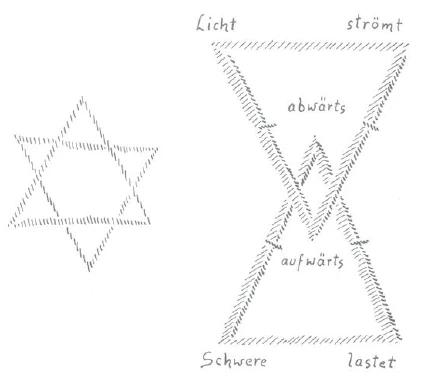
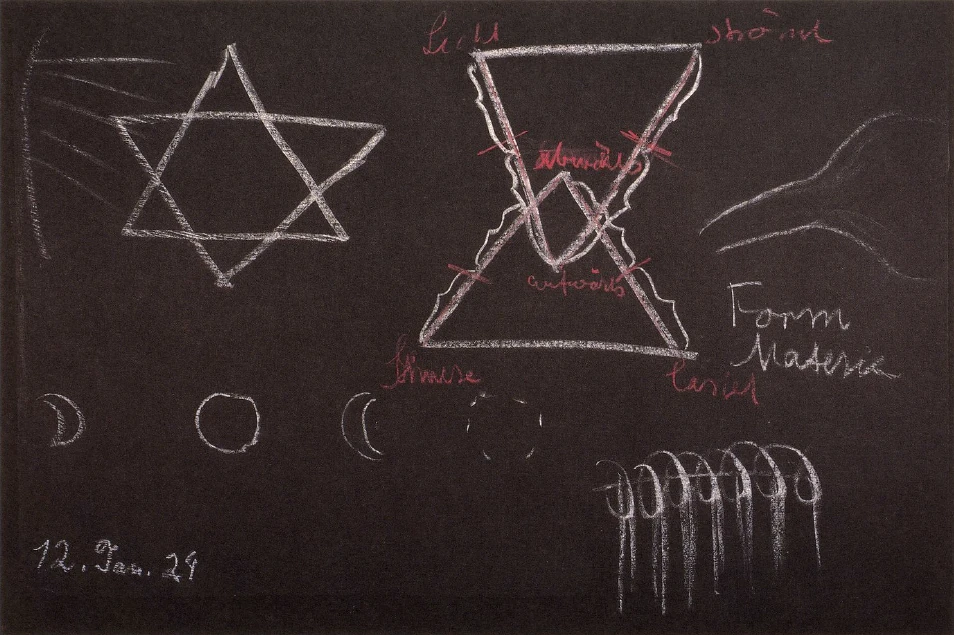
[ 4 ] It is precisely within this small community that one finds a profound teaching about human beings—specifically regarding two human faculties—that is still preserved with great precision. One can hear how a truly masterfully educated—one might even say, a scholar of the occult—instructs his students that with the ancient symbols, those symbols preserved from time-honored mysteries, which consist of certain geometric forms—let us take, for example, a form such as this (see drawing on page 71, left) —at the ends of which there are usually some Hebrew words—that one cannot make any immediate use of these symbols. And through their instruction, this master’s students knew that what Eliphas Levi, for example, presents is really just a kind of beating around the bush. For these students were able to learn that one can only arrive at the true meaning of such symbols when one rediscovers them in the very essence of one’s own human constitution.
[ 5 ] And so it was, in particular, a symbol that played a major role in this community. You obtain this symbol when you pull apart this Solomonic Key—as it is usually demonstrated—when you arrange and shift it so that this part moves down and that part is pushed up (illustration, page 71, right). It was precisely this symbol that, as I said, continued to play a significant role within that small community even into the 19th century. And that Master then had the members of his small circle of students assume a specific physical posture. He had them assume a posture through which, so to speak, the body itself inscribed this symbol. He had them stand in such a way that they spread their legs slightly apart and positioned their arms upward in this manner. As a result, when one extended the arms downward and the legs upward, these very four lines (thick lines) became visible on the human organism itself. This line then connects the feet, and this one connects the hands above. The other two became conscious as actual lines of force—as if light were streaming—as the student realized: currents, like electromagnetic currents, then flow from the left fingertip to the right fingertip and again from the left foot to the right foot. So that, in fact, the human organism itself inscribed these intertwined triangles into space. And then the task was for the student to learn to sense what lies in the words: “Light flows upward; heaviness weighs downward.” The students then had to experience this in deep meditation, in the posture I have just described. Through this, they gradually reached the point where the teacher could say to them: “Now you will experience something that was in fact practiced time and again in the ancient mysteries.” — And they truly experienced this: they felt the marrow in their arm and leg bones, they felt the bone marrow, they felt the innermost part of the bone.
[ 6 ] You see, these things can be understood by establishing a connection between something I told you yesterday and what I am telling you now. I told you in a certain context that when a person behaves solely in the way that has become customary over time—when they think merely in abstract terms—this remains external; they, so to speak, alienate themselves. The exact opposite occurs when a consciousness of the inner nature of the bone arises in this way.
[ 7 ] But there is something else that can help you understand this matter. You see, as paradoxical as it may sound to you, I must say that a book such as my *Philosophy of Freedom* cannot be grasped through logic alone, but must be understood by the whole person. And in fact, what is said in my *Philosophy of Freedom* about thinking cannot be understood unless one knows that human beings actually experience thinking through inner perception, through the inner sensing of their skeletal structure. One does not think with the brain; in reality, one thinks with one’s skeletal structure when thinking in sharp lines of thought. When thinking becomes concrete, as is the case in *The Philosophy of Freedom*, it then extends to the whole human being.
[ 8 ] But this master’s students went even further than that, and they learned to sense the inner essence of the bones. And with that, they had experienced one final example of what was common practice in the ancient mystery schools: experiencing symbols by making one’s own organism into those symbols, for only in this way can one truly experience symbols. Interpreting symbols is actually nonsensical. All speculation about symbols is nonsensical. The proper way to approach symbols is to create and experience them—just as one should not merely take fables, legends, and fairy tales in the abstract, but should identify with them. There is always something within a person that allows one to enter into all the characters of a fairy tale, to become one with the fairy tale. And so it is with these real symbols of ancient times, which stem from spiritual insight. And I have written down such words for you here in German (see page 71).
[ 9 ] Of course, in modern times it is more or less just nonsense to write down the Hebrew words—which are no longer fully understood—for this purpose, because it does not actually enliven a person from within; they do not experience the symbols, but rather are thrown off balance. It is something like having one’s bones broken. And that is actually what happens to a person—spiritually, of course—when one reads writings such as those of Eliphas Levi with seriousness.
[ 10 ] So these students learned to experience the inside of the bone. But once you begin to experience the inside of the bone, you are no longer within the human being. Just as when you hold your index finger forty centimeters in front of your nose and there is an object there—just as that object is not within you—so too is that which you then experience within your bones not within you. You go inward, but out of yourself. You truly go out of yourself. And this stepping out of oneself, going to the gods, entering the spiritual world—that is what the students of this lonely little school came to understand through this process. For through this they came to know the lines that had been drawn into the world from the side of the gods in order to constitute the world. They found, on the one hand, through the human being, the path to the gods.
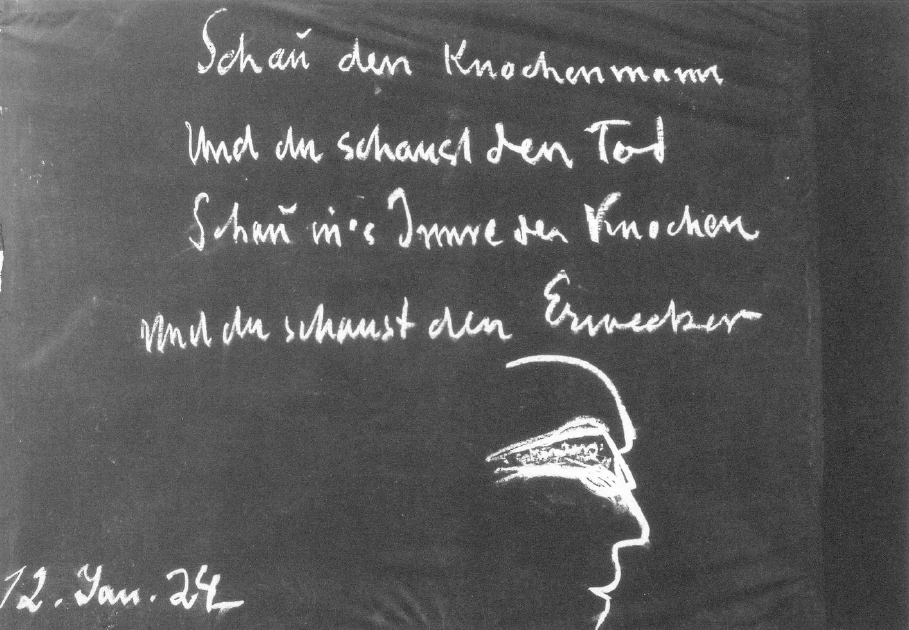
[ 11 ] And then the teacher summed up what the students were experiencing in a paradoxical sentence—a sentence that, of course, will seem ridiculous to many people today, but which, as you will recognize from what has been hinted at, contains a profound truth:
Look at the Bone Man
And you see Death
Look inside the bones
And you see the Awakener
[ 12 ] — the awakener of the human spirit, the being that connects humans to the world of the gods.
[ 13 ] Admittedly, not an extraordinary amount could be achieved in this way at that time, but still, some progress was made. And some of the teachings about the Earth’s evolution through various metamorphoses did indeed sink in with the students. Precisely because they were able to put themselves in the place of this spiritual being that is the human being, they learned to look far back into Atlantean times and even further back. And in fact, much of what was not actually written or printed at that time—but what people told one another about the Earth’s evolution—stemmed from such insights that arose in this way. That was one of the teachings imparted at this school.
[ 14 ] Another is just as interesting. Another was provided by practically demonstrating the superiority of humans over animals. One might say: What is widely used today for all sorts of purposes—purposes that are even highly valued—was, well into the 19th century, known precisely to those people who drew on sound, time-honored traditions of insight. — People today are, after all, proud to have police dogs that can track down all manner of wrongdoing in human life. This practical application did not exist in earlier times. But people’s understanding of dogs’ abilities in this regard, for example, was even greater than it is today, and they recognized that a finer substance exists around human beings than that which can be seen or smelled by humans and the like; they understood that something like a fine fluid also belongs to the world. It was recognized as a specific differentiation of heat currents, connected with all manner of currents that were regarded as electromagnetic currents, and the dog’s sense of smell was linked to these heat-electromagnetic currents; and the students of precisely that small school I am telling you about were made aware of such things in other animals as well. They were made aware of how this sense for a subtle fluid permeating the world is widely present throughout the animal kingdom. And then it was pointed out how that which in animals develops downward into the grossly material develops upward in human beings into the soul.
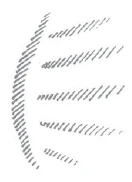
[ 15 ] You see, one thing that was taught in this little school is of immense interest. It was taught through external anatomical facts, but there was a profound spiritual meaning behind it. The students were told: Look, the human being is a microcosm. In his organization, he imitates what takes place in the structure of the universe. — The human being was regarded as a microcosm, as a small world, not only in terms of the substances he carries within himself, but also in terms of the processes that unfold within him. Indeed, many of the forms present within him were traced back to processes in the outer world. And so great attention was paid to how the moon passes through the first quarter, becomes full, reaches the last quarter, and becomes a new moon—how the moon undergoes twenty-eight to thirty phases in this way. This passage of the moon through its phases was observed in the cosmos. One observed the moon in motion along its orbit. People observed how it traced its vertebrae as it moved—its twenty-eight to thirty vertebrae—and then they understood how the human being has these twenty-eight to thirty vertebrae in the spine, and they understood how the movements of the Moon and its forces are connected to what develops embryonically in the human being as the spine. One could see the reflection of the moon’s monthly movement in the structure of the human spine. And when one looked at the human spine with its nerves (see drawing, above)—twenty-eight to thirty nerves extending throughout the entire organism—one saw in these twenty-eight to thirty nerves the reflections of the currents that the Moon constantly sends down to Earth at the various stages of its orbit. One could literally see the influence of the lunar currents in the bony extensions of the vertebrae. In short, in what the human being carries within—in the spinal nerves together with the spinal cord—one saw something that bound one to the cosmos, something that brought one into a living connection with the cosmos. And this whole concept, which I have just outlined for you, was taught to the student.
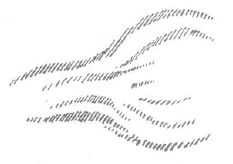
[ 16 ] And then his attention was drawn to something else. He was told: “Look, when you examine the optic nerve as it extends from the brain into the eye, you’ll see that it branches into very fine fibers at the point where it enters the eye.” How many such fibers are there? There are just as many of these fibers—which run from the optic nerve into the interior of the eye—as there are nerves emanating from the spinal cord: twenty-eight to thirty. Thus, a small spinal cord structure extends from the brain through the optic nerve into the eye (see diagram below). The fact is—as the teacher told the students—that human beings have received this threefold structure of the spinal-nervous system from the gods who shaped their existence in ancient times. But they themselves have created an image of it in their eye, which perceives the sensory world; they have created an image, there in the front of the head organism, of what the gods have made of them.
[ 17 ] And then the student’s attention was drawn to the fact that the spinal cord is related to the Moon in this way. But in turn, because of this special relationship between the Moon and the Sun, the year has twelve months, and twelve nerves extend from the human brain to the various parts of the organism—the twelve main cranial nerves. In this respect, through the organization of the head, the human being is a microcosm in relation to the relationship between the Sun and the Moon. The human form expresses an imitation of the processes taking place out there in the cosmos.
[ 18 ] And once again, the student’s attention was drawn to the fact that in his head, in the optic nerve—that is, through the thirty-part structure of the optic nerve leading into the eye—he mimics the lunar organization of the spine. Twelve nerves extend from the brain. But again, if one examines that particular part of the brain which sends the olfactory nerve into the nose, it becomes apparent that the entire large brain is imitated within that small part of the brain. Just as the spinal cord’s nervous system is mirrored in the eye, so too is the entire brain mirrored in the olfactory organ, in that the olfactory nerve extends to the nose in twelve parts, in twelve strands. Thus, when the spinal cord and head are positioned here (see drawing on p. 78), the human being has a veritable miniature human being situated right there in front. And then the students’ attention was drawn to the fact that this little human is, anatomically speaking, only hinted at. The structures are fused together; only a meticulous anatomical examination can reveal this. These structures are fused together, yet they exist in this way. However, they develop in a very distinct manner within the astral body. And because they are otherwise only hinted at, a person cannot make use of them in ordinary life. But they can learn to do so. — And just as the student was instructed to experience the inner workings of their bones, they were also instructed to experience this particular region vividly.
[ 19 ] You see, something else comes into play here—something that is actually much more akin to the entire Western way of seeing than what is often adopted from the East. The East, too, has this focusing on the bridge of the nose, this focusing on the point between the eyebrows. This indicates the location. But in truth, it is this focusing on that little human being who lies within and who is perceived astral-ly. And when he is perceived astral, when a meditation is actually structured in such a way that one perceives something in that area that has been designated, it is as if one were trying to form a small human being inwardly, as if in an embryonic state, in that area. The student received this instruction in that little school—in fact, a kind of embryonic formation of a small human being within a highly concentrated thought.
[ 20 ] As a result, the students who had the ability to do so developed the two-petaled lotus flower. Then they were told: The animal forms things down to the level of what is a thermal-electromagnetic fluid. Human beings form that which resides here and which, in a gross sense, appears only as the sense of smell; but the ability to perceive the activity of the eye plays into this, and human beings develop it into the astral realm. Through this, however, he gains the ability not only to track that fluid but also to bring about a continuous interaction with the astral light and to perceive, with the two-petaled lotus flower, what the human being continually inscribes into the astral light throughout his entire life. The dog smells only what has remained, what is there. Human beings proceed differently by moving with their two-petaled lotus flower; even when they cannot perceive with it, they continually inscribe everything that is in their thoughts into the astral light. Seeing then enables him only to track and perceive what he writes into it, and also to perceive other things through it—namely, the true difference between good and evil.
[ 21 ] In this way, echoes of ancient treasures of wisdom were indeed still present, and in rudimentary form, they were even still being taught in practice. And this shows us just how much has actually been lost under the influence of materialistic currents, which began to take hold most strongly around the middle of the 19th century. For such things, as I have indicated to you, were indeed felt and known—at least to a certain degree—in certain circles, albeit very isolated and reclusive ones. And in the most diverse fields, insights emerged from such underlying sources—insights that were later completely disregarded, yet which many people today long for once again. But because of the crude methods that prevail today, these insights are, for the time being, not accessible to external knowledge.
[ 22 ] Now, a very specific teaching grew out of what the teacher had conveyed to the students in this way within that small circle. It was made clear to the student: When he uses this organ—which is an olfactory organ elevated into the astral light—he learns to recognize the true material nature of all things, the true matter. And when they learn to perceive the inner workings of their skeletal system—and through this, to truly grasp the real geometry of the world, the way in which the gods inscribe their forces into the world—they learn to recognize what acts as form within things.
[ 23 ] “If you wish to understand a piece of quartz in terms of its substance,” the teacher told the student, “then contemplate it through the lens of the two-petaled lotus flower.” If you want to understand what its crystalline form is like, how the substance is shaped, then you must grasp this form from the cosmos using what you can comprehend when you enter the innermost depths of your skeletal system in a living way. Or it was made clear to the student: When you use your head organ, you learn to recognize the substantial nature of a plant. When you learn to experience the inner workings of your skeletal system, you learn to recognize how a particular plant grows, why it has this or that leaf shape, this or that arrangement of leaves, and why it unfolds its flowers in this or that way.
[ 24 ] So everything that is form should be understood in one way, and everything that is matter should be understood in another. And it is truly interesting that, if one goes back to Aristotle, one finds that he distinguishes—though this was taught in later times only in a purely abstract manner—between form and matter in relation to everything that exists, But this was taught in a completely abstract way within the intellectual current that flowed from Greece to Europe, so that one actually despaired at the abstractness with which these things were presented in books throughout the entire Middle Ages; and in modern times, it is no longer merely a matter of despair—it is enough to drive one up the walls to see how these things are presented. But if one goes back to Aristotle, one finds that for him the forms do indeed trace back to this experience—only that this, in turn, was carried over to Asia—and this truly inner insight into things, which sees with the organ of the mind what he calls the matter in things.
[ 25 ] But now, the inner understanding of what was taught in Greece as philosophy—the insight derived from the Akashic Records—points us to something that I could, of course, only hint at very superficially in my *Riddles of Philosophy*, where I showed how Aristotle is quite firmly of the opinion that: In human beings, form and matter flow into one another; matter is form, form is matter. — You can find this in my exposition of Aristotle in *The Riddles of Philosophy*.
[ 26 ] But Aristotle taught something quite different. Aristotle taught: When one approaches minerals, one first experiences form through the sensation within the lower leg bones, and one experiences matter through the head organ. The two are far apart. Human beings keep them separate—form and matter—in the mineral kingdom through crystallization. But when a person perceives a plant, they experience the form through the inner sensation of their thighs, and the matter, in turn, through the head organ—through the two-petaled lotus flower. It is already getting closer. And when a person experiences an animal, they experience the form through the inner experience of the forearm bones, and the matter, in turn, through the head organ—very close to one another. And when a person experiences another human being, they experience the form through the inner experience of the upper arm, which is connected to the brain itself via the indirect path of speech formation. I have often spoken of this, particularly in introductions to eurythmy. There, the two-petaled lotus flower unites with what flows from the interior of the upper arm to the brain. And especially in speech, a person no longer experiences another human being as separate in form and content, but as a unity of form and content.
[ 27 ] You see, in this concrete sense, this teaching still existed in Aristotle’s time. And, as I said, traces of it remained into the 19th century. There really is a chasm there. In the 1840s, these things were essentially lost. This chasm remained until the end of the 19th century, when, through the Michael era, these things could be rediscovered. But as people crossed this chasm, they were in fact crossing a threshold. And at this threshold stands a guardian. And humanity was initially unable to observe him as it passed him by between the years 1842 and 1879. But for its own salvation, it must now look back and take notice of the guardian. For failing to take notice of him and continuing to live into the following centuries without heeding him would lead to the very greatest calamity for humanity.
[ 28 ] Let's talk more about that tomorrow.