

Mystery Sites of the Middle Ages
Rosicrucianism and the Modern Principle of Initiation
GA 233a
12 January 1924, Dornach
Translate the original German text into any language:
Versions Available:
Mystery Sites of the Middle Ages, tr. SOL
Fünfter Vortrag
Fifth Lecture
[ 1 ] Wir haben ja gesehen, wie allmählich in eine Abenddämmerung hinein das alte, von der Menschheit durch instinktives Hellsehen erlangte Wissen sich entwickelt hat. Es ist außerordentlich schwierig in der neueren Zeit, namentlich nach dem 18. Jahrhundert, noch Spuren jenes alten Wissens irgendwie zu finden, denn es war ja wirklich so, wie ich Ihnen gesagt habe: Dasjenige, was sich erhalten hat oder eigentlich was neu heraufgekommen ist, das ist äußere Naturbeobachtung und Logik, abstrakte Gedankenfolge. — Weder mit äußerer Naturbeobachtung, Sinnesbeobachtung, noch mit der bloßen abstrakten logischen Gedankenfolge kann man die Brücke hinüberschlagen vom Menschen zu der wahren Wirklichkeit. Aber in einem gewissen Sinne traditionell hat sich doch bis in die neuesten Zeiten herein, man kann sagen, bis um die Mitte des 19. Jahrhunderts manches von dem alten Wissen erhalten. Und damit wir jetzt in den Betrachtungen, die wichtig sein werden und die uns bevorstehen, in der richtigen Weise uns mit unserer Seele werden verhalten können, möchte ich doch heute noch einiges sprechen von gewissen Vorstellungen, die sogar noch in der ersten Hälfte des 19. Jahrhunderts wie Überreste von altem Wissen vorhanden waren.
[ 1 ] We have seen, after all, how the ancient knowledge acquired by humanity through instinctive clairvoyance gradually developed as twilight set in. It is extremely difficult in more recent times, particularly since the 18th century, to find any traces of that ancient knowledge at all, for it was indeed as I have told you: what has been preserved—or rather, what has emerged anew—is the observation of external nature, logic, and abstract chains of thought. — Neither through external observation of nature, sensory observation, nor through mere abstract logical reasoning can one bridge the gap from the human being to true reality. Yet, in a certain traditional sense, much of that ancient knowledge has been preserved right up to the most recent times—one might say, up to around the middle of the 19th century. And so that we may now, in the reflections that will be important and that lie ahead of us, relate to our souls in the right way, I would like to say a few more things today about certain ideas that were still present, even in the first half of the 19th century, as remnants of ancient knowledge.
[ 2 ] Ich erzähle Ihnen diese Dinge heute aus dem Grunde, damit Sie sehen, wie in einer noch gar nicht so weit zurückliegenden Zeit die Denkungsart der Menschen doch ganz anders war, als sie heute ist. Aber wie gesagt, es ist eigentlich schwierig, auf diese Dinge zu kommen, denn es ist schon so, wie ich Ihnen gesagt habe: Einzelne einsam lebende Menschen, höchstens mit einem kleinen Schülerkreise, haben sich da oder dort erhalten und haben wirklich ganz im Geheimen manches von dem alten Wissen fortgesetzt, ohne daß sie selbst die ganz tiefen Gründe davon verstanden haben. Man muß ja auch für ältere Zeiten so etwas voraussetzen, denn es ist ganz gewiß, daß sowohl diejenige Persönlichkeit, die Ihnen bekannt ist unter dem Namen des Faust, wie auch die andere, die Ihnen bekannt ist unter dem Namen des Paracelsus, daß diese beiden Persönlichkeiten auf ihren Wanderungen an solche einsamen, man möchte sagen, seelische Höhlenbewohner gestoßen sind und von ihnen manches erfahren haben, was sie dann durch eine innere Fähigkeit, die auch gerade bei diesen Persönlichkeiten mehr instinktiv war, weiter ausgebildet haben.
[ 2 ] I am telling you these things today so that you can see how, in a time not so long ago, people’s way of thinking was quite different from what it is today. But as I said, it is actually difficult to come across these things, for it is just as I have told you: Individual people living in isolation, at most with a small circle of students, have survived here and there and have truly carried on much of the ancient knowledge in complete secrecy, without even understanding its deepest reasons themselves. One must, after all, assume such things for earlier times as well, for it is quite certain that both the figure known to you as Faust and the other known to you as Paracelsus—that these two figures, on their wanderings, came across such solitary, one might say, spiritual cave dwellers and learned much from them, which they then further developed through an inner ability that was particularly instinctive in these very individuals.
[ 3 ] Dasjenige aber, was ich Ihnen jetzt erzählen will, das war noch in den ersten Jahrzehnten des 19. Jahrhunderts vorhanden, wiederum in einer solch einsamen — man könnte es Schule nennen, wenn man es wollte —, in einer solch einsamen Schule Mitteleuropas. Da gab es in einem ganz kleinen Kreise eine sehr eindringliche Lehre von dem Menschen. Es ist seit langem auf einem geistigen Wege mir bewußt geworden, daß es in einem gewissen Orte Mitteleuropas eine solche kleine wissende Gemeinschaft gegeben hat. Wie gesagt, auf geistigem Wege ist es mir bekannt geworden. Ich konnte ja dazumal nicht in der physischen Welt Beobachtungen anstellen, da ich ja damals nicht in der physischen Welt war, aber auf geistigem Wege ist mir dies bewußt geworden, daß es eine solche kleine Gemeinschaft gegeben hat. Ich würde aber nicht sprechen über dasjenige, was innerhalb dieser kleinen Gemeinschaft gelehrt worden ist, wenn sich mir nun nicht nachträglich durch die eigene Forschung der Geisteswissenschaft gerade Wesentlichstes von dem, was da geborgen war, wiederum enthüllt hätte, wenn ich nicht sozusagen selber die Dinge wieder gefunden hätte. Denn gerade durch solches Wiederfinden bekommt man ja erst die richtige Stellung zu demjenigen, was sich aus alten Zeiten wirklich wie eine überwältigend große Weisheit erhalten hat. Und von der kleinen Gemeinschaft, von der ich sprechen möchte, zieht sich eigentlich dann nach vorne in der Geschichte durch das ganze Mittelalter hindurch bis in das Altertum hinein, bis in die Zeiten, die ich Ihnen geschildert habe während der Weihnachtstage, bis in die Zeiten des Aristoteles hinein eine Tradition, eine Tradition, die aber allerdings nicht direkt über Griechenland gekommen ist, sondern über Asien herein durch dasjenige, was von Makedonien aus durch Alexander nach Asien gebracht worden ist.
[ 3 ] But what I am about to tell you now still existed in the first decades of the 19th century, once again in such a secluded—one could call it a school, if one wished—in such a secluded school in Central Europe. There, within a very small circle, there was a very profound teaching about human beings. It has long since become clear to me through spiritual means that such a small, knowledgeable community existed in a certain place in Central Europe. As I said, I came to know this through spiritual means. I was, of course, unable to make observations in the physical world at that time, since I was not in the physical world then, but through spiritual means I have come to realize that such a small community existed. However, I would not speak about what was taught within this small community if, in retrospect, my own research in spiritual science had not revealed to me once again the very essence of what was preserved there—if I had not, so to speak, rediscovered these things myself. For it is precisely through such a rediscovery that one first gains the proper perspective on that which has truly been preserved from ancient times as an overwhelmingly great wisdom. And the small community of which I wish to speak actually extends forward through history, throughout the entire Middle Ages and back into antiquity, all the way to the times I described to you during the Christmas holidays, all the way back to the time of Aristotle—a tradition that, however, did not come directly via Greece, but entered through Asia via what was brought from Macedonia to Asia by Alexander.
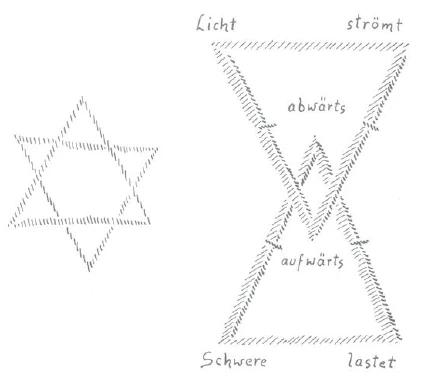
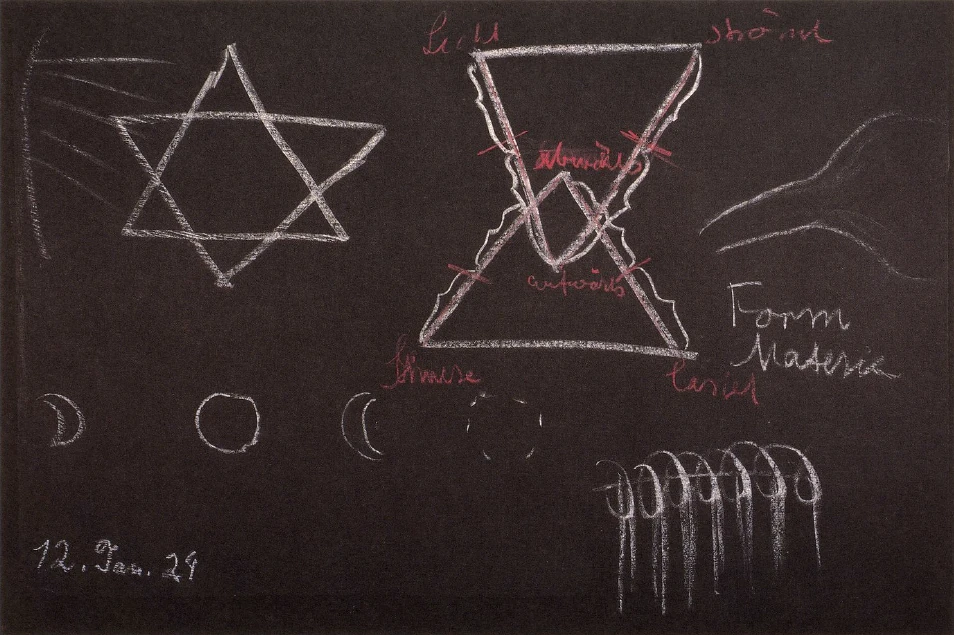
[ 4 ] Da findet man gerade innerhalb dieser kleinen Gemeinschaft, wie eine eindringliche Lehre vom Menschen in bezug auf zwei menschliche Fähigkeiten mit einer großen Genauigkeit noch vorhanden ist. So kann man vernehmen, wie da ein wirklich meisterhaft durchgebildeter, man kann schon sagen, Geheimwissenschafter seine Schüler darin unterrichtet, daß man mit den alten Symbolen, mit jenen Symbolen, die aus uralten Mysterien erhalten sind, die da bestehen aus gewissen geometrischen Formen, sagen wir zum Beispiel solch einer Form (siehe Zeichnung Seite 71, links) — an den Enden finden sich dann gewöhnlich irgendwelche hebräischen Worte —, daß man mit diesen Symbolen so unmittelbar nichts anfangen könne. Und die Schüler dieses Meisters wußten durch ihre Unterweisung, wie eigentlich dasjenige, was zum Beispiel Eliphas Levi gibt, bloß eine Art Herumreden ist um die Sache. Denn das konnten diese Schüler noch lernen, daß man auf die eigentliche Bedeutung solcher Symbole nur dann kommt, wenn man sie im Wesen der eigenen menschlichen Organisation wiederfindet.
[ 4 ] It is precisely within this small community that one finds a profound teaching about human beings—specifically regarding two human faculties—that is still preserved with great precision. One can hear how a truly masterfully educated—one might even say, a scholar of the occult—instructs his students that with the ancient symbols, those symbols preserved from time-honored mysteries, which consist of certain geometric forms—let us take, for example, a form such as this (see drawing on page 71, left) —at the ends of which there are usually some Hebrew words—that one cannot make any immediate use of these symbols. And through their instruction, this master’s students knew that what Eliphas Levi, for example, presents is really just a kind of beating around the bush. For these students were able to learn that one can only arrive at the true meaning of such symbols when one rediscovers them in the very essence of one’s own human constitution.
[ 5 ] Und so war es namentlich ein Symbolum, welches in dieser Gemeinschaft eine große Rolle spielte. Sie bekommen dieses Symbolum, wenn Sie diesen Salomonischen Schlüssel — so wird er gewöhnlich vorgeführt — auseinanderziehen, wenn Sie ihn so gestalten, verschieben, daß das hinunterkommt und das hinaufgeschoben wird (Zeichnung, Seite 71 rechts). Gerade dieses Symbolum, das spielte innerhalb jener kleinen Gemeinschaft, wie gesagt, auch noch im 19. Jahrhundert eine bedeutsame Rolle. Und jener Meister ließ dann die Angehörigen seines kleinen Schülerkreises eine bestimmte Attitüde ihres Leibes annehmen. Er ließ sie die Attitüde des Leibes annehmen, durch die gewissermaßen der Leib selber hinschrieb dieses Symbolum. Er ließ sie sich so stellen, daß sie die Beine etwas auseinanderspreizten und die Arme nach oben in dieser Weise einstellten. Dadurch kamen, wenn man die Arme nach unten verlängerte und die Beine nach oben verlängerte, eben diese vier Linien (starker Strich) am menschlichen Organismus selber zum Vorschein. Diese Linie verbindet dann die Füße, diese verbindet die Hände oben. Die anderen beiden kamen zum Bewußtsein als wirklich vorLicht strömt handene Kraftlinien, indem dem Schüler klar wurde: Es gehen Strömungen wie elektromagnetische Strömungen dann von der linken Fingerspitze zur rechten Fingerspitze und wiederum von dem linken Fuß zu dem rechten Fuß. So daß tatsächlich der menschliche Organismus selber diese ineinander verschlungenen Triangeln in den Raum hineinschrieb. Und dann handelte es sich darum, daß der Schüler empfinden lernte, was da liegt in den Worten: Licht strömt aufwärts, Schwere lastet abwärts. Dann mußten die Schüler dieses in tiefer Meditation erleben, in der Attitüde, die ich eben beschrieben habe. Dadurch kamen sie allmählich dahin, daß ihnen der Lehrer sagen konnte: Jetzt werdet ihr etwas erleben, was tatsächlich in alten Mysterien immer wieder und wiederum geübt worden ist. — Und sie erlebten wirklich dies, daß sie in ihren Arm- und Beinknochen das Mark erlebten, das Knochenmark erlebten, das Innere des Knochens erlebten.
[ 5 ] And so it was, in particular, a symbol that played a major role in this community. You obtain this symbol when you pull apart this Solomonic Key—as it is usually demonstrated—when you arrange and shift it so that this part moves down and that part is pushed up (illustration, page 71, right). It was precisely this symbol that, as I said, continued to play a significant role within that small community even into the 19th century. And that Master then had the members of his small circle of students assume a specific physical posture. He had them assume a posture through which, so to speak, the body itself inscribed this symbol. He had them stand in such a way that they spread their legs slightly apart and positioned their arms upward in this manner. As a result, when one extended the arms downward and the legs upward, these very four lines (thick lines) became visible on the human organism itself. This line then connects the feet, and this one connects the hands above. The other two became conscious as actual lines of force—as if light were streaming—as the student realized: currents, like electromagnetic currents, then flow from the left fingertip to the right fingertip and again from the left foot to the right foot. So that, in fact, the human organism itself inscribed these intertwined triangles into space. And then the task was for the student to learn to sense what lies in the words: “Light flows upward; heaviness weighs downward.” The students then had to experience this in deep meditation, in the posture I have just described. Through this, they gradually reached the point where the teacher could say to them: “Now you will experience something that was in fact practiced time and again in the ancient mysteries.” — And they truly experienced this: they felt the marrow in their arm and leg bones, they felt the bone marrow, they felt the innermost part of the bone.
[ 6 ] Sehen Sie, diese Dinge können nachempfunden werden dadurch, daß ein Zusammenhang hergestellt wird zwischen etwas, das ich Ihnen gestern gesagt habe, und dem, was ich Ihnen jetzt sage. Ich sagte Ihnen in einem gewissen Zusammenhange, daß der Mensch, wenn er wirklich nur so sich verhält, wie das im Laufe der Zeit üblich geworden ist, wenn er sich bloß abstrakt denkend verhält, daß das dann äußerlich bleibt, daß er gewissermaßen sich veräußerlicht. Gerade das Gegenteil tritt ein, wenn auf diese Art ein Bewußtsein von dem Knocheninnern auftritt.
[ 6 ] You see, these things can be understood by establishing a connection between something I told you yesterday and what I am telling you now. I told you in a certain context that when a person behaves solely in the way that has become customary over time—when they think merely in abstract terms—this remains external; they, so to speak, alienate themselves. The exact opposite occurs when a consciousness of the inner nature of the bone arises in this way.
[ 7 ] Nun gibt es aber noch etwas anderes, wodurch Sie zum Verständnis dieser Sache geführt werden können. Sehen Sie, so paradox es Ihnen klingen wird, so muß ich doch sagen, daß ein solches Buch wie meine «Philosophie der Freiheit» nicht durch die bloße Logik begriffen werden kann, sondern durch den ganzen Menschen verstanden werden muß. Und in der Tat, was in meiner «Philosophie der Freiheit» über das Denken gesagt wird, wird man nicht verstehen, wenn man nicht weiß, daß der Mensch eigentlich das Denken erlebt durch die innerliche Erkenntnis, durch das innerliche Erfühlen seines Knochenbaues. Man denkt eben nicht mit dem Gehirn, man denkt in Wirklichkeit mit seinem Knochenbau, wenn man in scharfen Denklinien denkt. Wenn das Denken konkret wird, wie es in der «Philosophie der Freiheit» der Fall ist, dann geht es eben in den ganzen Menschen über.
[ 7 ] But there is something else that can help you understand this matter. You see, as paradoxical as it may sound to you, I must say that a book such as my *Philosophy of Freedom* cannot be grasped through logic alone, but must be understood by the whole person. And in fact, what is said in my *Philosophy of Freedom* about thinking cannot be understood unless one knows that human beings actually experience thinking through inner perception, through the inner sensing of their skeletal structure. One does not think with the brain; in reality, one thinks with one’s skeletal structure when thinking in sharp lines of thought. When thinking becomes concrete, as is the case in *The Philosophy of Freedom*, it then extends to the whole human being.
[ 8 ] Aber die Schüler dieses Meisters gingen eben noch über das hinaus, und sie lernten erfühlen das Innere der Knochen. Und damit hatten sie ein letztes Beispiel erlebt von demjenigen, was in alten Mysterienschulen vielfach üblich war: Symbole dadurch zu erleben, daß der eigene Organismus zu diesen Symbolen gemacht wurde, denn nur so kann man Symbole wirklich erleben. Das Deuten der Symbole ist eigentlich etwas Unsinniges. Alles Spintisieren über Symbole ist etwas Unsinniges. Das richtige Verhalten zu Symbolen ist das, daß man sie macht und erlebt, so wie man schließlich auch Fabeln, Legenden, Märchen nicht bloß im Abstrakten aufnehmen soll, sondern sich damit identifizieren soll. Es gibt immer etwas im Menschen, wodurch man in alle Gestalten des Märchens hineingehen kann, eins werden kann mit dem Märchen. Und so ist es mit diesen wirklichen, aus geistiger Erkenntnis stammenden Symbolen der alten Zeit. Und ich haben Ihnen solche Worte hier in deutscher Sprache hergeschrieben (siehe Seite 71).
[ 8 ] But this master’s students went even further than that, and they learned to sense the inner essence of the bones. And with that, they had experienced one final example of what was common practice in the ancient mystery schools: experiencing symbols by making one’s own organism into those symbols, for only in this way can one truly experience symbols. Interpreting symbols is actually nonsensical. All speculation about symbols is nonsensical. The proper way to approach symbols is to create and experience them—just as one should not merely take fables, legends, and fairy tales in the abstract, but should identify with them. There is always something within a person that allows one to enter into all the characters of a fairy tale, to become one with the fairy tale. And so it is with these real symbols of ancient times, which stem from spiritual insight. And I have written down such words for you here in German (see page 71).
[ 9 ] Es ist natürlich für die neuere Zeit mehr oder weniger nur ein Unfug, wenn die nicht mehr voll verstandenen hebräischen Worte dafür hingeschrieben werden, denn dadurch wird der Mensch eigentlich innerlich nicht belebt, er erlebt nicht die Symbole, sondern er wird verrenkt. Es ist etwas, wie wenn ihm seine Knochen gebrochen würden. Und das geschieht einem eigentlich auch, geistig natürlich, wenn man mit Ernst solche Schriften wie die des Eliphas Levi liest.
[ 9 ] Of course, in modern times it is more or less just nonsense to write down the Hebrew words—which are no longer fully understood—for this purpose, because it does not actually enliven a person from within; they do not experience the symbols, but rather are thrown off balance. It is something like having one’s bones broken. And that is actually what happens to a person—spiritually, of course—when one reads writings such as those of Eliphas Levi with seriousness.
[ 10 ] Nun lernten also diese Schüler das Innere des Knochens erleben. Aber wenn man das Innere des Knochens anfängt zu erleben, dann ist man nicht mehr im Menschen. Geradesowenig wie, wenn Sie Ihren Zeigefinger vierzig Zentimeter vor Ihre Nase halten und da einen Gegenstand haben, so wenig wie dieser Gegenstand in Ihnen ist, so wenig ist in Ihnen dasjenige, was Sie dann innerhalb Ihrer Knochen erleben. Sie gehen nach innen, aber aus sich heraus. Sie gehen wirklich aus sich heraus. Und dieses Aus-sich-Herausgehen, Zu-den-Göttern-Gehen, In-die-geistige-Welt-Hineingehen, das ist dasjenige, was nun die Schüler dieser einsamen kleinen Schule damit begreifen lernten. Denn sie lernten damit die Linien kennen, welche von der Götterseite her in die Welt hineingezeichnet waren, um die Welt zu konstituieren. Sie fanden nach der einen Seite, durch den Menschen hindurch, den Weg zu den Göttern.
[ 10 ] So these students learned to experience the inside of the bone. But once you begin to experience the inside of the bone, you are no longer within the human being. Just as when you hold your index finger forty centimeters in front of your nose and there is an object there—just as that object is not within you—so too is that which you then experience within your bones not within you. You go inward, but out of yourself. You truly go out of yourself. And this stepping out of oneself, going to the gods, entering the spiritual world—that is what the students of this lonely little school came to understand through this process. For through this they came to know the lines that had been drawn into the world from the side of the gods in order to constitute the world. They found, on the one hand, through the human being, the path to the gods.
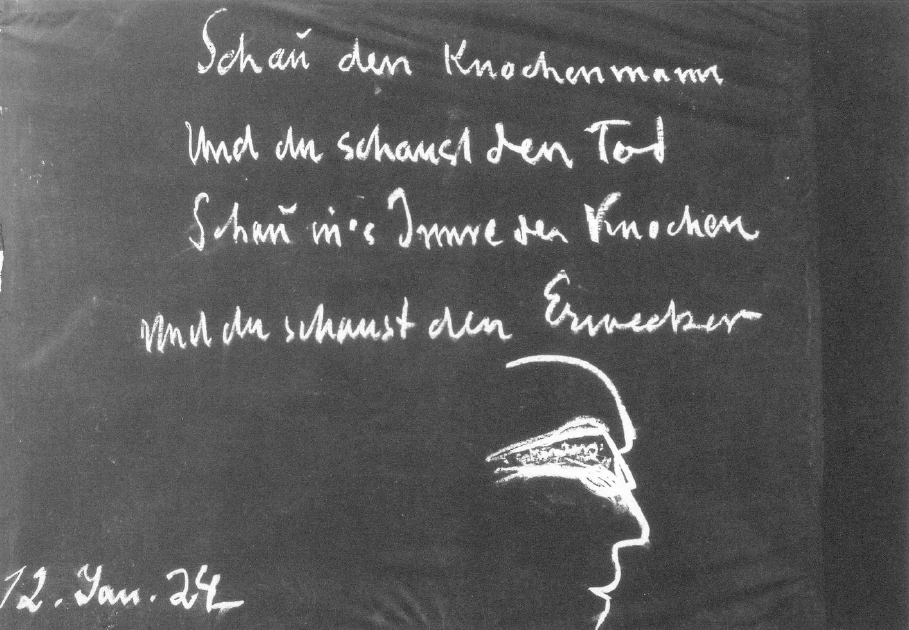
[ 11 ] Und dann faßte der Lehrer dasjenige, was da die Schüler erlebten, in einen paradoxen Satz zusammen, in einen Satz, der natürlich heute vielen Menschen lächerlich erscheinen wird, aber der, Sie werden es aus dem Angedeuteten erkennen, eine tiefe Wahrheit enthält:
[ 11 ] And then the teacher summed up what the students were experiencing in a paradoxical sentence—a sentence that, of course, will seem ridiculous to many people today, but which, as you will recognize from what has been hinted at, contains a profound truth:
Schau den Knochenmann
Und du schaust den Tod
Schau in’s Innere der Knochen
Und du schaust den Erwecker
Look at the Bone Man
And you see Death
Look inside the bones
And you see the Awakener
[ 12 ] — den Erwecker des Menschen im Geiste, das Wesen, das den Menschen in Zusammenhang bringt mit der Götterwelt.
[ 12 ] — the awakener of the human spirit, the being that connects humans to the world of the gods.
[ 13 ] Nun konnte ja in jener Zeit auf diesem Wege nicht gerade außerordentlich viel erreicht werden, aber einiges doch. Und einige von den Lehren über die Evolution der Erde durch verschiedene Metamorphosen hindurch gingen da doch den Schülern auf. Sie lernten gerade dadurch, daß sie sich in dieses Geist-Sein des Menschen versetzen konnten, weit zurückschauen in atlantische Zeiten und noch weiter zurück. Und in der Tat, mancherlei, was dazumal nicht eigentlich geschrieben oder gedruckt wurde, aber was sich die Leute erzählten von der Entwickelung der Erde, stammte aus solchen Einsichten her, die auf diese Weise zustande kamen. Das war eine der Lehren, die in dieser Schule gegeben wurden.
[ 13 ] Admittedly, not an extraordinary amount could be achieved in this way at that time, but still, some progress was made. And some of the teachings about the Earth’s evolution through various metamorphoses did indeed sink in with the students. Precisely because they were able to put themselves in the place of this spiritual being that is the human being, they learned to look far back into Atlantean times and even further back. And in fact, much of what was not actually written or printed at that time—but what people told one another about the Earth’s evolution—stemmed from such insights that arose in this way. That was one of the teachings imparted at this school.
[ 14 ] Eine andere ist ebenso interessant. Eine andere wurde gegeben, indem die Höherstellung des Menschen gegenüber den Tieren praktisch zur Einsicht gebracht wurde. Man möchte sagen: Dasjenige, was man heute vielfach zu allerlei Diensten, die heute sogar sehr geschätzt werden, verwendet, das war noch bis ins 19. Jahrhundert herein gerade solchen Menschen bekannt, die auf guten alten Einsichtstraditionen fußten. — Die Menschen sind ja heute stolz darauf, daß sie Polizeihunde haben, die die Spuren von allerlei Unrechtem im Menschenleben verfolgen können. Man hat diese praktische Anwendung in älteren Zeiten nicht gehabt. Aber die Fähigkeit zum Beispiel der Hunde nach dieser Richtung hin hat man noch besser gekannt als heute, und man hatte eine Einsicht darein, daß eben um den Menschen herum auch feinere Substantialität liegt, als diejenige ist, welche gesehen oder von Menschen gerochen und dergleichen wird, und man verstand, daß etwas wie ein feines Fluidum auch der Welt angehört. Man erkannte es als eine besondere Differenzierung von Wärmeströmungen, verbunden mit allerlei Strömungen, die man als elektromagnetische Strömungen ansah, und man brachte den Geruch des Hundes zusammen mit diesen wärme-elektromagnetischen Strömungen, und man machte die Schüler gerade jener kleinen Schule, von der ich Ihnen erzähle, auf solche Dinge auch bei anderen Tieren aufmerksam. Man machte sie aufmerksam, wie dieser Sinn für ein die Welt durchflutendes feines Fluidum weit im Tierreiche vorhanden ist. Und dann wies man darauf hin, wie dasjenige, was beim Tiere sich herunterentwickelt, ins Grob-Materielle sich entwickelt, beim Menschen sich hinauf ins Seelische entwickelt.
[ 14 ] Another is just as interesting. Another was provided by practically demonstrating the superiority of humans over animals. One might say: What is widely used today for all sorts of purposes—purposes that are even highly valued—was, well into the 19th century, known precisely to those people who drew on sound, time-honored traditions of insight. — People today are, after all, proud to have police dogs that can track down all manner of wrongdoing in human life. This practical application did not exist in earlier times. But people’s understanding of dogs’ abilities in this regard, for example, was even greater than it is today, and they recognized that a finer substance exists around human beings than that which can be seen or smelled by humans and the like; they understood that something like a fine fluid also belongs to the world. It was recognized as a specific differentiation of heat currents, connected with all manner of currents that were regarded as electromagnetic currents, and the dog’s sense of smell was linked to these heat-electromagnetic currents; and the students of precisely that small school I am telling you about were made aware of such things in other animals as well. They were made aware of how this sense for a subtle fluid permeating the world is widely present throughout the animal kingdom. And then it was pointed out how that which in animals develops downward into the grossly material develops upward in human beings into the soul.
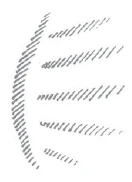
[ 15 ] Sehen Sie, eines ist ja von ungeheuerstem Interesse, was in dieser kleinen Schule gelehrt wurde. Es wurde gelehrt durch äußere anatomische Tatsachen, aber es war etwas tief Spirituelles damit gemeint. Es wurde dem Schüler gesagt: Sieh einmal, der Mensch ist ein Mikrokosmos. Er imitiert in seiner Organisation dasjenige, was im Weltengebäude vorgeht. — Der Mensch wurde durchaus nicht nur etwa in bezug auf die Stoffe, die er in sich trägt, sondern auch in bezug auf die Vorgänge, die in ihm sich abwickeln, als ein Mikrokosmos, als eine kleine Welt angesehen. Ja, es wurde manches, was in ihm plastisch vorhanden ist, auf Vorgänge in der äußeren Welt zurück.geführt. Und so wurde eine hohe Aufmerksamkeit darauf verwendet, wie der Mond durchgeht durch das erste Viertel, Vollmond wird, letztes Viertel, Neumond, wie der Mond in dieser Art achtundzwanzig bis dreißig Phasen durchmacht. Dieses Durchgehen des Mondes durch seine Phasen, das schaute man im Kosmos. Man schaute dabei den Mond in Bewegung in seiner Bahn. Man schaute, wie er seine Wirbel in seiner Bewegung herumzeichnete, seine achtundzwanzig bis dreißig Wirbel, und dann verstand man, wie der Mensch in seinem Rückgrat diese achtundzwanzig bis dreißig Wirbel hat, und man verstand, wie mit jenen Mondbewegungen und ihren Kräften dasjenige zusammenhängt, was sich im Menschen embryonal als Wirbelsäule ausbildet. Die Nachbildung der Mondenmonatsbewegung sah man in der Gestaltung der menschlichen Wirbelsäule. Und man sah, wenn man die menschliche Wirbelsäule mit ihren Nerven hat (siehe Zeichnung, oben), achtundzwanzig bis dreißig Nerven, die in den ganzen Organismus gehen, man sah in diesen achtundzwanzig bis dreißig Nerven die Abbildungen von Strömungen, die der Mond immer auf den verschiedenen Stufen seiner Bahnen auf die Erde herunterschickt. Man sah förmlich in den Knochenfortsetzungen der Wirbel das Eingreifen der Mondenströmungen. Kurz, man sah in demjenigen, was da der Mensch in sich trägt in seinen Rückenmarksnerven mit dem Rückenmark zusammen, man sah etwas, was einen an den Kosmos band, was einen mit dem Kosmos in einen lebendigen Zusammenhang bringt. Und dieses Ganze, das ich Ihnen jetzt andeutete, das brachte man dem Schüler bei.
[ 15 ] You see, one thing that was taught in this little school is of immense interest. It was taught through external anatomical facts, but there was a profound spiritual meaning behind it. The students were told: Look, the human being is a microcosm. In his organization, he imitates what takes place in the structure of the universe. — The human being was regarded as a microcosm, as a small world, not only in terms of the substances he carries within himself, but also in terms of the processes that unfold within him. Indeed, many of the forms present within him were traced back to processes in the outer world. And so great attention was paid to how the moon passes through the first quarter, becomes full, reaches the last quarter, and becomes a new moon—how the moon undergoes twenty-eight to thirty phases in this way. This passage of the moon through its phases was observed in the cosmos. One observed the moon in motion along its orbit. People observed how it traced its vertebrae as it moved—its twenty-eight to thirty vertebrae—and then they understood how the human being has these twenty-eight to thirty vertebrae in the spine, and they understood how the movements of the Moon and its forces are connected to what develops embryonically in the human being as the spine. One could see the reflection of the moon’s monthly movement in the structure of the human spine. And when one looked at the human spine with its nerves (see drawing, above)—twenty-eight to thirty nerves extending throughout the entire organism—one saw in these twenty-eight to thirty nerves the reflections of the currents that the Moon constantly sends down to Earth at the various stages of its orbit. One could literally see the influence of the lunar currents in the bony extensions of the vertebrae. In short, in what the human being carries within—in the spinal nerves together with the spinal cord—one saw something that bound one to the cosmos, something that brought one into a living connection with the cosmos. And this whole concept, which I have just outlined for you, was taught to the student.
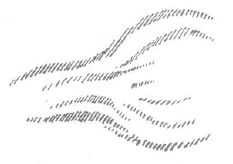
[ 16 ] Und dann machte man ihn auf etwas anderes aufmerksam. Dann sagte man ihm: Und siehe einmal, wenn du den Sehnerv ansiehst, wie er in das Auge übergeht vom Gehirn aus, so zerfasert er sich beim Übergang in das Auge in sehr feine Fasern. Wie viele solche Fasern sind es? Solcher Fasern, die vom Sehnerv in das Innere des Auges gehen, sind wiederum ebensoviel wie Nerven, die vom Rückenmark ausgehen, achtundzwanzig bis dreißig. So daß also eine kleine Rückenmarksorganisation vom Gehirn aus durch den Sehnerv ins Auge hineingeht (siehe Zeichnung unten). Das ist so, daß der Mensch — so sagte der Lehrer zu den Schülern — von den Göttern, die in uralter Zeit sein Dasein geformt haben, diese Dreißiggliedrigkeit des Rückenmark-Nervensystems erhalten hat. Aber er selber hat in seinem die Sinneswelt anschauenden Auge ein Abbild dessen geschaffen; da vorne im Kopforganismus ein Abbild dessen geschaffen, was die Götter aus ihm gemacht haben.
[ 16 ] And then his attention was drawn to something else. He was told: “Look, when you examine the optic nerve as it extends from the brain into the eye, you’ll see that it branches into very fine fibers at the point where it enters the eye.” How many such fibers are there? There are just as many of these fibers—which run from the optic nerve into the interior of the eye—as there are nerves emanating from the spinal cord: twenty-eight to thirty. Thus, a small spinal cord structure extends from the brain through the optic nerve into the eye (see diagram below). The fact is—as the teacher told the students—that human beings have received this threefold structure of the spinal-nervous system from the gods who shaped their existence in ancient times. But they themselves have created an image of it in their eye, which perceives the sensory world; they have created an image, there in the front of the head organism, of what the gods have made of them.
[ 17 ] Und dann machte man den Schüler darauf aufmerksam: So steht die Rückenmarksorganisation mit dem Monde in Beziehung. Aber hinwiederum, durch dieses besondere Verhältnis des Mondes zur Sonne hat das Jahr zwölf Monate, und vom Gehirn des Menschen gehen zwölf Nerven nach den verschiedenen Teilen des Organismus, die zwölf hauptsächlichsten Gehirnnerven. In dieser Beziehung ist der Mensch durch seine Hauptesorganisation ein Mikrokosmos in bezug auf dasjenige, was das Verhältnis der Sonne zum Monde ist. In der Gestaltung des Menschen drückt sich eine Imitation desjenigen aus, was Vorgänge draußen im Kosmos sind.
[ 17 ] And then the student’s attention was drawn to the fact that the spinal cord is related to the Moon in this way. But in turn, because of this special relationship between the Moon and the Sun, the year has twelve months, and twelve nerves extend from the human brain to the various parts of the organism—the twelve main cranial nerves. In this respect, through the organization of the head, the human being is a microcosm in relation to the relationship between the Sun and the Moon. The human form expresses an imitation of the processes taking place out there in the cosmos.
[ 18 ] Und wiederum machte man den Schüler aufmerksam darauf, daß er nun in seinem Haupte im Sehnerv, also durch die Dreißiggliedrigkeit des Sehnervs ins Auge hinein die Mondenorganisation vom Rückgrat nachahmt. Vom Gehirn aus gehen zwölf Nerven. Aber wiederum, wenn man vom Gehirn besonders jene Partie untersucht, die den Riechnerv in die Nase hineinsendet, dann stellt sich die Tatsache heraus, daß da in dem kleinen Teil vom Gehirn das ganze große Gehirn nachgeahmt wird. So wie im Auge das RückenmarkNervensystem nachgeahmt wird, so wird im Geruchsorgan das ganze Gehirn wiederum nachgeahmt, indem der Riechnerv in zwölf Teilen, in zwölf Strängen zur Nase hingeht. So daß also der Mensch, wenn Rückenmark und Kopf hier liegen (siehe Zeichnung S. 78), einen richtigen kleinen Menschen da vorne liegen hat. Und dann machte man den Schüler darauf aufmerksam: Dieser kleine Mensch ist aber anatomisch nur angedeutet. Die Dinge verwachsen; nur eine minuziöse anatomische Untersuchung kann das lehren. Die Dinge verwachsen, doch sie sind so. Aber dafür bilden sie sich ganz besonders im astralischen Leibe aus. Und weil sie sonst nur angedeutet sind, kann der Mensch sie im gewöhnlichen Leben nicht handhaben. Aber er kann sie handhaben lernen. — Und ebenso, wie der Schüler darauf hingewiesen wurde, das Innere seiner Knochen zu erleben, ebenso wurde er hingewiesen darauf, diese besondere Partie lebendig zu erleben.
[ 18 ] And once again, the student’s attention was drawn to the fact that in his head, in the optic nerve—that is, through the thirty-part structure of the optic nerve leading into the eye—he mimics the lunar organization of the spine. Twelve nerves extend from the brain. But again, if one examines that particular part of the brain which sends the olfactory nerve into the nose, it becomes apparent that the entire large brain is imitated within that small part of the brain. Just as the spinal cord’s nervous system is mirrored in the eye, so too is the entire brain mirrored in the olfactory organ, in that the olfactory nerve extends to the nose in twelve parts, in twelve strands. Thus, when the spinal cord and head are positioned here (see drawing on p. 78), the human being has a veritable miniature human being situated right there in front. And then the students’ attention was drawn to the fact that this little human is, anatomically speaking, only hinted at. The structures are fused together; only a meticulous anatomical examination can reveal this. These structures are fused together, yet they exist in this way. However, they develop in a very distinct manner within the astral body. And because they are otherwise only hinted at, a person cannot make use of them in ordinary life. But they can learn to do so. — And just as the student was instructed to experience the inner workings of their bones, they were also instructed to experience this particular region vividly.
[ 19 ] Sie sehen, etwas anderes tritt da ein, etwas, was nun wirklich dem ganzen abendländischen Anschauen ähnlicher ist als dasjenige, was man oftmals aus dem Morgenlande herübernimmt. Auch das Morgenland hat ja dieses Konzentrieren auf die Nasenwurzel, dieses Konzentrieren auf den Punkt zwischen den Augenbrauen. Damit wird der Ort angegeben. Aber in Wahrheit ist es dieses Konzentrieren auf jenen kleinen Menschen, der da drinnen liegt und der astralisch erfaßt wird. Und wird er astralisch erfaßt, wird tatsächlich eine Meditation so gestaltet, daß man etwas erfaßt in jener Gegend, die damit bezeichnet worden ist, so ist es, wie wenn man in jener Gegend einen kleinen Menschen innerlich wie embryonal ausbilden wollte. Diese Anleitung hat der Schüler bekommen in jener kleinen Schule, tatsächlich eine Art embryonale Ausbildung eines kleinen Menschen in einem stark konzentrierten Gedanken.
[ 19 ] You see, something else comes into play here—something that is actually much more akin to the entire Western way of seeing than what is often adopted from the East. The East, too, has this focusing on the bridge of the nose, this focusing on the point between the eyebrows. This indicates the location. But in truth, it is this focusing on that little human being who lies within and who is perceived astral-ly. And when he is perceived astral, when a meditation is actually structured in such a way that one perceives something in that area that has been designated, it is as if one were trying to form a small human being inwardly, as if in an embryonic state, in that area. The student received this instruction in that little school—in fact, a kind of embryonic formation of a small human being within a highly concentrated thought.
[ 20 ] Dadurch bekamen die Schüler, die dazu die Fähigkeit hatten, die zweiblättrige Lotusblume ausgebildet. Dann wurde ihnen gesagt: Das Tier bildet die Dinge hinunter zu demjenigen, was ein wärmeelektromagnetisches Fluidum ist. Der Mensch bildet dasjenige, was hier sitzt und was im groben nur als Geruchssinn erscheint, aber in das herüberspielt die Fähigkeit, die Tätigkeit des Auges, der Mensch bildet es aus ins Astralische hinein. Dadurch aber bekommt er die Fähigkeit, nicht bloß jenes Fluidum zu verfolgen, sondern eine fortwährende Wechselwirkung hervorzurufen mit dem Astrallichte und wahrzunehmen mit der zweiblättrigen Lotusblume, was der Mensch fortwährend sein ganzes Leben hindurch ins Astrallicht hineinschreibt. Der Hund riecht nur dasjenige, was geblieben ist, was da ist. Der Mensch verfährt anders, indem er mit seiner zweiblättrigen Lotusblume sich bewegt; auch dann, wenn er mit ihr nicht wahrnehmen kann, schreibt er fortwährend alles dasjenige, was in seinen Gedanken ist, in das Astrallicht hinein. Das Schauen befähigt ihn dann nur, das, was er hineinschreibt, eben zu verfolgen, wahrzunehmen und auch anderes damit wahrzunehmen, namentlich den wahren Unterschied von Gut und Böse.
[ 20 ] As a result, the students who had the ability to do so developed the two-petaled lotus flower. Then they were told: The animal forms things down to the level of what is a thermal-electromagnetic fluid. Human beings form that which resides here and which, in a gross sense, appears only as the sense of smell; but the ability to perceive the activity of the eye plays into this, and human beings develop it into the astral realm. Through this, however, he gains the ability not only to track that fluid but also to bring about a continuous interaction with the astral light and to perceive, with the two-petaled lotus flower, what the human being continually inscribes into the astral light throughout his entire life. The dog smells only what has remained, what is there. Human beings proceed differently by moving with their two-petaled lotus flower; even when they cannot perceive with it, they continually inscribe everything that is in their thoughts into the astral light. Seeing then enables him only to track and perceive what he writes into it, and also to perceive other things through it—namely, the true difference between good and evil.
[ 21 ] Auf diese Art waren tatsächlich da noch Nachklänge vorhanden an uralte Weisheitsschätze, die in Rudimenten auch praktisch noch gelehrt wurden. Und das zeigt uns, was eigentlich alles verlorengegangen ist unter dem Einfluß der materialistischen Strömungen, die in der stärksten Weise um die Mitte des 19. Jahrhunderts dann eingesetzt haben. Denn solche Dinge, wie ich sie Ihnen angedeutet habe, sind eben durchaus, wenigstens bis zu einem gewissen Grade, in gewissen, allerdings sehr einsamen und einsiedlerisch lebenden Kreisen empfunden und gewußt worden. Und auf den mannigfaltigsten Gebieten ergaben sich Erkenntnisse aus solchen Untergründen heraus, die ja später gar nicht mehr beachtet wurden, nach denen heute wiederum viele Menschen sich sehnen. Aber wegen der groben Methoden, die heute herrschen, sind ja diese Erkenntnisse zunächst für das äußere Wissen nicht wiederum erlangbar.
[ 21 ] In this way, echoes of ancient treasures of wisdom were indeed still present, and in rudimentary form, they were even still being taught in practice. And this shows us just how much has actually been lost under the influence of materialistic currents, which began to take hold most strongly around the middle of the 19th century. For such things, as I have indicated to you, were indeed felt and known—at least to a certain degree—in certain circles, albeit very isolated and reclusive ones. And in the most diverse fields, insights emerged from such underlying sources—insights that were later completely disregarded, yet which many people today long for once again. But because of the crude methods that prevail today, these insights are, for the time being, not accessible to external knowledge.
[ 22 ] Nun knüpfte sich eine ganz bestimmte Lehre an dasjenige, was in dieser Weise in jenem kleinen Kreise von dem Lehrer an die Schüler herangebracht wurde. Dem Schüler wurde klargemacht: Wenn er dieses Organ gebraucht, das ein ins Astrallicht hinaufgehobenes Geruchsorgan ist, dann lernt er die wahre Stofflichkeit aller Dinge erkennen, die wahre Materie. Und wenn er erkennen lernt das Innere seines Knochensystems und dadurch in Echtheit die wirkliche Weltgeometrie, die Art und Weise, wie von den Göttern in die Welt die Kräfte hineingezeichnet werden, dann lernt er erkennen, was als Form in den Dingen wirkt.
[ 22 ] Now, a very specific teaching grew out of what the teacher had conveyed to the students in this way within that small circle. It was made clear to the student: When he uses this organ—which is an olfactory organ elevated into the astral light—he learns to recognize the true material nature of all things, the true matter. And when they learn to perceive the inner workings of their skeletal system—and through this, to truly grasp the real geometry of the world, the way in which the gods inscribe their forces into the world—they learn to recognize what acts as form within things.
[ 23 ] Willst du also einen Quarz kennenlernen seinem Stoffe nach — so sagte man dem Schüler —, dann beschaue ihn mit der zweiblättrigen Lotusblume. Willst du kennenlernen, wie seine Kristallform ist, wie der Stoff geformt ist, dann mußt du diese Form aus dem Kosmos heraus begreifen mit demjenigen, was du begreifen kannst, wenn du in das Innere deines Knochensystems lebendig hineinkommst. Oder es wurde dem Schüler klargemacht: Wenn du dein Kopforgan gebrauchst, dann lernst du erkennen, wie die substantielle Beschaffenheit einer Pflanze ist. Wenn du erleben lernst das Innere deines Knochensystemes, dann lernst du erkennen, wie eine gewisse Pflanze wächst, warum sie diese oder jene Blätterform hat, diese oder jene Blätteranordnung, warum sie die Blüten in dieser oder jener Weise entfaltet.
[ 23 ] “If you wish to understand a piece of quartz in terms of its substance,” the teacher told the student, “then contemplate it through the lens of the two-petaled lotus flower.” If you want to understand what its crystalline form is like, how the substance is shaped, then you must grasp this form from the cosmos using what you can comprehend when you enter the innermost depths of your skeletal system in a living way. Or it was made clear to the student: When you use your head organ, you learn to recognize the substantial nature of a plant. When you learn to experience the inner workings of your skeletal system, you learn to recognize how a particular plant grows, why it has this or that leaf shape, this or that arrangement of leaves, and why it unfolds its flowers in this or that way.
[ 24 ] Also alles, was Form ist, sollte auf die eine Art, alles, was Stoff ist, sollte auf die andere Art erfaßt werden. Und es ist nun wirklich interessant, daß, wenn man bis zu Aristoteles zurückkommt, man findet, daß bei ihm unterschieden wird — aber das wurde ja in späterer Zeit nur rein abstrakt gelehrt — in bezug auf alles, was es gibt, die Form und die Materie, Aber das wurde eben in der Strömung, die von Griechenland nach Europa kam, in einer ganz abstrakten Weise gelehrt, so daß man eigentlich verzweifelt an der Abstraktheit, mit der diese Dinge in den Büchern dargestellt werden schon das ganze Mittelalter hindurch, und in der Neuzeit erst, da ist es nicht mehr bloß zum Verzweifeln, da ist es schon um die Wände hinaufzukriechen, wie man die Dinge dargestellt findet. Aber geht man zu Aristoteles zurück, so findet man, daß bei ihm die Formen wirklich zurückführen auf dieses Erleben — nur ist das wiederum nach Asien herübergetragen worden — und diese wirklich innere Einsicht in die Dinge, die mit dem Kopforgan sieht dasjenige, was er die Materie in den Dingen nennt.
[ 24 ] So everything that is form should be understood in one way, and everything that is matter should be understood in another. And it is truly interesting that, if one goes back to Aristotle, one finds that he distinguishes—though this was taught in later times only in a purely abstract manner—between form and matter in relation to everything that exists, But this was taught in a completely abstract way within the intellectual current that flowed from Greece to Europe, so that one actually despaired at the abstractness with which these things were presented in books throughout the entire Middle Ages; and in modern times, it is no longer merely a matter of despair—it is enough to drive one up the walls to see how these things are presented. But if one goes back to Aristotle, one finds that for him the forms do indeed trace back to this experience—only that this, in turn, was carried over to Asia—and this truly inner insight into things, which sees with the organ of the mind what he calls the matter in things.
[ 25 ] Aber nun weist uns die innere Erkenntnis desjenigen, was da in Griechenland gelehrt worden ist als Philosophie, es weist uns die Akasha-Chronik-mäßige Erkenntnis auf etwas hin, was ich ja natürlich nur ganz äußerlich andeuten konnte in meinen «Rätseln der Philosophie», wo ich zeigte, wie Aristoteles durchaus der Ansicht ist: Beim Menschen fließen Form und Materie ineinander, Materie ist Form, Form ist Materie. — Sie können das bei meiner Darstellung des Aristoteles in den «Rätseln der Philosophie» finden.
[ 25 ] But now, the inner understanding of what was taught in Greece as philosophy—the insight derived from the Akashic Records—points us to something that I could, of course, only hint at very superficially in my *Riddles of Philosophy*, where I showed how Aristotle is quite firmly of the opinion that: In human beings, form and matter flow into one another; matter is form, form is matter. — You can find this in my exposition of Aristotle in *The Riddles of Philosophy*.
[ 26 ] Aber Aristoteles hat das noch ganz anders gelehrt. Aristoteles hat gelehrt: Wenn man an Mineralien herantritt, dann erlebt man zunächst die Form durch das Erleben des Inneren der Unterschenkelknochen, und man erlebt die Materie eben mit dem Kopforgan. Die beiden sind weit voneinander. Der Mensch hält sie auseinander, Form und Materie, beim Mineralreiche die Kristallisation. Wenn der Mensch aber die Pflanze auffaßt, so erlebt er die Form durch das Erleben des Inneren seiner Oberschenkel, die Materie wiederum durch das Kopforgan, durch die zweiblättrige Lotusblume. Es kommt schon näher. Und erlebt der Mensch das Tier, so erlebt er die Form durch das Erleben des Inneren der Unterarmknochen, wiederum die Materie durch das Kopforgan — sehr nahe beieinander. Und erlebt der Mensch den Menschen selber, dann erlebt er die Form durch das Innere des Oberarms, der auf dem Umwege durch die Sprachbildung mit dem Gehirn selbst zusammenhängt. Ich habe öfter gerade in Einleitungen der Eurythmie davon gesprochen. Da schließt sich zusammen die zweiblättrige Lotusblume mit dem, was von dem Inneren des Oberarmes nach dem Gehirn geht. Und der Mensch erlebt namentlich in der Sprache den anderen Menschen nicht mehr nach Form und Inhalt getrennt, sondern als einen nach Form und Inhalt.
[ 26 ] But Aristotle taught something quite different. Aristotle taught: When one approaches minerals, one first experiences form through the sensation within the lower leg bones, and one experiences matter through the head organ. The two are far apart. Human beings keep them separate—form and matter—in the mineral kingdom through crystallization. But when a person perceives a plant, they experience the form through the inner sensation of their thighs, and the matter, in turn, through the head organ—through the two-petaled lotus flower. It is already getting closer. And when a person experiences an animal, they experience the form through the inner experience of the forearm bones, and the matter, in turn, through the head organ—very close to one another. And when a person experiences another human being, they experience the form through the inner experience of the upper arm, which is connected to the brain itself via the indirect path of speech formation. I have often spoken of this, particularly in introductions to eurythmy. There, the two-petaled lotus flower unites with what flows from the interior of the upper arm to the brain. And especially in speech, a person no longer experiences another human being as separate in form and content, but as a unity of form and content.
[ 27 ] Sehen Sie, in dieser Konkretheit gab es diese Lehre noch zu Aristoteles’ Zeiten. Und eine Spur davon, wie gesagt, war bis ins 19. Jahrhundert vorhanden. Da ist wirklich ein Abgrund. In den vierziger Jahren des 19. Jahrhunderts gingen im Grunde genommen diese Dinge wirklich verloren. Es ist der Abgrund da bis zum Ende des 19. Jahrhunderts, wo durch die Michael-Zeit die Dinge wieder gefunden werden konnten. Da aber, indem die Menschen über diesen Abgrund schritten, schritten sie eben eigentlich über eine Schwelle. Und an dieser Schwelle steht ein Hüter. Und die Menschheit konnte ihn zunächst nicht gleichzeitig beobachten, indem sie zwischen dem Jahre 1842 und 1879 an ihm vorbeigegangen ist. Aber sie muß zu ihrem Heil nunmehr zurückschauen und den Hüter beachten. Denn das Nichtbeachten und das Weiterhineinleben in die folgenden Jahrhunderte, ohne ihn zu beachten, würde eben zum alleräußersten Unheile der Menschheit führen.
[ 27 ] You see, in this concrete sense, this teaching still existed in Aristotle’s time. And, as I said, traces of it remained into the 19th century. There really is a chasm there. In the 1840s, these things were essentially lost. This chasm remained until the end of the 19th century, when, through the Michael era, these things could be rediscovered. But as people crossed this chasm, they were in fact crossing a threshold. And at this threshold stands a guardian. And humanity was initially unable to observe him as it passed him by between the years 1842 and 1879. But for its own salvation, it must now look back and take notice of the guardian. For failing to take notice of him and continuing to live into the following centuries without heeding him would lead to the very greatest calamity for humanity.
[ 28 ] Davon wollen wir dann morgen weiter reden.
[ 28 ] Let's talk more about that tomorrow.