

Esoteric Considerations of Karmic Connections
Volume I
GA 235
16 February 1924, Dornach
Translate the original German text into any language:
Versions Available:
Erster Vortrag
I. Karma Studies, Introductory Lecture
[ 1 ] Ich möchte nun beginnen, zu Ihnen über die Bedingungen und Gesetze des menschlichen Schicksals zu sprechen, das man ja gewohnt worden ist, das Karma zu nennen. Dieses Karma ist aber nur zu verstehen, zu durchschauen, wenn man sich darauf einläßt zunächst, die verschiedenen Arten der Weltgesetzmäßigkeit überhaupt erkennen zu lernen. Und so möchte ich denn heute vielleicht — es ist das notwendig — in einer etwas abstrakteren Form über die verschiedenen Arten der Weltgesetzmäßigkeit zu Ihnen sprechen, um dann die besondere Form, die als menschliches Schicksal, als Karma angesprochen werden kann, gewissermaßen herauszukristallisieren.
[ 1 ] I should like to begin by speaking to you about the conditions and laws underlying human destiny, destiny, which customarily is called karma. This karma, however, will be understood, be clearly seen into only when we begin by acquainting ourselves with the varieties of laws underlying the universe. So today, then, I should like—for it is necessary to speak to you in a rather abstract form about the various underlying universal laws, in order then to crystallize out of this the more special form which can be designated as human destiny—karma.
[ 2 ] Wir sprechen, wenn wir sowohl die Erscheinungen der Welt umfassen wollen, wie auch, wenn wir die Erscheinungen im Menschenleben selber ins Auge fassen wollen, von Ursachen und Wirkungen. Und heute ist man ja gewöhnt, besonders in der Wissenschaft, ganz im allgemeinen zu sprechen von Ursachen und Wirkungen. Aber gerade dadurch kommt man der wahren Wirklichkeit gegenüber in die größten Schwierigkeiten hinein. Denn die verschiedenen Arten, in denen Ursachen und Wirkungen in der Welt auftreten, werden dabei nicht berücksichtigt.
[ 2 ] We speak of cause and effect not only when we wish to comprehend the phenomena of the world, but also when we wish to fix our attention on the phenomena of human life itself. And at present it is quite customary to speak in general terms about cause and effect. Especially is this so in scientific circles. However, directly from this there result the greatest difficulties concerning the actual truth. For the various ways in which cause and effect appear in the world are not at all considered.
[ 3 ] Zunächst können wir uns die sogenannte leblose Natur ansehen, die uns ja am deutlichsten im mineralischen Reiche entgegentritt, in allem dem, was im Gestein in oft so wunderbaren Gestalten uns entgegentritt, aber auch in allem dem, was, man möchte sagen, zu Pulver zerrieben, dann wiederum zusammengebacken im formlosen Gestein uns entgegentritt. Das sehen wir uns zuerst an, meine lieben Freunde, was in dieser Art als Lebloses in der Welt auftritt.
[ 3 ] We can begin by looking at the so-called lifeless nature which, indeed, confronts us most clearly in the mineral kingdom, in all that we see in the rocky and stony part of the earth, often in such wonderful formations, but also in all that is reduced to powder, and which is then reunited and repacked in the formless rocky strata of the earth. Let us look, my dear friends, first at what thus appears as the lifeless in the world.
[ 4 ] Wenn wir das Leblose, ausnahmslos das Leblose betrachten, dann finden wir nämlich, daß wir die Ursachen, von denen in dem Reiche dieses Leblosen geredet werden kann, überall innerhalb dieses Leblosen selber suchen können. Wo Lebloses ist als Wirkung, da können wir in demselben Reiche des Leblosen auch die Ursachen suchen. Und man verfährt wirklich nur erkenntnisgemäß, wenn man das tut; wenn man also für die Vorgänge des Leblosen auch die Ursachen innerhalb des leblosen Reiches sucht.
[ 4 ] When we consider the lifeless—everything lifeless, without exception—we discover that everywhere within this kingdom of the lifeless we can find the causes themselves. Wherever the lifeless exists as effect, we can also seek the causes within this very same kingdom. In fact, we proceed in accordance with the principles of knowledge only when we seek the causes of the processes of the lifeless within its own kingdom.
[ 5 ] Wenn Sie einen noch so schön geformten Kristall vor sich haben, so sollen Sie die [Ursachen der] Formen dieses Kristalls im leblosen Reiche selber suchen. Und damit erweist sich dieses leblose Reich als etwas in sich Abgeschlossenes. Wir können zunächst nicht sagen, wo wir die Grenzen dieses Leblosen finden. Die können unter Umständen sehr entfernt in den Weltenweiten sein. Aber auch wenn für irgendein Lebloses, das vor uns steht, wenn es sich um seine Wirkungen handelt, Ursachen gesucht sein sollen, werden wir diese Ursachen wiederum im Reiche des Leblosen selber suchen. Damit aber stellen wir das Leblose schon neben etwas anderes hin. Und damit eröffnet sich uns zugleich eine gewisse Perspektive.
[ 5 ] If you have a crystal before you, however beautifully formed it may be, you should seek the cause of its forms in the kingdom of the lifeless itself. And thus, this lifeless kingdom shows itself as something contained within itself. We are, at first, not able to say where we can find the limits of this lifeless. Under certain conditions they may lie far distant out in the reaches of the universe. But if we are concerned with the effects of something lifeless confronting us, and we wish to find the causes, we must then seek them also within the realm of the lifeless. Through what we have said, however, we have already placed the lifeless alongside something else, and therewith a certain perspective is immediately opened before us.
[ 6 ] Betrachten Sie den Menschen selber. Betrachten Sie ihn, wie er durchgeht durch die Pforte des Todes. Alles, was gewirkt und gewest hat in ihm, bevor er durch diese Pforte des Todes gegangen ist, das ist aus der sichtbar greiflichen Gestalt, die übrigbleibt, wenn des Menschen Seele durch die Pforte des Todes geschritten ist, das ist aus dieser nunmehr übriggebliebenen Gestalt weg, und wir sagen auch gegenüber dieser Gestalt: sie ist leblos. Und geradeso wie wir von dem Leblosen sprechen, wenn wir hinschauen auf das Gestein des Gebirges mit seinen Kristallgestalten, so müssen wir vom Leblosen sprechen, wenn wir hinschauen auf den entseelten, entgeistigten Leichnam des Menschen. Und jetzt erst tritt für den Leichnam des Menschen ganz dasselbe ein, was von vornherein da war für die übrige leblose Natur.
[ 6 ] Consider the human being himself. Consider how he passes through the door of death. Everything which existed and acted in him before this event has left the visible, apprehensible form which remains after the human soul has passed through death's portal; nothing remains but this discarded, deserted form, of which we say that it is lifeless. And just as we speak of the lifeless when we gaze upon the stony structure of the mountains with its crystal forms, so must we speak of the lifeless when we behold this human corpse, bereft of soul and spirit. What from the beginning prevailed in the rest of lifeless nature only now comes into existence for the corpse of the human being.
[ 7 ] Wir konnten nicht für das, was an der menschlichen Gestalt geschieht als Wirkung während des Lebens, bevor die Seele durch das Tor des Todes gegangen ist, die Ursache suchen in dem Leblosen selber. Nicht nur, daß, wenn sich ein Arm hebt, wir vergeblich suchen werden in den leblosen physikalischen Gesetzen der menschlichen Gestalt nach den Ursachen dieses Armhebens, wir werden auch vergeblich suchen in den chemischen, in den physikalischen Kräften, die in der menschlichen Gestalt vorhanden sind, nach den Ursachen, sagen wir, des Herzschlages, der Blutzirkulation, irgendeines Vorganges, der auch gar nicht dem Willen unterliegt.
[ 7 ] We were unable to find in the lifeless itself the causes of what occurs in the human form as effects during life before the soul has passed through the door of death. It is true that, when an arm is raised, not only do we seek in vain in the lifeless, physical laws of the human form for the cause of this action, but we shall also seek in vain in the realm of the chemical, in the realm of the physical forces which are present in the human form, for the cause, let us say, of the heart-beat, of the blood circulation, of any of the processes which are not at all under the control of the will.
[ 8 ] In dem Augenblicke aber, wo die menschliche Gestalt Leichnam geworden ist, wo die Seele durchgeschritten ist durch die Pforte des Todes, beobachten wir auch eine Wirkung an dem menschlichen Organismus. Wir sehen meinetwillen: Es verändert sich die Hautfarbe, es werden die Glieder welk, kurz, es tritt alles das ein, was man gewöhnt ist, am Leichnam zu sehen. Wo suchen wir die Ursache? Im Leichnam selber, in den chemischen, physikalischen, in den leblosen Kräften des Leichnams selber.
[ 8 ] But, at the moment when the human form has become a corpse, when the soul has stepped through the gateway of death, we observe an effect in the human organism. We perceive, let us say, a change in the color of the skin, the limbs become limp; briefly, everything appears which we are accustomed to behold in a corpse. Where do we seek the cause? In the corpse itself, in the chemical, physical, lifeless forces of the corpse itself.
[ 9 ] Nun, wenn Sie sich das, was ich da andeute — ich brauche es nur anzudeuten —, wenn Sie das nach allen Seiten und Richtungen zu Ende denken, so werden Sie sich sagen: Der Mensch ist in bezug auf seinen Leichnam, nachdem seine Seele durch die Pforte des Todes geschritten ist, der leblosen Natur gleich geworden. Das heißt, wir müssen die Ursachen für Wirkungen nunmehr in demselben Gebiete suchen, wo die Wirkungen selber liegen. Das ist sehr wichtig.
[ 9 ] When now in all its aspects, in all directions, you think out to the end what I have here indicated—I need only indicate it—you will realize that, after the human soul has crossed the threshold of death, the human being has then become, regarding his corpse, like lifeless nature about him. That means that we must now seek the causes for the effects in the same region in which the effects themselves lie. This is very important.
[ 10 ] Aber gerade wenn wir auf diese besondere Artung des menschlichen Leichnams hinschauen, dann finden wir etwas anderes, was außerordentlich bedeutsam ist. Sehen Sie, der Mensch wirft gewissermaßen mit dem Tode seinen Leichnam ab. Und wenn man mit jener Beobachtungsgabe, die dazu fähig ist, beobachtet, was nunmehr der eigentliche Mensch, das geistig-seelische Menschenwesen geworden ist, nachdem es durch die Pforte des Todes geschritten ist, dann muß man eben sagen, die Sache ist doch so, daß der Leichnam abgeworfen ist, und daß nunmehr für dieses eigentliche geistig-seelische Menschenwesen, das angekommen ist jenseits des Tores des Todes, dieser Leichnam keine Bedeutung mehr hat. Er ist etwas Abgeworfenes.
[ 10 ] As soon, however, as we behold this special nature of the human corpse, we find something else that is extraordinarily significant. The human being casts off his corpse, as it were, at death. And if then, with that faculty of perception which is capable of it, we observe what the real human being, the soul-spirit human being, has become after he has passed through the door of death, we are compelled to say: Indeed, it is quite true that the corpse is cast off, and that now it has no longer any significance for this actual soul-spirit human being, who has reached the other side of death's door. This corpse has no longer any significance; it is now something discarded.
[ 11 ] Anders ist das mit der leblosen äußeren Natur. Und schon wenn man, ich möchte sagen, oberflächlich betrachtet, tritt einem dieses andere entgegen. Betrachten Sie einen menschlichen Leichnam. Sie können ihn ja am besten betrachten da, wo er gewissermaßen luftbeerdigt wird. Man findet in unterirdischen Gewölben, die namentlich gewisse Gemeinschaften früher als Begräbnisstätten gehabt haben, die Leichname von Menschen zum Beispiel einfach aufgehängt. Sie vertrocknen, und sie kommen in diesem Vertrocknen so weit, daß sie vollständig mürbe geworden sind, daß man dann eigentlich nur etwas anzutippen braucht, und sie zerfallen in Staub auseinander.
[ 11 ] With lifeless external nature this is quite a different matter. And, indeed, even if we consider the matter only superficially, this difference confronts us. Let us observe a human corpse. It can best be observed where it has had an air-burial. In subterranean caves, which formerly were chiefly used by certain communities as burial places, we find the corpses of men, for example, simply hung up. There they dry out. They go so far in this drying out process and become so completely brittle that it only requires a little tap to cause them to fall into dust.
[ 12 ] Das ist anders, was wir da als Lebloses erhalten haben, als dasjenige, was wir draußen in unserer Umgebung als leblose Natur finden. Diese leblose Natur, sie gestaltet sich, sie bildet Kristallgestalten. Sie ist überhaupt in einer merkwürdigen Veränderung befindlich. Wenn wir absehen von dem eigentlichen Erdigen und sehen auf das, was ja auch leblos ist, auf Wasser, Luft, so finden wir, daß eine regsame Verwandlung und Metamorphose in diesem Leblosen vorhanden ist.
[ 12 ] What we thus find preserved as the lifeless is something quite different from what we find outside in our earthly surroundings as lifeless nature. This lifeless nature fashions itself, it forms itself into crystal shapes. It is in a remarkable state of change. When we disregard what is purely earthly and look at other phenomena which are also lifeless, at water, and air, we then find that an active transformation and metamorphosis takes place in these lifeless elements. Let us now place this before the soul. Let us bear in mind the similarity of the human body in its lifelessness, after the soul has laid it aside, to extra-human lifeless nature.
[ 13 ] Nun wollen wir uns das zunächst einmal vor die Seele stellen, wir wollen die Gleichheit des menschlichen Leibes, wenn ihn die Seele abgelegt hat, in seiner Leblosigkeit, mit der außermenschlichen leblosen Natur einmal vor unsere Seele gestellt sein lassen.
[ 13 ] Let us now proceed further. Let us consider the plant kingdom. Here we enter the sphere of the living.
[ 14 ] Und gehen wir jetzt weiter. Betrachten wir das Pflanzenreich. Da kommen wir in die Sphäre des Lebendigen. Wenn wir eine Pflanze so richtig studieren, dann werden wir niemals finden, daß wir imstande sind, die Wirkungen, die in der Pflanze auftreten, bloß aus den Ursachen heraus zu suchen, die im Pflanzenreiche, also in demselben Reiche, wo die Wirkungen auftreten, selber liegen. Gewiß, es gibt heute eine Wissenschaft, die das versucht. Aber diese Wissenschaft ist eben auf dem Holzwege, denn sie kommt zuletzt darauf, zu sagen: Ja, man kann die physischen, in der Pflanze wirkenden Kräfte und Gesetze untersuchen, man kann die chemisch wirksamen Kräfte und Gesetze untersuchen; und es bleibt etwas übrig. — Da scheiden sich dann die Leute in zwei Parteien. Die einen sagen: Das, was da übrigbleibt, ist überhaupt nur eine Zusammenstellung, so eine Art Form, Gestalt; das Wirksame sind nur die physischen und chemischen Gesetze. — Die anderen sagen: Nein, es ist noch etwas anderes darinnen, das hat nur die Wissenschaft noch nicht erforscht; sie wird schon darauf kommen. — Sie wird das noch lange sagen. So ist die Sache eben nicht, sondern wenn man das Pflanzliche untersuchen will, so kann man es nicht verstehen, wenn man nicht das ganze Weltenall zu Hilfe nimmt, wenn man nicht auf die Pflanzen so hinsieht, daß man sich sagt: Die Kräfte der Pflanzenwirksamkeit liegen im weiten Weltenall. Alles, was da in der Pflanze geschieht, ist Wirkung des weiten Weltenalls. Es muß erst die Sonne zu einer bestimmten Position kommen im weiten Weltenall, damit irgendwelche Wirkungen im Pflanzenreiche auftreten. Es müssen andere Kräfte aus dem weiten Weltenall wirken, damit die Pflanze ihre Form, damit die Pflanze ihre inneren Triebkräfte und so weiter bekommt.
[ 14 ] If we study a plant intimately, we shall never find ourselves able to explain the effect appearing in the plant merely as a result of the causes which lie in the plant kingdom itself—that is, in the same kingdom in which the effects appear. Certainly, there is today a science which attempts to do this. However, this science is on the wrong track, for finally it comes to the point of saying: Yes, indeed, it is possible to investigate the physical forces and laws acting in the plant; the chemically active forces and laws can be investigated; but something remains over and above. At this point these people divide into two groups. One group maintains that what remains over is only a sort of aggregation, a sort of form, shape; that what is active are only the physical and chemical laws. The other group says: No! there is something else there besides, which science has not yet investigated; science will, however, eventually discover it. But this will be said for a long time to come. The fact of the matter, however, is something different. For, when we wish to investigate plant nature, we cannot comprehend it, if the entire universe is not called to our aid, if the plant is not beheld in such a way that we say that the forces of plant activity lie in the reaches of the cosmos. Everything that happens in the plant is the effect of the reaches of the universe. The sun must first advance to a certain position in the cosmos in order that some particular effects may appear in the plant kingdom. Different forces must be active from wide spaces of the universe in order that the plant may receive its form, in order that it may receive its inner driving forces.
[ 15 ] Und die Sache ist ja so: Wenn wir in die Lage kämen, meine lieben Freunde, nun zu wandern, nicht bloß wie Jules Verne es gemacht hat, sondern wirklich zu wandern, sagen wir bis zum Monde, bis zur Sonne und so weiter, so würden wir gar nicht viel gescheiter werden in bezug auf dieses Ursache-Suchen, als wir auf der Erde selber sind, wenn wir uns keine anderen Erkenntniskräfte aneignen als diejenigen, die wir schon haben. Wir würden nirgends zurechtkommen, wenn wir etwa sagen wollten: Nun schön, im Pflanzenreiche der Erde selber sind nicht die Ursachen für die Wirkungen, die im Pflanzenleben auftreten, also wandern wir zur Sonne, da werden wir die Ursachen finden. — Da finden wir sie auch nicht. Dagegen finden wir sie, wenn wir uns zur imaginativen Erkenntnis aufschwingen, wenn wir eine ganz andere Erkenntnis haben. Dann brauchen wir aber nicht zur Sonne zu wandern, wir finden sie im Erdenbereiche selber. Nur finden wir, daß wir nötig haben, von einer gewöhnlichen physischen Welt in eine Ätherwelt überzugehen, und daß in den Weiten der Welt überall der Weltenäther mit seinen Kräften wirkt, und daß er eben aus den Weiten hereinwirkt. Überall aus den Weiten herein wirkt der Äther.
[ 15 ] My dear friends, the truth of the matter is as follows. If we were able to travel, not in the manner of Jules Verne, but actually to travel out to the moon, to the sun, etc., then, unless we should have already acquired other forces of cognition than those we now possess, we would not become any more clever in this search for the causes than we are upon the earth itself. We would not get very far were we to say the following: “Very well, the causes of the effects which appear in the plant kingdom are not in the plant kingdom of the earth itself; so we travel to the sun; we shall find there the causes.” But we do not find them there with ordinary means of cognition. We do find them, however, if we lift ourselves to imaginative knowledge, if we possess quite a different mode of knowledge. In that case we do not need to travel to the sun; we find them here in the earth region itself. Only we shall find it necessary to cross over from an ordinary physical world to an ether world, and we shall find that in the reaches of the world the cosmic ether works everywhere with its forces, and that out of these reaches it works inward. Out of cosmic reaches everywhere the ether forces work into our world.
[ 16 ] Wir müssen also tatsächlich zu einem zweiten Reiche der Welt übergehen, wenn wir für das Pflanzenreich zu den Wirkungen die Ursachen suchen wollen.
[ 16 ] Thus, we must actually cross over to a second kingdom of the world, if we intend to seek the causes of the effects in the plant kingdom.
[ 17 ] Nun, der Mensch nimmt teil an dem selben, an dem da die Pflanze teilnimmt. Diejenigen Kräfte, die aus der Ätherwelt hereinwirken in die Pflanzen, sie wirken auch im Menschen. Der Mensch trägt in sich die ätherischen Kräfte, und wir nennen die Summe dieser ätherischen Kräfte, die er in sich trägt, den Ätherleib. Und ich habe Ihnen bereits angeführt, wie dieser Ätherleib wenige Tage nach dem Tode immer größer und größer wird und sich zuletzt verliert, so daß der Mensch nur in seinem astralischen Leib und in seiner Ich-Wesenheit übrigbleibt. Das also, was der Mensch ätherisch in sich getragen hat, wird immer größer und größer und verliert sich in den Weltenweiten.
[ 17 ] Now, the human being participates in the same element as the plant. The same forces which send their influences from the reaches of the ether cosmos down into the plants work also in the human being. He carries within him the ether forces, and we designate the sum of the forces he thus carries the ether body. And I have already told you how this ether body a few days after death becomes larger and larger and finally loses itself, so that the human being remains only in his astral and ego being. Thus, what he has carried within him of an etheric nature becomes larger and larger and finally loses itself in the cosmic reaches.
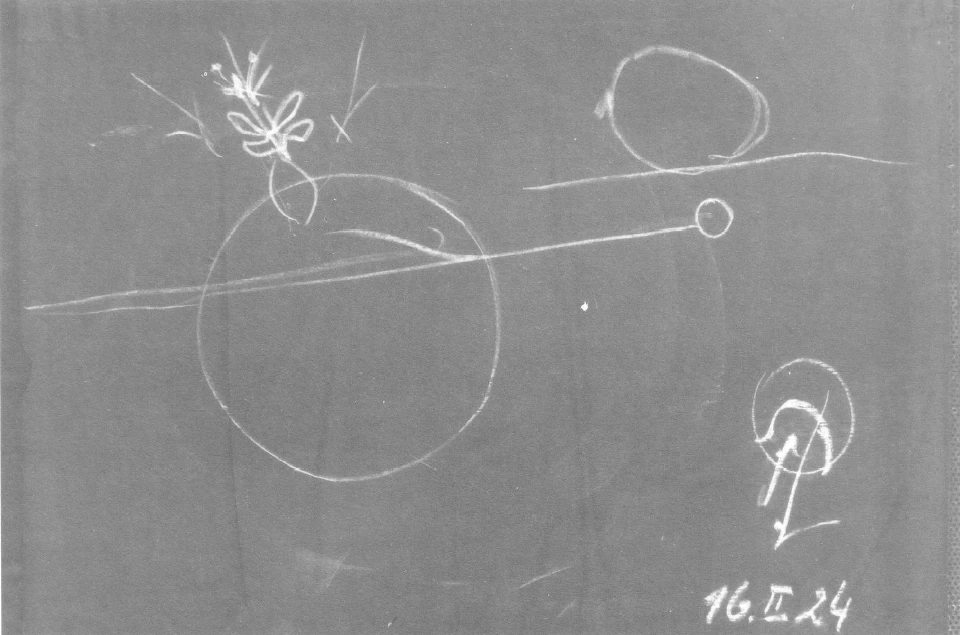
[ 18 ] Vergleichen Sie jetzt wieder dasjenige, was wir vom Menschen sehen können, wenn er durch die Pforte des Todes geschritten ist, mit dem, was wir im Pflanzenreiche sehen. Wir müssen vom Pflanzenreiche sagen: seine Ursachenkräfte kommen aus den Raumesweiten auf die Erde herein. Wir müssen vom menschlichen Ätherleib sagen: die Kräfte dieses Ätherleibes gehen in die Raumesweiten hinaus, das heißt, sie gehen dorthin, woher die Pflanzenwachstumskräfte kommen, wenn der Mensch durch die Pforte des Todes geschritten ist. Hier wird die Sache schon, ich möchte sagen, deutlicher. Wenn wir bloß den physischen Leichnam anschauen und sagen, er wird ein Lebloses, dann wird es uns schwer, herüberzukommen zu der übrigen leblosen Natur. Aber wenn wir das Lebendige anschauen, das Pflanzenreich, und gewahr werden: Aus dem Äther der Weltenweiten kommen die Ursachen, kommen die Kräfte für das Pflanzenreich — dann sehen wir, indem wir uns imaginativ in das Menschenwesen vertiefen, daß dorthin, woher die Kräfte, die Ätherkräfte für das Pflanzenreich kommen, der menschliche Ätherleib hingeht, wenn der Mensch durch die Pforte des Todes geschritten ist.
[ 18 ] Let us now compare again what we can see of the human being when he has crossed the threshold of death with what we see in the plant kingdom. We must say that the causative forces of the plant kingdom come down to earth out of the reaches of space. We must say in regard to the human ether body that the forces of this ether body go out into these reaches, that is to say, they go to that region whence come the growth forces of the plant when the human being has passed through death's door. Now the matter already becomes clearer. If we merely look at a physical corpse and say that it is lifeless, then a descent into the rest of lifeless nature becomes difficult for us. But, if we look at the living, at the plant kingdom, and become aware that the causative forces for this kingdom come out of the cosmic reaches, then by plunging ourselves imaginatively into the nature of man, we see that, when the human being has crossed the threshold of death, the human ether body goes out into the source whence come the etheric forces of the plant kingdom.
[ 19 ] Aber noch etwas ist charakteristisch. Ich möchte sagen: Dasjenige, was auf die Pflanzen als Ursachenkräfte wirkt, mit dem geht es verhältnismäßig schnell, denn auf die Pflanze, die aus dem Boden herauswächst, die Blüte bekommt, die Frucht bekommt, hat die Sonne von vorgestern nicht viel Einfluß. Da kann sie mit ihren Ursachen nicht viel wirken. Sie muß heute scheinen, sie muß wirklich heute scheinen. Das ist wichtig. Und Sie werden sehen in unseren folgenden Betrachtungen, daß es wichtig ist, daß wir uns das merken.
[ 19 ] Something else, however, is characteristic. What acts upon the plants as causative forces, acts relatively quickly; for upon the plants which are springing from the ground, which are developing their blossoms and their fruit, the sun of the day before yesterday has but little influence today. The sun of the day before yesterday is not effecting very much as a causative force. The sun must shine today, really shine today. That is important. And you will notice in our subsequent considerations that it is important that we note this fact.
[ 20 ] Die Pflanzen mit ihren Ätherursachen haben zwar innerhalb des Irdischen ihre eigentlichen Fundamentalkräfte, aber sie haben sie in dem, was gleichzeitig im Weltenall mit der Erde ist. Und wenn der menschliche Ätherleib, nachdem der Mensch als geistig-seelisches Wesen durch die Pforte des Todes geschritten ist, sich auflöst, so dauert das auch nur sehr kurze Zeit, tagelang nur. Wiederum ist Gleichzeitigkeit da, denn die Tage, die es dauert, sind eigentlich für die Zeit des Weltgeschehens eine Kleinigkeit.
[ 20 ] The plants with their ether-causative forces have, it is true, their actual fundamental forces within the realm of the earthly, but they have these in what exists simultaneously in the cosmos and the earth. And when the human ether body dissolves itself, after the human being as a soul-spirit being has passed through the portal of death, this process lasts only a brief time, a few days only. Again, a simultaneous relationship exists, for the days during which this dissolution takes place, measured in the time of cosmic events, are but an insignificant moment.
[ 21 ] Wiederum haben wir es, wenn der Ätherleib zurückkehrt zu dem, woraus die Pflanzenwachstumskräfte als Ätherkräfte kommen, damit zu tun, daß wir sagen können: Sobald der Mensch im Äther lebt, ist seine Ätherwirksamkeit zwar nicht auf die Erde beschränkt, sie geht ja von der Erde fort, aber sie entwickelt sich mit Gleichzeitigkeit.
[ 21 ] When the ether body returns to that region whence come the ether forces which manifest as plant growth forces, we have, again, to do with something which shows us that as soon as the human being lives in the ether, his ether activity is not limited to the earth, for it departs from the earth, yet it develops with simultaneousness.
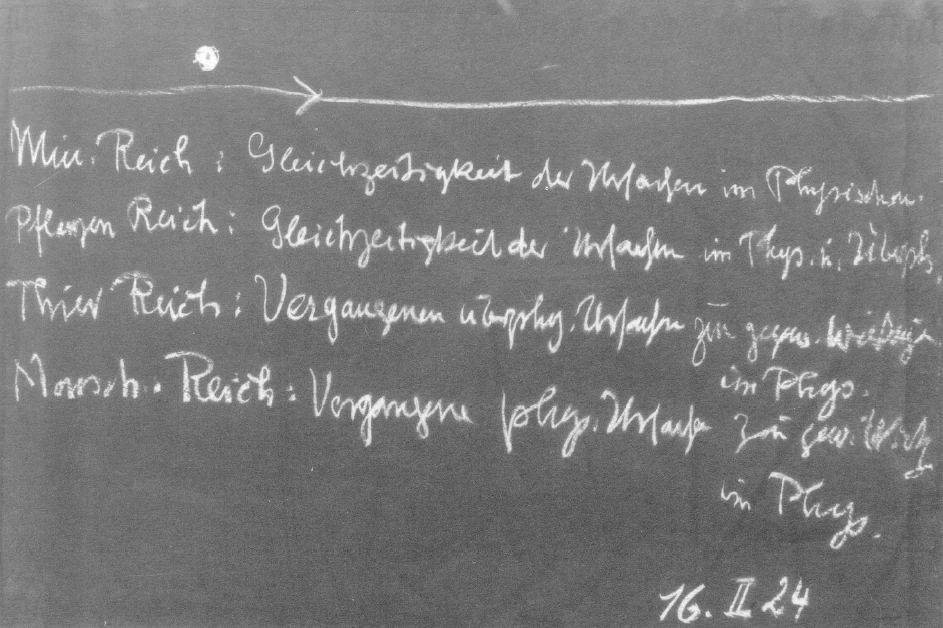
[ 22 ] Ich will Ihnen dafür ein Schema aufschreiben. Wir können sagen: Mineralreich: Gleichzeitigkeit des Physischen für Ursachen und Wirkungen. Also im wesentlichen haben wir es mit Gleichzeitigkeit zu tun der Ursachen im Physischen. Sie werden sagen: Ja, für manches, was im Physischen geschieht, sind ja die Ursachen der Zeit nach früher gelegen. — Das ist nicht in Wirklichkeit der Fall. Wenn Wirkungen entstehen sollen im Physischen, müssen die Ursachen andauern, müssen fortwirken. Wenn die Ursachen aufhören, treten keine Wirkungen mehr ein. Also wir können durchaus dieses Diktum hinschreiben: Mineralreich: Gleichzeitigkeit der Ursachen im Physischen.
[ 22 ] I shall now tabulate the foregoing in the following manner. We can say: Mineral Kingdom: Simultaneousness of cause and effect in the physical. Thus, we have essentially to do with simultaneousness of the causes in the physical. You will say: “Yes, but the causes of much that occurs in the physical lie prior in time.” This is in reality not the fact. If effects are to arise in the physical, then the causes must last, must continue to act. If the causes cease, effects no longer occur. We are, therefore, justified in writing this down thus: Mineral Kingdom: Simultaneousness of the causes in the physical.
[ 23 ] Kommen wir aber in das Pflanzenreich — und damit stehen wir auch in dem, was im Menschen selber als Pflanzliches zu verfolgen ist —, dann haben wir es zu tun mit Gleichzeitigkeit im Physischen und Überphysischen. Pflanzenreich; Gleichzeitigkeit der Ursachen im Physischen und Überphysischen.
[ 23 ] When we come to the plant kingdom, however—and in doing so we come to what can be observed in the human being also as something plantlike—we then have to do with simultaneousness in the physical and the super-physical. Plant Kingdom: Simultaneousness of the causes in the physical and super-physical.
[ 24 ] Nun treten wir an das Tierreich heran. Beim Tierreiche werden wir ganz vergeblich dasjenige, was als Wirkungen auftritt, solange das Tier lebt, im Tier selber suchen können. Wenn das Tier auch nur kriecht, um seine Nahrung aufzusuchen, in den chemischen, physischen Vorgängen, die sich innerhalb des tierischen Leibes finden, werden wir ganz vergeblich suchen nach den Ursachen. Wir werden auch ganz vergeblich suchen in den Weiten des Ätherraumes, wo wir die Ursachen für das Pflanzliche finden, wir werden da auch vergeblich suchen nach den Ursachen der tierischen Bewegung und der tierischen Empfindung. Für alles das, was im Tiere vorgeht mit Bezug auf das, was im Tiere pflanzlich ist, finden wir allerdings auch die Ursachen innerhalb des Ätherraumes, und wenn das Tier stirbt, geht ja auch der Ätherleib in die Weiten des Weltenäthers hinaus. Aber für das, was Empfindung ist, finden wir nimmermehr innerhalb dessen, was irdisch, was physisch oder was überphysisch-ätherisch ist, die Ursachen, können sie nicht finden.
[ 24 ] Let us now approach the animal kingdom. In this kingdom we shall seek quite in vain in the animal itself for what appears as effects as long as the animal is living. Even if the animal only crawls in order to seek its food, we shall seek quite in vain for the causes in the chemical and physical processes taking place within the animal body. We shall also seek entirely in vain in the reaches of ether space, where we find the causes for the plant nature,—we shall also seek there in vain for the causes of animal movement and animal sensation. For all that takes place in the animal in regard to what is plantlike in the animal, we find the causes also in ether space. And when the animal dies, its ether body also passes out into the reaches of cosmic ether. But we shall never be able to find within the earthly, within the physical, or the super-physical etheric, the causes of sensation. It is impossible to find them there.
[ 25 ] Hier tritt allerdings etwas ein, wo die moderne Anschauung wiederum sehr stark auf dem Holzwege ist. Das muß sich ja diese moderne Anschauung auch für viele Erscheinungen, die an einem Tier auftreten — Empfindungserscheinungen, Bewegungserscheinungen —, sagen: Untersuche ich das Tier in seinem Inneren nach seinen physischen, chemischen Kräften, da finde ich nicht die Ursachen. Aber auch in den Weiten des Weltenalls, in den Ätherweiten des Weltenalls finde ich nicht die Ursachen. Wenn ich eine Blüte erklären will, muß ich in das weite Weltenall, in das Ätherweltenall gehen, und ich werde die Blüte aus dem Ätherweltenall erklären können. Ich werde manches auch im Tier, was pflanzengleich ist, aus dem Ätherweltenall erklären können, aber nimmermehr das, was in dem Tier als Bewegungen auftritt, und nimmermehr das, was auftritt in dem Tier als Empfindung.
[ 25 ] Here it can be said that something occurs wherein the modern view is very much on the wrong track. Indeed, in regard to many phenomena which appear in the animal—the phenomena of sensation, of movement the human being with this modern conception must say to himself: “If I investigate the inner processes of the animal's physical, chemical forces, I cannot find the causes there. But also, in the reaches of the cosmos, in the ether reaches of the universe the causes cannot be found. If I wish to explain the nature of a blossom, then I must go out into the ether universe. I shall be able to explain the blossom's nature from the nature of the ether universe. I shall also be able to explain much in the animal which is plantlike from the nature of the ether cosmos, but I shall never be able to explain what appears in the animal as movement or as sensation.”
[ 26 ] Wenn ich am 20. Juni ein Tier betrachte in bezug auf seine Empfindungen, dann werde ich in allem dem, was irdisch ist und außerirdisch ist im Raume, die Ursachen für die Empfindungen nicht am 20, Juni finden. Gehe ich weiter zurück, werde ich sie auch nicht finden. Ich werde sie nicht im Mai, nicht im April und so weiter finden.
[ 26 ] If I observe an animal on the 20th of June and consider its sensations, then I shall not be able to find the causes of the sensations on the 20th of June in anything that is in earthly or extra-earthly space. If I go still farther back I shall not find them either. I shall not find them in May, nor in April, nor in any other month.
[ 27 ] Das spürt auch die moderne Anschauung. Daher erklärt diese moderne Anschauung das, was sich so nicht erklären läßt, wenigstens vieles davon, durch Vererbung, das heißt durch ein Wort: Es ist «vererbt», es stammt von den Vorfahren. — Natürlich nicht alles, weil das doch zu grotesk wäre, aber vieles. Es ist vererbt.
[ 27 ] The modern view feels this. Therefore, this modern view explains what is thus not capable of explanation, or at least a great deal of it, by means of heredity. That is to say, it explains by means of a phrase. It is “inherited.” It originates with the forebears, it is “inherited” by the offspring. Naturally, not everything, because that would, indeed, be too grotesque; nevertheless, a great deal. It is inherited!
[ 28 ] Was heißt vererbt? Es führt der Begriff der Vererbung zuletzt darauf zurück, daß dasjenige, was einem als mannigfaltig gestaltetes Tier entgegentritt, im Eikeim des Muttertieres enthalten war. Und das ist ja das Bestreben der modernen Anschauung, einen Ochsen äußerlich in seiner mannigfaltigen Gestaltung zu betrachten und dann zu sagen: Nun ja, der Ochse kommt aus dem Eikeim; da waren die Kräfte drinnen, die dann ausgewachsen den Ochsen geben. Daher ist der Eikeim ein außerordentlich komplizierter Körper. Er müßte auch furchtbar kompliziert sein, dieser Eikeim des Ochsen, denn nicht wahr, da ist alles drinnen, was nach vielen Seiten drängt und gestaltet und bildet und wirkt, damit aus dem kleinen Eikeim der vielgestaltete Ochse wird.
[ 28 ] What is meant by “inherited?” The concept of heredity leads finally back to the idea that what appears as complicated animal was contained in its mother's ovum. And it has, indeed, been the endeavor of the modern view to observe an ox outwardly in its complicated form and then to say: “Well, the ox sprang from the ovum; in it were the forces which then resulted in the full-grown ox. Therefore, the ovum is an extraordinarily complicated body.” It would have to be extremely complicated, this ovum of the cow, for, is it not true? everything is contained within it which presses toward all sides, and forms, and fashions, and works, in order that out of the little ovum the complicated ox may emerge!
[ 29 ] Und wie man sich auch windet — es gibt ja da viele Theorien, Evolutionstheorien, Epigenesistheorien und so weiter —, es ist immer nichts anderes, als daß man doch sich vorstellen muß: Dieser Eikeim, das kleine Ei, ist etwas furchtbar Kompliziertes. Wie alles zurückgeführt wird auf Moleküle, die in komplizierter Weise sich aus Atomen aufbauen, so stellen manche die erste Anlage dieses Eikeimes als ein kompliziertes Molekül dar. Aber das stimmt nicht einmal mit den physischen Beobachtungen überein, meine lieben Freunde.
[ 29 ] And however much we may struggle to find a way out—there are, indeed, many theories of evolution, of epigenesis, etc.—whatever way out we try to find, we see that there is nothing else to do than to conclude that this ovum, this little egg, is something extremely complicated. Since everything is led back to the molecule, which is built up of atoms in a complicated way, there are many who represent the first inception of this ovum as a complicated molecule. But, my dear friends, this does not even agree with physical observations.
[ 30 ] Die Frage entsteht: Ist denn dieser Eikeim wirklich ein so kompliziertes Molekül, ein so komplizierter Organismus schon? Das Eigentümliche des Eikeimes ist nämlich gar nicht, daß er kompliziert ist, sondern daß er die ganze Materie ins Chaos zurückwirft. Gerade der Eikeim ist etwas, was im Muttertiere nicht ein komplizierter Aufbau ist, sondern ein vollständig pulverisiertes, durcheinandergeschmissenes Materielles. Es ist gar nichts organisiert. Es ist gerade etwas, was ins absolut Unorganisierte, in sich Staubhafte zurückfällt. Und niemals würde eine Fortpflanzung entstehen, wenn nicht die unorganisierte, die leblose Materie, die ins Kristallinische, ins Gestaltige strebt, wenn nicht diese in sich ins Chaos gerade im Ei zurückfiele. Das Eiweiß ist nicht der komplizierteste Körper, sondern der allereinfachste, der gar keine Bestimmung in sich hat. Und aus diesem kleinen Chaos, das da als Eikeim besteht zunächst, könnte ewig kein Ochse werden, wirklich nicht, denn er ist eben ein Chaos, dieser Eikeim.
[ 30 ] The question arises: Is this ovum really such a complicated molecule, already such a complicated organism? The peculiarity of the ovum does not at all consist in its complexity, but in the fact that it throws all its substance back into chaos—into a chaotic state. Precisely the ovum is, in the mother-animal, not a complicated structure, but a completely pulverized, disarranged substance. It is not organized at all. It is something that falls back into an absolutely unorganized, powder-like condition. And reproduction would never occur, did not the unorganized, the lifeless matter which tends toward the crystalline, toward the form—did not this matter in the ovum fall back into itself, into chaos. The albumen is not the most complicated body, but rather the simplest, which has nothing determinative in it. And out of this little chaos, which exists there at first as an ovum, no ox could ever come into existence, for this ovum is just a chaos.
[ 31 ] Warum wird dann dennoch ein Ochse daraus? Weil im mütterlichen Organismus die ganze Welt nun auf diesen Eikeim wirkt. Gerade weil er bestimmungslos geworden ist, weil er Chaos geworden ist, kann die ganze Welt auf ihn wirken. Und die Befruchtung hat kein anderes Ziel in der Welt, als die Materie ins Chaos, ins Unbestimmte, ins Bestimmungslose zurückzuführen. So daß nicht etwas anderes, sondern nur das Weltenall wirkt.
[ 31 ] Why, then, does an ox come forth from it? Because, in the maternal organism, the entire cosmos acts upon this ovum. It is just because it is unconditioned, because it is chaotic, that the entire cosmos can act upon it. And fructification has no other purpose than to cast back the matter of the ovum into chaos, into the indeterminate, into the unconditioned. Thus, nothing else acts but the universe alone.
[ 32 ] Aber nun, wenn wir in die Mutter schauen, da sind nicht die Ursachen; wenn wir außerhalb in den Äther schauen, da sind auch im gleichzeitigen Geschehen nicht die Ursachen. Wir müssen zurückgehen bis bevor das Tier entstanden ist, wenn wir die Ursachen finden wollen für das, was da keimt als die Anlage zum empfindungs- und bewegungsfähigen Wesen. Wir müssen zurückgehen bis bevor das Leben angefangen hat! Das heißt, für das Empfindungs- und Bewegungsfähige liegt nicht in der Gleichzeitigkeit, sondern vor der Entstehung dieses Wesens die Ursachenwelt.
[ 32 ] But now, if we look into the mother, we do not find therein the causes. If we look outside into the ether world, there also in the simultaneous occurrences the causes are not to be found. We must go back until we come to the time before the animal was born, if we wish to find the causes for what germinates there as the potential capacities of a being, capable of sensation and movement. We must go back to a time before life has begun. That is, for the capacities of feeling and movement the causal world does not lie in simultaneousness but lies in a time prior to the conception of this being.
[ 33 ] Das ist das Eigentümliche: Wenn ich eine Pflanze anschaue, dann muß ich in dasjenige hinausgehen, was gleichzeitig ist, dann finde ich die Ursache — allerdings im weiten Weltenall. Wenn ich aber für das, was als Empfindung oder als Bewegungsfähigkeit im Tier wirkt, die Ursache finden will, so kann ich nicht ins Gleichzeitige gehen, sondern da muß ich in dasjenige gehen, was dem Leben vorangeht; die Sternkonstellation, mit anderen Worten, muß sich geändert haben, muß eine andere geworden sein. Nicht die Sternkonstellation im Weltenall, die mit dem Tiere gleichzeitig ist, hat ihren Einfluß auf das eigentlich Tierische, sondern die dem Leben vorangehende Konstellation der Sterne.
[ 33 ] The following is the curious fact: If I behold a plant, I must go out into what is simultaneous, and I then find the cause; but I find it in the reaches of the universe. If, however, I wish to find the cause of what acts in the animal as sensation, then I cannot look for it in simultaneousness, but I must look for it in what preceded life; in other words, the stellar constellation must have changed, it must have become different. It is not the stellar constellation in the universe which exists simultaneously with the animal that has its influence upon the actual animal nature, but the constellation of the stars preceding its life.
[ 34 ] Und jetzt schauen wir auf den Menschen hin, wenn er durch die Pforte des Todes geschritten ist. Der Mensch muß, wenn er durch die Pforte des Todes geschritten ist, wenn er seinen Ätherleib abgelegt hat, der in die Weltenweiten an jene Stelle hingeht, von denen die Kräfte des Pflanzenwachstums, die ätherischen Kräfte kommen, der Mensch muß zurückgehen, wie ich Ihnen ausgeführt habe, bis zu seiner Geburt. Da hat er in seinem astralischen Leib alles das durchgemacht, rückwärtslaufend, was er während des Lebens im Hin-Gang durchgemacht hat. Mit anderen Worten: Der Mensch muß nicht in das Gleichzeitige hineingehen nach dem Tode mit seinem astralischen Leib, er muß zurückgehen zu dem Vorgeburtlichen, er muß dorthin gehen, wo heraus die Kräfte kommen, die die tierische Empfindungsfähigkeit und Bewegungsfähigkeit geben. Die kommen nicht aus dem Raumesreiche, nicht aus den Konstellationen der Sterne, die gleichzeitig sind, die kommen aus den Konstellationen, die vorangehend sind. — Sprechen wir also vom tierischen Reich (siehe Schema Seite 27), dann können wir nicht von der Gleichzeitigkeit der Ursachen im Physischen und Überphysischen sprechen, sondern dann müssen wir von vergangenen überphysischen Ursachen zu gegenwärtigen Wirkungen im Physischen sprechen. Tierreich: Vergangene überphysische Ursachen zu gegenwärtigen Wirkungen.
[ 34 ] And now let us look at the human being when he has passed the threshold of death. When this has occurred, he must go back—after he has laid aside his ether body, which spreads out into every part of the reaches of the universe from whence come the growth forces of the plants, the etheric forces—he must go back, as I have described it, to his moment of birth. Then he has experienced in his astral body all that he has gone through in life, but in reverse order. In other words, the human being must not pass into the state of simultaneousness with his astral body after death; he must go back to the state prior to birth. He must go to that region whence come the forces which give the animal the capacity for sensation and the ability of movement. These do not come out of simultaneously existing stellar constellations, they come from the constellations existing prior to birth. Thus, if we speak of the animal kingdom, we cannot speak of the simultaneousness of the causes in the physical and super-physical, but we must then speak of past super-physical causes passing over to the present effects in the physical. Animal Kingdom: Past super-physical causes to present effects.
[ 35 ] Und wir kommen auch da wiederum in den Zeitbegriff hinein. Wir müssen, wenn ich mich trivial ausdrücken darf, in der Zeit spazierengehen. Wenn wir die Ursachen suchen wollen für irgend etwas, was in der physischen Welt geschieht, gehen wir in der physischen Welt spazieren; wir brauchen nicht aus der physischen Welt herauszugehen. Wenn wir für irgend etwas, was im lebendigen Pflanzenreiche bewirkt ist, die Ursache suchen wollen, müssen wir ja recht weit gehen. Wir müssen die Ätherwelt absuchen, und erst da, wo die Ätherwelt am Ende ist, wo — märchenhaft gesprochen — «die Welt mit Brettern vernagelt ist», erst da finden wir die Ursache für das Pflanzenwachstum.
[ 35 ] And here, too, we enter again the concept of time. We must, if I may use a trivial expression, go for a walk in time. If we wish to seek the causes of something occurring in the physical world, we go for a walk in this world; we do not need to go outside the physical world. If we wish to seek the causes of something which is really in the living plant kingdom, then we must go quite far away. We must seek in the ether world. And only there where the ether world comes to an end, where—speaking in terms of a fairy tale—the world is fenced, is boarded in, there only do we find the causes of plant growth.
[ 36 ] Aber wir können da herumgehen, soviel wir wollen, da finden wir nicht die Ursache der Empfindungsfähigkeit, auch nicht der Bewegungsfähigkeit. Da müssen wir anfangen, in der Zeit spazierenzugehen. Da müssen wir in der Zeit zurückschreiten. Da müssen wir aus dem Raum herauskommen und in die Zeit hineinspazieren.
[ 36 ] We may go about there as much as we wish, yet we shall not find the cause of the faculty of sensation or movement. We must begin to go for a walk in time, we must tread there the path of time in reverse order. We must leave space and go for a walk in time.
[ 37 ] Sie sehen, wir können nebeneinanderstellen in bezug auf dieses Verursachen den menschlichen physischen Leib in seiner Leblosigkeit mit der leblosen Natur; den menschlichen ÄÄtherleib in seinem Leben und in seinem Hinausgehen nach dem Tode in die Ätherweiten mit dem Ätherleben der Pflanzen, das auch aus den Ätherweiten hereinkommt, aber aus den gleichzeitigen Konstellationen des Überphysischen, des Überirdischen; und wir können zusammenstellen die menschliche astralische Organisation mit dem, was draußen im Tierischen ist.
[ 37 ] You will note that we can place the human physical body in its lifelessness alongside lifeless outer nature in respect of causation; we can place the human ether body in its life and its expansion after death into the ether spaces alongside the ether life of the plant, which also comes hither out of the reaches of the ether, but, indeed, out of the simultaneous constellations of the super-physical, of the super-earthly. And we are able to place the human astral organism alongside of that which exists outside in the animal nature.
[ 38 ] Und wir schreiten dann fort von dem mineralischen zu dem pflanzlichen, zu dem tierischen Reiche, kommen herauf zu dem eigentlichen Menschenreiche. Sie werden sagen: Das haben wir ja schon immer berücksichtigt. Ja, aber nicht ganz. Wir haben das Menschenreich zunächst berücksichtigt, insofern der Mensch einen physischen Leib hat, dann insofern er einen Ätherleib hat, dann insofern er einen astralischen Leib hat. Aber sehen Sie, wenn der Mensch bloß seinen physischen Leib hätte, so wäre er — ein komplizierter, aber immerhin — ein Kristall. Wenn der Mensch bloß dazu noch seinen Ätherleib hätte, so wäre er vielleicht auch eine zwar schöne Pflanze, aber immerhin bloß eine Pflanze. Wenn der Mensch noch dazu einen astralischen Leib hätte, würde er auf allen vieren gehen, vielleicht Hörner haben und dergleichen, er wäre eben ein Tier. Das alles ist der Mensch nicht. Die Gestalt, die er hat als aufrechtgehendes Wesen, diese Gestalt hat er dadurch, daß er außer der physischen, ätherischen, astralischen Organisation eben noch die Ich-Organisation hat. Und erst von diesem Wesen, das auch noch die Ich-Organisation hat, können wir sprechen als dem Menschen, dem Menschenreich.
[ 38 ] And we then advance from the mineral, to the plant, to the animal kingdom, coming finally to the real human kingdom. You will say: “Well, we have already considered that from the beginning.” Yes, indeed, but not altogether. We have, in the first place, considered the human kingdom in so far as the human being has a physical body; then, in so far as he has an ether body, and then, in so far as he has an astral body. But just note that he would be a crystal—a complicated one, to be sure, but a crystal, nevertheless—if he had only his physical body. If he were to have merely his ether body in addition, he would then be a plant, a beautiful plant perhaps, nevertheless, just a plant. If, again, the human being had in addition an astral body, he would go about on all fours, perhaps have horns and other similar animal characteristics—in short, he would be just an animal. The human being is none of these. The form which he has as an erect walking being he has by virtue of his possessing an ego organism besides the physical, etheric, and astral organisms. And only this being, who also has an ego organism, can we designate as man, as belonging to the human kingdom.
[ 39 ] Betrachten wir jetzt noch einmal das, was wir schon angeschaut haben. Wenn wir die Ursachen suchen wollen für das Physische, können wir im Physischen bleiben. Wenn wir die Ursachen suchen sollen für das Pflanzliche, müssen wir in die Weiten des Ätherreiches hinausgehen, aber wir können noch im Raume bleiben, nur, wie gesagt, wird der Raum da etwas hypothetisch, denn man muß ja sogar zu Märchenbegriffen, «wo die Welt mit Brettern vernagelt ist», seine Zuflucht nehmen. Aber dennoch, die Sache ist so, daß ja wirklich sogar die rein im Sinne der gegenwärtigen Naturforschung denkenden Menschen schon darauf kommen, daß man wirklich von so etwas sprechen kann, wie «die Welt ist mit Brettern vernagelt». Es ist natürlich ein trivialer, grober Ausdruck. Aber man braucht nur daran zu denken, wie in kindlicher Weise die Menschen denken; Da ist die Sonne, die schickt ihre Strahlen fort und immer weiter fort; sie werden zwar immer schwächer und schwächer — das Licht geht da fort, fort, fort, immer weiter fort, eben ins Endlose.
[ 39 ] Let us now once more consider what we have already observed. If we wish to seek the causes of plant nature, we must then go out into the reaches of the ether realm, but we are still able to remain in space; only, as has been remarked, space in that case becomes somewhat hypothetical, for we must even resort to the fairy-tale concept, we must go “where the world is boarded up.” It is, however, really a fact that even modern human beings who think in accord with purely natural scientific research are coming to the view that we can actually speak of something like that expressed in the fairy tale “where the world is boarded in.” It is, naturally, a trivial, clumsy expression. But we need only recall how childishly human beings think: There is the sun. It sends forth its rays, sends them farther and farther away. They become, it is true, weaker and weaker. The light goes on and on and on, it goes further and further away, into the endless.
[ 40 ] Ich habe für diejenigen, die schon jahrelang die Vorträge hören, längst auseinandergesetzt, daß das ein Unding ist, sich vorzustellen, daß das Licht ins Endlose hinausgeht. Ich habe immer gesagt, die Ausbreitung des Lichtes unterliegt der Elastizität. Wenn man einen Kautschukball hat und in ihn hineindrückt, so kann man bis zu einer gewissen Stelle eindrücken, dann schnellt er wieder zurück, das heißt, der Druck für die Elastizität hat ein Ende, dann geht es zurück. So, sagte ich, ist es auch für das Licht: das geht nicht ins Endlose hinaus, sondern wenn es eine gewisse Grenze erreicht hat, kommt es wieder zurück.
[ 40 ] I have explained long ago to those who have already for years heard my lectures that it is nonsense to imagine that the light goes out into the endless. I have always said that the outspreading of light is dependent on its elasticity. If we take a rubber ball and depress it, we can do this only up to a certain point, it then snaps back again. That is to say, the elasticity of the ball has its limits; then the depressed surface springs back into place. This I have said is also true of light. It does not go out into the limitless, but, when a certain limit is reached, it returns.
[ 41 ] Dieses, daß das Licht nicht bis ins Endlose geht, sondern nur bis zu einer gewissen Grenze und wieder zurückgeht, das wurde nun auch zum Beispiel in England von dem Physiker Oliver Lodge vertreten; so daß heute schon die physische Wissenschaft darauf gekommen ist, das, was die Geisteswissenschaft gibt, zu vertreten, wie sie in allen Einzelheiten eben einmal ankommen wird bei dem, was die Geisteswissenschaft sagt.
[ 41 ] This fact, that light does not expand out into the boundless, but only to a certain limit and then comes back, has found an advocate, for example, in England in the physicist Sir Oliver Lodge. So it can be seen that today physical science has already come to advocate what is given through spiritual science, and physical science will eventually accept, in all particulars, what is stated by spiritual science.
[ 42 ] Und so kann man schon auch sprechen davon, daß da draußen, wenn man genügend weit hinausdenkt, man wieder zurückdenken muß, nicht einfach den endlosen Raum annehmen darf, der eine Phantasterei ist, noch dazu eine Phantasterei, die man nicht fassen kann. Vielleicht werden sich einige von Ihnen erinnern, wie ich in der Beschreibung meines Lebensganges im letzten Kapitel, das vorige Woche erschienen ist, gesagt habe, daß es auf mich einen ganz besonders bedeutsamen Eindruck gemacht hat, wie ich beim Anhören der synthetischen neueren Geometrie zunächst von der Geometrie darauf hingewiesen worden bin, daß eine Gerade nicht so gedacht werden darf, daß sie da ins Endlose hinausgeht und niemals aufhört, sondern daß die Gerade, die da hinausgeht, von der anderen Seite wahrhaftig zurückkommt. Die Geometrie drückt das so aus: Die Synthese, der unendlich ferne Punkt nach rechts ist derselbe wie der unendlich ferne Punkt nach links. Das kann man ausrechnen. Das ist nicht etwa nach der bloßen Analogie, daß, wenn man einen Kreis hat und von hier ausgeht, man da wieder zurückkommt, daß, wenn der Halbbogen eine Unendlichkeit hat, er eine Gerade wäre. Das ist nicht so; das wäre eine Analogie, auf die derjenige, der exakt denken kann, nichts gibt. Das, was auf mich einen Eindruck machte, das war nicht diese triviale Analogie, sondern das wirklich rechnungsgemäße Nachweisenkönnen, daß der unendlich ferne Punkt von der einen Seite links derselbe ist wie der, der hier rechts eine Unendlichkeit ist, daß also wirklich jemand, der hier anfängt zu laufen und immerfort nach der Linie läuft, nicht ins Endlose läuft, sondern daß, wenn man nur die richtige Zeit abläuft, er einem von der anderen Seite wieder entgegenkommt. Das sieht für alles physische Denken grotesk aus. In dem Augenblicke, wo man das physische Denken ablegt, ist es eben auch eine Realität, weil die Welt nicht endlos ist, sondern so wie sie als physische Welt vorliegt, begrenzt ist. So daß man sagen kann: Man geht an die Grenze des Ätherischen, wenn man vom Pflanzlichen und von dem spricht, was im Menschen ätherisch ist. — Man muß aber herausgehen aus allem dem, was da im Raume überhaupt ist, wenn man das Tierische und im Menschen das Astralische erklären will. Da muß man in der Zeit spazierengehen, da muß man über das Gleichzeitige hinweggehen. Da muß man also vorschreiten in der Zeit.
[ 42 ] And thus it is, indeed, possible to speak also of the fact that there outside, if we think sufficiently far out into space, we must allow our thoughts to return and not permit ourselves simply to postulate endless space, which is fantastic—indeed, a fantasy we cannot imagine. Perhaps there may be some among you who will remember that in the description of the course of my life I said how very deep an impression was made on me when, in my study of modern synthetic geometry, I was led to the concept that a straight line may not be considered as having a limitless extension, a never ending extension, but that such a line extending in one direction actually returns from the other. Geometry expresses it somewhat as follows: The point at infinity to the right of a fixed point is the same as the infinitely distant point to the left. It is possible to calculate this. This is not merely analogous to the fact that when we have a circle and start here by following the circumference we return to the same point again, or that, if a semicircle is infinite it is a straight line. That is not the case. That would be an analogy to which those who can think with exactness do not attribute any value. What made an impression on me was not this trivial analogy, but the actual proof in accordance with strict calculation, that the infinitely distant point on the left is the same as the infinitely distant point on the right, and that actually if someone begins to run from here along a straight line continually he will not run to a limitless infinity, but that, if he but continue to run for the proper length of time, he will eventually come toward us again from the opposite direction. This appears grotesque to all physical thought. The moment physical thinking is laid aside, this is actually a reality, because the universe is not endless, but is limited in as far as the physical universe is concerned. Thus, it may be said that we reach the limits of the etheric when we speak of the vegetative and of what is etheric in the human being. But we must go outside of everything that exists in space when we wish to explain the animal and the astral nature in man. There we must go walking in time; there we must go beyond simultaneousness; there we must advance in time.
[ 43 ] Und nun kommt man an das Menschliche. Sehen Sie, wenn man in die Zeit hineinkommt, da überschreitet man eigentlich schon auf doppelte Art das Physische. Indem man das Tier begreift, muß man schon in der Zeit weitergehen. Nun muß man diese Denkweise nicht wiederum abstrakt fortsetzen, sondern konkret fortsetzen. Geben Sie jetzt einmal acht, wie man das konkret fortsetzt.
[ 43 ] When we enter time, we cross the boundary of the physical in a twofold way. In describing the animal, we must already proceed in time. We must, however, not continue this mode of thinking abstractly, but continue it in a concrete way. Pay attention for a moment and see how this can be continued concretely.
[ 44 ] Nicht wahr, die Menschen denken: Wenn die Sonne Licht aussendet, so geht das Licht endlos fort. Oliver Lodge zeigt aber, daß man jetzt schon diese Denkweise verläßt, daß man weiß, das kommt an ein Ende und kommt wieder zurück. Die Sonne bekommt von allen Seiten ihr Licht wiederum zurück, wenn auch in anderer Form, in verwandelter Form; sie bekommt es aber zurück. Wenden wir nun diese Denkweise an auf das, was wir eben durchgedacht haben. Wir stehen zunächst im Raume. Der Erdenraum bleibt drinnen, wir schreiten hinaus zum Weltenraum. Das ist uns noch nicht genug, wir schreiten hinaus in die Zeit. Jetzt könnte einer sagen: Nun ja, jetzt schreiten wir immer weiter und weiter. — Nein, jetzt kommen wir wieder zurück! Wir müssen die Denkweise fortsetzen. Wir kommen wieder zurück. Wir kommen gerade so wieder zurück, wie wir, wenn wir im Raume immer weiterschreiten, an die Grenze kommen und dann wieder zurückkommen; so kommen wir auch hier wieder zurück. Das heißt, wenn wir die vergangenen überphysischen Ursachen gesucht haben in der Zeitenweite, müssen wir wieder ins Physische zurückkommen.
[ 44 ] Human beings think, do they not? that when the sun sends forth its light, this continues on its path endlessly. Sir Oliver Lodge shows, however, that we have already forsaken this mode of thinking about the matter and, instead, that we know that light comes to a boundary and then returns again. The sun receives back its light from all sides, although in another form, in a transformed condition. The sun receives back the light. Let us now employ this mode of thinking on what we have just been considering. We stand, at the outset, in space. Earth-space remains within it. We stride out into the universe. That is not yet enough for us: we stride out into time. Now some one could say: “Very well, we now stride on ever further and further.” No, not at all! We now return again. We must continue this mode of thinking. We return again. We come back again in the same way as we do when we march forth into space, going ever further, reaching finally the boundary, and then return. So here also do we return. That is to say, if we have sought the past super-physical causes in the reaches of time, we must return again into the physical.
[ 45 ] Was heißt denn aber das? Das heißt, wir müssen wieder aus der Zeit herunter, aus der Zeit wieder auf die Erde herunter. Wenn wir also für den Menschen die Ursachen suchen wollen, dann müssen wir sie wieder auf der Erde suchen. Nun sind wir zurückgeschritten in der Zeit. Wenn wir, indem wir in der Zeit zurückschreiten, wieder auf die Erde herunterkommen, dann kommen wir in ein voriges Menschenleben hinein, selbstverständlich. Wir kommen in ein voriges Menschenleben hinein. Beim Tiere schreiten wir weiter; das löst sich in bezug auf die Zeit geradeso auf, wie sich unser Ätherleib auflöst bis an die Grenze. Der Mensch löst sich da nicht auf, sondern wir kommen auf die Erde wieder zurück bis an sein voriges Erdenleben.
[ 45 ] What does that mean? It means, we must again descend out of time, out of time descend again upon the earth. If we wish, thus, to seek the causes of the human being, then we must seek them again upon earth. Now we have marched back in time. If, by marching back in time, we come again upon the earth, then of course we come into a previous human life. With the animal, we stride further; it dissipates in regard to time just as our ether body dissipates right out to the boundary of the cosmos. The human being does not dissipate himself out there, for when we retract his path in time we come back to the earth into his previous life.
[ 46 ] So daß wir für den Menschen sagen können: Vergangene physische Ursachen zu gegenwärtigen Wirkungen im Physischen.
[ 46 ] Thus, we must say for the human being: From past physical causes to present effects in the physical.
Mineralreich: Gleichzeitigkeit der Ursachen im Physischen.
Pflanzenreich: Gleichzeitigkeit der Ursachen im Physischen und Überphysischen.
Tierreich: vergangene überphysische Ursachen zu gegenwärtigen Wirkungen.
Menschenreich: vergangene physische Ursachen zu gegenwärtigen Wirkungen im Physischen.
Mineral Kingdom: Simultaneousness of causes in the physical.
Plant Kingdom: Simultaneousness of the causes in the physical and super-physical.
Animal Kingdom: Past super-physical causes of present effects.
Human Kingdom: Past physical causes of present effects in the physical.
[ 47 ] Sie sehen, es hat heute, ich möchte sagen, Mühe gekostet, sich vorbereitend einmal in Abstraktionen hineinzuversetzen. Aber das war notwendig, meine lieben Freunde. Es war notwendig, weil ich Ihnen einmal zeigen wollte, daß es auch für diejenigen Gebiete, die man als die geistigen betrachten muß, eine Logik gibt. Nur stimmt diese Logik nicht überein mit der groben Logik, die bloß von den physischen Erscheinungen abgezogen ist und an die die Menschen gewöhnlich einzig und allein glauben.
[ 47 ] You see, it has required effort today to familiarize ourselves with abstractions in a preparatory way. But that, my dear friends, was necessary. It was necessary, because I wished to show you that there is also a logic for those spheres which we must consider to be the spiritual. Only, this logic does not agree with the clumsy logic which is deduced merely from physical phenomena, and in which human beings are accustomed entirely and only to believe.
[ 48 ] Wenn man rein logisch vorgeht und die Ursachenreihen absucht, dann kommt man auch im bloßen Gedankengang an die vergangenen Erdenleben. Und es ist notwendig, darauf aufmerksam zu machen, daß auch das Denken selber ein anderes werden muß, wenn man das Geistige begreifen will.
[ 48 ] If we proceed in a purely logical way and investigate the series of causes, then, in the mere train of thought, we reach the past earth lives. And it is necessary to call attention to the fact that also the mode of thinking itself must become different from the usual mode, if we wish to comprehend the spiritual.
[ 49 ] Nicht wahr, die Menschen meinen, man könne das nicht begreifen, was aus der geistigen Welt heraus sich offenbart. Man kann es begreifen, aber man muß seine Logik erweitern. Es ist ja auch notwendig, wenn man ein Musikstück oder ein anderes Kunstwerk begreifen will, daß man in sich die Bedingungen hat, die der Sache entgegenkommen. Wenn man diese Bedingungen nicht hat, so begreift man eben nichts davon. Dann geht die Sache als ein Geräusch vorbei. Oder man sieht in irgendeinem Kunstwerke nichts anderes als eben ein unverständliches Gebilde. So muß man auch dem, was aus der geistigen Welt heraus mitgeteilt wird, ein Denken entgegenbringen, das angemessen ist der geistigen Welt. Das aber stellt sich schon bei dem bloßen logischen Denken heraus. Man kommt, indem man die Verschiedenartigkeit der Ursachen untersucht, in der Tat dazu, die vergangenen Erdenleben auch in logischer Folge verstehen zu können.
[ 49 ] Human beings believe that what reveals itself from the spiritual world cannot be comprehended. It can be comprehended, but we must broaden our logic. It is, indeed, also necessary, if we wish to comprehend a musical or any other work of art, that we bear in ourselves the conditions which meet the matter halfway. If we do not possess these conditions, then we understand nothing concerning them. Then the music passes us by as a noise. Or we may see in some work of art nothing but an incomprehensible shape. Thus, we must also meet what is communicated from the spirit world with a mode of thought commensurate with this world. This, however, becomes evident in mere logical thinking. By investigating the various natures of the causes, we reach, indeed, the possibility of understanding the past earth lives also in logical sequence.
[ 50 ] Nun bleibt uns die große Frage, die da beginnt, wo wir den Leichnam betrachten. Er ist leblos geworden. Die leblose Natur draußen steht in ihren Kristallformen, in den verschiedenen Formen da. Die große Frage steht vor uns: Wie verhält sich die leblose Natur zum Leichnam des Menschen?
[ 50 ] Now there remains the important question, which begins there where we observe the corpse. It has become lifeless. Lifeless nature exists outside in its crystal forms, in its varied shapes. The important question now confronts us: What is the relationship of lifeless nature to the corpse of the human being?
[ 51 ] Vielleicht werden Sie schon finden, meine lieben Freunde, daß etwas beigetragen wird zu einem Sinn, der nach der Antwort dieser Frage hin liegt, wenn Sie die Sache in zweiter Etappe anfassen, wenn Sie sagen: Wenn ich die Pflanzenwelt anschaue, die um mich herum ist, so trägt diese in sich aus den Weiten des Ätherweltenalls die Kräfte, zu denen mein Ätherleib zurückkehrt. Da draußen in Ätherweiten, da ist dasjenige oben, was ursächlich den Pflanzen den Ursprung gibt, da ist dasjenige, wohin mein Ätherleib geht, wenn er meinem Leben ausgedient hat. Ich gehe dahin, woher aus den Ätherweiten das pflanzliche Leben quillt. Ich gehe dahin, das heißt, ich bin verwandt damit. Ja, ich kann geradezu sagen: Da oben ist etwas, mein Ätherleib geht dahin, die grünende, sprossende, quellende Pflanzenwelt kommt daher. — Aber es ist ein Unterschied: Ich gebe meinen Ätherleib ab, die Pflanzen empfangen den Äther zum Aufwachsen. Sie erhalten den Äther zum Leben, ich gebe den Ätherleib ab nach dem Tode. Ich gebe ihn als etwas ab, das übrigbleibt; sie, die Pflanzen, erhalten diesen Ätherleib als etwas, was ihnen das Leben gibt. Sie haben ihren Anfang von dem, wohin ich mit meinem Ende gelange. Der Pflanzenanfang gliedert sich zusammen mit des menschlichen Ätherleibes Ende.
[ 51 ] Perhaps you will see, my dear friends, that something is being contributed to a meaning which lies in the direction of the answer to this question, if you take hold of the matter in its second step, if you say: When I behold the plant world surrounding me, then I realize that it carries in itself the forces coming from the reaches of the ether cosmos to which my ether body returns. There outside in the ether reaches, there above are the causative sources of the plants. Thither goes my ether body when it has served its purpose during my life. I go thither where plant life gushes forth from the ether reaches. I go thither—that is, I am related to it. Indeed, I can say: Something exists there above me; my ether body ascends to it; the verduring, sprouting, up-springing plant world comes thither from it. But there is a difference. I give up my ether body; the plants receive the ether in order to grow. They receive the ether in order to live. I yield up the ether body after death. I yield it up as something remaining over. The plants, however, receive this ether body as something that gives them life. They have their beginning in that region which I reach at my end. The plant beginning unites with the human ether body's ending.
[ 52 ] Dies legt Ihnen die Frage nahe: Könnte es denn vielleicht auch so sein, daß ich beim Mineral, bei den mannigfaltigst gestalteten Kristallen fragen könnte: Ist vielleicht auch das ein Anfang gegenüber dem, was ich als physischen Leichnam, als Ende von mir, hinterlasse? Gliedert sich vielleicht da Anfang und Ende zusammen?
[ 52 ] May it perhaps be that in relation to the mineral, to the crystals of the most manifold forms, I can ask the following question: Is that which I leave behind as physical corpse, as an end of myself, perhaps also a beginning of the mineral? Do beginning and end perhaps meet?
[ 53 ] Mit dieser Frage wollen wir heute schließen, meine lieben Freunde, und morgen anfangen, um recht gründlich einmal in die Frage des menschlichen Schicksals, des sogenannten Karmas, hineinzukommen. Ich werde also in dem folgenden Vortrage über das Karma weitersprechen. Sie werden sich dann nicht mehr durch solches Gestrüpp von Abstraktionen durchzufinden haben, aber Sie werden auch einsehen, daß dies schon für eine gewisse Entwickelung des Denkens notwendig war.
[ 53 ] With this question in mind we intend to close today, my dear friends, and to begin tomorrow, in order to enter thoroughly into the question of human destiny, of so-called karma. Thus, in the next lecture, I shall continue to speak about karma. You will then no longer have to find your way through such a thicket of abstractions, but you will also understand that this was quite necessary for a certain development of thought.