

Esoteric Considerations of Karmic Connections
Volume II
GA 236
6 April 1924, Dornach
Translated by Steiner Online Library
First Lecture
[ 1 ] Let me now pick up where I left off regarding what I have been discussing here recently about karma. I have shown you how, throughout history, people’s spiritual impulses carry over from one earthly life to the next, so that what people themselves carry over is always transmitted from an earlier epoch to a later one.
[ 2 ] Such a thought should not merely approach us theoretically; such a thought should touch our emotional life, our entire soul, and our heart. We should feel how we—who, after all, have existed many times within earthly life just as we are here—have, each time we were present, taken into our soul whatever was part of the surrounding civilization. We have connected this with our soul. We have always carried it over into the next incarnation, after having worked through it from a spiritual perspective between death and a new birth, so that when we look back in this way, we actually feel all the more deeply immersed in the totality of humanity. And so that we can feel this—so that, in a sense, we can move more fully in the next lectures toward what, I would say, concerns us quite intimately and brings us closer to placing ourselves within the karmic context—so that this might happen, concrete examples should indeed be presented. And I sought to use such concrete examples to show how what a particular individual experienced and worked through in ancient times has remained effective right up to the present, precisely because it was part of karma.
[ 3 ] For example, I referred to Harun al-Rashid; I pointed out how Harun al-Rashid, this remarkable successor to Muhammad in the 8th and 9th centuries CE, was at the center of a marvelous cultural life—a cultural life that far surpassed anything that existed in Europe at the time. For what existed in Europe at the same time was, in fact, a primitive culture. While Charlemagne reigned in Europe, everything that could possibly converge in Asian civilization—enriched by European influences—came together at the court of Harun al-Rashid, over in the East: the flowering of what Greek culture and the ancient Eastern cultures had produced in all areas of life. Architecture, astronomy as it was practiced at the time, philosophy, mysticism, the arts, geography, and poetry—all flourished at the court of Harun al-Rashid.
[ 4 ] And Harun al-Rashid actually gathered around him the very best of those who were of any significance in Asia at that time. For the most part, these were people who had received their education within the schools of the initiated, within the schools of initiation. And Harun al-Rashid had in his circle a figure—I would like to mention just this one figure—who, at that time—we are, after all, already in the Middle Ages, even for the Orient—was initially able to assimilate, in a more intellectual manner, the marvelous spiritual heritage that had been passed down from ancient times into what were then more recent times. There lived at the court of Harun al-Rashid a figure who, in much earlier times, had himself undergone initiation.
[ 5 ] You have heard from me how it is quite possible that when a personality who is regarded as an initiate for a particular age returns—because she must use whatever body is available to her and must make use of the educational conditions available to her at that time—such an initiated personality may not appear as an initiate, even though they carry within their soul all the things they beheld during their life of initiation.
[ 6 ] As we saw with Garibaldi, he lived out what he had experienced as a former Irish initiate as a visionary of the will, devoted to the circumstances of his immediate present. But what is evident in him is how, while immersing himself in the circumstances of his surroundings, he nevertheless carries within himself impulses different from those an ordinary person could have absorbed from their upbringing and environment. The impulse that came to Garibaldi from his Irish initiation was at work within him. It was merely concealed, and it is likely that if Garibaldi had experienced some particular stroke of fate or anything else that fell outside the scope of what could be experienced at that time, then all that he carried within him from his time of Irish initiation would suddenly have welled up from within him in the form of imaginations.
[ 7 ] And that is how it has always been, right up to the present day. A person may be an initiate in a particular epoch, and because in a later epoch he must use a body that does not accommodate what the soul contains within itself, the person in question does not appear as an initiate in that age; rather, the impulse of initiation lives on in his actions or in some other circumstances. And so it was that a personality who had once been a higher initiate lived at the court of Harun al-Rashid. Although this individual could not carry the content of the initiation into the later era—the time of Harun al-Rashid—in an outwardly manifest way, he was nonetheless one of the most brilliant figures within Eastern culture in the 8th and 9th centuries. He was, so to speak, the organizer of all the sciences and arts that existed at the court of Harun al-Rashid.
[ 8 ] We have already discussed the path that Harun al-Rashid’s individuality has taken through the ages. When he had passed through the gates of death, the urge remained within him to venture further west—to carry, with his own soul, that aspect of Arab culture which was spreading westward. And so Harun al-Rashid, who surveyed the entirety of the various branches of Eastern knowledge and art, found his reincarnation in the famous Bacon of Verulam, the organizer and reformer of modern philosophical and scientific intellectual life. We see in Bacon the reappearance of what Harun al-Rashid, in a sense, observed around him—but translated into Western terms.
[ 9 ] And now, my dear friends, take this path—the one that Harun al-Rashid took from Baghdad, from his Asian homeland, to England. From England, Bacon’s ideas regarding the organization of the sciences then spread throughout Europe in a more powerful and intense way than is generally thought (see illustration, red).
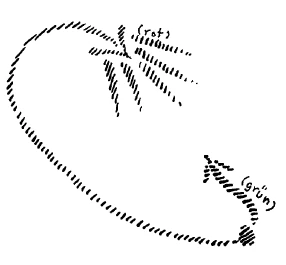
[ 10 ] Now one might say, for example: these two figures, Harun al-Rashid and his great advisor—that outstanding personality who had once been a deeply initiated one—parted ways; but in essence, they parted in order to work together after they had passed through the gate of death. Harun al-Rashid himself, who had lived in splendid royalty, chose the path I have shown you, all the way to England, to work in the realm of science as Bacon of Verulam. The other soul, the soul of his advisor, chose the path across (green arrow) to encounter, within Central Europe, what emanated from Bacon. Even if the time periods do not quite match, this is of no great consequence, for it holds little significance for those for whom time itself lacks deep meaning; for many things, often separated by centuries, interact within later civilization.
[ 11 ] Harun al-Rashid’s advisor chose the path through Eastern Europe into Central Europe during his life, between death and a new birth. And he was reborn in Central Europe, into Central European intellectual life, as Amos Comenius.
[ 12 ] And so we witness this remarkable, grand, and significant spectacle in the course of history: Harun al-Rashid emerging to initiate a cultural movement from west to east that is abstract and outwardly sensory; and from the East, Amos Comenius carried out his work in Transylvania—in what is now Czechoslovakia—extending as far as Germany, before going into exile in the Netherlands. Amos Comenius—as anyone who traces his life can see, given how he lived as the reformer of modern pedagogy for his time and as the author of the so-called “Pansophia”—brought over what he had developed at the court of Harun al-Rashid through an earlier initiation. At the time when the “Moravian Brethren” were founded—a time when Rosicrucianism had already been active for several centuries, and when The Chemical Wedding and The Reformation of the Whole World by Valentin Andreae were published— it was then that Amos Comenius, that great and significant mind of the 17th century, infused his own significant insights into all that was emerging from the same source.
[ 13 ] And so you see three significant earthly lives in succession—and it is precisely through significant earthly lives that one can then study the less significant ones and work one’s way up to an understanding of one’s own karma—so you see these three significant incarnations in succession: First, deep within Asia, the same individual who later appears as Amos Comenius, absorbing all the wisdom of Asia’s ancient times at an ancient site of mystery. It carries this wisdom forward to the next incarnation, in which it lives at the court of Harun al-Rashid, developing there into the magnificent organizer of all that blossoms and flourishes under Harun al-Rashid’s care and benevolence. Then it appears again, as it were, to meet Baco of Verulam—who is the reincarnated Harun al-Rashid—and to encounter him anew within European civilization, with a view to what both have to contribute to that civilization.
[ 14 ] What I am saying here is of great significance. For just follow the letters that were written and that made their way—of course in a more complicated way than is the case with letters written today—from Baconianists or people who were in some way close to Baconian culture, to the followers of the Comenius school, of Comenius’s wisdom. There, in the letters and replies, you can trace what I have sketched for you here on the board with a few strokes (see drawing).
[ 15 ] The letters written from West to East and from East to West represented the vibrant convergence of two souls who met in this way, having laid the foundation for this encounter while working together in the Orient during the 8th and 9th centuries, and who then reunited in activities that were opposite yet harmoniously complementary.
[ 16 ] You see, this is how history can be studied; this is how we see the living forces of humanity at work in history!
[ 17 ] Or let’s consider another case. Due to very special circumstances, my attention was drawn, so to speak, to certain events that—as we would say today—took place in northeastern France, but which also occurred in the 8th and 9th centuries, somewhat later than the period I have just been discussing. Special events took place there. It was, after all, a time when the great states had not yet emerged, and therefore what happened took place more within smaller circles of humanity.
[ 18 ] There was a man of energetic character who owned a large estate in the very region we would today call northeastern France. This man managed the estate in an exceptionally orderly manner—in a way that was, I would say, remarkably systematic for that time. He knew what he wanted and was a curious mixture of a determined man and an adventurer, so that he undertook small military campaigns—with varying degrees of success—from his estate, with men who, as was customary in those days, had dressed as warriors. These were small bands of soldiers with whom he set out to capture this or that.
[ 19 ] With a band of such warriors, the man in question set out from northeastern France. And it so happened that another individual—somewhat less adventurous than he himself, but energetic—seized the estate and the entire property during the owner’s absence; today this seems paradoxical, but back then such a thing could indeed happen. When the man in question returned home—he was unmarried—he found that another owner had taken possession of his estate. And events unfolded in such a way that, in fact, the man in question did not rise up against the current owner. The latter was the more powerful of the two, had more men, and had more warriors at his disposal. He did not rise up against him.
[ 20 ] Back then, things weren’t such that, if you couldn’t make a living in your homeland, you would immediately move to foreign lands. True, this man was an adventurer; but that didn’t happen so quickly after all—he didn’t have the means to do so—with the result that he, along with a band of followers, actually became a sort of serf on his own former master’s estate. He now had to work like a serf alongside the group of people who had set out on adventures with him, while his property had been taken from him.
[ 21 ] It so happened that among all the people who had become serfs—though they had once been lords—a mindset arose that was particularly, I would say, detrimental to the principle of lordship. And in those forested regions, fires blazed on many a night in the places where people gathered and discussed all manner of conspiracies against those who had seized their property.
[ 22 ] It was simply the case that the person in question, who had become more or less a serf or a slave to the large landowner, now spent the rest of his life—apart from the work he was required to do—devising plans for how he might once again acquire property and possessions. People hated the one who had seized the property.
[ 23 ] Well, you see, these two figures from that time passed through the gate of death in their individual forms, experienced everything in the spiritual world between death and a new birth that could be experienced since that time, and reappeared in the 19th century. The one who had lost his house and farm and had become a kind of serf reappeared as Karl Marx, the founder of modern socialism. And the other, who had taken his estate from him back then, reappeared as his friend Engels. What they had to settle between themselves back then was transformed, during the long journey between death and a new birth, into an urge to make amends for what they had done to one another.
[ 24 ] And read about what transpired between Marx and Engels; read everything that constitutes Karl Marx’s unique intellectual makeup, and keep in mind that the same kinds of individuals existed in the 8th and 9th centuries, just as I have told you. Then, I would say, every sentence by Marx and Engels will be illuminated in a new light for you, and you will not run the risk of saying in an abstract way that one thing is caused by this in history, and another is caused by that; rather, you will see the people who carry something over into another era—something that certainly appears quite different, yet still bears a certain resemblance to what came before.
[ 25 ] What do you think: in the 8th and 9th centuries, people gathered around forest fires and spoke differently than they had reason to speak in the 19th century—the era when Hegel was active, when everything was settled through dialectics. But try to imagine the forest in northeastern France in the 9th century: there sit the conspirators, the cursers, the railers, speaking in the language of their time. And translate that into the mathematical-dialectical language of the 19th century, and you’ll have what’s written by Marx and Engels.
[ 26 ] These are the things that lead us away from mere sensationalism—which can easily be associated with ideas about specific cases of reincarnation—and toward an understanding of historical life. And the best way to guard against error is not to focus on the sensational—not merely to ask, “What about reincarnation?”—but to try to understand, through the recurring earthly lives of individual human beings, everything connected with the historical unfolding of humanity’s joys and sorrows, suffering and happiness.
[ 27 ] Back when I was still living in Austria—even though I was part of the German-speaking community there—I was particularly fascinated by a certain figure who was a Polish member of the Imperial Council. I believe many of you will recall that I have often spoken of the Austrian-Polish Imperial Council member Otto Hausner, who was particularly active in the 1870s. Those of you who have been here longer will recall this. And ever since I repeatedly heard and saw Otto Hausner in the Austrian Imperial Council in the late 1870s and early 1880s, the image of this remarkable man has remained vivid in my mind: He wore a monocle in one eye; with his other eye he looked thoroughly shrewd, but in such a way that he lay in wait for his opponents’ weaknesses with the other eye, the one peering through the monocle. While he spoke, he would then check to see if the arrow had hit its mark.
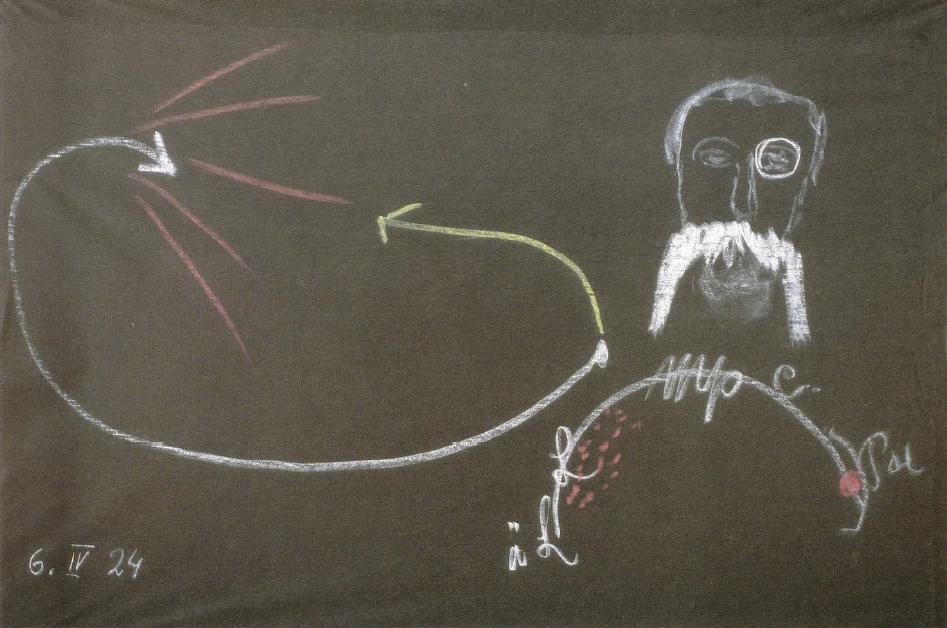
[ 28 ] He—who had a very peculiar mustache (I did not wish to go into such details in my autobiography)—was able to use this mustache in a remarkable way to accompany what he was saying, so that the mustache became a strangely animated eurythmy of the words he hurled in the face of the opposing representative in the manner described.
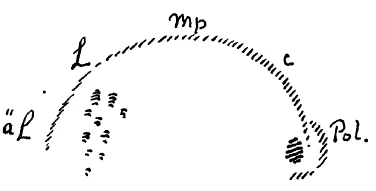
[ 29 ] It was quite an interesting scene. Just imagine: the far left, the left, the centrist party, the Czech Club, then the far right, the Polish Club; Hausner stood here, and here were all his opponents on the far left. There they all were; and the most curious thing was that when Hausner, on the issue of the Bosnian occupation, spoke in favor of Austria, he received thunderous applause from those people over on the left. When he later spoke about the construction of the Arlberg Railway, he faced outright opposition from those very same people on the far left. And this opposition persisted with regard to everything he subsequently expressed.
[ 30 ] But much of what Otto Hausner said in the 1970s and 1980s—as a warning, as a prophet—has come true to the letter right up to the present day. Today, in particular, we have reason to often look back on what Otto Hausner said back then.
[ 31 ] Well, there was one thing that stood out in almost every one of Otto Hausner’s speeches, and that—along with a few other, less significant aspects of Hausner’s life—became the impetus for me to trace the karmic path of this individual.
[ 32 ] Otto Hausner could hardly give a speech without inserting, as it were, a sort of panegyric on Switzerland. He always held up Switzerland as a model for Austria. Because three nationalities coexist harmoniously in Switzerland—and are exemplary in their coexistence—he also wanted the thirteen Austrian nationalities to take Switzerland as their model and for these thirteen to coexist in a similar, federalist manner as those three nationalities in Switzerland. He kept coming back to this point; it was remarkable. Hausner’s speeches were marked by irony, humor, and an inner logic; not always, but time and again, the panegyric on Switzerland would resurface. You could always see it there: the development of a genuine sympathy; it stung him, and he wanted to say it. Then he knew how to structure his speeches so that, in fact, no one else—except for a group of left-wing, liberal members of parliament—but they were terribly! — would be annoyed. It was very interesting to see how, whenever some left-liberal member of parliament had spoken, Otto Hausner would rise to respond, never taking his monocle-adorned eye off him, yet hurling the most unbelievable insults at the left. There were prominent men there, but he spared no one. And his perspectives were, at heart, always grand; he was one of the most educated men in the Austrian Imperial Council.
[ 33 ] One might well be interested in the karma of such a person. I assumed that he had this sort of side passion—always returning to a eulogy of Switzerland—and then that, in a speech on “Germanness and the German Empire,” which was also published as a pamphlet, he had compiled—with great futility but with genius—everything that could be said in favor of Germanness and against the German Empire of that time. There really is something magnificently prophetic in this speech, delivered in the early 1880s, in which the German Empire is, so to speak, torn to shreds, accused of every evil, and called the ruiner of the German essence—and these assertions were substantiated. That was the second thing: his peculiar—I would say—loving hatred and his hating love for German identity and the German Empire.
[ 34 ] And the third thing was how Otto Hausner spoke with such tremendous vitality back then, when the Arlberg Tunnel and the Arlberg Railway were to be built—the railway that runs from Austria over to Switzerland and was thus intended to connect Central Europe with the West. Of course, he also sang Switzerland’s praises back then, since the railroad was, after all, supposed to lead into Switzerland. But when he gave this speech—which was certainly spiced up, yet in a truly delicate way—one really had the feeling: this is a man who knows how to draw upon things that, in a strange way, must have been instilled in him during a previous earthly life.
[ 35 ] At the time, everyone was talking about the tremendous benefit that European civilization would derive from the German-Austrian alliance. Otto Hausner proposed in the Austrian Parliament at the time—for which, of course, everyone else tore him to shreds—that the Arlberg Railway must be built, because a state such as he envisioned for Austria, modeled after Switzerland and uniting thirteen nations, must have the freedom to choose its allies; and if it suited it, it would have Germany as an ally, and if it suited it, it would need a strategic route from Central Europe to the West in order to be able to have France as an ally. Of course, when that was voiced in Austria at the time, he was, as they said in Austria, thoroughly shot down. But it was truly a speech wonderfully seasoned with all manner of spice. The management passed this speech on to the West.
[ 36 ] And as I pieced these things together, I discovered how the individuality of Otto Hausner made its way from west to east through northern Switzerland—at the same time that Gallus and Columban also made their way there. He was to bring Christianity. He traveled over with those people who had been inspired by Irish initiations. He was to transplant Christianity there with them. Along the way, roughly in the region of present-day Alsace, he was immensely drawn to the antiquities of Germanic paganism—drawn to all that existed in Alsace, in Alemannic regions, and here in Switzerland in the form of ancient memories of the gods, worship of the gods, images of the gods, and statues of the gods. He absorbed all of this in a profoundly meaningful way.
[ 37 ] And something began to develop within him that, on the one hand, could be called an inclination toward the Germanic essence; on the other hand, however, a counterforce to this also developed: the feeling that he had gone too far at that time. And what he experienced in a tremendous inner transformation, in a tremendous inner metamorphosis, then manifested itself in these comprehensive perspectives. He could speak of German identity and the German Empire like someone who had once been intimately involved in all these matters, but who had actually absorbed them without intending to. After all, he was supposed to have spread Christianity. He had, so to speak, without intending to, found himself in those regions—you could hear it even in his turns of phrase—and he wanted to return to make amends for these things. Hence his passion for Switzerland, hence his passion for the construction of the Arlberg Railway. One could even say that this was expressed in his outward appearance—if you look at him, he didn’t really look Polish. And Hausner also said at every opportunity that he wasn’t even Polish by physical descent, but only by civilization and upbringing; that “Rhaetian-Alemannic” blood cells, as he put it, flowed through his veins. However, he had carried over from a previous incarnation the tendency to always look toward the region where he had once been—the place to which he had journeyed with Columban and Saint Gall, where he had intended to spread Christianity but had in fact been held back by Germanic culture. Thus, he made an attempt, so to speak, to be reborn into a family that was as un-Polish as possible, and to remain at a distance from—yet at the same time to regard with longing—that which he had once been completely immersed in.
[ 38 ] You see, my dear friends, these are examples I wanted to present to you first today to draw your attention to how remarkable the course of karmic development is. Next time, we will delve deeper into the way in which good and evil unfold through human incarnations and throughout historical life. In this way, however, we will be able to shed light on more everyday circumstances, drawing specifically on the more significant examples that we encounter in history.