Esoteric Considerations of Karmic Connections
Volume II
GA 237
4 July 1924, Dornach
Translated by Steiner Online Library
Second Lecture
[ 1 ] Today I will have a few more things to say about how the karmic preparatory forces in a human being continue their development after the person has passed through the gate of death. We must realize that, from the perspective of ordinary consciousness, the formation of karma—that interaction with the world which can be called karmic—takes place in human beings more instinctively. We see animals acting instinctively. Precisely such terms as “instinct,” which are used very frequently both within and outside of science, are usually employed in a completely vague manner. No effort is made to conceive of anything more precise by that term. What, then, is it in animals that we call “instinct”?
[ 2 ] We know that animals have a group soul. The animal, as it is, is not a self-contained being; rather, the group soul stands behind it. To which world does the group soul actually belong? We must answer the question: Where are the group souls of animals to be found? Here in the physical-sensory world, one does not find the group souls of animals; here there are only the individual animals. One finds the group souls of animals only when, either through initiation or in the ordinary course of human development, one enters—between death and a new birth—the entirely different world that a human being passes through between death and a new birth. There, among the beings with whom one is then together—and among whom are primarily those I have mentioned as the ones with whom one works out karma—one finds the group souls of the animals. And the animals that are here on this Earth, when they act instinctively, do so out of the full consciousness of these group souls. So you can imagine, my dear friends, how—if we schematically depict the realm here in which we live between death and a new birth (see diagram, yellow)—the forces emanating from the group souls of the animals (blue) are at work. They are there as well. And here on this Earth are the individual animals, which act, as it were, by being guided by the threads that lead to the group souls found in the realm between death and a new birth. That is instinct.
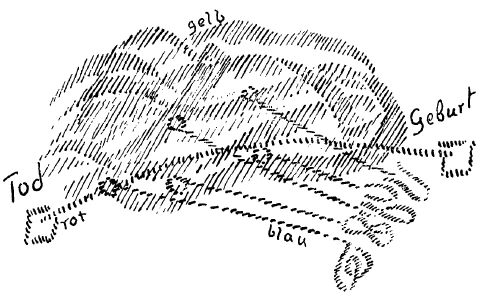
[ 3 ] It is only natural that a materialistic worldview cannot explain instinct, because instinct is an action arising from what Ste, for example, refers to as the “spirit realm” in my book Theosophy and in my Outline of the Occult Science. With human beings, it is different. Human beings also have an instinct, but when they are here on Earth, they do not act through this instinct from within that realm; rather, they act based on their past earthly lives—beyond time, from their past earthly lives, from a number of past earthly lives (red). Just as the spiritual realm influences animals in such a way that they act instinctively, so do a person’s earlier incarnations influence their later incarnations in such a way that karma is simply lived out instinctively—but it is a spiritual instinct; it is an instinct that works within the “I.” It is precisely when one considers this that one will perceive the absolutely consistent union of this instinctive activity with human freedom. For freedom operates from the same realm from which animals act instinctively: from the spiritual realm.
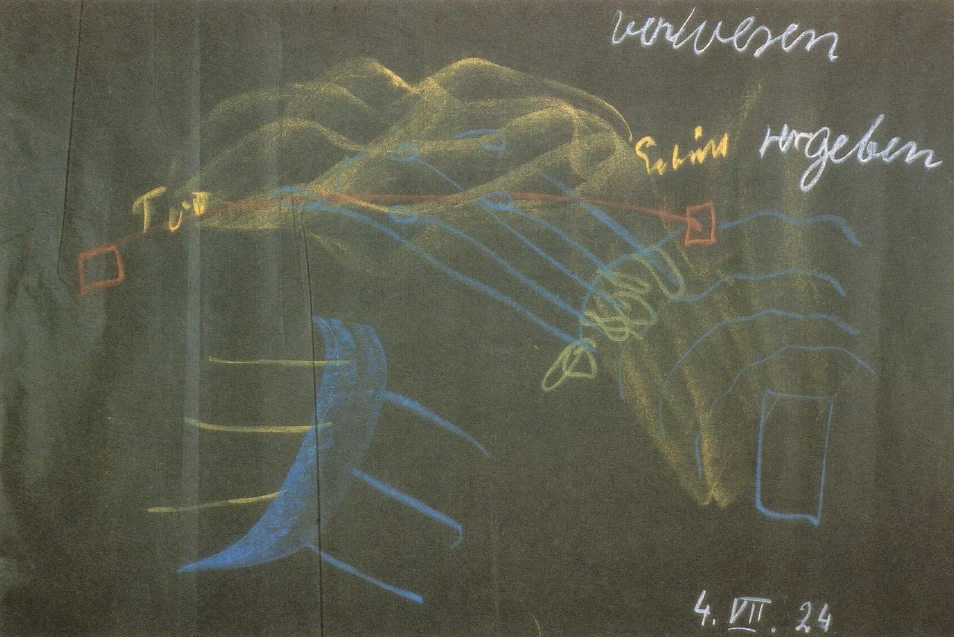
[ 4 ] Today, however, we will be much more concerned with how this instinct prepares itself when a person passes through the gate of death. Here in earthly life, the karmic experience is instinctive; it takes place, so to speak, beneath the surface of consciousness. At the very moment we pass through the gate of death, everything we initially experienced on Earth becomes objectively conscious over the course of a few days; we see it before us in ever-expanding images. Along with what we survey there goes, too, that which has unfolded instinctively within the workings of karma. So that when a person steps through the gate of death and life unfolds before their eyes, growing ever larger (see illustration, yellow), all of this is accompanied by what was only instinctive to them, not conscious: the entire karmic fabric (blue). They do not see this immediately in the days following death, but they do see—in vivid form—what they would otherwise only glimpse as a faint memory; for example, they see that there is already something different there than ordinary memory. When one then surveys, with the initiatory gaze, what the person has before them, the following can be explained.
[ 5 ] The person who has died—and who possessed ordinary consciousness during their earthly life—sees, so to speak, what lies before them as their earthly life in a vast panorama; they see it, so to speak, from the front (see illustration, blue). With the initiatory gaze, one can also view it from the other side, from the back (yellow); then the web of karmic connections emerges. There one sees it—this web of karmic connections, which are initially still woven from thoughts that were lived out in the will during one’s earthly life—that is what emerges.
[ 6 ] But now another thought follows immediately, my dear friends. I have often emphasized this to you: the thoughts that one consciously experiences during earthly life are dead; but those thoughts that are woven into karma and emerge from it are alive. So that, looking back through the panorama of life, living thoughts spring forth. And now the immensely significant and essential aspect of this is that the beings of the third hierarchy are approaching and receiving what is sprouting forth—I might say—from the reverse side of the life-overview. Angels, archangels, and archai, so to speak, absorb what is sprouting forth there; they breathe it in.
[ 7 ] This takes place during the period in which the human being ascends to the end of the lunar sphere. Then he enters this lunar sphere, and the journey backward through life begins, which lasts one-third of the time the person has lived on Earth—or, to be more precise, lasts as long as the periods of sleep the person spent on Earth.
[ 8 ] I have, of course, already explained to you on several occasions how this “life in reverse” takes place. But let us first ask ourselves: When a person is in ordinary sleep, how does that state compare to the state in which they find themselves immediately after death? Well, you see, when a person falls into ordinary sleep, as a spiritual-soul being they exist only in their “I” and in their astral body. They do not have their etheric body with them; it has remained behind in the bed. As a result, thoughts remain lifeless, have no active effect whatsoever, and are merely images. Now, as a person passes through the gate of death, they first take their etheric body with them, which then expands; and the etheric body now contains the life-giving force not only for the physical being but also for the thoughts. This is how thoughts can come to life: because the human being has taken their etheric body with them, which, in the process of detachment, carries the living thoughts out from the human being to be graciously received by the Angeloi, Archangeloi, and Archai.
[ 9 ] This is, I would say, the first act that takes place in life between death and a new birth: that beyond the threshold of death, the beings of the third hierarchy approach what is detaching itself from the human being—that which is entrusted to his dissolving etheric body—and that this is received by the beings of the third hierarchy. And as human beings, we offer a good, beautiful, and magnificent prayer when we reflect on the connection between life and death, or on a departed soul, in such a way that we say:
Angels, Archangels, and Archai in the etheric web
receive the web of destiny of the person in question.
[ 10 ] For here we are looking at a spiritual reality. And it does depend to some extent on whether people conceive of spiritual realities or not—whether they merely accompany the dead with thoughts that remain on Earth, or whether they accompany the dead on their further journey with thoughts that are reflections of what takes place in that realm into which the dead have entered.
[ 11 ] This, my dear friends, is precisely what appears so immensely desirable to today’s science of initiation: that within earthly life, we conceive of things that are a reflection of a real spiritual event. Mere theoretical thinking—merely thinking about the fact that human beings have higher members, or simply listing these higher members—does not yet establish a connection with the spiritual world. Only by thinking about realities that take place in the spiritual world is such a connection with the spiritual world established.
[ 12 ] Therefore, hearts should once again be able to perceive what hearts perceived during the ancient times of initiation in the ancient mysteries, when the words were always impressively proclaimed to those to be initiated: “You who shape the fates of the dead!” All that remains is the phrase “Memento mori,” which has become more or less abstract; it can no longer have a profound effect on people today precisely because it has become abstract, because it does not expand consciousness into a life more vibrant than that which exists here in the sensory world.
[ 13 ] And what is the reception of the human web of destiny by the Angeloi, Archangeloi, and Archai? It unfolds in such a way that one gets the impression: it weaves and lives within a violet-blue etheric atmosphere. It is weaving and living within a violet-blue etheric atmosphere.
[ 14 ] And when the etheric body dissolves—that is, when the thoughts have been inhaled by the Angeloi, Archangeloi, and Archai—then, after a few days, the human being enters into this “re-living,” as I have described it to you. There the human being experiences his deeds, his impulses of will, and his trains of thought just as they have affected the other people to whom he has done something good or evil. He immerses himself completely in the minds of other people; he does not live in his own mind. With the clear awareness that it is he who has had a hand in these matters, he experiences the events that have taken place in the depths of the souls of other people with whom he has entered into a karmic connection—those to whom he has inflicted anything at all, whether good or evil. Here it becomes evident once again how what the human being experiences in this way is now perceived. He experiences it in full reality—a reality that I had to describe as even more real than the sensory reality between birth and death. He thus experiences a reality in which, I might say, he stands more intensely immersed than here in earthly life.
[ 15 ] If, in turn, one views this from the perspective of initiatory insight—from the other side—one sees how what the human being experiences there is now absorbed into the essence, into the reality of Kyriotetes, Dynamis, and Exusiai. These absorb the negative aspects of human actions. They are permeated by them. And this view—this initiated gaze—which now looks upon this truly wondrous phenomenon, as the consequences of human actions carried out in righteousness are absorbed by Exusiai, Dynamis, and Kyriotetes—this entire vision transports the one who beholds it into such a state of consciousness that he knows he is at the center of the sun, and thus at the center of the planetary system. He observes what is happening from the perspective of the Sun. And he sees a lilac-like weaving and life; he sees the absorption of human deeds carried out in righteousness by the Exusiai, Dynamis, and Kyriotetes within the weaving and life of a bright violet, lilac-colored astral atmosphere.
[ 16 ] You see, the truth is that the view of the sun, as it appears to human beings on Earth, is indeed only from one side—from the periphery. From the center, the sun appears as the realm where spiritual forces—the actions of Exusiai, Dynamis, and Kyriotetes—take place. There, everything is spiritual action, spiritual event. There we find, I might say, the reverse side of the images of earthly life that we experience here between birth and death.
[ 17 ] And once again, we think correctly about what is happening there when we frame our thoughts in such a way that we take the word—which is usually used only to mean “fading,” “passing away,” “wilting,” or “being destroyed”—in its true sense. We have the word “essence,” we have the word “giving.” When we say “forgive,” it means “to give away.” Only in card games is it called something else, but in natural language it means “to give away.” When we say “to let the essence pass,” it means to guide the essence onward. With this awareness, we form the sentence:
They are reflected in exousia, dynamis, and kyriotetes
in the astral perception of the cosmos
as the just consequences of human life on Earth.
[ 18 ] Then, when this is accomplished—when the human being has lived through this third of earthly life after death, has returned, and now finds himself once again at the starting point of earthly life, but in the spiritual realm, in that moment before his entry into earthly life—the human being, so to speak, enters the actual realm of the spirits through the center of the sun. There, these earthly deeds—transformed into righteousness—are now incorporated into the activity of the first hierarchy. There they enter the realm of the Seraphim, Cherubim, and Thrones. There the human being enters a realm where, upon entering, he feels: what has been accomplished on Earth through me is taken up into the very essence of their own deeds by the Seraphim, Cherubim, and Thrones. Just consider, my dear friends, that we think correctly about what happens to the ‘dead’ in the life beyond death when we cherish the thought: What he has woven here on Earth into the web of destiny is first received by the Angeloi, Archangeloi, and Archai. They carry it onward, in the next phase between death and a new birth, into the realm of the Exusiai, Dynamis, and Kyriotetes. These are encompassed and enveloped by the beings of the first hierarchy. And in this enveloping and entwining, the human being’s actions on Earth are always incorporated into the essence, into the nature of action, and into the deeds of the Thrones, Cherubim, and Seraphim. And we are again correct in our thinking when we now add a third sentence to the first and second:
They arise in thrones, cherubim, and seraphim
as beings whose deeds
are the righteous manifestations of human life on earth.
[ 19 ] So that when we direct our initiatory gaze toward what is constantly happening in the spiritual world, we see here on Earth the activities of human beings with their karmic instincts, with what unfolds as the fabric of destiny: a fabric more or less similar to the fabric of thought. But if we turn our gaze upward into the spiritual worlds, we see how that which was once the earthly deeds of human beings—after passing through the Angeloi, Archangeloi, Archai, Exusiai, Dynamis, and Kyriotetes—is taken up and spreads out above as heavenly deeds among the Thrones, Cherubim, and Seraphim (it is written on the tablet):
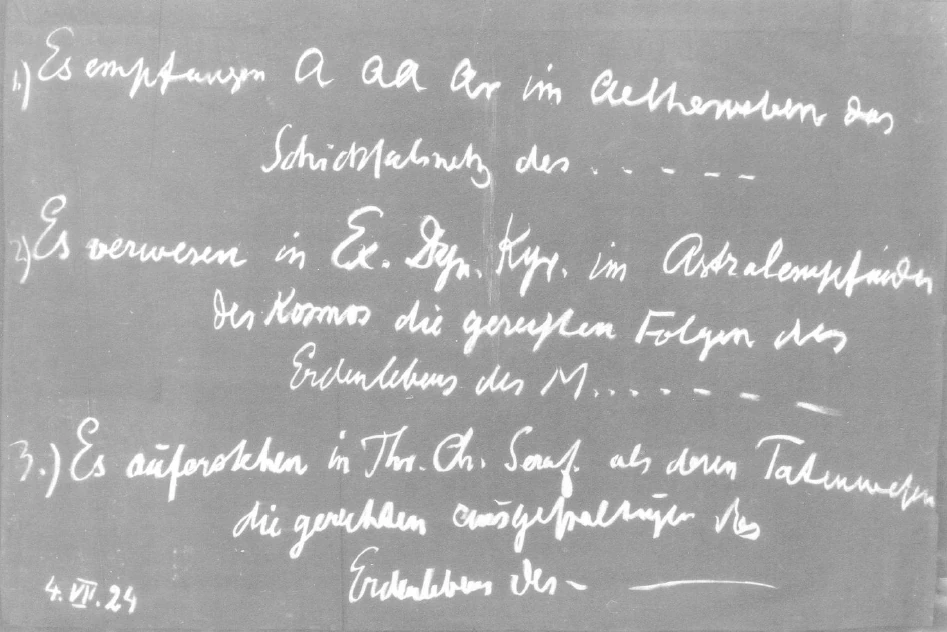
[ 20 ] 1. Angels, archangels, and archai receive the web of human destiny within the etheric fabric.
2. In Exusiai, Dynamis, and Kyriotetes, within the astral perception of the cosmos, the just consequences of human life on Earth are determined.
3. In Thrones, Cherubim, and Seraphim, as beings of action, the just manifestations of human life on Earth arise.
[ 21 ] That, my dear friends, is—especially in the present—a significant, an infinitely significant, and an infinitely sublime series of facts. For now, in the Michael Realm that has come to pass, it is the case—I would say—that at this moment in world history, the deeds of those people who lived here on Earth in the 1880s and 1890s, before the end of the Kali Yuga, can be beheld; that which existed among human beings at that time has now been taken up by thrones, cherubim, and seraphim. But never has the spiritual contrast of light been as great as it is in the present for this series of events.
[ 22 ] If, in the 1880s, one looked up and saw how the revolutionaries of the mid-19th century were, in a sense, received in their deeds by thrones, cherubim, and seraphim, then one could see that a certain gloom hung over the mid-19th century. And there was only a slight brightening of what one then saw upon entering the realm of the seraphim, cherubim, and thrones.
[ 23 ] But if one now looks back on what took place at the end of the 19th century in terms of human actions and the relationships among people—after having been able to see clearly, just a short while ago, during this waning Kali Yuga, after having been able to see, to some extent, what was taking place there and, so to speak, to penetrate like fleeting masses of thought what unfolded as a matter of destiny among these people at the end of the Kali Yuga—then all that fades away, and one beholds what has risen from it toward the heavens in a radiant, bright light.
[ 24 ] But this testifies to nothing other than the immense significance of what is actually taking place in the transformation of human deeds on Earth into deeds of the soul in Heaven in the present. For what a person experiences as his destiny, as his karma, unfolds for him, within him, and around him, from one earthly life to the next. But what unfolds in the region of the heavenly realms as a consequence of what a person has experienced and accomplished here on Earth continues to exert an influence on the historical shaping of earthly life. This takes place in the realm of what a person here on Earth cannot control as an individual.
[ 25 ] Please take this sentence in all its gravity, my dear friends. Each individual experiences his or her own destiny. Even when two people interact, something entirely different arises than the fulfillment of each person’s destiny. Something takes place, so to speak, between the two people that goes beyond what each individual experiences. To ordinary consciousness, no connection is initially apparent between what takes place between people and what happens above in the spiritual worlds. Only when sacred-spiritual action is brought into the physical-sensory world—when people consciously transform their physical-sensory deeds so that they are simultaneously deeds in the spiritual world—is such a connection established.
[ 26 ] But everything that then happens among people on a larger scale is, after all, something different from what the individual experiences as fate. All that which is not the fate of an individual, but rather what is brought about through the collective thinking, feeling, and acting of people on Earth, is connected to what the Seraphim, Cherubim, and Thrones do up above. And into this flow the deeds of human beings within the context of their collective lives, as well as the individual human lives on Earth.
[ 27 ] Then, the further vision that presents itself to the initiated gaze is of particular importance. We look up. Above, the heavenly sequence of events is now revealed—the events that unfolded here on Earth during the last seventy years, the eighties, and the nineties of the previous century. It is as if a fine rain, a spiritual rain, were falling upon the Earth, moistening human souls and drawing them toward what, in a sense, arises historically among human beings.
[ 28 ] And there, in turn, one can see how—in living reflections of thought—that which was accomplished here on Earth by human beings in the 1870s, 1880s, and 1890s lives on today through the Seraphim, Cherubim, and Thrones.
[ 29 ] When you see through this, you often find that you can see quite clearly: You speak with a person today; what they tell you—based on general opinion, not stemming from their own emotions or inner impulses, but rather what they say simply because they are a product of this age—often seems to you to be connected to those people who lived in the 1970s, 1980s, and 1990s of the last century. It is truly the case that one sees some people today as if in a spiritual gathering, surrounded by certain people who are concerned with them, but who are actually only the afterimages, rained down from heaven, of what was lived through by people in the last third of the 19th century.
[ 30 ] This is how the revenants—I would say, the very real ghosts of an earlier age—truly roam in a later age. It is one of the subtle, general effects of karma that exist in the world, and which are often overlooked even by the most occult of occultists. One might want to whisper in the ear of some people who say something to you today that is not personal but stereotypical: “That’s what so-and-so told you in the last third of the 19th century!”
[ 31 ] Only then does life become a whole. And once again, it must be said of this era—this era that began with the end of the Kali Yuga—that it differs from all earlier historical eras. It differs in that the human actions that took place in the last third of the 19th century have had the greatest possible influence on the first third of the 20th century.
[ 32 ] My dear friends, I say this to describe something that is far removed from any use of superstitious language; I say it with the full awareness that I am stating an exact fact: Never before have the ghosts of the era that preceded us walked among us as audibly as they do today. And if people today do not perceive these ghosts, it is not because we are living in a dark age, but because people are still, for the time being, dazzled by the light of the Age of Light. Consequently, what is being wrought among us by the revenants of the previous century is something immensely fruitful for the Ahrimanic forces. The Ahrimanic forces are at work today, unnoticed by people, in a particularly pernicious way. They are attempting to galvanize as many of these ghosts of the previous century as possible—I would say in an Ahrimanic way—and to make them exert influence on the people of the present.
[ 33 ] There is nothing that can counter this Ahrimanic tendency of our age more effectively than the very fact that popular associations are forming in support of the aberrations of the previous century—ideas that, for those with insight, have long since faded into obscurity. Never before has the laity popularized the aberrations of the previous century as strongly as in the present age, as in the present day. And one can certainly say: if one wishes to understand the nature of Ahrimanic deeds, one can actually do so today wherever one attends gatherings that operate out of ordinary consciousness. Today there are many opportunities to become acquainted with Ahrimanism in the world, for it is at work with extraordinary intensity. And it is precisely this force that, through the indirect means I have described today, prevents people from taking into their hearts and souls that which must now emerge—precisely because it was not there before—such as what is now coming to light in anthroposophy.
[ 34 ] People are already satisfied if they can somehow tie what is emerging anew in anthroposophy to some old saying. Just look at how satisfied people are when something comes up in one of my lectures that allows someone to say: “Look, that’s in an old book, too.” — But it’s presented quite differently there, based on entirely different states of consciousness! Yet people lack the courage to embrace what is growing out of the present, so they feel reassured just by being able to dredge up something like that from the past.
[ 35 ] This simply demonstrates how strongly impulses from the past influence people today and how comforted people of the present feel when these impulses affect them. And this stems precisely from the fact that the 19th century continues to exert such a strong influence on the 20th century. Future observers of the history of humanity as it is today—who will, of course, describe it in spiritual terms, whereas we today merely describe it based on documents—will, above all, have to describe what is contained in the following words: If one looks at the beginning of the 20th century, at the first three decades, it all appears, for the most part, as if it were actually the work of the shadows cast by human deeds from the end of the 19th century.
[ 36 ] If I may perhaps say a few words here—which are truly not meant in a political sense—politics must be kept entirely out of our Anthroposophical Society—but if I may say a few words here that are simply meant to describe facts, then it is this: One can look at the world-shaking deeds—or rather, events, for they were not actually deeds—but at the world-shaking events, particularly those of the second decade of the 20th century. It has, after all, been stated so often that it has become a cliché to say that, in fact, as long as the period about which history is written has lasted, nothing so earth-shattering has ever occurred. But are people not, when it comes down to it, so deeply immersed in these earth-shattering events that it is as if they were not part of them at all? People go about their business everywhere; it is as if these world-shaking events were taking place outside of them, as if people had no part in them at all. One is almost tempted to ask every person one meets today: “So, were you actually part of the second decade of the 20th century?” And when one looks at the matter from yet another perspective: how helpless people seem, how infinitely helpless, how helpless in their judgment, how helpless in their actions! Ministerial posts have never been filled under such great difficulties as in this era. Just consider how curious it is what is actually happening in this regard, how helpless people are in the face of what is unfolding! This naturally leads one to ask: “Well, who is actually doing anything here?” Who is actually involved? Well, my dear friends, those involved are, more than the people of the present, the people of the last third of the 19th century. Their shadow forces can be seen at work in everything.
[ 37 ] You see, that is the mystery of our time. One might say: No other dead people have ever been as powerful as those from the last third of the nineteenth century. This is also a global phenomenon. And when one examines the relevant aspects in detail with regard to their spiritual content, one arrives at something quite remarkable.
[ 38 ] For me, the question was whether I should change this or that in the new edition of my writings, which were written in the 1870s, 1880s, and 1890s. Those who are mere philistines of the present day say: Everything has changed; the scientific theories and hypotheses of that time are, after all, long-discarded notions. — But if one considers the matter from a realistic standpoint, there is nothing to change. For in truth, behind everyone who writes a book today or lectures from a pulpit, there stands a shadow figure: it is still the Du Bois-Reymonds, the Helmholtzes, the Haeckels—those who spoke in that era—who are speaking; in medicine, the Oppolzes, Billroths, and so on. This is part of the mystery of the present. That is why the science of initiation says: Never have the dead been as powerful as in our age.
[ 39 ] That is what I wanted to include in these reflections on karma.