

Esoteric Considerations of Karmic Connections
Volume II
GA 237
1 July 1924, Dornach
Translated by Steiner Online Library
First Lecture
[ 1 ] Today, for those who are able to be here, I would like to elaborate on a few points that may serve as a sort of interlude within the reflections we have been exploring here for some time now. What I have to say is intended to illustrate and explain certain points that may arise as questions from what we have discussed so far, and at the same time, it should shed some light on the state of mind of our present-day civilization.
[ 2 ] For years now, we have had to draw attention to a very specific point in the development of European civilization, which lies in the middle of the Middle Ages, around the 14th and 15th centuries. We are thus pointing to that point in human development where intellectualism begins, where people start to focus primarily on thinking and on the intellect, and to make it the judge of what should be thought and done among human beings.
[ 3 ] Now, since we are living in the Age of the Intellect, we can, at best, gain a true understanding of what intellectualism is—that which came to the surface of civilization in the 14th and 15th centuries—by experiencing the present. But the state of mind that preceded it is something we no longer really sense in a living way today. When we look at history, we actually project what we are accustomed to seeing in the present further back into the course of history, and we don’t get much of a sense of how completely different the mindsets were before that period. And when one lets historical documents speak for themselves, one tends to read into them, to a large extent, the very ways of thinking and perspectives that are characteristic of our own time.
[ 4 ] From a humanities perspective, however, many things appear quite differently. And if, for example, one turns one’s gaze to those figures who, emerging from Arab culture and the culture of Asia, were influenced on the one hand by what took shape as the religion of Islam, but on the other hand were also influenced by Aristotelianism—if one looks at these figures, who then found their way across Africa to Spain, who profoundly influenced the minds of Europe, and who—through Spinoza and beyond—continued to influence the minds of Europe, then one cannot gain any insight into them by imagining their state of mind as if they were simply people of the present, except that they did not yet know this or that, which was later discovered. For that is more or less how one imagines them. But the way of thinking and perceiving of even those figures from the aforementioned cultural tradition who lived around the 12th century was quite different from that of today.
[ 5 ] Today, when people look back on themselves in this way, they feel themselves to be the possessors of thoughts, feelings, and impulses of will that then become actions. Above all, people attribute to themselves the “I think,” the “I feel,” and the “I will.” For these spirits, for these personalities of whom I am now speaking, the “I think” was not yet accompanied by the kind of feeling with which we say today: “I think—,” but only the “I feel” and “I will.” These people attributed only their feeling and their willing to their own personality. Rooted in the foundations of ancient civilization, they lived much more in the sense of “it thinks within me” than in the sense of “I think.” They certainly thought, “I feel, I will,” but they by no means thought to the same extent, “I think”; rather, they told themselves—and this was a very real perspective that I now wish to share with you—that thoughts are in the sublunar sphere; that is where thoughts live. — These thoughts are everywhere in that sphere, which is defined by our imagining the Earth (see drawing, blue) at a certain point, the Moon here at another, then Mercury, Venus, and so on. They conceived of the Earth as a dense, solid mass of matter, but they also conceived of the lunar sphere extending up to the Moon (yellow) as an integral part of it.
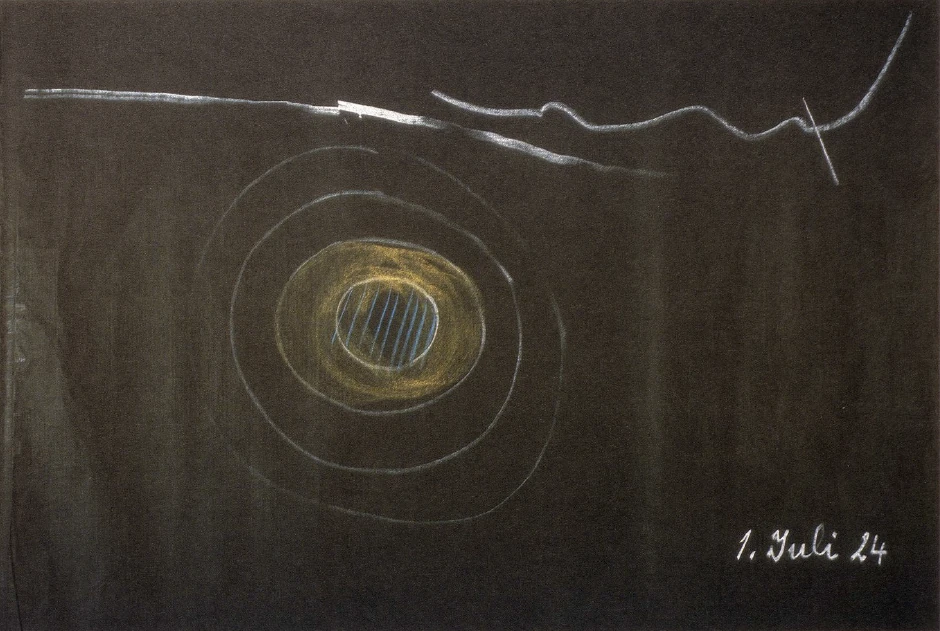
[ 6 ] And just as we say that the air we breathe contains oxygen, so these people said—it has simply been completely forgotten that this was the case—that the ether, which extends all the way to the moon, contains thoughts. — And just as we say that we inhale the oxygen in the air, these people did not, of course, say: “We inhale thoughts,” but rather: “We perceive thoughts; we take in thoughts.” And they were aware that they were taking them in.
[ 7 ] You see, today a person can, for my sake, take something like this on as a concept. He may even be able to understand something like this from the perspective of anthroposophy. But they forget it right away when it comes to practical life. When it comes to practical life, they immediately form a very strange notion—they imagine that thoughts arise within them, which would be just as if they thought that the oxygen they breathe in were not taken in from the outside but arose from within them. For the individuals I am speaking of, it was precisely a deep feeling, an immediate experience: I do not possess my thoughts as my own; I should not actually say, “I” think, but rather, “thoughts are,” and I take them in, these thoughts.
[ 8 ] Well, we know that the oxygen in the air completes a cycle through our organism in a relatively short time. We count these cycles based on our heartbeats. It happens quickly. The individuals I am speaking of already imagined the absorption of thoughts as a kind of breathing—but a very slow breathing, a breathing that consists in the fact that, at the beginning of earthly life, a person becomes capable of absorbing thoughts. Just as we hold our breath for a certain time between inhaling and exhaling, these people also imagined a process in which they now hold onto thoughts—but only in the same way that we hold onto the oxygen that belongs to the outside air. This is how they imagined it: they hold onto thoughts—specifically during the course of their earthly life—and they exhale them back out into the vastness of the world when they pass through the gate of death. Thus, the process consisted of inhalation: the beginning of life; holding one’s breath: the duration of earthly life; exhalation: sending thoughts out into the world. People who experienced this inwardly felt connected to all others who experienced it in the same way, within a shared atmosphere of thought that extended not merely a few miles above the Earth, but all the way to the Moon’s orbit.
[ 9 ] One can now imagine that this view, which at that time was fighting for European civilization, sought to spread farther and farther, particularly through those Aristotelians who had made their way from Asia to Europe along the route I have indicated. One could now imagine that this view had indeed spread. What would have become of it?
[ 10 ] Yes, it would not have come to pass that, in the fullest sense of the word, what was bound to unfold in the course of Earth’s evolution could have unfolded: namely, the soul of consciousness. The people I am speaking of here were, so to speak, in the final stage of the development of the intellectual or emotional soul. The consciousness soul was to emerge in the 14th and 15th centuries, and when it played itself out to the extreme, it transformed everything in civilization into intellectualism.
[ 11 ] The European population as a whole in the 10th, 11th, and 12th centuries was by no means fully capable of simply accepting a view such as that held by the individuals I have described, for the development of the conscious soul would then not have taken place. Even if it was, so to speak, decreed by the gods that the conscious soul should develop, the fact remained that this conscious soul could not have developed out of the independent activity of European humanity as a whole; rather, an impulse had to come, as it were, that was directed toward the specific development of the conscious soul.
[ 12 ] Thus, from the era I have just described, we see two intellectual currents emerging. One intellectual current was represented, so to speak, by the Arabizing philosophers who, coming from Western Europe, exerted a powerful influence on European civilization—far more so than is generally believed today. The other current was the one that most vehemently opposed the current I have described, and which, with the utmost severity, denounced this view as the most heretical for Europe. Just how strongly this sentiment persisted for a long time, my dear friends, you can sense when you look at paintings in which, for example, Dominican monks or Thomas Aquinas himself are depicted in triumph, in the triumph of an entirely different worldview—one that emphasizes above all else the individuality and the personal nature of the human being, that works toward the human being appropriating his thoughts as his own property—and where these Dominicans are depicted trampling the representatives of Arabism underfoot. They lie beneath their feet; they are being trampled. It is precisely in such a contrast that the two currents were long perceived. The emotional energy embodied in such a painting is, in fact, no longer present in today’s somewhat apathetic humanity. We certainly do not need it for the causes that were fought for back then, but we do need it very much indeed for other causes!
[ 13 ] Let us consider what was presented there: the inhalation of thoughts from the world ether, from the sublunar sphere: the beginning of life; holding one’s breath: earthly life; exhalation: once again, the outward flow of thoughts—but now imbued with an individual human character—into the world ether, into the impulses of the sphere beneath the moon, into the impulses of the sublunar sphere.
[ 14 ] What, then, is this exhalation? Exactly the same thing, my dear friends, as what we say: in the three days following death, the human etheric body expands. The human being looks back at the etheric body as it slowly expands; he sees how his thoughts spread out into the cosmos. It is, in fact, exactly the same thing, only—I would say—it was described back then from a more subjective point of view. So it is always true, after all, how those people felt and experienced things back then. They felt the cycle of life more deeply than it can be felt today.
[ 15 ] And yet: if their views had become dominant in Europe in the form they took at that time, then only a weak sense of self would have developed among the people of European civilization. The conscious soul would not have been able to emerge; the “I” would not have been grasped in the “I think”; and the idea of immortality would have become increasingly blurred. People would have looked more and more toward that which generally ripples and weaves about in the sublunar sphere—what remains of the human being who once lived here on Earth. People would have perceived the spirituality of the Earth as its extended atmosphere; they would have felt at one with the Earth, but not as individual human beings separate from it; for the people I described actually felt intimately connected to the Earth through this “it thinks within me.” They did not feel themselves to be individualities to the same degree that people in the rest of Europe were beginning to feel—albeit in an unclear way.
[ 16 ] But then we must also take the following into account: Only this spiritual movement I spoke of knew that when a person dies, the thoughts they absorbed during their earthly life ripple and weave through the world ether that surrounds the Earth. And this view was thus fiercely opposed by those figures who emerged specifically from the Dominican Order, and it was strongly asserted: A human being is an individual; one must look above all to what passes through the gate of death as an individual, not to what dissolves into the general world ether. This was emphasized primarily—though not exclusively—by the Dominicans, but I would say it was representative of the Dominicans. This view of the individuality of the human being was sharply and vigorously defended against the first approach I have described. But it was precisely this that brought about a very specific situation.
[ 17 ] For let us take a look at the proponents—let us say, for now—of individualism. There were, after all, these individually colored thoughts that flowed into the general world ether. And those who fought against this current—precisely because they still knew, still knew vividly: “This is being asserted; this view exists”—were unsettled precisely by what was actually there. This unease caused by the forces that were growing and dissolving and releasing human thoughts into the world ether—this unease felt precisely by the most outstanding thinkers—did not cease until the 16th and 17th centuries.
[ 18 ] One must be able to put oneself in the frame of mind of precisely those people who belonged to the Dominican Order in order to appreciate how deeply troubled these very people were by what remains as the legacy of the deceased—and in which, so to speak, they are no longer permitted or able to believe according to their own worldview. One must put oneself in the minds of these people. As dry, as abstract, as coldly conceptual as people think today, an outstanding mind in the 13th or 14th century could not have thought that way. Today, when people hold certain views, it seems as though a prerequisite for holding such views is that one’s heart must first be torn from one’s body. It wasn’t like that back then. Back then, there was sincerity—I would say warmth—in everything one advocated as an idea. But precisely because this warmth was present, there was also a strong inner struggle in a case such as the one I am citing here.
[ 19 ] And amid the most terrible internal struggles, what emerged—as exemplified by the Dominican Order—was a certain philosophy that later exerted a powerful influence on life, which at that time was still based much more on the authority of individual people. Such a general education did not yet exist at that time; everything that constituted education—and indeed, everything people knew—was infused with what only a few possessed, and it was these few who therefore aspired more highly toward what constituted philosophical life and striving. Everything that flowed into civilization at that time contained what had been lived through in such inner struggles. Today, when one reads the writings of the Scholastics, one perceives only dry thoughts. But in reality, it is only today’s readers who are dry. The people who wrote them were certainly not dry in their dispositions. They were filled with an inner fire toward their thoughts. And this inner fire stemmed precisely from the endeavor to reject the influence of objective thought.
[ 20 ] When someone today reflects on questions of worldview, nothing really leads them astray. Today one can entertain the greatest nonsense, and one does so quite calmly, because for humanity—which has been developing within the soul of consciousness for so long—no unease of this kind arises that would cause individuals to sense what human thoughts are like as they flow out after death into the Earth’s etheric environment. Today, such things are completely unknown, unlike in the 13th and 14th centuries, when younger priests would go to older priests and express the inner torments they endured in remaining steadfast in their religious convictions by saying: “I am tormented by the ghosts of the dead.”
[ 21 ] For that is precisely what was meant by the “ghosts of the dead”—what I have just described. Back then, people could still grow into what they were learning. Within a certain community—let’s say a Dominican community—one learned that the human being is an individual and possesses individual immortality. One learned that it is a false, heretical view to conceive of a universal earthly soul in relation to thought, and one learned to combat this view vigorously. But at certain moments, when one truly consulted within oneself, one sensed the objective influence of thoughts emanating from the remnants of the deceased and then asked oneself: Is it really quite right that I am doing what I am doing? There is something indefinable that is working its way into my soul. I cannot resist it. I am held fast. Yes, the intellects of people—or at least of many people—were still organized at that time in such a way that, for them, the dead continued to speak quite generally for days after their death. And when one had ceased to speak, another would begin. With regard to such things, one also felt completely immersed in the general spiritual realm of the universe—or at least still in the etheric realm.
[ 22 ] This sense of being at one with the universe has now completely ceased in our time. And in its place, we have attained life in the conscious soul. And everything that surrounds us as a reality just as much as tables and chairs, just as much as trees and rivers—everything that surrounds us as a spiritual reality—now affects only the depths of people’s subconscious. The inner nature of life, the spiritual inner nature of life, has simply come to an end. It will only be regained through a living, actively embraced understanding of spiritual science.
[ 23 ] And we must think about insights from the humanities as vividly as they present themselves to us when we look at such phenomena, which are not so long past. Consider the scholastic thinker or writer of the 13th century. He writes down his thoughts. Today, thinking is easy, because people have already grown accustomed to thinking in an intellectualistic way. Back then, it was just beginning; it was still difficult. Back then, people were still aware of an immense inner effort; they were aware of the fatigue caused by thinking—much like chopping wood, if I may put it in trivial terms. Today, thinking has become quite automatic for many people. And is anyone today even seized by the longing to pursue each of their thoughts with their human personality? One hears how people today can let one thought flow out of another like an automaton, so that one cannot keep up at all, nor does one even know why; for there is no sense of necessity involved. But as long as a person lives in the body, they should follow their thoughts with their personality. Then they take a different course: they spread out once the person has died.
[ 24 ] Yes, back then one could sit there and defend the doctrine of the individual human being—in order to save the doctrine of individual immortality—with all one’s incisive thoughts, engaging in polemics against Averroes or others of that early school I have described today. But then there was a possibility: there was the possibility that what had just dissolved after death—like a kind of ghost in the sublunar sphere—from such an outstanding personality as Averroes, had in turn been strongly gathered at the end of the sublunar sphere — precisely through the Moon itself — had been strongly gathered and remained there, had even been reduced in size after its enlargement, and had been given form, so that it was once again consolidated into a being, I might say, built up in the ether. That could have happened. Then people sat and tried to justify individualism: they polemicized against Averroes—and Averroes appeared, appeared menacingly, and led the mind astray. In the 13th century, the most important Scholastic writers rose up against Averroes, who had long since passed away. They polemicized against the long-dead man, against what remained of his teachings: he proved to them that his thoughts had in turn been condensed, consolidated, and continued to live on!
[ 25 ] These inner struggles, which preceded the dawn of the age of consciousness, are such that today we should look closely at their full intensity and depth. Words are, after all, just words, and people in later times simply interpret what lies behind the words using the concepts they possess. But such words sometimes encompassed a rich inner life, pointing to an inner life such as I have just described.
[ 26 ] And so we have two currents that, essentially, have remained active to this day. We have one current that seeks—now only from the spiritual world, but all the more strongly for that—to make it clear to people that a general life of thought surrounds the Earth, that in thought one breathes soulfully and spiritually; and the other current, which above all seeks to point out to people that they should become independent of such generality, that they should experience themselves in their individuality. The first current—more like an indistinct murmur in the spiritual atmosphere surrounding the Earth—is perceptible today to many people who are already attuned to it only when, on specially configured nights, they lie in bed and listen to the indistinct, and where, out of this indefiniteness, all manner of doubts are born regarding what people today assert with such certainty from their individuality. In other people, who always sleep well because they are content with themselves, we then see the strict emphasis on the individual principle.
[ 27 ] And this struggle is actually raging at the very heart of European civilization. It rages to this very day. And in the events that unfold outwardly on the surface of our lives, we essentially see little more than superficial ripples of what already exists in the depths of our souls—as remnants of that deeper, more intense spiritual life of that bygone era.
[ 28 ] Now, indeed, quite a few souls from that time are once again present in the current earthly life. In a certain sense, they have overcome what once greatly troubled their higher consciousness—or at least troubled it for certain moments. But deep down, this burns all the more fiercely in many minds today. Spiritual science is, after all, there once again to draw attention to such historical phenomena.
[ 29 ] But we must not forget the following. To the same extent that people in earthly life become unaware of what is actually there—the etheric thoughts of the immediate earthly environment—to the same extent that people thereby appropriate their own possession, the “I think,” to the same extent does the human soul constrict itself, and the human being passes through the gate of death with a constricted soul. This constricted soul has then carried false, incomplete, and contradictory earthly thoughts into the world ether. These, in turn, exert a retroactive influence on the minds of human beings. And from this arise social movements such as we are witnessing today. One must understand them in terms of their inner origins; then one will also realize that there is no remedy for these often so destructive social views other than the dissemination of the truth about spiritual life and being.
[ 30 ] You have already seen from the lectures that have just been given here—historical lectures that took the concept of reincarnation into account and led to very concrete examples—how things operate beneath the surface of external history, and how what lives in one age is carried over into a later age through people who return to life. But everything that exists in the spiritual realm between death and a new birth also contributes to shaping what is carried from one earthly life into the next through human beings. Today it would be a good thing if numerous souls were to acquire that objectivity which one can speak of in a way that awakens understanding when characterizing precisely those people who lived in the twilight of the Age of Reason or the Age of Sentiment.
[ 31 ] These people, who lived back then—and some of whom are here again now—have experienced the twilight of that era deep within their souls: Through their constant trials at the hands of those spectres of which I have spoken, they have, in essence, come to harbor a deep doubt regarding the unique validity of intellectualism. This doubt must be understood. For in the 13th century, there were many people who were discerning thinkers, who were involved in the academic world—which at that time was almost entirely theological—and who treated it as a profound matter of conscience: What is actually going to happen now?
[ 32 ] Such souls have often brought great and powerful things from their earlier incarnations into this era, by the standards of that time. They had already imbued it with an intellectualist hue, but they perceived the whole thing as a declining current, and they felt pangs of conscience in the face of the rising current that was pushing toward individuality—until those philosophers came along who were under a certain influence that actually stifled all meaning. To put it bluntly, one could also say: until those came along who were under the influence of Descartes, of Cartesius; for even many of those who had been immersed in earlier scholasticism had, so to speak, fallen victim to Cartesius’s way of thinking. I am not saying that they became philosophers. — These things did, of course, change, and when people begin to think in these directions, things that are strange nonsense become self-evident; for it is from Descartes that the statement comes: Cogito ergo sum — I think, therefore I am.
[ 33 ] My dear friends, countless astute thinkers have regarded this as a truth: I think, therefore I am. The consequence of this, from morning till night, is: I think, therefore I am. I fall asleep: I do not think, therefore I am not. I wake up again: I think, therefore I am. I fall asleep; therefore, since I do not think, I am not. — And the necessary consequence is: one does not merely fall asleep; one ceases to be when one falls asleep! There is no less suitable proof of the existence of the human mind than the statement: “I think, therefore I am.” Nevertheless, in the age of the development of consciousness, this statement began to be regarded as the definitive one.
[ 34 ] Today, when one draws attention to such matters, one is forced to appear to be committing sacrilege. But in light of all this, I would like to point out a kind of conversation that is not recorded in history but can be uncovered through spiritual research among the events that have taken place—a conversation that took place between an older and a younger Dominican, and which went something like this.
[ 35 ] The Younger One says: Thought takes hold of people. Thought—the shadow of reality—takes hold of people. In ancient times, thought was always the ultimate revelation of the living spirit from above. Now it is that which has forgotten this living spirit from above; now it is experienced as a mere shadow. Truly, this younger man said—when one sees a shadow, that shadow points to realities: the realities are already there! So it is not thinking as such that is being challenged, but the fact that one has lost the living spirit through thinking.
[ 36 ] The Elder said: It is precisely in thought—by turning one’s gaze lovingly toward external nature and accepting revelation as revelation, rather than approaching revelation with the mind—that an earthly reality must once again be found for the former heavenly reality.
[ 37 ] “What will happen?” said the younger man. “Will the people of Europe be strong enough to discover this earthly reality of thought, or will they be so weak as to lose the heavenly reality of thought?”
[ 38 ] In this dialogue, in fact, lies everything that can still be said today with regard to European civilization. For after that interim period marked by the dimming of vitality in thought—which has now passed—the reclaiming of living thought must once again take place; otherwise, humanity will remain weak and lose its own reality to the reality of thought. Therefore, it is essential that, since the advent of our Christmas impulse, there be unreserved speaking within the anthroposophical movement in the form of living thought. Otherwise, we will increasingly find that even what is known here and there—namely, that human beings have a physical body, an etheric body, and an astral body—is grasped solely through the forms of dead thinking. But this must not be grasped through the forms of dead thinking, for then it is actually a distorted truth, not the truth itself.
[ 39 ] That is what I wanted to describe today. We must come to feel, with inner participation that transcends ordinary history, a longing for that history which must be—and can be—read in the spirit. This history should be cultivated more and more within the anthroposophical movement. Today I wanted—I would say—to present to your souls, my dear friends, more of the concrete program in this direction. Some things have been expressed aphoristically, but the connection between these aphorisms I have spoken today will become clear to you if you try to follow what was meant to be expressed not so much intellectually as by feeling it with your whole being—recognizing it through feeling, feeling it through recognition— so that not only what is said within our circles, but also what is heard within our circles, may be increasingly and truly sustained by spirituality.
[ 40 ] We need to be taught to listen spiritually; then we will develop spirituality among ourselves. That is the sentiment I wanted to inspire today—not to give a systematic lecture, but rather—while drawing on all sorts of spiritual truths—to speak to your hearts.