Esoteric Considerations of Karmic Connections
Volume VI
GA 240
27 August 1924, London
Translate the original German text into any language:
Versions Available:
Esoteric Considerations of Karmic Connections VI, tr. SOL
Das Karma im einzelnen Menschen und in der Menschheitsentwickelung III
Karma in the Individual and in the Evolution of Humanity III
[ 1 ] Zurückschauend auf die Entwickelung der Menschheit seit dem Mysterium von Golgatha, bekommen wir den Eindruck, daß das Christentum, der Christus-Impuls, sich nur gegen gewisse Widerstände und im Zusammenhange mit anderen Geistesströmungen innerhalb der europäischen, der amerikanischen Zivilisation einleben konnte. Und die Entfaltung, die allmähliche Entwickelung des Christentums bietet ja die merkwürdigsten Tatsachen dar.
[ 1 ] Looking back on the development of humanity since the Mystery of Golgotha, we get the impression that Christianity—the Christ impulse—was able to take root only in the face of certain resistances and in connection with other spiritual currents within European and American civilization. And the unfolding, the gradual development of Christianity, indeed presents the most remarkable facts.
[ 2 ] Heute möchte ich diese Entwickelung des Christentums, indem ich sie mit ein paar Strichen streifen werde, im Zusammenhange mit demjenigen darstellen, was innerhalb der Anthroposophischen Gesellschaft leben soll, was innerhalb der Anthroposophischen Gesellschaft nicht nur leben soll, sondern leben kann, weil diejenigen Menschen, welche sich aus einem inneren ehrlichen Drange heraus zur Anthroposophie hingezogen fühlen, heute diesen Drang ja aus dem Innersten ihres Wesens heraus haben.
[ 2 ] Today I would like to outline this development of Christianity—by touching on it briefly—in connection with what is meant to live within the Anthroposophical Society, what not only is meant to live within the Anthroposophical Society but can live there, because those people who are drawn to anthroposophy out of an inner, sincere impulse do indeed feel this urge today from the very depths of their being.
[ 3 ] Wenn wir es nun ganz ernst nehmen mit der Tatsache der wiederholten Erdenleben, dann müssen wir uns sagen: Alles dasjenige, was einen solchen inneren Drang darstellt — den Drang, herauszugehen aus den Anschauungen, aus den Denkgewohnheiten derjenigen Bevölkerung, in die wir durch Leben, durch Erziehung, durch gesellschaftliche Verhältnisse sonst hineingestellt sind, und hinzugehen immerhin zu einer Weltanschauungsströmung, die einen mehr oder weniger in der Seele in Anspruch nimmt —, ein so verspürter Drang muß im Karma begründet sein, im Karma begründet sein aus früheren Erdenleben her.
[ 3 ] If we are to take the fact of repeated earthly lives completely seriously, then we must tell ourselves: Everything that constitutes such an inner urge—the urge to break away from the views and thought patterns of the community into which we are otherwise placed by our life experiences, upbringing, and social circumstances, and to turn instead toward a worldview that more or less captures our soul— such an urge must be rooted in karma, rooted in karma from previous earthly lives.
[ 4 ] Nun kann sich ergeben, gerade wenn man die Frage des Karma mit Bezug auf jene Persönlichkeiten ins Auge faßt, welche sich in der anthroposophischen Bewegung zusammenfinden, daß diese Persönlichkeiten eigentlich ausnahmslos vor ihrem gegenwärtigen Erdenleben ein anderes maßgebliches Erdenleben in der Zeit nach dem Mysterium von Golgatha hinter sich haben, so daß sie sozusagen schon einmal hineingestellt waren in die Zeit der Erdenmenschheitsentwickelung nach dem Mysterium von Golgatha, daß sie also ein zweites Mal seit dem Mysterium von Golgatha da sind.
[ 4 ] Now, when one considers the question of karma in relation to those individuals who have come together in the anthroposophical movement, it may become apparent that, without exception, these individuals have already lived through another significant earthly life in the period following the Mystery of Golgotha prior to their present earthly life, so that they were, so to speak, already once placed within the period of humanity’s earthly development following the Mystery of Golgotha—meaning they are here for a second time since the Mystery of Golgotha.
[ 5 ] Da entsteht denn die große Frage: wie hat das vorige Erdenleben auf diese Persönlichkeiten, die nun aus ihrem Karma heraus den Drang in die anthroposophische Bewegung verspüren, wie hat das vorige Erdenleben mit Rücksicht auf das Mysterium von Golgatha auf sie gewirkt?
[ 5 ] This raises the big question: How did their previous earthly life affect these individuals—who, as a result of their karma, now feel drawn to the anthroposophical movement? How did their previous earthly life influence them in light of the Mystery of Golgotha?
[ 6 ] Nun, schon äußerlich, exoterisch ergibt sich ja, daß selbst solche, ganz tief in der positiven christlichen Entwickelung drinnen stehende Menschen, wie der heilige Augustinus, Aussprüche wie diese getan haben: Das Christentum ist nicht erst seit Christus da, sondern es gab auch vor Christus Christen, nur nannte man sie noch nicht so. So sagt der heilige Augustinus.
[ 6 ] Well, even from an external, exoteric perspective, it is clear that even people deeply immersed in the positive development of Christianity, such as St. Augustine, have made statements like this: Christianity did not begin with Christ; there were Christians even before Christ, though they were not yet called by that name. So says St. Augustine.
[ 7 ] Derjenige, der nun tiefer eindringt in die geistigen Geheimnisse der Menschheit, der die geistigen Geheimnisse der Menschheit studieren kann mit der Initiationswissenschaft, der muß aber eine solche Anschauung, wie sie bei Augustinus zutage tritt, im allertiefsten Sinne bekräftigen. Es ist so. Nur entsteht dann das tiefe Bedürfnis, erkennen zu lernen, wie das, was durch das Mysterium von Golgatha der historische Christus-Impuls auf der Erde geworden ist, vorher gelebt hat.
[ 7 ] Anyone who now delves more deeply into the spiritual mysteries of humanity—who is able to study these mysteries through the science of initiation—must, however, affirm in the deepest sense the perspective that is evident in Augustine. This is so. Only then does the deep need arise to learn to recognize how that which, through the Mystery of Golgotha, became the historical Christ impulse on Earth, had lived previously.
[ 8 ] Nun kann ich heute, ich möchte sagen, einleitend auf diese vorherige Gestalt des Christentums dadurch hinweisen, daß ich von Eindrücken ausgehe, die in der Nähe des Ortes unseres Sommerkurses in Torquay zu erhalten waren, an der Stätte, wo die Geistesströmung des Königs Artus ausgegangen war, in Tintagel. Es war uns ja möglich, die Eindrücke, die heute noch an jener Stelle, wo einstmals das Schloß der Artusschen Tafelrunde war, die Eindrücke, welche heute noch dort, namentlich von der dieses Schloß umgebenden großartigen Natur gewonnen werden können, anzuschauen.
[ 8 ] Today, as an introduction to this earlier form of Christianity, I would like to begin by referring to impressions I gained near the site of our summer course in Torquay—at Tintagel, the place where the spiritual current of King Arthur originated. We were indeed able to take in the impressions that can still be gained today at that spot—where the castle of King Arthur’s Round Table once stood—and the impressions that can still be gained there today, particularly from the magnificent natural surroundings of that castle.
[ 9 ] Da ergibt sich ja, daß an jener Stätte, wo nur noch Trümmer der alten Artusburg vorhanden sind, man da schaut, gleichsam im Gedanken erschaut, wie durch die Jahrhunderte, seitdem die Artusströmung von dort ausgegangen ist, Stein um Stein abgebröckelt ist, so daß jetzt kaum mehr viel zu erkennen ist von den alten Burgen, die da von König Artus und den Seinen bewohnt worden sind. Aber wenn man mit dem geistigen Auge hinausschaut von jenem Platze aus, wo die Burg gestanden hat, hinausblickt auf das Meer, das sich farbenschillernd und anbrandend so darbietet, wenn man da hinausschaut — hier ein Bergkogel auf der einen Seite, hier das Meer —, dann bekommt man den Eindruck, daß der Mensch dort in der Lage ist, das elementarische Wesen der Natur und des Kosmos in einem ganz besonders tiefen Sinne in sich aufzunehmen. Und schaut man dann mit dem okkulten Blicke zurück, vergegenwärtigt man sich denjenigen Zeitpunkt, der ja wenige Jahrtausende zurückliegt, in dem die Artusströmung zunächst begonnen hat, dann sieht man: die Menschen, die dort lebten auf der Artusburg — wie es mit allen diesen okkulten Stätten der Fall ist —, hatten sich diesen Punkt ausersehen, weil ihnen nötig war für die Impulse, die sie brauchten, für die Aufgabe, die sie sich gestellt hatten, für alles, was sie in der Welt tun sollten, dasjenige, was sich da vor ihnen in der Natur abspielte.
[ 9 ] It follows, then, that at that site, where only ruins of the old Arthur’s Castle remain, one looks there—and, as it were, envisions in one’s mind’s eye—how, over the centuries since the Arthurian legend originated there, stone by stone has crumbled away, so that now hardly anything remains of the old castles once inhabited by King Arthur and his followers. But when one looks out with the spiritual eye from that spot where the castle once stood, out toward the sea, which presents itself in shimmering colors and crashing waves—when one looks out there—here a mountain peak on one side, and the sea on the other—then one gets the impression that a person there is able to absorb the elemental essence of nature and the cosmos in a particularly profound way. And if one then looks back with the occult gaze, recalling that moment—which, after all, lies only a few millennia in the past—when the Arthurian current first began, one sees: the people who lived there at Arthur’s Castle—as is the case with all such occult sites—had chosen this spot because they needed what was unfolding before them in nature for the impulses they required, for the task they had set for themselves, and for everything they were to do in the world.

[ 10 ] Nun ist es ja ich kann heute nicht sagen, ob es immer so ist, aber in denjenigen Augenblicken, wo ich das sah, stellte sich die Sache so dar —, ein hinreißend schönes Spiel der aus der Tiefe auftreibenden Meereswogen, deren wunderbares Kräuseln ohnedies ja schon eines der großartigsten Naturspiele ist, es ist das von den Felswänden abstoßende und wiederum zurückbrandende Treiben der Meereswogen, das von unten die elementarischen Geister aufsprießen und sich ausleben läßt, von oben herunter der Sonnenschein, der in den Luftwellen in der mannigfaltigsten Weise sich spiegelt, es ist dies, ich möchte sagen, ein Moment, in dem man dasjenige entwickeln kann, was ich nennen möchte: in heidnischer Art fromm werden. Dies Zusammenspiel von Elementarischem von oben, von Elementarischem von unten zeigt die ganze Sonnenkraft, breitet diese Sonnenkraft vor den Menschen so aus, daß der Mensch sie empfangen kann. Und derjenige, der aufnehmen kann das, was da die lichtgeborenen Elementarwesen von oben, die schweregeborenen Elementarwesen von unten in ihrem Zusammenspiel treiben, wer das in sich aufnehmen kann, der nimmt eben die Sonnenkraft auf, den Sonnenimpuls. Es ist etwas anderes, als in christlicher Art fromm werden. In heidnischer Art fromm werden, das heißt: hingegeben sein an die Götter der Natur, die überall im Wesen und Weben der Natur spielen und kraften und wirken und weben.
[ 10 ] Well, I can’t say today whether it’s always like this, but in those moments when I saw it, this is how it appeared—a ravishingly beautiful spectacle of the ocean waves surging up from the depths, whose marvelous rippling is, in any case, already one of nature’s most magnificent spectacles, it is the surging of the ocean waves as they rebound from the cliffs and rush back again, allowing the elemental spirits to spring forth from below and run their course, while from above the sunlight reflects in the airwaves in the most varied ways, it is this, I would say, a moment in which one can develop what I would like to call: becoming pious in a pagan way. This interplay of the elemental forces from above and the elemental forces from below reveals the full power of the sun, spreading this solar power before human beings in such a way that they can receive it. And whoever can take in what the light-born elemental beings from above and the gravity-born elemental beings from below are doing in their interplay—whoever can take this in within themselves—that person is precisely absorbing the power of the sun, the solar impulse. It is something different from becoming pious in the Christian sense. To become pious in the pagan sense means: to be devoted to the gods of nature, who play, exert their power, work, and weave throughout the very essence and fabric of nature.
[ 11 ] Und dieses ganze Naturwirken und -weben, das haben offenbar diejenigen aufgenommen, die mit und um den König Artus waren. Und das Bedeutsame ist das, was jene Menschen aufnehmen konnten, die in den ersten Jahrhunderten nach dem Mysterium von Golgatha um den König Artus waren.
[ 11 ] And all this natural activity and interplay was evidently absorbed by those who were with and around King Arthur. And what is significant is what those people who were around King Arthur in the first centuries after the Mystery of Golgotha were able to absorb.
[ 12 ] Nun möchte ich Ihnen heute, meine lieben Freunde, entwickeln, wie dieses besondere Geistesleben an solchen Stellen war, wie die der Artusschen Tafelrunde. Ich muß da ausgehen von einer Erscheinung, die Sie alle kennen.
[ 12 ] Today, my dear friends, I would like to explain to you what this special spiritual life was like in places such as King Arthur’s Round Table. I must begin with a phenomenon that you are all familiar with.
[ 13 ] Wenn der Mensch stirbt, läßt er zunächst seinen physischen Leib hinter sich, und er trägt noch einige Tage seinen Ätherleib an sich. Nach einigen Tagen legt er den Ätherleib ab, lebt im astralischen Leib und im Ich weiter. Was sich da mit dem Menschen, der durch des Todes Pforte gegangen ist, abspielt, das stellt sich dem schauenden Blicke so dar, daß man den Menschen sich ätherisch auflösen sieht nach dem Tode. Er wird immer größer und größer, aber auch immer undeutlicher und undeutlicher. Er webt sich in den Kosmos hinein.
[ 13 ] When a person dies, they first leave their physical body behind, and for a few days they still retain their etheric body. After a few days, they shed the etheric body and continue to live in the astral body and in the “I.” What takes place with the human being who has passed through the gate of death appears to the discerning eye in such a way that one sees the human being dissolving into the etheric after death. He becomes larger and larger, but also increasingly indistinct. He weaves himself into the cosmos.
[ 14 ] Eine merkwürdige, polarisch entgegengesetzte Erscheinung spielte sich weltgeschichtlich ab in Anknüpfung an das Mysterium von Golgatha. Was geschah denn dazumal, als das Mysterium von Golgatha geschah? Der Christus war bis dahin Sonnenwesen, gehörte der Sonne an. Bevor nun das Mysterium von Golgatha sich abspielte, standen die Ritter von Artus’ Tafelrunde oben auf ihren Felsenbergen, schauten hinaus in das Spiel der sonnengeborenen Geister und der erdgeborenen Geister und empfanden: dasjenige, was in dieser Kraft spielte, durchdrang ihr Herz, durchdrang aber vor allen Dingen ihren ätherischen Leib. Damit nahmen sie auf den Christus-Impuls, der dazumal von der Sonne wegströmte und in allem lebte, was von der Sonnenströmung bewirkt wird.
[ 14 ] A strange phenomenon, one of polar opposition, unfolded in world history in connection with the Mystery of Golgotha. What, then, happened at that time when the Mystery of Golgotha took place? Until then, the Christ had been a solar being; He belonged to the Sun. Before the Mystery of Golgotha took place, the Knights of the Round Table stood atop their rocky mountains, gazed out upon the interplay of the sun-born spirits and the earth-born spirits, and felt that whatever was at work in this force permeated their hearts, but above all permeated their etheric bodies. In this way, they received the Christ impulse, which at that time flowed forth from the Sun and lived in everything brought about by the solar current.
[ 15 ] Also vor dem Mysterium von Golgatha, ausgehend von Artus’ Tafelrunde, nahmen die Ritter der Artusschen Tafelrunde den Sonnengeist, das heißt, den vorchristlichen Christus in ihr eigenes Wesen auf. Dann sandten sie ihre Sendlinge hinaus nach ganz Europa, um die Wildheit der astralischen Leiber der europäischen Bevölkerung zu bekämpfen, zu läutern, zu zivilisieren, denn das war ihre Aufgabe. Und wir sehen gerade solche Menschen, wie die Ritter der Artusschen Tafelrunde, ausgehend von diesem westlichen Punkte des heutigen England, wir sehen sie das, was sie von der Sonne bekommen, hintragen über die ganze europäische dazumalige Menschheit, läutern, reinigen die Astralitäten der damals sehr wilden europäischen, wenigstens in Mitteleuropa und in Nordeuropa sehr wilden europäischen Bevölkerung.
[ 15 ] Thus, before the Mystery of Golgotha, beginning with Arthur’s Round Table, the knights of Arthur’s Round Table incorporated the Sun Spirit—that is, the pre-Christian Christ—into their own being. Then they sent their emissaries out across all of Europe to combat, purify, and civilize the wildness of the astral bodies of the European population, for that was their task. And we see precisely such people as the knights of the Round Table, setting out from this western point of present-day England; we see them carrying what they receive from the Sun out to all of the European humanity of that time, purifying and cleansing the astral qualities of the European population, which was very wild at that time—at least in Central and Northern Europe.
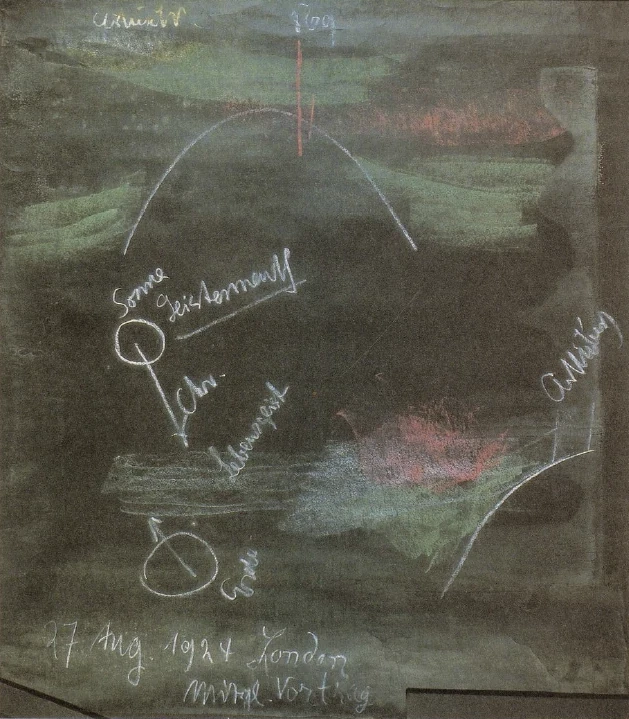
[ 16 ] Dann aber kam das Mysterium von Golgatha. Was geschah in Asien? In Asien drüben geschah es nun weltgeschichtlich, daß jenes hohe Sonnenwesen, das man nachher als den Christus bezeichnete, die Sonne verließ. Das war eine Art Sterben für den Christus. Christus ging fort von der Sonne, wie wir Menschen im Sterben fortgehen von der Erde. Also Christus ging fort von der Sonne, wie ein Mensch, der stirbt, fortgeht von der Erde. Und wie bei einem Menschen, der stirbt, indem er von der Erde fortgeht, für den okkulten Beschauer der ätherische Leib schaubar ist, den er nach drei Tagen ablegt und er den physischen Leib zurückläßt, so ließ Christus in der Sonne zurück dasjenige, was Sie in meiner «Theosophie» beschrieben finden am Menschen als den Geistesmenschen, als das siebente Glied der menschlichen Wesenheit.
[ 16 ] But then came the Mystery of Golgotha. What happened in Asia? Over in Asia, an event of world-historical significance took place: that exalted solar being, who was later called the Christ, left the sun. This was a kind of death for the Christ. Christ departed from the sun, just as we humans, when we die, depart from the earth. Thus Christ departed from the sun, just as a human being who dies departs from the earth. And just as, in the case of a human being who dies by departing from the earth, the etheric body is visible to the occult observer—a body which the person sheds after three days, leaving the physical body behind—so Christ left behind in the sun that which you will find described in my Theosophy as the spiritual human being, the seventh member of the human being.
[ 17 ] Christus «starb von der Sonne», er starb kosmisch von der Sonne zur Erde herab, er kam zur Erde herunter. Von dem Momente von Golgatha ab war auf der Erde zu schauen dasjenige, was sein Lebensgeist war. Wir lassen den Lebensäther, den Ätherleib, den Lebensleib zurück nach dem Tode; nach diesem kosmischen Tode ließ der Christus den Geistesmenschen auf der Sonne zurück, und im Umkreise der Erde den Lebensgeist. So daß vom Mysterium von Golgatha ab die Erde von dem Lebensgeiste Christi wie von einem Geistigen umweht war.
[ 17 ] Christ “died from the Sun”; he died cosmically, descending from the Sun to Earth; he came down to Earth. From the moment of Golgotha onward, what was his life spirit could be seen on Earth. We leave behind the life-ether, the etheric body, the life body after death; after this cosmic death, Christ left the spiritual human being behind on the Sun, and the life spirit in the sphere of the Earth. Thus, from the Mystery of Golgotha onward, the Earth was enveloped by the life spirit of Christ as if by a spiritual presence.
[ 18 ] Aber nun sind physische Ortszusammenhänge für das geistige Leben ganz anders als für das physische Leben. Dieser Lebensgeist, der war vor allen Dingen schaubar von den irischen Mysterien, von den Mysterien von Hybernia aus und wurde schaubar vor allen Dingen für die Ritter der Tafelrunde des Königs Artus. So daß von dieser Stätte aus bis zum Mysterium von Golgatha der Christus-Impuls der Sonne in Wirklichkeit ging: da wurden sie von der Sonne her empfangen, die Impulse. Nachher wurde ja auch die Kraft der Artusritter geringer. Aber sie standen lebendig drinnen in dem Lebensgeiste, der mit kosmischer Konfiguration die Erde umwehte, in dem sie fortwährend lebten und in dem fortwährend drinnen spielte dieses Spiel von Licht und Luft, von den Elementarwesen von oben und von den Elementarwesen von unten.
[ 18 ] But physical spatial relationships are quite different for spiritual life than they are for physical life. This life spirit was most clearly manifest in the Irish mysteries, in the mysteries of Hybernia, and became most clearly manifest for the Knights of the Round Table of King Arthur. Thus, from this place all the way to the Mystery of Golgotha, the Christ impulse of the sun actually extended: there, the impulses were received from the sun. Afterward, of course, the power of the Knights of the Round Table also waned. But they stood alive within the life spirit that swept over the Earth in a cosmic configuration, in which they lived continually and within which this interplay of light and air, of the elemental beings from above and the elemental beings from below, was constantly at work.
[ 19 ] Denken Sie sich: wenn man so hinschaut auf das Riff, wo oben die Artusburg ist, dann erschaut man, von oben herunter spielend die Sonne in Licht und Luft, von unten heraufspielend die Elementarwesen der Erde: oben Elementarwesen, unten Elementarwesen, Sonne und Erde in lebhafter Wechselwirkung.
[ 19 ] Just imagine: when you look at the ridge where Artusburg Castle stands, you see the sun playing down from above in light and air, and the elemental beings of the earth playing up from below: elemental beings above, elemental beings below—the sun and the earth in lively interaction.
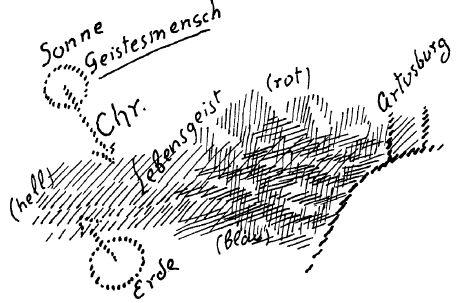
[ 20 ] Aber in den Jahrhunderten nach dem Mysterium von Golgatha spielte sich das alles ab im Lebensgeiste Christi. So daß wie in einem geistigen Schein, aber innerhalb von Naturtatsachen, in diesem Spiel von Meer und Felsen und Luft und Licht von jener Stätte aus zugleich die geistige Tatsache des Mysteriums von Golgatha drinnien spielte.
[ 20 ] But in the centuries following the Mystery of Golgotha, all of this unfolded within the life spirit of Christ. So that, as if in a spiritual glow—yet within the facts of nature—the spiritual reality of the Mystery of Golgotha was simultaneously at work within this interplay of sea, rock, air, and light emanating from that very site.
[ 21 ] Verstehen Sie mich recht, meine lieben Freunde, Damals sah man hinaus in das Meer, und wenn man jene Exerzitien, die die Zwölfe um den König Artus machten, die sich anlehnten an die Mysterien des Tierkreises, des Zodiakus, hinter sich hatte, so sah man — im 1., 2., 3., 4., 5. nachchristlichen Jahrhundert — nicht bloß das Spiel der Natur, sondern es war so, wie wenn man anfangen könnte zu lesen, geradeso wie wenn man ein Buch vor sich hat, das man entweder anglotzen oder das man lesen kann: da glänzte ein Flämmchen auf, kräuselte sich eine Welle, spiegelte sich die Sonne an irgendeinem Felsriff, da ward das Meer an das Felsriff hinaufgeschlagen — das alles ist konfiguriert, das alles ist ein Fließendes, Strömendes, ein sich Kreisendes, ein Weisendes, eine Wahrheit, die man entziffern kann.
[ 21 ] Understand me correctly, my dear friends: Back then, one looked out onto the sea, and once one had completed those spiritual exercises that the Twelve around King Arthur performed—which were based on the mysteries of the zodiac—one saw—in the 1st, 2nd, 3rd, 4th, and 5th centuries A.D.—not merely the play of nature, but it was as if one could begin to read, just as when one has a book before one that one can either stare at or read: a little flame would flicker, a wave would ripple, the sun would glint off some rocky reef, the sea would crash against the rocky reef—all of this is configured; all of this is a flow, a current, a circle, a sign, a truth that can be deciphered.
[ 22 ] Entzifferte man es, so las man die geistige Tatsache des Mysteriums von Golgatha, weil alles das durchspielt wurde vom Lebensgeiste Christi.
[ 22 ] If one were to decipher it, one would read the spiritual reality of the Mystery of Golgotha, because all of this was permeated by the life spirit of Christ.
[ 23 ] Drüben in Asien hatte sich das Mysterium von Golgatha abgespielt, hatte die Seelen, die Herzen der Menschen ergriffen, hatte sich tief hineingelebt in die Seelen, in die Herzen der Menschen. Man muß nur einmal auf diejenigen hinschauen, die die ersten Christen waren, welche Umwandelung diese in ihren Seelen erlebt haben, man wird schon finden: In derselben Zeit, in der hier im Westen sich das abspielte, was ich eben beschrieben habe, drang dort der wirkliche Christus, der Christus, der heruntergestiegen war, der seinen Geistesmenschen oben auf der Sonne gelassen hatte, seinen Lebensgeist in der Atmosphäre der Erde hatte, der drang, indem er sein Ich heruntertrug — noch mit dem Geistselbst heruntertrug auf die Erde —, vom Osten nach Westen durch Griechenland, Nordafrika, Italien, Spanien herüber nach Europa durch die Herzen der Menschen in derselben Zeit, in der er hier durch die Natur drang.
[ 23 ] Over in Asia, the Mystery of Golgotha had taken place; it had touched the souls and hearts of people, and had taken deep root in their souls and hearts. One need only look at those who were the first Christians and the transformation they experienced in their souls to see that: At the very same time that what I have just described was taking place here in the West, the true Christ—the Christ who had descended, who had left his spiritual being up in the sun, whose life spirit was in the Earth’s atmosphere—penetrated from East to West through Greece, North Africa, Italy, and Spain, into Europe through the hearts of human beings at the very same time that he was making his way through nature here.
[ 24 ] So daß wir sehen: Hier von Westen nach Osten wirkend, innerhalb der Natur lesbar für denjenigen, der lesen kann, die Historie des Mysteriums von Golgatha gewissermaßen als die Naturwissenschaft der Höhergraduierten aus des Artus Tafelrunde; von Osten nach Westen eine Strömung — jetzt nicht in Wind und Wellen, nicht in Luft und Wasser, nicht über Berge und Sonnenstrahlen hin, sondern eine Strömung durch das Blut der Menschen, durch die Herzen der Menschen, das Blut der Menschen ergreifend —, von Palästina durch Griechenland bis nach Italien und Spanien hinein.
[ 24 ] So we see: acting here from west to east, legible within nature to those who can read it, the history of the Mystery of Golgotha, as it were, as the natural science of the higher-ranking members of King Arthur’s Round Table; from east to west, a current—not now in wind and waves, not in air and water, not over mountains and sunbeams, but a current through the blood of human beings, through the hearts of human beings, seizing the blood of human beings—from Palestine through Greece into Italy and Spain.
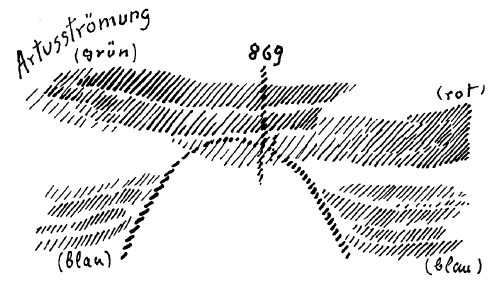
[ 25 ] So daß wir sagen können: Auf der einen Seite geht es durch die Natur, auf der anderen Seite geht es durch das Blut, durch die Herzen der Menschen. Diese zwei Strömungen gehen einander entgegen: die eine, die noch in der Natur spielt, die bei der ganzen heidnischen Strömung noch heute ist, die trägt den vorchristlichen, den heidnischen Christus, den Christus, der als Sonnenwesen von solchen Menschen wie den Rittern der Tafelrunde, aber auch den vielen anderen, vor dem Mysterium von Golgatha verbreitet worden ist. Diese Strömung trägt den vorchristlichen Christus auch noch in der Zeit des Mysteriums von Golgatha durch die Welt. Und ein großer Teil derjenigen ist ja ausgegangen von der Strömung, die man zusammenfaßt unter dem Titel der Strömung aus des Artus Tafelrunde. Man kann heute noch auf diese Dinge kommen: da ist heidnisches Christentum, Christentum, das nicht anknüpft an das historische Ereignis von Golgatha.
[ 25 ] So we can say: On the one hand, it flows through nature; on the other hand, it flows through the blood, through the hearts of human beings. These two currents flow toward one another: the one that still operates within nature—which is still present today in the entire pagan current—carries the pre-Christian, pagan Christ, the Christ who, as a solar being, was propagated by people such as the Knights of the Round Table, but also by many others, before the Mystery of Golgotha. This current continued to carry the pre-Christian Christ through the world even during the time of the Mystery of Golgotha. And a large portion of those people, after all, came from the current that is summarized under the heading of the “Arthurian Round Table” current. One can still encounter these things today: there is pagan Christianity—Christianity that does not connect to the historical event of Golgotha.
[ 26 ] Unten entgegenkommend ist das Christentum, das anknüpft an das Mysterium von Golgatha, das durch das Blut der Menschen, das durch die Herzen, die Seelen der Menschen geht. Zwei Strömungen, die einander entgegengehen: Die vorchristliche Christus-Strömung, ich möchte sagen, wie ätherisiert — die christliche Christus-Strömung. Die eine ist später eben bekanntgeworden als die Artusströmung; die andere ist bekanntgeworden als die Gralsströmung. Beide begegneten einander später. Und zwar begegneten sie einander innerhalb Europas und vor allen Dingen in der geistigen Welt.
[ 26 ] Coming from below is Christianity, which draws upon the Mystery of Golgotha—the blood of human beings that flows through their hearts and souls. Two currents moving toward one another: The pre-Christian Christ current—I would say, as it were, etherized—and the Christian Christ current. One later became known as the Arthurian current; the other became known as the Grail current. Both met later on. Specifically, they met within Europe and, above all, in the spiritual world.
[ 27 ] Wie können wir diese Bewegung nennen? Der Christus, der herabgestiegen war durch das Mysterium von Golgatha, ist in die Herzen der Menschen eingezogen. In den Herzen der Menschen selber zog er von Osten nach Westen, von Palästina durch Griechenland, über Italien nach Spanien. Das Grals-Christentum, durch das Blut, durch die Herzen der Menschen breitete es sich aus. Der Christus unternahm seinen Zug von Osten nach Westen.
[ 27 ] What can we call this movement? The Christ, who had descended through the Mystery of Golgotha, entered into the hearts of human beings. Within the hearts of human beings themselves, he journeyed from east to west, from Palestine through Greece, across Italy to Spain. Grail Christianity spread through the blood and through the hearts of people. Christ undertook his journey from east to west.
[ 28 ] Entgegen kam das Geist-Ätherbild des Christus von Westen, bewirkt durch das Mysterium von Golgatha, aber in sich noch tragend Christus mit dem Sonnenmysterium.
[ 28 ] In contrast, the spirit-etheric image of Christ came from the West, brought about by the Mystery of Golgotha, but still bearing within itself Christ with the Mystery of the Sun.
[ 29 ] Ein Großartiges, Wunderbares spielt sich hinter den Kulissen der Weltgeschichte ab. Von Westen herüber das heidnische Christentum, das Artus-Christentum, auch unter anderem Namen und in anderer Form auftretend; von Osten herüber der Christus in den Herzen der Menschen. Die Begegnung: Christus, der wirkliche, auf die Erde gekommene Christus. begegnet seinem Bilde, das ihm entgegengetragen wird, von Westen nach Osten strömend. 869 ist die Begegnung. Bis zu diesem Jahre haben wir deutlich voneinander unterschieden eine Strömung, die im Norden und über Mitteleuropa hingeht, die durchaus, ob man ihn nun Baldur oder irgendwie nannte, den Christus als Sonnenhelden in sich trug. Und unter der Flagge des Christus als Sonnenhelden verbreiteten die Artusritter ihre Kultur.
[ 29 ] Something magnificent and wondrous is unfolding behind the scenes of world history. From the West comes pagan Christianity, the Christianity of King Arthur, appearing also under other names and in other forms; from the East comes the Christ in the hearts of people. The encounter: Christ—the real Christ who came to Earth—meets his image, which is carried toward him, flowing from west to east. The encounter took place in 869. Up until that year, we have clearly distinguished between two distinct currents: one extending from the north through Central Europe, which—whether one called him Baldur or by some other name—carried within it the Christ as a solar hero. And under the banner of Christ as a solar hero, the Knights of Arthur spread their culture.
[ 30 ] Die andere Strömung, die innerlich im Herzen wurzelt, die dann später zur Gralsströmung wurde, sie ist mehr im Süden von Osten her zu sehen, sie trägt den eigentlichen, den wahren, den wirklichen Christus. Die von Westen kommende trägt gewissermaßen ein kosmisches Bild ihm entgegen.
[ 30 ] The other current, which is rooted deep within the heart and later became the Grail current, is more evident in the south, coming from the east; it carries the true, authentic, and real Christ. The current coming from the west, so to speak, carries a cosmic image toward him.
[ 31 ] Die Begegnung des Christus mit sich selbst, des Christus als Bruder des Menschen und des Christus als Sonnenhelden, der nur noch im Bilde vorhanden ist, diese Begegnung, dieses Zusammenfließen des Christus mit seinem eigenen Bilde findet statt im 9. Jahrhundert.
[ 31 ] The encounter between Christ and himself—between Christ as the brother of humankind and Christ as the sun hero, who now exists only as an image—this encounter, this merging of Christ with his own image, takes place in the 9th century.
[ 32 ] Damit habe ich Ihnen geschildert, wie innerlich der Zeitenlauf war in den ersten Jahrhunderten nach dem Mysterium von Golgatha, in jenen ersten Jahrhunderten, in denen ja auch, wie ich schon angeführt habe, die Seelen da waren, die nun wieder erschienen sind und die aus ihren früheren Erdenleben den Drang mitgebracht haben, sich ehrlich nach der anthroposophischen Bewegung hin zu bewegen.
[ 32 ] I have thus described to you the inner nature of the passage of time during the first centuries following the Mystery of Golgotha—those early centuries in which, as I have already mentioned, there were also souls who have now reappeared and who, from their earlier earthly lives, have brought with them the urge to move sincerely toward the anthroposophical movement.
[ 33 ] Wenn wir hinschauen auf diese bedeutungsvolle Artusströmung von Westen nach Osten, so erscheint sie als diejenige, welche den Sonnenimpuls in die Erdenzivilisation hineinträgt. Damit wellt und webt innerhalb dieser Artusströmung dasjenige, was man in christlicher Terminologie die Michael-Strömung nennen kann, jene Michael-Strömung im spirituellen Leben der Menschheit, in die wir als moderne Menschen wiederum einziehen seit dem Ende der siebziger Jahre des vorigen Jahrhunderts. Nachdem jene Macht, welche man mit dem christlichen Namen Gabriel bezeichnen kann, drei bis vier Jahrhunderte geherrscht hat als die dirigierende Macht in der europäischen Zivilisation, wurde sie abgelöst — Ende der siebziger Jahre des vorigen Jahrhunderts — durch die Michael-Herrschaft, die wiederum drei bis vier Jahrhunderte dauern wird, im Geistesleben der Menschen fortleben und weben und wellen wird und in der wir eben jetzt drinnen stehen.
[ 33 ] When we look at this significant Arthurian current flowing from west to east, it appears to be the force that carries the solar impulse into Earth’s civilization. Within this Arthurian current, what can be called—in Christian terminology—the Michael current undulates and weaves; this Michael current in the spiritual life of humanity is one into which we, as modern people, have been re-entering since the late 1870s. After that power—which can be designated by the Christian name Gabriel—had reigned for three to four centuries as the guiding force in European civilization, it was succeeded — at the end of the 1970s — by the Michael era, which in turn will last three to four centuries, continuing to live on, weave, and ebb and flow in the spiritual life of humanity, and in which we now find ourselves.
[ 34 ] Wir haben also in unserer Gegenwart immerhin Veranlassung — weil wir selber wiederum in der Michael-Strömung drinnen leben —, wir haben Veranlassung, auf solche Michael-Strömungen hinzuweisen.
[ 34 ] So in our own time, we do have reason—since we ourselves are living within the Michael current—to point out such Michael currents.
[ 35 ] Wir finden diese Michael-Strömung, wenn wir in der Zeit, die dem Mysterium von Golgatha hart voranging, hinschauen auf die vom englischen Westen ausgehende, ursprünglich von den Mysterien von Hybernia angeregte Artusströmung. Wir sehen in einer älteren Form diese Michael-Strömung, wenn wir hinblicken auf dasjenige, was Jahrhunderte vor der Entstehung des Mysteriums von Golgatha von Nordgriechenland, von Mazedonien aus, durch jene internationale, jene kosmopolitische Strömung geschehen ist, die an den Namen Alexanders des Großen geknüpft ist und unter dem Einfluß jener Weltanschauung gestanden hat, die unter dem Namen der aristotelischen bekannt ist. Was in der vorchristlichen Zeit sich durch Aristoteles und Alexander abgespielt hat, stand damals so in der Michael-Herrschaft drinnen, wie wir jetzt wiederum in der Michael-Herrschaft drinnen stehen, und dazumal war auf Erden ebenso wie jetzt in dem geistigen Leben der Michael-Impuls. Immer, wenn ein Michael-Impuls in der Erdenmenschheit ist, dann ist die Zeit, wo dasjenige, was in einem Kulturzentrum, in einem spirituellen Zentrum begründet worden ist, über viele Völker der Erde, in allen Gegenden, in denen es möglich ist, ausgebreitet wird.
[ 35 ] We find this Michael current when we look back to the time immediately preceding the Mystery of Golgotha and consider the Arthurian current that originated in the English West, originally inspired by the Mysteries of Hybernia. We see an earlier form of this Michael current when we look at what took place centuries before the emergence of the Mystery of Golgotha, originating in northern Greece, from Macedonia, through that international, that cosmopolitan current linked to the name of Alexander the Great and influenced by the worldview known as Aristotelianism. What unfolded in pre-Christian times through Aristotle and Alexander was then just as much a part of the Michael realm as we are now; and at that time, just as now, the Michael impulse was present in the spiritual life on Earth. Whenever a Michael impulse is present in humanity, it is the time when that which has been established in a cultural center, in a spiritual center, is spread across many peoples of the Earth, in all regions where it is possible.
[ 36 ] Das geschah in der vorchristlichen Zeit durch die Alexanderzüge. Da wurde das, was innerhalb der griechischen Kultur gewonnen worden ist, verbreitet über diejenige Menschheit, in der es verbreitet werden konnte. Und wenn man Aristoteles und Alexander gefragt hätte: Woher habt ihr dasjenige, was in euren Herzen sitzt als der Impuls zur Ausbreitung des geistigen Lebens eurer Zeit? — sie würden zwar mit einem anderen Namen, aber im Wesen doch geantwortet haben: Von dem Impuls des Michael, desjenigen, der als Diener Christi von der Sonne aus wirkt. Denn von den verschiedenen Archangeloi, welche abwechselnd die Kultur beherrschen, gehört Michael, der im Alexander-Zeitalter und wiederum in unserem Zeitalter herrscht, der Sonne an. Es gehört derjenige, der dann gefolgt ist auf die Alexander-Zeit, Oriphiel, dem Saturn an. Es gehört derjenige, der dann auf Oriphiel gefolgt ist, Anael, der Venus an. Es gehört derjenige Erzengel, der im 4., 5. Jahrhundert die europäische Zivilisation beherrscht hat, Zachariel, der Jupitersphäre an. Dann kam Raphael aus der Merkursphäre in derjenigen Zeit, in der insbesondere eine Art Medizinkultur-Denkweise im Untergrunde desjenigen blühte, was als europäische Zivilisation sich abspielte. Dann kam Samael so über das 12. Jahrhundert hin. Samael gehört dem Mars an. Dann kam Gabriel, der der Mondensphäre angehört. Und nun trat wiederum seit den siebziger Jahren des vorigen Jahrhunderts Michael ein, der der Sonnensphäre angehört. So gehen im Rhythmus fort die Herrschaften über das Geistesleben der Erde durch diese sieben Wesen aus der Hierarchie der Archangeloi. Wenn wir also zurückblicken — wo war die letzte Michael-Herrschaft? Sie war in der Alexanderzeit. Sie war da als dasjenige, was sich abgespielt hatte durch Jahrhunderte als griechische Zivilisation, hinübergetragen wurde nach Asien, hinübergetragen wurde nach Afrika, sich konzentrierte in der geistig mächtigen Stadt Alexandria mit ihren bedeutsamen Geisteshelden.
[ 36 ] This occurred in pre-Christian times through Alexander’s campaigns. Thus, what had been gained within Greek culture was spread among those peoples among whom it could be disseminated. And if one had asked Aristotle and Alexander: “Where did you get that which lies in your hearts as the impulse to spread the spiritual life of your time?”—they would have answered, albeit with a different name, but in essence: “From the impulse of Michael, the one who works from the Sun as a servant of Christ.” For among the various archangels who alternately govern civilization, Michael—who reigned during the age of Alexander and again in our own age—belongs to the Sun. The one who followed after the age of Alexander, Oriphiel, belongs to Saturn. The one who followed after Oriphiel, Anael, belongs to Venus. The archangel who presided over European civilization in the 4th and 5th centuries, Zachariel, belongs to the sphere of Jupiter. Then Raphael came from the sphere of Mercury during a time when, in particular, a kind of medical-cultural mindset flourished beneath the surface of what was unfolding as European civilization. Then Samael came during the 12th century. Samael belongs to Mars. Then came Gabriel, who belongs to the lunar sphere. And now, since the 1970s, Michael has once again taken his place; he belongs to the solar sphere. Thus, the dominions over the spiritual life of the Earth continue in rhythm through these seven beings from the hierarchy of the Archangels. So when we look back—where was the last Michael period? It was during the time of Alexander. It was present as that which had unfolded over centuries as Greek civilization, carried over to Asia, carried over to Africa, and concentrated in the spiritually powerful city of Alexandria with its significant spiritual heroes.
[ 37 ] Das ist ein eigentümlicher Anblick für das okkulte Schauen. Geht man diese paar Jahrhunderte vor das Mysterium von Golgatha zurück: man sieht von Mazedonien nach Osten hinüber — also wiederum von Westen nach Osten, aber weiter nach Osten gelegen — die Strömung, die man dann ebenso schaut von den englisch-irischen Seelen, wiederum von Westen nach Osten hinüber. Während der Alexanderherrschaft herrscht Michael auf Erden. Während der Artusherrschaft wird unter der Herrschaft des Michael, der jetzt von der Sonne herunter wirkt, von der Sonne herunter dasjenige getragen, was ich Ihnen dargestellt habe.
[ 37 ] This is a peculiar sight for occult vision. If one goes back a few centuries before the Mystery of Golgotha: looking eastward from Macedonia—that is, again from west to east, but further to the east—one sees the current that one then likewise observes flowing from the Anglo-Irish souls, again from west to east. During the reign of Alexander, Michael reigns on Earth. During the reign of Arthur, under the rule of Michael—who now acts from the sun—that which I have described to you is carried forth from the sun.
[ 38 ] Wie war es aber dann später, nachdem das Mysterium von Golgatha abgelaufen war, mit der Verbreitung derjenigen Geistesart, die von Alexander dem Großen durch die Eroberungszüge nach Asien hinübergetragen worden war, der aristotelischen?
[ 38 ] But what happened later, after the Mystery of Golgotha had come to an end, with regard to the spread of the Aristotelian school of thought—the one that had been carried over to Asia by Alexander the Great through his conquests?
[ 39 ] Wir sehen dann, wie in derselben Zeit, in der Karl der Große in Europa eine Art christlicher Kultur auf seine Weise begründet, drüben in Asien, in Vorderasien Harun al Raschid wirkt. Wir sehen am Hofe Harun al Raschids vereint alles das, was an orientalischer Weisheit, an Spiritualität vorhanden war in Architektur, in Kunst, in Wissenschaft, in Religion, im Schrifttum, in Dichtung, in allem. Und wir sehen einen Ratgeber neben Harun al Raschid, der zwar, während er neben Harun al Raschid steht, in dem allem nicht eingeweiht ist, der aber ein Eingeweihter war in alten Zeiten, in früheren Erdenleben. Und wir sehen unter diesen beiden Menschen, unter Harun al Raschid und unter seinem Ratgeber, ganz verändert dasjenige, was als Aristotelismus nach Asien verpflanzt war, dasjenige, was noch durch Aristoteles aus der alten Weisheit der Natur den Menschen gezeigt worden ist, die er unterrichten konnte; wir sehen das, was Alexandrinismus, was Aristotelismus war, am Hofe von Harun al Raschid, durchdrungen und imprägniert von Arabismus, von Mohammedanismus.
[ 39 ] We then see how, at the very same time that Charlemagne was establishing a form of Christian culture in Europe in his own way, Harun al-Rashid was making his mark over in Asia, in the Near East. At the court of Harun al-Rashid, we see brought together all that existed of Eastern wisdom and spirituality—in architecture, art, science, religion, literature, poetry, and everything else. And we see an advisor at Harun al-Rashid’s side who, though standing beside him, is not initiated into all of this, but who was an initiate in ancient times, in earlier earthly lives. And we see, in these two men—Harun al-Rashid and his advisor—a completely transformed version of what had been transplanted to Asia as Aristotelianism, that which Aristotle had still been able to show to the people he taught, drawing from the ancient wisdom of nature; we see what Alexandrianism and Aristotelianism were at the court of Harun al-Rashid, permeated and imbued with Arabism and Islam.
[ 40 ] Und wir sehen dann herübergetragen in die christliche Entwickelung dasjenige, was von Harun al Raschid, was vom Arabismus ausging. Wiederum, ich möchte sagen, dem Christentum nachgetragen, in das Christentum hineingeschoben, durch Griechenland, aber namentlich durch Nordafrika, durch Italien nach Spanien hineingeschoben, eine Art Arabismus.
[ 40 ] And we then see carried over into Christian development that which originated with Harun al-Rashid, that which stemmed from Arabism. Again, I would say, carried over into Christianity—introduced into Christianity—through Greece, but especially through North Africa, through Italy, and into Spain—a kind of Arabism.
[ 41 ] Aber Harun al Raschid und sein Ratgeber, sie sind ja früher durch die Pforte des Todes gegangen. Sie verfolgten von dem Leben, das sie jetzt vom Tode bis zur neuen Geburt, über dem irdischen führten, das, was unten als die mohammedanisch-maurischen Züge nach Spanien hinein sich abspielte, sie verfolgten von der geistigen Welt aus das, was sie selbst gepflegt hatten und was sich durch ihre Nachfolger ausbreitete, Harun al Raschid mehr, indem er seinen Blick von der geistigen Welt auf Griechenland, Italien, Spanien warf; sein Ratgeber, indem er seinen Blick warf auf dasjenige, was vom Osten herüber durch die Gegenden nördlich des Schwarzen Meeres, durch Rußland, bis nach Mitteleuropa hin ging.
[ 41 ] But Harun al-Rashid and his advisor had, after all, already passed through the gates of death. From the life they now led in the spiritual world—from death to new birth, above the earthly realm—they observed what was unfolding below as the spread of Muslim-Moorish influences into Spain; from the spiritual world, they observed what they themselves had fostered and what was spreading through their successors, Harun al-Rashid did so more by turning his gaze from the spiritual world toward Greece, Italy, and Spain; his advisor did so by turning his gaze toward what was spreading from the East through the regions north of the Black Sea, through Russia, all the way to Central Europe.
[ 42 ] Die Frage steht vor uns: Was ist mit Alexander, was ist mit Aristoteles selber geschehen? Sie waren tief verbunden mit der Michael-Herrschaft, aber nicht zu der Zeit auf Erden, als das Mysterium von Golgatha sich abspielte.
[ 42 ] The question before us is: What happened to Alexander, and what happened to Aristotle himself? They were deeply connected to the Michael Kingdom, but were not on Earth at the time the Mystery of Golgotha took place.
[ 43 ] Nun müssen wir uns lebhaft die beiden Gegenbilder vorstellen. Auf der Erde sind die Menschen, die Zeitgenossen sind des Mysteriums von Golgatha. Christus wird Mensch, geht durch das Mysterium von Golgatha, lebt von da an in der Erdensphäre fort. Wie ist es auf der Sonne? Da sind die Seelen, die dazumal zu Michael gehörten, in der Sphäre des Michael lebten. Sie sind diejenigen, die von der Sonne aus schauen, wie Christus die Sonne verläßt. Auf der Erde sind diejenigen, die des Christus Ankunft schauen; auf der Sonne sind diejenigen, die des Christus Weggang schauen: sie sehen ihn heruntersteigen zur Erde. Das ist der Gegensatz. Und das erleben vorzugsweise diejenigen, die im Erdenleben teilgenomen haben an jener Michael-Herrschaft, die zur Alexanderzeitwar.Sie erleben sozusagen das umgekehrte Christus-Ereignis: den Fortgang des Christus von der Sonne. Sie leben weiter — unmaßgebliche Inkarnationen will ich jetzt nicht erwähnen —, sie leben weiter und sie erleben das in der geistigen Welt für die Erdenwelt bedeutsame Zeitalter des 9. nachchristlichen Jahrhunderts, ungefähr das Jahr 869. Denn da findet ja erstens das statt, was ich Ihnen eben angedeutet habe: die Begegnung des Christus mit seinem Ebenbilde, mit seinem Lebensgeist, mit demjenigen, was noch vorhanden war von dem vorchristlichen heidnischen Christus. Aber es findet auch die Begegnung statt zwischen jenen Individualitäten, welche in Alexander dem Großen und Aristoteles lebten, mit jener Individualität, die in Harun al Raschid, und jener, die in seinem Ratgeber lebte: Der mohammedanisierte Aristotelismus von Asien in geistiger Entfaltung in Harun al Raschid und dem Ratgeber nach dem Tode mit Alexander und Aristoteles nach dem Tode. Aber das eine war der Aristotelismus und Alexandrinismus, der den Mohammedanismus aufgenommen hat, das andere war der wirkliche Aristotelismus, waren nicht jene nachträglichen Lehren, die schon durch Menschen gegangen waren. Aristoteles und Alexander hatten das Mysterium von Golgatha von der Sonne aus gesehen.
[ 43 ] Now we must vividly imagine these two contrasting images. On Earth are the people who are contemporaries of the Mystery of Golgotha. Christ becomes human, passes through the Mystery of Golgotha, and from then on continues to live in the earthly sphere. What is it like on the Sun? There are the souls who once belonged to Michael and lived in the sphere of Michael. They are the ones who, from the Sun, watch as Christ leaves the Sun. On Earth are those who witness Christ’s arrival; on the Sun are those who witness Christ’s departure: they see him descending to Earth. That is the contrast. And this is experienced primarily by those who, during their earthly lives, took part in that Michael reign that occurred in the time of Alexander. They experience, so to speak, the reverse of the Christ event: Christ’s departure from the Sun. They live on—I will not mention insignificant incarnations at this time—they live on and experience, in the spiritual world, the era of the 9th century A.D., around the year 869, which is significant for the earthly world. For it is there, first of all, that what I have just hinted at takes place: the encounter of the Christ with his image, with his life spirit, with that which still remained of the pre-Christian, pagan Christ. But there is also the encounter between those individualities that lived in Alexander the Great and Aristotle, and the individuality that lived in Harun al-Rashid, as well as the one that lived in his advisor: the Islamized Aristotelianism of Asia, unfolding spiritually in Harun al-Rashid and his advisor after death, alongside Alexander and Aristotle after their deaths. But one was the Aristotelianism and Alexandrianism that had absorbed Islam; the other was true Aristotelianism—not those later teachings that had already passed through human hands. Aristotle and Alexander had beheld the Mystery of Golgotha from the sun.
[ 44 ] Da fand die große Auseinandersetzung, gewissermaßen jenes himmlische Konzil statt zwischen dem mohammedanisierten Aristotelismus und dem christianisierten Aristotelismus, aber dem in der geistigen Welt christianisierten Aristotelismus.
[ 44 ] That was when the great debate took place—in a sense, that heavenly council—between Muslim-influenced Aristotelianism and Christian-influenced Aristotelianism, though the latter was Christian-influenced in the spiritual realm.
[ 45 ] So kann man sagen: Hier in der Welt, die unmittelbar als geistige Welt an unsere physische Erdenwelt angrenzt, begegneten sich Alexander und Aristoteles und Harun al Raschid und sein Ratgeber, sich auseinandersetzend über den weiteren Fortgang der Christianisierung Europas, hinweisend auf dasjenige, was kommen mußte am Ende des 19. Jahrhunderts, im 20. Jahrhundert, wo die Michael-Herrschaft wiederum auf Erden sein kann.
[ 45 ] So one might say: Here in the world that immediately adjoins our physical earthly world as a spiritual world, Alexander and Aristotle and Harun al-Rashid and his advisor met, discussing the further course of the Christianization of Europe and pointing to what was to come at the end of the 19th century and into the 20th century, when the reign of Michael could once again be upon the earth.
[ 46 ] Und das alles entstand, spielte sich ab wie bestrahlt von jenem Ereignisse der Begegnung des Christus mit seinem Gegenbilde. Das alles stand unter diesem Eindrucke. Das geistige Leben der Menschen wurde in der spirituellen Welt, die unmittelbar an die physische Erdenwelt angrenzt, in intensiver Weise projektiert, könnte man sagen, fadengezeichnet.
[ 46 ] And all of this came into being, unfolded as if illuminated by that event—the encounter between Christ and his counterpart. All of this was shaped by that impression. The spiritual life of human beings was projected—one might say, traced—in an intense manner into the spiritual world that immediately adjoins the physical world of the Earth.
[ 47 ] Und unten auf der Erde selber versammelten sich in Konstantinopel zum achten allgemeinen ökumenischen Konzil die Väter der Kirche und faßten das Dogma, daß der Mensch nicht aus Leib, Seele und Geist, sondern nur aus Leib und Seele bestehe, und die Seele einige geistige Eigenschaften habe. Die Trichotomie — so nannte man das, daß der Mensch aus Leib, Seele und Geist besteht —, die Trichotomie wurde abgeschafft. Wer ferner an sie glaubte in Europa, der wurde ein Häretiker. Die christlichen Väter in Europa vermieden unter allen Umständen, jemals von der 'Trichotomie, von Leib, Seele und Geist zu sprechen, sondern redeten nur von Leib und Seele.
[ 47 ] And down here on earth, the Church Fathers gathered in Constantinople for the Eighth Ecumenical Council and established the dogma that human beings consist not of body, soul, and spirit, but only of body and soul, and that the soul possesses certain spiritual qualities. The trichotomy—as the belief that human beings consist of body, soul, and spirit was called—was abolished. Anyone in Europe who continued to believe in it was deemed a heretic. The Christian Fathers in Europe avoided at all costs ever speaking of the “trichotomy,” of body, soul, and spirit, but spoke only of body and soul.
[ 48 ] Was so als Maßgebliches im Jahre 869 in übersinnlichen Welten geschah, wie ich es Ihnen beschrieben habe, das warf seine Schatten hinunter in die Welt. Das finstere Zeitalter des Kali Yuga nahm einen besonderen Impuls seiner Finsternis auf, während sich darüber dasjenige abspielte, was ich Ihnen eben beschrieben habe.
[ 48 ] What took place in the spiritual realms in the year 869—as I have described to you—cast its shadow down into the world. The dark age of Kali Yuga received a special impetus of its darkness while the events I have just described were unfolding.
[ 49 ] Das war der wirkliche Verlauf der Ereignisse: in der physischen Welt das Konzil von Konstantinopel, in dem der Geist abgeschafft wird; in der unmittelbar an die physische Welt angrenzenden Welt ein himmlisches Konzil, das sich.so abspielte, indem der Christus selber seinem Gegenbilde begegnete.
[ 49 ] This was the true course of events: in the physical world, the Council of Constantinople, at which the Spirit was abolished; in the world immediately adjacent to the physical world, a heavenly council that unfolded as Christ himself encountered his counterpart.
[ 50 ] Aber man war sich klar: Man muß warten, bis die neue MichaelHerrschaft auf der Erde beginnen kann. Immer aber fanden sich Lehrer, die, wenn auch gewissermaßen in der Dekadenz, etwas wußten von dem, was eigentlich hinter den Kulissen des Daseins vor sich geht; immer fanden sich Lehrer, die in, wenn auch manchmal nicht sehr zutreffenden Bildern darzustellen wußten, was geistiger Inhalt der Welt ist, was zugrunde liegt demjenigen, was in der unmittelbar an die physische Welt angrenzenden geistigen Welt ist. Und solche Lehrer fanden zuweilen Ohren, die ihnen zuhörten. Und diejenigen Ohren, die ihnen zuhörten, gehörten Menschen an, welche in der Weise vom Christentum hörten, daß sie allerdings nur da oder dort ein gebrochenes Wort, aber doch etwas von dem hörten, was kommen soll im 20. Jahrhundert, nachdem die Michael-Herrschaft wiederum begonnen haben wird.
[ 50 ] But everyone was clear on one thing: We must wait until the new reign of Michael can begin on Earth. Yet there were always teachers who, even if in a sense in a state of decadence, knew something of what was actually taking place behind the scenes of existence; there were always teachers who knew how to depict—albeit sometimes in not very accurate images—what the spiritual content of the world is, what underlies that which exists in the spiritual world immediately adjacent to the physical world. And such teachers sometimes found ears that listened to them. And those ears that listened to them belonged to people who had heard about Christianity in such a way that, although they heard only a fragment here or there, they nevertheless heard something of what is to come in the 20th century, after the reign of Michael has begun anew.
[ 51 ] Diese Menschen, meine lieben Freunde, in Euren eigenen Seelen sitzen die Seelen, die dazumal verkörpert waren und solchen Seelen zugehört hatten, die von der kommenden Michael-Herrschaft redeten; von der kommenden Michael-Herrschaft unter dem Einflusse solcher Impulse redeten, wie sie herunterkamen von jenem himmlischen Konzil, von dem gesprochen worden ist.
[ 51 ] These people, my dear friends—within your own souls dwell the souls that were once incarnated and belonged to those who spoke of the coming reign of Michael; who spoke of the coming reign of Michael under the influence of such impulses as came down from that heavenly council of which we have spoken.
[ 52 ] Aus solchem Erleben im früheren Leben, in den ersten christlichen Jahrhunderten — nicht gerade im 9. Jahrhundert, sondern vorher und später, aber namentlich vorher —, entwickelte sich der Drang heran, dann, wenn die Michael-Herrschaft Ende des 19. Jahrhunderts, Anfang des 20. Jahrhunderts kommt, unbewußt hinzuschauen auf die Stätte, wo jetzt wirklich unter dem Einfluß der Michael-Herrschaft das spirituelle Leben wieder gepflegt wird. Das pflanzte sich in die Seelen derjenigen, die von Lehren hörten, die etwas enthielten von den Geheimnissen, von denen wir heute gesprochen haben.
[ 52 ] From such experiences in earlier times, during the first centuries of Christianity—not exactly in the 9th century, but both before and after, but especially before that—the urge arose to look, unconsciously, toward the place where spiritual life is now truly being cultivated again under the influence of the Michael Kingdom, as that kingdom arrives at the end of the 19th century and the beginning of the 20th. This took root in the souls of those who heard teachings that contained something of the mysteries we have spoken of today.
[ 53 ] So pflanzt sich karmisch in die Seelen die Sehnsucht, heranzukommen an dasjenige Christentum, das unter dem Einflusse des Michael am Ende des 19. Jahrhunderts, Anfang des 20. Jahrhunderts anthroposophisch verbreitet werden sollte. Und was dazumal diese Seelen erlebt haben, das findet in der Wiederverkörperung jetzt seinen Ausdruck darinnen, daß gewisse Seelen den Zugang zur anthroposophischen Bewegung finden.
[ 53 ] Thus, a karmic longing takes root in the souls to come into contact with the form of Christianity that, under the influence of Michael, was to be spread through anthroposophy at the end of the 19th century and the beginning of the 20th century. And what these souls experienced back then now finds expression in reincarnation in the fact that certain souls find their way into the anthroposophical movement.
[ 54 ] Lehren, welche anknüpften an eine Art von Zusammenfluß von altem, vorchristlichem kosmischem Christentum und der innerlichen christlichen Lehre, Lehren, welche anknüpften an geistiges Leben und Weben in der Natur und die dennoch anknüpfen konnten an das Mysterium von Golgatha, wurden nun fortdauernd gelehrt, gelehrt auf Erden in der Zeit, als die Seelen, die jetzt zur Anthroposophie hingedrängt sich fühlen, schon wiederum durch die Pforte des Todes gegangen waren, lebten in dem Leben zwischen dem Tode und einer neuen Geburt, einzelne auch heruntersteigend zur Erde, sich verkörpernd. Wir sehen, wie fortlebten auf der Erde die alten Lehren, die noch das Christentum in kosmischer Art anschauten, die alten Lehren, welche fortpflanzten Traditionen an die alten Mysterien; wir sehen solche Lehren fortgepflanzt durch bedeutsame europäische Schulen, wie zum Beispiel eben namentlich die Schule von Chartres im 12. Jahrhunderte, wo so bedeutende Lehrer lehrten wie Bernardus Sylvestris, Alanus ab Insulis und andere große Lehrer, welche in der Schule von Chartres lehrten. Wir sehen, wie solche Lehren lebten und webten zum Beispiel in dem Ihnen am letzten Sonntag erwähnten Brunetto Latini. Brunetto Latini, der große Lehrer Dantes, trug solche Lehren in sich. Wir sehen in dieser Art dasjenige sich fortpflanzen, was noch einen Zusammenhang hatte zwischen dem kosmischen Christentum und dem rein menschlichen, irdischen Christentum, das ja auf der Erde doch immer mehr und mehr überhandnahm.
[ 54 ] Teachings that drew upon a kind of convergence between ancient, pre-Christian cosmic Christianity and inner Christian doctrine—teachings that drew upon spiritual life and the interplay of forces in nature, and yet were still able to connect with the Mystery of Golgotha— were now taught continuously—taught on Earth at a time when the souls who now feel drawn to anthroposophy had already passed through the gate of death once more, living in the life between death and a new birth, with some even descending to Earth to incarnate. We see how the ancient teachings—which still viewed Christianity in a cosmic light, and which carried on traditions rooted in the ancient mysteries—continued to live on on Earth; we see such teachings carried on through significant European schools, such as, for example, the School of Chartres in the 12th century, where such eminent teachers as Bernardus Sylvestris, Alanus ab Insulis, and other great teachers taught at the School of Chartres. We see how such teachings lived on and took shape, for example, in Brunetto Latini, whom I mentioned to you last Sunday. Brunetto Latini, Dante’s great teacher, carried such teachings within him. In this way, we see the continuation of that which still maintained a connection between cosmic Christianity and purely human, earthly Christianity, which, after all, was gaining more and more the upper hand on Earth.
[ 55 ] Das war ja das Gegenbild, dem auf Erden das irdische Konzil von Konstantinopel entsprach: daß in der Art, wie ich Ihnen erzählte, ein fortwährender Zusammenhang stattgefunden hat zwischen demjenigen, was in den geistigen Welten, was in der Welt, die unmittelbar an unsere physische Welt angrenzt, und unserer physischen Welt sich abspielte. Ein fortwährender Zusammenhang fand statt. So fühlten sich schon gerade die bedeutendsten Lehrer von Chartres inspiriert von dem wirklichen Alexander und dem wirklichen Aristoteles, aber auch in hervorragendstem Sinne von Plato und von alledem, was sich von Plato und dem Neuplatonismus an die damals im Mittelalter herrschende Mystik anlehnte.
[ 55 ] That was, in fact, the counterpart on Earth to the earthly Council of Constantinople: that, as I told you, there has been a continuous connection between what took place in the spiritual worlds—the world immediately adjacent to our physical world—and our physical world. A continuous connection existed. Thus, the most eminent teachers of Chartres, in particular, felt inspired by the real Alexander and the real Aristotle, but also, in the most outstanding sense, by Plato and by everything that drew upon Plato and Neoplatonism in the mysticism prevalent in the Middle Ages at that time.
[ 56 ] Und etwas sehr Bedeutendes fand statt. Diejenigen Menschen, die vorzugsweise um Michael sich scharten, die also im Alexander-Zeitalter vorzugsweise inkarniert waren, sie lebten jetzt in der geistigen Welt. Sie schauten schon auf so etwas herunter, wie es die christliche Entwickelung war durch dieLehrer von Chartres. Sie warteten aber, bis die Lehrer von Chartres, die letzten, die noch kosmisches Christentum lehrten, hinaufkamen in die geistige Welt. Und es war ein gewisser Zeitpunkt, ein Zeitpunkt am Ende des 12. Jahrhunderts, am Beginne des 13. Jahrhunderts, da begegneten sich gewissermaßen in der überirdischen Sphäre, die unmittelbar an die irdische angrenzte, die mehr platonisch gearteten Lehrer von Chartres mit jenen, die das himmlische Konzil von 869 durchmachten. Und da fand, wenn ich mich trivial-irdisch ausdrücken darf für diese erhabene Sache, da fand eine Art Besprechung statt zwischen denen, die als die Lehrer von Chartres eben hinaufkamen in die geistige Welt und nunmehr in der geistigen Welt weiter die Entwickelung erleben sollten, und jenen anderen, die unmittelbar heruntersteigen sollten, unter welchen die unmittelbaren Individualitäten von Alexander und Aristoteles selber waren, die dann im Dominikaner-Orden sich unmittelbar nachher verkörperten. Und es fand statt auf Erden in dem, was heute so verkannt wird, was wert wäre, daß man es tiefer in seiner Bedeutung erkennen würde, es fand statt in dem, was als Scholastik auf der Erde auftrat, die Vorbereitung für alles Spätere, was dann im späteren Michael-Zeitalter stattfinden sollte,
[ 56 ] And something very significant took place. Those people who had primarily gathered around Michael—that is, those who had primarily incarnated during the Alexander era—were now living in the spiritual world. They already looked down upon such things as the Christian development brought about by the teachers of Chartres. But they waited until the teachers of Chartres—the last ones who still taught cosmic Christianity—ascended into the spiritual world. And there was a certain moment—a moment at the end of the 12th century, at the beginning of the 13th century—when, in a sense, the more Platonic-minded teachers of Chartres met in the super-earthly sphere, which immediately adjoined the earthly one, with those who had lived through the Heavenly Council of 869. And there—if I may use a trivial, earthly expression for this sublime matter— a kind of discussion took place between those who, as the teachers of Chartres, had just ascended into the spiritual world and were now to continue their development there, and those others who were to descend immediately—among whom were the very individualities of Alexander and Aristotle themselves, who then incarnated in the Dominican Order shortly thereafter. And it took place on Earth within what is so misunderstood today—something whose significance deserves to be recognized more deeply—it took place within what appeared on Earth as Scholasticism: the preparation for everything that was to follow in the later Michael Age,
[ 57 ] Und um sich recht in das Christentum einzuleben, um ganz im Christentum drinnen zu stehen, verkörperten sich diejenigen, die der Michael-Sphäre angehörten, die im alten Alexander-Zeitalter lebten, nicht mitgemacht hatten die ersten christlichen Jahrhunderte oder nur in unmaßgeblichen Inkarnationen, verkörperten sich, um eben ins Christentum sich einzuleben, im Dominikaner-Orden oder in anderen christlichen Orden, aber hauptsächlich im Dominikaner-Orden. Dann gingen sie durch die Pforte des Todes hinauf in die geistige Welt und wirkten in der geistigen Welt weiter.
[ 57 ] And in order to truly settle into Christianity, to be fully immersed in it, those who belonged to the Michael sphere—who had lived in the ancient Age of Alexander but had not participated in the first Christian centuries, or had done so only in insignificant incarnations—took physical form, precisely to settle into Christianity, in the Dominican Order or in other Christian orders, but mainly in the Dominican Order. Then they passed through the gate of death into the spiritual world and continued their work there.
[ 58 ] Da fand nun im 15. Jahrhundert — bis ins 16. Jahrhundert hinein dauerte es, die Zeitverhältnisse sind ganz andere für die geistige Welt — jene gewaltige Unterweisung im Übersinnlichen statt, die von Michael selber für die Seinigen ausgegangen ist. Da wurde sozusagen eine übersinnliche, eine spirituelle Schule begründet, eine Schule, in der Michael selber der Lehrer war, eine Schule, an der die entsprechenden Menschen teilnahmen, die dazumal inspiriert waren namentlich durch das frühere Michael-Zeitalter, inspiriert dann durch das Hineinleben in das Christentum auf die Art, wie ich es dargestellt habe. All dasjenige, was zu Michael gehörte an entkörperten Menschenseelen, nahm teil an jener großen Schule, die übersinnlich stattfand im 14., 15., 16. Jahrhunderte. Alle diejenigen Wesenheiten aus der Hierarchie der Angeloi, Archangeloi, Archai, die zur Michael-Strömung gehörten, nahmen teil. Zahlreiche Elementarwesen nahmen teil.
[ 58 ] It was in the 15th century—and it continued well into the 16th century, though the circumstances are quite different for the spiritual world—that this powerful instruction in the supersensible took place, which Michael himself imparted to his own people. A supersensory, spiritual school was founded, so to speak—a school in which Michael himself was the teacher, a school attended by those individuals who were inspired at that time, notably by the earlier Michael Age, and subsequently inspired by living within Christianity in the manner I have described. All the disembodied human souls that belonged to Michael took part in that great school, which took place on a supersensible plane during the 14th, 15th, and 16th centuries. All those beings from the hierarchy of the Angeloi, Archangeloi, and Archai who belonged to the Michael current took part. Numerous elemental beings also took part.
[ 59 ] Es fand dort ein bedeutsamer Rückblick auf alles alte Mysterienwesen statt. Eine genaue Erkenntnis wurde für die Seelen über das alte Mysterienwesen verbreitet, Zurückgeschaut wurde in die Sonnenmysterien, in die Mysterien der anderen Planeten. Aber auch der Ausblick für die Zukunft wurde eröffnet, für das, was im neuen MichaelZeitalter beginnen sollte, das gegen Ende des 19. Jahrhunderts anfängt, das jetzt herrschend ist. All das ging dazumal durch die Seelen. Es waren wieder dieselben Seelen, die in unserem Michael-Zeitalter sich zur anthroposophischen Bewegung hingedrängt fühlten.
[ 59 ] A significant review of the entire ancient mystery tradition took place there. A precise understanding of the ancient mystery tradition was imparted to the souls; they looked back upon the solar mysteries and the mysteries of the other planets. But a vision of the future was also opened up—for what was to begin in the new Michael Age, which began toward the end of the 19th century and is now in full swing. All of this passed through the souls at that time. It was once again these same souls who, in our Michael Age, felt drawn to the anthroposophical movement.
[ 60 ] Mittlerweile fand auf Erden, ich möchte sagen, der letzte Anprall statt. Harun al Raschid verkörperte sich wieder, begründete in seiner Wiederverkörperung den Impuls des Materialismus, erschien als Baco von Verulam. Die Universalität Bacos von Verulam ist von Harun al Raschid, aber auch das, was an Intellektuellem, an Materialismus in Bacon lebt, ist von Harun al Raschid. Bacon erschien als der wiederverkörperte Harun al Raschid. Sein Ratgeber, der den anderen Weg gemacht hat, erschien in dem gleichen Zeitalter als Amos Comenius.
[ 60 ] Meanwhile, on Earth, I would say, the final impact took place. Harun al-Rashid reincarnated, established the impulse of materialism in his reincarnation, and appeared as Bacon of Verulam. Bacon of Verulam’s universality stems from Harun al-Rashid, but so too does the intellectual and materialistic aspect that lives within Bacon. Bacon appeared as the reincarnated Harun al-Rashid. His advisor, who took the other path, appeared in the same era as Amos Comenius.
[ 61 ] Und so sehen wir, während das Christentum in der Beleuchtung des Aristotelismus im Übersinnlichen im 14., 15., 16., 17. Jahrhundert und so weiter die hauptsächlichste Entwickelung durchmachte, auf Erden den Materialismus geistig begründet: begründet in der Wissenschaft durch Bacon, den wiederverkörperten Harun al Raschid, begründet im Erziehungswesen unter Amos Comenius, dem wiederverkörperten Ratgeber des Harun al Raschid. Beide wirkten zusammen.
[ 61 ] And so we see that, while Christianity, in the light of Aristotelianism, underwent its most significant development in the supernatural realm during the 14th, 15th, 16th, 17th centuries and so on, materialism was spiritually grounded on earth: grounded in science by Bacon, the reincarnated Harun al-Rashid, and grounded in education by Amos Comenius, the reincarnated advisor to Harun al-Rashid. The two worked together.
[ 62 ] Und Amos Comenius und Bacon bewirkten beide, als sie nun durch die Pforte des Todes gingen, Merkwürdiges in der geistigen Welt. Als Baco von Verulam durch die Pforte des Todes ging, zeigte sich, wie von seinem ätherischen Leibe durch die besondere Denkungsart, die er in der Bacon-Inkarnation angenommen hatte, eine ganze Welt von Idolen, dämonischen Idolen ausging, welche die geistige Welt erfüllten, von der ich eben gesprochen habe, in der die Nachwirkungen jenes seelischen Konzils sich abspielten unter den Individualitäten, welche von Michael belehrt wurden. In dieser Welt breiteten sich Idole aus.
[ 62 ] And Amos Comenius and Bacon both brought about remarkable events in the spiritual world when they passed through the Gate of Death. When Bacon of Verulam passed through the gate of death, it became apparent how, from his etheric body—through the particular mode of thinking he had adopted in the Bacon incarnation—a whole world of idols demonic idols emanated from his etheric body—which filled the spiritual world I have just spoken of, where the aftereffects of that spiritual council were unfolding among the individualities who had been instructed by Michael. Idols spread throughout this world.
[ 63 ] Es ist schon so, wie in meinem ersten Mysterium dargestellt ist, daß das, was auf Erden geschieht, mächtige Wirkungen in die geistige Welt hinein hat. Bacons irdische Geistesart hatte in die geistige Welt hinein die tumultuarische Wirkung, daß eine ganze Welt von Idolen sich ausbreitete.
[ 63 ] It is indeed true, as described in my first Mystery, that what happens on Earth has powerful effects in the spiritual world. Bacon’s earthly mindset had the tumultuous effect in the spiritual world of causing a whole world of idols to spread.
[ 64 ] Und aus dem, was Amos Comenius auf Erden doch eigentlich als eine Art materialistische Pädagogik begründet hatte, bildete sich sozusagen die Grundlage, die Welt, die Sphäre, die Weltatmosphäre für dasjenige, was die Idole des Bacon waren. Ich möchte sagen: Bacon lieferte die Idole, und was zu den Idolen als andere Reiche gehörte, das lieferte ihnen Amos Comenius durch dasjenige, was auf Erden stattgefunden hatte. Denn wie wir als Menschen das Mineralreich, das Pflanzenreich um uns haben, so hatten nun diese Idole des Bacon die anderen Reiche, die sie brauchten, um sich.
[ 64 ] And from what Amos Comenius had actually established on earth as a kind of materialistic pedagogy, the foundation, the world, the sphere, the world atmosphere, so to speak, was formed for what constituted Bacon’s idols. I would like to say: Bacon provided the idols, and what belonged to the idols as other kingdoms was provided to them by Amos Comenius through what had taken place on earth. For just as we, as human beings, have the mineral kingdom and the plant kingdom around us, so now these idols of Bacon had the other kingdoms they needed around them.
[ 65 ] Und der Bekämpfung von alledem, der Bekämpfung dieser dämonischen Idole, hatten sich jetzt jene Individualitäten zu widmen, die einstmals unter der Führung von Alexander und Aristoteles auf der Erde waren. Das spielte sich ab bis zu dem Momente hin, wo die Französische Revolution auf Erden stattfand.
[ 65 ] And it was to the fight against all of this—the fight against these demonic idols—that those individualities who had once been on Earth under the leadership of Alexander and Aristotle were now to devote themselves. This continued until the moment when the French Revolution took place on Earth.
[ 66 ] Diejenigen Idole, die nicht bekämpft werden konnten, diejenigen Dämonen, idolischen Dämonen, die sozusagen entkommen waren im Kampfe, die stiegen dann zur Erde herunter und inspirierten das, was der Materialismus des 19. Jahrhunderts war, mit allem, was nachfolgte. Das sind die Inspiratoren des Materialismus des 19. Jahrhunderts!
[ 66 ] Those idols that could not be vanquished—those demons, idolatrous demons, who had, so to speak, escaped during the battle—then descended to Earth and inspired what became 19th-century materialism, along with everything that followed. These are the inspirers of 19th-century materialism!
[ 67 ] Die Seelen, die zurückgeblieben waren, die die Lehren des Michael unter der Assistenz der Individualitäten des Aristoteles und Alexander genossen hatten, die kamen eben mit den Impulsen in sich, die ich geschildert habe, wiederum auf die Erde herunter Ende des 19. Jahrhunderts, Anfang des 20. Jahrhunderts. Und viele dieser Seelen erkennt man wieder in denjenigen, die an die anthroposophische Bewegung herankommen. Das ist das Karma derjenigen, die ehrlich, innerlich aufrichtig an die anthroposophische Bewegung herankommen.
[ 67 ] The souls who had remained behind—those who had received Michael’s teachings with the assistance of the individualities of Aristotle and Alexander—returned to Earth at the end of the 19th century and the beginning of the 20th century, carrying within them the impulses I have described. And many of these souls can be recognized in those who are drawn to the anthroposophical movement. This is the karma of those who approach the anthroposophical movement honestly and with inner sincerity.
[ 68 ] Es ist ein Erschütterndes, wenn man es so schildert, wie es im unmittelbaren Hintergrunde desjenigen dasteht, was sich äußerlich in der Gegenwart abspielt. Es ist aber etwas, was hineingesenkt werden muß unter dem Einfluß des Weihnachtsimpulses vom Goetheanum in die Seelen, in die Herzen derjenigen, die sich Anthroposophen nennen. Es ist etwas, was leben sollte in den Herzen, in den Seelen derjenigen, die sich Anthroposophen nennen. Und das wird einem die Kraft geben, nun weiter zu wirken; denn diejenigen, die heute Anthroposophen sind, im ehrlichen, wahren Sinne Anthroposophen sind, die werden einen starken Drang haben, bald wiederum zur Erde herunterzukommen. Und innerhalb der Michael-Prophetie sieht man voraus, wie zahlreiche Anthroposophenseelen mit dem Ende des 20. Jahrhunderts wiederum zur Erde kommen, um das, was heute mit starker Kraft als anthroposophische Bewegung begründet werden soll, zur vollen Kulmination zu bringen.
[ 68 ] It is deeply moving when one describes it as it stands in the immediate background of what is outwardly taking place in the present. But it is something that must be sunk deep into the souls and hearts of those who call themselves anthroposophists under the influence of the Christmas impulse from the Goetheanum. It is something that should live in the hearts and souls of those who call themselves anthroposophists. And that will give one the strength to continue working; for those who are anthroposophists today—anthroposophists in the honest, true sense—will have a strong urge to return to Earth once more. And within the Michael Prophecy, one can foresee how, at the end of the 20th century, numerous anthroposophical souls will return to Earth to bring to full culmination what is to be established today with great force as the anthroposophical movement.
[ 69 ] Das ist es, was Anthroposophen eigentlich bewegen sollte: Hier stehe ich. Der anthroposophische Impuls ist in mir. Ich erkenne ihn als den Michael-Impuls. Ich warte, indem ich mich für mein Warten stärke durch die rechte anthroposophische Arbeit in der Gegenwart und die kurze Zwischenzeit ausnütze, die gerade den Anthroposophenseelen beschieden ist im 20. Jahrhundert zwischen dem Tode und einer neuen Geburt, um am Ende des 20. Jahrhunderts wiederzukommen und die Bewegung mit einer viel spirituelleren Kraft fortzusetzen. Ich bereite mich für dieses neue Zeitalter vom 20. ins 21. Jahrhundert hinein vor — so sagt sich eine rechte Anthroposophenseele —, denn viele zerstörende Kräfte sind auf der Erde. In die Dekadenz muß alles Kulturleben, alles Zivilisationsleben der Erde hineingehen, wenn nicht die Spiritualität des Michael-Impulses die Menschen ergreift, wenn nicht die Menschen wiederum imstande sind, dasjenige, was an Zivilisation heute hinabrollen will, wiederum hinaufzuheben.
[ 69 ] This is what should truly inspire anthroposophists: Here I stand. The anthroposophical impulse is within me. I recognize it as the Michael impulse. I wait, strengthening myself for this waiting through proper anthroposophical work in the present and making use of the brief interim period that has been granted to anthroposophical souls in the 20th century—between death and a new birth—so that I may return at the end of the 20th century and continue the movement with a far more spiritual power. I am preparing myself for this new era from the 20th into the 21st century—so says a true anthroposophical soul—for many destructive forces are at work on Earth. All cultural life, all civilizational life on Earth, must descend into decadence unless the spirituality of the Michael impulse takes hold of humanity, unless people are once again able to lift up what is now threatening to roll downhill in our civilization.
[ 70 ] Finden sich solche ehrlichen Anthroposophenseelen, die die Spiritualität in dieser Weise in das Erdenleben hineintragen wollen, dann wird es eine Bewegung nach aufwärts geben. Finden sich solche Seelen nicht, dann wird die Dekadenz weiterrollen. Der Weltkrieg mit all seinen üblen Beigaben wird nur der Anfang von noch Üblerem sein. Denn es steht heute die Menschheit vor einer großen Eventualität: vor der Eventualität, entweder in den Abgrund hinunterrollen zu sehen alles, was Zivilisation ist, oder es durch Spiritualität hinaufzuheben, fortzuführen im Sinne dessen, was im Michael-Impuls, der vor dem Christus-Impuls steht, gelegen ist.
[ 70 ] If there are such sincere anthroposophical souls who wish to bring spirituality into earthly life in this way, then there will be an upward movement. If there are no such souls, then decadence will continue to spread. The World War, with all its evil consequences, will be only the beginning of something even worse. For humanity today faces a great crossroads: the choice between watching everything that constitutes civilization tumble into the abyss, or lifting it up through spirituality and carrying it forward in the spirit of what is contained in the Michael Impulse, which precedes the Christ Impulse.
[ 71 ] Das ist dasjenige, meine lieben Freunde, was ich vor Euren Seelen zu entwickeln hatte bei dieser Anwesenheit, von dem ich möchte, daß es fortwirken sollte in Euren Seelen. Denn wie ich oftmals gesagt habe, wenn ich nach einem erfreulichen, befriedigenden Zusammensein beschließen mußte, was verhandelt, gearbeitet werden konnte in solchem Zusammensein: Anthroposophen sind, wenn sie vereinigt sind im physischen Leben, zusammen, nehmen das als ihr Karma hin, bleiben aber vereint, auch wenn sie im physischen Raume auseinander sind. So wollen wir vereint bleiben in denjenigen Zeichen, die sich uns zeigen können vor dem geistigen Auge, vor dem geistigen Ohre, wenn wir in vollem Ernst solches aufnehmen, wie ich es gerne hätte fließen lassen, wenn ich verstanden worden bin, durch das, was ich in diesen drei Stunden vor Ihnen, meine lieben anthroposophischen Freunde, entwickeln durfte.
[ 71 ] This, my dear friends, is what I had to unfold before your souls during this gathering, and I would like it to continue to have an effect within your souls. For as I have often said, when, after a joyful and satisfying gathering, I had to take stock of what had been discussed and accomplished during such a gathering: Anthroposophists, when they are united in physical life, are together; they accept this as their karma, yet remain united even when they are physically apart. So let us remain united in those signs that may reveal themselves to us before the spiritual eye and the spiritual ear, if we take them in with full seriousness—as I would have liked them to flow, if I have been understood—through what I was able to unfold before you, my dear anthroposophical friends, during these three hours.