Initiate Consciousness
True and False Paths of Spiritual Research
GA 243
22 August 1924, Torquay
Translated by Steiner Online Library
11. What about the understanding of spiritual research?
Two Research Opportunities
[ 1 ] Of course, there would be an extraordinary amount to say as a direct continuation of what has been touched upon in these lectures; however, today we will attempt to present a sort of summary conclusion to these lectures.
[ 2 ] Above all, one question must arise before the eye of the soul from the overall spirit of these lectures, and that is: What is the actual state of our understanding of anthroposophy—of spiritual research—as it is to be brought into the world through anthroposophy? What is the state of our understanding of what is offered through such anthroposophy, given the fact that not everyone today can immediately engage in those spiritual exercises that would quickly enable them to perceive for themselves, in the corresponding worlds, everything one hears through anthroposophy—and thus to test it thoroughly? This is, after all, a question that is close to the hearts of most of those who feel a certain urge, a certain longing for anthroposophy. But this question is precisely always viewed in a false light, and it can be seen in an even more false light precisely because of what is stated as correct—as I have done in these lectures. One might say: Yes, what good are all these descriptions of the spiritual world to me if I cannot look into the spiritual world myself? That is why I would like to weave this question into today’s summary discussion.
[ 3 ] It is simply not the case that one cannot acquire insight into or an understanding of the things presented by anthroposophy before one is able to explore the spiritual world oneself. One must distinguish—especially in this day and age—between research, that is, the discovery of facts pertaining to the various worlds, and the understanding of what is revealed through this research. And the significance of this distinction will become fully clear to you when you consider that human beings, as they stand before us today, do indeed belong to different worlds, and that the experiences they have originate entirely from these different worlds. Human beings, as they are today, acquire in ordinary life the consciousness of everyday life and of ordinary science, from which we have started. During waking hours, this consciousness gives him a certain overview of a part of the world—of everything in the world that reveals itself through the senses and that can be interpreted and understood by the intellect, which human beings have acquired over the course of evolution.
[ 4 ] As I have explained, human beings reach into a world that is immediately adjacent to this one—but which is already hidden beyond the sensory world—in a very indistinct way through their understanding, namely in dreams. And into that world which human beings experience between death and a new birth, they extend their earthly soul life only during dreamless sleep, in which it is spiritually dark and black around them, and in which they live a life of which they usually have no memories.
[ 5 ] Human beings are familiar with this consciousness and its three states: the waking state, the dream state, and the state of deep sleep. But they do not live solely in the worlds that are accessible to them through this consciousness. Human beings are, after all, beings who live in a whole series of worlds. Their physical body lives in a different world than their etheric body; the etheric body, in turn, lives in a different world than the astral body; and all of these together live in a different world than the “I.” And this consciousness—lucid waking consciousness, dream consciousness, and sleeping consciousness (one might call it “unconsciousness,” but it is more accurate to describe it as “dull consciousness”)—these three states of consciousness are actually possessed by the “I” as it is today. And this “I,” as it is today, also has three states when it looks inward. It has three states when it looks outward: waking daily life, dream consciousness, and sleep consciousness. When it looks inward, it has the clear thinking consciousness; it has the much darker emotional consciousness—which is far more similar to the dream life than is commonly believed—the life of feelings; and it has the dull, twilight-like volitional consciousness, which is very similar to the life of sleep. How our volition comes about is completely, completely unknown to ordinary consciousness—in fact, as unknown as sleep itself. When a person wants something, they have a thought; it is clear and bright. They then develop a feeling that is somewhat darker than this thought. And then the thought, imbued with feeling, descends into the limbs. What takes place there is not experienced by the person with ordinary consciousness. From the perspective of the research I spoke of yesterday and the day before, volition appears as follows: While the thought in the head desires something and then descends through the feeling into the entire body—and the person wills through their entire body—during this time, something like a fine, subtle, intimate combustion process develops within the person.
[ 6 ] When a person attains the consciousness of an initiate, they can experience this will, which is influenced by warmth. But for ordinary consciousness, this remains entirely hidden. This is just one example of how that which can already be raised up into the consciousness of the initiate nevertheless remains hidden from ordinary consciousness. For example, people will one day come to understand the following once the ideas that will gradually be brought into the world through the book mentioned yesterday are truly grasped. They will realize that when a person wills something and one observes this with the consciousness of an initiate, it is as if one were observing from the outside the process of a candle burning or, more generally, any light that generates heat. Just as one has a clear picture from this external observation, so one can view the thought striking into the will in such a way that one says: The thought develops the feeling, and from the feeling flows down—it moves in the human being from top to bottom—heat generation, flame; and this flame wills. — Thus it is gradually revealed.
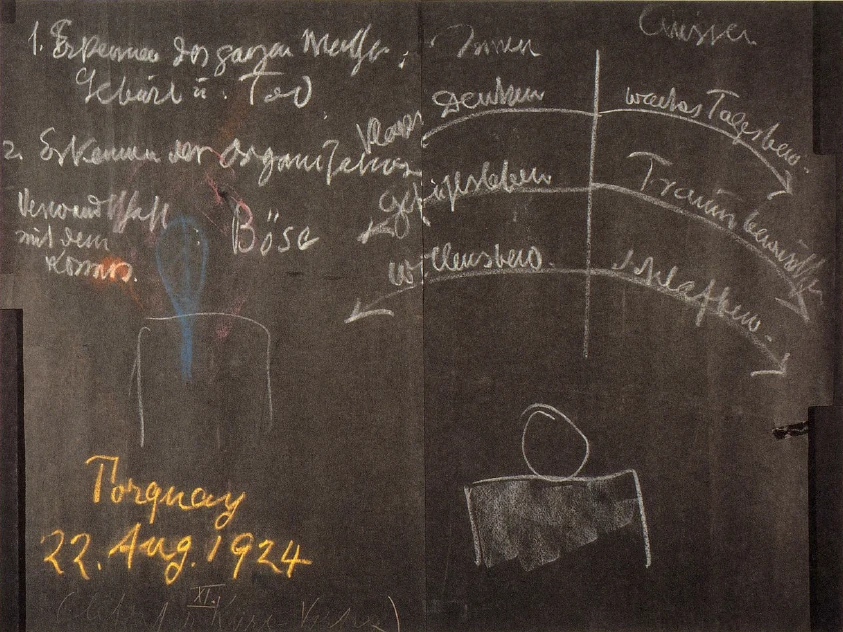
[ 7 ] We can, in fact, schematically represent this ordinary consciousness as follows:
Inner: Clear Thinking Emotional Life
Consciousness of the WillOuter: Alert Daytime Consciousness
Dream Consciousness
Sleep Consciousness
[ 8 ] Outwardly, alert waking consciousness; inwardly, clear thinking; outwardly, dream consciousness; inwardly, an unclear but warm emotional life; outwardly, sleeping consciousness; inwardly, a completely dark consciousness of the will.
[ 9 ] But now, if a person, in order to explore the spiritual world, that is, to seek out the facts that can be revealed from the spiritual world, is compelled to direct his consciousness toward the world he wishes to penetrate with his understanding, then—provided the findings are communicated honestly—the ideas conveyed through words will enter into the consciousnesses of others. And now you may perhaps understand that there are two kinds of situations. First, there is the case where, for example, one conducts research into the world of human organs, as I explained yesterday, using the forces that arise in human beings as they draw closer to the spiritual world to investigate the facts in question. There one finds the corresponding facts. There, these facts present themselves to the soul for recognition. There they are. So people in the outer world are confronted with these facts. Now these facts are communicated by the people concerned; they are presented to the world. When they are presented to the world by human beings, they can be understood with ordinary consciousness, provided one brings the necessary open-mindedness to the task. That is why, throughout human evolution, it has always been the case that a few people have devoted themselves to investigating the facts relevant to the spiritual world and, once they had investigated them, have communicated them to others.
[ 10 ] The only thing standing in the way of accepting such insights today is that people generally grow up in a social environment and through an educational process that instills in them the habit of believing only in the external world of facts—the world of the senses and what the intellect derives from the world of the senses. This is a habit that exerts such a strong influence that, out of this habit, one is always inclined to say: There is a university; people have graduated from the university; they now teach at the university, they also investigate certain facts, or when others investigate certain facts of the sensory world, they confirm them. — One believes in it! After all, one does not investigate these facts of the sensory world oneself; one simply believes in them. And especially with regard to modern natural science, people are infinitely credulous. They believe things that, for those with insight, are not merely problematic but certainly entirely untrue. This stems solely from centuries of education.
[ 11 ] People in earlier centuries, if I may say so, did not have this kind of education. Back then, because everyone still had some remnant of the ability to look into the spiritual world—of an emotional and volitional immersion into the spiritual world—people were still more inclined to believe even those who investigated spiritual realities. Today, people are simply not accustomed to this, and they have become accustomed to a way of thinking that has become thoroughly established—more theoretically on the continent, and more practically in England and America.
[ 12 ] On the continent, there are detailed theories on this subject; in England and America, there is a sense of it that is not easily overcome internally. It is this: People have become accustomed to accepting what has emerged over the centuries—the natural sciences that rely on the external senses, such as astronomy, botany, zoology, and medicine—exactly as they are presented in recognized schools and institutions. People have grown accustomed to this over the centuries, and today they cling to it with a fierce determination. And when a chemist conducts research in his laboratory—and we have not the faintest idea how he does it—but the results become known, they say: “That is true; that is knowledge.” — They say: “That is not faith; that is knowledge.” — Of course it’s pure faith! But people say: “That’s knowledge.”
[ 13 ] And yet, in all the methods people use to explore the sensory world—to discover its laws through reason—in all these methods, one finds nothing about the spiritual world. But there are very few people who can do without the spiritual world entirely, and those who tell themselves they can are not being honest about it. Above all, people have a need to know something about the spiritual world as well. Even today, they do not listen to those who can tell them about the spiritual world in a modern way, but they do listen to what has been handed down through history, what is written in books, what is found in the sacred texts of the East, and what is written in the Bible. They listen to these things because they cannot help but have some kind of connection to the spiritual world. And yet, even though everything written in the Bible or in the sacred texts of the East has been explored only by individual initiates, they say: Yes, this is a different kind of perspective. It is not like the knowledge of the external sensory world, like scientific knowledge; rather, it is based on faith. One must believe. — And so people draw a sharp distinction: one thing is science, another is faith. And they then relate science to the sensory world and faith to the spiritual world.
[ 14 ] On this subject, there are—on the continent, specifically among theologians of the Protestant Church—not among theologians of the Catholic Church, who have merely preserved the traditions of earlier times and do not distinguish in the same way as Protestant theologians or secular scholars— there are entire theories on the continent about how knowledge extends to a certain point, and then faith begins. That is how it must be. Here in England there are fewer theories, because people are not so fond of theories. But here there is this way of life: on the one hand, listening properly to science and accepting what one learns from it; on the other hand, living properly—piously, though I won’t say pietistically—in faith, and strictly separating the two things.
[ 15 ] It is not only laypeople who can do this; scholars have been able to do it for a long time. On the one hand, Newton established the theory of gravity—that is, a spatial worldview which, by its very nature, excludes any conception of the spiritual. If the world were as Newton conceived it, it could contain no spirit. People simply lack the courage to admit this to themselves. Just as a spinning wheel could never become a human being—just as it is impossible to conceive of a human being within a spinning wheel—so, too, is it impossible to conceive of a divine-spiritual force at work in Newton’s world. People simply lack the inner courage to admit this to themselves. But it is not only those who accept such ideas who manage, on the one hand, to devote themselves to a spatial and temporal worldview that excludes the spiritual; it is also those who conduct their own research—of whom Newton is a fine example—who, on the one hand, establish a worldview that excludes everything spiritual, and on the other hand, interpret the Apocalypse with the soul completely separated from it.
[ 16 ] The bridges have been severed between what constitutes knowledge and understanding of the external sensory world and what constitutes knowledge and understanding of the spiritual world. And today, even in circles where theories are cherished, people try to prove this rigorously; whereas in circles where theories are not cherished, they try to ingrain it so deeply into habits of feeling and thinking that one cannot escape it at all. In contrast, human reason—understanding, the power of ideas, the capacity for ideas—is already so advanced today that, if one only reflects on it and truly masters it, what emerges from initiatory science can be fully grasped by reason, but cannot be investigated.
[ 17 ] What, then, is necessary? That insight may develop: First, that which is to be investigated from the spiritual world must be explored by those people who, in their present life, can draw upon forces from earlier incarnations that enable them to bring forth what is necessary for the investigation; furthermore, that what is thus investigated be received by a number of people—by more and more people—and understood in concepts as it can be understood; and that, as a result, when what has been spiritually investigated is received with sound understanding, the foundation is laid—precisely for these other people—through that understanding, to truly look into the spiritual world. — For I have often said: The healthiest way to truly enter the spiritual world is to begin by engaging with reading or by taking in what is proclaimed from the spiritual world.
[ 18 ] When one takes these thoughts to heart, they come alive within, and the individual enters not only into understanding but also into insight, to the extent that his karma permits. And it is precisely on this point that one must thoroughly familiarize oneself with the concept of karma. People today do not think about karma. They argue that just as sulfur is examined in a laboratory, so too must one examine, in a laboratory-like manner, how a human being brings about so-called abnormal phenomena. They claim that one must experiment with a person who produces abnormal perceptions in the same way that one experiments with sulfur. But you see, sulfur has no karma. Only the “sulfur” that people speak of has karma! Ordinary mineral sulfur has no karma. Only human beings have karma. And it can never be assumed that a human being’s karma includes allowing experiments to be conducted on them in a laboratory—and this would have to be the case if the research were to bear fruit. Therefore, spiritual science would have to be in place first. One would first have to investigate the conditions under which it follows from karma that one can learn something about the spiritual world through a human being. I clearly stated this at the end of the later editions of my Theosophy. But the present world is not suited—not out of inability, but out of habit—to take these things in. But this is infinitely important. Above all, it is important to be clear about this: You do not have to have already penetrated the spiritual world through research; rather, as long as you do not engage in anything unhealthy here on the physical plane—such as experimenting with karma, which would not necessarily be karmically conditioned, or with mediums whose methods you do not understand; if you rely here on what is, for the time being, precisely the right consciousness for this world—and what I have described as everyday consciousness; if you rely correctly on this everyday consciousness, then you will arrive at a complete understanding of what is said in the science of initiation. — And if one believes that one cannot have such an understanding until one can penetrate it oneself, then one is succumbing to a very great error. And this, again, is one of the false paths people take today—to say: “What does the spiritual world have to do with me, as long as I cannot look into it myself?” — Herein lies one of the very greatest, the very most dangerous, and the very clearest errors. Above all, this error must be sharply recognized by a movement such as the Anthroposophical Society embodies.
[ 19 ] Birth, Death, and Evil
[ 20 ] The fact that human beings, through their existence here in the physical world, belong to different worlds, is something that can be readily apparent to an unbiased consciousness simply from the fact that the realities a person experiences—as they present themselves to the totality of human experience—are such that, wherever the most important aspects of life are concerned, they come up against the incomprehensibility of everyday consciousness; they come up against it because they appear to be disconnected, even though in certain cases they are closely interrelated.
[ 21 ] In this brief reflection, I would like to begin by pointing out humanity’s entry into this physical world and its departure from it—that is, birth and death. Birth and death, these two most pivotal events in human life on Earth, appear to ordinary consciousness as separate occurrences. Everything that precedes birth—everything connected with the human being’s entry into earthly existence—is placed at the beginning of earthly life. Death is placed at the end of earthly life. They seem to be separated from one another. For those who explore the realm of spiritual life, however, they draw ever closer together. For when one treads the path I have characterized as the human being’s penetration into the lunar mysteries—where night is conjured into the day, as I described yesterday—one sees how, in all the processes of birth, the physical and etheric bodies become ever more sprouting and budding; how they emerge from the tiny seed, how they gradually take on human form, how they continue to display—one might say—an upward-striving life even during earthly existence, and only in the middle of one’s earthly life, around the age of thirty-five, do they begin to gradually decay, displaying a downward-striving life. This is what a person observes externally as well. But the one who embarks on that lunar path I spoke of yesterday also sees how, at the very same time that a sprouting, budding germ life begins for the physical and etheric bodies and continues to develop, another life—which we summarize in the field of anthroposophy as the astral body and the “I”—actually dies off and succumbs to death.
[ 22 ] When one enters into the mystical life—which I described in concrete terms yesterday—one sees not only the birth of the physical and etheric bodies, but also the death of the astral body and the “I.” One sees death weaving itself into life, the dying uniting with the sprouting. And again, when one observes a human being with this initiatory consciousness, one sees—as the body begins to decay, starting around the age of thirty-five—the beginning of a revival in the astral and the “I.” Only, these are disturbed by what is dying all around them in the physical and etheric bodies. But a genuine revival does take place. And so, through this path of spiritual research, one comes to know death already in life, and life in death. In this way, one prepares oneself to trace back what one sees dying during birth even further into the pre-earthly life, where it reveals itself in its full significance and grandeur. And by seeing, in the dying earthly life, the astral and the “I” nature gradually becoming more vivid—though still held captive by the etheric and the physical—one prepares oneself once again to follow what passes through the gate of death out of the human physical and etheric bodies, to follow it into the spiritual world. Death and birth draw closer to one another, whereas in ordinary consciousness they appear as separate events.
[ 23 ] But everything that is brought to light in this way through research into the spiritual world can, as I indicated in the first part of today’s lecture, certainly be grasped by ordinary consciousness. One simply has to break the habit of what this ordinary consciousness demands of us today. You see, I knew a man who said: The stone falls down; if I pick up a chair and let it go, it falls down; everything falls down to the earth. Yet people claim that the earth isn’t resting on anything; it ought to fall down, too—he said. And this person failed to realize that everything on Earth must fall downward because the Earth is there, but that the Earth itself floats freely in space, just as the stars, in their totality, support and hold one another.
[ 24 ] People who claim today that everything must be proven through the external senses according to the model of modern science are like someone who says: If the Earth does not rest on a large peg, then it must fall down. — The truths of anthroposophy are such that they support one another just like the stars. One must come to this realization. And once one has arrived at this point through one’s ordinary understanding, one actually begins to grasp anthroposophy conceptually, including such things as the interconnection between birth and death. But let us continue. Let us consider how someone who is well-prepared by what contemporary science has to offer, yet approaches the subject with lively receptivity, does not come to recognize the whole human being, but rather, in the manner described yesterday, comes to understand the human organs.
[ 25 ] Yes, you see, through this understanding of the organs—this understanding gained on the path of the initiate—it is not birth and death that stand before the soul, but something entirely different. Even before this understanding of the organs, birth and death have lost their usual meaning, for only the whole human being can truly die; a single organ cannot die. The lungs, for example, do not die. Modern science has already grasped a small part of this: that when the whole human being has died, the individual organs can, in a certain sense, be kept alive on their own. The individual organs do not die, regardless of whether the person is buried or cremated; each organ seeks its own path out into the cosmos in accordance with its nature, even if the person lies in the earth and the earth covers him when he has been buried; the organs seek their way out into the cosmos through water, air, and warmth. In reality, the organs dissolve; they do not die. Only the whole human being dies.
[ 26 ] Speaking of death in humans only makes sense in relation to the whole person. In animals, one must speak of the organs in the sense that they die. In humans, the difference from animals is that the organs disintegrate. They simply disintegrate more quickly—just as when you cook an unripe apple; in a certain sense, it undergoes the process more rapidly than a ripe apple. Burial is the slow process; cremation is the fast process. The organs can also be observed in their own way as they extend into infinity. But out there in the cosmos, they do not extend into infinity; rather, what I described yesterday returns to us—the great human being, the cosmic human being.
[ 27 ] So, when one observes the organs with the consciousness of an initiate, one sees what truly takes place with the organs at death—this departure, according to their affinities, into the regions of the cosmos. The heart goes elsewhere than the lungs; the liver goes elsewhere than the lungs and heart. They disperse throughout the cosmos. One can perceive this by developing, on the path of initiation, the consciousness of the organs—the awareness of the organs themselves. Then this human being appears. Then the human being appears as he or she is actually integrated into the cosmos. And in observing this human being—how he is actually integrated into the cosmos—one can perceive what, for example, underlies successive incarnations.
[ 28 ] One needs the kind of perception that arises not from the whole human being but solely from the perception of the organs, in order to be able to recognize, in turn, the return of past earthly lives into this earthly life for the sake of perception. That is why it was the case that people who, like the mystics, theosophists, and so on, ventured into the spiritual world via the lunar path saw all manner of things—human souls as they had lived in the past, gods, spirits—but could not actually recognize them, could not figure out what they were, and could not say with certainty: “That is Alanus ab Insulis; that is Dante; that is Brunetto Latini.” — The beings were there; they were sometimes given quite grotesque names. Past incarnations were there. But one could not distinguish whether they were one’s own, someone else’s, or just any others. So that the spiritual world enters this night world conjured up into the day, but then dissolves under the influence of the Venusian impulses, and now exists as the spiritual world in its entirety, without attaining the definiteness it is meant to have. You see, in this world, then, the possibility arises to understand how the human being as a whole is situated within the world, how he exists as a cosmic being.
[ 29 ] On the other hand, this is linked to a realization that I would call extraordinarily tragic. For if human beings were simply the whole human being, just as they appear here on Earth in their physical form—oh, what a good, gentle, and noble being that would be! Just as one cannot explore death with ordinary consciousness—one can grasp it in the sense indicated, but not explore it— nor can one explore with ordinary consciousness why people with their guileless faces—they all have such guileless faces, after all—why they, with their guileless faces, can also become evil. For one does not become evil as a whole person. The skin is something extraordinarily good. One becomes evil through the individual organs. The possibility of evil lies within the organs. And thus, in connection with this relationship between the organs and the individual regions of the world, one also learns to recognize from which regions of the world the obsession with evil originates; for such an obsession is, in essence, present even in the slightest evil. Thus, first, through the understanding of the whole human being, birth and death arise; second, through the understanding of the human organism, a connection with the cosmos in both healthy and diseased states: evil.
[ 30 ] And so even the Being who has passed through the Mystery of Golgotha can only appear before the human soul if one first has the opportunity to view the cosmic human being from the perspective of human organology. For as a cosmic human being, Christ came from the sun. Until then, He had not yet been an earthly human being. He approached as a cosmic human being. How can one recognize a cosmic human being if one has not first prepared oneself to grasp the cosmic human being at all! It is precisely a Christology that can emerge from this understanding of the cosmic human being. And so you see how the right paths lead into the spiritual world, lead to an understanding of birth and death, lead to an understanding of the relationship between the human organs and the cosmos, lead to an understanding of evil, and lead to an understanding of the cosmic human being: Christ.
[ 31 ] All of this, when presented in a way that allows the various elements to support one another, can be understood. And that understanding is then the best way to enter the spiritual world oneself—understanding and meditating on that which one has come to understand. The other rules of meditation then serve as further support. But this is the right path into the spiritual world for everyone today. In contrast, all attempts to take other paths—ones that do not pass through ordinary consciousness today and do not preserve ordinary consciousness—all attempts made with consciousness switched off, such as in mediumship, somnambulism, hypnosis, and so on, all investigations into such worldly phenomena that cannot be approached with consciousness in the sense of today’s caricatured natural science—all of these are false paths, for they do not lead into the real spiritual world.
[ 32 ] The Revelation of the Celestial in the Earthly Through Art
[ 33 ] When a person becomes emotionally attuned—and this can happen in response to what emerges from research, as I have now indicated, namely, that through knowledge of the organs the cosmic human being returns, and that Christ can, in a sense, be understood in this return; when this—which can be revealed through occult research and insight, which can be incorporated into the consciousness of the initiate through research—arises emotionally within a person, then, in a sense, the heavenly is revealed within the earthly through feeling in the consciousness I have described to you. And this happens through art. In art, a semi-subconscious force holds fast, in a soulful way, that which comes to human beings from the spiritual world precisely along the return paths—those return paths I have described. That is why, throughout the ages, those human beings who were predestined by their karma have preserved the spiritual through the earthly-material in art.
[ 34 ] Our naturalistic art has strayed from this. But every pinnacle of artistic development in humanity represents the spiritual within the sensual—or, one might also say, elevates the sensual into the sphere of the spiritual. Raphael, the painter, is held in such high esteem because he, more than anyone else, was able to depict in the sensual something that rises to the spiritual.
[ 35 ] Now, in the general course of human development, there has been a current that was primarily plastic in nature and inclined toward the visual arts. Today we must once again find new life in the visual arts; but the immediate, elemental impulse in the visual arts has already run its course in times past. For quite some time now—for centuries—the other impulse has been taking shape: the impulse toward the musical. That is why the visual arts, too, are taking on a more or less musical form. In artistic terms, the musical is the future of humanity, as is everything musical that may also manifest itself in the performing arts. The renovation of the Goetheanum in Dornach was conceived in musical terms. This is why it has so far been so poorly understood as architecture, sculpture, and painting. The new building, too, will be difficult to understand for precisely this reason: because the musical must be integrated into the sculptural, pictorial, and plastic arts entirely in accordance with the course of human development.
[ 36 ] But precisely what I have alluded to—what is the highest point in human development, the emergence of the figure of Christ, yes, the living, spirit-filled figure of Christ—that is something which, in a certain sense, was wonderfully achieved in painting through Renaissance art and what preceded it, but which in the future will have to be found through music. You see, the urge was there. It was present in Richard Wagner. And this impulse ultimately led Richard Wagner to his Parsifal. But Parsifal, in terms of conjuring the Christ impulse into the physical-sensory world—where it is meant to be most Christian—remains, so to speak, merely a symbolic allusion: the dove appears and the like. Communion is present symbolically. What actually constitutes the Christ impulse in the cosmos and on Earth has not been achieved within the realm of music. Music, however, is capable of one day presenting this Christ impulse to the world through sounds—through shaped sounds, through sounds imbued with soul and spirit. If music allows itself to be inspired by anthroposophical spiritual science, it will find the ways to do so, for it will unravel—purely artistically, creatively, and emotionally—how that which lives in the cosmic-terrestrial realm as the Christ impulse can be brought to life symphonically in sounds.
[ 37 ] All that is needed is to be able to delve deeply into the realm of major thirds through a musical experience that reaches inward to the point of the mystical. If one experiences this as something that is musically rooted deep within the human being, and then perceives the realm of fifths in the major mode, one perceives the realm of fifths as having an enveloping quality—one that, as the human being grows into the structure of the fifths, they reach the boundary between the human and the cosmic, where the cosmic resounds into the human, and the human yearns out into the cosmic—indeed, surges outward in longing—then, precisely through music, one can experience, through the mystery unfolding between the third and fifth intervals in major, something of what, as an inner human quality, seeks to reach out into the cosmic. And if one then succeeds in first allowing the life of the cosmos to resound in the seventh dissonances—where the seventh dissonances speak as that which a human being can experience sensually in the cosmos when on the path outward into the various spiritual regions— and if one succeeds in allowing the seventh dissonances to drift away in such a way that, precisely through their drifting, they take on a definite form, then the seventh dissonances ultimately acquire, in their drifting, something that presents itself to musical experience like a musical firmament.
[ 38 ] And if one then finds—having already hinted at an intimate sense of a minor experience within the major experience—if one then finds in this floating of the seventh dissonances, in this shaping of the seventh dissonances into a totality that, in its totality, becomes almost harmonious, almost consonant because it floats, one finds within it the possibility of emerging, in intense minor, from the seventh dissonance, from the almost-harmonious nature of the floating of the seventh dissonances; one finds the way back into the realm of fifths in minor, and from there the interweaving of the realm of fifths with the realm of minor thirds—then, in this way, one has created the experience, the musical experience of incarnation, specifically the incarnation of Christ.
[ 39 ] For one will be able to find, in this feeling of reaching out into the realm of sevenths—which is only seemingly dissonant with regard to cosmic perception and which one shapes into a firmament by having the octave lie behind it, though only approximately so—once one has grasped this through feeling, and returns in the manner suggested, discovering how the embryonic form of the third consonances in the minor mode holds the possibility of representing the Incarnation as something musical—then, when one returns once more to the major mode in this realm, the “Hallelujah” of Christ may resound from this musical form, purely musically, purely from the shaping of the tones. Then, within the structure of the tones, the human being will conjure forth—in this shaping of the tones—something immediately supersensible and present it to the musical sensibility.
[ 40 ] The Christ impulse can be found in music. And that dissolution of the symphonic into something no longer quite musical, which was present in Beethoven, can in turn be traced back to the truly cosmic force at work within the musical element. Bruckner attempted this out of a certain narrowness and, I would say, a certain traditional limitation. But the posthumous symphony in particular shows how he remained stuck there—on the one hand, in its wondrousness, and on the other, in a tentative feeling one’s way through the truly musical elements and a failure to arrive at a full experience of these musical elements, which can only be experienced in the way I have just indicated, when one advances within the purely musical realm and finds within the music itself the essential, the fundamental—that which can conjure a world out of sound.
[ 41 ] If humanity does not fall into decadence, what I have hinted at will certainly come into being one day through anthroposophical inspiration. And so it may one day come to pass—it depends, after all, only on human beings—that, precisely in the realm of music, the Christ impulse will also step forward in its true form before the outer world.
[ 42 ] I wanted to present this to your soul for the following reason: because from it you can see that anthroposophy seeks to flow into life in all areas, and this can happen if life, on the other hand, truly finds the path—the right path—toward anthroposophical experience and anthroposophical research. And it may even be that what exists in the field of anthroposophy will one day resound like an echo from the realm of music, as if the echo were a solution to the Christological riddle.
[ 43 ] With these words, I would like to conclude what I could only hint at in these lectures—namely, the intentions behind them. I would just like to add that I hope I have succeeded in stirring within your souls a little of what I sought to bring to light through these presentations of anthroposophical truths—that these anthroposophical truths can indeed be seeds within every soul, seeds that can come to life and lead to ever greater and greater life within civilization.
[ 44 ] May this series of lectures also be a small contribution to these far-reaching aspirations of the anthroposophical will.