

Supplements to Member Lectures
GA 246
13 August 1914, Dornach
Translate the original German text into any language:
Versions Available:
Supplements to Member Lectures, tr. SOL
65. Samariterkurs Verbandkurs I
65. First Aid Course: Bandaging Course One
[ 1 ] Es gibt zweierlei Arten blutender Wunden:
[ 1 ] There are two types of bleeding wounds:
[ 2 ] 1. Arterielles Blut. Dieses ist hellrot und kommt in Strömen oder Güssen, es spritzt. Hier muss verbunden werden von der Wunde zum Herz-Organismus hin, also an den Gliedmaßen von unten nach oben. Das Ende des Verbandes wird [gespalten], geknotet und die beiden äußersten Spitzen um den Verband herum gelegt und festgebunden - nicht auf der Wunde!
[ 2 ] 1. Arterial blood. This is bright red and flows in streams or gushes; it spurts. In this case, the bandage must be applied from the wound toward the heart, that is, on the limbs from the bottom up. The end of the bandage is [split], knotted, and the two outer ends are wrapped around the bandage and tied tightly—not over the wound!
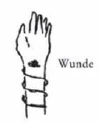
[ 3 ] 2. Venöses Blut. Dieses ist dunkelrot oder bläulich. Dann muss erstens die Wunde selbst verbunden werden (wie oben, aber nur an der Stelle der Wunde selbst bleibend), und zweitens muss der Blutumlauf abgeschlossen werden, und zwar so, dass die Wunde zwischen diesem ersten Verband und dem Organismus ist [(also beim Arm unter der Wunde)]. Es darf nicht allzu lang geschehen, es darf keine Steifheit oder Bläue der Finger auftreten; dann sollte er gelockert werden.
[ 3 ] 2. Venous blood. This is dark red or bluish. First, the wound itself must be bandaged (as described above, but only covering the wound itself), and second, blood flow must be occluded in such a way that the wound is located between this first bandage and the rest of the body [(i.e., in the case of an arm, below the wound)]. This should not be done for too long; if stiffness or blue discoloration of the fingers occurs, the bandage should be loosened.
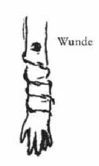
[ 4 ] 3. Kopfwunde. Der Verband wird einige Male um das Haupt gelegt und dann mit einem senkrechten Umschlagen des Verbandes in die andere Richtung gebracht. Die Stelle, wo dieses geschieht, wird festgehalten durch die folgenden Windungen. Mehr Windungen über die Wunde hinübergehend als senkrecht darauf! Zum Schluss mit einer Sicherheitsnadel abschließen, am besten oben auf dem Kopf (nur nicht auf der Wunde!).
[ 4 ] 3. Head wound. Wrap the bandage around the head several times, then bring it in the opposite direction by folding it vertically. Secure the point where this occurs with the following wraps. Make more wraps across the wound than perpendicular to it! Finally, secure it with a safety pin, preferably at the top of the head (but not directly over the wound!).

[ 5 ] In allen drei Fällen soll zuerst Mull, dann Watte auf die Wunde gelegt werden. [Am besten ist zuerst Mull, dann Watte.]
[ 5 ] In all three cases, gauze should be applied to the wound first, followed by cotton wool. [It is best to apply gauze first, then cotton wool.]
[ 6 ] Beim ersten und zweiten Fall oder bei einem gebrochenen Arm, diesen zuerst in ein Tuch legen. Dreieckiges Tuch oder wenn viereckig, dieses doppelt falten. Die Hand des betreffenden Armes wird auf die Spitze des Tuches gelegt, dieses umgeschlagen, von den beiden anderen Spitzen wird eine über die Schulter (beim linken Arm über die rechte Schulter) gelegt, die andere über die andere Schulter [(also hier linke Schulter)]. Auf dem Rücken zusammenbinden. Das Ende der letzten Spitze wird zuerst ein wenig um die Hand herübergeschlagen. Man kann die Hand mitsamt dem Tuch mit einer Sicherheitsnadel feststecken, damit man die Hand oder den Arm hochbekommt.
[ 6 ] In the first and second cases, or if the arm is broken, first wrap it in a cloth. Use a triangular cloth, or if it is rectangular, fold it in half. Place the hand of the affected arm on the tip of the cloth, fold it over, and drape one of the other two tips over the shoulder (for the left arm, over the right shoulder) and the other over the opposite shoulder [(i.e., the left shoulder in this case)]. Tie the ends together at the back. First, wrap the end of the last corner slightly around the hand. You can secure the hand and the cloth together with a safety pin so that you can raise the hand or arm.
[ 7 ] Bei der Wunde mit arteriellem Blut muss der Arm während des Verbindens hochgehalten werden. Wenn niemand in der Nähe ist, der dabei behilflich sein kann, dann sollte der Arm auf etwas aufgestützt werden.
[ 7 ] If the wound is bleeding arterial blood, the arm must be held elevated while applying the dressing. If there is no one nearby who can assist, the arm should be propped up on something.
[ 8 ] Wunden müssen in Ruhe gehalten werden; auch nicht zu viel mit Wasser berühren! Wenn sie schmutzig werden, so sollen sie zuerst mit einem anti- oder aseptischen Mitteln gereinigt werden (Hände zuerst fünf Minuten aseptisch waschen, Instrumente und so weiter auskochen!). Ist die Wunde nicht schmutzig, dann sol] man sie ganz in Ruhe lassen. Um die Wunde herum kann man gut reinigen. Alle antiseptischen Mittel und so weiter halten sehr die Heilkraft zurück. Die hauptsächlichen Heilkräfte kommen doch aus dem Organismus selbst. 4. Wenn kein Verbandszeug zum Abbinden vorhanden ist, soll man die Arterie über der Wunde (Puls-, Oberarm-, Halsarterie) steif zuhalten, vielleicht 10 bis 15 Minuten.
[ 8 ] Wounds must be kept still; do not rinse them with too much water! If they become dirty, they should first be cleaned with an antiseptic or aseptic agent (wash your hands aseptically for five minutes first; boil instruments and so on!). If the wound is not dirty, then you should leave it completely alone. You can clean the area around the wound thoroughly. All antiseptic agents and the like significantly inhibit the body’s natural healing process. The primary healing power comes from the body itself. 4. If no bandages are available to apply pressure, firmly compress the artery above the wound (radial, brachial, or carotid artery) for about 10 to 15 minutes.
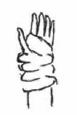
[ 9 ] 5. Bei gebrochenem Handgelenk nehme man ziemlich breiten, starken Verband. Die Hand gut ausstrecken. Beim Winden mit der Hand anfangen. Die erste Windung über den Daumen schief wickeln, dann die Hand ohne Daumen. Beim Höherhinaufkommen jedes Mal den Verband umschlagen. Den Ellbogen freilassen und noch etwas über den Ellbogen hinaus verbinden[; mit Sicherheitsnadeln abschließen]. Im Notfalle kann es mit jedem Tuch gemacht werden.
[ 9 ] 5. For a broken wrist, use a fairly wide, sturdy bandage. Extend the hand fully. Start wrapping with the hand. Wrap the first turn diagonally over the thumb, then wrap the hand without the thumb. As you go higher, fold the bandage over each time. Leave the elbow exposed and wrap the bandage slightly beyond the elbow [; secure with safety pins]. In an emergency, any piece of cloth can be used.
[ 10 ] 6. Gebrochener Unterschenkel. Schuh und Strumpf werden rasch nach unten zu durchgeschnitten. Das Bein beim Fuß festhalten lassen und gut ausstrecken. Großes Stück Watte um das Bein herum legen. Dann ein Stück Holz, Stock oder Regenschirm oder was auch so flach ist wie möglich unterhalb und rechts und links vom Bein legen. Dieses wird an drei verschiedenen Stellen mit in Streifen geschnittenem Verbandszeug zusammengebunden (1. oberhalb des Knies, 2. beim Knöchel, 3. in der Mitte - nur nicht an der Bruchstelle). Die Knoten auf das Holz, nicht auf das Bein.
[ 10 ] 6. Broken lower leg. Quickly cut the shoe and sock off. Have the person hold their foot firmly and keep the leg fully extended. Wrap a large piece of cotton wool around the leg. Then place a piece of wood, a stick, an umbrella, or anything else that is as flat as possible beneath and to the right and left of the leg. Secure it in three different places with bandages cut into strips (1. above the knee, 2. at the ankle, 3. in the middle—just not at the fracture site). Tie the knots on the wood, not on the leg.
[ 11 ] Das Bein hochhalten. Kissen oder dergleichen unter das Bein legen.
[ 11 ] Elevate the leg. Place a pillow or something similar under the leg.
[ 12 ] 7. Zersplitterte Schädeldecke. Die Haare wegschneiden oder im Not fall wegkämmen. Ein links und rechts aufgeschnittenes Tuch wird über den Kopf gelegt, die vorderen Spitzen hinter dem Kopf kreuzweise zusammengeknotet, die hinteren vor dem Kopfe. Zuerst müssen die hinteren Spitzen vorn zusammengebunden werden, da das Festigkeit gibt. Dasselbe kann man auch im Falle einer Kopfwunde anwenden, wenn Verbandszeug fehlt, dann aber selbstverständlich zuerst Gaze oder Watte auflegen. Auch bei Kinnbeschädigungen zu gebrauchen. Die obersten Spitzen werden einfach hinter das Haupt gelegt, die untersten über das Haupt (aber kreuzweise).
[ 12 ] 7. Fractured skull. Cut away the hair or, in an emergency, comb it away. Place a cloth—cut open on the left and right sides—over the head, tying the front corners together in a cross behind the head and the back corners in front of the head. First, tie the back corners together at the front, as this provides stability. The same method can be used for a head wound if bandages are unavailable—but of course, apply gauze or cotton wool first. It can also be used for chin injuries. Simply place the top corners behind the head and the bottom corners over the head (but crossed).
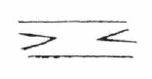
[ 13 ] 8. Nasenverwundung oder -beschädigung. Gaze, Watte, dann Verband über die Nase und senkrecht darauf. Über die Ohren, wie bei der Kopfwunde oder auch mit verspaltenem Verband wie oben.
[ 13 ] 8. Nose injury or damage. Apply gauze and cotton wool, then wrap a bandage around the nose and vertically over it. Wrap around the ears as with a head wound, or use a split bandage as described above.