

Supplements to Member Lectures
GA 246
17 August 1908, Stuttgart
Translated by Steiner Online Library
12. Philosophy and Theosophy
[ 1 ] Now that we have completed a long series of purely theosophical lectures, let us today, so to speak, strike a different note, [that is, speak from a completely different perspective—namely, a more philosophical one]. Therefore, I ask you to bear in mind from the outset that today’s lecture is not theosophical in the strict sense, and that the purely philosophical tone that must be adopted may seem somewhat abstract and difficult to some who are not accustomed to engaging with such lines of thought. This is done for a very specific reason; it is done because, time and again—and especially in those circles that possess, or believe they possess, a certain philosophical education—the opinion inevitably arises (I deliberately choose the word “inevitably”) that Theosophy is, in fact, only to be endorsed by people who have not progressed beyond a certain level of dilettantism in philosophical or scientific matters. But one might easily think in these circles that anyone who has a thorough philosophical education—who has come to understand the foundations of scientific certainty and conviction—should not really concern themselves at all with all that fantasy, with all that which presents itself as supposedly higher experience; that is something for those who are not yet mature enough for scientific thinking. To understand what cs actually means by such a judgment, let us, so to speak, take a look at philosophical activity itself. Of course, today this can only be done very briefly, merely in hints [and in a sketchy manner, since it has been rigorously and thoroughly proven]; but when we have the opportunity to discuss such matters in greater detail, you will see that these hints are taken from a larger [and true] context [, which is easily apparent upon closer examination].
[ 2 ] Philosophy is generally regarded by those who practice it as something absolute, not as something that had to emerge only in the course of human evolution. It is precisely in the case of philosophy that one is able to determine—even from external historical documents—when it originated as such within human evolution and when it had to originate. Most historians of philosophy, particularly the older ones, have also captured this quite accurately. In all these accounts, you will find that the narrative begins with Thales and then proceeds from him right up to our own time.
[ 3 ] However, some more recent historians of philosophy, who wanted to be particularly thorough and particularly clever, have shifted the origins of philosophy to even earlier times and incorporated all sorts of elements from earlier wisdom traditions. But all of this stems from a very specific form of dilettantism, which fails to recognize that all the teachings of wisdom that preceded philosophy in India, Egypt, and Chaldea have, methodologically speaking, a completely different origin than purely philosophical thought, which tends toward the speculative. This mode of thought first developed in the Greek world; and the first figure who truly comes into consideration there is Thales. We need not even begin with a characterization of the various Greek philosophers—not Thales, not Anaxagoras, Heraclitus, or Anaximenes, nor even Socrates and Plato; we can proceed directly to the figure who actually stands out first and foremost as the philosopher par excellence, and that is Aristotle.
[ 4 ] [Everything else that preceded him either arose directly from the Mysteries or was at least closely related to them.] All other philosophies are, in essence, still abstractions inspired by the wisdom of the Mysteries; this can be easily demonstrated in the case of Thales and Heraclitus, for example. But not even Plato or Pythagoras—both of whom draw their sources from the art of divination—are philosophers in the true sense of the word. For when we characterize philosophy as such, what matters is not that someone expresses himself in concepts, but where his sources lie. Pythagoras drew on the wisdom of the mysteries and transformed it into concepts; he was a clairvoyant, but he simply put what he experienced as intuition into philosophical form, and the same is true of Plato.
[ 5 ] But what defines the philosopher—and what we encounter for the first time in Aristotle—is that he works solely through pure conceptual technique and that he must necessarily reject other sources or find them inaccessible to him. [Aristotle is a philosopher in the most eminent sense because he developed pure thought through the mere technique of concepts.] And because this is only the case with Aristotle, it is not without world-historical significance that it is precisely he who founded logic, the science of the technique of thought. Everything else was merely a precursor. The way in which concepts are formed, judgments are made, and conclusions are drawn—Aristotle was the first to identify all of this as a kind of natural history of subjective human thought, and everything we encounter in his work is closely linked to this foundation of the technique of thought. Since we will return to several points that are of fundamental importance in his work for all subsequent considerations, this historical note is sufficient for now to briefly characterize the starting point.
[ 6 ] Aristotle remained the leading philosopher even in later times. His contributions not only shaped the post-Aristotelian period of antiquity up to the establishment of Christianity, but especially during the early Christian era and well into the Middle Ages, he was the thinker whom people looked to as a guide in the development of all attempts to formulate a worldview. This is not to say that, particularly in the Middle Ages—when the original texts were not available—Aristotle was regarded as a system or a set of dogmas; rather, people had become accustomed to the method of ascending the ladder of pure conceptual technique to attain knowledge, all the way up to the highest divine knowledge. And so it came to pass that Aristotle increasingly became the teacher of logic. In the Middle Ages, people reasoned something like this: Whatever the source of positive knowledge of the world’s facts—whether it stems from human beings examining external reality with their senses or from a revelation through divine grace, such as that through Christ Jesus—these are things that must simply be accepted: on the one hand, as sensory perceptions; on the other, as revelation. But if one wishes to ground something given in this or that way through pure concepts, then one must do so using the technique of thought established by Aristotle.
[ 7 ] [Especially in early Scholasticism, Aristotle’s logic—and, to some extent, his actual teachings—were still relevant.] And in fact, Aristotle’s contribution to the foundations of the art of thinking was so significant that Kant—and rightly so—said that since Aristotle, logic had not actually advanced by a single proposition. And essentially, this still holds true today; even today, the foundation of logical and methodological teachings has remained largely unchanged from what Aristotle established. What people seek to add today stems from a rather amateurish approach to the concept of logic, even in philosophical circles.
[ 8 ] It was not merely the study of Aristotle, but above all the process of familiarizing oneself with his method of thought that became relevant during the middle period of the Middle Ages—the early scholastic period, as it might be called—when Scholasticism was in its heyday. This period, in terms of its heyday, came to a close with Thomas Aquinas in the thirteenth century. When speaking of this early scholastic period, one must be clear that today one can only discuss it philosophically if one is free from all authority and all dogmatic belief. Indeed, it is almost harder today to speak about these things purely objectively than it is to speak disparagingly about them. If one speaks disparagingly about Scholasticism, one does not run the risk of being condemned by the so-called free spirits; but if one speaks objectively about it, there is a high probability of being misunderstood—precisely because today, within the positive and, indeed, the most intolerant church movements, there are many instances of completely misleading references to Thomism.
[ 9 ] What is considered orthodox Catholic philosophy today should not concern us; nor should we be deterred by the possibility that we might be accused of espousing the very same views that are promoted and mandated by dogmatists. Rather, without concern for anything that might be asserted from the right or the left, we wish to characterize the spirit that characterized the heyday of Scholasticism with regard to science, the art of thinking, and supernatural revelation.
[ 10 ] Early Scholasticism is not what people today usually try to characterize it as with a catchphrase; on the contrary, it is monism, the doctrine of unity—it is not in the least dualistic in nature. For Scholasticism, the source of the world is thoroughly unified; it is just that the Scholastic has a certain perception regarding the contemplation of this foundation. He says: There is a certain supersensible treasure of truth, a treasure of wisdom, that was first revealed to humanity; human thought, with all its techniques, is not yet advanced enough to penetrate on its own into the realms whose essence is the content of the highest revealed wisdom. Therefore, for the early Scholastic, there exists a certain treasure of wisdom that is initially inaccessible to the techniques of thought [; yet these techniques do extend almost to the very limits of those revelations].—It is accessible to them only insofar as thought is capable of elucidating what has been revealed.
[ 11 ] For this part of the treasure of wisdom, it is therefore incumbent upon the thinker to accept it as revealed; and to use the technique of thought only to clarify it. What human beings can discover on their own is confined to certain subordinate realms of reality. For these, the scholastic applies the act of thinking to his own research. There he pushes forward to a certain limit, where he encounters revealed wisdom. Thus, the contents of one’s own research and of revelation merge into an objectively unified, monistic worldview. The fact that a kind of dualism—dictated by human nature—enters into the matter is only secondary. It is a dualism of knowledge, not one concerning the foundations of the world.
[ 12 ] The scholastic, then, describes this method of thought as suitable for rationally processing what is gained in empirical science and through sensory observation, and furthermore for advancing a step further toward spiritual truth. And then, in humility, the scholastic presents a portion of wisdom as revelation—something he cannot discover on his own, but must simply accept.
[ 13 ] However, the particular method of thought employed by the scholastics sprang entirely from the soil of Aristotelian logic. For early scholasticism, which drew to a close around the thirteenth century, there was a twofold necessity to engage with Aristotle. One necessity stemmed from historical development: Aristotelianism had simply become established. The other necessity arose from the fact that, little by little, an adversary had emerged from another quarter to challenge the traditional Christian doctrine.
[ 14 ] Aristotle’s teachings had, in fact, spread not only throughout the West but also throughout the East; and everything that the Arabs brought to Europe via Spain was, in terms of methodology, steeped in Aristotelianism. Specifically, it was a certain form of philosophy and natural science—extending even into medicine—that had been brought over and that was permeated, in the most eminent sense, by Aristotelian methods of thought. Now, the view had taken hold there that nothing other than a kind of pantheism—which, particularly in philosophy, had emerged from a very vague form of mysticism—could follow as a consequence of Aristotle. Thus, in addition to the single reason that Aristotle had lived on in the method of thought, there was another reason to engage with him: in the Arabs’ interpretation, Aristotle appeared as an adversary, as an enemy of Christianity.
[ 15 ] [The Arabs sought to use Aristotle to support their false mysticism and pantheistic teachings in general. This led the Scholastics to ask whether the Aristotle brought to Europe by the Arabs was in fact the true Aristotle.] One had to conclude: If what the Arabs brought over as an interpretation of Aristotle were true, then Aristotelianism would be a scientific foundation capable of refuting Christianity. Now let us imagine how the Scholastics must have felt in the face of this. On the one hand, they held fast to the truth of Christianity; on the other, however, in accordance with all tradition, they had no choice but to admit that Aristotle’s logic—his method of thought—was the true and correct one. This dilemma presented the Scholastics with a task: to prove that one could apply Aristotle’s logic, pursue his philosophy, and that it was precisely through him that one possessed the instrument to truly grasp and understand Christianity. It was a task dictated by the course of history. Aristotelianism had to be approached in such a way that it became clear: what had been brought by the Arabs as Aristotle’s teaching was merely a misinterpretation of it if it proved hostile to Christianity. That one merely had to interpret it correctly in order to find in it the foundation for understanding Christianity: That was the task that Scholasticism set for itself and to which the entire body of Aquinas’s writings was devoted. [Therefore, it was necessary to demonstrate that Christian teachings could be supported precisely on the basis of a correctly understood Aristotle. Only in this way could one effectively combat the half-baked materialism and vague pantheism coming from the East.]
[ 16 ] But now something else happens. In the course of development, following the heyday of the Scholastics, a complete break occurs in the entire logical-philosophical development of human thought. The natural course of events would have been (but this is not meant as a criticism, nor is it even meant to suggest that it could have happened at all; the actual course of events was, after all, necessary—the following is merely a hypothetical scenario), it would have been natural for the technique of thought to have been expanded further and further, for ever higher and higher realms of the supersensible world to have been grasped through thought. But that was not how development proceeded at first.
[ 17 ] The fundamental idea—which, for Thomas Aquinas, for example, initially applied to the highest realms, and which could well have developed in such a way that the boundaries of human inquiry might have expanded ever higher into the supernatural realm—was distorted to the point of caricature and now lived on in the conviction: The highest spiritual truths are entirely beyond the reach of purely human thought and the conceptual elaboration that human beings are capable of producing on their own. This has created a rift in human intellectual life. Supernatural knowledge was portrayed as something that is absolutely beyond the reach of any human intellectual effort, that cannot be attained through subjective acts of cognition, and that must arise solely from faith. [At most, one can approach those realms only with a kind of emotional conviction, with mere faith. This chasm between faith and knowledge, thus opened up, became a powerful impetus for later times.] The seeds of this had already been sown earlier, but it was driven to extremes toward the end of the Middle Ages. The distinction between faith—which must be attained through a subjective emotional conviction—and that which can be worked out through logical activity as the basis for a certain judgment was increasingly elaborated.
[ 18 ] And it was only natural that, once this chasm had opened up, knowledge and faith were increasingly driven apart. It was also natural that Aristotle and his method of thought were drawn into this rift, which had opened up through historical development. In particular, he was drawn into it at the dawn of the modern era. At that time, scientists argued—and much of what they said we can consider well-founded—that one cannot make progress in the empirical search for truth by merely building upon what Aristotle had already established. Moreover, historical developments unfolded in such a way that it became problematic to be associated with the Aristotelians; indeed, as the era of Kepler and [Galileo] dawned, misunderstood Aristotelianism had become a veritable scourge.
[ 19 ] It happens time and again that the successors—the adherents of a worldview—undermine so much of what the founders had quite rightly established. Instead of looking into nature itself, instead of observing, it was deemed convenient at the end of the Middle Ages to take the old books of Aristotle and to base all academic lectures on what Aristotle had written. [Aristotle was held in higher regard than direct observation.] A characteristic example of this is that an orthodox Aristotelian was asked to examine a corpse to verify that—contrary to what he had mistakenly inferred from Aristotle—the nerves do not originate in the heart, but rather that the nervous system has its center in the brain. The Aristotelian replied: “Observation shows me that this is indeed the case, but Aristotle states the opposite, and I believe him more.” Thus, the Aristotelians had indeed become a scourge. And that is why empirical science had to do away with this false [misunderstood] Aristotelianism and [in order to make progress again at all] rely on pure experience—an impulse we see particularly strongly exemplified in the great Galileo.
[ 20 ] On the other hand, something else was taking shape. Among those who, so to speak, wanted to protect the faith from the encroachment of thought now left to its own devices, an aversion, a distaste for the technique of thinking began to develop. They believed that this technique of thinking was powerless in the face of revealed wisdom. While the secular empiricists drew upon Aristotle’s book, the others drew upon something they had taken—albeit in a misleading way—from another book, the Bible. We see this most clearly expressed at the dawn of the modern era when we hear Luther’s harsh words: “Reason is a blind, deaf fool,” which has no business dealing with spiritual truths; and when he goes on to assert that pure faith can never truly dawn through rational thought based on Aristotle. He calls Aristotle “a hypocrite, a sycophant, a stinking goat.” These are, as I said, harsh words, but from the perspective of the modern era they seem understandable to us; a deep chasm had simply opened up between reason and its methods of thought on the one hand, and supernatural truth on the other.
[ 21 ] This divide found its ultimate expression in a philosopher under whose influence the nineteenth century became entangled in a web from which it can hardly escape: Kant. He is, in essence, the last offshoot of that schism brought about by the rift of the Middle Ages. He strictly separates faith from what human beings can attain through knowledge. [He undertook a complete separation of purely theoretical and practical reason, whereby the latter stands entirely on the ground of mere faith, while in theoretical reason only matters of thought play a role—matters that can never reach reality and essence, the “thing-in-itself.” Human beings always remain stuck in the subjective; they cannot approach truly objective thinking. This is the fundamental error of Kant’s philosophy.]
[ 22 ] Even outwardly, the Critique of Pure Reason stands alongside the Critique of Practical Reason, and practical reason attempts to adopt a standpoint of faith—albeit a rationalistic one—in contrast to what can be called knowledge. In contrast, theoretical reason is stigmatized in the most extreme way in Kant’s philosophy, in that it is deemed incapable of comprehending reality—the thing-in-itself. Although the thing-in-itself makes impressions on human beings, they can live only in their mental images, in their own concepts. Now, we would actually have to delve deeply into the history of Kant’s philosophy if we wanted to characterize Kant’s devastating fundamental error; but that would take us too far from our task. — Incidentally, you will find what is necessary on this subject in my Truth and Science.
[ 23 ] Today, however, we are more interested in something else, namely the web in which nineteenth-century philosophical thought became entangled. Let us examine how this came about. Above all, Kant felt the need to show to what extent there is something absolute in thought—something in which there can be no uncertainty. But everything that stems from experience, he said, is not certain. Certainty can be given to our judgment only insofar as a part of our knowledge derives not from things themselves but from ourselves. In the Kantian sense, we now view things in our knowledge as if through tinted glass; in our knowledge, we capture things within the lawful relationships that stem from our own nature. Our cognition has certain forms—spatial form, temporal form, the category of cause and effect—which have no significance for the thing-in-itself; at least, human beings cannot know whether the thing-in-itself exists in space, time, or causality. These are forms that arise solely from the human subject, and which humans weave around the “thing-in-itself” the moment it approaches them, so that the thing-in-itself remains unknown to them. So whenever humans encounter this thing-in-itself, they envelop it in the forms of space and time and frame it in terms of cause and effect; and in this way, humans cast their entire web of concepts and forms over the thing-in-itself. This is why there is a certain certainty of knowledge for humans, because—as long as they are as they are—time, space, and causality apply to them: What man himself sees in things, he must unravel from them again. But man cannot know what the thing-in-itself is, for he remains eternally trapped in his own mental image. Schopenhauer expressed this classically in the statement: “The world is my mental image.”
[An example:
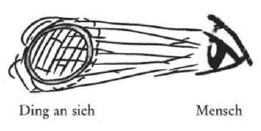
[ 24 ] Human beings, with their “antennas,” gaze, as it were, upon the unknown “thing-in-itself,” without, of course, ever entering into it. He always sees only his mental images reflected in the “thing-in-itself”; he literally weaves the “thing-in-itself” into the forms of his mental images.]
[ 25 ] This entire line of reasoning has permeated the entire thought of the nineteenth century—not merely epistemology, but also, for example, the theoretical foundations of physiology. Certain empirical findings supported this view. If, for example, one looks at the theory of specific sensory energies, it seems to confirm Kant’s view. At least, that is how the matter was viewed throughout the nineteenth century. The argument goes like this: The eye perceives light. But if the eye is stimulated in other ways—for example, by pressure, by an electrical impulse, and so on—it also exhibits light perception. Hence it was said: Perception of light is produced by the eye’s specific energy and is superimposed upon the thing-in-itself. Helmholtz, in particular, expressed this in stark terms as a physiological-philosophical doctrine, stating: Everything we perceive cannot even be conceived as bearing a pictorial resemblance to the things that exist outside of us. An image bears a resemblance to what it represents; but what we call sensory perception cannot even bear such a resemblance to the original as the image does to its original. One can therefore, he continues, refer to what a person experiences within themselves as nothing other than a “sign” of the thing-in-itself. After all, a sign need not bear any resemblance to what it expresses.
[ 26 ] And what had been brewing for so long eventually, so to speak, became ingrained in the philosophical thinking of our time, to the point that people became incapable of comprehending anything else—indeed, of even conceiving that things could be any different. Thus, Eduard von Hartmann was completely unable to extricate himself from his conceptual tangles. For example, in a conversation I once had the opportunity to have with him, it was utterly impossible to get past the point where he said: “Yes, we must surely start from the mental image, and if one defines the mental image, one must surely say that it is that through which a person brings something not yet conceived into perception! But if the mental image from which we start is something subjective, then we cannot go beyond the subjective either.
[ 27 ] He had no idea that he had first cobbled together this definition himself and then found himself unable to escape from a concept he had constructed. And yet his entire “transcendental realism” rests on the fact that he has entangled himself in something he himself created and which he assumes to be an objective truth. In this way, human beings never transcend judgment: what I grasp in my mental image always extends only as far as the limit of the thing-in-itself; it is therefore merely subjective. - This habit of thought has become so deeply ingrained over time that all those epistemologists who pride themselves on understanding Kant regard anyone who cannot admit that their definition of the mental image and of the subjective nature of what is observed is correct as a narrow-minded person. All of this has been brought about by the rupture in the development of the human mind described earlier. [Although Eduard von Hartmann provided significant insights in his ethical investigations, his epistemological studies have contributed nothing new or important. Thus, Kantian thought has developed into a formal habit of thought in modern intellectual life.]
[ 28 ] But anyone who truly studies Aristotle would find that, in a straightforward—that is, in a sense, unaltered—development of Aristotle’s thought, something quite different from the principle and theory of knowledge could have emerged. Aristotle had already grasped certain insights in the field of epistemology to which people today, due to all the academic undergrowth that arose under Kant’s influence, will only be able to rise again slowly and gradually. Above all, we must learn to understand that Aristotle already had the ability, through his method of thought, to formulate concepts that are correctly conceived and that lead directly to transcending these human-imposed limits [and guiding us beyond the realm of the empirical].
[ 29 ] We need only consider a few of Aristotle’s fundamental concepts to see this. It is entirely in keeping with his thinking to say: When we analyze the things around us, we first find what gives us knowledge of these things through our sensory perception: The senses provide us with the individual thing. But when we begin to think, things group themselves together for us; we combine different things into a single unit of thought. - And now Aristotle identifies the correct relationship between this unit of thought and an objectively real entity—that objective reality which leads to the thing-in-itself—by showing that, if we think consistently, we must conceive of the world of experience around us as composed of matter and what he calls form. For Aristotle, matter and form are two concepts that he truly distinguishes in the only correct sense, as they must be separated. We could talk for hours if we wanted to exhaustively explore these two concepts and everything related to them. But let us at least bring up some basic points to understand what Aristotle distinguishes as form and matter. He is clear that, with regard to all things that are initially around us—the things that make up our world of experience—what matters for cognition is that we grasp form, for it is form that gives things their essence, not matter. For Aristotle, form is the essence.
[ 30 ] Even in our time, however, there are still individuals who have a true understanding of Aristotle. Vinzenz Knauer, who was a university lecturer in Vienna in the 1880s, usually explained to his students the difference between matter and form—and what is essential in this regard—using an illustration that some might find laughable. He said one should imagine a wolf that has spent part of its life eating nothing but lambs—how it is then essentially composed of the matter of the lambs—and yet the wolf will never become a lamb! If one follows this line of thought correctly, this illustrates the difference between matter and form. Is the wolf a wolf by virtue of matter? No! It has acquired its essence through form—we find this not only in this particular wolf, but in all wolves. Thus, we find form through a concept which, in contrast to what the senses perceive in particular instances, is something universal.
[ 31 ] Now, in the spirit of Aristotle—in a truly epistemological sense—one can distinguish this universal quite precisely in three ways. One can say that this universal is the essential, that which matters most. But is that which exists in human thought the same as what we refer to, in the true sense, as form? No. A person approaches the various wolves and forms a concept—a universal—from the individual wolves. But what he has formed there as a concept that summarizes the same properties is merely a “representation” of the true universal. (All this can only be sketched out in broad strokes.) Thus, one can distinguish between: a universal that precedes the particulars that present themselves to us externally; then, since it is, after all, the essence contained within them, a universal that lies within things; and a third form of the universal, which human beings form in their thoughts afterward. There are thus: 1) universalia ante rem, 2) universalia in re, 3) universalia post rem. The latter unfold before the subjective mind and are the inner experiences that “represent the objective, real universals.”
[ 32 ] Unless one addresses the threefold distinction, one cannot, on this basis, arrive at a proper understanding of what is important here. For consider what is at stake! It is the insight that human beings, insofar as they live within the universalia post rem, possess a subjective aspect there. But at the same time, something essential is pointed out, namely that the concept of man is a “representation” of what exists universally as real forms (entelechies). And these—the universalia in re—have, in turn, only flowed into things because they already existed prior to things as universalia ante rem.
[ 33 ] Here, as universalia ante rem, we have that which we must assume to exist first and foremost in the Godhead, in the wisdom of God. As a Christian theologian, as a scholastic, one understands it in a similar way, except that one does not immediately ascend to the highest Divine. As theosophists, we know that the universalia in re, when it comes to animals, for example, signify their group soul; and so we do, in fact, find in Aristotelianism a foundation for what can truly underpin theosophy conceptually. However, along with everything we encounter in Aristotle, there is something else that has become increasingly unpopular in modern times: It is necessary to accustom oneself to thinking in sharp, finely chiseled concepts—concepts that one must first prepare for oneself; it requires having the patience to proceed from concept to concept; above all, one must have a penchant for conceptual purity and clarity, and one must know what one is talking about when one introduces a concept. If, for example, one speaks in the scholastic sense of the relationship between the concept and what it represents, one must first work through lengthy definitions in scholastic writings. One must know what it means when one says that the concept is formally grounded in the subject and fundamentally in the object: What the concept has as its actual form comes from the subject, what it has as content comes from the object—that is just a small sample. Truly just a small one. When you work your way through scholastic works, you have to wade through thick volumes of definitions, and that is very unwelcome to today’s scientist; therefore, he regards the scholastics as academic pedants and dismisses them as such. He has no idea that true scholasticism is nothing other than the thorough elaboration of the art of thought, so that it may form a foundation for the genuine comprehension of reality.
[ 34 ] As I say this, you will feel that it is a great blessing when, within the Theosophical Society itself, efforts emerge that aim—in the very best (epistemological) sense—to elaborate on epistemological principles. And since we have here in Stuttgart a scholar of extraordinary importance in this field (Dr. Unger), this should be regarded as a beneficial current within our movement. For this movement will not gain its standing in the world through those who wish only to hear about the facts of the higher world, but through those who possess the patience to delve into a technique of thought that creates a solid foundation for truly sound work—a framework for working in the higher world.
[ 35 ] [We should not only seek to gain interesting and new ideas from theosophy, but also—though this is admittedly less convenient—work on establishing a sound foundation for our own conceptual framework.] Thus, it may be precisely within the Theosophical Movement and from Theosophy itself that we will once again come to understand what Scholasticism—which has been distorted into a caricature by both its supporters and opponents—actually intended. It is, of course, more convenient to try to grasp everything that presents itself to us as a higher reality using a few preconceived concepts than to establish a solid foundation in conceptual methodology—but what are the consequences of this? One gets a disconcerting impression when picking up philosophical books today. People no longer understand one another at all when they speak of higher matters; they are unclear about how they are using the terms. This could not have happened in the scholastic era, for back then one had to be clear about the contours of a concept.
[ 36 ] [These days, the proper use of terms has been completely lost, and the terms themselves have nothing but blurred contours. If, therefore, one had once continued straight along the path discovered by Aristotle, one would always have had a proper method of thought; but as it was, one eventually became entangled in Kant’s web of concepts. Then that gulf between knowledge and faith would never have arisen.]
[ 37 ] As you can see, there was indeed a way to penetrate the depths of the technique of thought. And if this path had been pursued further—if one had not allowed oneself to be ensnared in Kant’s web of the “thing-in-itself” and the mental image that it is supposed to be subjective—then two things would have been achieved: First, one would have arrived at a theory of knowledge that is self-contained and secure, and second—and this is of great importance—one would not have been able to so completely misunderstand, in the influential circles, those great philosophers who worked in the tradition of Kant. Take, for example, the trio of Fichte, Schelling, and Hegel. What do they mean to people today? They are regarded as philosophers who sought to spin a world out of purely abstract concepts. That never even occurred to them. But people were constrained by Kantian concepts, and for that reason, they were unable to comprehend the world’s greatest philosophers—neither philosophically nor objectively. You know, it is the man who spent his youth in the house across the street—as indicated by the commemorative plaque you can see when you step onto the street here—Hegel. Only gradually will people mature enough to understand what he gave to the world; only then will one be able to grasp him, once one emerges from the constricting web of knowledge spun by theory. And it would be so simple! One need only allow oneself to think naturally and without prejudice and free oneself from what, in philosophical literature under the influence of the clouded currents of Kantianism, has developed into habits of thought. One must be clear about the question: Is it really the case that human beings proceed from the subject, construct their mental image within the subject, and then project this mental image onto the object? Is that really how it is? Yes, it is. — But does it necessarily follow from this that human beings can never penetrate to the thing-in-itself?
[ 38 ] Let me give you a simple example. Imagine you have a seal bearing the name Müller. Now press the seal into sealing wax and remove it. Surely you realize that if this seal is, say, made of brass, none of the brass will transfer into the sealing wax. If this sealing wax were capable of perception in Kant’s sense, it would say: “I am entirely wax; nothing from the brass enters me, so there is no relationship through which I could know the nature of what stands before me.” Yet this completely overlooks the fact that what really matters—namely, the name Müller—is objectively present as an imprint in the sealing wax, without anything from the brass having been transferred. As long as one thinks materialistically and believes that, in order to establish relationships, matter must pass from one to the other, one will also say theoretically: “I am sealing wax, and the other is brass in itself; and since nothing from ‘brass in itself’ can enter into me, the name ‘Müller’ can be nothing other than a sign. But the thing-in-itself that was inside the seal, which imprinted itself on me so that I can read it: That remains eternally unknown to me.” There you see the concluding formula that is employed here. If one takes this comparison further, the following emerges: Man is entirely sealing wax (mental image); the thing-in-itself is entirely the seal (that which exists outside of the mental image). Since I, as sealing wax (the representing entity), can only approach the boundary of the seal (the thing-in-itself), I remain within myself; nothing from the thing-in-itself passes into me. As long as materialism is extended to the theory of knowledge, we will not discover what really matters. The premise holds: We do not go beyond our mental image; but what comes over must be described as spiritual; this does not require that material atoms be transmitted. Nothing material enters the subject—yet the spiritual does enter the subject, as surely as the name Müller enters the sealing wax. Sound epistemological research must be able to start from this again; then one will see how deeply modern materialism has, without anyone noticing, become entrenched in epistemological concepts. An unbiased examination of the situation leads to no other conclusion than that Kant can form a mental image of a “thing-in-itself” only in material terms, however grotesque such a claim may seem at first glance.
[ 39 ] However, if we wish to consider the matter in its entirety, we must now outline something else. We have said that Aristotle pointed out that, with regard to everything around us, a distinction must necessarily be made between what is form (entelechy) and what is matter. Now one might say: In the process of cognition, we approach form in the sense just described. But is there also a way to approach the material? It should be noted that Aristotle understands the material not only as physical matter, but as substance—that which, as the spiritual, underlies reality. Is there a way not only to grasp what flows toward us, but also to penetrate into things, to identify with matter? This question is also important for the theory of knowledge. It can only be answered by someone who has delved deeply into the nature of thought—pure thought. One must first rise to this concept of pure thought. According to Aristotle, we can describe pure thought as actuality. It is pure form; initially, as it appears, it is without content in relation to the immediate individual things in sensory reality out there. Why? Let us first clarify how the pure concept arises in contrast to perception.
[ 40 ] Imagine that you want to form the concept of a circle. You can do this, for example, by sailing out to sea until you see nothing but water all around you; then, through perception, you have formed a mental image of a circle. However, there is another way to arrive at the concept of a circle, namely by telling yourself the following without appealing to the senses: I construct in my mind the set of all points that are equidistant from a single point. To form this construction, which takes place entirely within the realm of thought, you do not need to appeal to anything external: this is pure thought in the Aristotelian sense, pure actuality.
[ 41 ] But now something special comes into play. The pure ideas formed in this way correspond to experience. Without them, one cannot even comprehend experience. Just consider this: when Kepler, through the pure construction of concepts, develops a system that, for example, depicts elliptical orbits for the planets, with the sun at one of the foci, and when one then subsequently observes through a telescope that the observation corresponds to the pure mental image conceived prior to experience! It becomes evident to any unbiased mind that what arises as pure thought is not meaningless for reality, for it does, in fact, correspond to reality. A researcher like Kepler illustrates through his method what Aristotelianism has established epistemologically. He grasps what belongs to the universalia post rem, and finds, when he approaches things, that these universalia post rem have previously been embedded in them as universalia ante rem. If, then, the universals are not reduced to mere subjective mental images in the sense of a distorted epistemology, but rather it becomes evident that they are objectively found in things, they must first have been embedded in the form that Aristotle assumes underlies the world.
[ 42 ] Thus you find that what is initially the most subjective—what is established independently of experience—is precisely what leads most objectively into reality. What, then, was the reason why the subjective aspect of the mental image could not initially emerge into the world? The reason was that it came up against a “thing-in-itself.” When a person constructs a circle, he does not come up against a thing-in-itself; he lives within the thing itself, even if only formally at first.
[ 43 ] Now the next question is: Can we even arrive at any reality, at anything enduring, from such subjective thinking? And the point here is that, as we have characterized it, the subjective is, at first, constructed precisely within thought and is formal; that is, it initially appears to the objective as something added on. Certainly, we can say: Fundamentally, it makes no difference to a circle or a sphere in the world whether I think of it or not. My thought, which is added to reality, is completely irrelevant to the world of experience surrounding us. This world exists in and of itself, independent of our thinking. It may therefore be the case that, while our thinking is an objectivity for us, it has no bearing on things themselves. How do we move beyond this apparent contradiction? Where is the other pole that we must now grasp? Where, within pure thought, is there a way not only to produce form but, along with form, reality as well? As soon as we have something that produces reality along with form, then we can anchor ourselves epistemologically to a fixed point. After all, we are everywhere—for example, when we construct a circle—in the specific case where we say: What I say about this circle is objectively true—whether it is applicable to things depends on the fact that, when I encounter things, they show me whether they contain within themselves the laws I have constructed. If the sum of all entelechies dissolves into pure thought, then a residue must remain—what Aristotle calls matter—if it is not possible to arrive at reality from pure thought itself.
[ 44 ] Aristotle’s view can be supplemented here by Fichte. In the spirit of Aristotle, one can first arrive at the following formulation: Everything that surrounds us—including that which belongs to invisible worlds—makes it necessary for us to contrast the formal aspect of entelechy with a material aspect. - For Aristotle, the concept of God is pure actuality, a pure act—that is, an act in which actuality, or the formation of form, simultaneously possesses the power to bring forth its own matter; it is not something opposed by matter, but rather something that, in its pure activity, is itself the matter.
[ 45 ] The image of this pure actuality is found in human beings themselves when, through pure thought, they arrive at the concept of the “I.” There, in the “I,” he encounters what Fichte calls an “act of fact.” He arrives within himself at something which, by living in actuality, simultaneously brings forth its own substance along with that actuality. When we grasp the “I” in pure thought, we find ourselves at a center where pure thought simultaneously and essentially brings forth its own material essence. When you grasp the “I” in thought, a threefold “I” is present: a pure “I” that belongs to the universals “ante rem,” an “I” within which you are situated, which belongs to the universals “in re,” and an “I” that you comprehend, which belongs to the universals “post rem.” But there is something else quite special here: For the “I,” the situation is such that when one rises to the level of truly grasping the “I,” these three “I’s” coincide. The “I” lives within itself by bringing forth its pure concept and is able to live as reality within that concept. For the “I,” it is not indifferent what pure thought does, for pure thought is the creator of the “I.” Here, the concept of the creative coincides with the material, and one need only realize that in all other processes of cognition we initially encounter a limit—except in the case of the “I”: We grasp this in its innermost essence by apprehending it in pure thought.
[ 46 ] From an epistemological perspective, this provides a foundation for the assertion that even in pure thought, a point can be reached where reality and subjectivity fully intersect—where the human being experiences reality. - If he begins there and enriches his thinking in such a way that his thinking, starting from that point, emerges anew from within itself, then he grasps things from within. Thus, within the “I”—which is grasped and thereby simultaneously created through a pure act of thought—there exists something through which we penetrate the boundary that must be set for everything else between entelechy (form) and matter.
[ 47 ] Thus, a theory of knowledge that proceeds thoroughly becomes something that, even in pure thought, points the way to entering into reality. If one follows this path, one will find that from there one must enter into theosophy. Very few philosophers understand this path. They have entangled themselves in a self-made web of concepts; moreover, because they know the concept only as something abstract, they can never grasp the single point where it is archetypically creative; consequently, they cannot find anything through which they might connect with a “thing-in-itself.” You see what is necessary before philosophers will come to realize that theosophists are not merely dilettantes. Part of this is that philosophers must first have philosophy—that there be a philosophy that truly delves into the foundations. It is not the case that philosophy contradicts theosophy; rather, philosophers simply do not understand philosophy. They know nothing of the deeper foundations of philosophy; they are deluded, entangled in an epistemological error from which they cannot escape. Once they break free, they will also find the path to theosophy. It is not so much Theosophy that is amateurish to philosophers (for they are simply unable to understand it); rather, what is amateurish is what today, in many cases, dominates the world as “philosophy.” Once this philosophy is capable of thinking expertly, a bridge will be built between philosophy and Theosophy.