

Supplements to Member Lectures
GA 246
17 August 1908, Stuttgart
Translate the original German text into any language:
Versions Available:
Supplements to Member Lectures, tr. SOL
12. Philosophie und Theosophie
12. Philosophy and Theosophy
[ 1 ] Nachdem wir eine lange Reihe von rein theosophischen Vorträgen hinter uns haben, wollen wir heute einmal sozusagen aus einem anderen Ton heraus sprechen, [einmal von einem ganz anderen Gesichtspunkte aus reden, nämlich mehr vom philosophischen]. Daher bitte ich Sie, von vornherein darauf Rücksicht nehmen zu wollen, dass der heutige Vortrag nicht im eigentlichen Sinne theosophisch ist, und dass der rein philosophische Ton, der angeschlagen werden muss, für manchen, der nicht gewöhnt ist, sich in solchen Denkrichtungen zu bewegen, etwas abstrakt und schwierig erscheinen kann. Es geschieht das aus einem ganz bestimmten Grunde; es geschieht, weil immer wieder und wieder, und gerade in denjenigen Kreisen, die eine gewisse philosophische Bildung haben oder zu haben glauben, die Meinung auftauchen muss (ich wähle ausdrücklich das Wort «muss»), Theosophie sei eigentlich nur zu billigen von Menschen, welche es in philosophischen oder wissenschaftlichen Dingen über einen gewissen Dilettantismus nicht hinausgebracht haben. Derjenige aber, so könnte man leicht in diesen Kreisen denken, der eine gründliche philosophische Bildung hat, der kennengelernt hat, welches die Grundlagen einer wissenschaftlichen Sicherheit und Überzeugung sind, der könne sich mit all der Phantasterei, mit all dem, was einem da als angeblich höhere Erfahrung entgegentritt, eigentlich gar nicht befassen; das sei etwas für solche, die noch nicht reif für wissenschaftliches Denken sind. Um nun zu erkennen, was cs eigentlich mit einem solchen Urteil auf sich hat, wollen wir uns sozusagen die philosophische Betätigung selbst einmal anschauen. Natürlich kann das heute nur ganz kurz geschehen, nur in Andeutungen [und skizzenhaft, denn streng und ausführlich bewiesen]; aber wenn wir einmal Gelegenheit haben werden, ausführlicher über solche Dinge zu sprechen, dann werden Sie sehen, dass diese Andeutungen aus einem großen [und wahrhaftigen] Zusammenhange herausgenommen sind [, was bei genauerer Prüfung leicht ersichtlich ist].
[ 1 ] Now that we have completed a long series of purely theosophical lectures, let us today, so to speak, strike a different note, [that is, speak from a completely different perspective—namely, a more philosophical one]. Therefore, I ask you to bear in mind from the outset that today’s lecture is not theosophical in the strict sense, and that the purely philosophical tone that must be adopted may seem somewhat abstract and difficult to some who are not accustomed to engaging with such lines of thought. This is done for a very specific reason; it is done because, time and again—and especially in those circles that possess, or believe they possess, a certain philosophical education—the opinion inevitably arises (I deliberately choose the word “inevitably”) that Theosophy is, in fact, only to be endorsed by people who have not progressed beyond a certain level of dilettantism in philosophical or scientific matters. But one might easily think in these circles that anyone who has a thorough philosophical education—who has come to understand the foundations of scientific certainty and conviction—should not really concern themselves at all with all that fantasy, with all that which presents itself as supposedly higher experience; that is something for those who are not yet mature enough for scientific thinking. To understand what cs actually means by such a judgment, let us, so to speak, take a look at philosophical activity itself. Of course, today this can only be done very briefly, merely in hints [and in a sketchy manner, since it has been rigorously and thoroughly proven]; but when we have the opportunity to discuss such matters in greater detail, you will see that these hints are taken from a larger [and true] context [, which is easily apparent upon closer examination].
[ 2 ] Philosophie wird gemeiniglich von denjenigen, die sie treiben, als etwas Absolutes angesehen, nicht als etwas, was erst im Laufe der Menschheitsentwicklung hat entstehen müssen. Gerade der Philosophie gegenüber ist man imstande, auch aus äußerlichen historischen Dokumenten anzugeben, wann sie als solche ihren Ursprung innerhalb der Menschheitsevolution genommen hat und nehmen musste. Das haben auch die meisten, namentlich älteren Darsteller der Philosophie-Geschichte ziemlich gut getroffen. In allen diesen Darstellungen werden Sie finden, dass mit dem Thales begonnen wird und dass von ihm dann fortgeschritten wird bis in unsere Zeit herein.
[ 2 ] Philosophy is generally regarded by those who practice it as something absolute, not as something that had to emerge only in the course of human evolution. It is precisely in the case of philosophy that one is able to determine—even from external historical documents—when it originated as such within human evolution and when it had to originate. Most historians of philosophy, particularly the older ones, have also captured this quite accurately. In all these accounts, you will find that the narrative begins with Thales and then proceeds from him right up to our own time.
[ 3 ] Allerdings haben einige neuere Philosophie-Geschichtsschreiber, die ganz besonders vollständig und ganz besonders gescheit sein wollten, den Anfang der Philosophie in noch frühere Zeiten verlegt und allerlei aus früheren Weisheitslehren hereingezogen. Aber das ist alles entsprungen aus einer ganz bestimmten Form des Dilettantismus, der nicht weiß, dass alles, was in Indien, Ägypten und Chaldäa an Weisheitslehren vorangegangen ist, auch methodisch einen ganz anderen Ursprung hat als das rein philosophische, dem Spekulativen zuneigende Denken. Dieses hat sich erst in der griechischen Welt entwickelt; und der Erste, welcher da in Betracht kommt, ist wirklich erst Thales. Wir brauchen gar nicht erst eine Charakteristik der verschiedenen griechischen Philosophen von Thales ab, nicht von Anaxagoras, Heraklit, Anaximenes , auch nicht von Sokrates und Platon; wir können gleich anknüpfen an diejenige Persönlichkeit, die eigentlich zu allererst als der Philosoph katexochen dasteht, und das ist Aristoteles.
[ 3 ] However, some more recent historians of philosophy, who wanted to be particularly thorough and particularly clever, have shifted the origins of philosophy to even earlier times and incorporated all sorts of elements from earlier wisdom traditions. But all of this stems from a very specific form of dilettantism, which fails to recognize that all the teachings of wisdom that preceded philosophy in India, Egypt, and Chaldea have, methodologically speaking, a completely different origin than purely philosophical thought, which tends toward the speculative. This mode of thought first developed in the Greek world; and the first figure who truly comes into consideration there is Thales. We need not even begin with a characterization of the various Greek philosophers—not Thales, not Anaxagoras, Heraclitus, or Anaximenes, nor even Socrates and Plato; we can proceed directly to the figure who actually stands out first and foremost as the philosopher par excellence, and that is Aristotle.
[ 4 ] [Alles andere vor ihm ist entweder direkt aus den Mysterien hervorgegangen, oder doch mit ihnen in enger Beziehung stehend.] Alle anderen Philosophien sind im Grunde genommen noch durch Mysterienweisheit angeregte Abstraktionen; für Thales und Heraklit ließe sich das zum Beispiel leicht nachweisen. Aber Philosophen im eigentlichen Sinne des Wortes sind auch noch nicht einmal Platon oder Pythagoras, die beide ihre Quellen im Sehertum haben. Denn nicht darauf kommt es an, wenn wir die Philosophie als solche charakterisieren, dass irgendjemand sich in Begriffen ausdrückt, sondern wo seine Quellen sind, darauf kommt es an. Pythagoras hat als Quellen die Mysterienweisheit und hat diese in Begriffe umgewandelt; er ist Hellseher, nur hat er das, was er als Scher erfahren, in philosophische Form gebracht, und dasselbe ist auch bei Platon der Fall.
[ 4 ] [Everything else that preceded him either arose directly from the Mysteries or was at least closely related to them.] All other philosophies are, in essence, still abstractions inspired by the wisdom of the Mysteries; this can be easily demonstrated in the case of Thales and Heraclitus, for example. But not even Plato or Pythagoras—both of whom draw their sources from the art of divination—are philosophers in the true sense of the word. For when we characterize philosophy as such, what matters is not that someone expresses himself in concepts, but where his sources lie. Pythagoras drew on the wisdom of the mysteries and transformed it into concepts; he was a clairvoyant, but he simply put what he experienced as intuition into philosophical form, and the same is true of Plato.
[ 5 ] Was aber den Philosophen ausmacht, und was uns gerade erst bei Aristoteles entgegentritt, ist, dass er aus der reinen Begriffstechnik heraus arbeitet und dass er andere Quellen notwendig ablehnen muss oder sie ihm unzugänglich sind. [Aristoteles ist im eminentesten Sinn Philosoph, weil er mit der bloßen Begriffstechnik das reine Denken herausarbeitete.] Und weil das erst bei Aristoteles der Fall ist, deshalb ist es auch nicht ohne welthistorischen Grund, dass eben er es ist, der die Logik, die Wissenschaft der Denktechnik, begründet hat. Alles andere ist nur Vorläufertum gewesen. Die Art und Weise, wie man Begriffe bildet, Urteile formt, Schlüsse zicht, das alles hat erst Aristoteles als eine Art Naturgeschichte des subjektiven menschlichen Denkens gefunden, und alles, was uns bei ihm entgegentritt, ist mit dieser Grundlegung der Denktechnik eng verknüpft. Da wir noch auf einiges zurückkommen werden, was bei ihm fundamental wichtig ist für alle späteren Betrachtungen, so bedarf es jetzt nur dieser historischen Andeutung, um den Ausgangspunkt kurz zu charakterisieren.
[ 5 ] But what defines the philosopher—and what we encounter for the first time in Aristotle—is that he works solely through pure conceptual technique and that he must necessarily reject other sources or find them inaccessible to him. [Aristotle is a philosopher in the most eminent sense because he developed pure thought through the mere technique of concepts.] And because this is only the case with Aristotle, it is not without world-historical significance that it is precisely he who founded logic, the science of the technique of thought. Everything else was merely a precursor. The way in which concepts are formed, judgments are made, and conclusions are drawn—Aristotle was the first to identify all of this as a kind of natural history of subjective human thought, and everything we encounter in his work is closely linked to this foundation of the technique of thought. Since we will return to several points that are of fundamental importance in his work for all subsequent considerations, this historical note is sufficient for now to briefly characterize the starting point.
[ 6 ] Aristoteles bleibt auch für die spätere Zeit der tonangebende Philosoph. Seine Leistungen flossen nicht nur ein in die nacharistotelische Zeit des Altertums bis zur Begründung des Christentums, sondern gerade in der ersten christlichen Zeit bis hinein in das Mittelalter war er derjenige Denker, nach dem man sich bei der Ausarbeitung aller Weltanschauungsbestrebungen richtete. Damit soll nicht gesagt werden, dass man etwa, namentlich im Mittelalter, wo man nicht die Urtexte hatte, den Aristoteles als System, als eine Summe von Dogmen vor sich gehabt hatte; aber man hatte sich eingelebt in die Art, wie man an der Leiter der reinen Begriffstechnik zu einem Wissen, bis hinauf zum höchsten göttlichen Wissen, kommt. Und so kam es, dass Aristoteles immer mehr und mehr der logische Lehrer wurde. Man sagte sich im Mittelalter etwa so: Möge die positive Tatsachenerkenntnis der Welt wo immer herkommen, möge sie daher kommen, dass der Mensch mit seinen Sinnen die äußere Wirklichkeit untersucht oder dass eine Offenbarung durch göttliche Gnade stattfindet wie durch den Christus Jesus - so sind das Dinge, die einfach hinzunehmen sind, auf der einen Seite als Aussagen der Sinne, auf der andern als Offenbarung. Will man aber etwas in dieser oder jener Art Gegebenes durch reine Begriffe begründen, dann muss man es mit jener Denktechnik tun, die Aristoteles begründet.
[ 6 ] Aristotle remained the leading philosopher even in later times. His contributions not only shaped the post-Aristotelian period of antiquity up to the establishment of Christianity, but especially during the early Christian era and well into the Middle Ages, he was the thinker whom people looked to as a guide in the development of all attempts to formulate a worldview. This is not to say that, particularly in the Middle Ages—when the original texts were not available—Aristotle was regarded as a system or a set of dogmas; rather, people had become accustomed to the method of ascending the ladder of pure conceptual technique to attain knowledge, all the way up to the highest divine knowledge. And so it came to pass that Aristotle increasingly became the teacher of logic. In the Middle Ages, people reasoned something like this: Whatever the source of positive knowledge of the world’s facts—whether it stems from human beings examining external reality with their senses or from a revelation through divine grace, such as that through Christ Jesus—these are things that must simply be accepted: on the one hand, as sensory perceptions; on the other, as revelation. But if one wishes to ground something given in this or that way through pure concepts, then one must do so using the technique of thought established by Aristotle.
[ 7 ] [Besonders in der Frühscholastik waren die Logik und zum Teil auch die eigentlichen Lehren des Aristoteles aktuell.] Und in der Tat, die Begründung der Denktechnik ist von Aristoteles so bedeutsam geleistet worden, dass Kant, und zwar mit Recht, gesagt hat, dass seit Aristoteles die Logik eigentlich um keinen einzigen Satz fortgeschritten sei. Und im Grunde genommen gilt das im Wesentlichen auch noch für heute; auch heute ist der Grundstock logischer, denktechnischer Lehren ziemlich unverändert geblieben gegenüber dem, was Aristoteles gegeben hat. Das, was man heute hinzufügen will, entspringt aus einem ziemlich dilettantischen Verhalten gegenüber dem Begriffe der Logik, auch in philosophischen Kreisen.
[ 7 ] [Especially in early Scholasticism, Aristotle’s logic—and, to some extent, his actual teachings—were still relevant.] And in fact, Aristotle’s contribution to the foundations of the art of thinking was so significant that Kant—and rightly so—said that since Aristotle, logic had not actually advanced by a single proposition. And essentially, this still holds true today; even today, the foundation of logical and methodological teachings has remained largely unchanged from what Aristotle established. What people seek to add today stems from a rather amateurish approach to the concept of logic, even in philosophical circles.
[ 8 ] Nun wurde nicht bloß etwa das Studium des Aristoteles, sondern vor allen Dingen das Sichhineinfinden in seine Denktechnik aktuell für die mittlere Zeit des Mittelalters, für die frühscholastische Zeit, wie man sie auch nennen könnte, wo die Scholastik in der Blüte stand. Diese Zeit fand ja in Bezug auf ihre Blüte ihren Abschluss durch Thomas von Aquin im dreizehnten Jahrhundert. Wenn man von dieser frühscholastischen Zeit spricht, muss man sich klar darüber sein, dass man heute nur dann philosophisch darüber sprechen kann, wenn man frei von aller Autorität und allem Dogmenglauben ist. Es ist ja heute fast schwerer, rein objektiv als abfällig über diese Dinge zu sprechen. Wenn man abfällig über die Scholastik spricht, kommt man nicht in die Gefahr, von den sogenannten freien Geistern verketzert zu werden; spricht man aber objektiv darüber, so liegt die Wahrscheinlichkeit nahe, missverstanden zu werden, und zwar deshalb, weil man sich heute innerhalb der positiven und gerade der intolerantesten Kirchenbewegung vielfach ganz missverständlich auf die Thomistik beruft.
[ 8 ] It was not merely the study of Aristotle, but above all the process of familiarizing oneself with his method of thought that became relevant during the middle period of the Middle Ages—the early scholastic period, as it might be called—when Scholasticism was in its heyday. This period, in terms of its heyday, came to a close with Thomas Aquinas in the thirteenth century. When speaking of this early scholastic period, one must be clear that today one can only discuss it philosophically if one is free from all authority and all dogmatic belief. Indeed, it is almost harder today to speak about these things purely objectively than it is to speak disparagingly about them. If one speaks disparagingly about Scholasticism, one does not run the risk of being condemned by the so-called free spirits; but if one speaks objectively about it, there is a high probability of being misunderstood—precisely because today, within the positive and, indeed, the most intolerant church movements, there are many instances of completely misleading references to Thomism.
[ 9 ] Was heute als orthodox-katholische Philosophie gilt, das alles darf uns nicht berühren; aber ebenso wenig darf uns abschrecken, dass uns der Vorwurf gemacht werden könnte, wir pflegten dasselbe, was von dogmatischer Seite getrieben und anbefohlen wird. Wir wollen vielmehr, unbekümmert um alles was von rechts und links sich geltend machen kann, einmal charakterisieren, welche Empfindung die Blütezeit der Scholastik in Bezug auf die Wissenschaft, die Denktechnik und die übernatürliche Offenbarung hatte.
[ 9 ] What is considered orthodox Catholic philosophy today should not concern us; nor should we be deterred by the possibility that we might be accused of espousing the very same views that are promoted and mandated by dogmatists. Rather, without concern for anything that might be asserted from the right or the left, we wish to characterize the spirit that characterized the heyday of Scholasticism with regard to science, the art of thinking, and supernatural revelation.
[ 10 ] Die Frühscholastik ist nicht das, als was man sie gewöhnlich heute mit einem Schlagwort charakterisieren möchte; sie ist im Gegenteil Monismus, Einheitslehre - nicht im Entferntesten ist sie dualistischer Natur. Der Urgrund der Welt ist für sie ein durchaus einheitlicher; nur hat der Scholastiker in Bezug auf das Erschauen dieses Urgrundes eine bestimmte Empfindung. Er sagt: Es gibt ein gewisses übersinnliches Wahrheitsgut, ein Weisheitsgut, das zunächst der Menschheit offenbart worden ist; das menschliche Denken mit all seiner Technik ist nicht so weit, um aus sich selbst in die Regionen zu dringen, deren Wesenheit der Inhalt der höchsten geoffenbarten Weisheit [ist]. Daher besteht für den Früh-Scholastiker ein gewisses Weisheitsgut, das zunächst der Denktechnik nicht zugänglich ist [; indessen reicht diese doch bis hart an die Grenze jener Offenbarungen]. - Nur insofern ist es ihr zugänglich, als der Gedanke imstande ist, das, was geoffenbart wurde, zu verdeutlichen.
[ 10 ] Early Scholasticism is not what people today usually try to characterize it as with a catchphrase; on the contrary, it is monism, the doctrine of unity—it is not in the least dualistic in nature. For Scholasticism, the source of the world is thoroughly unified; it is just that the Scholastic has a certain perception regarding the contemplation of this foundation. He says: There is a certain supersensible treasure of truth, a treasure of wisdom, that was first revealed to humanity; human thought, with all its techniques, is not yet advanced enough to penetrate on its own into the realms whose essence is the content of the highest revealed wisdom. Therefore, for the early Scholastic, there exists a certain treasure of wisdom that is initially inaccessible to the techniques of thought [; yet these techniques do extend almost to the very limits of those revelations].—It is accessible to them only insofar as thought is capable of elucidating what has been revealed.
[ 11 ] Für diesen Teil des Weisheitsgutes obliegt also dem Denker, es als geoffenbartes hinzunehmen; und die Denktechnik nur zu seiner Verdeutlichung zu verwenden. Was der Mensch aus sich selbst finden kann, bewegt sich nur in gewissen untergeordneten Regionen der Wirklichkeit. Für diese wendet der Scholastiker die Denktätigkeit auf die eigene Forschung an. Er dringt da bis zu einer gewissen Grenze, an der ihm die geoffenbarte Weisheit begegnet. So schließen sich die Inhalte der eigenen Forschung und der Offenbarung zu einer objektiv einheitlichen monistischen Weltanschauung zusammen. Dass dabei eine Art von Dualismus, durch die menschliche Eigentümlichkeit geboten, in die Sache hineinkommt, ist nur sekundär. Es handelt sich um einen Dualismus der Erkenntnis, nicht um einen solchen der Weltgründe.
[ 11 ] For this part of the treasure of wisdom, it is therefore incumbent upon the thinker to accept it as revealed; and to use the technique of thought only to clarify it. What human beings can discover on their own is confined to certain subordinate realms of reality. For these, the scholastic applies the act of thinking to his own research. There he pushes forward to a certain limit, where he encounters revealed wisdom. Thus, the contents of one’s own research and of revelation merge into an objectively unified, monistic worldview. The fact that a kind of dualism—dictated by human nature—enters into the matter is only secondary. It is a dualism of knowledge, not one concerning the foundations of the world.
[ 12 ] Der Scholastiker erklärt also die Denktechnik geeignet, dasjenige, was in der empirischen Wissenschaft, in der Sinnesbeobachtung gewonnen wird, rationell zu bearbeiten, ferner auch ein Stück hinaufzudringen bis zur spirituellen Wahrheit. Und dann stellt der Scholastiker in Bescheidenheit ein Stück der Weisheit als Offenbarung hin, die er nicht selbst finden kann, die er nur hinzunehmen hat.
[ 12 ] The scholastic, then, describes this method of thought as suitable for rationally processing what is gained in empirical science and through sensory observation, and furthermore for advancing a step further toward spiritual truth. And then, in humility, the scholastic presents a portion of wisdom as revelation—something he cannot discover on his own, but must simply accept.
[ 13 ] Was nun aber der Scholastiker als diese besondere Denktechnik anwendet, das ist durchaus aus dem Boden aristotelischer Logik entsprungen. Es gab für die Frühscholastik, die etwa mit dem dreizehnten Jahrhundert sich ihrem Abschluss nähert, eine zweifache Notwendigkeit, sich mit Aristoteles zu befassen. Die eine Notwendigkeit war in der geschichtlichen Entwicklung gegeben: Der Aristotelismus hatte sich eben eingelebt. Die andere Notwendigkeit war die Folge davon, dass dem überlieferten christlichen Lehrgut nach und nach von einer anderen Seite ein Gegner erstanden war.
[ 13 ] However, the particular method of thought employed by the scholastics sprang entirely from the soil of Aristotelian logic. For early scholasticism, which drew to a close around the thirteenth century, there was a twofold necessity to engage with Aristotle. One necessity stemmed from historical development: Aristotelianism had simply become established. The other necessity arose from the fact that, little by little, an adversary had emerged from another quarter to challenge the traditional Christian doctrine.
[ 14 ] Aristoteles hatte nämlich nicht nur im Abendlande seine Verbreitung gefunden, sondern auch im Morgenlande; und alles, was durch die Araber über Spanien nach Europa gebracht war, war in Bezug auf die Denktechnik durchtränkt von Aristotelismus. Namentlich war es eine gewisse Form der Philosophie, der Naturwissenschaft, bis in die Medizin hineinreichend, was da herübergebracht war und was im eminentesten Sinne von aristotelischer Denktechnik durchdrungen war. Nun hatte sich von dort her die Meinung gebildet, dass gar nichts anderes als Konsequenz aus Aristoteles folgen könne als eine Art von Pantheismus, der namentlich in der Philosophie aus einer sehr verschwommenen Mystik herausgekommen war. Man hatte also außer dem einen Grunde, dass nämlich Aristoteles in der Denktechnik fortgelebt hatte, noch einen andern, sich mit ihm zu befassen: In der Auslegung der Araber erschien Aristoteles als Gegner, als Feind des Christentums.
[ 14 ] Aristotle’s teachings had, in fact, spread not only throughout the West but also throughout the East; and everything that the Arabs brought to Europe via Spain was, in terms of methodology, steeped in Aristotelianism. Specifically, it was a certain form of philosophy and natural science—extending even into medicine—that had been brought over and that was permeated, in the most eminent sense, by Aristotelian methods of thought. Now, the view had taken hold there that nothing other than a kind of pantheism—which, particularly in philosophy, had emerged from a very vague form of mysticism—could follow as a consequence of Aristotle. Thus, in addition to the single reason that Aristotle had lived on in the method of thought, there was another reason to engage with him: in the Arabs’ interpretation, Aristotle appeared as an adversary, as an enemy of Christianity.
[ 15 ] [Was die Araber an falscher Mystik und überhaupt an pantheistischen Lehren besaßen, suchten sie mit dem Aristoteles zu stützen. Da musste man sich in der Scholastik doch fragen, ob denn tatsächlich jenes der wahre Aristoteles sei, der von den Arabern nach Europa importiert wurde.] Man musste sich sagen: Wenn das, was die Araber als Interpretation des Aristoteles herübergebracht haben, wahr ist, dann wäre der Aristotelismus eine wissenschaftliche Grundlage, die dazu geeignet wäre, das Christentum zu widerlegen. Nun stellen wir uns vor, was mussten demgegenüber die Scholastiker empfinden? Auf der einen Seite hielten sie fest an der Wahrheit des Christentums, auf der anderen aber konnten sie nach aller Tradition nicht anders, als eingestehen, dass die Logik, die Denktechnik des Aristoteles, die wahre, die richtige sei. Aus diesem Zwiespalt heraus ergab sich für die Scholastiker die Aufgabe: zu beweisen, dass man die Logik des Aristoteles anwenden könne, seine Philosophie treiben könne, und dass man gerade durch ihn das Instrument habe, das Christentum wirklich zu begreifen und zu verstehen. Es war eine Aufgabe, die durch die Zeitentwicklung gestellt war. Es musste der Aristotelismus so behandelt werden, dass ersichtlich wurde: Was als Lehre des Aristoteles von den Arabern gebracht worden war, ist dann nur eine missverständliche Auffassung desselben, wenn es dem Christentum feindlich sich erweist. Dass man es nur richtig deuten müsse, um in ihm das Fundament für das Begreifen des Christentums zu haben: Das war die Aufgabe, die sich die Scholastik stellte und der das gesamte Schrifttum des Aquinaten gewidmet war. [Daher war es nötig darzulegen, dass man gerade aus dem richtig verstandenen Aristoteles heraus die christlichen Lehren stützen könne. Nur so konnte man wirksam ankämpfen gegen den vom Morgenland kommenden halben Materialismus und verschwommenen Pantheismus.]
[ 15 ] [The Arabs sought to use Aristotle to support their false mysticism and pantheistic teachings in general. This led the Scholastics to ask whether the Aristotle brought to Europe by the Arabs was in fact the true Aristotle.] One had to conclude: If what the Arabs brought over as an interpretation of Aristotle were true, then Aristotelianism would be a scientific foundation capable of refuting Christianity. Now let us imagine how the Scholastics must have felt in the face of this. On the one hand, they held fast to the truth of Christianity; on the other, however, in accordance with all tradition, they had no choice but to admit that Aristotle’s logic—his method of thought—was the true and correct one. This dilemma presented the Scholastics with a task: to prove that one could apply Aristotle’s logic, pursue his philosophy, and that it was precisely through him that one possessed the instrument to truly grasp and understand Christianity. It was a task dictated by the course of history. Aristotelianism had to be approached in such a way that it became clear: what had been brought by the Arabs as Aristotle’s teaching was merely a misinterpretation of it if it proved hostile to Christianity. That one merely had to interpret it correctly in order to find in it the foundation for understanding Christianity: That was the task that Scholasticism set for itself and to which the entire body of Aquinas’s writings was devoted. [Therefore, it was necessary to demonstrate that Christian teachings could be supported precisely on the basis of a correctly understood Aristotle. Only in this way could one effectively combat the half-baked materialism and vague pantheism coming from the East.]
[ 16 ] Nun aber geschieht etwas anderes. Im Laufe der Entwicklung tritt nach der Blütezeit der Scholastiker in der ganzen logischen philosophischen Denkentwicklung der Menschheit ein völliger Bruch ein. Das Natürliche wäre gewesen (aber das soll keine Kritik sein, nicht einmal soll damit gesagt sein, dass es überhaupt nur hätte geschehen können; der tatsächliche Verlauf war eben notwendig - nur hypothetisch soll das Folgende hingestellt werden), das Natürliche wäre gewesen, dass man die Denktechnik immer mehr ausgedehnt hätte, dass man immer höhere und höhere Teile der übersinnlichen Welt durch das Denken ergriffen hätte. So war aber die Entwicklung zunächst nicht.
[ 16 ] But now something else happens. In the course of development, following the heyday of the Scholastics, a complete break occurs in the entire logical-philosophical development of human thought. The natural course of events would have been (but this is not meant as a criticism, nor is it even meant to suggest that it could have happened at all; the actual course of events was, after all, necessary—the following is merely a hypothetical scenario), it would have been natural for the technique of thought to have been expanded further and further, for ever higher and higher realms of the supersensible world to have been grasped through thought. But that was not how development proceeded at first.
[ 17 ] Der Grundgedanke, der zum Beispiel für Thomas von Aquino zunächst für die höchsten Gebiete galt und welcher hätte durchaus sich so entwickeln können, dass die Grenze der menschlichen Forschung sich immer mehr nach oben in das übersinnliche Gebiet hätte erweitern können, wurde bis zur Karikatur verzerrt und lebte nun weiter in der Überzeugung: Die höchsten spirituellen Wahrheiten entziehen sich ganz und gar der rein menschlichen Denktätigkeit, der Ausarbeitung in Begriffen, zu denen es der Mensch aus sich selbst heraus bringen kann. Dadurch ist ein Riss im menschlichen Geistesleben eingetreten. Man stellte die übersinnliche Erkenntnis als etwas hin, das sich jeder menschlichen Denkarbeit absolut entziehe, das nicht durch subjektive Akte der Erkenntnis zu erreichen sei, das nur einem Glauben entspringen müsse. [Höchstens noch mit einer Art gefühlsmäßiger Überzeugung, mit bloßem Glauben, kann man sich jenen Gebieten nähern. Dieser so geöffnete Abgrund zwischen Glauben und Wissen nun ward ein mächtiger Impuls für spätere Zeiten.] Veranlagt war das schon früher, zum Extrem getrieben wurde es gegen das Ende des Mittelalters. Es wurde immer mehr herausgearbeitet die Scheidung zwischen dem Glauben, der durch eine subjektive Gefühlsüberzeugung erreicht werden muss, und dem, was als Grundlage eines sicheren Urteils durch logische Tätigkeit bearbeitet werden kann.
[ 17 ] The fundamental idea—which, for Thomas Aquinas, for example, initially applied to the highest realms, and which could well have developed in such a way that the boundaries of human inquiry might have expanded ever higher into the supernatural realm—was distorted to the point of caricature and now lived on in the conviction: The highest spiritual truths are entirely beyond the reach of purely human thought and the conceptual elaboration that human beings are capable of producing on their own. This has created a rift in human intellectual life. Supernatural knowledge was portrayed as something that is absolutely beyond the reach of any human intellectual effort, that cannot be attained through subjective acts of cognition, and that must arise solely from faith. [At most, one can approach those realms only with a kind of emotional conviction, with mere faith. This chasm between faith and knowledge, thus opened up, became a powerful impetus for later times.] The seeds of this had already been sown earlier, but it was driven to extremes toward the end of the Middle Ages. The distinction between faith—which must be attained through a subjective emotional conviction—and that which can be worked out through logical activity as the basis for a certain judgment was increasingly elaborated.
[ 18 ] Und es war nur natürlich, dass, nachdem dieser Abgrund sich einmal aufgetan hatte, Wissen und Glauben immer mehr auseinandergedrängt wurden. Und natürlich war es auch, dass man Aristoteles und seine Denktechnik hineinzog in diesen Riss, der sich durch die historische Entwicklung aufgetan hatte. Insbesondere wurde er im Beginne der Neuzeit hineingezogen. Da sagte man auf der Seite der Wissenschafter - und vieles von dem, was sie sagten, können wir als begründet ansehen: Mit dem bloßen Fortspinnen des schon bei Aristoteles Gegebenen kann man doch keine Fortschritte in der empirischen Wahrheitsforschung machen. Außerdem gestaltete sich die geschichtliche Entwicklung so, dass es misslich wurde, mit den Aristotelikern eine Vereinigung zu haben, ja als die Zeit des Kepler und [des] Galilei heraufkam, da war der missverstandene Aristotelismus eine wahre Landplage geworden.
[ 18 ] And it was only natural that, once this chasm had opened up, knowledge and faith were increasingly driven apart. It was also natural that Aristotle and his method of thought were drawn into this rift, which had opened up through historical development. In particular, he was drawn into it at the dawn of the modern era. At that time, scientists argued—and much of what they said we can consider well-founded—that one cannot make progress in the empirical search for truth by merely building upon what Aristotle had already established. Moreover, historical developments unfolded in such a way that it became problematic to be associated with the Aristotelians; indeed, as the era of Kepler and [Galileo] dawned, misunderstood Aristotelianism had become a veritable scourge.
[ 19 ] Es kommt ja immer wieder vor, dass die Nachfolger, die Bekenner einer Weltanschauung, ungemein viel von dem verderben, was die Begründer durchaus richtig hingestellt haben. Statt in die Natur selbst hineinzuschauen, statt zu beobachten, fand man es am Ende des Mittelalters bequem, die alten Bücher des Aristoteles zu nehmen und bei allen akademischen Vorlesungen das Geschriebene des Aristoteles zugrunde zu legen. [Der Aristoteles galt mehr als die direkte Beobachtung.] Charakteristisch dafür ist, dass ein orthodoxer Aristoteliker aufgefordert wurde, sich an einer Leiche zu überzeugen, dass nicht, wie er missverständlich aus Aristoteles herausgelesen hatte, die Nerven vom Herzen ausgehen, sondern dass das Nervensystem sein Zentrum im Gehirn habe. Da sagte der Aristoteliker: «Die Beobachtung zeigt mir, dass sich das wirklich so verhält, aber im Aristoteles steht das Gegenteil, und dem glaube ich mehr.» So waren die Aristoteliker in der Tat eine Landplage geworden. Und darum musste die empirische Wissenschaft aufräumen mit diesem falschen [falsch verstandenen] Aristotelismus und [um überhaupt wieder Fortschritte zu erzielen] sich auf die reine Erfahrung berufen, wie wir das besonders stark als Impuls gegeben sehen bei dem großen Galilei.
[ 19 ] It happens time and again that the successors—the adherents of a worldview—undermine so much of what the founders had quite rightly established. Instead of looking into nature itself, instead of observing, it was deemed convenient at the end of the Middle Ages to take the old books of Aristotle and to base all academic lectures on what Aristotle had written. [Aristotle was held in higher regard than direct observation.] A characteristic example of this is that an orthodox Aristotelian was asked to examine a corpse to verify that—contrary to what he had mistakenly inferred from Aristotle—the nerves do not originate in the heart, but rather that the nervous system has its center in the brain. The Aristotelian replied: “Observation shows me that this is indeed the case, but Aristotle states the opposite, and I believe him more.” Thus, the Aristotelians had indeed become a scourge. And that is why empirical science had to do away with this false [misunderstood] Aristotelianism and [in order to make progress again at all] rely on pure experience—an impulse we see particularly strongly exemplified in the great Galileo.
[ 20 ] Auf der andern Seite entwickelte sich etwas anderes. Bei denen, die sozusagen den Glauben vor einem Einbruch des nun auf sich selbst gestellten Denkens schützen wollten, bei denen entwickelte sich eine Aversion, eine Abneigung gegen die Denktechnik. Sie waren der Meinung, dass diese Denktechnik ohnmächtig sei gegenüber dem geoffenbarten Weisheitsgut. Wenn die weltlichen Empiriker sich auf das Buch des Aristoteles beriefen, so beriefen sich die andern auf etwas, was sie - freilich in missverständlicher Weise - einem andern Buche, der Bibel, entnommen hatten. Das sehen wir am stärksten im Beginn der Neuzeit zum Ausdruck gebracht, wenn wir die harten Worte Luthers hören: «Die Vernunft ist die stockblinde, taube Närrin», die nichts zu schaffen haben soll mit den spirituellen Wahrheiten; und wenn er weiter behauptet, dass die reine Glaubensüberzeugung niemals in richtiger Weise aufdämmern kann durch das vernünftige Denken, das sich auf Aristoteles stützt. Diesen nennt er «einen Heuchler, einen Sykophanten, einen stinkenden Bock». Das sind, wie gesagt, harte Worte, aber vom Standpunkte der neuen Zeit erscheinen sie uns begreiflich; es hatte sich eben eine tiefe Kluft aufgetan zwischen der Vernunft und ihrer Denktechnik einerseits und der übersinnlichen Wahrheit anderseits.
[ 20 ] On the other hand, something else was taking shape. Among those who, so to speak, wanted to protect the faith from the encroachment of thought now left to its own devices, an aversion, a distaste for the technique of thinking began to develop. They believed that this technique of thinking was powerless in the face of revealed wisdom. While the secular empiricists drew upon Aristotle’s book, the others drew upon something they had taken—albeit in a misleading way—from another book, the Bible. We see this most clearly expressed at the dawn of the modern era when we hear Luther’s harsh words: “Reason is a blind, deaf fool,” which has no business dealing with spiritual truths; and when he goes on to assert that pure faith can never truly dawn through rational thought based on Aristotle. He calls Aristotle “a hypocrite, a sycophant, a stinking goat.” These are, as I said, harsh words, but from the perspective of the modern era they seem understandable to us; a deep chasm had simply opened up between reason and its methods of thought on the one hand, and supernatural truth on the other.
[ 21 ] Einen letzten Ausdruck hat diese Kluft in einem Philosophen gefunden, unter dessen Einfluss sich das neunzehnte Jahrhundert in einem Netz gefangen hat, aus dem es schwer wieder herauskommen kann: in Kant. Er ist im Grunde genommen der letzte Ausläufer jener durch den mittelalterlichen Riss hervorgebrachten Spaltung. Er trennt streng den Glauben und dasjenige, was der Mensch durch das Wissen erreichen kann. [Er unternahm eine völlige Trennung rein theoretischer und praktischer Vernunft, wobei letztere durchaus auf dem bloßen Glaubensstandpunkt steht, während in der theoretischen Vernunft nur denktechnische Dinge eine Rolle spielen, die aber niemals zur Wirklichkeit und Wesenheit, zum «Ding an sich» gelangen können. Der Mensch bleibt immer im Subjektiven stecken, an das wahrhaft objektive Denken kann er nicht herantreten. Das ist der Fundamentalirrtum der Kant’sehen Philosophie.]
[ 21 ] This divide found its ultimate expression in a philosopher under whose influence the nineteenth century became entangled in a web from which it can hardly escape: Kant. He is, in essence, the last offshoot of that schism brought about by the rift of the Middle Ages. He strictly separates faith from what human beings can attain through knowledge. [He undertook a complete separation of purely theoretical and practical reason, whereby the latter stands entirely on the ground of mere faith, while in theoretical reason only matters of thought play a role—matters that can never reach reality and essence, the “thing-in-itself.” Human beings always remain stuck in the subjective; they cannot approach truly objective thinking. This is the fundamental error of Kant’s philosophy.]
[ 22 ] Schon äußerlich steht die «Kritik der reinen Vernunft» neben der «Kritik der praktischen Vernunft», und die praktische Vernunft versucht, einen, wenn auch rationalistischen, Glaubensstandpunkt zu gewinnen gegenüber dem, was man Wissen nennen kann. Dagegen wird in der Kant’sehen theoretischen Vernunft in der extremsten Weise stigmatisiert, dass diese unfähig sei, das Wirkliche, das Ding an sich, zu begreifen. Das Ding an sich mache zwar Eindrücke auf den Menschen, aber dieser könne nur in seinen Vorstellungen, in seinen eigenen Begriffen leben. Nun müssten wir eigentlich tief in die Geschichte der Kant’sehen Philosophie hineingehen, wenn wir den verwüstenden Fundamental-Irrtum Kants charakterisieren wollten; aber das würde uns zu weit von unserer Aufgabe entfernen. - Sie finden übrigens das Nötige darüber in meiner «Wahrheit und Wissenschaft».
[ 22 ] Even outwardly, the Critique of Pure Reason stands alongside the Critique of Practical Reason, and practical reason attempts to adopt a standpoint of faith—albeit a rationalistic one—in contrast to what can be called knowledge. In contrast, theoretical reason is stigmatized in the most extreme way in Kant’s philosophy, in that it is deemed incapable of comprehending reality—the thing-in-itself. Although the thing-in-itself makes impressions on human beings, they can live only in their mental images, in their own concepts. Now, we would actually have to delve deeply into the history of Kant’s philosophy if we wanted to characterize Kant’s devastating fundamental error; but that would take us too far from our task. — Incidentally, you will find what is necessary on this subject in my Truth and Science.
[ 23 ] Für heute interessiert uns vielmehr etwas anderes, nämlich das Netz, in dem sich das philosophische Denken des neunzehnten Jahrhunderts gefangen hat. Wir wollen einmal untersuchen, wie das zustande gekommen ist. Kant hatte vor allen Dingen das Bedürfnis, zu zeigen, inwiefern in dem Denken etwas Absolutes vorliege, etwas, in dem es keine Unsicherheit geben könne. Alles aber, was aus der Erfahrung stammt, sagte er, das ist kein Sicheres. Die Sicherheit kann unserm Urteil nur dadurch gegeben werden, dass ein Teil der Erkenntnis nicht von den Dingen, sondern von uns selbst stammt. Wir sehen nun im Kant’sehen Sinne in unserer Erkenntnis die Dinge wie durch ein gefärbtes Glas an; wir fangen in unserer Erkenntnis die Dinge in die gesetzmäßigen Zusammenhänge ein, die von unserer eigenen Wesenheit herrühren. Unsere Erkenntnis hat gewisse Formen - die Raumform, die Zeitform, die Kategorie von Ursache und Wirkung -, die haben für das Ding an sich keine Bedeutung, wenigstens kann der Mensch nichts davon wissen, ob das Ding an sich in Raum, Zeit oder Kausalität existiert. Das sind Formen, die nur aus dem Subjekt des Menschen entspringen, und die der Mensch in dem Augenblicke über das «Ding an sich» spinnt, in dem dies letztere an ihn herantritt, sodass ihm das Ding an sich unbekannt bleibt. Wo also der Mensch diesem Ding an sich gegenübertritt, da umspinnt er es mit der Form des Raumes, der Zeit, fasst es in Ursache und Wirkung; und so legt der Mensch sein ganzes Netz von Begriffen und Formen über das Ding an sich hinüber. Deshalb gibt es ja für den Menschen eine gewisse Sicherheit der Erkenntnis, weil - so lange er ist, wie er ist - Zeit, Raum und Kausalität für ihn gelten: Was der Mensch selbst in die Dinge hineinschaut, das muss er wieder aus ihnen herausdröseln. Aber was das Ding an sich ist, kann der Mensch nicht wissen, denn er bleibt ewig in der Vorstellung befangen. Das hat Schopenhauer zum klassischen Ausdruck gebracht in dem Satze: «Die Welt ist meine Vorstellung».
[ 23 ] Today, however, we are more interested in something else, namely the web in which nineteenth-century philosophical thought became entangled. Let us examine how this came about. Above all, Kant felt the need to show to what extent there is something absolute in thought—something in which there can be no uncertainty. But everything that stems from experience, he said, is not certain. Certainty can be given to our judgment only insofar as a part of our knowledge derives not from things themselves but from ourselves. In the Kantian sense, we now view things in our knowledge as if through tinted glass; in our knowledge, we capture things within the lawful relationships that stem from our own nature. Our cognition has certain forms—spatial form, temporal form, the category of cause and effect—which have no significance for the thing-in-itself; at least, human beings cannot know whether the thing-in-itself exists in space, time, or causality. These are forms that arise solely from the human subject, and which humans weave around the “thing-in-itself” the moment it approaches them, so that the thing-in-itself remains unknown to them. So whenever humans encounter this thing-in-itself, they envelop it in the forms of space and time and frame it in terms of cause and effect; and in this way, humans cast their entire web of concepts and forms over the thing-in-itself. This is why there is a certain certainty of knowledge for humans, because—as long as they are as they are—time, space, and causality apply to them: What man himself sees in things, he must unravel from them again. But man cannot know what the thing-in-itself is, for he remains eternally trapped in his own mental image. Schopenhauer expressed this classically in the statement: “The world is my mental image.”
[Ein Beispiel:
[An example:
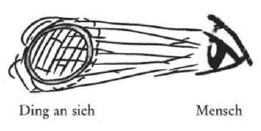
[ 24 ] Der Mensch nun schaut mit seinen «Fühlhörnern» gleichsam das unbekannte «Ding an sich», ohne freilich je in dasselbe hineinzukommen. Er sieht immer nur seine am «Ding an sich» reflektierten Vorstellungen; er spinnt das «Ding an sich» förmlich in die Vorstellungsformen ein.]
[ 24 ] Human beings, with their “antennas,” gaze, as it were, upon the unknown “thing-in-itself,” without, of course, ever entering into it. He always sees only his mental images reflected in the “thing-in-itself”; he literally weaves the “thing-in-itself” into the forms of his mental images.]
[ 25 ] Diese ganze Schlussfolgerung ist übergegangen in das gesamte Denken des neunzehnten Jahrhunderts; nicht bloß in die Erkenntnistheorie, sondern auch zum Beispiel in die theoretischen Grundlagen der Physiologie. Da kamen gewisse Erfahrungen zu Hilfe. Wenn man zum Beispiel auf die Lehre von den spezifischen Sinnesenergien blickt, so scheint in ihr eine Bestätigung der Kant’sehen Meinung zu liegen. Wenigstens hat man die Sache so im Laufe des neunzehnten Jahrhunderts angesehen. Man sagt so: Das Auge nimmt Licht wahr. Wenn man aber das Auge auf andere Weise affiziert, zum Beispiel durch Druck, durch elektrischen Impuls und so fort, so zeigt es auch Lichtwahrnehmung. Daher sagte man: Die Lichtwahrnehmung ist aus der spezifischen Energie des Auges heraus erzeugt und ist übergezogen über das Ding an sich. Insbesondere Helmholtz hat das in krasser Weise als physiologisch-philosophische Lehre zum Ausdruck gebracht, indem er sagt: Alles, was wir wahrnehmen, ist nicht einmal bildhaft ähnlich zu denken mit den Dingen, die außer uns sich befinden. Das Bild hat Ähnlichkeit mit dem, was es darstellt; aber das, was wir Sinnesempfindung nennen, das kann nicht einmal solche Ähnlichkeit mit dem Original haben, wie es das Bild mit seinem Original hat. Man kann daher, sagt er weiter, das, was der Mensch in sich erlebt, nicht anders ansprechen, denn als cin «Zeichen» des Dinges an sich. Ein Zeichen braucht ja nichts Ähnliches zu haben mit dem, was es ausdrückt.
[ 25 ] This entire line of reasoning has permeated the entire thought of the nineteenth century—not merely epistemology, but also, for example, the theoretical foundations of physiology. Certain empirical findings supported this view. If, for example, one looks at the theory of specific sensory energies, it seems to confirm Kant’s view. At least, that is how the matter was viewed throughout the nineteenth century. The argument goes like this: The eye perceives light. But if the eye is stimulated in other ways—for example, by pressure, by an electrical impulse, and so on—it also exhibits light perception. Hence it was said: Perception of light is produced by the eye’s specific energy and is superimposed upon the thing-in-itself. Helmholtz, in particular, expressed this in stark terms as a physiological-philosophical doctrine, stating: Everything we perceive cannot even be conceived as bearing a pictorial resemblance to the things that exist outside of us. An image bears a resemblance to what it represents; but what we call sensory perception cannot even bear such a resemblance to the original as the image does to its original. One can therefore, he continues, refer to what a person experiences within themselves as nothing other than a “sign” of the thing-in-itself. After all, a sign need not bear any resemblance to what it expresses.
[ 26 ] Und das, was sich da lange vorbereitet hatte, das hat sich dann sozusagen eingefressen in das philosophische Denken unserer Zeit, sodass der Mensch unfähig wurde, etwas anderes zu begreifen, ja überhaupt nur zu denken, dass es auch anders sein könnte. So ist Eduard von Hartmann ganz unfähig gewesen, sich aus seinen Begriffsgespinsten herauszufinden. Es war zum Beispiel in einem Gespräch, das ich einmal Gelegenheit hatte, mit ihm zu führen, ganz unmöglich, darüber hinauszukommen, dass er sagte: Ja, wir müssen doch ausgehen von der Vorstellung, und wenn man die Vorstellung definiert, so muss man doch sagen, sie ist dasjenige, durch das der Mensch ein Nichtvorgestelltes sich zur Wahrnehmung bringt! Wenn aber die Vorstellung, von der wir doch ausgehen, etwas Subjektives ist, dann können wir doch auch nicht über das Subjektive hinauskommen.
[ 26 ] And what had been brewing for so long eventually, so to speak, became ingrained in the philosophical thinking of our time, to the point that people became incapable of comprehending anything else—indeed, of even conceiving that things could be any different. Thus, Eduard von Hartmann was completely unable to extricate himself from his conceptual tangles. For example, in a conversation I once had the opportunity to have with him, it was utterly impossible to get past the point where he said: “Yes, we must surely start from the mental image, and if one defines the mental image, one must surely say that it is that through which a person brings something not yet conceived into perception! But if the mental image from which we start is something subjective, then we cannot go beyond the subjective either.
[ 27 ] Er hatte keine Ahnung davon, dass er sich diese Definition zuerst selbst zurechtgezimmert hatte und dann einem zurechtgelegten Begriffe nicht wieder entrinnen konnte. Und doch beruht sein ganzer «transzendentaler Realismus» darauf, dass er sich in etwas eingesponnen hat, was er selbst gemacht hat und von dem er annimmt, dass es eine objektive Wahrheit sei. Auf diese Weise kommt der Mensch niemals über das Urteil hinaus: Das, was ich im Vorstellen begreife, geht immer nur bis an die Grenze des Dinges an sich, es ist also nur subjektiv. - Diese Denkgewohnheit hat sich im Laufe der Zeit so fest eingelebt, dass alle diejenigen Erkenntnistheoretiker, die sich etwas darauf zugutetun, Kant zu verstehen, einen jeden für einen beschränkten Menschen halten, der nicht zugeben kann, dass ihre Definition von der Vorstellung und von der subjektiven Natur des Beobachteten richtig sei. Das alles ist durch den vorhin geschilderten Riss in der menschlichen Geistesentwicklung herbeigeführt worden. [In seinen ethischen Untersuchungen hat Eduard von Hartmann zwar bedeutsame Anregungen gegeben, seine erkenntnistheoretischen Untersuchungen haben nichts Neues und Wichtiges gebracht. So hat sich das kantische Denken im modernen Geistesleben zur förmlichen Denkgewohnheit entwickelt.]
[ 27 ] He had no idea that he had first cobbled together this definition himself and then found himself unable to escape from a concept he had constructed. And yet his entire “transcendental realism” rests on the fact that he has entangled himself in something he himself created and which he assumes to be an objective truth. In this way, human beings never transcend judgment: what I grasp in my mental image always extends only as far as the limit of the thing-in-itself; it is therefore merely subjective. - This habit of thought has become so deeply ingrained over time that all those epistemologists who pride themselves on understanding Kant regard anyone who cannot admit that their definition of the mental image and of the subjective nature of what is observed is correct as a narrow-minded person. All of this has been brought about by the rupture in the development of the human mind described earlier. [Although Eduard von Hartmann provided significant insights in his ethical investigations, his epistemological studies have contributed nothing new or important. Thus, Kantian thought has developed into a formal habit of thought in modern intellectual life.]
[ 28 ] Wer nun aber wirklich den Aristoteles studiert, der würde finden, dass in einer geraden, also gewissermaßen nicht umgebogenen Entwicklung von Aristoteles aus ganz anderes als Erkenntnis-Prinzip und -Theorie hätte kommen können. Aristoteles hat bereits Dinge eingesehen auf erkenntnistheoretischem Gebiet, zu denen sich der Mensch heute durch all das akademische Gestrüpp, das unter dem Einflusse Kants entstanden ist, erst wieder langsam und allmählich wird aufschwingen können. Er muss vor allen Dingen begreifen lernen, dass Aristoteles schon die Möglichkeit hatte, durch die Denktechnik Begriffe herbeizubringen, die richtig gefasst sind, und die unmittelbar dahin führen, diese hier selbst gezogenen menschlichen Grenzen zu überschreiten [und uns über das Gebiet des Empirischen hinausleiten].
[ 28 ] But anyone who truly studies Aristotle would find that, in a straightforward—that is, in a sense, unaltered—development of Aristotle’s thought, something quite different from the principle and theory of knowledge could have emerged. Aristotle had already grasped certain insights in the field of epistemology to which people today, due to all the academic undergrowth that arose under Kant’s influence, will only be able to rise again slowly and gradually. Above all, we must learn to understand that Aristotle already had the ability, through his method of thought, to formulate concepts that are correctly conceived and that lead directly to transcending these human-imposed limits [and guiding us beyond the realm of the empirical].
[ 29 ] Wir brauchen uns nur mit einigen Fundamental-Begriffen des Aristoteles zu befassen, um das einzusehen. Es ist durchaus in seinem Sinne zu sagen: Wenn wir die Dinge um uns herum analysieren, finden wir zunächst das, was uns eine Erkenntnis dieser Dinge verschafft, dadurch, dass wir mit dem Sinn wahrnehmen: Der Sinn liefert uns das einzelne Ding. Wenn wir aber anfangen zu denken, da gruppieren sich uns die Dinge, wir fassen verschiedene Dinge in einer Denkeinheit zusammen. - Und nunmehr findet Aristoteles die richtige Beziehung zwischen dieser Gedankeneinheit und einem objektiv Wirklichen, jenem Objektiven, das zu dem Ding an sich führt - indem er zeigt, dass wir bei konsequentem Denken die Erfahrungswelt um uns herum zusammengesetzt denken müssen aus Materie und aus dem, was er die Form nennt. Materie und Form sind für Aristoteles zwei Begriffe, die er in dem einzig richtigen Sinne, wie sie geschieden werden müssen, wirklich scheidet. Wir könnten stundenlang reden, wenn wir diese beiden Begriffe und alles, was damit zusammenhängt, erschöpfen wollten. Aber einiges Elementare wollen wir wenigstens herbeitragen, um zu verstehen, was Aristoteles als Form und Materie unterscheidet. Er ist sich klar darüber, dass es in Bezug auf alle Dinge, die zunächst um uns herum sind, die unsere Erfahrungswelt bilden, dass es bei all dem für das Erkennen darauf ankommt, dass wir die Form ergreifen, denn die Form gibt den Dingen das Wesentliche, nicht die Materie. Die Form ist für Aristoteles das Wesentliche.
[ 29 ] We need only consider a few of Aristotle’s fundamental concepts to see this. It is entirely in keeping with his thinking to say: When we analyze the things around us, we first find what gives us knowledge of these things through our sensory perception: The senses provide us with the individual thing. But when we begin to think, things group themselves together for us; we combine different things into a single unit of thought. - And now Aristotle identifies the correct relationship between this unit of thought and an objectively real entity—that objective reality which leads to the thing-in-itself—by showing that, if we think consistently, we must conceive of the world of experience around us as composed of matter and what he calls form. For Aristotle, matter and form are two concepts that he truly distinguishes in the only correct sense, as they must be separated. We could talk for hours if we wanted to exhaustively explore these two concepts and everything related to them. But let us at least bring up some basic points to understand what Aristotle distinguishes as form and matter. He is clear that, with regard to all things that are initially around us—the things that make up our world of experience—what matters for cognition is that we grasp form, for it is form that gives things their essence, not matter. For Aristotle, form is the essence.
[ 30 ] Es gibt auch in unserer Zeit allerdings noch Persönlichkeiten, die ein richtiges Verständnis haben für Aristoteles. Vinzenz Knauer, der in den Achtzigerjahren des neunzehnten Jahrhunderts in Wien Universitätsdozent war, hat seinen Hörern den Unterschied zwischen Materie und Form und auf was es dabei ankommt, gewöhnlich durch eine Illustration klargemacht, über die man vielleicht spotten mag. Er sagte, man solle sich einmal denken, wie ein Wolf, der einige Zeit seines Lebens lauter Lämmer gefressen hat, wie der sich dann eigentlich aus der Materie der Lämmer zusammensetzt - und doch wird der Wolf niemals ein Lamm! Das gibt, wenn man es nur richtig verfolgt, den Unterschied zwischen Materie und Form. Ist der Wolf ein Wolf durch Materie? Nein! Seine Wesenheit hat er eingeimpft durch die Form - wir finden sie nicht nur bei diesem Wolf, sondern bei allen Wölfen. So finden wir die Form durch einen Begriff, der, im Gegensatz zu dem, was die Sinne im Einzelnen erfassen, etwas Universelles ist.
[ 30 ] Even in our time, however, there are still individuals who have a true understanding of Aristotle. Vinzenz Knauer, who was a university lecturer in Vienna in the 1880s, usually explained to his students the difference between matter and form—and what is essential in this regard—using an illustration that some might find laughable. He said one should imagine a wolf that has spent part of its life eating nothing but lambs—how it is then essentially composed of the matter of the lambs—and yet the wolf will never become a lamb! If one follows this line of thought correctly, this illustrates the difference between matter and form. Is the wolf a wolf by virtue of matter? No! It has acquired its essence through form—we find this not only in this particular wolf, but in all wolves. Thus, we find form through a concept which, in contrast to what the senses perceive in particular instances, is something universal.
[ 31 ] Nun kann man im Sinne des Aristoteles in einem richtig erkenntnistheoretischen Sinne dies Universelle ganz genau in dreifacher Weise unterscheiden. Man kann sagen, dieses Universelle ist das Wesentliche, das, worauf es ankommt. Aber ist dasjenige, was im menschlichen Denken lebt, dasselbe wie das, was wir im wahren Sinne als Form ansprechen? Nein. Der Mensch geht an die verschiedenen Wölfe heran und bildet sich den Begriff, ein Universelles, aus den einzelnen Wölfen. Aber das, was er da als einen Begriff sich gebildet hat, der die gleichen Eigenschaften zusammenfasst, das ist nur ein «Repräsentierende» des wahren Universellen. (Es kann das alles nur skizzenhaft angedeutet werden.) Sodass man also unterscheiden kann: Ein Universelles, das vor den Einzelheiten ist, die uns äußerlich entgegentreten; dann, weil es ja das Wesentliche darinnen ist, ein Universelles, das in den Dingen liegt; und eine dritte Form des Universellen, das sich der Mensch in Gedanken hinterher bildet. Es gibt somit: 1) universalia ante rem, 2) universalia in re, 3) universalia post rem. Die letzteren entrollen sich dem subjektiven Geiste und sind die «die objektiven realen Universalien repräsentierenden» inneren Erlebnisse.
[ 31 ] Now, in the spirit of Aristotle—in a truly epistemological sense—one can distinguish this universal quite precisely in three ways. One can say that this universal is the essential, that which matters most. But is that which exists in human thought the same as what we refer to, in the true sense, as form? No. A person approaches the various wolves and forms a concept—a universal—from the individual wolves. But what he has formed there as a concept that summarizes the same properties is merely a “representation” of the true universal. (All this can only be sketched out in broad strokes.) Thus, one can distinguish between: a universal that precedes the particulars that present themselves to us externally; then, since it is, after all, the essence contained within them, a universal that lies within things; and a third form of the universal, which human beings form in their thoughts afterward. There are thus: 1) universalia ante rem, 2) universalia in re, 3) universalia post rem. The latter unfold before the subjective mind and are the inner experiences that “represent the objective, real universals.”
[ 32 ] Bevor man nicht auf die dreifache Unterscheidung eingeht, kann man auf diesem Grunde zu keiner richtigen Einsicht in Bezug auf dasjenige kommen, was hier wichtig ist. Denn bedenken Sie, um was es sich handelt! Es handelt sich um die Einsicht, dass der Mensch, insofern er in den universalia post rem drinnen lebt, dass er da ein Subjektives hat. Aber es wird zugleich auf etwas Wesentliches hingewiesen, nämlich darauf, dass der Begriff des Menschen eine «Repräsentation» dessen ist, was als reale Formen (Entelechien) universalen Bestand hat. Und diese - die universalia in re, sind wiederum nur in die Dinge hineingeflossen, weil sie schon vor den Dingen existiert haben als universalia ante rem.
[ 32 ] Unless one addresses the threefold distinction, one cannot, on this basis, arrive at a proper understanding of what is important here. For consider what is at stake! It is the insight that human beings, insofar as they live within the universalia post rem, possess a subjective aspect there. But at the same time, something essential is pointed out, namely that the concept of man is a “representation” of what exists universally as real forms (entelechies). And these—the universalia in re—have, in turn, only flowed into things because they already existed prior to things as universalia ante rem.
[ 33 ] Da haben wir als universalia ante rem dasjenige, was wir als zuerst in der Gottheit, in der Weisheit Gottes existierend annehmen müssen. Als christlicher Theologe, als Scholastiker, fasst man es auf ähnliche Weise auf, nur dass man nicht gleich bis zum höchsten Göttlichen hinaufgeht. Als Theosophen wissen wir, dass die universalia in re, wenn es sich zum Beispiel um Tiere handelt, deren Gruppenseele bedeuten, und so haben wir in der Tat im Aristotelismus eine Fundamentierung dessen, was wirklich die Theosophie begrifflich stützen kann. Nur gehört zu all dem, was uns bei Aristoteles entgegentritt, noch etwas anderes, was in der Neuzeit immer unbeliebter geworden ist: Es ist nötig, dass man sich dazu bequemß, in scharfen, fein ziselierten Begriffen zu denken, in Begriffen, die man sich erst zubereitet, es gehört dazu, dass man die Geduld hat, von Begriff zu Begriff vorzuschreiten, dass man vor allen Dingen Neigung zu begrifflicher Reinheit und Sauberkeit habe, dass man weiß, wovon man redet, wenn man einen Begriff anschlägt. Wenn man im scholastischen Sinne zum Beispiel von der Beziehung des Begriffs zu dem, was er repräsentiert, spricht, so muss man erst lange Definitionen in den scholastischen Schriften durcharbeiten. Man muss wissen, was es heißt, wenn man sagt, der Begriff ist formaliter begründet im Subjekt und fundamentaliter im Objekt: Was der Begriff als eigentliche Gestalt hat, kommt vom Subjekt, was er als Inhalt hat vom Objekt her - das ist nur eine kleine Probe. Wirklich nur eine kleine. Wenn Sie scholastische Werke durchnehmen, müssen Sie sich durch dicke Bände von Definitionen durchwinden, und das ist dem heutigen Wissenschafter sehr unangenchm; daher betrachtet er die Scholastiker als Schulfüchse und tut sie damit ab. Er weiß gar nicht, dass wahre Scholastik nichts anderes ist als die gründliche Ausarbeitung der Gedankenkunst, sodass diese ein Fundament für das wirkliche Begreifen der Wirklichkeit bilden kann.
[ 33 ] Here, as universalia ante rem, we have that which we must assume to exist first and foremost in the Godhead, in the wisdom of God. As a Christian theologian, as a scholastic, one understands it in a similar way, except that one does not immediately ascend to the highest Divine. As theosophists, we know that the universalia in re, when it comes to animals, for example, signify their group soul; and so we do, in fact, find in Aristotelianism a foundation for what can truly underpin theosophy conceptually. However, along with everything we encounter in Aristotle, there is something else that has become increasingly unpopular in modern times: It is necessary to accustom oneself to thinking in sharp, finely chiseled concepts—concepts that one must first prepare for oneself; it requires having the patience to proceed from concept to concept; above all, one must have a penchant for conceptual purity and clarity, and one must know what one is talking about when one introduces a concept. If, for example, one speaks in the scholastic sense of the relationship between the concept and what it represents, one must first work through lengthy definitions in scholastic writings. One must know what it means when one says that the concept is formally grounded in the subject and fundamentally in the object: What the concept has as its actual form comes from the subject, what it has as content comes from the object—that is just a small sample. Truly just a small one. When you work your way through scholastic works, you have to wade through thick volumes of definitions, and that is very unwelcome to today’s scientist; therefore, he regards the scholastics as academic pedants and dismisses them as such. He has no idea that true scholasticism is nothing other than the thorough elaboration of the art of thought, so that it may form a foundation for the genuine comprehension of reality.
[ 34 ] Indem ich dies spreche, werden Sie empfinden, dass es eine große Wohltat ist, wenn gerade innerhalb der Theosophischen Gesellschaft Bestrebungen auftauchen, die in allerbestem (erkenntnistheoretischem) Sinne auf eine Ausarbeitung der erkenntnistheoretischen Prinzipien hinzielen. Und wenn wir gerade hier in Stuttgart einen Arbeiter auf diesem Gebiete von außerordentlicher Bedeutung haben (Doktor Unger), so ist das als eine wohltätige Strömung innerhalb unserer Bewegung zu betrachten. Denn diese Bewegung wird in ihren tiefsten Teilen nicht durch diejenigen ihre Geltung in der Welt erlangen, die nur die Tatsachen der höheren Welt hören wollen, sondern durch solche, welche die Geduld besitzen, in eine Gedankentechnik einzudringen, die einen realen Grund für ein wirklich gediegenes Arbeiten schafft, die ein Skelett schafft für das Arbeiten in der höheren Welt.
[ 34 ] As I say this, you will feel that it is a great blessing when, within the Theosophical Society itself, efforts emerge that aim—in the very best (epistemological) sense—to elaborate on epistemological principles. And since we have here in Stuttgart a scholar of extraordinary importance in this field (Dr. Unger), this should be regarded as a beneficial current within our movement. For this movement will not gain its standing in the world through those who wish only to hear about the facts of the higher world, but through those who possess the patience to delve into a technique of thought that creates a solid foundation for truly sound work—a framework for working in the higher world.
[ 35 ] [Nicht nur interessante und neue Gedanken sollen wir von der Theosophie erhalten wollen, sondern auch, was freilich nicht so bequem ist, an der richtigen Fundierung unserer eigenen Begriffstechnik arbeiten.] So wird vielleicht gerade innerhalb der theosophischen Bewegung und aus der Theosophie selbst heraus erst wiederum verstanden werden, was die von Anhängern und Gegnern zum Zerrbild gemachte Scholastik eigentlich wollte. Es ist natürlich bequemer, mit ein paar mitgebrachten Begriffen alles, was uns als höhere Wirklichkeit entgegentritt, begreifen zu wollen, als eine gediegene Fundamentierung in der Begriffstechnik zu schaffen - aber was sind die Folgen davon? Es gibt einen misslichen Eindruck, wenn man heute philosophische Bücher in die Hand nimmt. Die Menschen verstehen einander gar nicht mehr, wenn sie über höhere Dinge sprechen; sie sind sich nicht klar darüber, wie sie die Begriffe gebrauchen. Das hätte in der scholastischen Zeit nicht vorkommen können, denn damals musste man sich klar über die Konturen eines Begriffs sein.
[ 35 ] [We should not only seek to gain interesting and new ideas from theosophy, but also—though this is admittedly less convenient—work on establishing a sound foundation for our own conceptual framework.] Thus, it may be precisely within the Theosophical Movement and from Theosophy itself that we will once again come to understand what Scholasticism—which has been distorted into a caricature by both its supporters and opponents—actually intended. It is, of course, more convenient to try to grasp everything that presents itself to us as a higher reality using a few preconceived concepts than to establish a solid foundation in conceptual methodology—but what are the consequences of this? One gets a disconcerting impression when picking up philosophical books today. People no longer understand one another at all when they speak of higher matters; they are unclear about how they are using the terms. This could not have happened in the scholastic era, for back then one had to be clear about the contours of a concept.
[ 36 ] [Heutzutage ist einem eben der richtige Gebrauch der Begriffe ganz abhandengekommen, und die Begriffe selber haben bloß noch verschwommene Konturen. Wäre man also dereinst in gerader Richtung auf dem Wege weitergeschritten, der von Aristoteles aufgedeckt worden ist, so hätte man immer eine richtige Gedankentechnik gehabt, so aber musste man sich schließlich in dem Kant’sehen Begriffsgespinst verfangen. Dann wäre auch niemals jene Kluft entstanden zwischen Wissen und Glauben.]
[ 36 ] [These days, the proper use of terms has been completely lost, and the terms themselves have nothing but blurred contours. If, therefore, one had once continued straight along the path discovered by Aristotle, one would always have had a proper method of thought; but as it was, one eventually became entangled in Kant’s web of concepts. Then that gulf between knowledge and faith would never have arisen.]
[ 37 ] Sie sehen, es hat in der Tat einen Weg gegeben, um in die Tiefen der Denktechnik einzudringen. Und wäre dieser Weg weiter beschritten worden, hätte man sich nicht einfangen lassen in das Kant’sche Gespinst vom «Ding an sich» und der Vorstellung, die subjektiv sein soll, dann hätte man zweierlei erreicht: Erstens wäre man zu einer in sich selbst sicheren Erkenntnistheorie gelangt, und zweitens - und das ist von großer Bedeutung — hätte man nicht in den maßgebenden Kreisen diejenigen großen Philosophen so gänzlich missverstehen können, die nach Kant gearbeitet haben. Es folgt zum Beispiel das Trifolium Fichte, Schelling, Hegel. Was sind sie dem heutigen Menschen? Man hält sie für Philosophen, die aus rein abstrakten Begriffen eine Welt haben herausspinnen wollen. Das ist ihnen niemals eingefallen. Aber man war eingezwängt in Kant’sche Begriffe und deshalb konnte man den größten Philosophen der Welt weder philosophisch noch sachlich begreifen. Sie wissen, es ist derjenige, der im Hause vis-A-vis, wie aus der Gedenktafel hervorgeht, die Sie sehen können, wenn Sie hier die Straße betreten, seine Jugendzeit verbracht hat: Hegel. Erst allmählich wird man dazu heranreifen, das zu verstehen, was er der Welt gegeben hat; erst dann wird man ihn begreifen können, wenn man wieder herauskommt aus dem theoretisch gesponnenen, beengenden Erkenntnisgespinst. Und das wäre so einfach! Man brauchte sich nur zu einem natürlichen, unbefangenen Denken zu bequemen und sich frei zu machen von dem, was in der philosophischen Literatur unter dem Einfluss der getrübten Strömungen des Kantianismus sich zu Denkgewohnheiten entwickelt hat. Man muss sich klar sein über die Frage: Verhält es sich denn wirklich so, dass der Mensch vom Subjekt ausgeht, sich im Subjekt seine Vorstellung baut und diese Vorstellung dann hinüberspinnt über das Objekt? Ist das wirklich so? Ja, es ist so. - Aber folgt daraus notwendigerweise, dass der Mensch niemals in das Ding an sich eindringen kann?
[ 37 ] As you can see, there was indeed a way to penetrate the depths of the technique of thought. And if this path had been pursued further—if one had not allowed oneself to be ensnared in Kant’s web of the “thing-in-itself” and the mental image that it is supposed to be subjective—then two things would have been achieved: First, one would have arrived at a theory of knowledge that is self-contained and secure, and second—and this is of great importance—one would not have been able to so completely misunderstand, in the influential circles, those great philosophers who worked in the tradition of Kant. Take, for example, the trio of Fichte, Schelling, and Hegel. What do they mean to people today? They are regarded as philosophers who sought to spin a world out of purely abstract concepts. That never even occurred to them. But people were constrained by Kantian concepts, and for that reason, they were unable to comprehend the world’s greatest philosophers—neither philosophically nor objectively. You know, it is the man who spent his youth in the house across the street—as indicated by the commemorative plaque you can see when you step onto the street here—Hegel. Only gradually will people mature enough to understand what he gave to the world; only then will one be able to grasp him, once one emerges from the constricting web of knowledge spun by theory. And it would be so simple! One need only allow oneself to think naturally and without prejudice and free oneself from what, in philosophical literature under the influence of the clouded currents of Kantianism, has developed into habits of thought. One must be clear about the question: Is it really the case that human beings proceed from the subject, construct their mental image within the subject, and then project this mental image onto the object? Is that really how it is? Yes, it is. — But does it necessarily follow from this that human beings can never penetrate to the thing-in-itself?
[ 38 ] Ich will einen einfachen Vergleich machen. Denken Sie sich, Sie haben ein Petschaft, darauf stehe der Name Müller. Nun drücken Sie das Petschaft in einen Siegellack und nehmen es fort. Nicht wahr, darüber sind Sie sich doch klar, dass, wenn dies Petschaft, sagen wir, aus Messing besteht, dass nichts von dem Messing in den Siegellack übergehen wird. Wenn nun dieser Siegellack erkennend im Kant’sehen Sinne wäre, so würde er sagen: «Ich bin ganz Lack, nichts kommt vom Messing in mich herein, also gibt es keine Beziehung, die ich über die Natur dessen, was mir da entgegentritt, wissen könnte.» Dabei aber ist ganz vergessen, dass das, worauf es ankommt, nämlich der Name Müller, ganz objektiv als Abdruck im Siegellack drinnen ist, ohne dass vom Messing etwas hinübergegangen ist. So lange man materialistisch denkt und glaubt, dass, um Beziehungen herzustellen, Materie von dem einen zum andern hinüberließen müsse, so lange wird man auch theoretisch sagen: «Ich bin Siegellack, und das andere ist Messing an sich; und da von dem «Messing an sich» nichts hereinkommen kann in mich, kann auch der Name Müller nichts anderes sein als ein Zeichen. Das Ding an sich aber, das im Petschaft drinnen war, das sich mir abgedrückt hat, sodass ich es lesen kann: Das bleibt mir ewig unbekannt.» Da sehen Sie die Schlussformel, der man sich da bedient. Spinnt man in dem Vergleiche weiter, so ergibt sich: Der Mensch ist ganz Siegellack (Vorstellung), das Ding an sich ist ganz Petschaft (das außerhalb der Vorstellung Befindliche). Weil ich nun als Lack (Vorstellender) nur an die Grenze des Petschafts (das Ding an sich) herankommen kann, so bleibe ich in mir selbst, es kommt nichts vom Ding an sich in mich herüber. So lange man den Materialismus auf die Erkenntnistheorie ausdehnen wird, so lange wird man nicht herausfinden, worauf es ankommt. Der Vordersatz gilt: Wir kommen nicht über unsere Vorstellung hinaus; aber was herüberkommt, ist als Geistiges zu bezeichnen; das hat nicht nötig, dass materielle Atome herüberließen. Nichts von einem Materiellen kommt in das Subjekt herein - trotzdem aber kommt das Geistige herüber in das Subjekt, so wahr wie der Name Müller in den Siegellack. Davon muss eine gesunde erkenntnistheoretische Forschung wieder ausgehen können, dann wird man sehen, wie sehr sich der neuzeitliche Materialismus selbst unvermerkt in die erkenntnistheoretischen Begriffe eingebürgert hat. Es folgt nichts anderes aus einem unbefangenen Betrachten der Sachlage, als dass Kant sich ein «Ding an sich» nur materiell vorstellen kann, so grotesk eine solche Behauptung sich auch für den ersten Blick ausnchmen mag.
[ 38 ] Let me give you a simple example. Imagine you have a seal bearing the name Müller. Now press the seal into sealing wax and remove it. Surely you realize that if this seal is, say, made of brass, none of the brass will transfer into the sealing wax. If this sealing wax were capable of perception in Kant’s sense, it would say: “I am entirely wax; nothing from the brass enters me, so there is no relationship through which I could know the nature of what stands before me.” Yet this completely overlooks the fact that what really matters—namely, the name Müller—is objectively present as an imprint in the sealing wax, without anything from the brass having been transferred. As long as one thinks materialistically and believes that, in order to establish relationships, matter must pass from one to the other, one will also say theoretically: “I am sealing wax, and the other is brass in itself; and since nothing from ‘brass in itself’ can enter into me, the name ‘Müller’ can be nothing other than a sign. But the thing-in-itself that was inside the seal, which imprinted itself on me so that I can read it: That remains eternally unknown to me.” There you see the concluding formula that is employed here. If one takes this comparison further, the following emerges: Man is entirely sealing wax (mental image); the thing-in-itself is entirely the seal (that which exists outside of the mental image). Since I, as sealing wax (the representing entity), can only approach the boundary of the seal (the thing-in-itself), I remain within myself; nothing from the thing-in-itself passes into me. As long as materialism is extended to the theory of knowledge, we will not discover what really matters. The premise holds: We do not go beyond our mental image; but what comes over must be described as spiritual; this does not require that material atoms be transmitted. Nothing material enters the subject—yet the spiritual does enter the subject, as surely as the name Müller enters the sealing wax. Sound epistemological research must be able to start from this again; then one will see how deeply modern materialism has, without anyone noticing, become entrenched in epistemological concepts. An unbiased examination of the situation leads to no other conclusion than that Kant can form a mental image of a “thing-in-itself” only in material terms, however grotesque such a claim may seem at first glance.
[ 39 ] Nun müssen wir allerdings, wenn wir die Sache ganz vollständig betrachten wollen, noch etwas anderes skizzieren. Wir haben gesagt, dass Aristoteles darauf hingewiesen hat, dass bei allem, was um uns herum ist, notwendig unterschieden werden müsse zwischen dem, was Form (Entelechie) und was Materie ist. Nun kann man sagen: Wir kommen im Erkenntnisprozess bis zur Form heran in dem Sinne, wie eben dargestellt worden ist. Gibt es aber nun auch eine Möglichkeit, bis zum Materiellen heranzukommen? Wohl gemerkt: Aristoteles versteht unter dem Materiellen nicht nur Stoffliches, sondern die Substanz, dasjenige, was auch als Geistiges der Wirklichkeit zugrunde liegt. Gibt es eine Möglichkeit, nicht nur das, was herüberfließt, zu begreifen, sondern auch in die Dinge hineinzukriechen, sich mit der Materie zu identifizieren? Diese Frage ist auch für die Erkenntnistheorie wichtig. Sie kann nur von demjenigen beantwortet werden, der sich in die Natur des Denkens, des reinen Denkens, vertieft hat. Zu diesem Begriff des reinen Denkens muss man sich erst aufschwingen. Das reine Denken können wir nach Aristoteles als Aktualität bezeichnen. Es ist reine Form, es ist zunächst, so wie es auftritt, ohne Inhalt in Bezug auf die unmittelbaren einzelnen Dinge in der sinnlichen Wirklichkeit draußen. Warum? Machen wir uns einmal klar, wie der reine Begriff im Gegensatz zur Wahrnehmung entsteht.
[ 39 ] However, if we wish to consider the matter in its entirety, we must now outline something else. We have said that Aristotle pointed out that, with regard to everything around us, a distinction must necessarily be made between what is form (entelechy) and what is matter. Now one might say: In the process of cognition, we approach form in the sense just described. But is there also a way to approach the material? It should be noted that Aristotle understands the material not only as physical matter, but as substance—that which, as the spiritual, underlies reality. Is there a way not only to grasp what flows toward us, but also to penetrate into things, to identify with matter? This question is also important for the theory of knowledge. It can only be answered by someone who has delved deeply into the nature of thought—pure thought. One must first rise to this concept of pure thought. According to Aristotle, we can describe pure thought as actuality. It is pure form; initially, as it appears, it is without content in relation to the immediate individual things in sensory reality out there. Why? Let us first clarify how the pure concept arises in contrast to perception.
[ 40 ] Stellen Sie sich vor, dass man sich den Begriff des Kreises bilden will. Das können Sic, wenn Sie zum Beispiel hinausfahren aufs Meer, bis Sie rings um sich herum nur Wasser sehen; dann haben Sie sich durch die Wahrnehmung die Vorstellung eines Kreises gebildet. Es gibt aber eine andere Art zum Begriff des Kreises zu kommen, indem Sie nämlich, ohne an die Sinne zu appellieren, sich Folgendes sagen: Ich konstruiere mir im Geiste die Summe aller Orte, welche von einem Punkte gleich weit entfernt sind. Um diese ganz im Innern des Gedankenlebens verlaufende Konstruktion zu bilden, brauchen Sie nicht an Äußerliches zu appellieren: Das ist durchaus reines Denken im Sinne des Aristoteles, reine Aktualität.
[ 40 ] Imagine that you want to form the concept of a circle. You can do this, for example, by sailing out to sea until you see nothing but water all around you; then, through perception, you have formed a mental image of a circle. However, there is another way to arrive at the concept of a circle, namely by telling yourself the following without appealing to the senses: I construct in my mind the set of all points that are equidistant from a single point. To form this construction, which takes place entirely within the realm of thought, you do not need to appeal to anything external: this is pure thought in the Aristotelian sense, pure actuality.
[ 41 ] Nun aber tritt etwas Besonderes hinzu. Diejenigen reinen Gedanken, die so gebildet werden, passen zur Erfahrung. Ohne sie kann man sogar die Erfahrung gar nicht begreifen. Denken Sie einmal, wenn Kepler sich durch reine Begriffskonstruktion ein System ausarbeitet, das zum Beispiel elliptische Bahnen zeigt für die Planeten, wobei die Sonne sich in einem Brennpunkt befindet, und wenn man dann hinterher durch das Fernrohr konstatiert, dass die Beobachtung übereinstimmt mit dem vor der Erfahrung gefassten reinen Gedankenbilde! Da zeigt es sich für jedes unbefangene Denken, dass, was als reines Denken entsteht, für die Realität nicht bedeutungslos ist denn es stimmt ja mit der Realität überein. Ein Forscher wie Kepler illustriert durch sein Verfahren, was der Aristotelismus erkenntnistheoretisch begründet hat. Er erfasst das, was zu den Universalien post rem gehört, und findet, wenn er an die Dinge herangeht, dass diese universalia post rem vorher als universalia ante rem in sie hineingelegt worden sind. Werden nun nicht im Sinne einer verkehrten Erkenntnistheorie die Universalien zu bloßen subjektiven Vorstellungen gemacht, sondern zeigt es sich, dass man sie objektiv in den Dingen findet, so müssen sie erst in die Form hineingelegt sein, von der Aristoteles annimmt, dass sie der Welt zugrunde liegt.
[ 41 ] But now something special comes into play. The pure ideas formed in this way correspond to experience. Without them, one cannot even comprehend experience. Just consider this: when Kepler, through the pure construction of concepts, develops a system that, for example, depicts elliptical orbits for the planets, with the sun at one of the foci, and when one then subsequently observes through a telescope that the observation corresponds to the pure mental image conceived prior to experience! It becomes evident to any unbiased mind that what arises as pure thought is not meaningless for reality, for it does, in fact, correspond to reality. A researcher like Kepler illustrates through his method what Aristotelianism has established epistemologically. He grasps what belongs to the universalia post rem, and finds, when he approaches things, that these universalia post rem have previously been embedded in them as universalia ante rem. If, then, the universals are not reduced to mere subjective mental images in the sense of a distorted epistemology, but rather it becomes evident that they are objectively found in things, they must first have been embedded in the form that Aristotle assumes underlies the world.
[ 42 ] So finden Sie, dass das, was zuerst das Subjektivste ist, was unabhängig von der Erfahrung festgestellt ist, dass gerade das am allerobjektivsten in die Wirklichkeit hineinführt. Was war denn der Grund, warum das Subjektive der Vorstellung zuerst nicht in die Welt hinauskommen konnte? Der Grund war, dass es sich an einem «Ding an sich» stieß. Wenn der Mensch einen Kreis konstruiert, da stößt er an kein Ding an sich, da lebt er in der Sache selbst, wenn auch zunächst nur formal.
[ 42 ] Thus you find that what is initially the most subjective—what is established independently of experience—is precisely what leads most objectively into reality. What, then, was the reason why the subjective aspect of the mental image could not initially emerge into the world? The reason was that it came up against a “thing-in-itself.” When a person constructs a circle, he does not come up against a thing-in-itself; he lives within the thing itself, even if only formally at first.
[ 43 ] Nun ist die nächste Frage: Kommen wir überhaupt aus einem solchen subjektiven Denken zu irgendeiner Realität, zu einem Bleibenden? Und nun handelt es sich darum, dass ja, wie wir charakterisiert haben, das Subjektive zunächst, gerade im Denken konstruiert, formal ist, dass es zunächst für das Objektive wie etwas Hinzugebrachtes aussieht. Gewiss, wir können sagen: Im Grunde genommen ist es einem in der Welt befindlichen Kreis oder einer Kugel ganz gleichgültig, ob ich sie denke oder nicht. Mein Gedanke, der zur Wirklichkeit hinzukommt, ist für die um uns liegende Erfahrungswelt ganz gleichgültig. Diese besteht in sich, unabhängig von unserem Denken. Es kann also sein, dass unser Denken zwar für uns eine Objektivität ist, dass es aber die Dinge nichts angehe. Wie kommen wir über diesen scheinbaren Widerspruch hinaus? Wo ist der andere Pol, den wir jetzt ergreifen müssen? Wo gibt es innerhalb des reinen Denkens einen Weg, nicht nur die Form zu erzeugen, sondern mit der Form zugleich die Realität? Sobald wir irgendetwas haben, was mit der Form zugleich die Realität erzeugt, dann können wir an einen festen Punkt erkenntnistheoretisch anknüpfen. Wir sind ja überall, zum Beispiel wenn wir einen Kreis konstruieren, in dem besonderen Fall, dass wir sagen: Was ich von diesem Kreis sage, ist objektiv richtig - ob es anwendbar ist auf die Dinge, das hängt davon ab, dass, wenn ich den Dingen begegne, sie mir zeigen, ob sie die Gesetze in sich tragen, die ich konstruiert habe. Wenn die Summe aller Entelechien sich auflöst im reinen Denken, so muss ein Rest bleiben, den Aristoteles Materie nennt, wenn es nicht möglich ist, aus dem reinen Denken selbst zu einer Realität zu kommen.
[ 43 ] Now the next question is: Can we even arrive at any reality, at anything enduring, from such subjective thinking? And the point here is that, as we have characterized it, the subjective is, at first, constructed precisely within thought and is formal; that is, it initially appears to the objective as something added on. Certainly, we can say: Fundamentally, it makes no difference to a circle or a sphere in the world whether I think of it or not. My thought, which is added to reality, is completely irrelevant to the world of experience surrounding us. This world exists in and of itself, independent of our thinking. It may therefore be the case that, while our thinking is an objectivity for us, it has no bearing on things themselves. How do we move beyond this apparent contradiction? Where is the other pole that we must now grasp? Where, within pure thought, is there a way not only to produce form but, along with form, reality as well? As soon as we have something that produces reality along with form, then we can anchor ourselves epistemologically to a fixed point. After all, we are everywhere—for example, when we construct a circle—in the specific case where we say: What I say about this circle is objectively true—whether it is applicable to things depends on the fact that, when I encounter things, they show me whether they contain within themselves the laws I have constructed. If the sum of all entelechies dissolves into pure thought, then a residue must remain—what Aristotle calls matter—if it is not possible to arrive at reality from pure thought itself.
[ 44 ] Aristoteles kann hier durch Fichte ergänzt werden. Im Sinne des Aristoteles kann man zunächst zu der Formel kommen: Alles, was um uns herum ist, auch das, was unsichtbaren Welten angehört, macht es notwendig, dass wir dem Formalen der Entelechie ein Materielles entgegensetzen. - Für Aristoteles ist nun der Gottesbegriff eine reine Aktualität, ein reiner Akt, das heißt ein solcher Akt, bei dem die Aktualität, also die Formgebung, zugleich die Kraft hat, ihre eigene Materie hervorzubringen, nicht etwas zu sein, dem die Materie entgegensteht, sondern etwas, das in ihrer reinen Tätigkeit zugleich selbst die Materie ist.
[ 44 ] Aristotle’s view can be supplemented here by Fichte. In the spirit of Aristotle, one can first arrive at the following formulation: Everything that surrounds us—including that which belongs to invisible worlds—makes it necessary for us to contrast the formal aspect of entelechy with a material aspect. - For Aristotle, the concept of God is pure actuality, a pure act—that is, an act in which actuality, or the formation of form, simultaneously possesses the power to bring forth its own matter; it is not something opposed by matter, but rather something that, in its pure activity, is itself the matter.
[ 45 ] Das Abbild dieser reinen Aktualität findet sich nun im Menschen selbst, wenn er aus dem reinen Denken heraus zu dem Begriff des «Ich» kommt. Da ist er im Ich bei etwas, was Fichte als Tathandlung bezeichnet. Er kommt in seinem Innern zu etwas, was, indem es in Aktualität lebt, zugleich mit dieser Aktualität seine Materie mit hervorbringt. Wenn wir das Ich im reinen Gedanken fassen, dann sind wir in einem Zentrum, wo das reine Denken zugleich essenziell sein materielles Wesen hervorbringt. Wenn Sie das Ich im Denken fassen, so ist ein dreifaches Ich vorhanden: ein reines Ich, das zu den Universalien «ante rem» gehört, ein Ich, in dem Sie drinnen sind, das zu den Universalien «in re» gehört, und ein Ich, das Sie begreifen, das zu den Universalien «post rem» gehört. Aber noch etwas ganz Besonderes ist hier: Für das Ich verhält es sich so, dass, wenn man sich zum wirklichen Erfassen des Ich aufschwingt, diese drei «Ichs» zusammenfallen. Das Ich lebt in sich, indem es seinen reinen Begriff hervorbringt und im Begriff als Realität leben kann. Für das Ich ist es nicht gleichgültig, was das reine Denken tut, denn das reine Denken ist der Schöpfer des Ich. Hier fällt der Begriff des Schöpferischen mit dem Materiellen zusammen, und man braucht nur einzusehen, dass wir in allen andern Erkenntnisprozessen zunächst an eine Grenze stoßen, nur beim Ich nicht: Dieses umfassen wir in seinem innersten Wesen, indem wir es im reinen Denken ergreifen.
[ 45 ] The image of this pure actuality is found in human beings themselves when, through pure thought, they arrive at the concept of the “I.” There, in the “I,” he encounters what Fichte calls an “act of fact.” He arrives within himself at something which, by living in actuality, simultaneously brings forth its own substance along with that actuality. When we grasp the “I” in pure thought, we find ourselves at a center where pure thought simultaneously and essentially brings forth its own material essence. When you grasp the “I” in thought, a threefold “I” is present: a pure “I” that belongs to the universals “ante rem,” an “I” within which you are situated, which belongs to the universals “in re,” and an “I” that you comprehend, which belongs to the universals “post rem.” But there is something else quite special here: For the “I,” the situation is such that when one rises to the level of truly grasping the “I,” these three “I’s” coincide. The “I” lives within itself by bringing forth its pure concept and is able to live as reality within that concept. For the “I,” it is not indifferent what pure thought does, for pure thought is the creator of the “I.” Here, the concept of the creative coincides with the material, and one need only realize that in all other processes of cognition we initially encounter a limit—except in the case of the “I”: We grasp this in its innermost essence by apprehending it in pure thought.
[ 46 ] So lässt sich erkenntnistheoretisch der Satz fundamentieren, dass auch im reinen Denken ein Punkt erreichbar ist, in dem Realität und Subjektivität sich völlig berühren, wo der Mensch die Realität erlebt. - Setzt er da ein und befruchtet er sein Denken so, dass sein Denken von da aus wiederum aus sich herauskommt, dann ergreift er die Dinge von innen. Es ist also in dem durch einen reinen Denkakt erfassten und damit zugleich geschaffenen Ich etwas vorhanden, durch das wir die Grenze durchdringen, die für alles andere zwischen Entelechie (Form) und Materie gesetzt werden muss.
[ 46 ] From an epistemological perspective, this provides a foundation for the assertion that even in pure thought, a point can be reached where reality and subjectivity fully intersect—where the human being experiences reality. - If he begins there and enriches his thinking in such a way that his thinking, starting from that point, emerges anew from within itself, then he grasps things from within. Thus, within the “I”—which is grasped and thereby simultaneously created through a pure act of thought—there exists something through which we penetrate the boundary that must be set for everything else between entelechy (form) and matter.
[ 47 ] Damit wird eine solche Erkenntnistheorie, die gründlich vorgeht, zu etwas, was auch im reinen Denken den Weg zeigt, in die Realität hineinzugelangen. Geht man diesen Weg, so wird man schon finden, dass man von da aus in die Theosophie hineinkommen muss. Die wenigsten Philosophen haben ein Verständnis für diesen Weg. Sie haben sich in ein selbstgemachtes Begriffsnetz eingesponnen; sie können auch, weil sie den Begriff nur als etwas Abstraktes kennen, niemals den einzigen Punkt erfassen, wo er archetypisch schöpferisch ist; sie können dadurch auch nichts finden, durch das sie mit einem «Ding an sich» sich verbinden könnten. Sie sehen, was notwendig ist, bevor die Philosophen dazu kommen werden, einzusehen, dass die Theosophen nicht bloß Dilettanten sind. Es gehört dazu, dass die Philosophen erst die Philosophie haben, dass es eine wirklich in die Fundamente gehende Philosophie gebe. Es verhält sich nicht so, dass die Philosophie etwa der Theosophie widerspricht, sondern die Philosophen verstehen nur die Philosophie nicht. Sie wissen nichts von den tieferen Grundlagen der Philosophie, sie sind verblendet, eingesponnen in einen erkenntnistheoretischen Irrweg, aus dem sie nicht herauskommen können. Wenn sie einmal herauskommen, dann werden sie auch den Weg zur Theosophie finden. Dilettantisch ist nicht so sehr die Theosophie für die Philosophen (denn sie können sie nur nicht verstehen); dilettantisch ist vielmehr das, was heute als Philosophie vielfach die Welt beherrscht. Wenn diese Philosophie erst imstande sein wird, fachmännisch zu denken, dann wird auch die Brücke geschlagen werden zwischen Philosophie und Theosophie.
[ 47 ] Thus, a theory of knowledge that proceeds thoroughly becomes something that, even in pure thought, points the way to entering into reality. If one follows this path, one will find that from there one must enter into theosophy. Very few philosophers understand this path. They have entangled themselves in a self-made web of concepts; moreover, because they know the concept only as something abstract, they can never grasp the single point where it is archetypically creative; consequently, they cannot find anything through which they might connect with a “thing-in-itself.” You see what is necessary before philosophers will come to realize that theosophists are not merely dilettantes. Part of this is that philosophers must first have philosophy—that there be a philosophy that truly delves into the foundations. It is not the case that philosophy contradicts theosophy; rather, philosophers simply do not understand philosophy. They know nothing of the deeper foundations of philosophy; they are deluded, entangled in an epistemological error from which they cannot escape. Once they break free, they will also find the path to theosophy. It is not so much Theosophy that is amateurish to philosophers (for they are simply unable to understand it); rather, what is amateurish is what today, in many cases, dominates the world as “philosophy.” Once this philosophy is capable of thinking expertly, a bridge will be built between philosophy and Theosophy.