

Supplements to Member Lectures
GA 246
15 August 1914, Dornach
Translated by Steiner Online Library
68. First Aid Course: Bandaging Course Two
[ 1 ] 9. Gunshot wounds to the collarbone: gauze, cotton wool, wide bandage. First over the shoulder where the wound is and under the other arm, then around the body (not too tightly). While applying the bandage, the artery in that area (near the first upper rib, as it were in the clavicle) must be continuously compressed by another person.
[ 2 ] You can also first press a piece of cotton wool against the artery and tie it extra tightly in the same way as described above (but slightly higher up, not around the body). This should be done if only one person is present. In general, it is best to tie off the artery first and then bandage the wound.
[ 3 ] 10. Broken rib: Place a large piece of cotton wool and a very wide bandage around the midsection. Then create a sort of sling over the shoulders, securing it to the bandage at the front and back with safety pins (one pin at the back, two at the front) so that the bandage cannot shift.

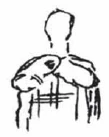
[ 4 ] 11. Broken collarbone: You can identify the fracture by comparing it to the other collarbone. Tie a narrow bandage around the right shoulder close to the neck (if the right collarbone is broken) and pull it under the left arm. Place cotton between the bandage and the skin! Place a triangular bandage on the right shoulder, with one corner tucked under the bandage and pulled through at the neck; tie the other two corners together on the arm.
[ 5 ] 12. Abdominal injury: If the intestines are protruding, do not touch them; simply cover them. Otherwise, lay the injured person on the ground and wrap a firm, very wide bandage around the abdomen. When lifting the victim, the legs must be held together in a crossed position; under no circumstances should they be held apart.
[ 6 ] 13. Artificial respiration: Lay the patient down, open the mouth, and pull the tongue out of the mouth with your hand. Move the arms up and down. Grasp the arms just below the elbows, press them against the chest, and then stretch them out over the head. If a second person is present, they should press on the stomach as the patient exhales—that is, immediately before the elbows touch the body again. Meanwhile, the tongue must be held in place; since there is a risk of biting, this should be done with a cloth, or a cork should be placed between the teeth (in the first case, at least two people would be necessary). Pace: Four to five seconds for a single back-and-forth movement, meaning: fairly slowly. Do not place a pillow under the head, but rather under the upper body so that the head hangs over the edge.
[ 7 ] 14. Treatment for fainting: Do not pour anything into the mouth or do anything similar. Elevate the legs by placing a board under the knees or something similar, and rest the feet on a chair. Unbutton all the clothing. Either perform the movements just described, or rub the stomach and the area below the calves with a cloth. In an emergency, let the patient smell something—ammonia, for example—but otherwise wait and see! 15. Sunstroke: Place the patient in the shade, loosen their clothing, and give them some salt water or about half a spoonful of salt, provided it melts in the mouth. The body position is the opposite of the previous case: the head elevated, the feet lowered (this is also recommended for epileptic seizures). The salt water can also be applied to the body, specifically to the head. The head can also be rubbed with lemon juice.