

The History of the German Section
of the Theosophical Society
1902–1913
GA 250
21 October 1906, Berlin
Translated by Steiner Online Library
31. Fourth General Assembly of the German Section of the Theosophical Society
Report in the “Bulletin for Members of the German Section of the Theosophical Society (Headquarters: Adyar), published by Mathilde Scholl,” No. IV/1907
[ 1 ] At 10:30 a.m., the Secretary General of the German Section, Dr. Rudolf Steiner, opened the fourth regular general assembly. The first item on the agenda was the tally of votes. The following were represented:
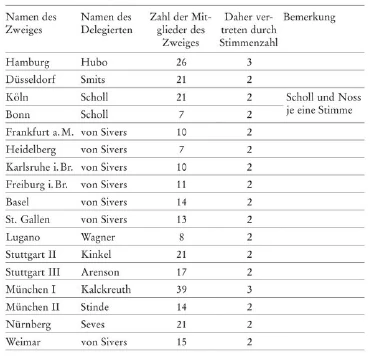
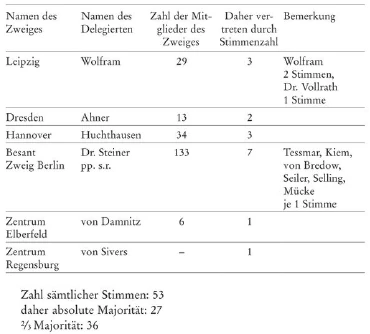
[ 2 ] The following were not represented: Bremen, Stuttgart I, Charlottenburg. Likewise, section members who did not belong to a branch did not exercise their right to appoint representatives.
[ 3 ] Mr. Selling is elected secretary. He reads aloud the minutes of the general meeting held on October 22, 1905; the meeting approves them.
[ 4 ] Regarding Item II, the Secretary-General’s Report, Dr. Rudolf Steiner first extends a warm welcome to the members present in the theosophical spirit and provides the following overview of the movement’s activities over the past year:
[ 5 ] “It has become clear during my travels and lectures that the true, effective foundation of our Theosophical Movement does not lie in mere talk of universal love for humanity and the like; rather, the real reason that drives most people to Theosophy is the desire to gain access to the treasure trove of wisdom that Theosophy offers. And this is entirely justified. Morality is the result of wisdom. Just as certain as it is that the longing to develop into a noble human being lives within man, so certain is it that the hackneyed platitudes about duties and mere moral exhortations have proven ineffective. - Just as a stove needs not exhortation but actual fuel to radiate heat, so too must human beings receive such an impetus in order to act morally. This actual fuel is occult wisdom.
[ 6 ] Naturally, the dissemination of this wisdom was bound to encounter resistance and obstacles of all kinds. — The opposition encountered in spreading this wisdom can be characterized as a lack of understanding on the one hand, and complacency on the other. While many people want to know nothing at all about what they cannot immediately perceive for themselves, it is certainly true, on the other hand, that people ask themselves: Can we comprehend these occult matters using ordinary logic? Yet if they were only truly willing to engage with them, they would soon realize that the teachings of theosophy are no more at odds with logic than, say, the teachings of the ordinary natural sciences.
[ 7 ] Others may well wish to contribute to the refinement of morality, but they want to do so while remaining exactly where they are; they want to help with what they have already achieved. Theosophy, however, consists in the pursuit of self-perfection. To understand this requires a certain tact—one that does not feel compelled to offer help unless one truly has something to give.
[ 8 ] Few scholars still belong to the Theosophical Movement today—that is, few from among those who are convinced of the infallibility of their own views; for, in their own opinion, there can be nothing more infallible than modern science. For the most part, it is people in the prime of life who are driven to the Theosophical Movement by a longing for the powers that flow from the teachings of wisdom. This longing for security and strength is growing despite all the obstacles of our time, as evidenced by the encouraging increase in membership. - If the scholarly world still takes a hostile stance toward us, this should not lead us to be unfair to the merits of that scholarly world, but rather spur us on to win over contemporary culture and its scholarship to our Theosophical Movement. Under the influence of our present-day culture, almost all of our scholars think in a far more materialistic way than they themselves realize.
[ 9 ] As an example of the obstacles that this materialistic way of thinking poses to our views, I would like to point to an explanation of the nature of motion recently offered by a biologist who holds the view that everything in the world is based on materialistic principles. The scholar in question believed that he could not form a mental image of the deeper causes of a billiard ball’s motion in any other way than that, upon collision, very small particles from one ball were transferred to the other, thereby causing the motion. - Thus, for a modern scholar, the problem of motion presents itself as a kind of tiny passenger transferring from one train to another. - In an age when such a materialistic worldview dominates science, it is understandable that a spiritual movement faces particularly great difficulties.
[ 10 ] Without going into all these matters any further, I would just like to emphasize that the Theosophical Movement is the only movement built entirely on freedom.
[ 11 ] However, it is not entirely possible to do without authority in this context; but authority is understood in no other sense than that in a laboratory, the person who understands chemistry is an authority.
[ 12 ] In contrast to all earlier spiritual movements that used external means of power to assert themselves—I need only mention the Church—the Theosophical Movement is a completely free movement based solely on the spirit. Without calling upon external powers for support—which are bound to fail for a spiritual movement today—and without propaganda in the usual sense, for the Theosophical Movement does not agitate but simply presents itself. Everyone must approach it of their own free will. What it offers to humanity is not an external organization or agitation in the sense of the old power structures. In Theosophy, organization can only serve to enable people to find what they themselves are seeking within themselves. Without polemics—even without polemics against those who attack us—let us carry out positive work.
[ 13 ] Although we were sometimes told that we ought to fend off the attacks against us, it is certainly true that a correction is sometimes necessary; in general, however, every thing can be recognized by its fruits. We want to do positive work—positive work that leads upward to the higher worlds; struggle accomplishes nothing; at best, it can set things right on the physical plane. But on the higher planes, only positive work can help.
[ 14 ] You have, of course, received a report on this year’s international congress in Paris. The most important thing we brought back for the German Section is a major undertaking: the preparations for the next congress in Germany. Next year, we will welcome the representatives of the individual sections to Germany. The discussions regarding the next congress are, of course, part of the agenda for today’s General Assembly.
[ 15 ] In addition to the lectures that have been held all over the place, something new has been added: lecture series—not only in Paris, but also in Leipzig and Stuttgart; one is set to begin soon in Munich. Such series are of great value; they allow the fundamentals of the theosophical worldview to take root in the soul.
[ 16 ] We should also take this opportunity to remember the members who have passed away this year. We would like to pay special tribute to our deeply esteemed member, Countess Brockdorff, whose unassuming yet all the more commendable work came at a time when few in Germany were willing to advocate for Theosophy. Let us rise from our seats in honor of the deceased.
[ 17 ] Our movement has gained some excellent collaborators over the past year, particularly Ms. Wolfram from Leipzig. This is worth emphasizing because she is the kind of collaborator the Theosophical Society could only hope for. Furthermore, I would like to announce that our long-standing and trusted member, Mr. Günther Wagner, has decided to move from Lugano to Berlin in order to assist us here. With his support, we will be able to accomplish many things that had to be put on hold in recent years.
[ 18 ] “Let us hope that, through the combined efforts of all involved, the Theosophical Movement may continue to flourish and develop significantly in the coming year.” Miss von Sivers, as secretary of the German Section, then presents the following report on the course of Theosophical life in the past year:
[ 19 ] There are 24 branches, compared to 18 last year, as well as 3 centers: Regensburg, Elberfeld, and Esslingen.
[ 20 ] Eleven members resigned, seven died, and 232 joined—compared to 131 the previous year—for a net increase of 214. The total membership now stands at 591, compared to 377 the previous year.
[ 21 ] The names of the new branches are: Basel, Bonn, Bremen, Frankfurt am Main, Heidelberg, Munich II, St. Gallen. The DTG (Berlin branch) has been dissolved.
[ 22 ] Next is the financial report from the treasurer, Mr. Seiler:
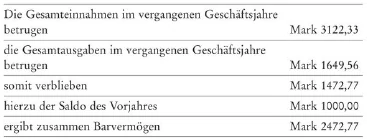
[ 23 ] According to the report by the treasury auditor, Mr. Tessmar, the treasurer is granted discharge.
[ 24 ] Miss von Sivers then read aloud and translated a welcome letter from the English Secretary-General, Miss Kate Spink.
[ 25 ] Since there are no reports from delegates regarding the work in the branches, the Secretary General remarked on this point that it would be desirable for the branches to recognize it as their duty to publish such reports in Miss Scholl’s “Mitteilungen.”
[ 26 ] This was followed by the election of a new board member to replace Ms. Lübke, who joined the local chapter in England after moving there. Ms. Wolfram, from Leipzig, was nominated for this position and elected unanimously by acclamation.
[ 27 ] Item III concerns the discussion of next year’s congress of the Federation of European Sections. Dr. Steiner takes the floor on this matter and states the following: “The General Secretariat and the Executive Board propose holding the congress in Munich. The reasons for this are purely practical, since the necessary personnel for this long and demanding work are available only in Munich. Pentecost appears to be the most suitable time.”
[ 28 ] In response to Mr. Hubo’s question about how the congress was to be organized, Dr. Steiner remarked, in essence, that all previous congresses should be regarded as experiments. The task of the German congress is to bring everything into intimate harmony with one another, so that works of art, music, and speech interact and resonate atmospherically with the rest of the arrangement—striving, in its intended effect, to evoke the ancient mysteries. To this end, the performance of a mystery play is also planned. The extent to which all this can be realized naturally depends on the circumstances. Dr. Steiner further announced that Miss Stinde had been elected as secretary of the International Congress Committee for this year, replacing Mr. van Manen; Countess Kalckreuth as treasurer of the International Congress Committee; and Miss von Sivers as director and treasurer of the German Section. All inquiries from German members, including payments, should therefore be directed exclusively to Miss von Sivers, who will be the sole point of contact with Miss Stinde.
[ 29 ] The following individuals were elected as additional members of the German committee:
Miss Scholl,
Baroness von Gumppenberg,
Mr. Günther Wagner,
Mr. Arenson.
[ 30 ] To cover the costs of the conference, estimated at between 4,000 and 5,000 marks, it is further proposed that a list for voluntary contributions be circulated as soon as possible, and Mr. Selling is authorized to accept donations.
[ 31 ] The Secretary-General then requested authorization to greet the secretaries-general of the other sections on behalf of the General Assembly. The Assembly agreed.
[ 32 ] Regarding Item IV, “Final Settlement of the Matter Concerning the Library of the German Theosophical Society,” the Secretary-General reports that the matter has taken a favorable turn; Count Brockdorff has, in fact, transferred all rights to which he is entitled with respect to the library to Mr. Günther Wagner. After a lengthy debate, Mr. Günther Wagner, in turn, transferred these rights to the German Section.
[ 33 ] The General Assembly adopts the following resolution on this matter:
[ 34 ] “The German Section will take over the library of the former German Theosophical Society based on the transfer of the rights that Count Brockdorff held in it to Mr. Günther Wagner. The Section’s Executive Committee will act as the library commission and entrusts Mr. Günther Wagner with the tasks of properly organizing the library and its ongoing administration.” At the request of Mr. Tessmar, Mr. Günther Wagner is appointed by the German Section as the library’s administrator for life, in recognition of his magnanimous conduct.
[ 35 ] Item V: Motions from the floor.
[ 36 ] Mr. Hubo: The costs of the “Mitteilungen” are to be covered by an annual contribution of 50 pfennigs per member.
[ 37 ] Dr. Steiner notes that the motion cannot be approved in its current form, since last year’s General Assembly had resolved to provide free, mandatory delivery of the “Mitteilungen.” It might therefore be necessary to pass a resolution to increase the membership fee. After a lengthy debate in which members Scholl, Wolfram, Hubo, Ahner, and Wagner participated, Mr. Hubo withdrew his motion. Mr. Hubo then proposes: In view of the fact that, based on previous experience, the costs of the German congress will amount to at least 4,500 marks, voluntary contributions are necessary, and a registration list should be circulated immediately. It is once again pointed out that contributions may only be sent to Miss von Sivers.
[ 38 ] Regarding Item VI, “Miscellaneous,” no material is available, whereupon Dr. Steiner concludes the business portion of the meeting and announces that the substantive theosophical portion of the General Assembly will begin at 4:00 p.m.