

The History of the German Section
of the Theosophical Society
1902–1913
GA 250
30 October 1910, Berlin
Translated by Steiner Online Library
43. Ninth General Assembly of the German Section of the Theosophical Society
Article in the “Bulletin for Members of the German Section of the Theosophical Society (Headquarters: Adyar), edited by Mathilde Scholl,” No. 11/1910
[ 1 ] At around a quarter to 11 a.m., the General Assembly will be opened by the Secretary General of the German Section, Dr. Rudolf Steiner.
[ 2 ] First item: Determination of the voting ratio among the delegates from the individual branches.
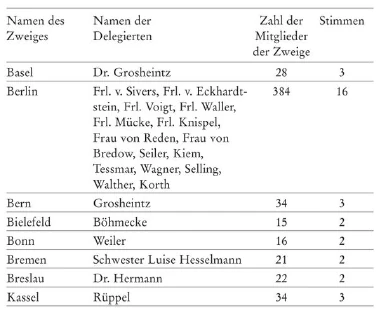
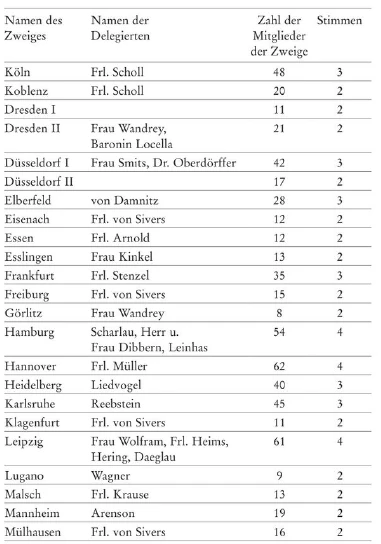
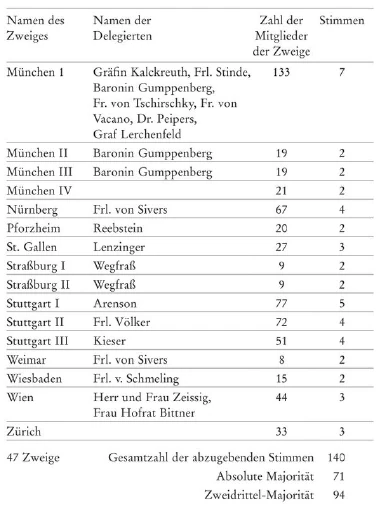
[ 3 ] The second item on the agenda was the reading of the minutes from last year’s General Assembly. A motion was made to waive the reading, since the minutes were included in full in the “Mitteilungen.” The motion was approved. This was followed by a report from the secretary, Miss von Sivers, on membership trends over the past year.
[ 4 ] The number of members in 1950 was about 1,500, compared to the previous year; 522 new members joined, compared to 415 the previous year; 63 members resigned or could no longer be located and were therefore removed from the rolls; 1 transferred to another section; and 8 died.
[ 5 ] Three new branches were established: the Görlitz Branch, the Vienna Branch, and the Klagenfurt Branch. Two new centers were formed: the Göttingen Center and the Wyrow Center. The total number of branches is 47, and the total number of centers is 3. Next is the financial report presented by the treasurer, Mr. Seiler.
Total revenue amounted to 7,546 marks
Total expenses: 6,255.61 marks
This leaves a surplus of 1,290.39 marks
In addition, bank balances of 2,020.45 marks
and movable property valued at 565 marks
result in total assets of 3,875.84 marks
[ 6 ] According to the report by the treasury auditors, Mr. Tessmar and Ms. Motzkus, the treasurer is granted discharge.
[ 7 ] Report by the Secretary General [Rudolf Steiner]:
[ 8 ] “I will try to keep the Secretary-General’s report as brief as possible this year, because we need the time for other matters; it is most gratifying that quite a number of our dear Theosophical friends have agreed to delight us with lectures during the course of this General Assembly.
[ 9 ] My first duty is, above all, to extend the warmest welcome to all of you who have gathered here—whether to see one another again or to get to know those who have recently joined our ranks— and to welcome you in particular on behalf of the Berlin Besant Branch, which always takes special pleasure in welcoming not only the various Theosophical friends of the German Section but also friends from abroad into its midst.
[ 10 ] It has often been emphasized on other occasions that such gatherings have a very different significance for us Theosophists than they might for any other association. When other associations meet, they find like-minded people who agree with them regarding this or that goal of external or internal life, regarding this or that question, in terms of activities, profession, and perhaps also regarding some ideal of life or the like. Theosophists, too, come together to find like-minded people—and, above all, to find in them bearers of our shared ideals; but it must be said that such a Theosophical gathering differs greatly from the gatherings of all other associations.
[ 11 ] When we look at the Theosophical Movement and consider what its core content is, we see the innermost essence and striving of the human soul—not a single activity in life, not a specific ideal, not anything limited by space and time—but that which springs directly from the realization that those gathered here feel and think together about what is most precious to them in life. That is what unites us. And to sense this in the souls of others, to see it realized in our friendly fellowship—that is what each of us welcomes. Just as other members of an association come together, knowing that they will find this or that in common with those they meet; so do the Theosophists come together, knowing that they may find within others the very innermost feelings and thoughts that they carry within themselves. This is what should pass through our gathering like a magical breath; and out of the awareness that such a spiritual, meaningful bond unites us, I warmly welcome you. We are not merely together as bearers of the Theosophical Movement; we are not merely together in some outwardly business-like sense; we are together insofar as we are Theosophists; and the shared feeling and shared experience of Theosophical ideas is the soul of our being together. It is from this soul of our Theosophical togetherness that I wish to speak as I address these opening remarks to you.
[ 12 ] Over the past year, it has once again become apparent within our German Section that our theosophical work has made significant progress. And when we ask ourselves whether we may look back on this progress in such a way that we can truly call it progress—and not merely rely on our feelings, but ask: “Do the facts indicate that our life is one of progress?”—then we must above all see how, everywhere within our theosophical branches, an inner life is beginning to stir more and more. Today, at the ninth General Assembly, following the conclusion of the eighth year of our German Section’s theosophical life, we may say that the inner life of the German Section has been realized in a broader sense.
[ 13 ] The German Section consists of individual branches, and these exhibit a vibrant inner life. When one looks into this life, one can characterize how it has taken shape only in very general terms. And one may say that it cannot be characterized more precisely than by stating that it has become an intense one. In particular, in certain branches, this inner life has even developed of its own accord, as in the Berlin Besant Branch and in several others, especially the Munich and Stuttgart branches. For we, as members of a branch composed of Theosophists, also engage in Theosophical undertakings that are not, so to speak, hastily instigated by the Theosophical Society itself, but which flourish out of the inner Theosophical life of the branches. These are the various events that go beyond the life of the local chapter, taking place in the so-called art and music rooms, where popular Theosophy is also practiced to some extent. This demonstrates how Theosophical life can be kindled everywhere, if we only try to speak to humanity in the right way. It would take us too far afield if I were to name all the members who have rendered services in this regard in a way that we cannot praise highly enough. In any case, I would like to express here my hope that these activities, organized in the art and music rooms, may continue and expand as much as possible. For it is through them that we will best be able to make a certain impression on our time, if we are able to have an impact on the outside world as well.
[ 14 ] The next step, of course, is the development of theosophical life within the branches; and I would have to speak for hours if I were to describe how intensely work is being done within the individual branches—through the gradual implementation of this inner work, as is already taking place in Berlin, Stuttgart, Munich, Cologne, and other places, so that individual members take it upon themselves to introduce theosophical truths to new members through courses. Such courses have been established, and it is certainly appropriate to express the hope here that, on the one hand, this system of courses taught by members be expanded as much as possible. On the other hand, however, it may well be stated that these courses should also be attended as much as possible, so that members who are still new and have not yet familiarized themselves with the basic tenets of Theosophy may do so. Significant progress will only be possible if such courses are established for members who have only recently joined. Progress can only be made if the opportunity to become acquainted with the wisdom of Theosophy is continually provided.
[ 15 ] But if the content bestowed upon us from the fountainhead of theosophical wisdom is to continue flowing to the members, then the younger members must ensure that they catch up on what was given earlier; otherwise, it would not be possible to proceed in the appropriate manner, and the older members would have to forgo anything new altogether. As a side note, I might add that this catching up should by no means be taken too lightly. And the greater the reverence for theosophical truths, the greater the possibility of a theosophical movement gaining ground within our culture.
[ 16 ] The vitality of this theosophical movement is evident even further afield. I specifically say “vitality”: A living organism is not merely alive when it, so to speak, draws in more and more new life within itself, but only when there is active life between its individual parts, when the exchange of vital fluids takes place between the individual parts of the organism. And it is precisely in this regard that we can say this has taken shape in the most beautiful way—that a kind of such exchange of vital substances is taking place among the individual parts. Time and again, members from the most diverse branches—not only from Germany but also from abroad—step forward to facilitate this exchange, so that through these theosophical courses, which have become established, mutual inspiration and the mutual exchange of impressions and feelings are fostered in the most beautiful way. It is therefore gratifying that every year we can report on several courses attended by Theosophical members abroad. I would like to mention in particular the course in Stockholm, where a number of members of our German Section were present; and it can be said that the interaction that unfolded between our friends in Stockholm and our members was a very lively one.
[ 17 ] Then, above all, in the course in Vienna, we experienced, so to speak, something that might be called the outward growth of our Theosophical movement. With this course, a vibrant—and hopefully ever-expanding—theosophical life has begun in Vienna, and, as it continues, it has deepened the foundations of Theosophy that had already been laid there by our friends for years. This has also been evident externally through the establishment of the Vienna branch. Thus, a link has been added to our work that will carry Theosophy eastward as well. Following the establishment of the Theosophical Branch in Vienna, a similar branch was also founded in Klagenfurt. And when we consider that the Czech Section was also established at our suggestion, we can note a gratifying outward growth of the Theosophical Movement. It would again take us too far afield here to describe in detail everything that our dear friends have done to carry this work eastward. Therefore, we have merely pointed out in general terms the highly gratifying fact that, with the Czech Section, the Vienna Branch, and the Klagenfurt Lodge, we are making significant inroads in the East. The Vienna Cycle has indeed shown that within the Theosophical Movement—with all that took place in terms of the imponderables, the indefinable—there is evidence of what might be called a subtle, intimate progress in humanity’s cultural striving, in the mood of feeling that is directed toward today’s cultural activities. It is, after all, characteristic of our time how modern people perceive the mood surrounding all cultural activity. When modern people are confronted with any form of cultural activity, they ask themselves: Do I understand it, or do I not?—If they do not understand it, they reject it. We encountered this particularly strikingly in Basel, where, on the occasion of a theosophical lecture, a feature article was written that began with the words: “The most striking thing about theosophy is its incomprehensibility.” This is precisely the intangible mood that modern people bring to cultural pursuits. This becomes particularly evident when one applies the quoted statement to another field. Imagine someone writing a feature article on mathematics that began in the same way; they would merely be characterizing their personal relationship to mathematics. Such a relationship is taken as objective today, and people believe they have said something meaningful—yet they have said nothing at all. For if someone has not engaged with mathematics, they simply know nothing about it and therefore cannot pass judgment on it. Thus, that feature writer reveals nothing other than his own stance toward theosophy. Thus, the only correct course of action would be to stop writing about it after such a statement. If people today have not understood something, well, then they have been bored; but that does not constitute a judgment on what has been presented. Yet this modern sensibility is gradually changing, and one may now dare to bring even difficult topics within the theosophical movement up for discussion. The Vienna course was, after all, a particularly difficult one, and if at that time there had been only people present who attached any special importance to the kind of judgment we have just described, then the Vienna course would certainly have remained fruitless. But it did bear fruit; and we were able to return home at that time with the beautiful feeling that even from the ineffable things, beautiful blossoms were springing forth to meet us.
[ 18 ] This became evident later on during the Hamburg course. It is always a difficult matter to discuss things that, so to speak, require a certain nuance of perception—at least for the time being—in order to understand everything that is given from the wellspring of theosophy. In principle, all of this is certainly comprehensible to critical reason and logic. But it would certainly take us a long time, and we would have to organize lengthy courses if all these things were to be verified through logic. And in a certain sense, it is certainly not to be dismissed when a sound sensibility forms a relationship to what is presented. There are souls who are more mature than they realize, who bring forth from the subconscious something of which they themselves are unaware. And then, the things that are highest in nature are the easiest to examine through logic, while those relating to practical personal life are the most difficult. It is far more difficult to find evidence that is convincing when someone seeks a connection between an obvious passion and an illness. This can, of course, be examined through logic. But there is a long way from what can be established through spiritual research to a convincing logical judgment. This is where subconscious reception comes into play, which manifests itself in a healthy sense of truth. This sense perceives the truth, which, while it could be proven, can also be accepted even before proof is provided. Such perception must be particularly assumed in courses of this kind. This will become increasingly possible, and it has indeed occurred in the courses mentioned. And one is taught how a different nuance of feeling and a different spiritual nuance—which were not previously present in the physical world—are now revealing themselves.
[ 19 ] Since we were able to point to a sort of new endeavor within our Theosophical Movement, perhaps I may also briefly mention to you some of the progress made in our internal activities this year. This brings us to Kristiania, where we were able to speak about the processes taking place in the life of the Earth. There, the national spirits—or Folk-souls—were discussed; we were able to speak about racial evolution and its course. In this way, this course could only be built upon the specified prerequisites. This also provided the opportunity to present something inner to our members in an outward form.
[ 20 ] This also happened in Munich, where, as part of our initial experiments, we were allowed to attempt something that was a direct translation of esoteric concepts into an exoteric artistic form.
[ 21 ] But then, following that, an attempt was also made to view the writings that have come down to us through humanity’s prehistoric wisdom in a broader light. This took place in the courses, which placed very special demands on the listeners. This was done in the Munich course and in Bern.
[ 22 ] It has been said of the Bern course that matters were discussed there that have value only at the moment they are spoken. This is, of course, something intentional and justified. At these two courses—the Munich and the Bern courses—one could experience that there was something within them that cannot be conveyed in writing. With this, we can once again note a certain degree of progress.
[ 23 ] I have already spoken much more than I intended, so I ask you to take this as a report on the inner workings and progress of our cause, and to forgive me for not specifically thanking, with all my heart, all those of our members who have participated in this inner work. It goes without saying that this gratitude is a heartfelt one from all of us.
[ 24 ] At the end of our seven-year period, we also have other developments to report, which we Theosophists always characterize differently than the outside world does. In this past year alone, we have noted that some of our oldest members—some who were particularly dedicated to the Theosophical cause—have departed from the physical plane. And when we commemorate these dear Theosophical members of ours, we think of them in such a way that we continue to regard them as belonging to us with the same affection and love with which we counted them among us while they were with us on the physical plane. By this we mean that for us Theosophists there is something that, while indeed counted among the most important duties of the heart even in the outer, non-Theosophical world, must, for us Theosophists, be imbued with a special dedication and a special infusion of the nuances of feeling and thought acquired through the Theosophical life. This is the sending forth of love, the sending forth of our best feelings beyond the physical plane, toward those who have left this physical plane. We should strive to develop such feelings—strengthened by theosophical sensibility—toward the departed. Through our theosophical progress, we should enable ourselves to send such feelings into the other worlds, so that we may constantly perceive the love, the truth, and the goodness we encountered in such members as ever-present, and thereby perceive these members themselves as ever-present, so that we speak of them as those who continue to walk among us, and whose presence becomes ever more sacred to us for the reason that what they can send us from that world must be of greater value to them than what they were able to give us on the physical plane. In this active way, we commemorate those of our dear members who have left the physical plane in the past year.
[ 25 ] In particular, we think of an older member who has been with us since the section was founded; this member is especially close to us because we are also close to this member’s brother, who is here as our dear friend, Mr. Wagner.
[ 26 ] Miss Amalie Wagner of Hamburg, whom many of us know well, left the physical plane earlier this year, and we will always look back on what she sought to do for theosophic life. Many of the Theosophists who were close to our dear Amalie Wagner held her work in the highest regard in their hearts and showed boundless love for this friend. And that was, after all, merely the beautiful reflection of the beautiful Theosophical striving within Amalie Wagner’s soul. And with reverence and sacred devotion, we commemorate an important moment in the life of Amalie Wagner. That was the moment when her sister—who, along with her, was a member of our movement in Hamburg—preceded her in death. At that time, I was able to experience firsthand the beautiful, loving understanding that Amalie Wagner’s soul brought to that event, which was unfolding with her sister’s passing. There I was able to receive Amalie Wagner’s view of her sister, held, so to speak, in genuine theosophical feeling. How Amalie Wagner looked up into the higher worlds to form mental images about the way a person continues to live in those higher worlds—much was spoken of this in Amalie Wagner’s dear, solitary living room. And now let us follow her in our thoughts as she, in turn, receives from above what is sent to her and, from below—from the physical plane—the feelings of love and reverence that we send her from here. We can already see two aspects of this soul today—how she lives both upward and downward, how a human being lives in the spiritual world when there was an impulse in her heart here to connect with what passes through our movement as a soul. And so we gaze in reverence and love upon the soul of this dear Miss Wagner, as if she were always present with us.
[ 27 ] Another long-standing member has left the physical plane—one whom few knew, but those few were people who held this dear member in very high regard; whenever they met him, they were once again struck by the soul of our dear friend Jacques Tschudy in Glarus, who had belonged to our German Section from the very beginning, a soul that commanded respect. He was met by a number of our dear members at the Swiss Theosophical gatherings. And if I may use a phrase in this context—one meant very seriously—I would like to say that the soul of this individual had such an effect that one simply could not help but love him. And anyone who has often witnessed how this man was loved knows that those who knew him will continually send this feeling to him in the spiritual world.
[ 28 ] Then another exceptionally ambitious member, who with vigorous energy sought to penetrate the exoteric and esoteric aspects of Theosophy, and who had only recently joined our German Section, left the physical plane. Our dear friend Minuth from Riga was present at the last Stuttgart cycle; he then reappeared in Hamburg, and by that time his outer physical body was already afflicted with the seed that would prevent him from living any longer. He was already unable to complete the entire cycle and soon thereafter also left the physical plane. To him, too, we will send up into the higher worlds those feelings that we not only had when we decided to become Theosophists, but that we have cultivated throughout our Theosophical life.
[ 29 ] We have seen yet another personality depart from the physical plane: the wife of our dear friend Sellin. You all know our dear friend Sellin from earlier Theosophical gatherings. While he was working in Zurich, his dear wife ascended into the spiritual world. Our dear friend understands his wife’s passing in the most wonderful way, and anyone who has been able to feel what Sellin himself feels toward the deceased knows how a theosophist should feel toward the dead in a genuine and beautiful sense. I would have to use words that depict, in the most vivid terms, the feelings that flow vividly upward into the spiritual world if I were to convey to you some of the beautiful words that were sent from the soul of our dear friend Sellin here on the physical plane to his beloved wife. But it is better, so to speak, if we evoke within ourselves only a glimpse of what can be expressed through something so beautiful, if we have not heard it ourselves. And anyone who, like me, has heard such beautiful words as those of our dear friend Sellin—words that bear witness to his truly beautiful, genuine feelings—anyone who has experienced this firsthand feels the need not to profane such beautiful words by uttering them. But I feel this need in my soul at this very moment: to awaken in your own hearts a sense of what beautiful feeling and beautiful inner experience are—for those who have physically passed away on their journey toward the spiritual world.
[ 30 ] Another prominent figure in Stuttgart has passed away from those close to her in the physical world; our dear friend [Frentzel] recently had to let his wife go to fulfill higher plans. When we see how we Theosophists are beginning to develop a true spiritual life, we need only think of our dear Mrs. Frentzel, who worked so beautifully on her soul to enter into the Theosophical life. Perhaps only those who were as close to her soul as I myself was can truly appreciate this. And so we may send up to our dear friend, Mrs. Frentzel, all that we have learned.
[ 31 ] And so we also remember another friend who, through a tragic turn of fate, has left the physical plane: Mrs. Hedwig von Knebel, whose loving devotion to the Theosophical cause was evident both to us when we were in Wiesbaden and to the people of Wiesbaden themselves.
[ 32 ] But then, with a special power, with a very special vitality, the image of a theosophical personality who recently left the physical plane descends to us from the higher worlds—a person who, with an intensity, an understanding, and a devotion that truly cannot be described in words, had for years devoted herself to the theosophical cause with everything she could—and she could do a great deal. I myself will always remember the moment after a Theosophical meeting when our dear Hilde Stockmeyer approached me for the first time to learn more about various aspects of what she had learned in Theosophy, which she had embraced with all the strength she possessed. On the other hand, she endeavored—and she was allowed and able to try many things—to combine what she had learned in Theosophy with the truth and goodness offered by external science. And it may be said that her comprehensive scholarship was able to bear fruit even in the external world, as she had passed her final exam shortly before her passing, to the satisfaction of the external world. Hilde Stockmeyer’s scholarship may be seen as the first thing she offered us as a beautiful gift of her personal values. What Hilde Stockmeyer, the chairwoman of the Malsch Lodge, was to us on the physical plane was defined by her abilities and by the way she applied those abilities. She was thus called to work fruitfully, and to what Hilde Stockmeyer acquired in this way through the development of her abilities, she added something else—a quality whose radiance affected those close to her—which, through its very effect, revealed to us just how fruitful genuine, true theosophical feeling can become here in human life. This is evident in the way her father, mother, siblings, and friends received news of her passing into the higher worlds. This, in turn, serves as further proof in this case of the effectiveness of Theosophy in human souls. It is proof in yet another way than was the case even with the others mentioned. In the cases of the others, there were always people in their immediate surroundings who had sought out Theosophy. In Hilde Stockmeyer’s case, even her parents acknowledged: “She brought Theosophy to us; she was sent to us.” The people who had preceded her on the physical plane—who had given her physical life—acknowledged what they could feel in response to what came to them from the higher worlds through their own daughter, about which they had to say: “We could not help bring this into existence on the physical plane; in this regard, we were merely the instrument.” And it is among the most beautiful sentiments ever expressed within our Theosophical Movement that Hilde Stockmeyer’s parents gave voice to the depth of their gratitude and appreciation for their daughter’s knowledge—the knowledge of the daughter who had brought Theosophy into her parents’ home. And this wonderful echo is what Hilde Stockmeyer’s parents send to their daughter, who has departed into the spiritual world. But we, in turn, should learn to send up to the higher worlds—especially for Hilde Stockmeyer—what can only be intuited in such matters. And it is clear to me that I can send no better feeling up into the spiritual worlds than by now sending up the very feelings of Hilde Stockmeyer’s soul itself, making myself an instrument of her soul for the beauty that our dear friend knew how to express out of a beautiful feeling while she was still here with us. In two short poems entrusted to me—written by our dear friend’s own hand and springing from her beautifully gifted spirit—she herself still speaks to us from the physical plane. How Hilde Stockmeyer felt about the eternal teachings of theosophy may resonate with us at this very moment through her own little poems. This is how Hilde Stockmeyer spoke while she was still alive; may her own words continue to resonate with us:
Are we really all alone?
Can one person never understand the other?
Can he never see into his heart?
Ease his pain?
I think that when love speaks to love,
Truly from the heart with a faithful face,
To ease the torments for love’s sake,
To lessen the pain with loving words,
Then I believe it could not be in vain!
Are we really so completely alone?
Aren’t there bridges to every heart?
Isn’t there balm for all pain?
When we gaze deep into each other’s eyes,
Without thinking of ourselves at all,
There’s no need even for words—
True understanding speaks silently!
Even to the most hardened of hearts
There is a path.
If you walk courageously along a wobbly bridge
With the single thought of being a helper
You will soon no longer be alone!
[ 33 ] Let us try, after her departure, to cultivate such feelings in our hearts that we may send them flowing back to her—feelings worthy of her own beautiful sentiments. And let us learn to feel as she herself felt, and as she expressed it in that other little poem:
I wish to be a pure source of blessing,
That always flows and never runs dry,
A heart full of courage I wish to call my own,
That never despairs, nor trembles in pain,
And I would let love flow through the worlds;
So that all living things may rejoice with delight.
And thus, giving, I would quietly sink into the cosmos,
Like a melody that softly fades away.
[ 34 ] Thus she spoke in life, and thus she departed from the physical plane. It goes without saying that we should strive to send her something just as precious as what she, foreseeing her own death, expressed in her final words—that last little poem. Anyone who knew Hilde Stockmeyer as well as I did knows that the death of this dear soul was this:
And so, giving, I wish to sink silently into the universe,
Like a melody that fades softly away.»
[ 35 ] The assembly honored the memory of the aforementioned individuals by rising from their seats.
[ 36 ] Third item: Motions from the floor:
[ 37 ] The first motion to be read aloud is the van Leer motion, Düsseldorf.
[ 38 ] Van Leer’s Motion: The proposer refers to the appointment of members of the Executive Committee who hold their offices for life. This motion was submitted and adopted to ensure continuity in the Section’s Theosophical work. This provides a safeguard against any biased efforts by new members who might simply seek to break with the legacy that has been built up. This motion is intended to further develop this concept by ensuring that, in the future, two individuals cannot arbitrarily admit as many members into the Society as they please; rather, the signature of the lodge chairperson should be required for every person wishing to join a lodge, in order to prevent what has been built up over the years from being ruined by biased new admissions.
[ 39 ] Dr. Steiner notes in this regard that the Executive Board decided at yesterday’s meeting to propose at the General Assembly that the admission certificate for new members must bear not only the signatures of two sponsors but also the signature of the chairperson of the respective branch, and that the admission certificate for Section members must in future be countersigned by the chairperson of the German Section. This would serve to prevent, in an appropriate manner, the very situation that forms the basis of the motion.
[ 40 ] Pastor Wendt states that if two thousand new people were to join the community, the existing members could simply form a new community.
[ 41 ] Dr. Steiner responds that this scenario must be prevented—that a society should not simply be forced to rebuild itself from scratch.
[ 42 ] Ms. von Sonklar notes that every member does, after all, have the right to propose new members, and that these two thousand people, too, could be converted.
[ 43 ] Dr. Steiner: “The point is that the other scenario—that two thousand new members who are open to conversion might not be admitted—cannot occur. They would, of course, be welcomed with the greatest satisfaction. There is absolutely no reason to assume that the slightest obstacle would be placed in the way of the new members to be admitted. The motion can have no other effect than to deprive these two thousand new members of the opportunity to undermine the theosophical work accomplished thus far.”
[ 44 ] At the request of Mr. Tessmar, the debate is closed and the matter is put to a vote. The motion is approved.
[ 45 ] The second proposal under consideration was the one submitted by Horst von Henning in Weimar, in which he suggested that the central building of the German Theosophists, originally planned for Munich, be constructed in Weimar instead.
[ 46 ] Regarding this motion, Dr. Steiner states: “A motion, as formulated in the manner in which it has been presented, cannot be a motion; it can only be an appeal, and can only be addressed to the assembly as such. For this is not an undertaking of the Theosophical Society, but rather a theosophical endeavor officially undertaken privately by a number of Theosophists. As you know, a number of our Theosophical friends have resolved to build a dedicated building for events such as those we held in Munich last year and the year before. I just want to say that the intention is to erect such a building as a kind of central facility in Munich. And hopefully, all those who are in a position to do so will contribute their share, ranging from ten pfennigs to a million. Hopefully, this will be one result of the work in Munich. Another result lies in the appeal.
[ 47 ] I have familiarized you with the contents of this appeal. It cannot be treated as a motion because it does not concern the German Section. The German Section is not a legal entity, and only those who actually contribute the money are building this central facility.
[ 48 ] The second point is a matter of fact. First, the appeal fails to take into account that we had intended from the very beginning to regard this as an entirely internal matter for Theosophists; therefore, only those artists who are Theosophists were invited. Therefore, the point emphasized in the proposal—that a city like Weimar has a large number of actors or excellent painters—is completely irrelevant; what matters is organizing the event in the city where the majority of artists are Theosophists. Moreover, choosing any location other than Munich would immediately contradict everything associated with the entire development of this idea. I would like to expressly emphasize that it does not matter whether I am against it or not; one must always take the actual circumstances into account. In principle, something may be correct, but in reality it is only correct if one also takes historical circumstances into account.”
[ 49 ] A question was raised from the assembly as to why Berlin was not being considered. Dr. Steiner replied: “For the same reason that Berlin was not chosen back then, when we wanted to organize the Congress of European Sections. For the reason that such an undertaking requires such a colossal amount of work from the members that those who are not involved have absolutely no mental image of the extent of it. Now, however, the members in Berlin are occupied all year round with the affairs of the German Section, and practical circumstances have simply shown that the Berlin members would, so to speak, collapse if they also had to take on this work. Something like this could only be done in Berlin if the members were relieved of the leadership of the German Section. But since this leadership is best kept in Berlin, it goes without saying that another city was considered for this purpose. I certainly find Henning’s motion extremely appealing, but when one considers the actual circumstances, one must simply say that it is not feasible. In addition, however, there is an inner reason to consider, one that corresponds to an occult law; and that is that places which have already experienced a period of flourishing are, in fact, not fruitful for later epochs. The appeal specifically wants to choose Weimar precisely because the flowering of German spiritual life has already developed there once before. In Weimar, archival work can only develop in the present. Societies are founded there to commemorate and elaborate on what has already existed. That alone would argue against Weimar; the very greatness that emanates from Weimar would resist our plan, and we would not be able to succeed.”
[ 50 ] Miss Stinde adds: “The address to which funds for the construction can be sent is: To the account of Miss Marie von Sivers and Miss Sophie Stinde, Deutsche Bank, Munich.”
[ 51 ] The third motion, submitted by Ms. von Sonklar of Berlin, concerns the regular publication of the “Mitteilungen” four times a year and the expansion of the journal.
[ 52 ] Miss von Sivers notes in this regard that a decision to publish the “Mitteilungen” regularly, four times a year, was never made; rather, they were to be published only when sufficient material had been received from the local branches. The “Mitteilungen” were intended to deal only with the internal affairs of the German Section. Incidentally, one could generally observe that the more work is done, the less is reported about it. For those members who were unable to attend the courses, extensive study material was now available in the form of the duplicated lecture series.
[ 53 ] Mr. Scharlau expressed financial concerns about publishing the “Mitteilungen” four times a year. In response, Ms. von Sonklar proposed turning the “Mitteilungen” into a magazine in order to cover the costs through subscriptions.
[ 54 ] Mr. Tessmar objects to Sonklar's motion and proposes that the “Mitteilungen” continue to be published as needed, as they have been. This motion is approved by the assembly.
[ 55 ] After a brief debate, Mr. Walther moved to reject Sonklar’s motion to expand the “Mitteilungen.” The motion was rejected by a vote.
[ 56 ] No other motions have been submitted.
[ 57 ] Dr. Steiner presents the Executive Board’s urgent motion to reschedule the General Assembly for the turn of the year.
[ 58 ] After a lengthy and lively debate, Mr. Arenson moved that, for the time being, November be considered as the date for holding next year’s General Assembly. This motion was approved.
[ 59 ] Dr. Steiner then reads aloud a welcoming telegram from the Italian Section and announces that the Congress of the European Sections of the Theosophical Society will take place next year—that is, in 1911—beginning on September 18 in Genoa.
[ 60 ] Fourth item: Reports from the various branches. Two reports have been submitted; given the late hour, it was decided not to read them aloud and instead to publish the reports in the next issue of “Mitteilungen.”
[ 61 ] There is no material available regarding the fifth item, “Miscellaneous.” Dr. Steiner thus concludes the business portion of the meeting and announces that the substantive theosophical portion of the General Assembly will begin at 5Y o’clock.