

Difficulties of Living Together
in the Anthroposophical Society
The Dornach Crisis in the Summer of 1915
GA 253
16 September 1915, Dornach
Translated by Steiner Online Library
7. The Psychoanalytic Worldview in Light of the Spiritual Science's Understanding of Human Nature
[ 1 ] My dear friends! Today I would like to add just a few more thoughts to yesterday’s reflections and, if possible, begin a new topic tomorrow.
[ 2 ] I have emphasized that a key aspect of understanding the world in the broadest sense—that is, the world in general, the individual human being, human coexistence, and so on—as well as of grasping the interrelationship of facts, lies in finding the correct perspective in every situation. The root of many, many errors is, after all, the belief that one can arrive at the truth through mere logical deductions starting from any arbitrary point of departure. But if one truly wants to understand a matter, the first step is to work one’s way toward the correct perspective. This struggle to arrive at the correct perspective should actually be understood as the true essence of studying. Many mistakes are indeed made because, in the pursuit of knowledge, one simply approaches a subject and, as I said, examines it from any arbitrary starting point.
[ 3 ] In recent days, we have turned our attention to a particularly abhorrent ideological current: the psychoanalytic one. One can use this term here without falling into subjectivist considerations. This psychoanalytic worldview—as we have recognized—is not, however, abhorrent because of its starting point—for this is, in fact, one that, if handled correctly, could lead to entirely correct results—but rather it becomes abhorrent because of the way in which the people who engage with it inject their own particular feelings and sensibilities into it. Because the subjectivity of the people who engage with it is introduced into the theory, this psychoanalytic theory, as I have put it, “spills over” into sexualism.
[ 4 ] But if a person who is familiar with the principle of first finding the correct perspective in every situation were to familiarize himself with the starting point of psychoanalytic theory and then proceed from there, such a person would arrive at entirely different conclusions. In fact, starting from psychoanalytic theory, such a person might proceed in such a way as to initially introduce certain materialistic pretensions into psychoanalytic theory. Then he would find that the distinction between the conscious and the unconscious naturally compels one to take purer, nobler paths of knowledge, because he recognizes the introduction of the perspectives we have discussed as arbitrary emotions of a subjective nature and not as something objective.
[ 5 ] That is, in fact, the significance of true study: that one is usually led beyond the starting point, that the subject matter drives one forward, rather than one imposing one’s own subjective impulses onto it.
[ 6 ] You see, my dear friends, this principle is one that gradually reveals itself to the true student as a necessity—and it is indispensable if a worldview based on Spiritual Science is to be realized today, and it is also indispensable for the structure of a society in which a worldview based on Spiritual Science is to be cultivated. We must come to take the tenets of the Spiritual Science worldview truly seriously and with dignity; that is to say, we should not repeatedly carry over what we previously regarded as our subjective habits into the realm of the Spiritual Science worldview, but rather allow ourselves to be guided by the principles of that worldview. For example, in everyday life, a person may have the habit of being late everywhere, of failing to arrive on time at the appointed hour. In ordinary, philistine life, the habit of being late is not exactly pleasant, and may not even be advantageous for the progress of one’s tasks; in the Spiritual Science movement, however, the very way one takes the truths of Spiritual Science to heart should make it impossible for the soul to cultivate such a habit unless it corresponds to an urgent necessity.
[ 7 ] So much has been said these days about seriousness and dignity—not only in Spiritual Science but also in our social life—and we have seen how necessary it is for us, as a society, to set ourselves apart. Of course, it is a matter of outward decorum that one should at least take the small precaution of arriving on time; nevertheless, even these days—although the lecture began 20 minutes past six—some individuals have once again arrived late. And in this way, my dear friends, we will never succeed in realizing the concept of society to the extent that we can, in a word, begin sensibly. For if we cannot be certain that, once we begin, no one else will arrive, then—given the somewhat more expansive nature of our social circles—we can never protect ourselves from the possibility that, here and there, unauthorized individuals who do not belong will once again find themselves among us. Consider, after all, that it is inconsiderate to arrive late in a society when that society, on the other hand, ensures that truly everyone who enters belongs there. To achieve this, however, certain members must make sacrifices and monitor the entry of members until all who belong to the society are present. Once those who are monitoring have entered, the door must be closed, and everyone should be there.
[ 8 ] You see, my dear friends, it certainly should not be necessary to discuss such things specifically; but the worldview of Spiritual Science must be based on the concept of symptomatology. “Symptomatics” here means that whatever a person does on a small scale, they will be very inclined to do on a larger scale as well. Anyone who cannot even bring themselves to arrive on time for meetings will also, when it comes to larger matters where something significant is at stake, fail to develop the sense of duty that is necessary. A large part of the damage that has come to light in such a glaring way is intimately connected precisely with not taking things seriously enough, with not taking them clearly enough. It is truly important that we, in the same spirit as has just been discussed, also take the work of Spiritual Science—if I may put it that way—seriously ourselves. Therefore, it is also an illustration of what Spiritual Science demands of us when we bring such matters of the most ordinary life to mind in the context of a Spiritual Science society.
[ 9 ] If we now strive to find the correct perspective on the matters we have discussed in various aphoristic ways in recent days, we must first and foremost bear in mind that, in the entire structure of the world, in the entire order of the universe, we are dealing with the self-revelation and self-manifestation of the true essences that lie hidden from our knowledge behind the world as it appears to us.
[ 10 ] These entities, my dear friends—as will become clear to you from many of the reflections that have been made—are in a state of constant inner motion, truly in a state of constant inner motion. At this moment, I am not referring to any single movement in particular, but rather to inner motion in the broadest sense. However, we must familiarize ourselves with the concept of a certain complexity in this inner movement if we are to understand how to conceive of the relationship between the entities lying behind the phenomena and the phenomena themselves. Let us take an example that we can choose because it is already familiar to us from previous considerations in Spiritual Science.
[ 11 ] We know that human beings began their initial physical development during the ancient Saturn era, continued it during the Sun era, and added etheric development to it, and so on. Now the question is how we should actually view what we understand as the physical development of the human being within the Saturn epoch in relation to the entire constitution of the worlds. It would be entirely wrong, my dear friends, for anyone to look at the physical nature of the human being today and believe that, if they have a mental image of it that is sufficiently primitive and simple, they have a picture of the ancient Saturn physical nature of the human being. You will understand me best regarding this question when I say: Anyone who believes they can find anything in today’s physical world, on today’s physical plane, that even remotely resembles the physical nature of human beings during the Saturn evolution would be very much mistaken. What the human being was as a physical being during the Saturn evolution cannot be found today in any form or fact of the physical world. In order to recognize the physical nature that the human being possessed during the ancient Saturn era, we must exert much greater effort within our soul-spiritual nature, which has freed itself from the physical-etheric.
[ 12 ] Let us first schematically describe the world through which we can understand the nature of what existed as the first physical structure during the ancient Saturn era—as a world of knowledge for physical human nature on Saturn [it was written on the board]:
[ 13 ] The realm of knowledge for the physical human nature on Saturn.
[ 14 ] For now, I will say nothing more than that human beings must emerge from their physical bodies and, even after they have done so, must undergo a higher stage of development in order to be able to observe and comprehend those forms that correspond to the physical nature of human beings during the Saturnic era.
[ 15 ] Let us now consider human physical nature during the Solar Age, which is thus already a further development of human physical nature during the Saturn Age. This physical human nature during the Solar Age, too, cannot be grasped with the faculties of perception of today’s physical human being; rather, one must enter the spiritual world to understand it—though one need not have reached the stage of development necessary to comprehend physical human nature during the Saturn Age. So we can say: A somewhat lower level of understanding of the relationship between the world and the human being allows us to glimpse the physical nature of the human being during the Solar Age. And we can then say [it was written on the blackboard]:
[ 16 ] The realm of knowledge for the physical human nature on the Sun.
[ 17 ] If we now wish to consider physical human nature as it developed during the Lunar Age, then, my dear friends, we must descend to an even lower level of insight. The moment we are even able to perceive without the body, we already perceive that which corresponds to physical human nature during the Lunar Age. So we can say: A third stage in humanity’s relationship to objectivity is [it was written on the board]:
[ 18 ] The realm of knowledge for the physical human nature on the Moon.
[ 19 ] Let’s continue. We now come to the physical nature of human beings during the earthly stage. We do not need to step outside our bodies at all. We perceive this through the physical organs of perception that we possess on the physical plane, on Earth. This, then, is the level of knowledge that is natural to human beings during their earthly existence, so that we can say [it was written on the blackboard]:
[ 20 ] The realm of knowledge for physical human nature on Earth.
[ 21 ] And now, my dear friends, we have simultaneously considered four levels of the realms of knowledge, which are also referred to as [it was written on the board]: “physical plane”; “world of the soul” or “astral plane”; “Spirit Realm” or, as it has become customary to say, “Devachan Plane”; “Higher Spirit Realm” or “Higher Devachan Plane.”
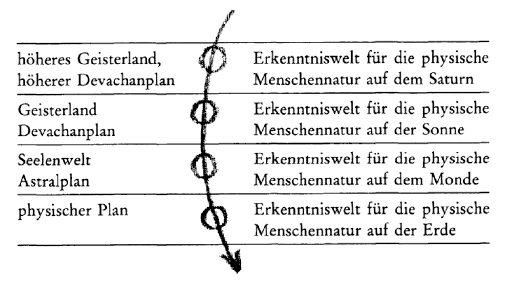
[ 22 ] If you follow the discussion we have just had, you will be able to say to yourself: Well then, we must place the physical human being of the Saturn era up here, that of the Sun era here, that of the Moon era here, and that of the Earth era here. The small circles have been drawn. This is not a contradiction to the familiar concepts, but is already quite clearly indicated in my *Secret Science*. There I explained in detail that what is called physical human nature on the Moon is not to be observed on the physical plane, but rather higher up, and so on. You will find all of this explained there very clearly.
[ 23 ] Today, however, we can say: Human beings have thus descended. [The line connecting the small circles was drawn.] In the course of his development as a physical human being, he has indeed descended. It is also an ancient principle of Spiritual Science that human beings—insofar as we are speaking of today’s physical human nature—are descending spiritual beings. But this means nothing other than that, when we look at our physical body, we must say to ourselves: Just as we see it today, during our time on Earth, everything that can be seen of it today is that which has descended the farthest.
[ 24 ] But there is also something hidden within the physical body. There is something hidden that is actually of a lunar nature; something even more deeply hidden that is of a solar nature; and something even more deeply hidden that is of a Saturnian nature. Thus, within the manifest physical body, an inner character and inner essence are hidden. The physical body is, so to speak, only one-quarter visible, for the other three-quarters lie hidden behind it. They are of a nobler, more spiritual nature than what we encounter in human beings on the physical plane.
[ 25 ] So when we consider anything about the human being—insofar as the human being appears to us today on the physical plane as a physical being—we must tell ourselves: These physical organs are in a process of inner movement, a process of descent, a process of development from the spiritual toward the material. We are therefore obliged to view any organ we observe in a human being in such a way that we say: As it grows and flourishes, as it takes on precisely the form that befits it on the physical plane, it is on the descending path of development. It descends from a more spiritual to a more physical, more material nature.
[ 26 ] Therefore, when we find something in a person that needs to be judged in terms of their character, we must also set ourselves the rule of finding the correct perspective. And we are led to the correct perspective when we become aware that human physical nature is, in a certain respect—namely, the one I have discussed today—descending. This, however, compels us to view, for example, a child’s development into adulthood in such a way that childhood development is still more spiritual, whereas mature human development is more material—that is, a descent from the spiritual to the material has taken place. From any other perspective, one cannot understand human physical development at all. One can only understand it by becoming aware that a descent of the physical human being takes place during growth and development, that insofar as the human being grows, a spiritual element descends deeper into the material.
[ 27 ] Just as it is with human beings, so it is out in the world. We can visualize this if we consider that we also speak of evolution out in the world. For example, we say: There was an ancient Indian cultural stage that evolved into the Proto-Persian, the Egyptian-Chaldean-Babylonian, the Greek-Latin, and our own cultural stage. But at the same time, we know that the older cultural stages continue to exist alongside the newer ones. We have even demonstrated this with regard to language. An older cultural stage continues to exist alongside the newer one. Applied to human beings, this can make it clear to us that in humans—insofar as they are physical beings—the organs can also be viewed in such a way that, on the path of descent, some are the most advanced, while others, less advanced, still reflect earlier stages.
[ 28 ] We will gradually see—I want only to hint at this aphoristically for now—that, according to this principle I have just outlined, we can consider two organ systems in human nature.
[ 29 ] If we first consider the human senses—all the organs a person possesses for sensory perception—we can say: The sense organs, since we are dealing with the physical here, exist on a certain level. But for us, this means that the spiritual has descended, has flowed down, to a certain level. Let’s sketch this schematically [it was drawn on the blackboard]:
[ 30 ] We said that the whole of human nature is a downward flow [red]; now let us designate the level of this downward flow at which the senses are situated with this blue. Within the downward-flowing current—which flows in this direction [arrow]—we designate the senses with this blue. Thus, we shall regard everything that constitutes the organs of the sensory world as situated at level a in this downward flow.
[ 31 ] If we consider another organ system, we have, for example, the respiratory system—the entire respiratory system. We, too, will only be able to view this from the correct perspective if we examine it at the level to which the human being has descended. And as we gradually expand these observations, we will find that the respiratory system has now descended as far as b. Thus, the sensory system has descended to a, and the respiratory system to b.
[ 32 ] Now you can create a mental image of this downward slide going even further. So there could be an organ system that has slid even further down: an organ system c. And this organ system would be the one that serves sexuality:
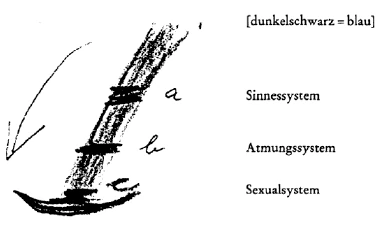
[ 33 ] If we now consider the physical human being, my dear friends, we find that at the time when the descent reached a certain culmination and an ascent—which we cannot discuss today—began, one that is connected to the descent, the descent had progressed up to this point [see drawing, the arc below]. The descent on Earth did not proceed any further than that. From this, however, you can readily see that the human sense organs are, in relation to the respiratory organs and so on, more spiritual organs. And since a clear, distinct insight—as we shall increasingly see—teaches us that the sexual system represents, so to speak, the lowest level, we can conclude from this that everything else a human being possesses in terms of physical human nature is more spiritual than this system.
[ 34 ] Now you might say: That would be easy enough to understand. — Perhaps; but what is important for us now is to realize that the abominable worldview of psychoanalysis has been unable to recognize this fact, which I have just stated. For what does psychoanalysis do? It says: Everything a person does—even the experiences of a mystic—are transformed sexual forces. —That is to say, the psychoanalyst—or the materialist in general, as we might say in this case—takes sexuality as his starting point and explains everything else about human beings as transformed, reshaped sexuality. I have already hinted to you how, in Freudian theory, everything that occurs in human life is explained as transformed sexuality. For example, the fact that children suck on a pacifier is explained by the fact that this expresses a somewhat infantile form of sexuality, and so on.
[ 35 ] But what is the truth? The truth, my dear friends, is that all human activities are more spiritual than sexual life, and that, in order to arrive at the correct perspective, one must take the opposite approach. Thus, one must say: Any attempt to bring sexuality or eroticism into connection with any human activity in order to explain it is entirely the wrong approach. The only correct approach is to explain sexuality through the transformation of humanity’s higher activities into the lowest things on earth.
[ 36 ] Since we have to deal with these matters anyway, let’s take one of the most horrifying claims made by the psychoanalyst—namely, the claim—one simply has to mention such horrifying things, my dear friends, we must, because they do occur in our time today—so the claim that the relationship of the son to the mother, of the daughter to the father, as it appears in childhood as love for the mother, as love for the father, is a sexual relationship. For the psychoanalyst says that what the little daughter feels for her father, and the little son for his mother, is a sexual relationship, because the father is actually always regarded by the son as a rival; the son is unconsciously jealous of him; likewise, the daughter is jealous of her mother. - This is, so to speak, one of the most appalling excesses of psychoanalysis. You know that literary works such as the Oedipus myth are interpreted in the writings of psychoanalysts on the basis of these psychoanalytic premises.
[ 37 ] Well, the correct perspective is this: What gives rise to sexuality in later life? It arises when something more spiritual descends. Later sexuality is thus a descended, childlike-spiritual quality. And the correct perspective is this: above all, one must not in any way—neither consciously nor unconsciously—confuse that which is not sexual with this realm; one must be clear that sexuality cannot yet exist in a child. And only when one is fully aware of this will one find the correct perspective from which to view the matter. This is also an extraordinarily important point in pedagogy, for the greatest misconceptions arise when certain forms of childish misbehavior are automatically reinterpreted as some kind of premature sexuality; these may stem from something entirely different than the idea that a child’s nature inherently possesses anything sexual. To claim that a child’s nature already possesses something sexual would be tantamount to claiming that today could already contain within itself all the rain of a future day.
[ 38 ] This, however, best illustrates what we are dealing with here: namely, the assertion of a completely inverted perspective. But when one arrives at such an inverted perspective, it cannot happen in a natural, self-evident way; rather, it must be arbitrarily contrived through human instincts. The entire psychoanalytic perspective is colored and nuanced by people’s basest instincts; in it, the world is turned upside down. The interpretation of the relationship between a young daughter and her father, or between a young son and his mother, in the psychoanalytic sense can only arise when the researcher’s subjective instinctual life is intermingled with the objective course of the investigation. It follows that, if one proceeds with strict precision, one may also use here such expressions as are applied to the subjective aspects of human activities, without thereby departing from the standpoint of objectivity. To apply subjective terms and expressions in a wholly objective science would be folly. Suppose, for example, that someone held the view that the hands of a clock are driven forward by little demons sitting inside it; we could say: That is folly. The clock is a mechanism, for there are no demons inside it. But we are operating in the realm of the objective and would never be allowed to say: “The person who attributes little demons to the clock is insulting the clock.” However, when the psychoanalyst interprets human nature in such a way that he attributes this kind of sexuality to the childlike nature—as the psychoanalyst does—then the subjective aspect of instincts truly intrudes into the theory. Therefore, it is justified here to use subjective expressions and to say: The psychoanalytic worldview is one that denigrates human nature. And we must strive to practice truth and call things by their proper names. And only when a sufficiently large number of people realize that in today’s materialistic world there are a number of people who have made it their mission to cultivate a theory—not only about individual human beings but about human nature as a whole—that denigrates human nature —and, from a scientific standpoint, insults it to such an extent that this scientific theory itself is nothing but a collection of insults—only then, when people come to realize this, will they appreciate psychoanalytic theory in the proper way. Then people will no longer quibble over words but will focus on the substance of the matter in this field. And that will be a path to achieving clarity precisely in this area.
[ 39 ] Only when one has recognized everything that has been analyzed today may that which has been recognized coalesce into the impulse to curse. For if one calls psychoanalytic theory a “theory of filth,” that is an insult, but this insult must be one to which one is driven by the objectivity of the matter itself, to which one is compelled by one’s own insight. The criticism must not, in turn, stem from subjective instincts.
[ 40 ] But that is precisely what is peculiar about Spiritual Science: that what appears to be merely abstract theory is transformed into feelings and sensations that are then justified. Anyone who struggles to understand what psychoanalysis actually is may, without betraying objectivity, call it a filthy theory. Just as one may, with objectivity, call a canvas white and charcoal black, so one may call psychoanalysis a “filthy theory.” This is merely a technical term derived from human nature itself, one that has taken shape from the understanding of what human nature actually is.
[ 41 ] To deepen our concepts—and not only our concepts, but our entire nature—that, my dear friends, is the task of the Spiritual Science worldview. And now consider this: when we speak of a society—which is to serve as the instrument of the worldview of Spiritual Science—as having to be an organism, then there must be something within it that reveals that the feelings expressed there have truly developed out of the worldview of Spiritual Science, so that even such a radical statement as the expression “filth theory” can only be uttered if it is grounded in the worldview of Spiritual Science, if one does not project one’s own instincts into it.
[ 42 ] Well, there will be all sorts of things to say in connection with these matters—and indeed, they will be said in the near future.