

The Occult Movement
in the Nineteenth Century
and its Relationship to World Culture
GA 254
19 October 1915, Dornach
Translated by Steiner Online Library
Sixth Lecture
[ 1 ] If you take a moment to reflect—by which I mean more of a summary review, without going into the details—if you take a moment to reflect on what I took the liberty of discussing here before you in my recent lectures and reflections, you will see that the course of development which the Spiritual Science worldview movement has had to take imposes certain responsibilities—significant responsibilities—on those who feel a sense of responsibility toward this Spiritual Science worldview. For you have surely been able to gather from the reflections of recent times that great difficulties arise for human beings—a different kind of difficulty than one usually encounters in life—in finding their bearings and walking a true, straight path.
[ 2 ] Isn’t it true that, in life on the physical plane, we are in many respects protected from straying in one direction or another? I drew attention to this protection many years ago, when I gave some descriptions of the problem of the Keeper of the Threshold, which have since been supplemented over time. Even in the early essays that have been incorporated into the book *How Does One Gain Knowledge of the Higher Worlds?*, one can see how human beings on the physical plane are protected from straying too easily in one direction or another, both intellectually and morally. Isn’t it true that we enter life in such a way that, in the course of our childhood, we are, so to speak, endowed with guiding forces for life? We know full well that, fundamentally speaking, we do not awaken to the free exercise of our power of judgment until later in life.
[ 3 ] Observe a child for a moment and compare its inner life with that of an adult. Then you will see that, in a certain sense, you can indeed perceive a nuance in the difference between a child’s life and that of an adult, in that you can say to yourself: a person grows from a certain twilight existence—which they lead during childhood—into the free exercise of their judgment in later years. It is truly a matter of grasping this nuance of life clearly.
[ 4 ] If one focuses too much on the child as representing the entire course of human life from birth to death, one might pay too little attention to this metamorphosis of the inner life of the soul. But it is important to engage with it, because during the time when our power of judgment has not yet fully awakened, it is precisely those influences that can reach us which will then guide and direct us in later life. We must, so to speak, remain in a state of twilight regarding our own free power of judgment during the first years of life, so that certain guiding forces may enter our intellect and our moral impulses, so that we do not crystallize too early the forces that are given to us for life, that are infused into our being—I do not wish to say incorporated. In this way, we have something for our entire life; in this way, we truly orient ourselves throughout our entire life according to such intellectual and moral impulses that have been instilled in us.
[ 5 ] In a certain sense, as we now draw closer to the concepts of the spiritual worlds, we become freer. It has often been said—and must often be said—that this entry into the spiritual worlds is, in turn, a kind of awakening from the ordinary state of life, from ordinary living conditions; that is, it is a nuance in the metamorphoses of life similar to that from childhood to the ability to exercise judgment.
[ 6 ] However, this does indeed make it very easy for us—when we take in the Spiritual Science worldview conceptually, as we should—to see the firm direction of life that we previously had begin to waver. It is therefore a matter of bringing together the whole human being that has been instilled in us as we enter into an understanding of the spiritual worlds, because we need this capital of life—instilled and animated within us through childhood—all the more when we approach those things that are to be revealed to us from the world beyond the threshold of life. And I showed you how easy it is to stray here or there under the natural influences of the various currents of the times. For such straying—as is the case, for example, in Sirnett’s *Esoteric Buddhism*—arises because the powerful impulse of materialism can act upon people’s souls; I say: can act upon them.
[ 7 ] Just as, because of the presence of Orientalizing influences, it was possible to stray in the direction of actually denying and slandering the entire nature of the present-day Moon, so too, on the other hand, we can stray and see the possibility of straying in that certain people have an interest in preventing the truth about repeated earthly lives from coming to light. The one—and in this case it is not Mr. Sinnett, but the one who stood behind him—who has an interest in shaping human life on Earth in such a way that materialism is, as it were, further materialized, introduces something like the doctrine of the Moon into an otherwise true system and thereby diverts the true system in a certain direction.
[ 8 ] Now, we know that Western culture, along with its American offshoot, has been strongly influenced by Christianity over the past few centuries. I have endeavored to show that “Christianity” cannot be understood solely in the way it is understood today. Much will only be understood in the future, and we ourselves are only just beginning to grasp some aspects of the mystery of Golgotha. But the influences of Christianity are real; they are at work even when people do not yet understand them. However, in past centuries they had to operate in such a way that a portion of the general truths of the world—which is quite compatible with Christianity—was excluded. But people’s insight was not sufficient to clearly grasp that it is indeed compatible. That which relates to repeated earthly lives was excluded from Christianity. And thus a Western culture and a new generation in America have emerged, with a form of Christianity that has excluded certain elements, such as the doctrine of repeated earthly lives.
[ 9 ] I have now shown how certain occultists have endeavored to carry this on in their own way, how they sought, in a one-sided manner, to do everything in their power to preserve this long-established view of Christian impulses—a view that has ruled out the truth of repeated earthly lives. I have pointed out certain occultist movements, such as those associated with the High Church. These were by no means uninformed people. Indeed, one can say that they were much better trained in the occult than the leaders of the Theosophical Society. But they were determined to further eliminate the doctrine of repeated earthly lives; and this is connected with the fact that they denied that human beings—as I have described in *An Outline of Esoteric Science*—do indeed enter into a relationship with the other planets of our solar system in the course of their earthly evolution.
[ 10 ] The forces that are implanted in the human soul are primarily connected to humanity’s share in the extraterrestrial cosmos; and it is precisely this aspect of the human soul’s connection to the extraterrestrial cosmos that certain quarters wish to keep people in the dark about. They wish to distract them from the awareness that the soul is connected not only to earthly beings and earthly events, but also to what lies outside in the cosmos—such as the light shining toward us from the other planets in our solar system.
[ 11 ] Primarily, the impulses emanating from the other planets of our solar system, by acting upon human beings, possess the power to snatch the soul—as a living soul—from physical death. This is their primary concern, as you can see from the descriptions of life between death and a new birth that I have provided in various contexts and from various perspectives.
[ 12 ] But if you look back at the development of humanity, you will see that it was precisely during those times when atavistic insights—clairvoyant insights, as it were, inherited from ancient times—were still present that people turned their gaze toward the other planets in our solar system; and astrology—which has become such a questionable science in our time—played an immensely important role in ancient times.
[ 13 ] Why, we might ask, did astrology cease to play this role? Because, in order to give Christianity time to become rooted in earthly life, the gaze of the souls had to be diverted. Just as the clairvoyant gaze had to be diverted from the imaginative world, so too did the gaze have to be diverted from the impulses emanating from the planets of our solar system. What remains of astrology consists entirely of ancient traditions. I have spoken about this on several occasions. In a sense, we can say: ancient clairvoyance, as well as the ancient perception and knowledge of the impulses emanating from the planets of our solar system—all of that was restricted. Humanity was confined to our merely perceptible world, to its senses, with which it was to see only what takes place on Earth, so that the impulses from the Mystery of Golgotha might grow strong, so that they might be imbued into the souls and feelings of the believers, so that people might internalize them.
[ 14 ] For in ancient times, clairvoyance was, after all, an innate ability. One did not need to acquire it; one possessed it as part of one’s genetic makeup. Just as we have eyes and ears today, so did people in those days possess clairvoyance. But the time is approaching when people will increasingly have to acquire it anew. To this end, people first had to be cut off from the spiritual world and confined to the external mineral world, so that everything could be rebuilt from within. Thus, what was once perceived from the outside must now be built up from within. Let me illustrate this schematically for you.
[ 15 ] Create a mental image of a person with the ancient clairvoyant gaze. They directed their gaze—I will use the eye as a representative of the clairvoyant gaze, although the clairvoyant gaze is not bound to the eye—out into the stellar sphere and saw within it the various spiritual impulses emanating from it (see drawing).
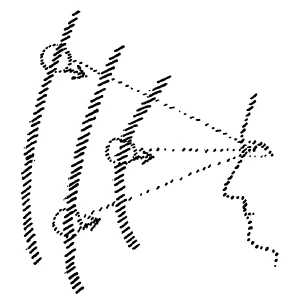
[ 16 ] Then, over the course of time, this clairvoyance faded away, and human vision became limited to earthly life. Something else had to take the place of the former clairvoyance. We could now describe what had to take its place as follows. We could say: What had formerly come from the outside to the inside now had to go from the inside to the outside. Human beings had to learn, as it were, to project outward once more what heaven had implanted within them, so that they might rediscover their connection with celestial phenomena.
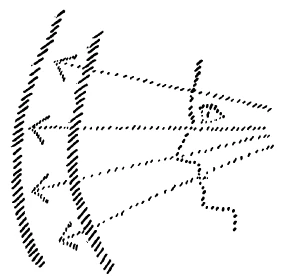
[ 17 ] It was precisely the opposite path that had to be taken. It is truly the case that human nature is currently, at this very moment, undergoing a reorganization. It has passed, I would say, through the point of utter darkness, and one expression of this is what I have called the deluge of materialism in the 19th century. But a new phase of life is already taking shape for humanity. If we wish to characterize this from an occult perspective, we can say: in the past, people did not merely perceive and think with their physical body, but they perceived and thought with their etheric body. What was perceived in the etheric body became conscious in the astral body as astrology; today, in astronomy, everything is calculated. Now the etheric body must be reanimated, and this is connected with the etheric reappearance of Christ. As the etheric bodies are reanimated, they behold Christ. But you see: a reanimation, a vitalization of the etheric body must take place.
[ 18 ] You can make some very strange discoveries there if you really delve into things. The whole sense that human beings have an etheric body has disappeared; in its place has emerged the feeling that human beings have only a physical body. But you would be quite mistaken if you thought that this view—that human beings have only a physical body—is actually very old. It is not that old at all. If this restriction to the physical body was indeed brought about by the deluge of 19th-century materialism, then, you might say, people must have had some inkling beforehand of the etheric body that had gone into hiding and is now reemerging. Well, I could give you plenty of evidence that people really did know something about the etheric body—that they possessed a knowledge which existed and has now gradually been disregarded. I could cite many passages from older works. But I want to read just one passage to you from a book published in 1827. On page 208, you will find a remarkable passage. I will read it very slowly so that, as I read, you can notice how differently people write about these things today, under the influence of a worldview that has become entirely materialistic.
[ 19 ] “People mistakenly associate the concept of nutrition with the mere intake of food and drink and their processing in the digestive organs. It is not food and drink, but blood that nourishes the organism and sustains organic life—specifically, blood (the neutralized earthly and etheric life principle)” — thus he shows that he is not speaking of physical blood, but of that which underlies the blood as the etheric life principle — “not until it has been elevated and, as it were, sublimated in the plastic membranes into the vitalizing and formative breath (Aura vitalis).”
[ 20 ] What is this man trying to say? External nutrition is not actually the main phenomenon; rather, what matters is that, while external nutrition takes place, the food releases certain extracts into the blood, so that a process occurs in what underlies the blood as an etherized life principle. This was written in 1827. The author even added a parenthetical note where he says: “... until it is heightened and, as it were, sublimated in the plastic membranes into the animating and formative breath (Aura vitalis).” This “plastic” is the same word as “imaginative.” I might just as well read: “... until it is elevated and, as it were, sublimated into the life-giving and formative breath (Aura vitalis) within the imaginative, malleable membranes.” In parentheses it says: “Aura vitalis.” You cannot translate this as anything other than: etheric body.
[ 21 ] The man who wrote this was a professor of psychiatry at the University of Leipzig and a physician at St. Georgenhaus there. It is Dr. Johann Christian August Heinroth, whom I once mentioned in connection with Goethe.
[ 22 ] From this you can surmise—and there are hundreds of such examples—just how different the tone was, and how the knowledge that existed not so long ago has now been subsumed into the materialistic worldview. One could say there was a stream of knowledge there. One could schematically represent it as follows:
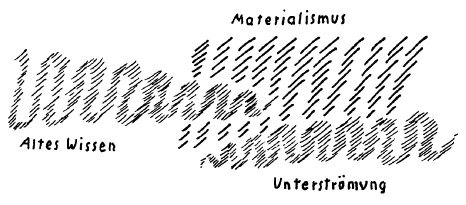
[ 23 ] The current seeps away there, and the materialistic worldview rises to the surface. But beneath the current—as an undercurrent, so to speak—what I have described develops within human nature: from within, the connection with the cosmos is reestablished. You may now say again: Prove to us that there were people who sensed something of this—that while, on the one hand, knowledge of the ancient significance of the etheric body, which received impressions from the outside, is fading away, on the other hand there may already have been people who knew that the etheric body was being revitalized from within.
[ 24 ] I would like to read you a passage from a book that was published even earlier, and from which you can see that there have already been people who drew attention to how the organization of humanity will change in the future. Admittedly, the story is told in a very veiled way, but it is told nonetheless. This book tells the story of a female character. Most of you will know, when I read the passage aloud, where it comes from.
[ 25 ] This woman is said to be in a relationship with our solar system “that one hardly dares to put into words.” In her mind, soul, and imagination, she not only contemplates it but, as it were, becomes a part of it: she sees herself drawn along in those celestial circles, but in a manner all her own; she has been orbiting the sun since childhood, and, as has now been discovered, in a spiral, moving ever farther from the center and circling toward the outer regions.” So what is being described here is that there is a soul within the woman’s body that no longer follows earthly life but rather the life of the sun; that in the course of life it traces ever-wider circles; indeed, that one may assume that beings, insofar as they are physical, strive toward the center, and insofar as they are spiritual, strive toward the periphery. Thus, a soul is described that lives in harmony with the cosmos:
[ 26 ] “Makarie stands in a relationship to our solar system that one hardly dares to put into words. In the spirit, the soul, and the imagination in which she nurtures it, she not only beholds it but, as it were, becomes a part of it: she sees herself carried along in those celestial spheres, but in a manner all her own; since her childhood, she has been orbiting the sun—and, as has now been discovered, in a spiral, moving ever farther from the center and circling toward the outer regions.
[ 27 ] If we may assume that beings, insofar as they are physical, strive toward the center, and insofar as they are spiritual, toward the periphery, then our friend belongs to the most spiritual; she seems to have been born solely to free herself from the earthly realm, to penetrate the nearest and farthest realms of existence. This quality, as magnificent as it is, was nevertheless bestowed upon her from her earliest years as a heavy burden. From a very young age, she has remembered her inner self as being permeated by luminous beings, illuminated by a light that even the brightest sunlight could not dim.” — She thus carries sources of light within her, and the external light cannot harm her. — “She often saw two suns—one inner and one outside in the sky—and two moons, the outer one remaining the same size throughout all its phases, while the inner one grew smaller and smaller.
[ 28 ] This gift set her apart from ordinary things, but her admirable parents devoted everything to her education; all her abilities came to life, all her activities became effective, so that she knew how to adapt to all external circumstances; and although her heart and spirit were entirely filled with otherworldly visions, her deeds and actions always remained in accordance with the noblest moral principles. As she grew up, helpful everywhere, tireless in deeds both great and small, she walked like an angel of God on earth, her entire spiritual being revolving around the sun of this world, yet moving in ever-widening circles toward the transcendent.
[ 29 ] The intensity of this state was somewhat tempered by the fact that day and night seemed to coexist within her as well; for when her inner light was subdued, she strove to fulfill her external duties with the utmost faithfulness, while when her inner light shone brightly, she surrendered herself to the most blissful peace. Indeed, she claimed to have noticed that a kind of cloud would hover around her from time to time, momentarily obscuring her view of her heavenly companions—a period she always knew how to use for the benefit and joy of those around her.
[ 30 ] As long as she kept her views secret, it took a great deal of strength to endure them. What she revealed of them was either dismissed or misinterpreted; she therefore, throughout her long life, presented it to the outside world as an illness, and that is still how it is spoken of in the family: but in the end, good fortune brought her together with the man you see here with us—a physician, mathematician, and astronomer of equal merit, a truly noble man, who, however, initially approached her merely out of curiosity. But as she came to trust him, gradually describing her condition to him, linking the present to the past, and bringing coherence to the events, he became so captivated by the phenomenon that he could no longer part from her, but strove day after day to penetrate ever deeper into the mystery.
[ 31 ] At first, as he made quite clear, he took it for a delusion; for she did not deny that, from her earliest youth, she had devoted herself diligently to the study of astronomy and celestial science, that she had been well instructed in these matters, and that she had never missed an opportunity to gain a deeper understanding of the structure of the universe through machines and books. That is why he would not be dissuaded from the view that it was a matter of acquired knowledge, that one must assume the effect of a highly disciplined imagination, the influence of memory, a contribution of the power of judgment, and, above all, a hidden calculation.
[ 32 ] He is a mathematician and therefore stubborn; a brilliant mind and therefore skeptical; he resisted for a long time, but noticed that what she stated was accurate, sought to reconcile the data from various years, adhered particularly to the most recent data that corresponded with the relative positions of the celestial bodies, and finally exclaimed: “Well, why shouldn’t God and nature also create and arrange a living armillary sphere, a spiritual mechanism, so that—just as clocks do for us daily and hourly—it would be capable of following the course of the celestial bodies on its own, in its own way!”
[ 33 ] Here, however, we dare not go any further; for the unbelievable loses its value when one attempts to examine it in greater detail. Yet let us say this much. What served as the basis for the calculations to be made was as follows: to her, the seer, our sun appeared in the vision to be much smaller than she saw it by day; moreover, an unusual position of this higher celestial light in the zodiac gave rise to certain conclusions. On the other hand, doubts and errors arose because the seer indicated that one celestial body or another also appeared in the zodiac, even though none of them could be perceived in the sky. These may have been the small planets that were still undiscovered at the time; for other indications suggested that they, having long since passed beyond the orbit of Mars, were approaching the orbit of Jupiter. Apparently, for some time she had gazed in wonder at this planet—it would be difficult to say at what distance—in all its immense splendor and observed the dance of its moons around it; but afterward she saw it, in the most wondrous manner, as a waning moon, and indeed inverted, just as the waxing moon appears to us. From this it was concluded that it was viewing Jupiter from the side and was indeed about to pass beyond its orbit and journey toward Saturn in infinite space. No imagination can follow it there, but we hope that such an entelechy will not depart entirely from our solar system; rather, once it has reached its boundary, it will yearn to return, so that it may once again influence earthly life and bring benefit to our great-grandchildren.”
[ 34 ] There we have presented, in a very meaningful way, the vision of how the human soul truly seeks to become, and how the human soul will return, from within, to the world of the stars. I read to you Makarien’s description from Goethe’s *Wilhelm Meister’s Journeyman Years*, and he expressly added that he had not said everything. He hinted that it is an ethereal poem, saying: “As we now conclude this ethereal poem—hoping for your forgiveness—we turn once more to that terrestrial fairy tale, of which we gave a brief hint above.”
[ 35 ] And before Goethe gives his account of Makarien, he says: “Having reached this point, however, we cannot resist the temptation to share a document from our archives”—Goethe means intellectual archives—“which concerns Makarien and the special quality bestowed upon her spirit. Unfortunately, this essay was written from memory long after the content had been communicated and cannot, as would be desirable in such a remarkable case, be regarded as entirely authentic. Be that as it may, enough is shared here to stimulate reflection and draw attention to the question of whether something similar or even remotely comparable has already been observed and recorded somewhere.”
[ 36 ] I wanted to draw your attention to this episode from *Wilhelm Meister’s Journeyman Years* because it shows that, with our Spiritual Science, we are truly meeting the demands of the times. Human nature is changing in such a way that it will once again give birth from within itself to what it has lost from its ancient heritage of the pre-earthly world. And people will need to know what is coming toward them; otherwise, they would become completely confused. Thus, Spiritual Science must take its place in our time.
[ 37 ] But the moment people become aware of what has been alluded to here, they will inevitably come to the doctrine of reincarnation, because they must conclude that such an entelechy from the otherworld—from the spheres of Jupiter, Saturn, and so on—might indeed have something to do with the Earth and could return to us. That is why, say those occultists who do not want the doctrine of reincarnation to gain ground, barricades must be erected against the spread of this view, and these barricades are erected by distracting people as much as possible from the connection with the celestial bodies of the solar system. Thus we see how, precisely from this quarter, there is an intense interest in preventing certain things from coming to light. I said yesterday: If there is an interest in a one-sided direction, it will always find support; but the truth in general is contested, and every possible effort is made to prevent the truth itself from coming to light at all. And it will be part of maintaining the proper stance within our spiritual movement that we are fully aware that the truth we seek will be contested from many, many sides. But nothing is more necessary than that we strive—in order to be prepared—to truly develop clarity of thought in every direction. You must realize that what appears as opposition—namely, what appears as opposing personalities standing against our movement—is in fact, for the most part, mere pawns of the opposing forces. We are entering into the sphere of action of supersensible forces. These supersensible forces, to which Ahriman and Lucifer belong, naturally work in human life through human souls, who are simply their instruments.
[ 38 ] Therefore, it is necessary to know exactly what is at stake in each case; but what is most essential is never to fail to cultivate a very clear and precise way of thinking—as best one can. As you know, life itself has its contradictions, and Hegel built his entire philosophy on the revelation of the contradictions in existence. The point is not to avoid contradictions in life, for they are there. But the point is to recognize the contradiction and face it head-on.
[ 39 ] Ahriman and Lucifer can only act when a contradiction goes unnoticed, when we lack the strength and the will to uncover it. Wherever we become entangled in a contradiction that we do not recognize as such—but simply accept as a truth of life—there Lucifer and Ahriman have the opportunity to take possession of our soul.
[ 40 ] Let us consider a curious contradiction that we have encountered here in recent weeks. Pressed by the facts, I had to read to you a passage from a letter written by a lady, which contained the words that what was sought from that side was not the teaching and not the teacher, but the human being. So it was not the teaching and not the teacher, but the human being who was sought. The teaching was, so to speak, accepted and treated as something of an afterthought, while the primary value was placed on the person. That is how the matter was presented. Then something else happened—the exact opposite occurred. The person was vehemently rejected, and it was asserted that the teaching must be recognized as correct. Just think: on the one hand, it is claimed that one seeks not the teaching nor the teacher, but the human being; and on the other hand, it is claimed: “I hate the human being; I reject the human being, who makes promises and does not keep them; but the teaching is good—I accept the teaching.”
[ 41 ] What does that actually mean? It means: For a while, I had a certain relationship with a person; that person interested me, but the doctrine did not. Then I turn away from that person, and in doing so, I emphasize what actually didn’t interest me at all. I emphasize what I had previously rejected; I hadn’t taken in the teaching at all, and then I say: it is good. — It’s clear, after all, that I’m talking about nothing when I express myself this way. I say: I retain what I didn’t want to take in at all, what I cannot possibly have, because I had previously refused to take it in.
[ 42 ] There you have a vivid example of a contradiction that exists in the world. How can you possibly doubt that, where such a contradiction makes itself felt, there can still be any real inner connection to our Spiritual Science movement! There is simply no inner connection whatsoever to what our Spiritual Science movement is. It is important to keep such a real contradiction in mind. For if we do not notice such things among ourselves, we will never find the straight path to knowledge of the spiritual world. Of course, much may escape our notice, but we must have the good will to truly notice such contradictions in life.
[ 43 ] But on the other hand, such contradictions are used precisely to, so to speak, upend the truth. Consider, for example, if someone were to say: A person puts forward a doctrine, but that person is full of contradictions, even full of immorality, even dominated by the power of evil; yet the doctrine itself and various other things connected with it are good—let us fully accept that. — Yes, but if the teaching in question consists precisely in the fact that the person who advocates the teaching and the movement for that teaching establishes his relationships with others through this teaching—that is, that he establishes the relationship between himself and others precisely through the teaching—if he wants to be nothing other than the bearer of the teaching: then, based on such an attitude, one demands that he be something else! And while one demands all sorts of things from the person and yet, at the very core, rejects what the doctrine offers, one says: The doctrine is good, but the person is bad!
[ 44 ] Truly, if one feels too weak to directly challenge the teaching in this way, one can still undermine it to some extent among those who share one’s beliefs. This is the best way to completely undermine a teaching that one cannot refute, for one thereby delivers it into the hands of the Luciferic-Ahrimanic forces, as I already indicated yesterday.
[ 45 ] How often has it been said, especially within our movement, that our teaching should not be mere theory, but should be immediate life. By reducing it to mere theory, one kills it; one hands it over to Ahriman, the god of death. The best way to hand over to Ahriman what is taught is to systematically eliminate it from the world, and this method, as you can see, is very similar to what certain individuals—who, let us say, stood behind Mr. Sinnett—have done. They gave him a specific direction that was incorrect, in order to lead him down a certain wrong path. This direction consisted in slandering precisely what was right. The Moon, which as a physical Moon is actually a paralysis in relation to the eighth sphere, is declared to be the eighth sphere. The eighth sphere is thereby obscured, wiped away. And later, H. P. Blavatsky corrects this by stating—while Yahweh created a remedy in the moon against the eighth sphere—that he had created only the lower sphere of life, the human sensory sphere. This method, then, consists of spreading a haze of disparagement over something and thereby casting it in a false light. If you examine the matters closely, you will see that what has happened here among us is essentially of the same nature, only on a smaller scale. It is an attempt to slander what is seeking to emerge into the world as truth. One feels too weak to refute the teaching, so one accuses the one who is supposed to represent it. Linked to this is the fact that one is oneself too weak to grasp the teaching.
[ 46 ] This is an immensely significant problem for anyone who stands among our ranks with seriousness and dignity, for we must view these matters from a higher perspective. I would like to give one more example. I cite these examples because they are obvious and because they show us where we must direct our gaze and how they can help us assess the matters at hand from a higher perspective. It must be emphasized most strongly in our movement—and this has been the case throughout all the years since I have represented our movement—that atavistic clairvoyance be placed in the proper light, that one never be misled by the old atavistic clairvoyance. An example of what was invented to distort what we do or intend to do in the most extreme way is the claim that “there is a movement dedicated to cultivating clairvoyance”—and the effort to present the matter as if everyone in this movement were encouraged to cultivate clairvoyance. When something like this is done, a fog is cast over this movement. The truth is virtually turned on its head, even though it is entirely justified that we must cultivate clairvoyance. But this provides a good means of filling people with hatred toward the movement.
[ 47 ] One could say that if a movement emerges today, it must do so in such a way that it no longer cultivates the old, atavistic form of clairvoyance. But if one insists, “That is precisely what this movement does”—in other words, if one says the very same thing that the movement itself says—then one is attributing to the movement the very criticism expressed by those words. One thus reverses the direction of the arrow. We encounter this, for example, in our own midst. In our midst, it is preached and proclaimed that I, in particular, am encouraging those gathered here in Dornach to practice clairvoyance. In doing so, it is implied that this is a pathological, atavistic form of clairvoyance.
[ 48 ] Of course, whoever says that has no idea what they’re actually saying. They are, of course, just a pawn. But we must look more deeply into the bigger picture. We must be clear that we live in a time when such forces are being directed against us. And this could present itself to us in a particularly grotesque way if our own teaching were taken up as a weapon against us, and we were refuted on the basis of our own teaching. That, too, has in fact already happened. As you know, in one of last week’s counter-pamphlets, an attack was mounted against what I advocate, using quotations from the “Mystery Dramas” and “The Secret Science.” So everywhere, the forces are at work that do not want the truth to come to light.
[ 49 ] We need not worry about the truth itself, especially when we realize that we are even being attacked with our own truths—that is, that what we ourselves say is being turned against us. So the issue is not one of refutation, but of what we actually do. Therefore, as long as we were not under attack, we had no need to engage in polemics of any kind. Hence our rejection of polemics, as has often been emphasized in the past. The truth may go out into the world by emphasizing only the positive. But the moment claims are put forth that do not touch upon the truth at all, we must be prepared and recognize from which perspective such things are to be judged. We must not merely adopt the standpoint of reflecting on what is written in books; rather, we must put into practice what serves as a guiding principle in our teaching. This means, however, that we judge life according to the principles of our teaching—that is, we do not respond to external attacks in the way we would if we had merely accepted our teaching as a theory. The need for polemics arises only when we are attacked. But then we must realize that we have a doctrine that can very easily be turned into its opposite, and which we must therefore guard and protect. In particular, we must guard against all forms of one-sidedness. |
[ 50 ] For example, one could detect this or that undertone in what was said here or there: undertones that stem from something that very easily veers into extremes. And in such cases, one can be refuted quite easily. Just consider for a moment that we were compelled to say a few words about all sorts of delusions regarding this or that incarnation. If we were to take this to the extreme of ridiculing every such thing, then our opponents could say: “They’re teaching something there!” But if they are to even hint at it in any way, then they make fools of themselves.
[ 51 ] Of course, we have no reason to reject psychic or clairvoyant experiences; we simply have a duty to get to the bottom of them when such spiritual experiences are being distorted in the service of personal vanity, or even when the outward course of events shows that these spiritual experiences are not accurate. So, if I may put it simply, we must not throw the baby out with the bathwater. Our society certainly must not transform itself into a scientific theory.
[ 52 ] And here, too, you can see that this danger can arise very easily. I mentioned that a certain pamphlet sent to us in recent days is skillfully written. It is indeed skillfully written, for there is no more credible way to attack our movement than by saying: “They behave as if they reject any connection between the physical world and the spiritual world, as if they deny all of this everywhere.” — But that is what is written in that text. Strangely enough, an enclosed text goes on to ask: “Why shouldn’t the Mother of God also reincarnate?” — Certainly, one might say, why shouldn’t she? There is no reason why it cannot be so. But you can be certain that the exoteric life of this Mother of God would then have been different, that the reincarnation would not have occurred in the way it did—not as a personality, but in the manner of a representation.
[ 53 ] Truly, these matters concern something I have been emphasizing for many years—so strongly, in fact, that I felt it necessary to include it in my foundational philosophical work. Try reading the other philosophies. You will find in their theory, in their modes of expression, and even in earlier writings, many things that recur in my *Philosophy of Freedom*. But there is one thing in there—at least in the way it is woven into the text as an ethical principle, as a moral impulse—that, as expressed there, is truly original: For the first time, moral tact is introduced as something that cannot be grasped by mere reason alone, but can only be grasped by the totality of the mind; that one does not, when something is to be dealt with lightly, immediately fall into the extreme and seek to sweep one sin out with another—that is moral tact. I have tried to define it as clearly as possible, particularly in *The Philosophy of Freedom*. Today it is truly necessary to emphasize that we must avoid the danger of falling into the other extreme, precisely because we are dealing with a fateful matter.
[ 54 ] Yesterday I pointed out the various dangers. But precisely in doing so, I felt the need to add something today, because I wanted to draw attention to the fact that we must not fall into the other extreme. All our work and the very essence of our movement must be based on affirming the spiritual world; it must be based on perceiving and experiencing our own lives in connection with the spiritual world.
[ 55 ] But then, if this is sacred to us, we must tactfully reject the idea that our immediate personal life—our subjective personal life—should be drawn into these matters. This, in turn, does not mean that we should not investigate to what extent we ourselves are the reincarnation of someone else. But the point here is not to search for one personality based on another person. That would be the easy way out. Rather, we must search in the manner I myself hinted at in a lecture. We must search in such a way that we first come to—I would say—gain insight into certain mysteries of our own lives. Then we will make progress. In this regard, we truly stand at an infinitely significant point: we must know and heed the common saying, “Don’t throw the baby out with the bathwater.” But on the other hand, we must proceed with the utmost rigor so that what would be eminently harmful to an occult movement does not occur—namely, the gradual sinking into a hazy sphere, a sphere of obscurity. And what incredible obscurity is this, when one can say: “It is not the teaching nor the teacher, but the human being who is sought”—and then again: “Ah, the human being is of the evil one, but the teaching is good”—the very teaching that one had just rejected. This is a slipping into a nebulous sphere; but what is at stake here is clarity and precision. From this point of view, we must consider the matter in the service of our movement. There may be practical considerations that necessitate a certain firmness in our approach. That is another matter. But we must always keep in mind, deep within ourselves, the ground on which we stand; we must keep in mind that we stand on the ground of a serious, dignified spiritual movement.
[ 56 ] These are some of the perspectives that can lead us to an understanding of the conditions under which our movement operates. When we speak of external reality as maya, we must truly study this maya. One must not merely emphasize the theoretical statement—“External reality is maya”—and then treat that statement as if it were the most important thing when one encounters it concretely in the world.