

The Occult Movement
in the Nineteenth Century
and its Relationship to World Culture
GA 254
24 October 1915, Dornach
Translated by Steiner Online Library
Ninth Lecture
[ 1 ] If you recall what I tried to explain yesterday, you will be able to say to yourself that, essentially, the rise of materialism—I am not referring to the materialist worldview, but to materialism itself—has its positive aspects. The problem, of course, is that materialism is made the foundation of a worldview. The positive aspect of materialism is that it is used as a method for investigating the external phenomena of the physical-sensory world, which, as you have seen, is given to us during the Earth period as the mineral world. In this regard, materialism is an excellent instrument for investigating the mineral world. This mineral world is, in fact, particularly important for earthly development. And another important aspect of Earth’s development is that human beings undergo this incarnation in the material-mineral world, thereby simultaneously developing those abilities that we can only attain when we have a mineral-physical body. Intelligence and free will must be acquired to a certain degree during the Earth period. During the Jupiter, Venus, and Vulcan epochs, human beings will be able to exercise these abilities, but it is impossible for any being in the world to acquire them in any other way than by a soul-being such as a human being undergoing this earthly existence while incarnated in a mineralized body.
[ 2 ] A counterbalance to our development within the mineralized earthly body is created in human beings by the fact that they repeatedly undergo the life between death and a new birth—the life of the soul without such a mineralized body. One could say that human beings must endure many things on Earth between birth and death simply because they have a mineralized body. But what the human being experiences—in a sense, to his cosmic disadvantage—through being embodied in a mineralized body is all offset by what he experiences between death and a new birth, when he is not embodied but is, so to speak, “soulified”—the word used in its proper sense.
[ 3 ] It is the task of the materialistic method to investigate what minerals, plants, animals, and humans have absorbed in terms of mineral substances; and by applying this materialistic method over the course of centuries, humans essentially acquire what they must acquire during their time on Earth. The methods of research that preceded the materialistic method were all still influenced by the clairvoyant heritage that human beings carried over from their earlier stages of development. And when humanity, after our fifth post-Atlantean period and in the course of our entire post-Atlantean epoch, will have essentially completed its mineral development, when it will once again enter into a different phase of development, then it will once again have to be so close to the spiritual world that it will have already acquired the intelligence intended for it during its earthly existence. Likewise, they will have to have already acquired the degree of free will intended for them; otherwise, they would not be able to cope with their development.
[ 4 ] Viewed in this light, the materialistic method has great significance; but it must remain a method—a method for investigating the external, physical, material world. And it also has its significance—its very great significance—in a higher sense. Its benefit lies in the fact that, by perceiving, researching, and engaging in the mineral world purely within its realm, human beings gradually develop their free will. For when human beings are so deeply immersed in the mineral world, what actually underlies the mineral-physical world—what it truly is—remains hidden from them.
[ 5 ] In recent weeks, we have seen where one ends up when one remains confined to theoretical speculation within the realm of physical, sensory perceptions. One arrives at atomism. We have also seen that atomism is nothing other than a subjective delusion of human beings. But if one were to go out into the real world, to the place where human beings, allowing themselves to be deceived, seek out atoms, one would find Ahriman and his beings. For through those spiritual beings of whom I spoke yesterday—and to whom human beings come when they pierce the veil of nature—human beings will come to develop destructive forces; these are also cosmic beings.
[ 6 ] Thus we can see how this materialistic method works. It provides human beings with an illusion, a maya. But this illusion is actually beneficial to human beings, for at every moment when they see through this illusion, they first enter the realm of Ahriman and his spiritual beings, who seek destruction and killing, and who cause destructive forces to develop within their own human nature to a certain degree of sophistication. In particular, the intellect—purely external cleverness—is developed in such a way by the forces into whose realm one enters that one becomes subtly clever. If one has not yet developed one’s earthly cleverness to the point of seeing through these things, then one simply becomes unconsciously, yet subtly, clever. Materialistic natural philosophy thus represents, in a sense, a period of grace during which a person can mature so that later on they may enter this realm of Ahriman without danger.
[ 7 ] Thus, one might say that materialist natural scientists or natural philosophers follow an instinct that is certainly very well-founded. For this reason, the guardians of the ancient symbols have not dared to make the esoteric public and reveal the secrets to humanity. The natural scientists tell themselves—not literally, of course, but one can express it symbolically this way: We are doing something very good when we lead people only up to the curtain and not beyond it. —They do this instinctively, of course, but they do it nonetheless. Essentially, they are doing humanity a service, for if the natural scientists were to go so far as to pierce the veil, the curtain, they would acquaint people with the forces of those destructive beings of whom I spoke yesterday: beings in the service of Ahriman. And the consequence of this would be that people, still unprepared, would, so to speak, welcome with open arms the forces coming from that side. And with these forces, people would be capable of much, but all in the service of destruction, in the service of killing what is good. So even the ignorance in which humanity is to be left by the scientific worldview has, in a certain sense, a positive aspect. That is one side of the matter. The other side of the matter, however, is this:
[ 8 ] In order for human beings to live in this world of illusion—into which they are instinctively placed by natural scientists—they must live within it for a time, for centuries on end. We have already had a number of centuries in which human beings have lived in this illusion, in this maya. But this does not simply pass by human nature! After all, when a person lives in illusion regarding a matter, they do not live in reality; and so human beings have truly been living themselves into an illusion for centuries. This illusion does not seize their soul’s power as strongly as reality would; and the consequence of this is that, little by little, doubt upon doubt arises in the human soul—doubts which, as I have already indicated, have also made themselves felt in this context. Prominent natural scientists have proclaimed the “Ignorabimus.” The second half of the nineteenth century had already brought to light everything that can be called: living immersed in doubt upon doubt. But the truth is that a time is approaching that will be brought about by humanity living more and more within this illusion and believing that it has found reality in what already exists. People are becoming increasingly immersed in materialism as a worldview, yet this will give rise to ever more doubts; and it would not be long before, through scientific philosophy, nothing but doubts would dwell in every human soul. People would then be unable to hold on to anything at all; they would be forced to harbor doubt upon doubt regarding every problem and every task. Skepticism would become a vast sea in which the human soul would be bound to drown. This is the task of spiritual research: to recognize such a thing; to recognize how a vast sea of skepticism, of a craving for doubt, is about to break in, in which the human soul would drown. And its further task is to erect dams so that these doubts—this sea of doubt, this sea of skepticism—cannot break in. We are faced with the prospect of something that will most certainly come upon humanity if the teachings of natural science continue to prevail as a worldview. That is the other side.
[ 9 ] What I am about to say is connected with a profound mystery—the mystery that, in the outer sensory world, everything that unfolds within it must unfold within duality. I once said that the number two is the number of revelation; the number two is the number that governs the entire sensory realm of revelation. But the number two has significance only for the sensory realm of revelation. It is always the case in the world of revelation that we must say: a certain evolution is taking place. Let us take the evolution of the natural Maya. I will call what I am sketching here “natural Maya,” which has gradually emerged since the advent of the scientific worldview and reached a peak in the 19th century. But living within this maya means that, in a certain sense, something else is taking place beneath this worldview that exists within the “maya of Nature”: the preparation for a different worldview, for a penetration into reality.
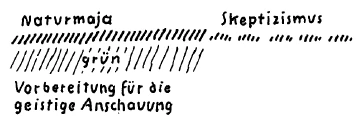
[ 10 ] This is taking shape in the subconscious. And precautions must be taken to ensure that the next stage of development becomes a reality; otherwise, the Maya of nature will go beyond skepticism—beyond the most terrible doubt that drowns the human soul. Thus, we are heading toward a time of which we can say: If Spiritual Science were not to come, humanity would sink ever deeper into doubt; but if Spiritual Science does come, then what humanity needs will take the place of what would otherwise fill the human soul with doubt—that which would drown the human soul.
[ 11 ] You see, it is a duality. The Maya of nature continues. But beneath it lies green life, the preparation for Spiritual Science. Everything in the sensory world continues within this duality. That is why the occultist says: the number two is the number of sensory revelation. The moment one passes from the sensory world into another world, the number two no longer has this meaning, and one is entirely mistaken if one attempts to characterize higher worlds directly through duality. Only the fundamental law of the physical-sensory world can be characterized by duality. In the higher world, if one wishes to proceed from a number, one must be clear that one must start, for example, from the number three, and that this initially governs everything just as the sensory world is governed by duality. Just as the sensory world is governed by duality, so too in the spiritual worlds one is dealing with a triad. It is sometimes important to know this. For example, it is good to know that everything that can be characterized in terms of duality has significance only for the physical world. When someone says that magic is divided into white and black magic, they have established a duality. Such a duality, however, can have significance only for the physical world. Thus, the person immediately reveals that he has no understanding of the fundamental laws of the spiritual world, for in the spiritual world one could never base anything on the number two. Just as it is true that in the physical-sensory world one must take the number two as a basis, so it is true that in the supersensory world one never has to do with the number two.
[ 12 ] Now, there is indeed a kinship between human beings and the entire cosmos. Human beings, insofar as they live as earthly beings, are—as we have often emphasized—a microcosm. There is a kinship with the entire cosmos, and in order to recognize certain things, it is necessary to reveal humanity’s relationship to the cosmos. We have pointed to a fact, namely that when human beings pierce the veil of nature and enter the world that lies beyond it, they encounter Ahrimanic beings—beings of a destructive nature. These beings are, in fact, within the world order, bitter enemies of human earthly nature; so that if one aligns oneself with them out of weakness—which can happen, as I have indicated—one aligns oneself with enemies of the earthly human being. One truly enters into an alliance with enemies of the earthly human being, and this alliance is particularly fostered by a certain relationship of the human being to the cosmos.
[ 13 ] These beings, who are behind the veil of nature, are intelligent; they possess their own intelligence. I spoke earlier of human intelligence, but these beings have their own thinking, their own intelligence; they have feelings, even if they differ from human feelings, and a will, even if it differs from the human will. They perform certain actions that are outwardly expressed as natural phenomena, but whose very essential substance lies behind the veil. Now, however, there is a remarkable kinship between something in human beings and the highest faculties of these beings. I will clarify this in the following way. When the person who crosses the threshold into the spiritual world approaches these beings—it may seem to him as if he were entering hell, or however he chooses to create a mental image of it; but that is not the point; what matters is that one assesses this experience correctly—such a person must first and foremost be struck by the high, extraordinary intelligence of these beings. They are extraordinarily clever and wise. This is where their soul power manifests itself. But these soul powers—these higher powers of these beings—are all related to the forces of the lower nature of human beings. Just as human beings have sensual drives, so these beings possess forces that make a particularly strong impression. There is thus a kinship between the lowest forces of human beings and the highest forces of these spiritual beings. For this reason, they seek to identify with the lower forces of human beings. When one enters this world, they stir up instincts of destruction and hatred or other such instincts, because such spirits draw what is low in human beings up to their own higher nature, and act through the human lower nature with their higher nature. One cannot truly form an alliance with these beings without degrading one’s nature, without developing certain sensual drives to a particularly strong degree.
[ 14 ] This is a fact that must be taken into account in a very special way, for it truly shows us how we must form our mental image of our relationship to the cosmos. There are base instincts within our own human nature. But these lower instincts are forces that represent lower instincts only in us humans. As soon as those spiritual beings possess these forces, the same instincts become higher forces in them. Yet these spiritual beings are always at work within our nature. They are always present within it. The essence of progress in Spiritual Science consists solely in our recognizing them—in knowing that they are there—so that we can say: we have our higher forces and we have our lower forces; and we recognize a third aspect: the forces that are lower forces in us are higher forces in those spiritual beings. This complements the duality of our world—our higher and lower powers—into a trinity. Thus, we are already touching the threshold of the spiritual world when, instead of the duality of our lower and higher powers, we touch this trinity.
[ 15 ] Now I have told you that it is impossible in our time to do anything similar to what Father Antonius did with Paul the Simple. It is also impossible to do certain things the way some religious orders have done them. The fact is, the ancient knowledge simply cannot be used. For if one were to bring it to people, one would bring about precisely what I have just explained: one would awaken base instincts in people. There is absolutely no doubt that this would happen.
[ 16 ] For example, there is even an order in the world that readily leads people to an understanding of those mysterious beings I have just spoken of. However, such people all develop destructive instincts, so that this order simply ensures, in reality, that people with destructive instincts emerge from it. Nietzsche refers to this order once in his writings, without actually knowing the true facts of the matter or taking them into account in his reasoning.
[ 17 ] So that is one thing I must point out: that there is a veil here separating us from the mysteries of nature. This veil represents everything that can be discovered through materialistic methods. Behind it lies the true world. Entering that world is not, at first, such a simple matter. Let’s keep that in mind on the one hand. On the other hand lies our human inner life with its thinking, feeling, and willing. But just as it appears before our inner eye, just as we experience it there, it is just as much a maya as external nature is merely a maya. That is not the true form of our inner life, which appears to us before the soul itself as thinking, feeling, and willing; rather, behind thinking, feeling, and willing lies true reality once again.
[ 18 ] Just as natural scientists today instinctively develop the view that nature itself already presents reality, but at most arrive at atomism, so the representatives of certain religious communities today strive to present the matter concerning the soul as if the soul, with its thinking, feeling, and willing, were already the real thing, and as if it would continue to live on after death with this thinking, feeling, and willing. Just as natural scientists describe the “maya” of nature, so do the representatives of certain religious communities describe the “maya” of the soul, and with these views they, in turn, instinctively serve, in a certain sense, the evolution of humanity.
[ 19 ] As you may know—I have hinted at this on several occasions—as early as the Middle Ages, the so-called trichotomy, the division of the human being into body, soul, and spirit, began to be regarded as heresy within the historical form of Christianity. It began to be regarded as heresy as early as the early Middle Ages. As you know, a relatively early council abolished the concept of the spirit, and human beings are now classified as body and soul. Since that time, people in the West have become accustomed to dividing the human being into body and soul. In the Middle Ages, it was considered utterly terrible for anyone to speak of spirit, soul, and body—of a trinity. It was the worst kind of heresy, because the spirit had been abolished, and because body and soul were established as a duality. This corresponds to the instinct to limit oneself, even numerically, to that which has significance only for this world here. So there really is this tendency I have spoken of: to keep human beings confined within the world, which is actually nothing but a maya, because one remains stuck in maya-like thinking, feeling, and willing. Then one actually considers only what will be utilized from the present incarnation in the period between death and a new birth. That which is developed within the human being to appear in the next incarnation is left entirely out of the picture.
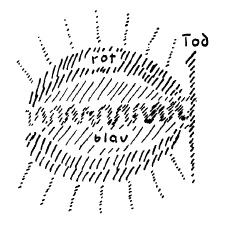
[ 20 ] Perhaps I’ll sketch this schematically as follows. Suppose I draw the human body here (in red). If I were to draw what lies behind the human body, I would have to draw it like this. This is, of course, a schematic representation; it lies, so to speak, outside the human body. In reality, I would have to draw it here; that would not be visible. One would see it if one were to penetrate through the nerve endings. If one were not to take atoms as the basis of the world, but were to look outward from the body, one would arrive at the place where the destructive beings hold the whole human being captive. And now I want to draw within that the soul, which the human being first develops in the physical world (blue). The red and the blue, then, are what a human being perceives here: his physicality and his soul. But while we live here between birth and death, the imperceptible (yellow) develops. This remains completely imperceptible to us. Now we die. When we die, our thinking, feeling, and willing no longer develop. They are exhausted, and as they are exhausted, the yellow—the imperceptible—develops. This imperceptible aspect becomes ever more powerful between death and a new birth, and as it grows ever more powerful, it becomes the foundation of the new incarnation. With new thinking, feeling, and willing, and with a new physicality, we are reincarnated.
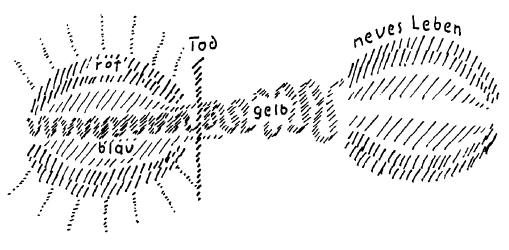
[ 21 ] So when we speak of what is now revealed to our soul here on Earth, we are speaking of something that ends here, something that does not carry over into the next incarnation at all. When we speak of the soul in its entirety, we must refrain from speaking as religious leaders do: “A person dies, goes to heaven or to hell, and we no longer concern ourselves with them.”—According to certain religious leaders, that is sufficient; that is already immortal enough; the other part, which carries over into the next incarnation, is not so important. The fact is to be concealed that the spiritual aspect enters the spiritual worlds and continues to live on until the next incarnation.
[ 22 ] Now we can say: The representatives of the various religious communities are very careful not to let people get to the bottom of things, not to let them know anything about it. And in doing so—one might also say—they are following a certain sound instinct, which, however, demonstrates even more clearly that it has already lost its value in our time than does the other instinct followed by natural scientists.
[ 23 ] All efforts by the representatives of the various religious communities are primarily and quite decisively aimed at concealing the fact that there is a spiritual world to which our innermost essence belongs—an essence that is destined to appear in repeated earthly lives and to experience a truly spiritual life in between; they seek to conceal this by comforting people with the idea that the aspect of the soul’s existence that manifests itself in thought, feeling, and will is already sufficiently immortal.
[ 24 ] What the soul caregivers instinctively do and think is that they prevent people from coming into contact with certain beings again. One can never penetrate the world that is our true inner self without coming into contact with certain beings in a similar way to how one comes into contact with certain beings in the manner described when one wants to and is able to pierce the veil of nature; only the beings with whom one now comes into contact are of a Luciferic nature.
[ 25 ] You see, if a person, by being taught certain doctrines without the necessary caution, truly comes into contact with certain destructive beings behind the veil of nature, then he becomes the sort of person who values nothing in the world, and he will soon show that he takes pleasure in destroying and annihilating. It need not always be external things that they destroy. Some for whom this was the case have shown a delight in tormenting and tormenting other souls. These characteristics manifest themselves there. But one cannot say that people with such characteristics are always selfish because of their alliance with Ahrimanic elemental forces. They need not be selfish at all; indeed, they usually are not. They do this out of a completely different impulse than a selfish one. They do it out of a lust for destruction, and they destroy even when they gain not the slightest benefit from it. The beings into whose sphere one enters there are truly destructive beings, and they try to tempt one into destruction.
[ 26 ] The other beings whose realm one enters when one goes beyond the veil of soul life are of an entirely different nature. They have no particular desire to destroy. In fact, they do not even know what is meant by “destruction.” They have a true passion for creating, for bringing something into being; they possess an immense drive for activity and creation. And they, too, possess certain higher faculties that are now less related to our thinking but, on the other hand, more closely related to our feeling and, in particular, to our willing. There we enter a sphere inhabited by beings who are eminently related to our willing—but, curiously enough, to the noblest aspects of our willing.
[ 27 ] So when we first enter the world, without knowing anything of what the initiate knows—that there is a spiritual world behind both the natural world and the world of the soul—when we permeate our will with ideals, when we develop a noble, spiritualized will, and we enter this world, then this noble will becomes allied precisely with the lower qualities of those beings into whose sphere we are entering. There is a mysterious bond of attraction between the noble aspect of our will and the lower drives and needs of these beings.
[ 28 ] Now consider: when a person stands before a spiritual guide who, to nurture his soul, offers him the comfort of immortality, the value of the human soul, the value of the divine, and so on, it may happen that, through a slight impulse—especially if the person was a noble soul—the thin veil of the soul is pierced at some point, and they gain access to the mysteries of thinking, feeling, and willing. But they enter the realm of these beings of will, and the consequence of this is that the ideal aspect of willing actually begins to take on a sensual character. And now, please, read many descriptions by male and female mystics with these introductory remarks in mind. When you read biographies of male and female mystics, notice the sultry atmosphere into which you are drawn. Just consider how the highest ideals take on a sensual character there. I need only remind you of the intense experiences of male and female mystics with their soul-bride and soul-bridegroom, where, for the female mystic, the mystical union is like a sensual union with the Savior, or, for the male mystic, like a real union with the soul-bride, with the Virgin Mary.
[ 29 ] It is the aspiration of these beings of will to infuse our thinking and our ideals with what we otherwise know only as sensuality. This is a weighty statement to make. These beings, into whose realms one enters, strive—and from their point of view, this is quite understandable—to infuse their sensual instincts into our idealized will. And it is then as if, within the will of our mind—which otherwise possessed a certain coolness—a sultry sensation of the spiritual world were now taking root, which often manifests as a form of hot, sultry mysticism. The representatives of various religious communities have a deep-seated fear of this, and the representatives of certain religious communities fear nothing more than those who present themselves as mystics within their devout congregations.
[ 30 ] It truly is a choice between Scylla and Charybdis. If we wish to pass through the veil of nature, we encounter Scylla—the Ahrimanic beings of intelligence who seek to lavish us with destructive intellectual forces. If we wish to pass through the veil of the soul beings, we encounter the Charybdis of the Luciferic-type will beings, who wish to endow us abundantly with spiritual haze, spiritual stagnation, and spiritual instincts.
[ 31 ] The religious orders, which sought to cultivate the religious life in a special way, therefore had to ensure—with good reason—that even if mystics emerged from their ranks, this mysticism would at least not manifest its darker aspects. For this reason, they also erected barriers, so to speak, against entering the spiritual realms. Just consider how certain religious orders—I do not mean secret orders, but religious orders—were associated with external work, with the kind of work that instills in people’s souls a joy in nature, a joy in everything that lives out in the world; such orders, when they understood the right principle, had their members perform manual labor. For those who founded such orders told themselves: The worst thing we can do is to isolate people and allow a mystical life to develop within them—a mystical life that arises from idleness, from external inactivity. — If you read the various monastic rules originating from better times and from better orders, you will see everywhere how full consideration was given to what I have said, how external work was used to counteract mystical vapors and mystical stagnation. Now you will also understand why Anthony had Paul engage in work for its own sake, even if it served no external purpose. For if he had allowed him to lie around and indulge in idleness for years on end, this simple-minded Paul would have become a thoroughly sensual mystic.
[ 32 ] As you can see, we are dealing with a duality: objective occultism, which, when simply left in the hands of people who are not prepared for it, turns them into destructive beings; and with subjective mysticism, which, when cultivated by people or when it arises, turns these people from idealists into egoists—egoists such as we encounter in numerous mystics who have developed nothing more than a more refined form of egoism, a more refined obsession with cultivating their own souls. Read the biographies of the mystics, and you will often be deeply moved—in the most terrible way—by that spiritual egoism that lives within such mystics. The spirits who serve Ahriman—and into whose sphere we enter when we cultivate not egoism but a spirit of destruction—are the Scylla into whose realm we enter. If we cultivate the subjective mysticism of the Luciferic spirits of will—into whose realm we enter—then Charybdis will approach us from the other side; for they cultivate inner egoism in a very special way, so that our own inner being forms our world for us. This is the duality in the sensory world: objective occultism—subjective mysticism. Both can have their pitfalls.
[ 33 ] But essentially, what has developed over the centuries—and in more recent times—includes, on the one hand, objective occultism, guarded within secret orders, though no longer properly guarded because people can no longer guard it properly, since everything is coming out into the open. But we have seen how hard people have struggled to find some kind of way out. I have demonstrated this over the past few weeks. And on the other hand, there is subjective mysticism.
[ 34 ] What follows from this? It follows that, if we wished to establish a Spiritual Science, we could not allow ourselves to be drawn toward either Scylla or Charybdis, but had to navigate right through the middle; that we could neither cultivate the old, traditional occultism nor the old, traditional forms of mysticism. And here you have grasped even more deeply what gives direction to our spiritual scientific movement. Both objective occultism in the old sense and subjective mysticism in the old sense had to be avoided, and our Spiritual Science had to have a character that would allow us to avoid both Scylla and Charybdis.
[ 35 ] I will now have to explain to you the fundamental character of our Spiritual Science—the character it must possess because it must avoid both pitfalls. But of course, it cannot be avoided at present that, on the one hand, people who are actually seeking an old, objective occultism come our way—and, on the other hand, people who are seeking the old, subjective mysticism. Neither group finds what they are looking for with us. But they believe they have found what they seek simply by reinterpreting our teachings. How our teachings must be, and how we must understand them so that we may navigate our ship of spiritual life and pass safely between Scylla and Charybdis—I must speak of this tomorrow.